Most facade colour decisions in India are made in the wrong room. A shade card is put on a table, somebody points at a colour they like, and a fabrication order goes out the same week. Six monsoons later the panels are streaked, or the pattern everyone paid for has flattened into a wall, or a saturated shade has gone chalky on the sea-facing elevation. None of that is a taste failure — it is a specification failure. On a metal facade the colour is doing a technical job: hiding tolerance, stepping back so shadow can read, surviving coastal ultraviolet, or catching a low sun. This post walks through four fresh SOGA Design Studio concepts, in Dehradun, Hyderabad, Goa and Ludhiana, where the colour was specified for one of those four jobs — and shows what each choice costs to build and to keep.
Facade Design in India: Why Dehradun Is Choosing Parametric Metal
Facade design in India has moved from an afterthought to the single most important decision on a residential project. Today, demand for parametric facade design in India is rising fastest in cities such as Dehradun, Mumbai, Bangalore, Delhi, and Pune, where homeowners and developers want elevations that are both performance-driven and instantly recognisable. SOGA Design Studio specialises in facade design in India — from G+3 individual homes to G+7 residential blocks — pairing algorithmic geometry with matte powder-coated ral 6003 military and fabrication-ready detailing. Whether you are comparing metal facade design in India for a new build or a retrofit, the concepts below show how a considered facade redefines a building’s identity and its long-term value.
1. Dehradun: Olive Green That Hides What a Busy Road Does to a Facade
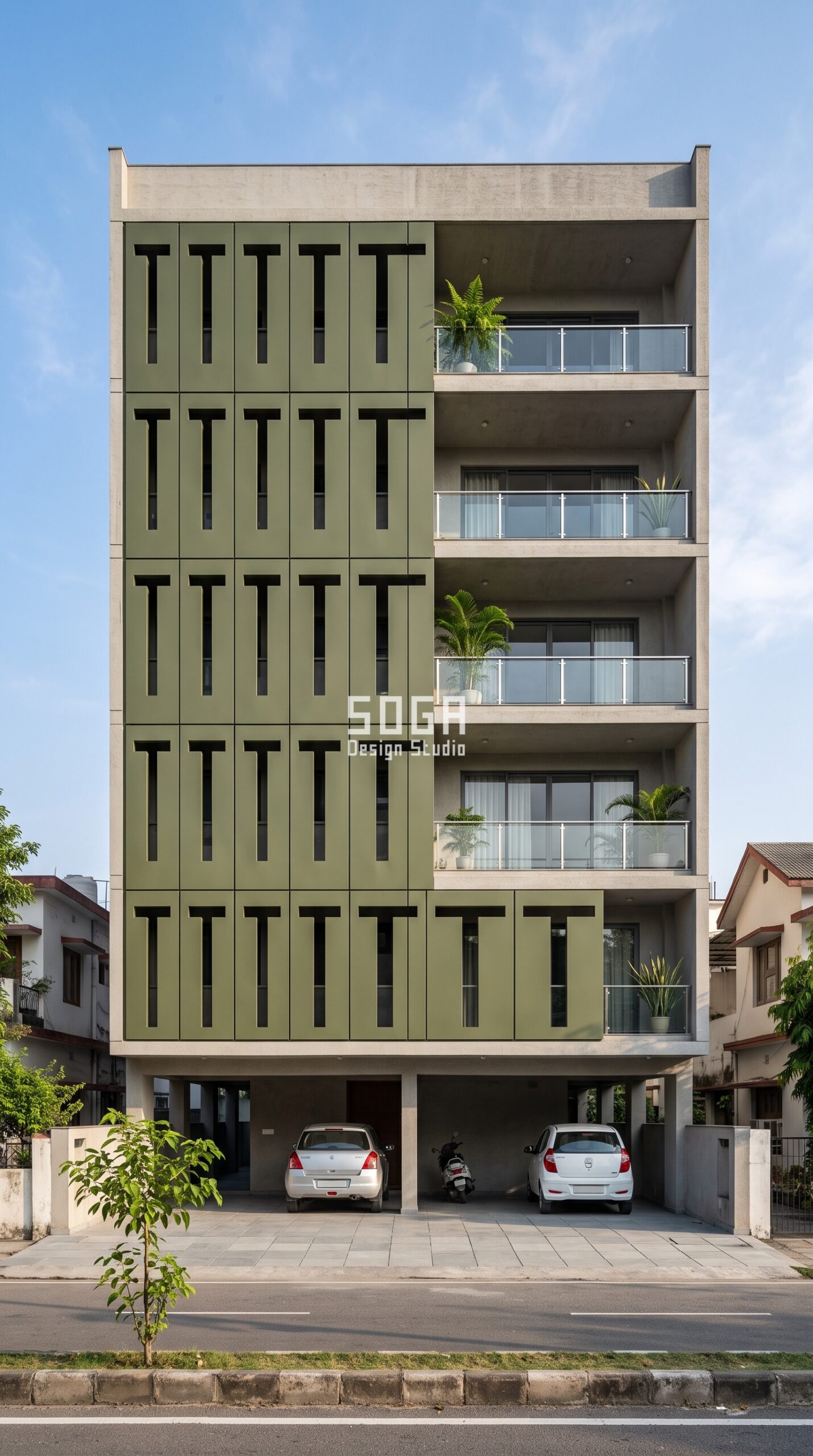
The Dehradun concept is a Parametric Notch Screen on a G+5 residence off GMS Road, and it is finished in matte powder-coated RAL 6003 military olive green for one unglamorous reason: it is a low-chroma colour that refuses to advertise dirt. A hill-city arterial road throws up fine grit through the dry months and washes it down the elevation through the monsoon, and on a pale or high-gloss skin every streak becomes a line item in a maintenance contract. The same low chroma quietly absorbs fabrication tolerance — a 2 to 3 mm variation between adjacent cassettes is invisible in olive and glaring in white. That is what makes the T-bar aperture pattern legible: because the colour is flat and recessive, the eye reads the openings as pattern rather than reading the panel joints as defects, and the aperture can widen from 120 mm on the shaded side to 380 mm on the sun-facing side without the elevation looking patchy. Expect a solid powder-coated steel screen of this type to land in the ₹1,200 to ₹2,800 per sq ft band installed in 2026, with the colour choice adding nothing to the panel cost and measurably reducing the cleaning cycle. Specify a matte or low-sheen finish here, not a satin one — sheen is what makes dust visible, more than the shade itself.
2. Hyderabad: Grey Brown That Gets Out of the Way of the Shadow
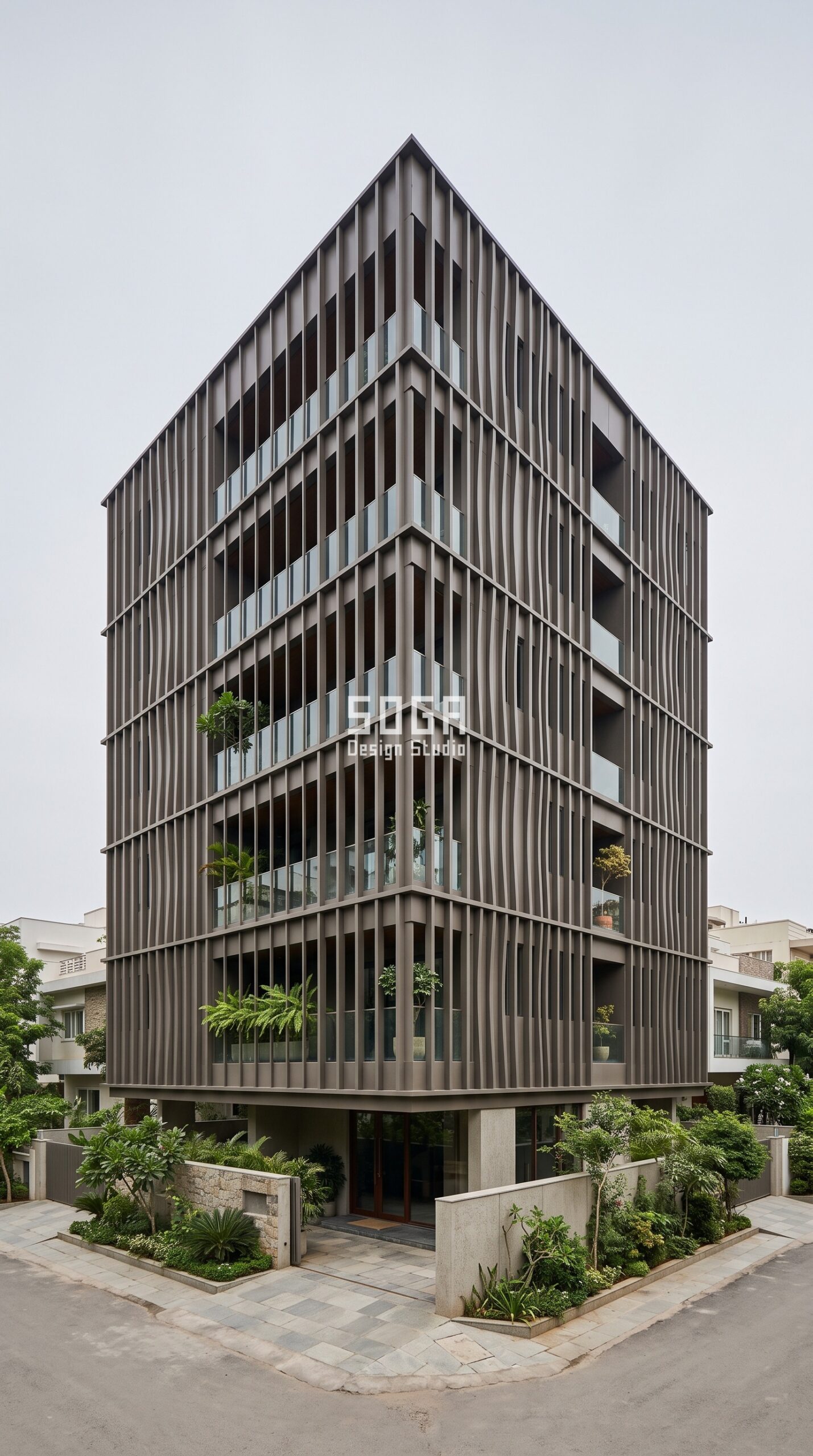
In Banjara Hills the facade is a Parametric Bow Weave — continuous vertical steel ribs press-formed to bow outward between 40 mm and 220 mm across a G+5 corner elevation — and the finish is matte powder-coated RAL 8019 grey brown. The reasoning inverts the Dehradun logic. When the geometry carries deep relief, the pattern a passer-by actually sees is not the metal, it is the shadow the metal casts, and shadow only reads cleanly against a neutral mid-tone. Put a strong hue on a facade like this and two patterns compete: the colour draws a flat graphic across the elevation while the relief draws a moving one, and by mid-morning the building looks busy rather than sculptural. Grey brown also holds up under the Deccan’s flat overcast skies, which is precisely when a saturated colour looks dead and a neutral keeps its depth. The practical rule we apply in the studio is a hierarchy rule: on any facade where the relief depth exceeds roughly 100 mm, the colour gets demoted to a background role and the budget moves from finish to fabrication, because rib forming and the concealed substructure — not the shade — are what set the price.
3. Goa: Wine Red and the Coating Grade That Decides Whether It Lasts
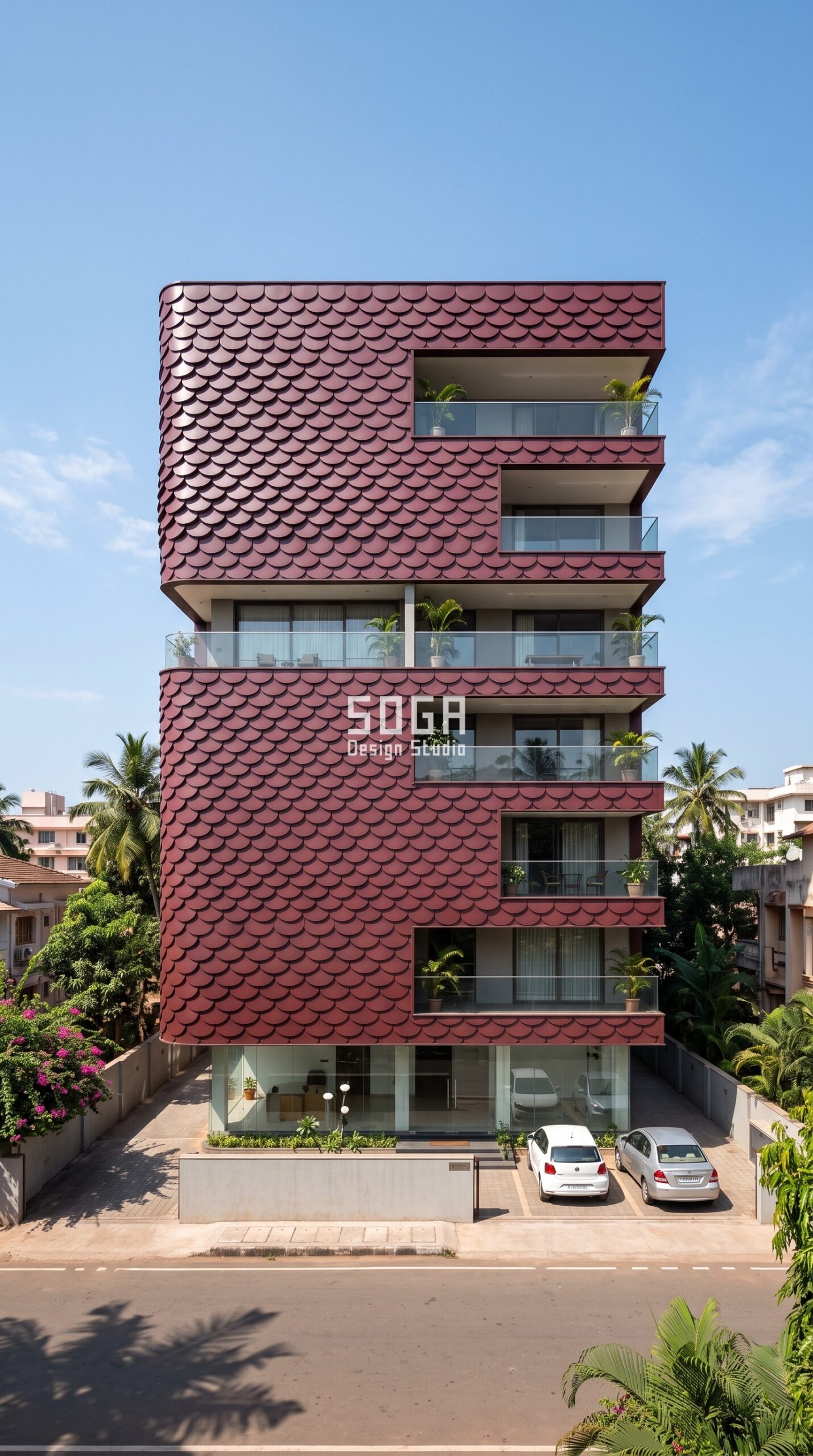
The Dona Paula concept is a Parametric Scale Shell: overlapping convex fish-scale shingle tiles, each 450 mm, in matte powder-coated RAL 3005 dark wine red, with the tile curvature rising from 15 mm to 60 mm as the elevation turns toward the sea breeze. Saturated reds are the highest-risk family on the chart for fade, because red and orange pigments lose chroma under ultraviolet faster than greys, browns or greens do — and a coastal Goan elevation gets both intense ultraviolet and airborne salt. The design answer is not to abandon the colour, it is to move the decision from the shade to the coating system. A standard polyester powder coat will disappoint on this elevation within a few years; a PVDF or super-durable polyester system, over a correctly pre-treated substrate, is what carries a meaningful colour-retention warranty. That is a specification line with a real cost: the higher coating grade typically pushes a solid aluminium tile assembly toward the upper end of the ₹800 to ₹2,500 per sq ft range rather than the middle of it. If a quotation for a saturated colour on a coastal site does not name the coating system and its warranty period, the quotation is incomplete.
4. Ludhiana: Slate Ocean Blue That Only Works Because the Geometry Is Directional
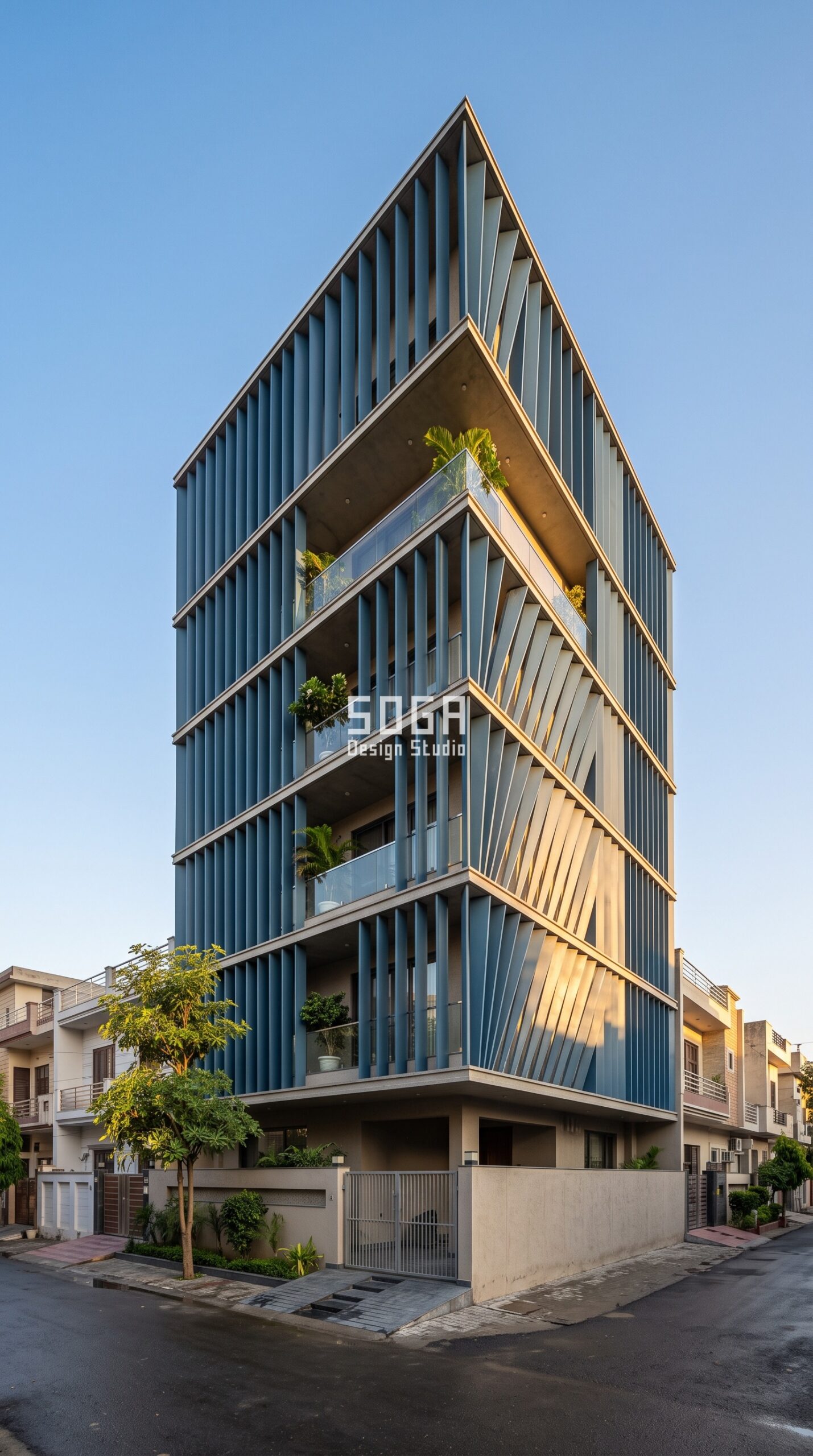
The Ludhiana concept is a Parametric Fan Pulse — flat petal-shaped fins fanning outward from each floor slab, the fan angle opening from 8 degrees at the quiet bays to 46 degrees where the afternoon sun strikes — finished in matte powder-coated slate ocean blue. This is the one colour in today’s set chosen for what it does with light rather than what it resists. A mid-tone blue with a grey base shifts character across the day: cool and almost flat under Punjab’s white midday glare, then warm and bronze-edged when late-afternoon light rakes low across the fins. That shift is only visible because the geometry is directional — every fin presents one face to the sun and one to shade, so the elevation reads as two tones of the same colour rather than one. Try the same shade on a flat cladding wall and it simply looks grey-blue all day, and the client wonders what they paid for. The lesson generalises: a colour that depends on light angle needs geometry that varies with light angle, and the two should be specified together rather than one being chosen after the other is frozen.
Cost Benchmarks for Indian Parametric Metal Facades
One of the most-asked questions on a Dehradun project brief is budget. The current all-in installed rates for parametric metal facades in India sit in the following ranges:
- Steel facade (full design + install): ₹1,200–₹2,800 per sq ft
- Aluminium, anodised or powder-coated: ₹800–₹2,500 per sq ft
- Zinc cladding: ₹1,500–₹3,000 per sq ft
- ACM panels (3 mm basic): ₹200–₹250 per sq ft (basic)
- ACM panels (4 mm): ₹250–₹350 per sq ft
- Solid aluminium panels: ₹800–₹1,800 per sq ft
- Installation labour: ₹50–₹150 per sq ft (varies by height + access)
- Conventional cladding (for comparison): ₹400–₹1,200 per sq ft installed (stone veneer / ceramic / standard ACM)
- how many finishes an elevation should carry, and which element gets which
These figures are baseline; actual project cost depends on facade area, panel complexity, fabricator location, and finish specification. SOGA Design Studio prepares an itemised cost estimate as part of every consultation so the budget conversation starts with hard numbers rather than guesses.
Parametric Facade Design Across India, Dubai & Singapore
For NRI clients building or renovating in India, SOGA Design Studio runs a complete remote workflow. Clients in Dubai, Singapore, the UK, the US, and Australia routinely commission parametric facades for properties in their hometowns — Coimbatore, Indore, Hyderabad, Pune, and Chandigarh are particularly active corridors. The pipeline is fully virtual: site survey by our local team, design development over weekly video reviews, fabrication-ready drawings shared on cloud storage, and on-site supervision relayed through dated photo updates. NRI projects now make up a growing share of our parametric facade portfolio.
Why Trust SOGA Design Studio for Facade Design in Dehradun
- Experience: Every concept above was modelled to a real Indian plot condition — setback, orientation and street context — and rendered at G+4 to G+5, the envelope most of our residential enquiries actually sit in.
- Expertise: SOGA Design Studio specifies parametric metal facades end to end: geometry in Rhino and Grasshopper, panel rationalisation to standard sheet sizes, substructure coordination, and coating specification down to the pre-treatment and warranty clause.
- Authority: We deliver parametric facades across Indian metros and tier-two cities, and for NRI clients building in India from Dubai, the wider UAE, Singapore and the UK.
- Trust: The cost bands quoted here are 2026 supply-and-install ranges for the assemblies described, not teaser rates: powder-coated steel ₹1,200 to ₹2,800 per sq ft, anodised or powder-coated aluminium ₹800 to ₹2,500 per sq ft, with installation of ₹50 to ₹150 per sq ft depending on height and access.
Frequently Asked Questions
Which facade colour lasts longest in the Indian climate?
Neutral and earth tones — greys, browns, greens and bronzes such as RAL 8019 or RAL 6003 — hold their appearance longest, because their pigments are more ultraviolet-stable and they conceal dust and water streaking between cleaning cycles. Saturated reds, oranges and bright blues are not off the table, but they need a PVDF or super-durable polyester coating rather than a standard polyester powder coat, especially on coastal and high-ultraviolet sites.
Do dark facade colours make an Indian building hotter?
A dark skin does absorb more solar radiation, but on a ventilated metal facade that heat is largely carried away in the cavity behind the panel rather than conducted into the room. The variables that actually move indoor temperature are the cavity depth, the insulation behind it and the amount of self-shading the geometry provides — which is why a dark, deeply modelled facade often outperforms a pale, flat one.
How much does a powder-coated metal facade cost per sq ft in India in 2026?
Budget ₹1,200 to ₹2,800 per sq ft for a powder-coated steel facade and ₹800 to ₹2,500 per sq ft for anodised or powder-coated aluminium, supplied and installed, with installation alone accounting for ₹50 to ₹150 per sq ft depending on building height and site access. Zinc runs higher at ₹1,500 to ₹3,000 per sq ft. The colour itself rarely changes the panel rate; the coating grade and the geometry do.
Can a facade be matched to an exact RAL shade?
Yes. Powder coating works to the RAL system, so a shade such as RAL 3005 or RAL 8019 can be specified and repeated across future phases. Ask for a sprayed sample on the actual substrate and sheen level rather than approving from a printed chart, and have all panels for one elevation coated in a single batch so there is no visible batch-to-batch variation.
Should facade colour or facade geometry be decided first?
Geometry first. The relief depth determines how much of the visual effect comes from shadow, and that in turn tells you whether the colour should recede into the background or carry the elevation. Choosing a shade before the geometry is frozen is the most common reason a built facade looks flatter than the render it was approved from.
Which facade colour is best for a house in India?
For luxury Indian residential facades today, the most-specified materials are powder-coated aluminium, precision-cut bronze and copper, and pre-patinated zinc. The choice depends on climate, budget, and the visual language of the building.
Does facade colour affect the cost of a metal facade?
Currently, all-in parametric metal facade rates in India range from ₹800–₹2,500 per sq ft for aluminium and ₹1,200–₹2,800 per sq ft for steel, installed. SOGA Design Studio prepares itemised estimates as part of the consultation.
What is a kinetic facade and is it practical for Indian residences?
A kinetic facade has moving panels — louvres, rotating fins, or actuated screens — that respond to sun angle, occupancy, or wind. For mid-rise Indian residences, the practical version is ‘pseudo-kinetic’: a static parametric pattern that creates the visual illusion of motion as the sun tracks across it. True actuated kinetic systems are typically reserved for premium G+10 and above commercial buildings.
What is the typical timeline from design to installed parametric facade?
For a G+3 to G+4 residence: 3 weeks for concept and approval, 4 weeks for fabrication-ready drawings, 6–8 weeks for fabrication, and 3–5 weeks for site installation — total 16–20 weeks from go-ahead to occupancy. Retrofit projects on existing buildings compress this to 10–14 weeks because no structural coordination is needed.
Which RAL colours work best for Indian residential facades?
Three palettes dominate 2026 Indian residential work: warm earthy bronze and corten tones (RAL 8004, 8019) for traditional contexts; deep desaturated blues and greens (RAL 5004, 5011, 6009) for contemporary luxury; and matte charcoal/black (RAL 9005, 7016) paired with brass or copper accents for a graphic urban look. Light cladding with dark frames is the most-searched aesthetic of 2026.
How much does a parametric metal facade cost in India 2026?
Aluminium parametric facades range ₹800–₹2,500 per sq ft (full design + install), steel ₹1,200–₹2,800 per sq ft, and zinc ₹1,500–₹3,000 per sq ft. Basic ACM cladding (3–4 mm) starts at ₹200–₹350 per sq ft; solid aluminium panels run ₹400–₹600 per sq ft. Installation labor adds ₹50–₹150 per sq ft depending on building height. SOGA Design Studio provides itemised cost estimates as part of every consultation.
How is AI changing facade design in India in 2026?
AI is now a routine input at the concept stage: generative tools propose dozens of parametric variations from a single brief, and computational performance simulators predict heat gain, daylight, and material cost before any drawing is finalised. SOGA Design Studio uses AI-assisted visualisation to accelerate the concept phase from 4 weeks to 4 days, while the engineering and fabrication detailing remain human-led.
What is parametric facade design?
Parametric facade design uses algorithmic rules — light, climate, orientation, and structural parameters — to generate a building skin where every panel is mathematically calibrated. The result is a facade that performs (heat control, ventilation, daylighting) while expressing a unique sculptural identity. It is the direct computational descendant of traditional Indian metal screens.
What is a sculptural petal-shaped metal fin facade?
SOGA Design Studio addresses this question in detail during the design consultation. For Dehradun projects, we provide a fully customised answer based on plot, orientation, and budget — typically within 48 hours of receiving the brief.
Related Reading
- Parametric facade design in India: trends, systems and what’s buildable in 2026
- Facade design in Dehradun 2026: is parametric right for your plot?
- ACP vs glass vs stone vs metal: choosing the right facade material in India
- House facade design India 2026: 8 parametric ideas
- Facade and elevation design in India: complete FAQ guide
- Arabesque Jali & Geometric Perforated Metal Facades — 4 Indian Residential Concepts 2026
- Vajra Jewelers | 3D Parametric Metal Facade Design Concept in Hyderabad
Start Your Facade Project With SOGA Design Studio
Decide what the colour has to survive before you decide what it looks like — concealment, deference to shadow, fade resistance or light response — and the shade card becomes an easy last step instead of an expensive first guess.
Book a free 30-minute discovery call with SOGA Design Studio to discuss how a bold geometric T-bar aperture screen or similar parametric concept can work on your Dehradun plot. NRI clients welcome — full remote workflow available.