Walk down GMS Road in Dehradun in 2026 and you will pass a dozen new G+5 and G+7 buildings that all made the same choice: flat cladding, straight to the parapet, nothing to catch the hill light. Then one of them stops you, because its skin has depth. That is usually the moment an owner starts searching for parametric facade design in India – and it is also the moment the wrong decision gets made. A parametric metal facade is not a style you switch on. It is an answer to a specific problem your elevation has. The useful question is not which pattern you like; it is whether your plot qualifies at all. Here is the four-gate test we run before we quote, shown through four concepts across Dehradun and other Indian cities.
Facade Design in India: Why Dehradun Is Choosing Parametric Metal
Facade design in India has moved from an afterthought to the single most important decision on a residential project. Today, demand for parametric facade design in India is rising fastest in cities such as Dehradun, Mumbai, Bangalore, Delhi, and Pune, where homeowners and developers want elevations that are both performance-driven and instantly recognisable. SOGA Design Studio specialises in facade design in India — from G+3 individual homes to G+7 residential blocks — pairing algorithmic geometry with matte powder-coated ral 1019 warm grey and fabrication-ready detailing. Whether you are comparing metal facade design in India for a new build or a retrofit, the concepts below show how a considered facade redefines a building’s identity and its long-term value.
1. Gate 1 – Dehradun Parametric Pixel Relief: When the Problem Is a Flat, Featureless Elevation
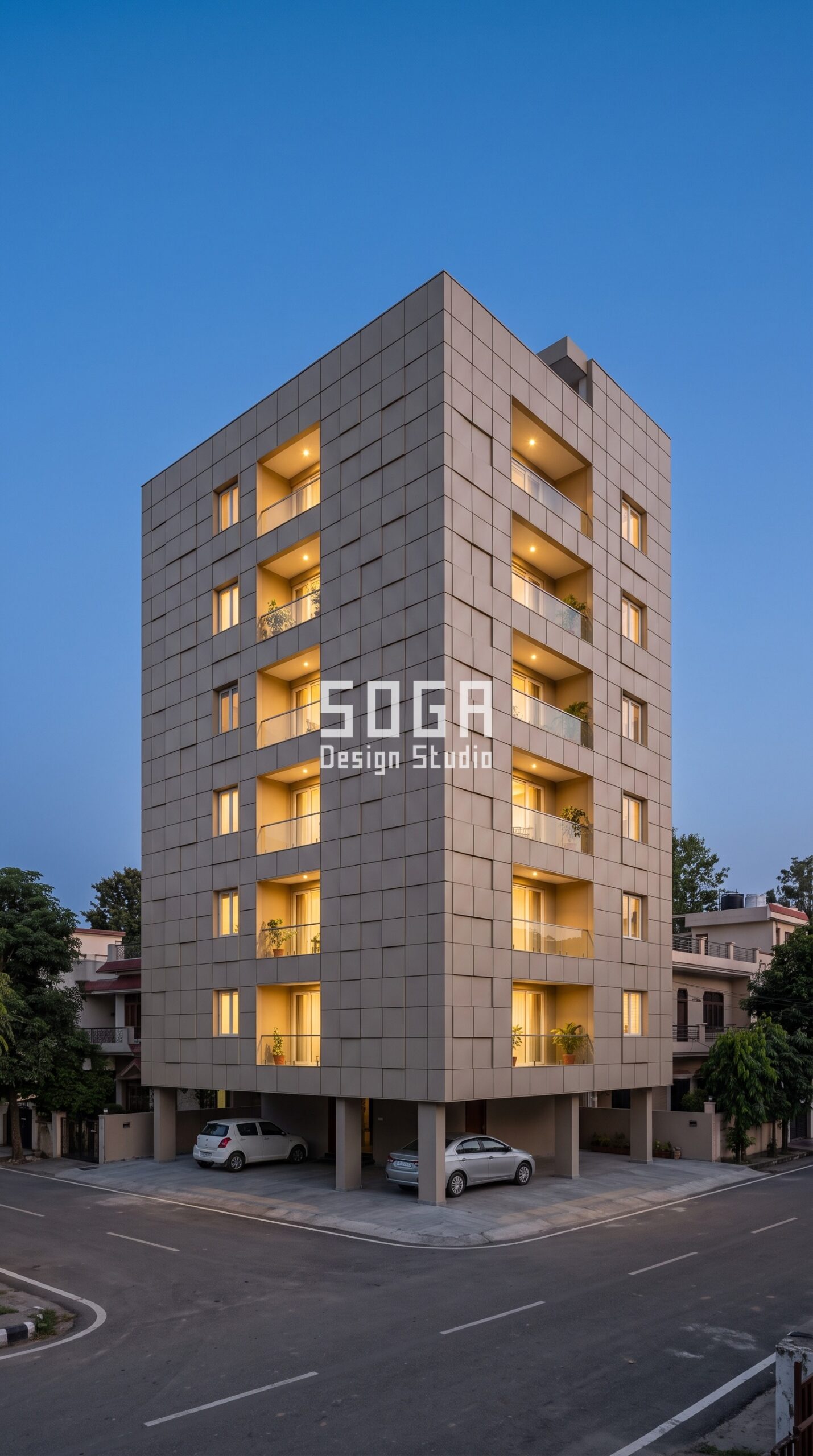
The first gate is the simplest and the most common: a long street elevation with nothing on it. This G+7 study on GMS Road, Dehradun sits on a plot where setbacks left no room for projecting balconies, so the frontage was heading for a flat wall seven floors high. The Parametric Pixel Relief system answers it with a strict grid of 600mm pressed steel tiles in matte powder-coated RAL 1019 warm grey beige, where each tile steps forward from 25mm at the edges to 180mm near the centre. Nothing about the grid changes – only the depth – and that alone is enough to turn a blank plane into a surface that reads differently at every hour, sharp and raking in Dehradun’s morning hill light, soft and almost flat by the blue hour. If your elevation’s real problem is that there is simply nothing on it, depth is the cheapest thing you can buy, and this is the gate you pass.
2. Gate 2 – Indore Parametric Facet Prism: When One Elevation Takes the Full Western Sun
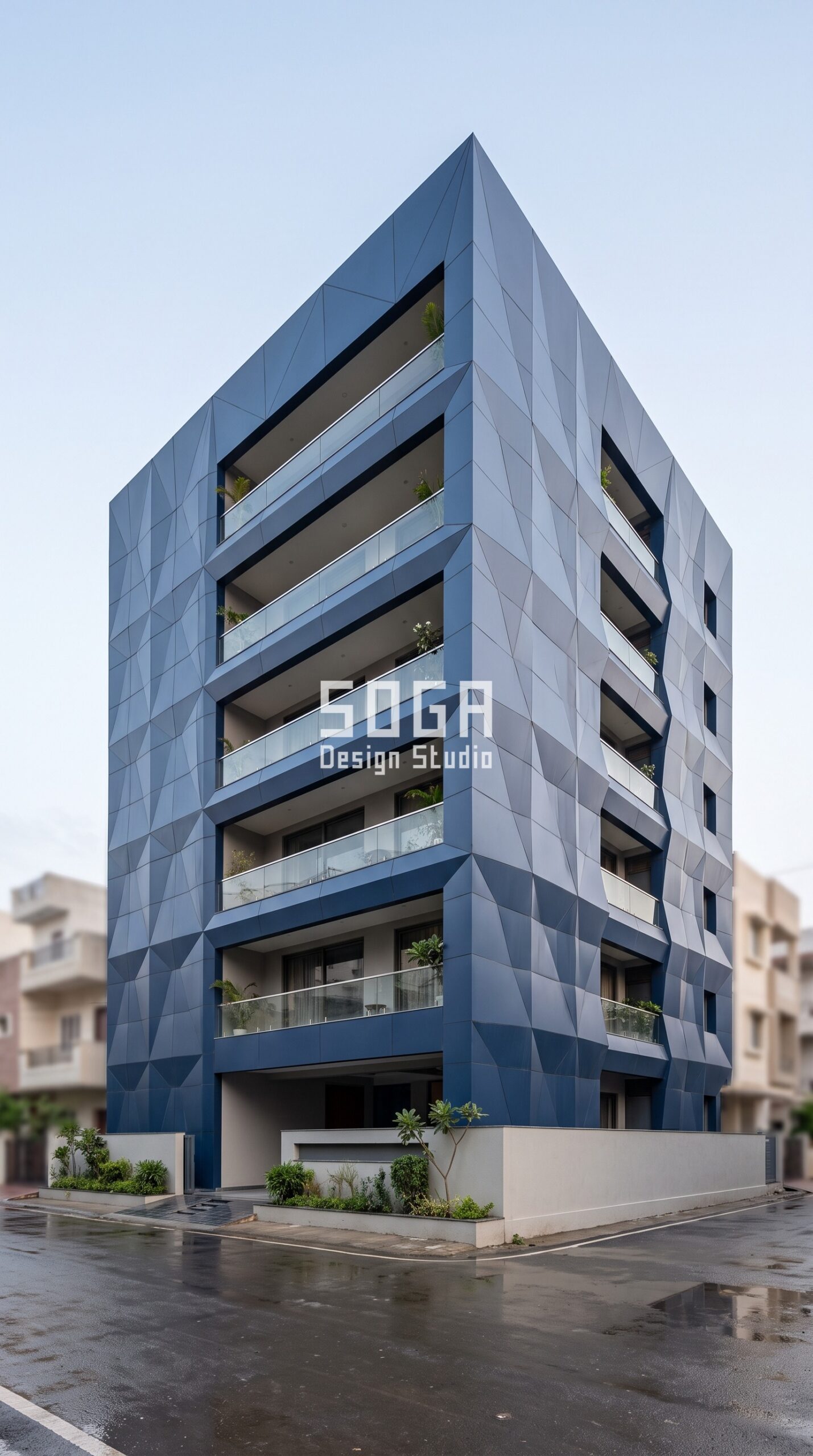
The second gate is orientation, and it is the one Indian owners underestimate most. In Vijay Nagar, Indore, this G+6 study has a west face that turns living rooms into an oven from three in the afternoon until sunset, while the north face has no such problem at all. A uniform screen across both would waste money on one side and under-perform on the other. The Parametric Facet Prism system uses 900mm triangular folded ACP cassettes in matte navy blue, with the fold projection growing from 70mm on the shaded north face to 300mm on the sun-facing west face, so the shading depth is spent exactly where the heat is. The module grid behind stays perfectly regular, which is what keeps it a fabricable panel family rather than a sculpture. If one of your elevations measurably cooks and the others do not, a parametric facade is not decoration – it is the cheapest passive cooling you will install, and it pays back in running cost.
3. Gate 3 – Bhopal Parametric Pinwheel Grid: When the Problem Is Being Overlooked
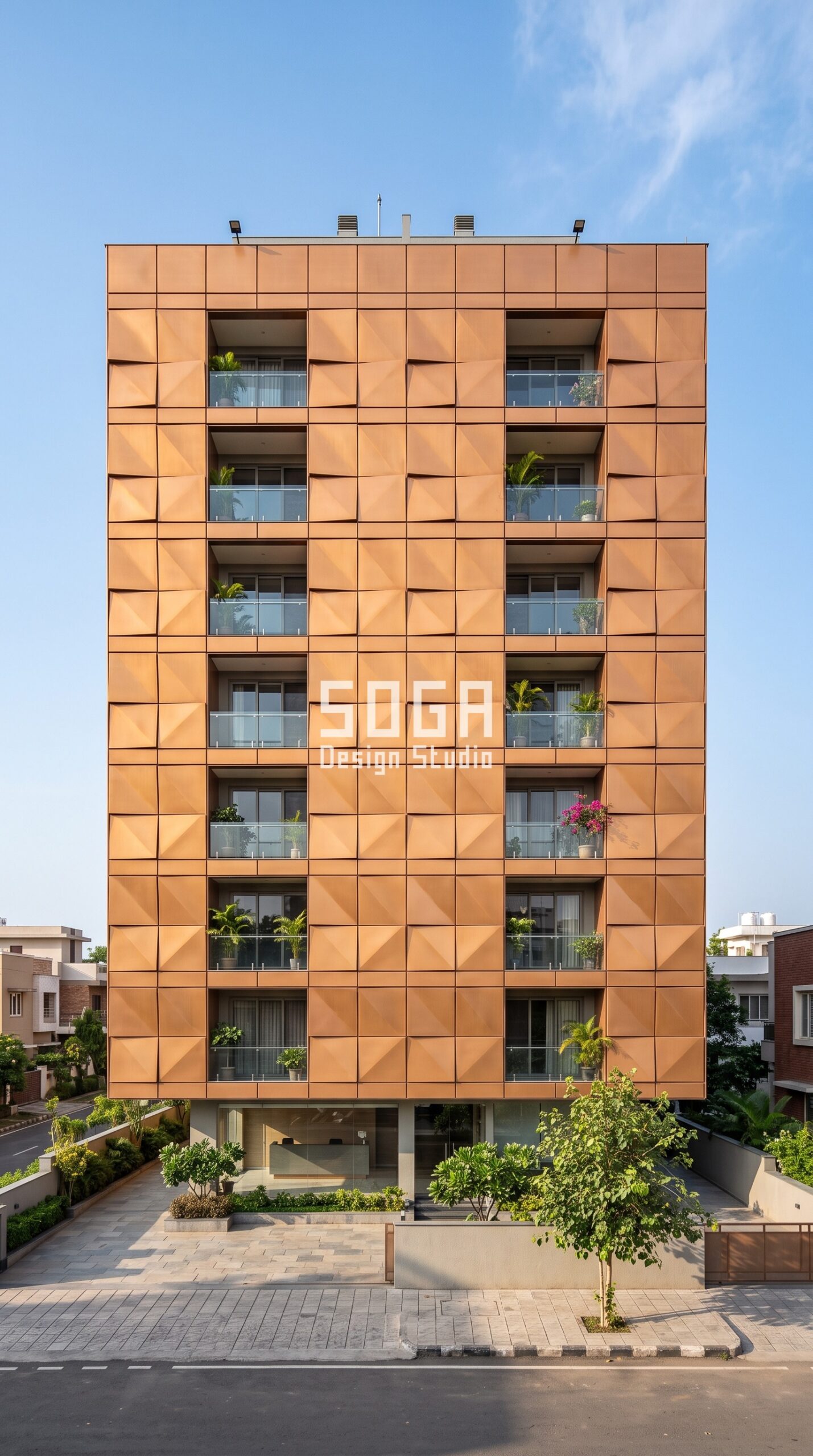
The third gate is privacy, and it is why so many Indian plots with a good view still end up living behind closed curtains. This G+7 study in Shamla Hills, Bhopal faces a road on one side and a neighbouring plot close on the other, so the balconies that should have been the best rooms in the building were unusable. The Parametric Pinwheel Grid answers it geometrically rather than by blocking: 750mm square panels in matte burnished warm honey copper, each rotated about its own centre pin from 0 degrees at the base to 35 degrees at the top floor. Rotation opens the view outward and upward while closing the sightline in from street level, so the lower floors gain privacy and the upper floors keep the hill view. Copper matters here too – it holds its warmth in Bhopal’s bright morning light instead of flattening to grey. If your plot is overlooked but you do not want to give up the view, this is your gate.
4. Gate 4 – Gurugram Parametric Mosaic Step: When the Building Already Exists
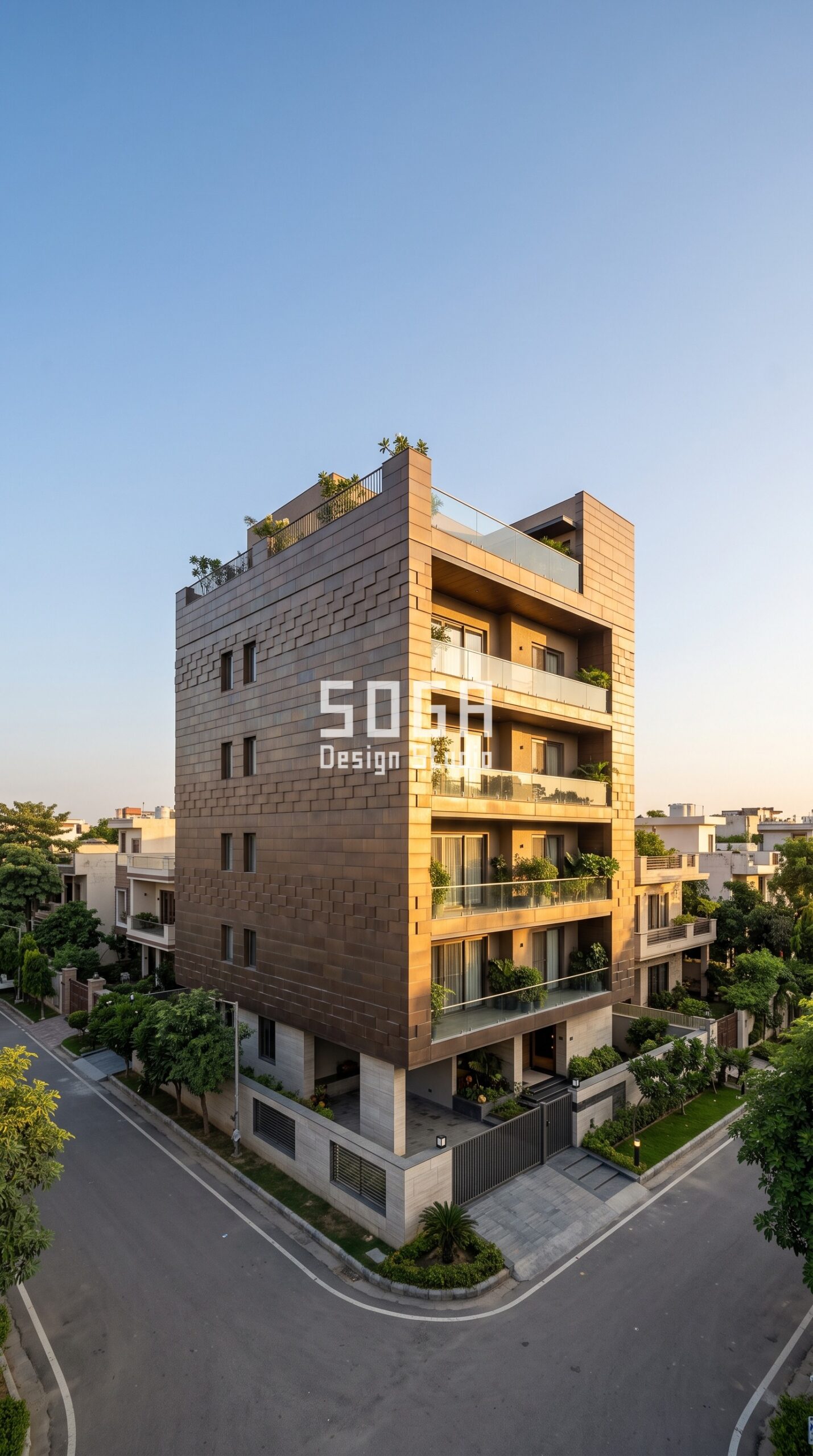
The fourth gate is the one most people assume is closed to them: the building is already built. This G+5 study in Nirvana Country, Gurugram is a re-skin, not a new build, and that changes every decision. The Parametric Mosaic Step system uses 400 by 800mm rectangular tiles in matte iridescent bronze, laid in horizontal bands where the projection steps from 40mm on the lower bands to 220mm on the upper ones. Banding is deliberate: it lets the work be staged floor by floor on a lightweight secondary frame, so the building stays occupied and the structural load stays within what an existing RCC frame can accept without strengthening. The late-afternoon raking light in Gurugram does the rest, because banded depth reads strongest when the sun is low. If your problem is a dated shell rather than a blank site, you qualify – and a retrofit is usually the highest-return facade money in this list.
Cost Benchmarks for Indian Parametric Metal Facades
One of the most-asked questions on a Dehradun project brief is budget. The current all-in installed rates for parametric metal facades in India sit in the following ranges:
- Steel facade (full design + install): ₹1,200–₹2,800 per sq ft
- Aluminium, anodised or powder-coated: ₹800–₹2,500 per sq ft
- Zinc cladding: ₹1,500–₹3,000 per sq ft
- ACM panels (3 mm basic): ₹200–₹250 per sq ft (basic)
- ACM panels (4 mm): ₹250–₹350 per sq ft
- Solid aluminium panels: ₹800–₹1,800 per sq ft
- Installation labour: ₹50–₹150 per sq ft (varies by height + access)
- Conventional cladding (for comparison): ₹400–₹1,200 per sq ft installed (stone veneer / ceramic / standard ACM)
These figures are baseline; actual project cost depends on facade area, panel complexity, fabricator location, and finish specification. SOGA Design Studio prepares an itemised cost estimate as part of every consultation so the budget conversation starts with hard numbers rather than guesses.
Parametric Facade Design Across India, Dubai & Singapore
SOGA Design Studio operates across the full Indian residential market — Mumbai, Delhi, Bangalore, Hyderabad, Chennai, Pune, Jaipur, Ahmedabad, and tier-2 cities including Coimbatore, Indore, Nagpur, and Chandigarh. Demand for dynamic shading facade, sculptural metal cladding is no longer concentrated in metros; we are seeing equal pull from owner-builders in tier-2 markets who want their G+3 home to read as clearly designed, not generic. Every project starts with your plot dimensions, local building bylaws, and a 30-minute discovery call to align on aesthetic direction.
Why Trust SOGA Design Studio for Facade Design in Dehradun
- Experience: SOGA Design Studio has designed and visualised parametric metal facades for real Indian G+3 to G+7 plots across hill cities, tier-one metros and tier-two growth corridors, and has run a daily facade study series since 2023 – which is where the four concepts on this page come from.
- Expertise: Every concept is built as a parametric system, not a drawing: a defined module size, one varying parameter with a stated numeric range, and an orientation-by-orientation climate check, then detailed for fabrication with vetted Indian metal fabricators so panel schedules and substructure are buildable.
- Authority: SOGA works as India’s facade design specialists, publishing openly on cost, buildability and – as on this page – on when a parametric facade is the wrong purchase.
- Trust: Real 2026 Indian cost ranges are published below rather than hidden behind an enquiry, estimates are itemised into panel, substructure and installation, the first consultation is free and carries no commitment, and NRI owners are handled entirely remotely.
Frequently Asked Questions
Is a parametric facade worth it for a G+5 building in India?
It is worth it when the elevation has a job to do – a flat featureless frontage, a west face that overheats, an overlooking problem, or a dated shell being re-skinned. In those cases the facade buys shade, privacy or value that plain cladding cannot. If none of those apply, conventional cladding at Rs 400-1,200 per sq ft installed is the better purchase, and we will say so.
Can a parametric facade be added to an existing building?
Yes, and retrofits are often the highest-return work we do. The panels hang on a lightweight secondary frame fixed back to the existing structure, so the added load stays within what a typical RCC frame accepts without strengthening. A banded system, like the Gurugram concept above, also lets the work be staged floor by floor so the building stays occupied. The one non-negotiable is an accurate site survey before design.
Does a metal facade actually reduce heat gain on a west-facing elevation?
A shading layer held off the wall works in two ways: it intercepts direct sun before it reaches the glass and wall, and the ventilated gap behind it carries away the heat the panel absorbs. The gain comes from getting the depth and angle right for that specific orientation – which is exactly why the Indore concept above grows its fold from 70mm on the north face to 300mm on the west.
Which metal finish lasts best in an Indian hill city like Dehradun?
Hill cities bring high humidity, heavy monsoon and big day-night temperature swings rather than coastal salt. Powder-coated steel and anodised aluminium both perform well there provided the coating grade and the fixing detail are specified for it; drainage and drip detailing at panel joints matter more than the metal choice. Copper and bronze finishes are also stable, and change tone slowly rather than failing.
Is parametric design suitable for G+3 and G+4 residential plots?
Absolutely — it is in fact the highest-growth segment in India. G+3 and G+4 plots benefit most because the entire facade is visible from the street, so a sculptural parametric treatment yields maximum identity per rupee invested. SOGA Design Studio specialises in this typology, with concepts adapted to standard 30×40, 40×60, and 50×80 ft plots across Indian metros and tier-2 cities.
How much heat does a parametric metal facade actually reduce?
Independent studies on Indian residential applications show double-skin parametric metal screen facades reduce direct solar heat gain by 25-40% on west and south orientations, dropping interior surface temperatures by 4-7 deg C compared to bare RCC. The shaded gap also enables passive cross-ventilation. SOGA Design Studio tunes the screen opening density based on each orientation solar load.
How is AI changing facade design in India in 2026?
AI is now a routine input at the concept stage: generative tools propose dozens of parametric variations from a single brief, and computational performance simulators predict heat gain, daylight, and material cost before any drawing is finalised. SOGA Design Studio uses AI-assisted visualisation to accelerate the concept phase from 4 weeks to 4 days, while the engineering and fabrication detailing remain human-led.
Which RAL colours work best for Indian residential facades?
Three palettes dominate 2026 Indian residential work: warm earthy bronze and corten tones (RAL 8004, 8019) for traditional contexts; deep desaturated blues and greens (RAL 5004, 5011, 6009) for contemporary luxury; and matte charcoal/black (RAL 9005, 7016) paired with brass or copper accents for a graphic urban look. Light cladding with dark frames is the most-searched aesthetic of 2026.
How much does a parametric metal facade cost in India 2026?
Aluminium parametric facades range ₹800–₹2,500 per sq ft (full design + install), steel ₹1,200–₹2,800 per sq ft, and zinc ₹1,500–₹3,000 per sq ft. Basic ACM cladding (3–4 mm) starts at ₹200–₹350 per sq ft; solid aluminium panels run ₹400–₹600 per sq ft. Installation labor adds ₹50–₹150 per sq ft depending on building height. SOGA Design Studio provides itemised cost estimates as part of every consultation.
Parametric metal facade vs traditional stone or paint — which is better long-term?
Stone is heavy, expensive (₹600–₹1,500 per sq ft just for material), and difficult to repair when chipped. Paint requires repainting every 4–6 years in Indian conditions. A powder-coated parametric metal facade has higher upfront cost but a 25–30 year service life, zero repainting, and far stronger street identity — making total cost of ownership lower over a 20-year horizon. It is also significantly lighter, reducing structural cost on G+3 and above.
What is a sculptural petal-shaped metal fin facade?
SOGA Design Studio addresses this question in detail during the design consultation. For Dehradun projects, we provide a fully customised answer based on plot, orientation, and budget — typically within 48 hours of receiving the brief.
Related Reading
- the difference between a facade and an elevation
- 3D parametric facade panel design and cost in India
- how a facade project timeline and cost actually run
- Parametric Design Career FAQ 2026: 40 Expert Questions Answered for Indian Architects
- Parametric Metal Facades That Change With Light: The New Standard for Indian Luxury Residences
- Podwave Residence: A Parametric Facade Landmark by SOGA Design Studio
Start Your Facade Project With SOGA Design Studio
If your plot passes none of these four gates, the honest answer is that plain cladding will serve you better and cheaper – and a facade designer worth hiring will tell you so before you spend on design.
Whether you are building new or retrofitting an existing block, SOGA Design Studio can adapt the concepts above to your exact plot and budget. Start the conversation here — consultations are free and no-commitment.