Walk down a Sector 56 lane in Gurugram in 2026 and you will pass four or five buildings with the same beige plaster and the same aluminium windows, and then one that stops you — a G+3 wrapped in slender terracotta arches that catch the last blue light. The owner did not knock it down. They kept the frame, the slabs and the staircase, and changed only the 1,900 sq ft of skin the street actually sees. That is what most facade design in India now looks like: not a rebuild, but an overhaul. And the question every owner asks first is not what it will look like — it is how long it takes, what it costs, and what happens in between. This post walks that process through four parametric metal concepts across Gurugram and other Indian cities, one for each decision an overhaul forces you to make.
Facade Design in India: Why Gurugram Is Choosing Parametric Metal
Facade design in India has moved from an afterthought to the single most important decision on a residential project. Today, demand for parametric facade design in India is rising fastest in cities such as Gurugram, Mumbai, Bangalore, Delhi, and Pune, where homeowners and developers want elevations that are both performance-driven and instantly recognisable. SOGA Design Studio specialises in facade design in India — from G+3 individual homes to G+7 residential blocks — pairing algorithmic geometry with matte warm terracotta-toned metal comp and fabrication-ready detailing. Whether you are comparing metal facade design in India for a new build or a retrofit, the concepts below show how a considered facade redefines a building’s identity and its long-term value.
1. Gurugram: The Shell Decision — A Terracotta Arched Colonnade Over an Existing Frame
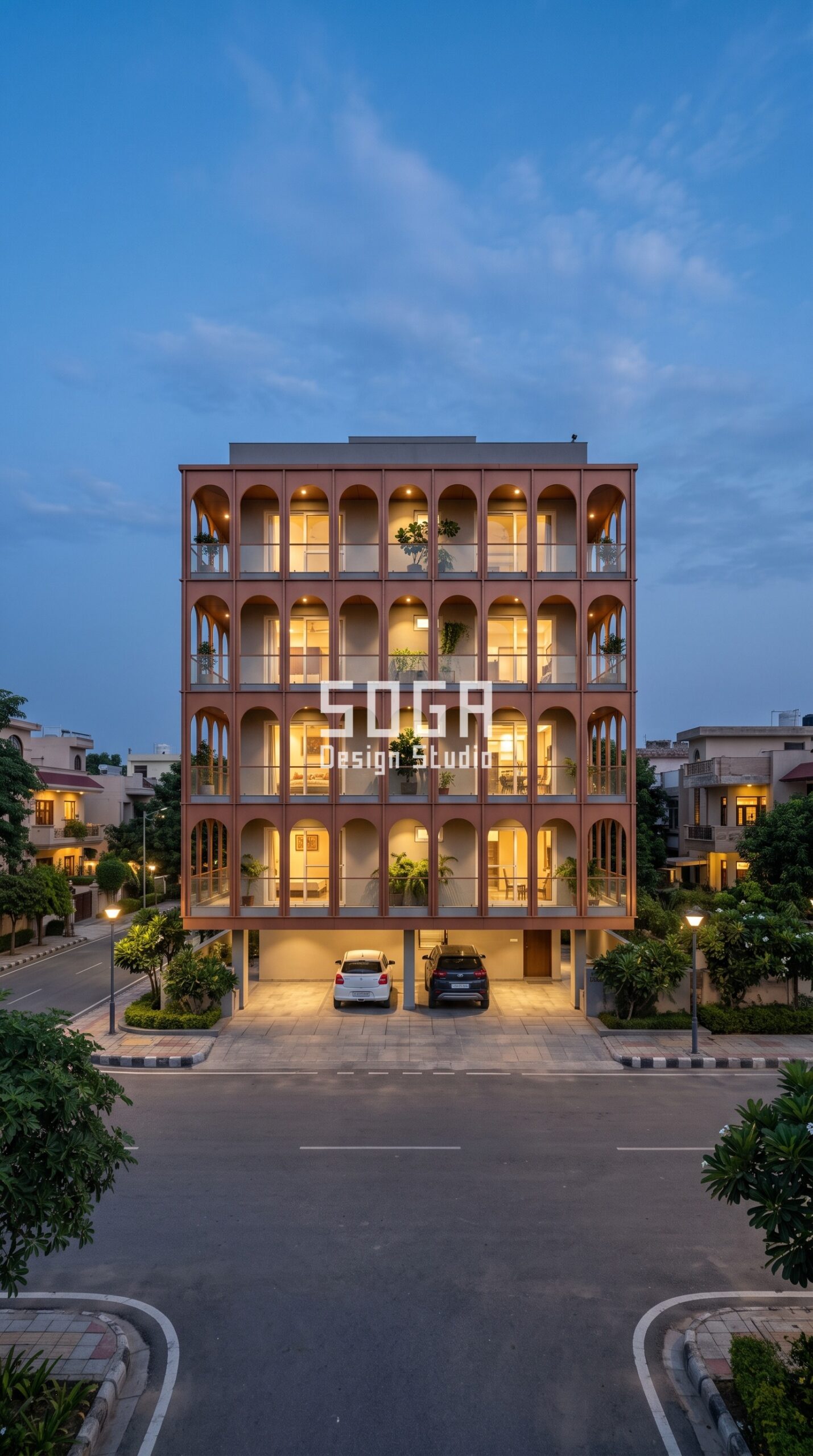
The first decision in any overhaul is what the new skin is made of as a whole — a shell that wraps, or a flat cladding that merely resurfaces. This G+3 in Sector 56 takes the wrapping route: a full-height arched metal colonnade in matte warm terracotta-toned composite panels, running unbroken around the perimeter so the building reads as one object rather than four separate elevations. The arches are not decoration; each one is a 600 mm deep reveal that shades the balcony glazing behind it through Gurugram’s punishing April-to-June west sun, and the depth is what makes the facade legible at dusk when the interior light spills through. Because the colonnade hangs off a new secondary frame bolted back to the existing slab edges, none of the original structure had to be touched — the survey, fabrication and install ran while the flats stayed occupied. Terracotta was chosen over the obvious anthracite because it holds Gurugram’s dust without looking dirty between washes. Shell decisions like this one are where an overhaul either gains its identity or settles for a resurface.
2. Ludhiana: The Panel Decision — Folded Fir-Green Cassettes That Absorb a Crooked Slab
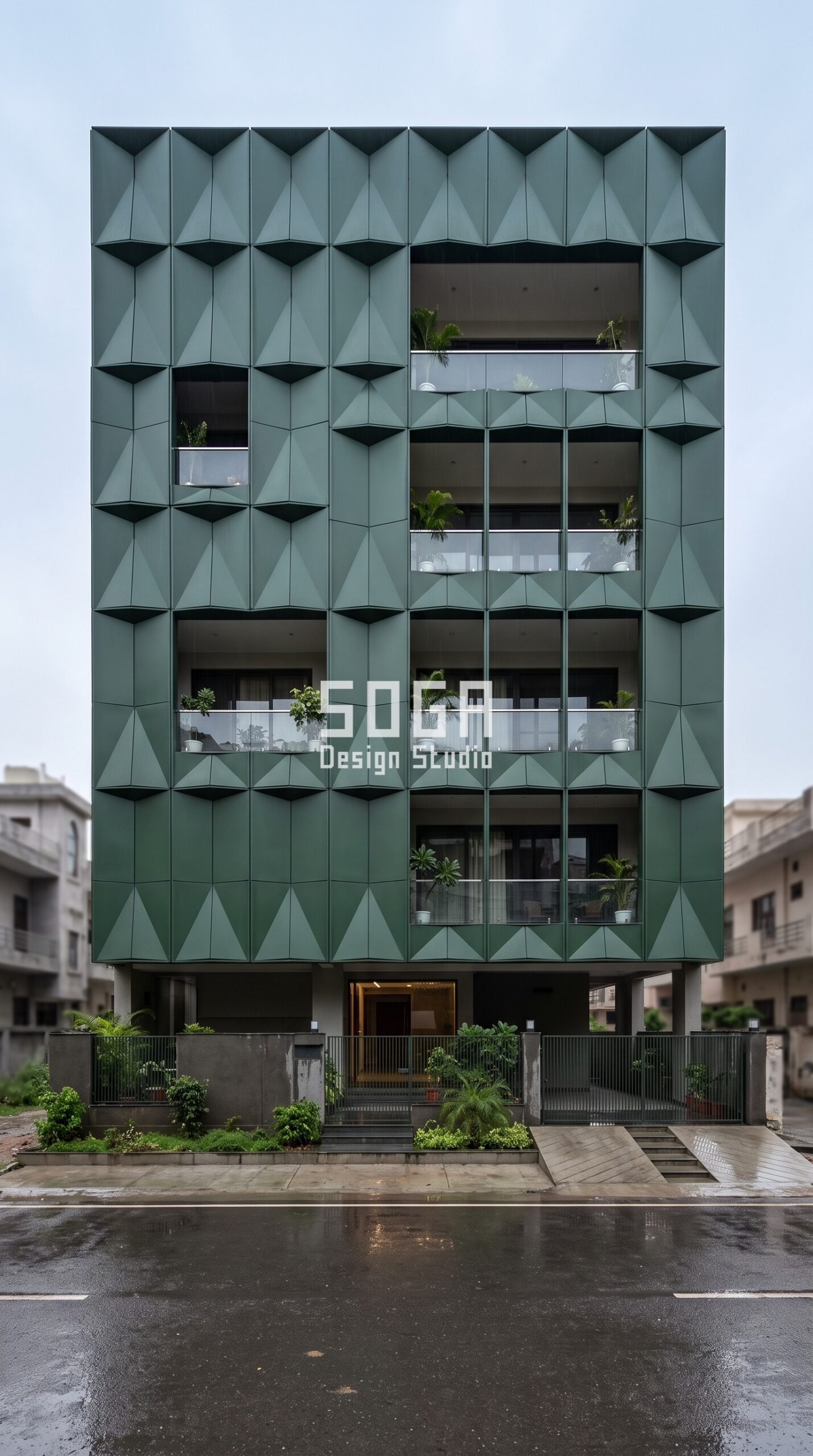
Once the shell is chosen, the panel itself decides whether the facade is buildable. This G+6 in BRS Nagar, Ludhiana uses press-braked cassettes in matte powder-coated RAL 6009 deep fir green steel, each one a discrete flat-sided module whose fold depth steps gradually across the elevation so the wall reads as a slow diagonal ripple without a single curved part being made. That matters on a retrofit: the existing slab edges were out of true by nearly 40 mm across the frontage, and a folded cassette on an adjustable bracket swallows that error inside the joint, where a flat sheet would have telegraphed every millimetre. The deep green was specified against Punjab’s monsoon and winter fog, both of which flatten mid-greys into something grim by January. Each cassette is small enough for two people to lift, which kept the site free of heavy lifting equipment on a narrow residential street. When someone asks why a parametric facade costs more than plain cladding, this is the honest answer — you are paying for panels that are individually different and still fit.
3. Bangalore: The Structure Decision — Cladding a Cantilever in Iridescent Bronze
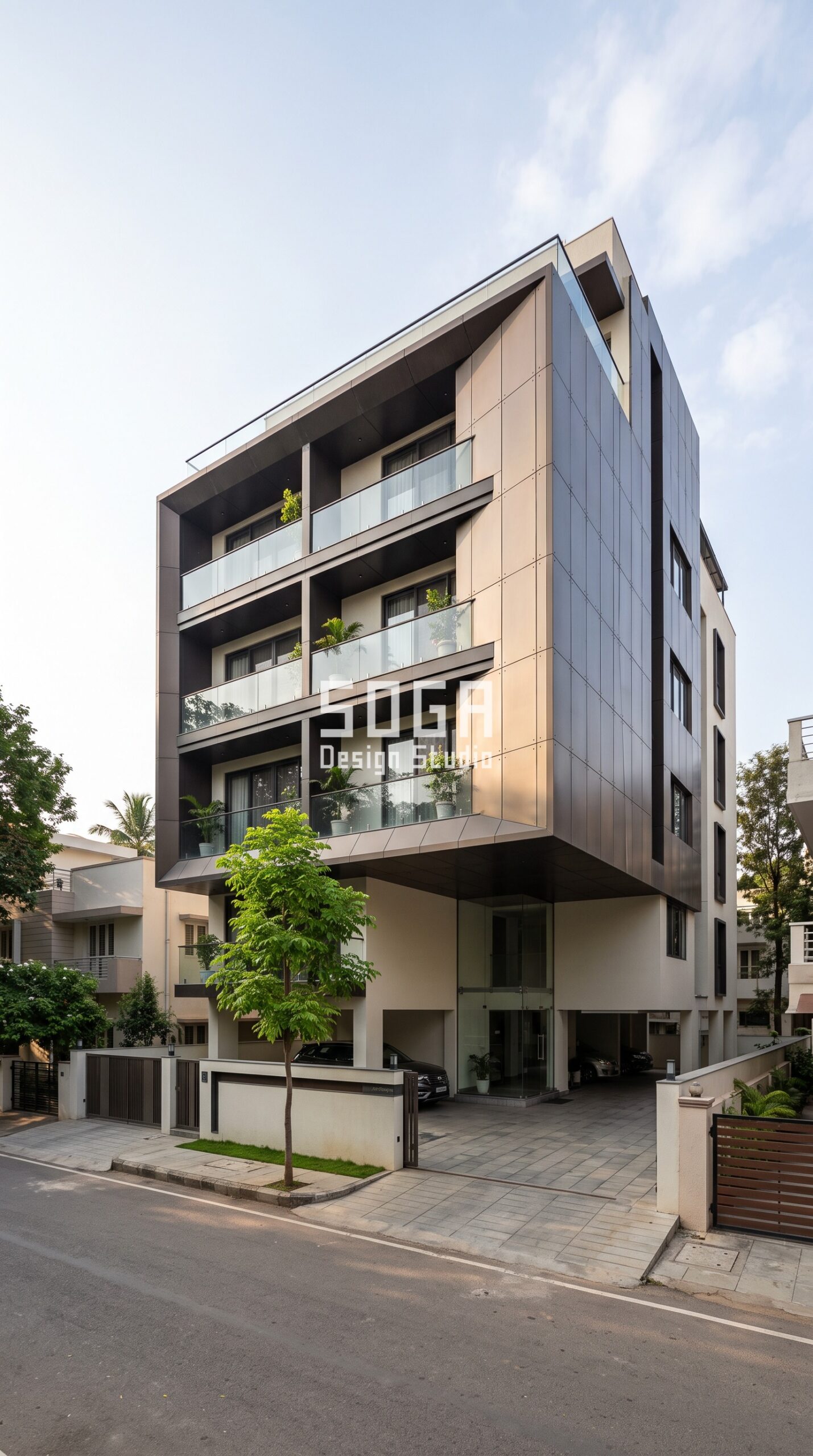
The third decision is the one owners underestimate: whether the overhaul stays cosmetic or starts touching structure. In Jayanagar, Bangalore, a G+4 pushes a deep box volume out over the open parking level, and the moment a facade turns a corner and continues across a soffit, wind uplift and panel weight stop being a cladding problem and become an engineering one. The matte iridescent bronze panels here shift in module width and angle along the elevation, and the same system had to run underneath the cantilever where every fixing is working against gravity in full view. That meant a structural check on the existing cantilever before a single panel was ordered, and a heavier bracket specification on the soffit than on the flanks. The payoff is the thing that makes the building: from across the street on a bright Bangalore morning the bronze reads warm and matt, and by four in the afternoon the same panels have gone almost pewter. Structure decisions add two to three weeks to a programme — and they are the ones you cannot retrofit later.
4. Mumbai: The Screen Decision — A Charcoal Aperture Gradient for a Tight Juhu Plot
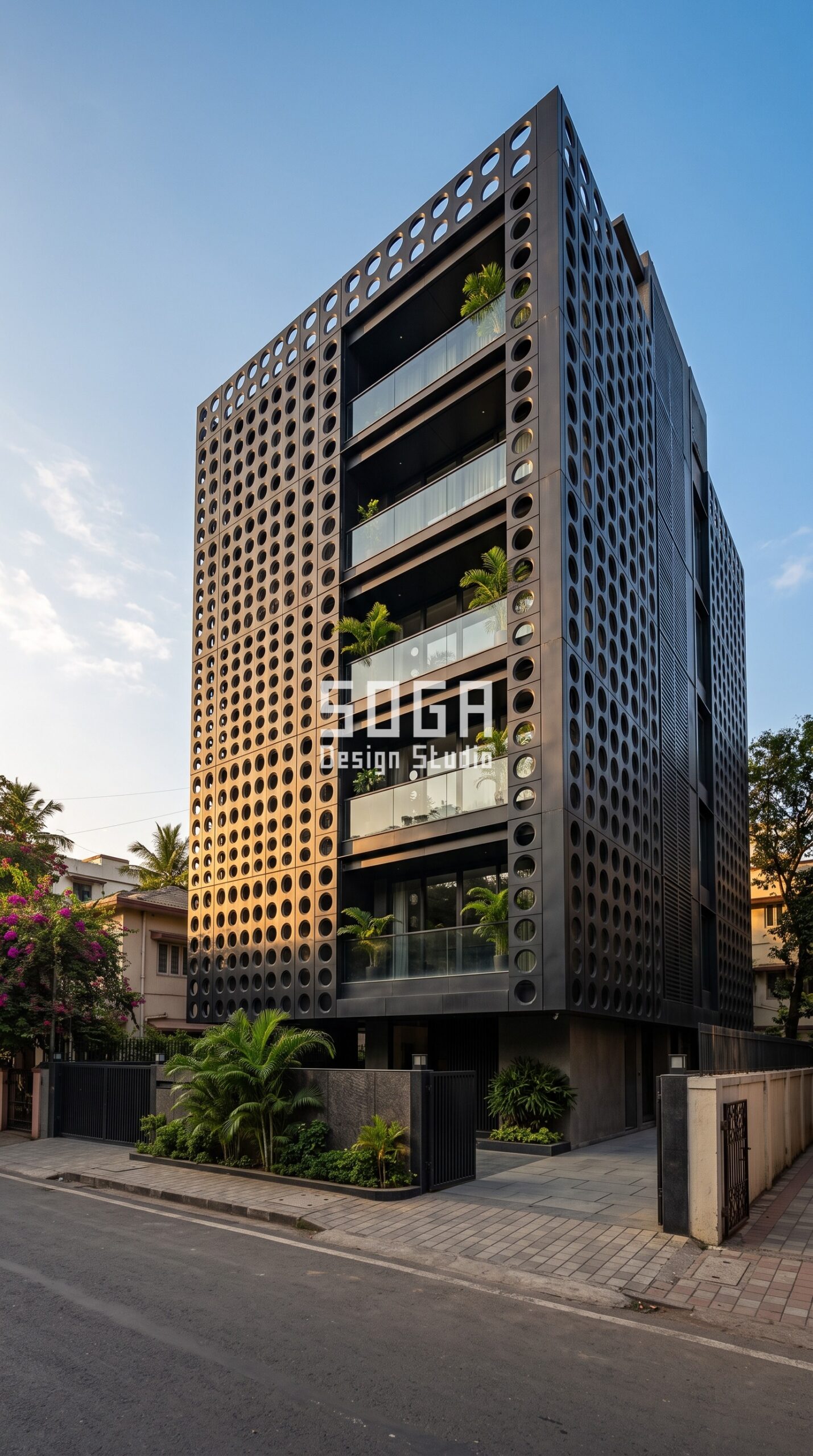
The last decision is what the facade does for the people behind it, and on a tight Mumbai plot that means privacy without darkness. This G+5 in Juhu hangs a clean geometric precision-cut metal screen in matte deep charcoal black powder-coated steel clear of the glazing, its repeating circular-and-chamfered openings easing wider as they rise so the lower floors — the ones a neighbour can see into from six metres away — stay dense while the upper floors open to sky and light. The gradient is set from an actual overlooking study, not from an aesthetic whim, which is why the pattern is asymmetric across the two street elevations. Coastal Mumbai forced the specification as much as the geometry did: marine-grade pretreatment and a thicker powder coat, because a screen this fine has enormous exposed edge length and edges are where corrosion starts. In late-afternoon raking light the openings throw a second, moving pattern onto the wall behind them. Screen decisions are the cheapest way to change how a facade actually feels to live behind.
Cost Benchmarks for Indian Parametric Metal Facades
One of the most-asked questions on a Gurugram project brief is budget. The current all-in installed rates for parametric metal facades in India sit in the following ranges:
- Steel facade (full design + install): ₹1,200–₹2,800 per sq ft
- Aluminium, anodised or powder-coated: ₹800–₹2,500 per sq ft
- Zinc cladding: ₹1,500–₹3,000 per sq ft
- ACM panels (3 mm basic): ₹200–₹250 per sq ft (basic)
- ACM panels (4 mm): ₹250–₹350 per sq ft
- Solid aluminium panels: ₹800–₹1,800 per sq ft
- Installation labour: ₹50–₹150 per sq ft (varies by height + access)
- Conventional cladding (for comparison): ₹400–₹1,200 per sq ft installed (stone veneer / ceramic / standard ACM)
These figures are baseline; actual project cost depends on facade area, panel complexity, fabricator location, and finish specification. SOGA Design Studio prepares an itemised cost estimate as part of every consultation so the budget conversation starts with hard numbers rather than guesses.
Parametric Facade Design Across India, Dubai & Singapore
For NRI clients building or renovating in India, SOGA Design Studio runs a complete remote workflow. Clients in Dubai, Singapore, the UK, the US, and Australia routinely commission parametric facades for properties in their hometowns — Coimbatore, Indore, Hyderabad, Pune, and Chandigarh are particularly active corridors. The pipeline is fully virtual: site survey by our local team, design development over weekly video reviews, fabrication-ready drawings shared on cloud storage, and on-site supervision relayed through dated photo updates. NRI projects now make up a growing share of our parametric facade portfolio.
Why Trust SOGA Design Studio for Facade Design in Gurugram
- Experience: SOGA Design Studio has designed and visualised parametric metal facades for real Indian G+3 to G+7 plots since 2023, and runs a daily facade study series across Indian cities — the four concepts in this post come from that ongoing work, each set on a specific plot condition rather than a generic elevation.
- Expertise: Every concept is developed through SOGA’s parametric systems workflow: orientation and shading analysis per elevation, module and tolerance design around real slab and column deviations, and fabrication-ready detailing in aluminium, powder-coated steel, composite panel and anodised finishes with vetted Indian fabricators.
- Authority: SOGA Design Studio works as a facade design specialist for Indian clients and NRI owners across India, Dubai, Singapore and the UK, covering concept, parametric development, material specification and fabrication drawings.
- Trust: This post quotes 2026 India cost ranges per sq ft rather than a single headline number, states where a decision adds weeks to a programme, and offers a free no-commitment consultation with an itemised estimate. Remote survey and approval workflows are available for NRI owners.
Frequently Asked Questions
What is the typical timeline from design to installed parametric facade?
For a G+3 to G+6 Indian building, budget roughly four to six months end to end in 2026. A measured site survey and concept design take two to three weeks, parametric development and material selection another three to four, fabrication drawings and approvals two to three, factory fabrication six to ten weeks depending on panel count and finish, and installation three to six weeks. Structural work on a cantilever or new secondary framing adds two to three weeks. Monsoon months slow installation, not fabrication, so a facade drawn in March usually installs cleanly after September.
Can a parametric metal facade be retrofitted onto an existing Indian building?
Yes, and it is now the most common brief SOGA receives. The new skin hangs off a lightweight secondary frame bolted back to the existing slab edges or columns, so the original structure, staircase and internal layout stay untouched and the building often stays occupied through the work. The one non-negotiable is a measured 3D survey first — existing slab edges are routinely out of true by 25 to 50 mm, and adjustable brackets plus folded panel returns are what absorb that error invisibly.
How much does a parametric metal facade cost in India in 2026?
Indicative 2026 supply-and-install ranges per sq ft of facade area: aluminium, anodised or powder-coated, roughly Rs 800 to Rs 2,500; solid aluminium panels Rs 800 to Rs 1,800; steel facade systems Rs 1,200 to Rs 2,800; zinc Rs 1,500 to Rs 3,000; ACM composite panels Rs 200 to Rs 350 depending on 3 mm or 4 mm core. Installation labour is a further Rs 50 to Rs 150 per sq ft depending on building height and site access. Conventional cladding such as stone veneer or standard ACM sits at Rs 400 to Rs 1,200. Panel count, curvature and the number of unique modules move the number more than the metal does.
Can NRIs design and build a parametric facade in India remotely?
Yes. SOGA Design Studio runs end-to-end remote consultations for NRI clients in Dubai, Singapore, the UK, and the US. The workflow — site analysis, design development, client review, fabrication-ready drawings, and on-site supervision — is delivered virtually. NRI projects in tier-2 cities like Coimbatore, Indore, and Chandigarh make up a fast-growing share of our portfolio.
Parametric metal facade vs traditional stone or paint — which is better long-term?
Stone is heavy, expensive (₹600–₹1,500 per sq ft just for material), and difficult to repair when chipped. Paint requires repainting every 4–6 years in Indian conditions. A powder-coated parametric metal facade has higher upfront cost but a 25–30 year service life, zero repainting, and far stronger street identity — making total cost of ownership lower over a 20-year horizon. It is also significantly lighter, reducing structural cost on G+3 and above.
How much heat does a parametric metal facade actually reduce?
Independent studies on Indian residential applications show double-skin parametric metal screen facades reduce direct solar heat gain by 25-40% on west and south orientations, dropping interior surface temperatures by 4-7 deg C compared to bare RCC. The shaded gap also enables passive cross-ventilation. SOGA Design Studio tunes the screen opening density based on each orientation solar load.
How long does a powder-coated metal facade last in Indian conditions?
Quality powder-coated aluminium or galvanised steel facades, when correctly detailed and ventilated, last 25–30 years before recoating is needed — even in coastal Mumbai, Chennai, and Kochi. Anodised aluminium and pre-patinated zinc/copper can exceed 40 years. Maintenance is annual rinse-down only; no repainting like traditional plaster facades.
Which RAL colours work best for Indian residential facades?
Three palettes dominate 2026 Indian residential work: warm earthy bronze and corten tones (RAL 8004, 8019) for traditional contexts; deep desaturated blues and greens (RAL 5004, 5011, 6009) for contemporary luxury; and matte charcoal/black (RAL 9005, 7016) paired with brass or copper accents for a graphic urban look. Light cladding with dark frames is the most-searched aesthetic of 2026.
What is a kinetic facade and is it practical for Indian residences?
A kinetic facade has moving panels — louvres, rotating fins, or actuated screens — that respond to sun angle, occupancy, or wind. For mid-rise Indian residences, the practical version is ‘pseudo-kinetic’: a static parametric pattern that creates the visual illusion of motion as the sun tracks across it. True actuated kinetic systems are typically reserved for premium G+10 and above commercial buildings.
How much does a parametric metal facade cost per square foot in Indore?
Currently, all-in parametric metal facade rates in India range from ₹800–₹2,500 per sq ft for aluminium and ₹1,200–₹2,800 per sq ft for steel, installed. SOGA Design Studio prepares itemised estimates as part of the consultation.
What is a sculptural petal-shaped metal fin facade?
SOGA Design Studio addresses this question in detail during the design consultation. For Gurugram projects, we provide a fully customised answer based on plot, orientation, and budget — typically within 48 hours of receiving the brief.
Related Reading
- parametric facade design in India
- facade design in New Delhi
- choosing between ACP, glass, stone and metal
Start Your Facade Project With SOGA Design Studio
An overhaul is bought as a look and delivered as a sequence — survey, shell, panel, structure, screen — and the owners who get the calendar they were promised are the ones who paid for a measured survey before anyone drew a panel.
Whether you are building new or retrofitting an existing block, SOGA Design Studio can adapt the concepts above to your exact plot and budget. Start the conversation here — consultations are free and no-commitment.