Drive down almost any residential street in Vizag and the buildings blur together – the same flat plaster, the same railings, the same beige. Then one building stops you. It is not louder or taller; its skin simply catches the light differently, folding shadow and colour into a rhythm the eye wants to follow. That is curb appeal by design, and in 2026 it is being engineered with parametric metal facades. Below are four concepts – one for Vizag and three from other Indian cities – each solving the same problem with a different move: depth, rotation, weave, and rhythm.
Facade Design in India: Why Vizag Is Choosing Parametric Metal
Facade design in India has moved from an afterthought to the single most important decision on a residential project. Today, demand for parametric facade design in India is rising fastest in cities such as Vizag, Mumbai, Bangalore, Delhi, and Pune, where homeowners and developers want elevations that are both performance-driven and instantly recognisable. SOGA Design Studio specialises in facade design in India — from G+3 individual homes to G+7 residential blocks — pairing algorithmic geometry with matte powder-coated military olive dra and fabrication-ready detailing. Whether you are comparing metal facade design in India for a new build or a retrofit, the concepts below show how a considered facade redefines a building’s identity and its long-term value.
1. Vizag: A Dune Shell That Sculpts Coastal Light
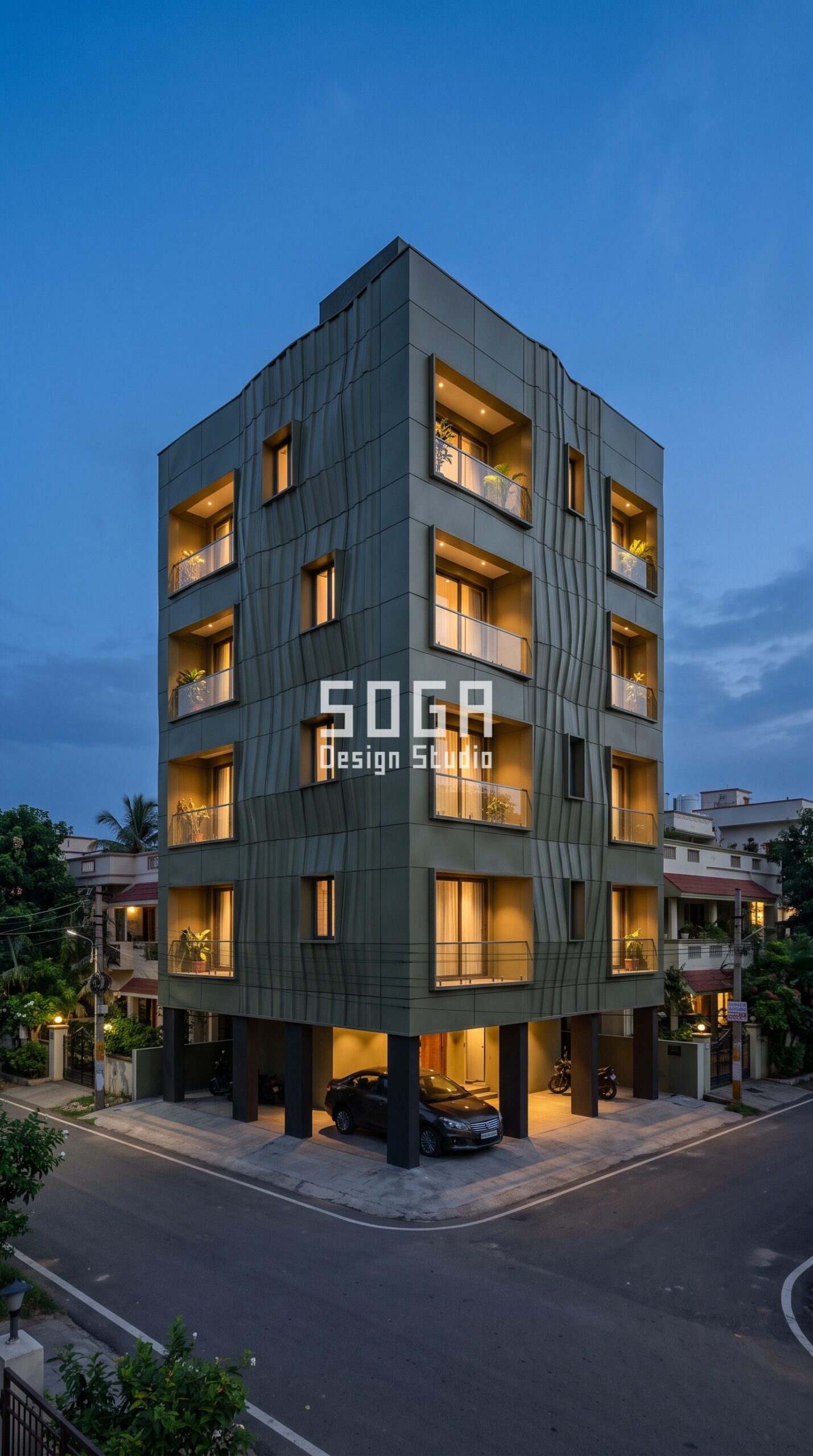
The Vizag concept is a G+5 residence in Lawsons Bay Colony wrapped in a Parametric Dune Shell – a concave-convex undulating metal surface in matte military olive-drab, its wave depth easing gently from floor to floor. Curb appeal here comes from depth: because the surface is three-dimensional, the sea-facing evening light rakes across it and paints a slow gradient of highlight and shadow that a flat wall could never hold. The olive-drab powder coat is deliberately quiet in daylight, then glows warm at blue hour when the interiors light up behind clear-glass balconies. For a coastal city, the powder-coated steel also shrugs off salt-laden air far better than paint on plaster, so the street presence you buy on day one still reads the same a decade later.
2. Surat: A Torque Screen That Moves as You Walk Past
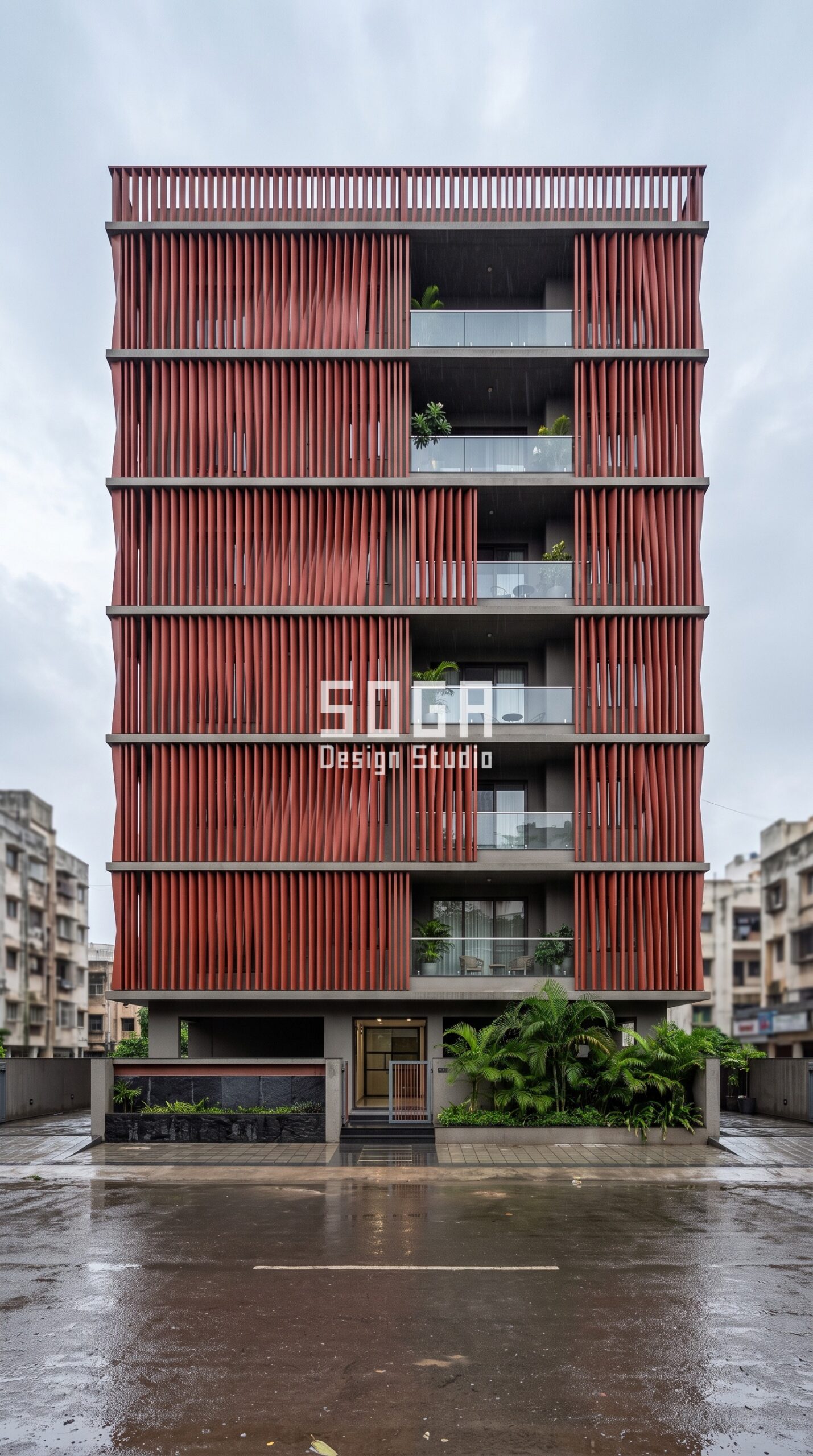
In Piplod, Surat, the same problem gets a kinetic answer. This G+5 block carries a Parametric Torque Screen of twisted vertical metal fins in oxide-red, each fin rotating a few controlled degrees more than the one below. Stand still and it reads as a calm striped facade; walk or drive past and the fins appear to open and close, so the building animates in your peripheral vision. That movement is what makes it memorable from the road. The oxide-red is a considered choice for Surat’s bright, humid climate – warm enough to feel premium, matte enough to avoid glare – and the fins double as a shading layer that keeps the west sun off the glass behind the balconies.
3. Bangalore: A Knot Weave That Becomes an Address
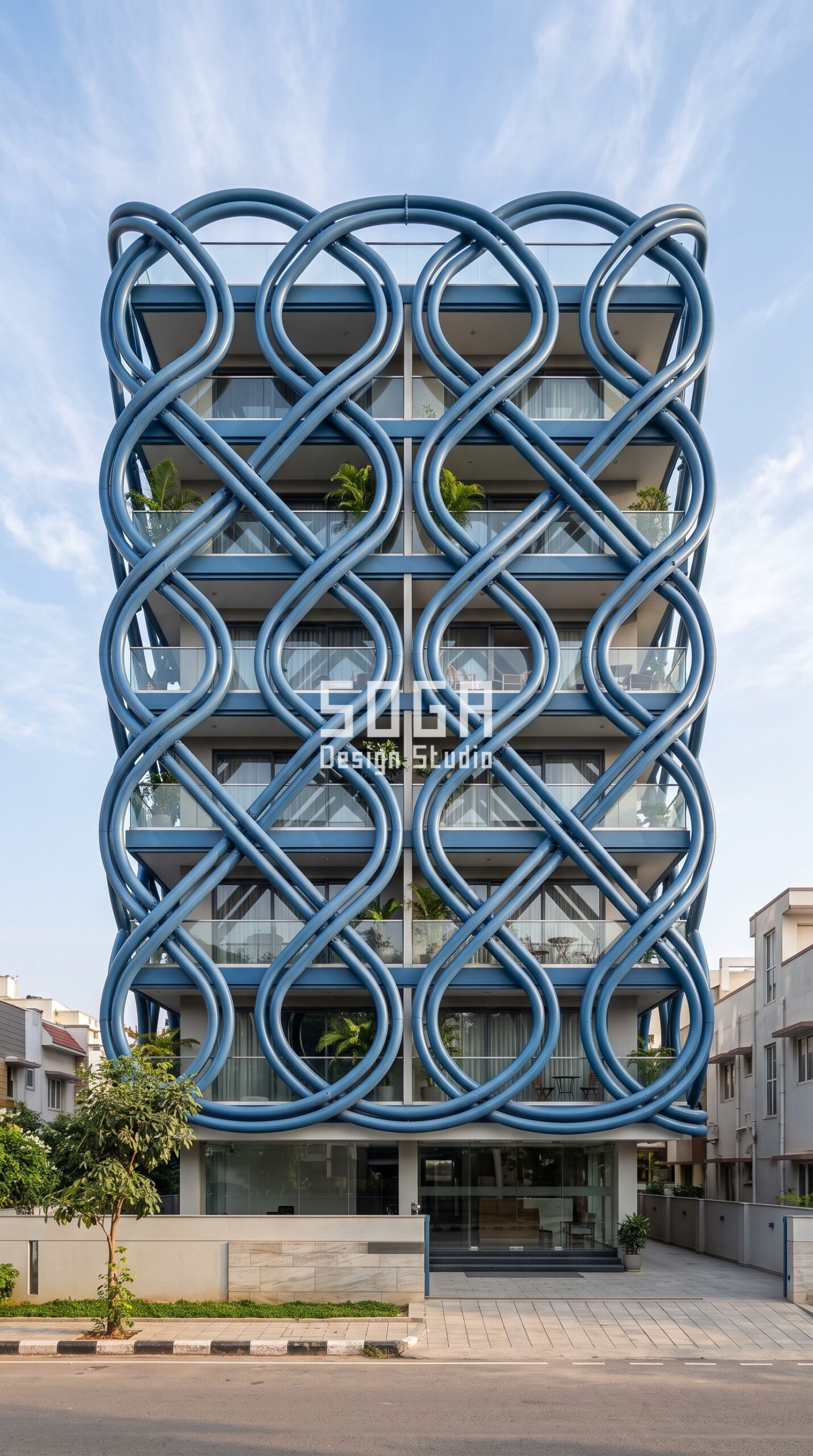
The Hebbal, Bangalore concept goes all-in on identity. A G+7 tower is wrapped in a Parametric Knot Weave – giant interlocking loops of bent metal pipe in steel-blue, a clean repeating woven module that runs unbroken from the second floor to the roofline. This is curb appeal as landmark: the building stops being ‘the blue one’ and becomes a recognised address, the kind of facade neighbours give directions by. The discipline is in the restraint – the loops are crisp and ordered rather than chaotic, so it reads as engineered art, not novelty. Behind the weave, a clear-glass ground-floor lobby keeps the base calm and lets the sculptural skin do all the talking.
4. Amritsar: A Shelf Grid That Turns Rhythm Into Shade
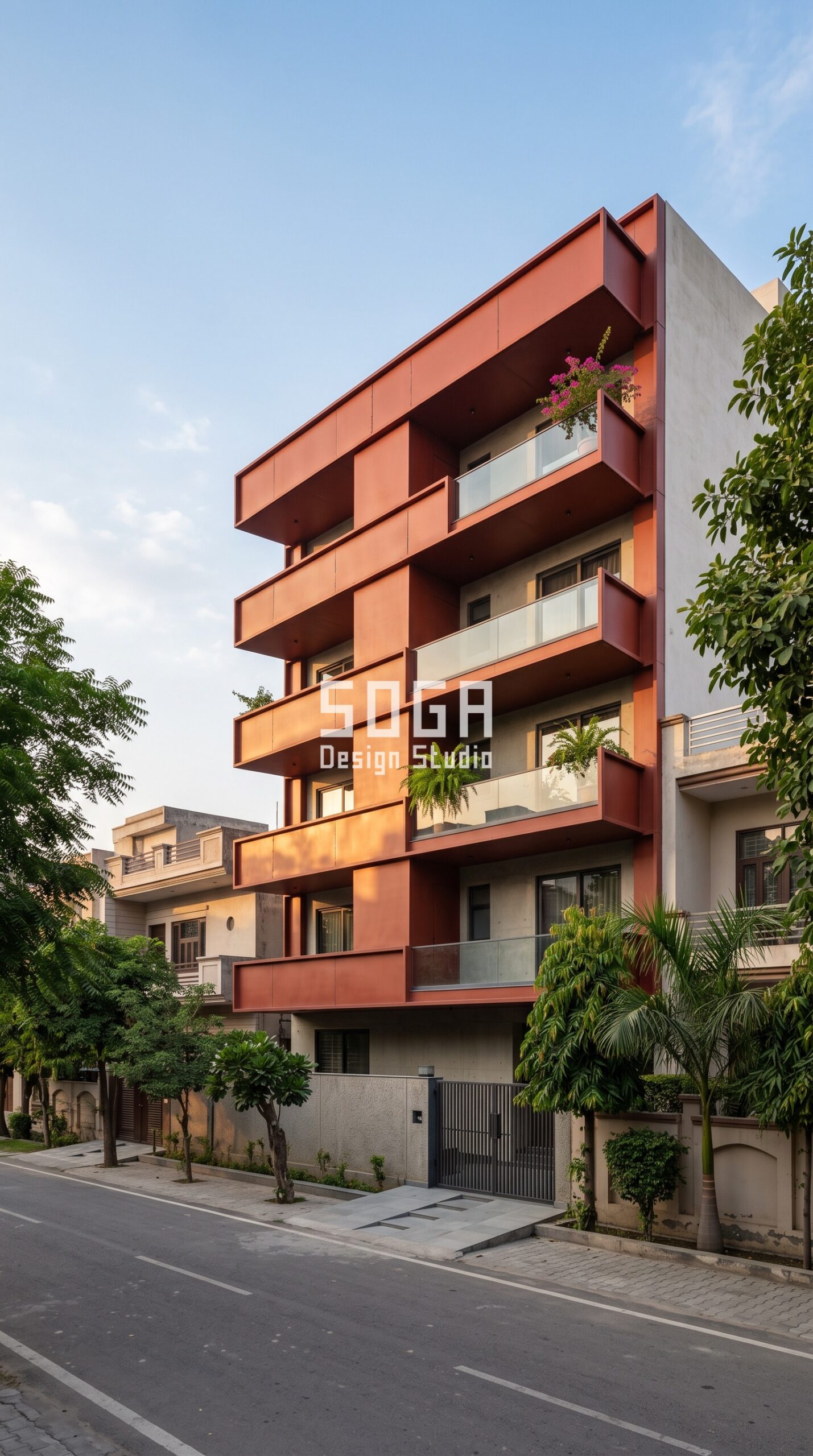
The Model Town, Amritsar concept proves curb appeal and comfort are the same investment. This G+4 residence uses a Parametric Shelf Grid – staggered cantilevered metal trays at alternate floors in warm terracotta-red – that steps in and out in an ordered horizontal beat. Under Amritsar’s low late-afternoon sun, those trays throw long banded shadows down the facade, so the building looks richest exactly when the street is busiest. The offset trays are not only decorative: each one shades the floor below, cutting solar heat gain on the balconies while giving the elevation its signature stepped silhouette. Terracotta-red ties it to Punjab’s warm material palette without a single applied ornament.
Cost Benchmarks for Indian Parametric Metal Facades
One of the most-asked questions on a Vizag project brief is budget. The current all-in installed rates for parametric metal facades in India sit in the following ranges:
- Steel facade (full design + install): ₹1,200–₹2,800 per sq ft
- Aluminium, anodised or powder-coated: ₹800–₹2,500 per sq ft
- Zinc cladding: ₹1,500–₹3,000 per sq ft
- ACM panels (3 mm basic): ₹200–₹250 per sq ft (basic)
- ACM panels (4 mm): ₹250–₹350 per sq ft
- Solid aluminium panels: ₹800–₹1,800 per sq ft
- Installation labour: ₹50–₹150 per sq ft (varies by height + access)
- Conventional cladding (for comparison): ₹400–₹1,200 per sq ft installed (stone veneer / ceramic / standard ACM)
These figures are baseline; actual project cost depends on facade area, panel complexity, fabricator location, and finish specification. SOGA Design Studio prepares an itemised cost estimate as part of every consultation so the budget conversation starts with hard numbers rather than guesses.
Parametric Facade Design Across India, Dubai & Singapore
Indian residential architecture is shifting from decoration to performance. SOGA Design Studio’s residential work is built for the scale most clients actually build at: G+3 to G+7 homes on plots of 2,400 to 6,000 sq ft, where a parametric metal facade has to earn its place by controlling sun, dust, and privacy as well as it controls first impressions. The studio’s role is to compress what used to take a six-month traditional design cycle into a sharper, AI-accelerated process — without sacrificing the engineering rigour that separates a buildable facade from a rendering. Every concept is developed for the plot, the orientation, and the budget in front of us, not borrowed from a catalogue.
Why Trust SOGA Design Studio for Facade Design in Vizag
- Experience: SOGA Design Studio has delivered parametric metal facades on live residential and commercial buildings across Indian cities, from coastal Vizag to Bangalore’s tech corridors, so every concept here is drawn from what actually builds and lasts on site.
- Expertise: Each facade is engineered in parametric tools (Rhino and Grasshopper) and translated into fabrication-ready powder-coated steel and aluminium panels with concealed fixings, real seams, and controlled module tolerances – not renders that cannot be built.
- Authority: SOGA works end to end – concept, parametric detailing, material specification, and fabrication coordination – which is why builders and NRI clients across India, Dubai, Singapore, and the UK commission the studio for standout residential elevations.
- Trust: Consultations are free and no-commitment, plot-specific concepts are returned within 48 hours, and every design is costed transparently against 2026 India rates before a client commits.
Frequently Asked Questions
How can facade design improve a building’s curb appeal?
Curb appeal is driven by four things a good facade controls: depth (a three-dimensional surface that catches light and shadow), rhythm (a repeating module the eye can follow), colour (a considered matte tone rather than flat plaster), and movement (fins or panels that shift as you pass). A parametric metal facade lets a designer tune all four to your building and street, which is why a well-designed skin can make an ordinary block the standout on its road.
How much does a parametric metal facade cost per sq ft in India in 2026?
As a 2026 guide, powder-coated steel and aluminium parametric facades in India typically run about Rs 550-1,400 per sq ft of facade area depending on system complexity, panel depth, and finish, with premium double-skin systems reaching Rs 1,600-2,200 per sq ft. SOGA costs every concept transparently against these rates before you commit, so you see the number tied to the design, not a vague range.
Which metal facade material lasts longest in coastal Indian cities like Vizag?
For coastal, salt-heavy air, marine-grade powder-coated aluminium and properly coated steel outperform paint-on-plaster by a wide margin – the factory powder coat resists salt corrosion and holds its colour for years with only occasional rinsing. That durability is a core reason the Vizag Dune Shell concept uses matte powder-coated panels rather than a painted finish.
Can a parametric facade be added to an existing building, or only a new one?
Both. Every concept shown here can be engineered as a retrofit skin fixed to an existing structure or built into a new block. A retrofit needs a quick structural check of the existing frame, after which the parametric metal system mounts on a secondary support grid – a common way to give an older residential building a completely new street presence without rebuilding.
What is the typical timeline from design to installed parametric facade?
For a G+3 to G+4 residence: 3 weeks for concept and approval, 4 weeks for fabrication-ready drawings, 6–8 weeks for fabrication, and 3–5 weeks for site installation — total 16–20 weeks from go-ahead to occupancy. Retrofit projects on existing buildings compress this to 10–14 weeks because no structural coordination is needed.
Where are parametric metal facades fabricated in India?
The main fabrication clusters are Mumbai-Pune (precision aluminium and steel), Chennai-Coimbatore (laser cutting and powder coating), Delhi-NCR (large-format ACM and screens), and Ahmedabad (brass and copper specialty). SOGA Design Studio works with vetted fabricators in each cluster to keep transport cost and lead-time low for any project location.
How much heat does a parametric metal facade actually reduce?
Independent studies on Indian residential applications show double-skin parametric metal screen facades reduce direct solar heat gain by 25-40% on west and south orientations, dropping interior surface temperatures by 4-7 deg C compared to bare RCC. The shaded gap also enables passive cross-ventilation. SOGA Design Studio tunes the screen opening density based on each orientation solar load.
Which RAL colours work best for Indian residential facades?
Three palettes dominate 2026 Indian residential work: warm earthy bronze and corten tones (RAL 8004, 8019) for traditional contexts; deep desaturated blues and greens (RAL 5004, 5011, 6009) for contemporary luxury; and matte charcoal/black (RAL 9005, 7016) paired with brass or copper accents for a graphic urban look. Light cladding with dark frames is the most-searched aesthetic of 2026.
Can NRIs design and build a parametric facade in India remotely?
Yes. SOGA Design Studio runs end-to-end remote consultations for NRI clients in Dubai, Singapore, the UK, and the US. The workflow — site analysis, design development, client review, fabrication-ready drawings, and on-site supervision — is delivered virtually. NRI projects in tier-2 cities like Coimbatore, Indore, and Chandigarh make up a fast-growing share of our portfolio.
Parametric metal facade vs traditional stone or paint — which is better long-term?
Stone is heavy, expensive (₹600–₹1,500 per sq ft just for material), and difficult to repair when chipped. Paint requires repainting every 4–6 years in Indian conditions. A powder-coated parametric metal facade has higher upfront cost but a 25–30 year service life, zero repainting, and far stronger street identity — making total cost of ownership lower over a 20-year horizon. It is also significantly lighter, reducing structural cost on G+3 and above.
How much does a parametric metal facade cost per square foot in Indore?
Currently, all-in parametric metal facade rates in India range from ₹800–₹2,500 per sq ft for aluminium and ₹1,200–₹2,800 per sq ft for steel, installed. SOGA Design Studio prepares itemised estimates as part of the consultation.
What is a sculptural petal-shaped metal fin facade?
SOGA Design Studio addresses this question in detail during the design consultation. For Vizag projects, we provide a fully customised answer based on plot, orientation, and budget — typically within 48 hours of receiving the brief.
Related Reading
- Parametric Facade Design in India: the complete guide
- Book a free facade design consultation with SOGA
Start Your Facade Project With SOGA Design Studio
The most memorable building on the street is rarely the biggest – it is the one whose facade was designed to work with light, movement, and rhythm rather than just cover the structure.
Whether you are building new or retrofitting an existing block, SOGA Design Studio can adapt the concepts above to your exact plot and budget. Start the conversation here — consultations are free and no-commitment.