The moment a hotel guest arrives at the porte-cochère, a decision has already been made about the quality of what follows. Not consciously, not deliberately — but the brain has registered the scale of the entrance, the quality of the materials, the precision of the detailing, and the coherence of the design. That judgment shapes every subsequent experience: whether the lobby feels as impressive as it should, whether the room lives up to its promise, whether the stay becomes a memory worth sharing.
In India’s rapidly expanding hospitality sector in 2026, facade design has become a primary instrument of competitive differentiation. The country is adding premium hotel inventory faster than at any point in its history — driven by the domestic luxury travel boom, international tourist recovery, and the explosion of destination weddings and MICE events in tier-2 cities. Hotels that fail to communicate their quality through their exterior are losing bookings before a guest even checks the room rates.
This guide is for hotel developers, hospitality chains, and boutique hotel owners making facade specification decisions. We cover what makes a great hotel facade, how different hotel typologies approach exterior design differently, material options with real costs, and SOGA’s specific approach to hospitality architecture.
The Instagram Effect on Hospitality Architecture
There is a phenomenon reshaping hotel design decisions across India that every developer and operator should understand: the booking power of a distinctive, photogenic facade.
A hotel with a stunning exterior generates organic social media content from every arriving guest. The arrival moment — the first view of the building from the driveway, the selfie at the entrance portal, the wide shot of the facade against a sunset sky — is one of the most photographed moments of any hotel stay. This content appears on Instagram, in travel blogs, and in the album that a wedding couple shares with 500 guests. It is unpaid marketing of extraordinary reach.
Conversely, a generic facade — indistinguishable from the commercial buildings on either side — generates no organic sharing. Guests do not photograph it because there is nothing remarkable to photograph. The hotel must earn its marketing reach through paid channels alone.
In 2026, the most successful Indian hotel operators understand this dynamic and brief their architects accordingly. The facade is not the exterior of the building. It is the primary marketing asset.
What Makes a Great Hotel Facade
1. Brand Alignment
The facade must communicate the hotel’s brand promise before the guest sets foot inside. A luxury heritage resort in Rajasthan with a glass curtain wall facade is sending a confused message. A contemporary business hotel in Hyderabad’s HITEC City with heavy stone cladding and ornamental arches is equally incoherent. The exterior architecture must speak the same language as the interior design, the brand identity, and the price point.
2. Climate Response
Indian climates are severe by any international standard. A hotel facade in Jaisalmer faces extreme solar radiation and sandstorm exposure. One in Mumbai faces monsoon rain and salt air. In Shimla or Mussoorie, freeze-thaw cycles affect materials differently. A beautiful facade that deteriorates within five years — peeling paint, rusting fixings, staining stone — is a reputational problem, not just a maintenance cost.
3. Night-Time Expression
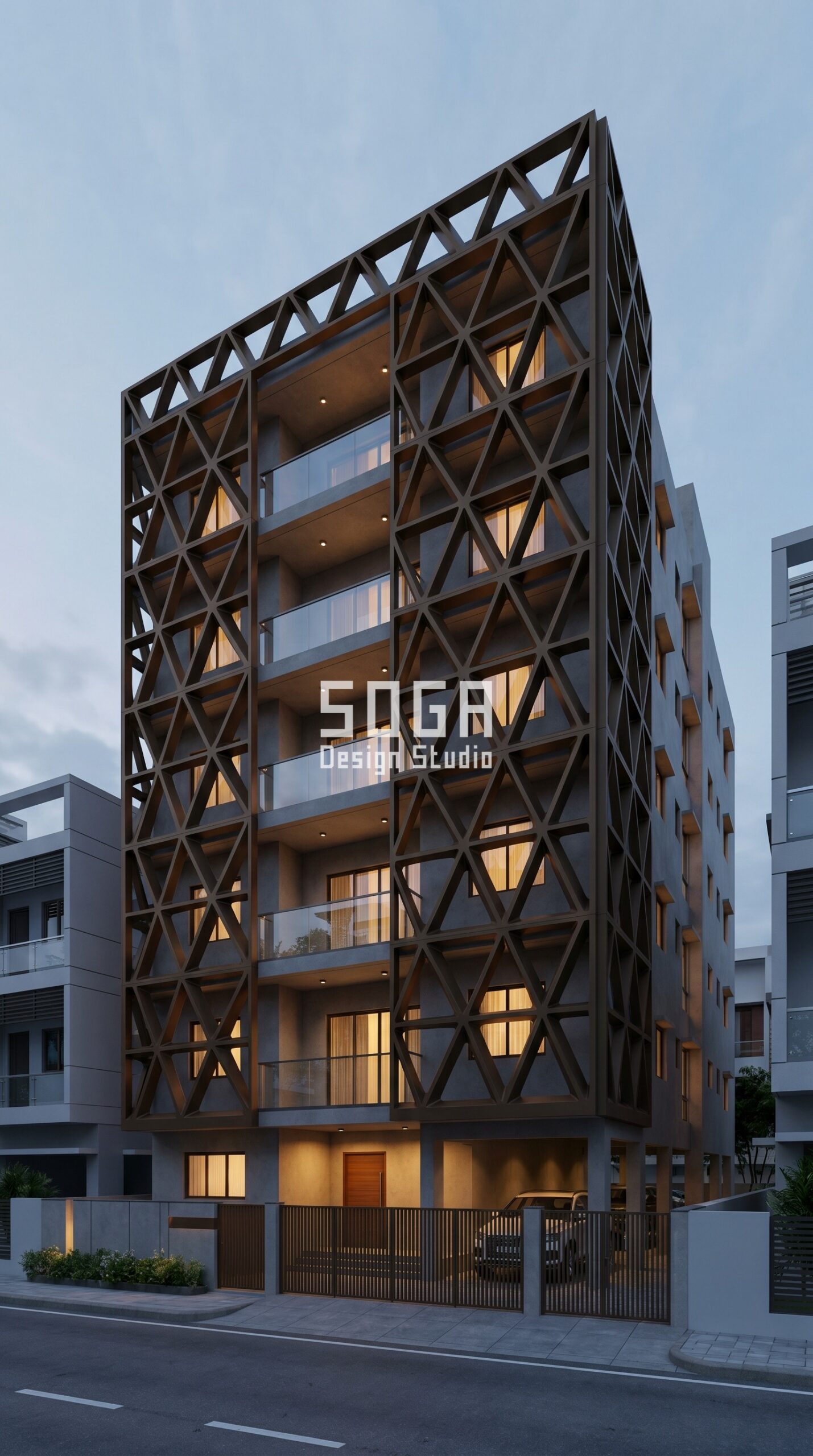
Hotels are used 24 hours a day. The facade’s night-time expression — how it appears when illuminated — is as important as its daylight appearance. Well-designed facade lighting can make a modest building extraordinary at night. Parametric screen systems are particularly effective with backlighting: the pattern glows from within and creates a lantern effect that is unmistakably distinctive. This is an underexplored dimension of Indian hotel facade design.
4. Operational Durability
Unlike a private villa, a hotel facade must endure constant cleaning, the occasional impact of luggage trolleys and delivery vehicles, and guests who may be less careful with exterior surfaces than they would be with their own home. Materials that look beautiful in renderings but require specialist cleaning or are easily damaged — hand-polished stone, light-coloured terracotta without proper sealing, or delicate glass fins at ground level — create ongoing maintenance costs and aesthetic degradation.
Hotel Types and Facade Strategies
Luxury 5-Star Hotels (₹12,000+ per night rate)
At this level, the facade must do architectural statement work. Guests paying ₹15,000–₹40,000 per night are sophisticated, internationally experienced, and will immediately register a generic or mediocre exterior as a mismatch with the price point. The building must announce itself.
Facade strategies at this level typically involve: a distinctive primary material (hand-cut stone, bespoke metalwork, or a fully parametric system), sculptural entrance elements (large-scale canopy, water feature integrated into the facade, monumental portal), and a comprehensive lighting design that transitions the building’s character from day to evening.
Typical facade cost at this level: ₹4,000–₹12,000/sqft for the primary facade area, depending on material and complexity.
Boutique Hotels (15–60 rooms, ₹4,000–₹15,000 per night)
The boutique hotel’s greatest asset is its distinctiveness — the sense that this property exists nowhere else, that it is specific to this place and this story. The facade must establish this distinctiveness from the first sight of the building.
Boutique hotel facades often integrate local material or cultural references in a contemporary design language: traditional jaali patterns executed in CNC-cut aluminium (SOGA’s SogaScreen™ excels here), local stone interpreted through contemporary geometry, or regional craft techniques applied at architectural scale.
The advantage of the boutique scale: smaller facade areas mean that premium materials are financially viable even on relatively modest overall project budgets. A 500 sqft feature facade in bespoke parametric metalwork costs ₹6–₹17 lakh — meaningful in a boutique context but decisive for visual identity.
Business Hotels (₹3,000–₹8,000 per night, 80–200 rooms)
Business hotel facades face a different challenge: they need to communicate professionalism, cleanliness, and contemporary credentials — without the budget for luxury statement architecture. The risk is defaulting to a generic glass-and-ACP exterior that looks identical to every other business hotel in the city.
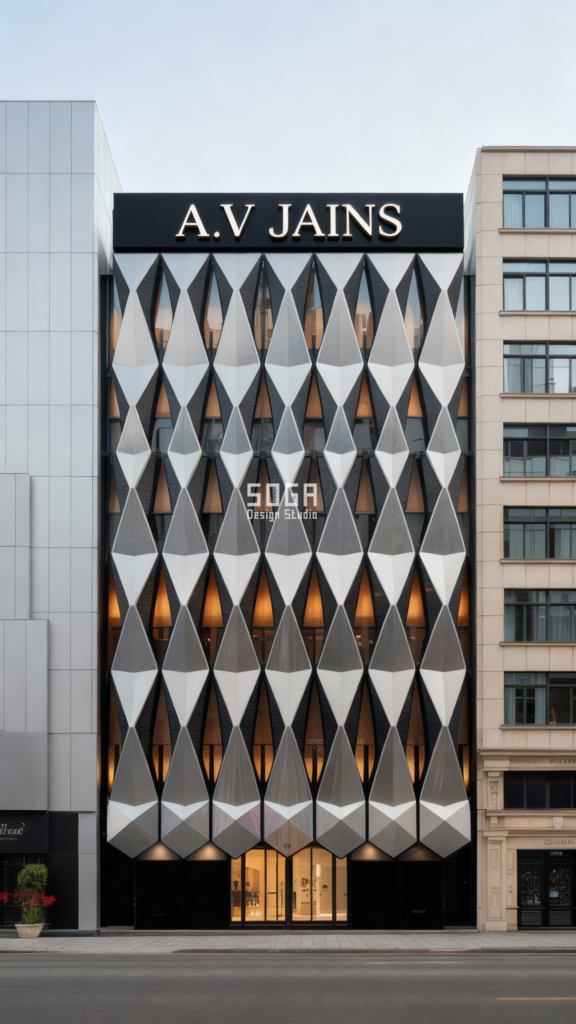
The most effective approach for business hotel facades in India in 2026: a clean, well-proportioned primary facade (glass with solar-shading fins, or a simple aluminium panel system) with one distinctive element that creates visual identity — a dramatic entrance canopy, a parametric screen on the principal bay, or a branded feature wall. The SOGA SogaGrid™ diamond panel on the entrance wing of a business hotel creates immediate visual distinction at a cost point that is viable for this segment.
Typical facade cost: ₹1,200–₹3,500/sqft for the primary facade; ₹2,500–₹5,000/sqft for the feature entry element.
Resorts and Destination Hotels (varied price points, site-specific)
Resort facades have the most latitude — and the most complexity — of any hospitality typology. The site itself is part of the brand: a beach resort in Goa, a forest lodge in Coorg, a desert retreat in Rajasthan. The facade must respond to the site, the local material vocabulary, and the natural landscape in a way that feels appropriate without being a caricature.
The most successful resort facades in India read as “of the place” — they use materials, forms, and textures that belong to the regional landscape, interpreted through a contemporary design sensibility. Bamboo and steel composite facades in forest resorts. Rough-cut local stone combined with weathered steel or copper in desert contexts. Timber-look aluminium (with the durability of metal and the warmth of wood) in coastal and hill environments.
For larger resort properties with multiple accommodation blocks, SOGA’s parametric approach allows each block to be individually responsive to its microsite — orientation, topography, view — while maintaining a coherent design family across the property.
Materials for Hotel Facades in India 2026
Parametric Aluminium Panel Systems — ₹1,200 to ₹4,500/sqft (installed)
The most versatile option for hotel facades at all levels. Aluminium is completely weather-resistant, lightweight, available in any finish (including timber-look, copper-look, and patinated metal finishes), and maintenance-free. For boutique hotels, bespoke geometric patterns can be CNC-cut to create unique identities. For luxury properties, formed and shaped aluminium panels can achieve sculptural results comparable to much more expensive materials.
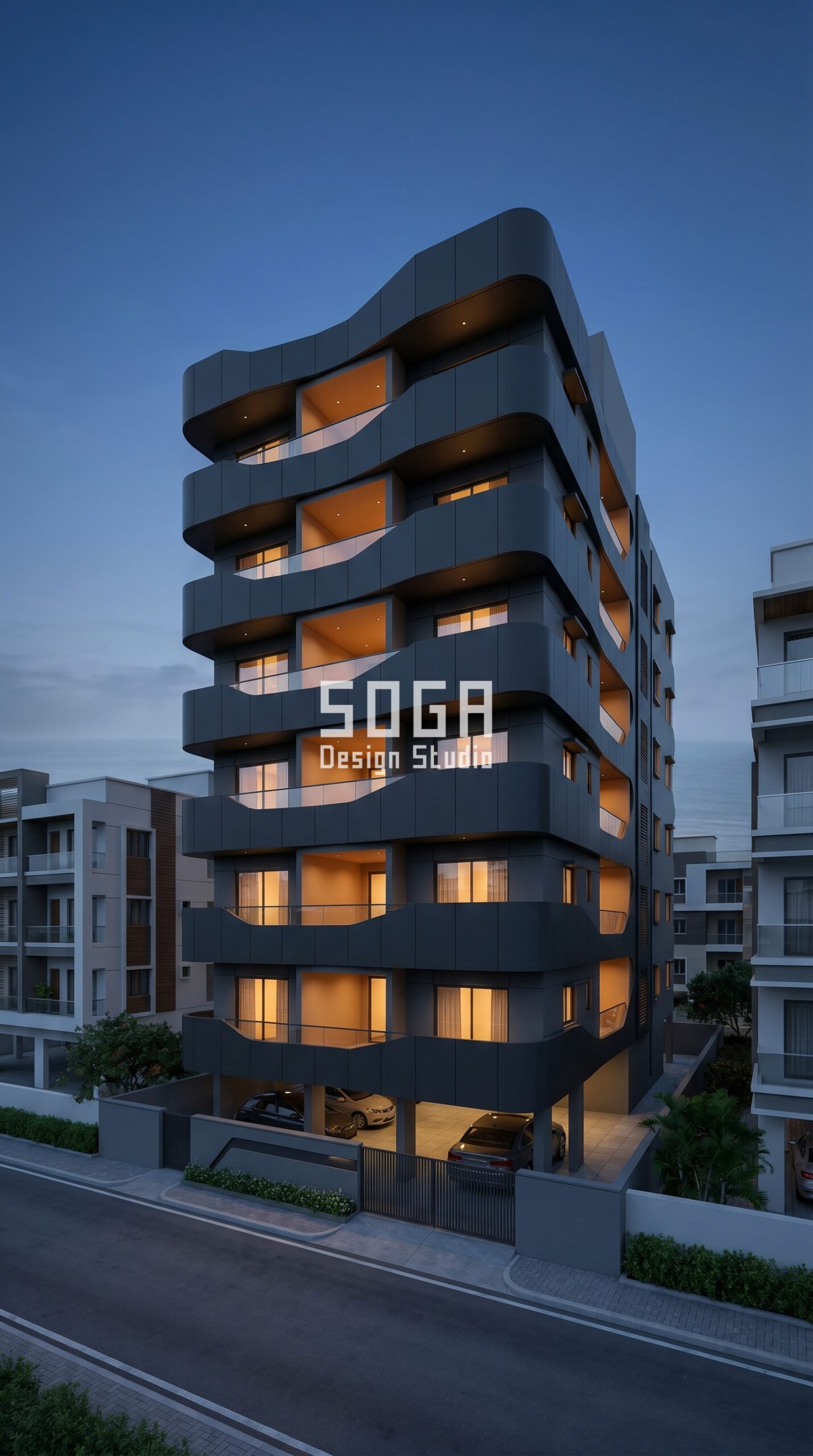
SOGA’s SogaShell™ — organic wave panels — and SogaWeave™ twisted fins are particularly effective for hotel entrance canopies and feature facades, creating the sculptural impact that luxury and boutique hotel facades require.
Natural Stone — ₹500 to ₹2,500/sqft (installed)
Indian sandstone, marble, and granite remain highly appropriate for heritage-adjacent, luxury, and resort hotels. The visual warmth and material authenticity of natural stone communicates quality and permanence in a way no synthetic material matches. The constraints: weight (requiring substantial structural substrate), maintenance (sealing every 3–5 years, stain risk), and consistency of colour and texture across large areas.
For coastal and high-humidity locations, stone selection matters enormously: sandstone that performs beautifully in Rajasthan will suffer salt crystallisation damage in a sea-facing Mumbai or Goa location. Specify stone with a clear understanding of the site’s microclimate.
Glass Curtain Wall and Louvres — ₹3,000 to ₹8,000/sqft (installed)
Glass-dominant facades are effective for contemporary business hotels and tower-format city hotels where the view out — skyline, city, landscape — is part of the room’s selling proposition. The challenge in India’s hot climates is solar management: unshaded glass facades create uncomfortable interiors and enormous cooling loads.
The solution: combine glass with external solar shading — horizontal brise-soleil on south and west facades, or a parametric screen layer. High-performance glass (low-e coating, argon-filled double-glazed units) reduces solar gain at the material level. Both measures together can make a glass-dominant hotel facade viable even in Delhi or Hyderabad’s climate zones.
Terracotta Panels — ₹700 to ₹1,600/sqft (installed)
Gaining strong traction in boutique and heritage hotel design, where the warmth and earthiness of terracotta complements the desired aesthetic. The ventilated terracotta panel system also performs well climatically: the air cavity behind the panels reduces heat gain significantly. Self-cleaning in rain and UV-stable, terracotta requires minimal maintenance — critical for hotel properties where maintenance downtime is a revenue cost.
Bamboo and Timber-Look Aluminium — ₹800 to ₹2,200/sqft (installed)
For eco-resort, forest lodge, and coastal boutique hotel applications, the combination of natural textural warmth and engineered durability makes timber-look aluminium profiles an increasingly popular choice. The profiles are extruded aluminium with a wood-grain powder coat or anodised finish — they look like timber but are impervious to moisture, insect attack, and UV degradation that would quickly destroy real timber in these environments.
Cost Guide for Hotel Facades in India 2026
To make this concrete, here are indicative total facade budgets for different hotel categories:
Budget business hotel (80 rooms, ₹3,000–₹5,000/night): Total facade area approximately 2,500–4,000 sqft. Budget: ₹35 lakh – ₹1.2 crore depending on specification. ACP at the lower end; parametric aluminium screen on the principal elevation at the higher end.
Mid-market boutique (25 rooms, ₹6,000–₹12,000/night): Total facade area approximately 1,200–2,500 sqft. Budget: ₹30 lakh – ₹1.8 crore. Feature parametric element (SogaGrid or SogaScreen) on the entrance bay is the priority investment.
Luxury city hotel (150 rooms, ₹15,000–₹30,000/night): Total facade area approximately 8,000–20,000 sqft. Budget: ₹3 crore – ₹15 crore. Full facade specification including primary cladding, entrance statement, shading system, and integrated lighting.
Destination resort (50 units, site-specific): Highly variable; budget ₹1.5 crore – ₹20 crore depending on scale, material specification, and site complexity.
For a full breakdown of parametric facade costs in Indian conditions, see our 2026 cost guide.
SOGA’s Hotel Facade Approach
Hotel facade projects require a different pace and process from commercial or residential work. Operational requirements — minimising disturbance to guests during renovation, managing construction access around a functioning hotel — add significant coordination complexity. And the standards are higher: a chip in a stone panel or a faded powder coat finish that might be acceptable in an office building is a quality failure in a five-star hotel.
SOGA’s approach to hotel facades begins with the brand brief — understanding what the property is trying to communicate — before any design work begins. We then develop a facade strategy that aligns the exterior architecture with the brand promise, the site’s climate context, and the operational realities of a hotel environment.
Our parametric facade design process includes full construction supervision to ensure that the quality of installation matches the quality of the design specification — critical in a sector where the facade is the marketing asset and there is no tolerance for execution failures.
FAQ
Q: How important is a hotel’s facade to its booking performance and RevPAR? A: Increasingly important. OTA (online travel agency) listings that feature a striking, photogenic exterior generate 25–40% higher click-through rates than listings with generic or poorly photographed facades. Properties with distinctive facades also appear more frequently in travellers’ social media content — creating organic reach that directly influences bookings. In India’s 2026 hospitality market, we estimate that a well-designed facade contributes 10–20% to a property’s RevPAR premium over comparable properties with generic exteriors, though this varies significantly by market and segment.
Q: What facade materials are most durable for a coastal hotel in Goa or Kerala? A: Coastal environments (high humidity, salt spray, occasional cyclonic wind) are among the most demanding for facade materials. Best performers: powder-coated or anodised aluminium (marine-grade specification), terracotta panels (impervious to salt), and high-performance glass with proper framing gaskets. Avoid: natural stone without exceptional sealing (efflorescence and staining risk), standard ACP (adhesive bond failure in humid conditions), and untreated steel or iron (corrosion). All fixings in coastal facades should be stainless steel or hot-dip galvanised; standard mild steel fixings will rust through within 3–5 years.
Q: Can a parametric facade be designed to reference local architectural heritage without looking like a pastiche? A: Yes — this is one of the most interesting design challenges in Indian hospitality architecture, and one that SOGA approaches frequently. The key is abstraction: taking the geometric logic of a traditional element (a Rajasthani jaali, a Kerala sloped roof form, a Mughal arch proportion) and reinterpreting it through parametric geometry at a scale appropriate to the building. The result is a facade that has cultural resonance for guests who recognise the reference, while being clearly contemporary in execution rather than a superficial historical replica.
Q: How do we manage facade renovation at a hotel that cannot close during construction? A: Hotel facade renovation during operation requires a carefully phased construction programme. The facade is typically divided into zones — by elevation, by floor, or by wing — and each zone is constructed in sequence with full protection of occupied areas and guests. Scaffolding access and construction hours are planned around hotel operations (no early morning noise, no access through guest arrival areas during peak check-in/check-out). SOGA’s construction supervision service includes preparation of a hotel-specific construction management plan that coordinates facade work with hotel operations.
Q: What is the payback period for a premium facade upgrade on an existing hotel property? A: In our experience with Indian hotel projects, a premium facade upgrade typically pays back within 5–8 years through a combination of: higher average room rates (2–8% premium driven by improved perception), higher occupancy (improved social media presence and OTA performance), and lower maintenance costs (premium materials require less frequent intervention than the systems they replace). For properties in highly competitive markets — South Goa, Udaipur, Bengaluru, Hyderabad — the payback can be as short as 3–5 years.
Design Your Hotel’s First Impression
SOGA Design Studio works with hospitality developers, hotel operators, and architects across India on facade design for properties ranging from boutique hotels to large resort developments. We understand the business case for facade investment in hospitality — and we design facades that deliver it.
Contact SOGA Design Studio to discuss your hotel facade project. We would be glad to share relevant case studies and a preliminary assessment of what your property’s facade could achieve.
Explore our full range of systems at sogadesignstudio.com/soga-parametric-systems/