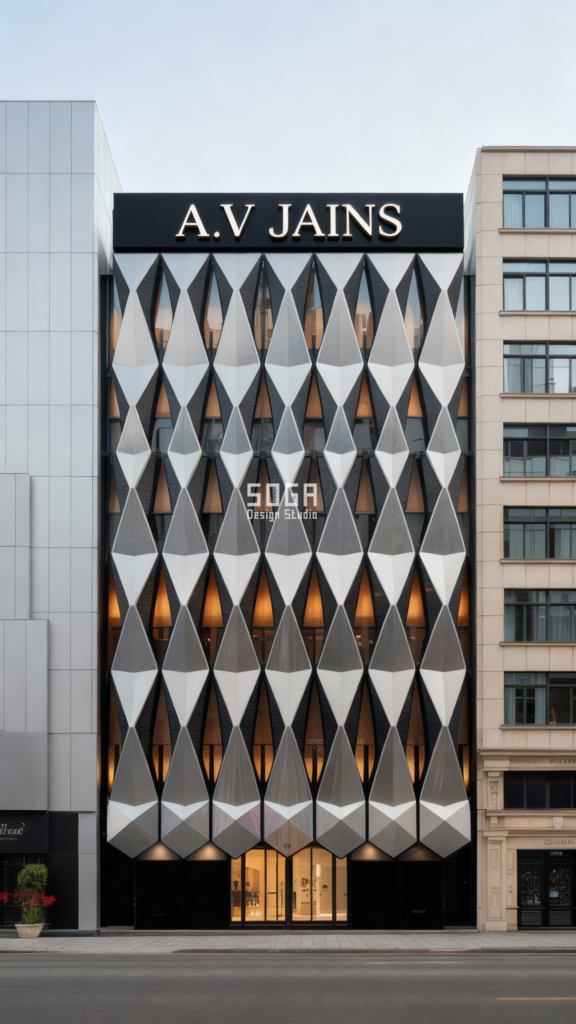
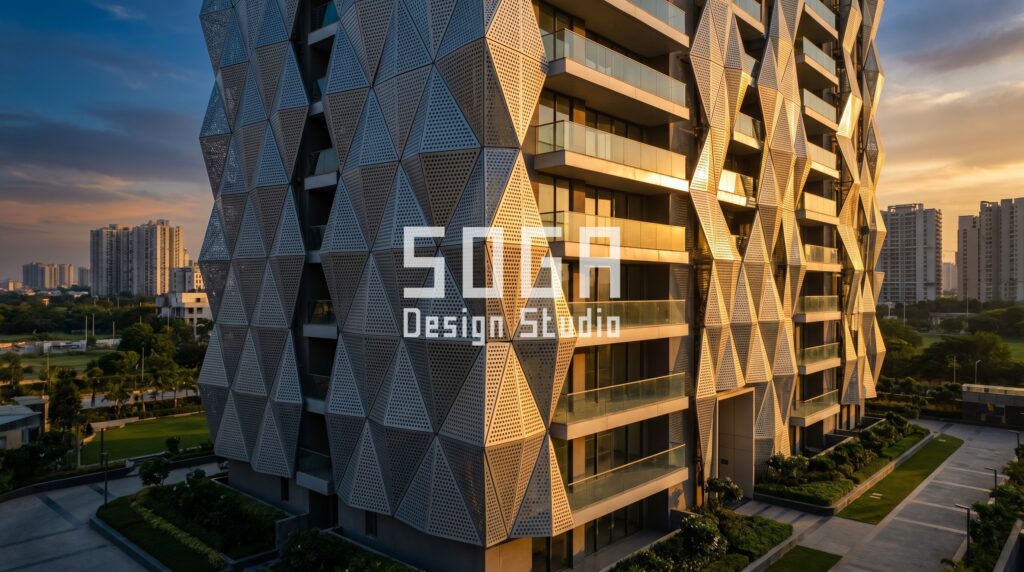
A commercial building’s facade is doing more work than most developers realise. It is branding: the first visual signal of what kind of company occupies or owns this building. It is performance: the building’s primary interface with climate, managing heat gain, glare, and ventilation. It is compliance: subject to fire codes, structural wind-load standards, and increasingly, the requirements of green building rating systems like GRIHA and LEED. And it is a financial instrument: better facades command higher lease rates, lower vacancy, and stronger resale values.
In 2026, India’s commercial real estate market is experiencing its most sophisticated demand cycle yet. Grade A office parks in Pune’s Hinjewadi, Hyderabad’s HITEC City, Chennai’s Old Mahabalipuram Road, and the Gurugram-Manesar corridor are competing fiercely for the same multinational and domestic large-enterprise tenants. These tenants have global standards. They have seen what a well-designed building looks like in Singapore, London, and Dubai. A generic glass-box commercial building with failing ACP panels is not going to win their lease commitment.
This guide is for commercial developers, project management consultants, and property owners who want to make informed decisions about facade specification in India’s current market.
4 Types of Commercial Buildings and What Their Facades Need to Do
1. Office Towers (Mid-Rise to High-Rise)
An office tower facade must simultaneously communicate corporate credibility, manage the solar gain that drives a building’s air-conditioning load, and meet fire safety standards for buildings above 15 metres in height.
The glass curtain wall dominated Indian office tower design from 2005 to 2018 — often with insufficient solar shading, resulting in enormous cooling loads and uncomfortable interior environments. The reckoning has arrived: LEED and GRIHA certification points now strongly incentivise facades that reduce SHGC (Solar Heat Gain Coefficient), and major tenants are requiring green building certification as a lease condition.
The emerging standard for Grade A office tower facades in India: a unitised or semi-unitised curtain wall system (glass) with integrated external or internal shading — louvres, fins, or a secondary parametric screen layer. The result is a building that looks premium from outside, performs thermally, and meets certification criteria.
What office facades need: Visual credibility, solar shading, fire compliance above 15m, identity differentiation from competing buildings.
2. Retail Malls and High Streets
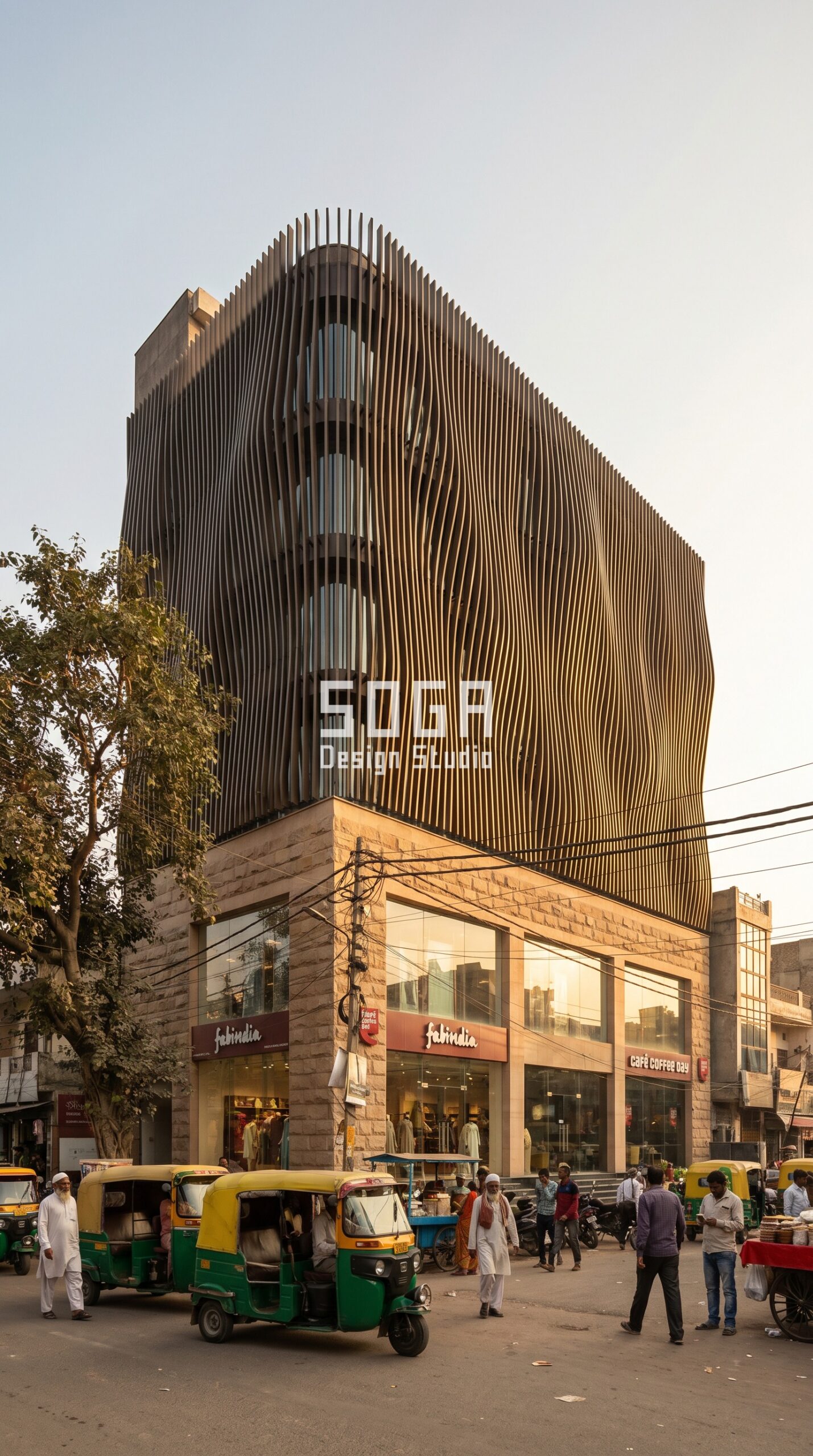
Retail facade design operates on a completely different logic. The objective is not to filter solar gain — it is to attract footfall. Retail facades must be visually engaging, legible from a fast-moving vehicle (for mall approaches) or at pedestrian scale (for high-street retail), and capable of accommodating tenant branding and signage without becoming chaotic.
India’s retail segment is polarising in 2026: at the top end, destination malls are investing heavily in landmark facades — parametric metal forms, large-format stone cladding, LED-integrated surfaces. At the other end, value retail is still dominated by painted plaster and flex banners. The middle is disappearing.
The critical mistake retail developers make with facades: designing a handsome base building and then allowing tenants to apply signage without any coordination framework. The result is a visual disaster within 18 months of opening. Build the signage strategy into the facade design.
What retail facades need: Visual impact, brand accommodation, pedestrian engagement, night-time illumination strategy.
3. IT Parks and Tech Campuses
IT parks have become India’s most architecturally ambitious commercial typology. The competition for tech talent has made the campus environment — including the quality and identity of its buildings — a recruitment and retention tool. Companies are choosing campuses partly based on how they look and feel.
The IT park facade of 2026 is not just a wall. It is expected to contribute to the campus’s LEED or IGBC certification (mandatory for most large IT developers and increasingly required by MNC tenants), to integrate biophilic elements (living walls, planted terraces, timber-look materials), and to create a distinctive visual identity that photographs well for corporate communications.
Parametric facades are particularly well-suited to IT campus buildings because they can create distinctive identity across multiple buildings in a campus using a coherent design language — varying the geometry between buildings while maintaining a family resemblance.
What IT park facades need: Green rating contributions, campus identity, biophilic integration, media-friendly aesthetics.
4. Mixed-Use Developments
Mixed-use buildings — retail podium, office tower, service apartment tower — are the most complex facade design challenges in Indian commercial architecture. The different building uses typically require different facade treatments (retail needs visual porosity; office needs privacy and solar control; residential needs ventilation openings). Managing these different requirements across a single building or cluster requires a carefully considered facade strategy.
The best mixed-use facades use a unifying design language — a consistent material palette, a recurring geometric motif — applied differently at each use level. The parametric approach is particularly effective here because the same design logic can be parametrically varied to suit each zone.
Commercial Facade Materials 2026: Costs and Performance Comparison
System | Installed Cost (₹/sqft) | LEED/GRIHA Credits | Solar Performance | Maintenance | Brand Impact
Glass curtain wall (unshaded) | ₹3,500 – ₹7,000 | Low | Poor | Medium | Standard
Glass curtain wall + external shading | ₹4,500 – ₹9,000 | Medium-High | Good | Medium | Premium
Parametric aluminium screen | ₹1,200 – ₹3,500 | High | Excellent | Very Low | Distinctive
Natural stone cladding | ₹800 – ₹2,500 | Medium | Good | High | Traditional
Terracotta panel system | ₹900 – ₹2,000 | High | Good | Very Low | Contemporary
ACP (standard) | ₹350 – ₹800 | Low | Poor | Medium | Generic
Precast concrete + fins | ₹1,000 – ₹2,500 | Medium | Good | Low | Architectural
Costs are indicative for commercial-scale projects (above 5,000 sqft facade area). Large-volume projects typically achieve 15–25% cost reductions through economies of scale.
Why Parametric Facades Win for Commercial Buildings
The case for parametric facades in commercial buildings is not aesthetic — it is financial. Here is why the numbers work:
Brand differentiation drives lease premium. A building with a distinctive, well-designed facade commands 8–18% higher lease rates per sqft than a comparable generic building in the same micro-market. In a 2 lakh sqft Grade A office building in Gurugram, an 8% lease premium on a ₹80/sqft monthly rent is ₹12.8 lakh per month — ₹1.5 crore per year. The additional facade investment typically pays back within 3–5 years from this premium alone.
Solar performance reduces operating costs. A parametric screen system on a south or west facade can reduce solar heat gain by 40–65% versus an unshaded glass facade. For a typical office building in Delhi NCR’s climate zone, this translates to a 15–25% reduction in chiller load — significant given that cooling represents 45–55% of a typical Indian commercial building’s energy bill.
LEED and GRIHA points reduce long-term vacancy risk. MNC tenants increasingly require LEED Gold or Platinum certification as a lease condition. Buildings without certification are excluded from consideration by a growing proportion of premium tenants. A well-specified parametric facade system contributes to multiple LEED credit categories: Energy & Atmosphere (EA), Indoor Environmental Quality (IEQ), and Materials & Resources (MR).
Lower maintenance cost over the building lifecycle. A powder-coated aluminium parametric system installed in 2026 will still look good in 2046 with periodic cleaning. ACP, by contrast, typically requires replacement or major refurbishment within 12–15 years — a significant capital expenditure that parametric aluminium avoids.
For a detailed comparison of parametric facades against stone cladding and ACP in the Indian market, see our facade comparison guide.
SOGA’s Commercial Projects Approach
At SOGA Design Studio, our commercial facade work begins with a building performance brief before we produce a single design drawing. The brief establishes:
• Solar exposure analysis: which orientations face high heat gain risk
• Tenant category and lease expectation: what a typical tenant for this building category expects from the environment
• Green rating target: LEED, IGBC, or GRIHA, and what credits the facade needs to contribute
• Brand positioning: where on the market spectrum (generic, premium, landmark) this building needs to sit
From this brief, we develop a facade strategy — not just a material choice, but a complete system specification: the primary cladding, the shading layer, the anchoring system, the sealant and waterproofing specification, and the maintenance protocol.
Our SogaPulse™ system — algorithmically optimised parametric panels — is particularly suited to large commercial facades where the panel geometry can be tuned for maximum solar performance while maintaining a coherent visual identity. For IT campus buildings with multiple blocks, SogaGrid™ and SogaWeave™ create strong campus identity across varied building footprints.
Our full design process, from brief through construction supervision, is detailed at sogadesignstudio.com/parametric-facade-design-process-india-concept-to-construction/.
Compliance: Fire Ratings, Wind Load, and Green Rating Considerations
Fire Safety
NBC 2016 (National Building Code of India) and local fire department requirements specify fire resistance ratings for facade materials in buildings above certain heights. The key requirements relevant to commercial facades:
• External cladding above 15m height: Must meet specified fire reaction to fire tests. Standard ACP (polyethylene core) typically fails these requirements; FR (fire-retardant) core ACP or solid aluminium is required.
• Cavity facades (ventilated systems): The cavity must incorporate fire stops at each floor level to prevent fire spread through the cavity. This is a construction detail that many contractors miss and that inspectors are increasingly checking.
• Glass facades: Insulated glass units used in facades above ground level must meet impact resistance standards (IS 2553).
SOGA specifies all materials and systems with full fire compliance documentation. Ask your facade contractor for material test certificates before accepting any specification.
Wind Load
High-rise commercial buildings — anything above G+10 floors in exposed locations — require a wind load analysis for the facade anchoring system. IS 875 (Part 3) governs wind load design in India. Facade anchoring must be designed to resist the calculated wind pressure, which varies by zone, building height, and terrain category.
The anchor design is a structural engineering exercise, not an aesthetic one. Facades on tall buildings that skip proper wind load analysis are a structural liability. SOGA coordinates with structural engineers on all high-rise facade projects.
GRIHA and LEED Credits
Relevant LEED v4 credits for facade design:
• EA Prerequisite: Minimum Energy Performance (facade SHGC and U-value targets)
• EA Credit: Optimize Energy Performance (facade performance beyond minimum)
• IEQ Credit: Daylight (facade geometry affects daylight penetration)
• MR Credit: Building Product Disclosure and Optimization (material transparency)
Relevant GRIHA credits:
• Criterion 8: Optimise building design to reduce conventional energy demand (facade performance)
• Criterion 21: Water-efficient exterior (relevant for facade cleaning protocols)
A well-specified parametric facade system can contribute to 8–15 LEED points across these categories — a meaningful contribution to achieving Gold or Platinum certification.
FAQ
Q: What is the cost difference between a standard glass curtain wall and a parametric facade for an office building in India? A: A standard unitised glass curtain wall in India is typically installed at ₹3,500–₹6,000/sqft. Adding external shading (louvres or fins) pushes this to ₹4,500–₹9,000/sqft. A parametric aluminium screen system used as the primary facade — rather than as a shading add-on — typically costs ₹1,200–₹3,500/sqft for the screen layer, often lower in total cost than a fully glazed option when the structural support for glass is factored in. The long-term operating cost advantage (lower cooling loads) further improves the parametric system’s economics.
Q: Do commercial building facades in India require statutory approval? A: Yes. Commercial buildings require planning approval from the local development authority for their design, including the facade. In addition, buildings above 15m require fire department approval (which includes a review of facade materials and fire stops). High-rise buildings may require an additional wind load clearance. RERA-registered projects have additional disclosure requirements. Your architect should manage all these approvals as part of the design process.
Q: Can a parametric facade help our building get LEED Gold certification? A: A well-specified parametric facade system contributes to multiple LEED credit categories — primarily through improved energy performance (lower solar heat gain reduces HVAC load) and indoor environmental quality (better daylight control without glare). A parametric facade alone cannot deliver LEED Gold, but it is a significant contributor to the energy and indoor environment credits that make the difference between Silver and Gold. SOGA can provide an energy performance analysis for your specific building and orientation as part of the design brief.
Q: What facade system is best for a retail mall entrance in India? A: Retail mall entrances need maximum visual impact — this is the moment of seduction that converts a passing car or pedestrian into a visitor. Large-format glass with a dramatic structural element (a steel or aluminium portal, a parametric canopy, an illuminated overhead screen) works well. The SogaShell™ organic wave system has been used effectively as a dramatic retail entrance canopy. The key is that the entrance must read from 50–100 metres away (from a moving car) as well as at 2 metres (pedestrian approach).
Q: How does facade maintenance work for a large commercial building — who is responsible? A: In commercial buildings, the developer or building owner is responsible for maintaining the base building facade; tenants are typically responsible for their own signage and any tenant-installed elements. Aluminium and terracotta systems require only periodic cleaning (typically annually or after monsoon) and occasional sealant inspection. Glass systems require squeegee cleaning and periodic gasket replacement. The building’s facility management should have a written facade maintenance protocol — SOGA provides this as a standard project deliverable.
Discuss Your Commercial Facade Project
SOGA Design Studio works with commercial developers, project management consultants, and architects on facade design and specification for office towers, IT campuses, retail properties, and mixed-use developments across India.
Contact our commercial team to discuss your project’s requirements. We offer building-specific solar analysis and LEED/GRIHA facade contribution assessments as part of our initial consultation.
Explore our parametric systems at sogadesignstudio.com/soga-parametric-systems/
For the low-rise version of this calculation, including the corner-zone case, see how wind pressure is calculated for a house facade panel.