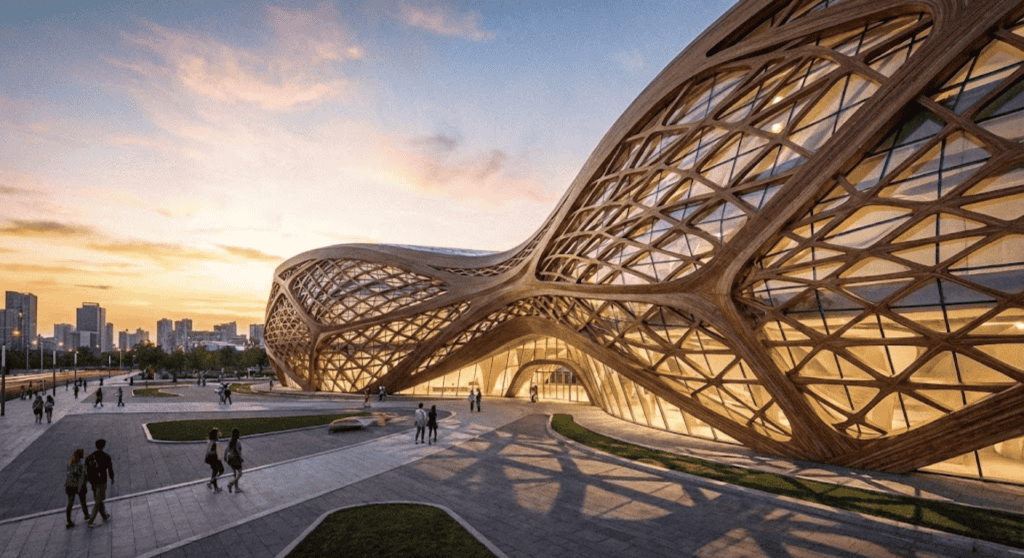
Great house facade design in India has to do two jobs that often pull in opposite directions: look stunning, and survive a climate that can hit 45°C. Too many homes nail the first and ignore the second — a gorgeous exterior that turns the upper bedrooms into ovens by afternoon. The best modern facade design treats heat as a design input, not an afterthought, so the same elements that make the house beautiful also keep it cool. This guide covers heat-smart exterior facade design ideas, the materials and shading that actually work in Indian conditions, real costs, and how SOGA Design Studio designs facades that are as comfortable as they are striking.
Why Heat Has to Lead Your Facade Decisions
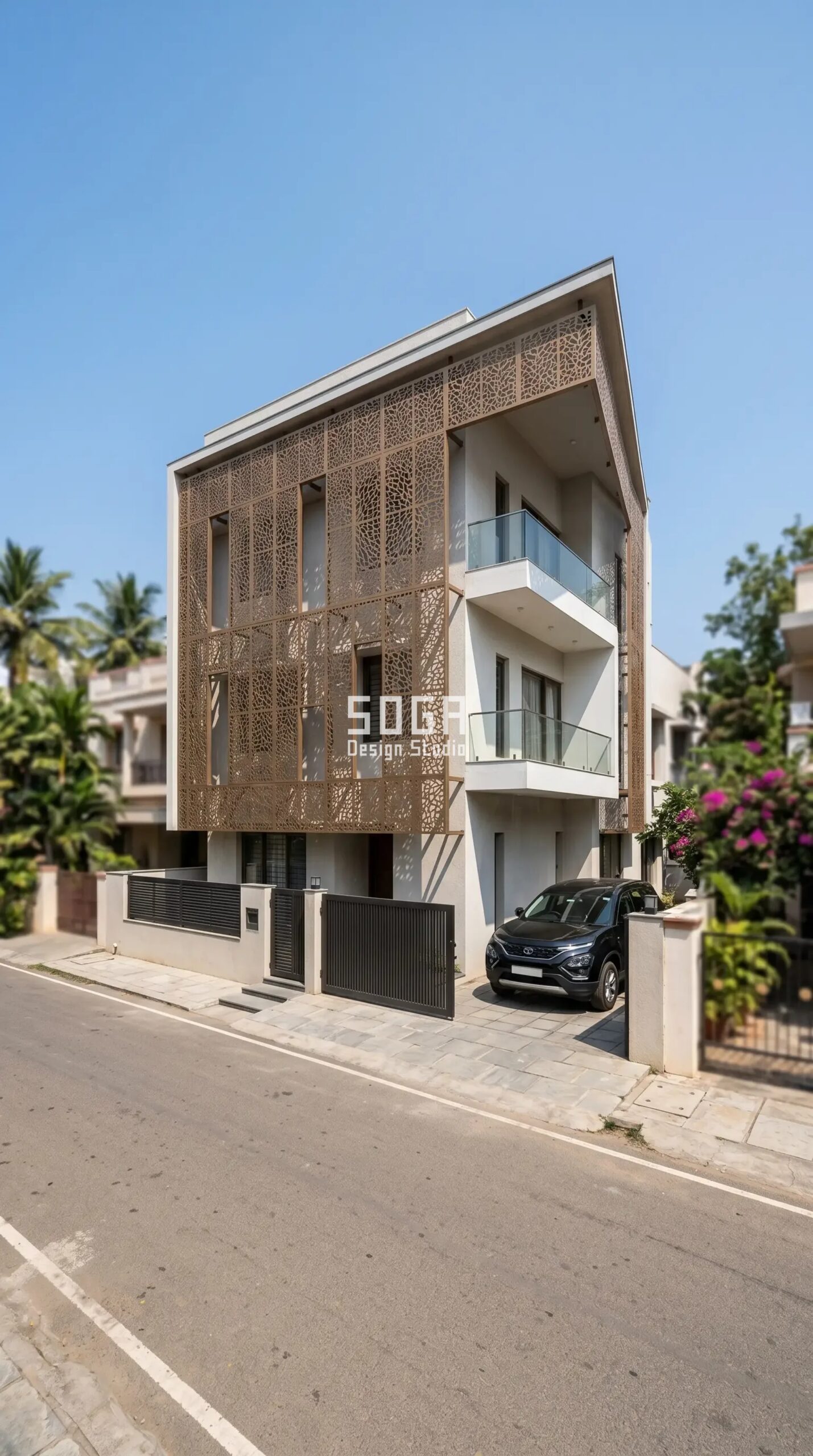
In most of India, the afternoon sun on a west- or south-facing wall is the single biggest source of indoor discomfort. A bare RCC or plastered wall absorbs that radiation and re-radiates it inward for hours after sunset. So the smartest house facade design starts not with a Pinterest mood board but with one question: where does the hard sun hit, and how do we stop it before it reaches the wall? Get that right and the aesthetics follow naturally, because the best heat-control elements — screens, louvers, deep reveals, and layered materials — are also the most beautiful, three-dimensional parts of a modern facade.
Heat-Smart Exterior Facade Ideas
Shading Elements (the highest impact)
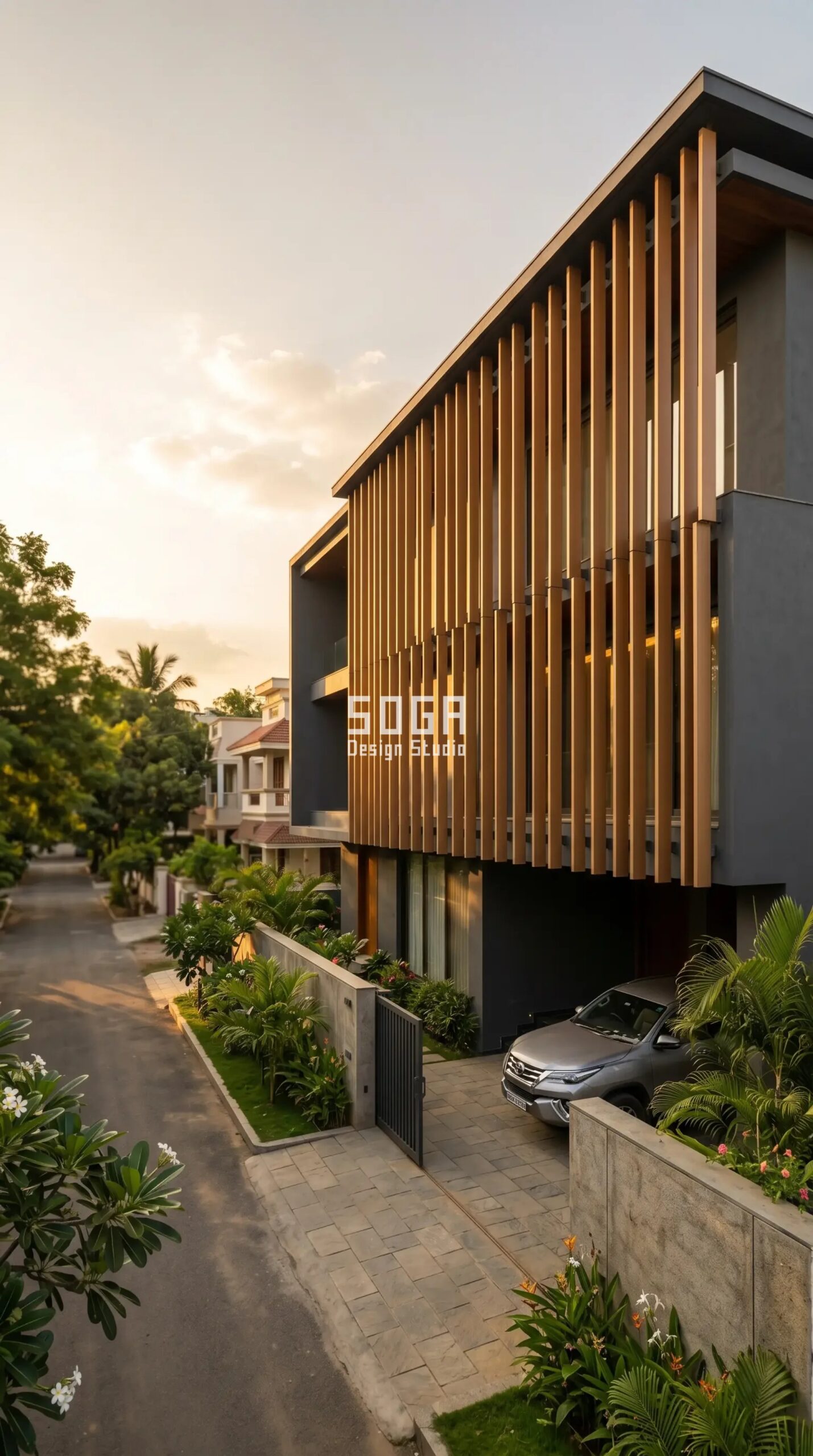
- Wood-tone or metal louver screen over the west/south walls
- A precision-cut metal screen as a second skin on hot bedrooms
- Deep window reveals and projecting hoods for self-shading
- A pergola or louver canopy extending over the porch and terrace
- Vertical fins to block low evening sun on west faces
Cool Materials & Finishes
- Light, matte colours that reflect rather than absorb heat
- Ventilated cladding (metal/GFRC) with an air gap behind
- Insulated cavity walls behind the feature facade
- Cool-roof and light parapet finishes to reduce top-down heat
- Avoiding large unshaded glass on west and south faces
Passive & Green Moves
- Integrated planter ledges for evaporative cooling and shade
- A double-skin screen that ventilates the cavity behind
- Cross-ventilation openings shaded by the facade screen
- Recessed balconies that self-shade the rooms below
The principle is simple: shade the glass and the hot walls, ventilate behind the cladding, and reflect rather than absorb. A modern facade design that follows it stays cool without leaning entirely on air conditioning.
How Much Heat Does Facade Shading Actually Stop?
This is not soft marketing — the numbers are measurable. A ventilated external screen or louver layer held 150–250 mm off a hot wall cuts direct solar heat gain by 25–40% on west and south orientations, and drops interior surface temperatures by 4–7°C compared to bare RCC. That translates directly into a lower cooling load, smaller AC bills, and rooms that are usable in the afternoon. Deep window reveals and projecting hoods add another layer by self-shading the glass. The most effective house facade design stacks these — screen plus reveal plus light finish — so the heat is intercepted at several points before it gets indoors. A parametric facade tunes the shading density precisely per orientation, so you shade aggressively where the sun is harsh and stay open where you want light and breeze.
House Facade Cost Per Square Foot (2026)
| Facade element | Installed cost (₹ per sq ft) | Heat benefit |
|---|---|---|
| Light texture paint + plaster | ₹120–₹300 | Reflective, low |
| ACP cladding | ₹200–₹350 | Low (cladding only) |
| Wood-look aluminium louvers | ₹450–₹900 | High (shading) |
| Powder-coated metal screen | ₹800–₹2,500 | High (shading + identity) |
| GFRC panels | ₹900–₹2,200 | Medium-high (mass + texture) |
The money you spend on a shading screen for the hot face pays back twice — once in looks, once in lower running costs. For a typical home, concentrating a ₹800–₹2,500 per sq ft screen on the genuinely hot 100–200 sq ft of wall is far smarter than spreading a cheap finish everywhere. SOGA Design Studio identifies exactly which planes need shading so the budget targets the heat.
Modern Looks That Are Also Cool
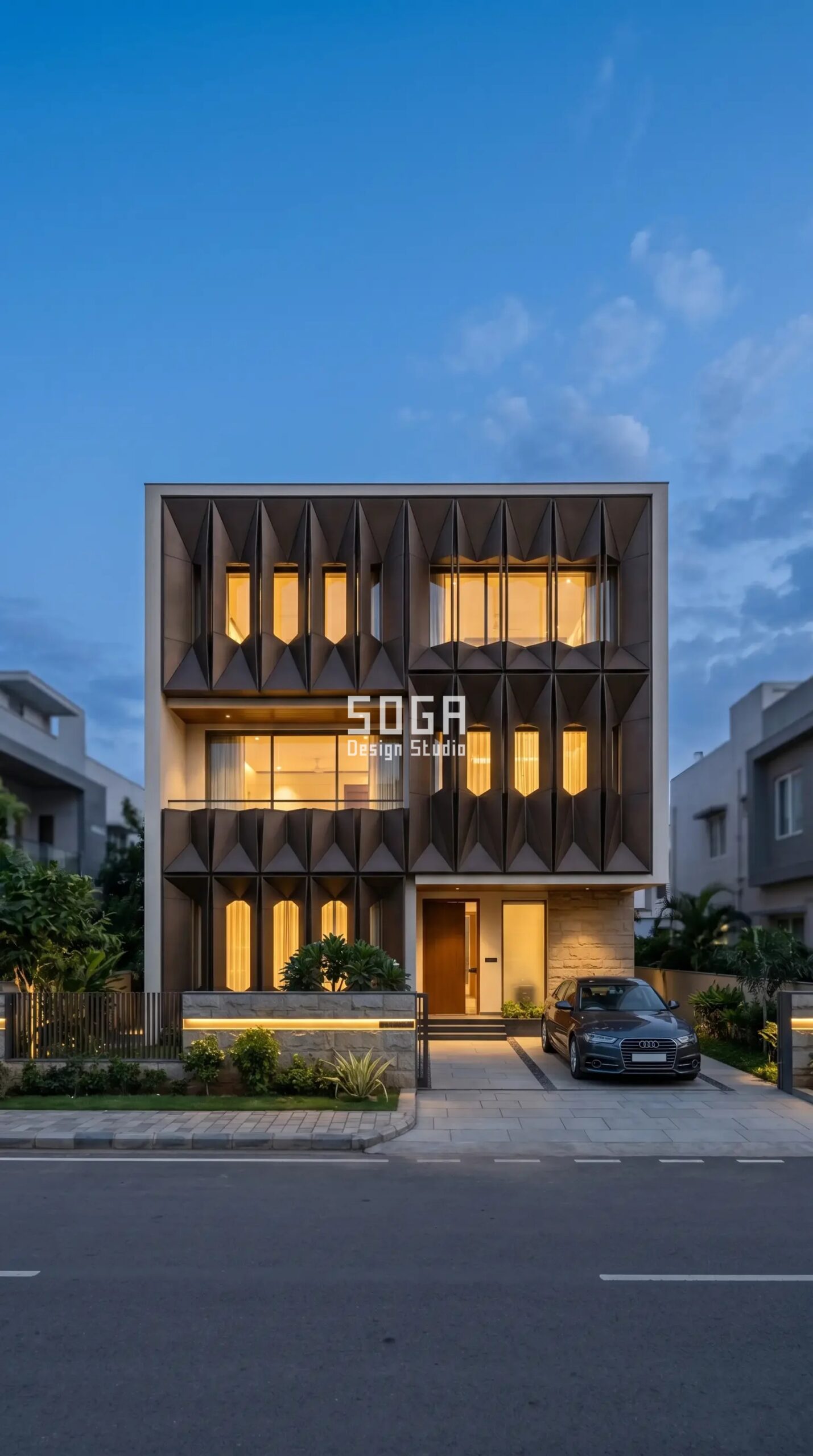
The good news: heat-smart and good-looking are the same thing in 2026. The most-searched modern facade design aesthetic — light cladding with dark frames, layered screens, deep shadow lines, warm wood tones — is exactly what also controls heat. A metal or wood screen reads as premium and three-dimensional while shading the wall behind it. Deep reveals create the crisp shadow lines that make a facade photograph well, and also keep sun off the glass. You do not trade beauty for comfort; the elements that deliver one deliver the other. That is the core insight behind serious exterior facade design in a hot country.
Why SOGA Design Studio
SOGA Design Studio is a parametric and computational architecture firm based in Gurugram, India, working across India, Dubai, and Singapore — all climates where heat is the defining challenge. We design every house facade with solar analysis built in: the skin is modelled in Rhino and Grasshopper, each orientation’s sun load is calculated, and the shading is tuned before fabrication. Through a fabrication-first workflow with GFRC and CNC production, the parametric facade you approve performs in the real climate and gets built precisely. Explore our parametric facade design services and shading systems like the Para-Scale Shingle facade and Para-Timber Ribbon facade. Get a custom facade concept for your home — contact SOGA Design Studio at sogadesignstudio.com/contact.
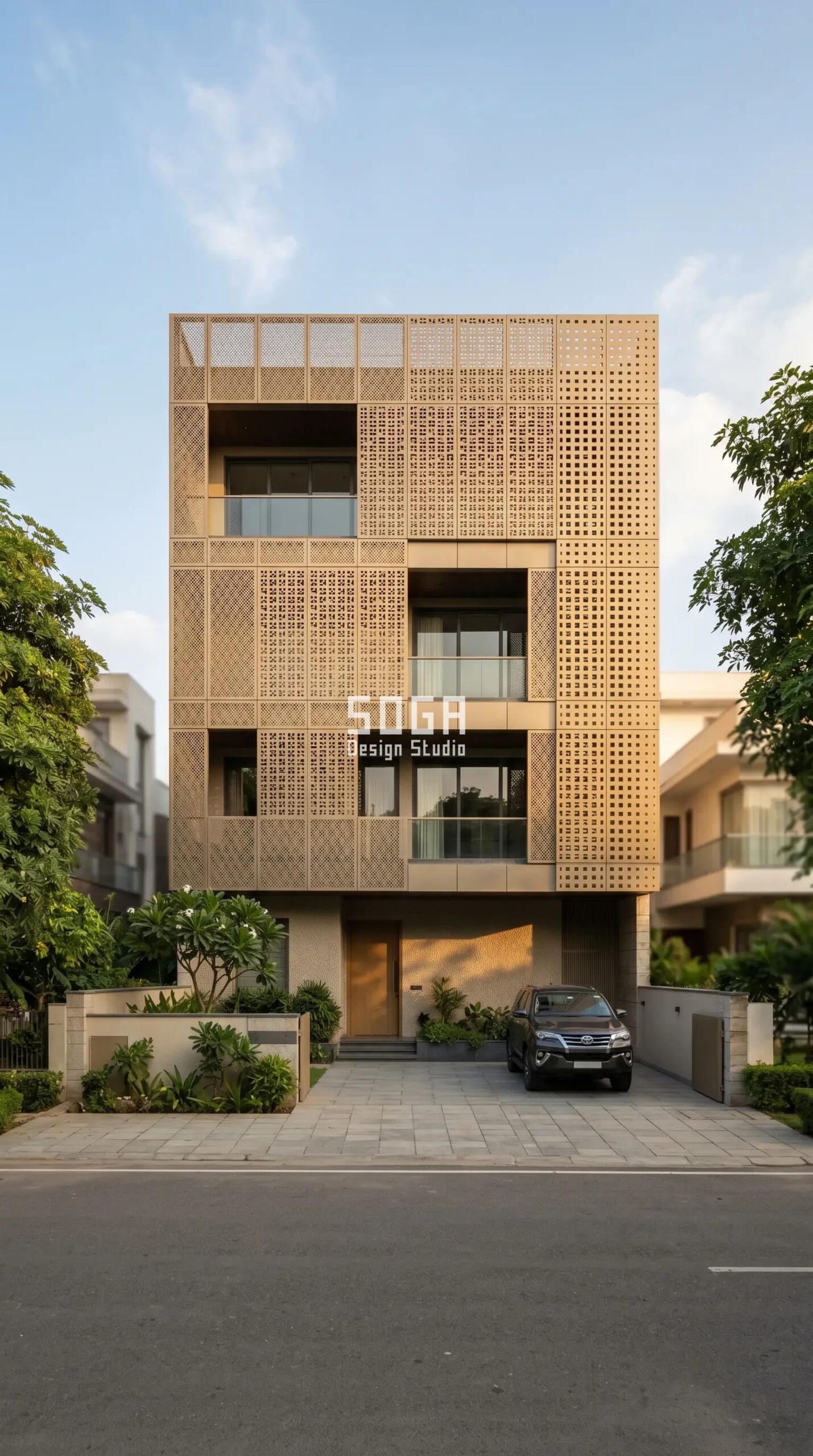
The measurable underneath every one of these ideas is wall surface temperature at 16:00 in May.
Frequently Asked Questions
What is the best house facade design for the Indian heat? The best house facade design for Indian heat combines a ventilated shading screen or louvers on the west and south walls, deep window reveals, light reflective finishes, and self-shading balconies. This cuts solar heat gain by 25–40% while delivering a modern, three-dimensional look.
How does a facade help reduce heat in a house? A facade reduces heat by intercepting the sun before it reaches the wall or glass. A ventilated external screen held off the wall cuts direct solar heat gain by 25–40% on hot orientations and lowers interior surface temperatures by 4–7°C versus bare RCC, reducing cooling bills.
Which facade material is best for a hot climate? Powder-coated metal screens, wood-look aluminium louvers, and GFRC are best for hot climates because they shade walls, ventilate behind, and last 25–30 years. Light matte finishes that reflect heat are better than dark glossy surfaces that absorb it.
Is a modern facade design more expensive than a plain one? A modern facade with shading elements costs more upfront than plain paint (₹800–₹2,500 per sq ft for metal screens vs ₹120–₹300 for paint), but the shading pays back through lower cooling bills and far longer life, making the total cost of ownership competitive.
Can SOGA Design Studio design a heat-smart facade for my house? Yes. SOGA Design Studio designs heat-smart parametric facades for homes across India and for NRI clients in Dubai, Singapore, and the UK. Each facade is modelled with orientation-specific solar analysis and delivered as fabrication-ready drawings, balancing cooling performance with a striking modern look.