Stand under a G+4 in Surat a week after the first big monsoon downpour and look up. On some buildings the metal still catches the light clean, edge to edge. On others, every panel below a ledge or a sill carries a grey-black tide mark running down from the joint above it — rainwater picking up dust and bitumen off a flat surface, running along an edge with nowhere else to go, and drying exactly where it last touched the panel. The difference isn’t the metal grade. It’s whether whoever drew the facade thought about where the water goes after it hits the building, not just how the elevation looks dry in a render.
Facade Design In India: What Actually Decides It in 2026
Facade Design In India is one of the questions that decides whether a facade gets built or quietly dropped. SOGA Design Studio hears it from Surat and from Mumbai, Bangalore, Delhi and Hyderabad, usually with a contractor standing nearby. Each concept below is taken down to sub-frame, bracket and fixing before it is presented, drawing on the parametric facade systems the studio builds across India, Dubai and Singapore, shown here in dark bronze.
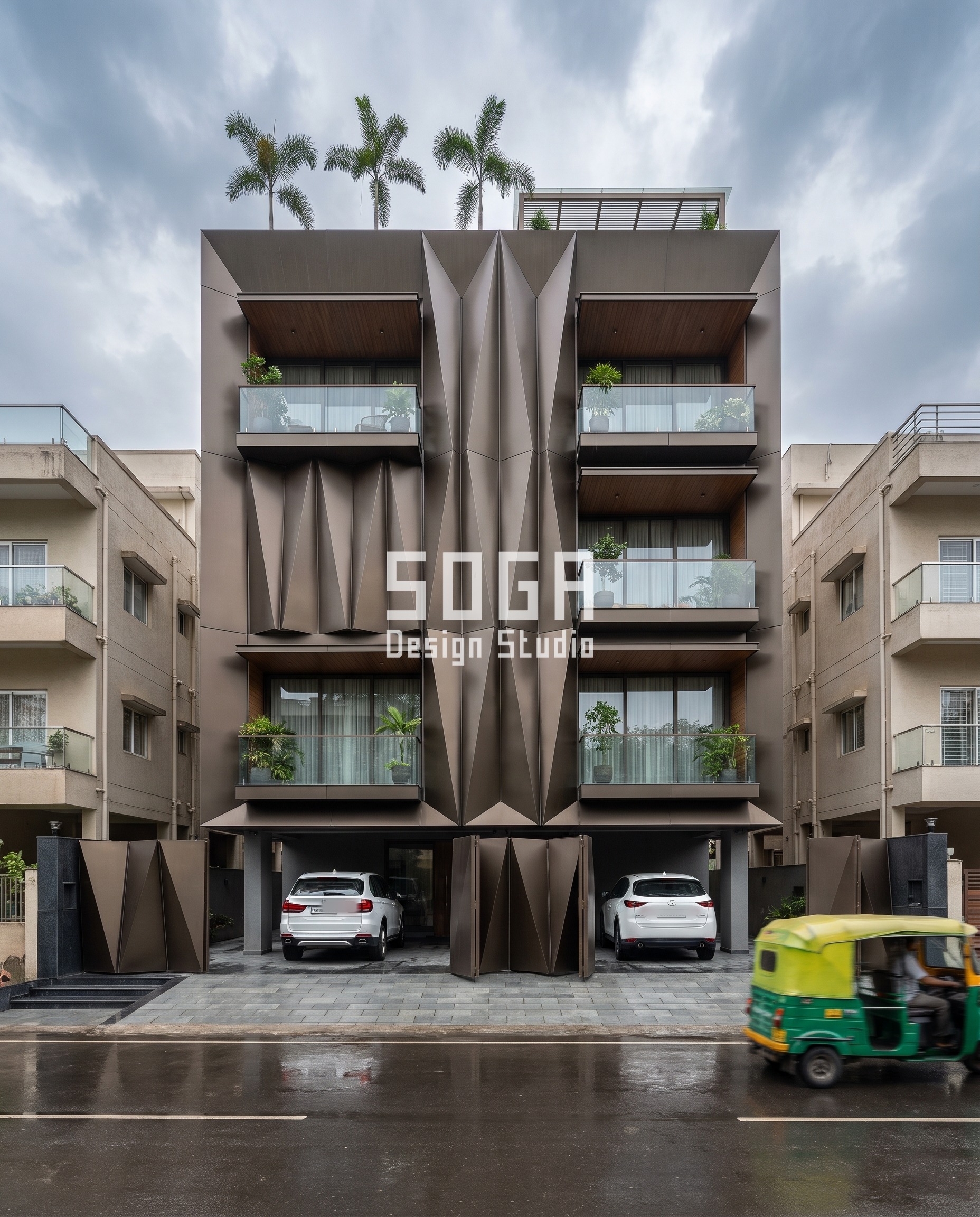
1. Surat Pattern / Relief Skin Wall: The Facet Angle That Sheds Water
This Surat builder-floor carries a full-width screen of folded bronze plates, each facet tilting between 4 and 13 degrees so the wall catches light differently panel to panel — a gesture built for exactly the kind of grey, just-after-rain morning this one was shot in. The facet angle isn’t only visual: a panel tilted even a few degrees off vertical sheds a falling sheet of water off its own leading edge instead of letting it crawl sideways across the face and pool at a seam. The trade-off is real and unhedged: more facets means more fabrication folds and more welded or gasketed joints, and every one of those joints is a place detailing can go wrong, so this system costs more in shop labour than a flat panel wall of the same area — the homeowner is paying for the geometry, not just the metal.
2. Noida Arches, Vaults & Loops: Why a Deep Reveal Needs Its Own Drip Line
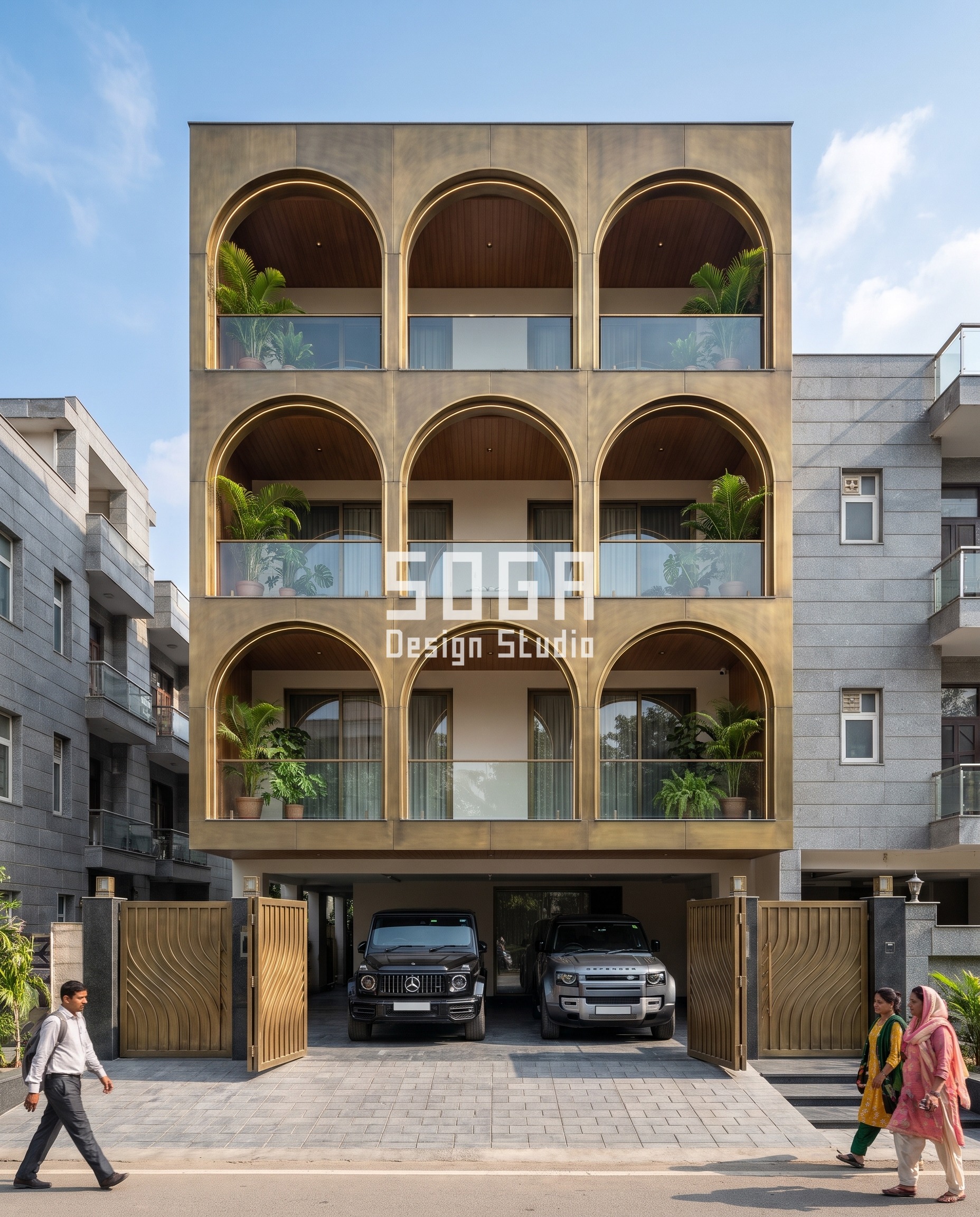
Five stacked round-top arches per floor, each reveal 550mm deep, give this Noida G+3 a shaded loggia band rather than a flat punched window. A reveal that deep is also exactly where staining shows up worst if it’s treated as decoration instead of plumbing: a horizontal soffit that deep needs its own projecting drip line at the outer edge, cut slightly proud of the wall below it, so water breaks clean off the lip instead of creeping back under the arch and staining the brass behind it. Skip that one detail — a few millimetres of projection — and the most expensive-looking part of the facade becomes the first part to streak. It costs almost nothing extra to draw; it costs a repaint to fix after the fact.
3. Gurugram Sweeping S-Ribbon: A Curved Ribbon Still Needs a Flat-Ledge Rule
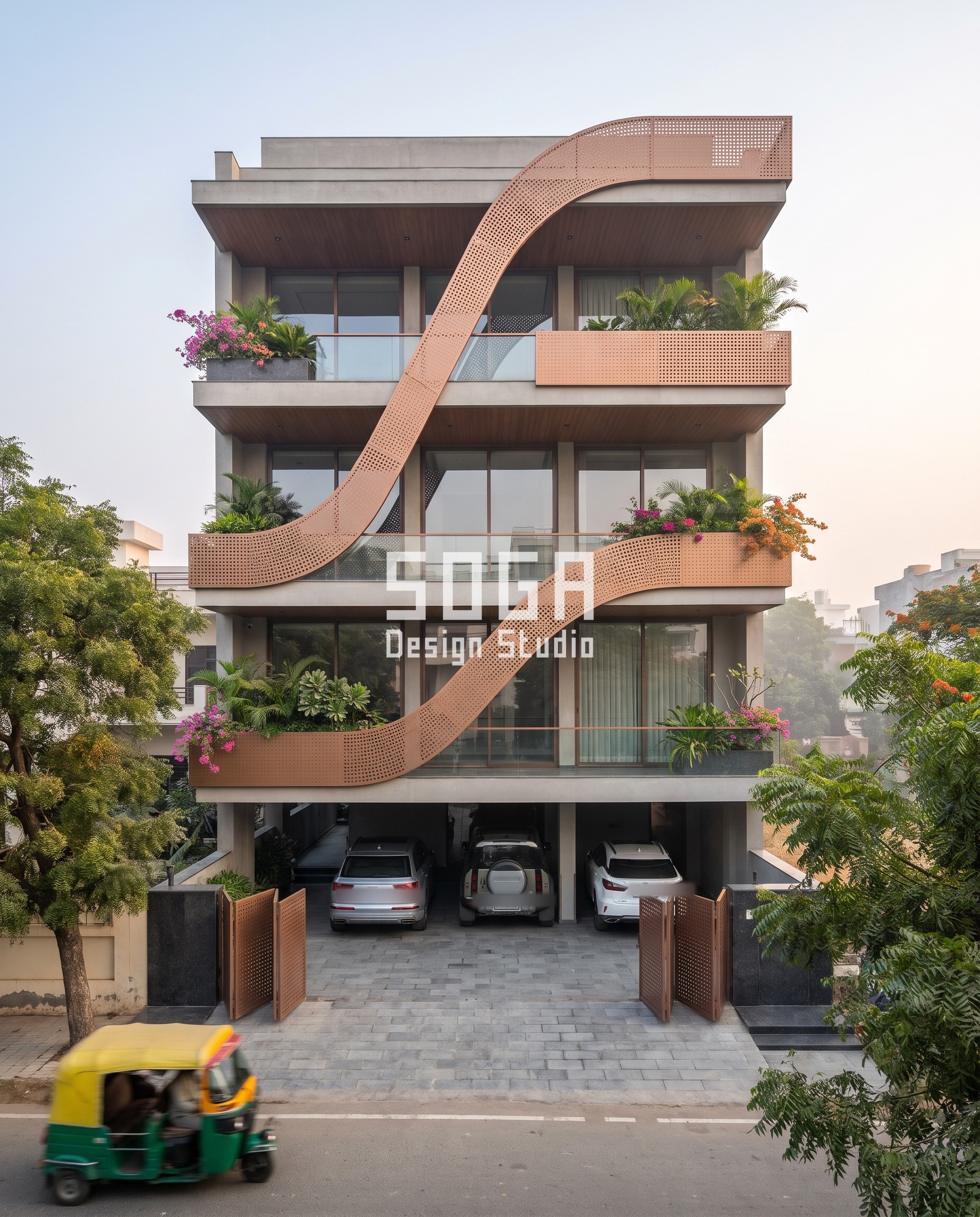
The Gurugram ribbon sweeps from the parapet down across every floor in one continuous S-curve, its perforation hole size grading from 20mm to 55mm as the band widens and tapers. On a hazy North Indian winter morning like the one this was shot in, the building takes a second, slower wetting cycle most homeowners never budget for — condensation and fog settling on cold metal well before the monsoon even starts. Wherever a sweeping curve like this flattens out, even briefly, to meet a slab edge or turn a corner, that short flat run becomes a place water can sit rather than keep moving; the fix is making sure the ribbon’s fall is continuous end to end, never flat, even for 200mm. It’s a one-line instruction to a fabricator, and most fabrication drawings never carry it.
4. Kochi Origami Frames: Where a Tilted Frame Collects Instead of Sheds
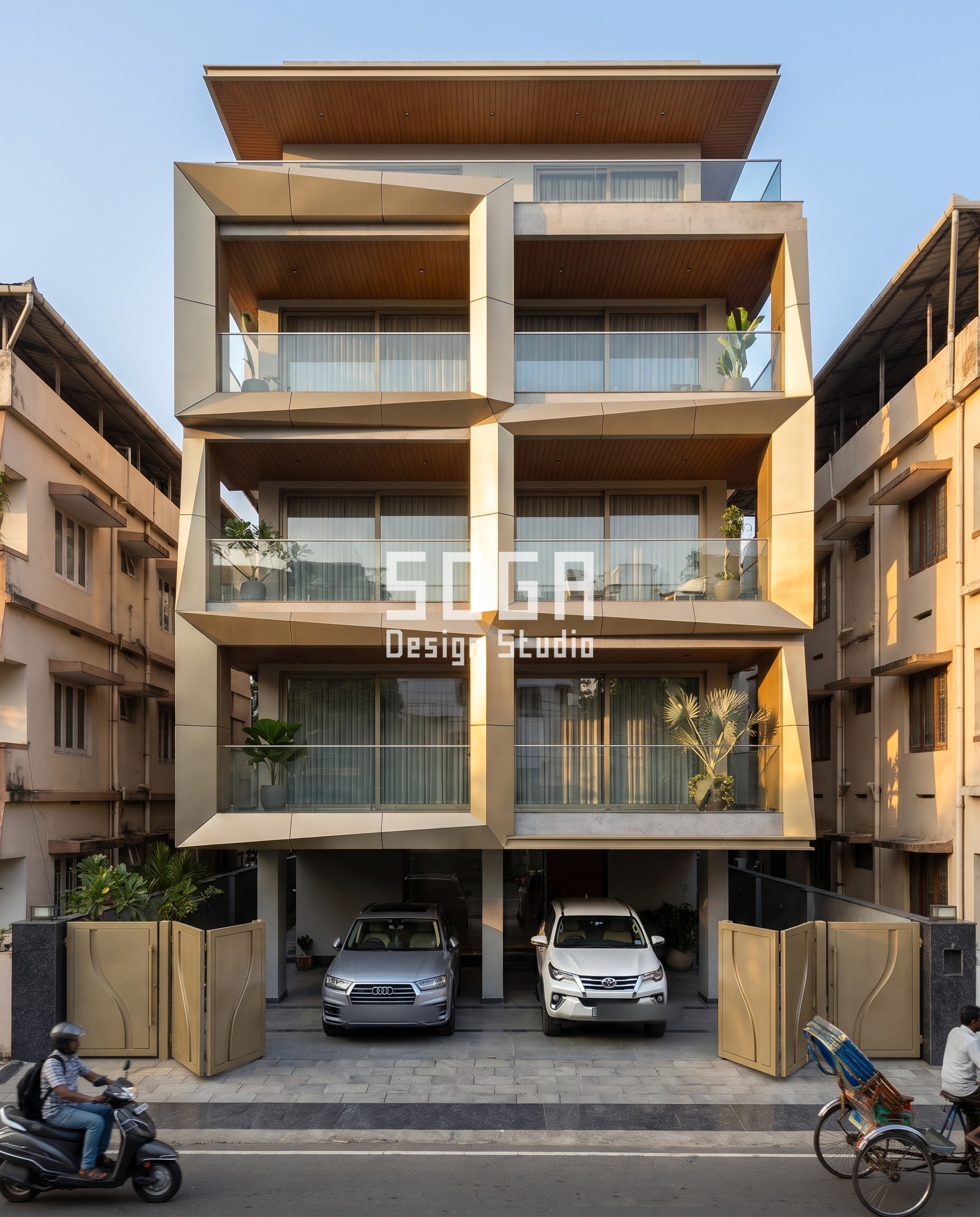
Kochi takes the heaviest, most wind-driven monsoon rain of any of today’s four cities, which makes it the honest test case for this origami-framed facade, where each balcony sits inside a folded quadrilateral frame tilted between 5 and 15 degrees in a different direction from its neighbours. Some of those faces, tilted steeply away from the prevailing wind-driven rain, shed water almost as fast as it lands; others, tilted the wrong way for a coastal storm, can briefly hold a thin film of water after the rain stops. A homeowner building this in Kochi has to make a real call with their designer — which face takes the worst of the weather and gets the steeper tilt — and that call costs engineering time a uniform, single-tilt facade never needs. The kaleidoscope look is the payoff; the per-face drainage check is the price of it.
What a Parametric Metal Facade Costs in India in 2026
Budget is usually the second question on a Surat brief, right after whether the idea is buildable at all. These are the current all-in installed rates in India:
- Steel facade (full design + install): ₹1,200–₹2,800 per sq ft
- Anodised or powder-coated metal panels: ₹800–₹2,500 per sq ft
- Zinc cladding: ₹1,500–₹3,000 per sq ft
- ACM panels (3 mm basic): ₹200–₹250 per sq ft (basic)
- ACM panels (4 mm): ₹250–₹350 per sq ft
- Solid metal panels: ₹800–₹1,800 per sq ft
- Installation labour: ₹50–₹150 per sq ft (varies by height + access)
- Conventional cladding (for comparison): ₹400–₹1,200 per sq ft installed (stone veneer / ceramic / standard ACM)
Treat these as the band a real quotation lands inside, not the quotation itself. The count of genuinely different pieces moves the figure more than the area does, because repetition is what makes a parametric facade affordable to fabricate.
Where SOGA Design Studio Works: India, Dubai and Singapore
Re-skinning an existing Surat building is less about ambition than about access. The screen has to be fixed from outside, in pieces a two-person team can lift, on brackets that land where the structure actually is rather than where the grid says it should be. Get those constraints down before the elevation is drawn and a retrofit reads as deliberate; treat them as details to resolve later and the design gets value-engineered into something nobody chose.
Why Trust SOGA Design Studio for Facade Design in Surat
- Experience: SOGA has designed and visualised metal facade concepts for real Indian G+3 to G+7 plots across sharply different climate zones — coastal Kochi, humid Surat, hazy-winter Gurugram, plains Noida — as a daily study series since 2023, with drip-edge and joint detailing considered at concept stage rather than left for the fabricator to work out later.
- Expertise: Facade geometry and water-shedding behaviour — facet angles, reveal depth and drip-line projection, continuous-fall curved panels, hairline joint detailing — alongside climate-responsive design per city and orientation.
- Authority: One of the few studios in India that treats water-shedding geometry as a design decision made at concept stage, not an afterthought handed to the fabricator.
- Trust: Real, sourced numbers, not invented ones: quality powder-coated metal facades run 25-30 years before recoating is needed in Indian conditions, including coastal cities, with maintenance limited to an annual rinse-down — against a 4-6 year repaint cycle for traditional plaster and paint. Free, no-commitment consultation; remote-friendly workflow for NRI clients.
Frequently Asked Questions
Does monsoon rain leave stains on a metal facade in India?
It can, but the stain comes from dust and grime in the run-off, not from the metal itself. A well-detailed facade gives that water a clean, continuous path off the building — angled facets, projecting drip lines under deep reveals, and curved panels with no flat resting points — so the dirt rinses straight off instead of drying in a streak at a joint or a ledge.
How do you stop water streaking on a metal building facade?
Three details do most of the work: a facet or panel angled enough to shed water off its own edge rather than along its face; a drip line (a slightly proud lip) under any reveal deeper than roughly 150-200mm, so water breaks clean instead of creeping back under; and continuous fall on any curved or sweeping panel, with no short flat run where it can briefly pool. All three are decided on the drawing, before fabrication.
Is water streaking the same as rust on a metal facade?
No. Streaking is surface dirt and dust carried in rainwater that dries as a visible mark — it’s a cleaning and detailing issue, not metal damage, and a rinse-down removes it. Rust is corrosion of the metal itself, a separate and more serious concern with its own detailing rules.
How long does a metal facade last in Indian monsoon conditions?
Quality powder-coated metal or galvanised steel facades, correctly detailed and ventilated, last 25-30 years before recoating is needed, even in coastal cities like Mumbai, Chennai and Kochi that see the heaviest monsoon exposure. Maintenance is an annual rinse-down; there’s no repainting cycle like a plaster facade.
Does a facade need different detailing in Surat than in Delhi or Gurugram?
Yes. Surat and Kochi sit in heavy, sustained monsoon zones and need every drip-edge and fall detail treated as non-negotiable from day one. Gurugram and Delhi see less rain but more dew and winter haze, which wets a facade more slowly and over longer hours — the same drainage details still matter, just under a gentler but more constant load.
How much does a parametric metal facade cost in India in 2026?
Steel facade systems, fully installed, typically run ₹1,200-₹2,800 per sq ft; powder-coated or anodised metal panel systems run ₹800-₹2,500 per sq ft; zinc runs ₹1,500-₹3,000 per sq ft. The drip-edge and continuous-fall detailing discussed here adds fabrication time, not a different material, so it’s a modest addition within these bands rather than a separate cost line.
Related Reading
Start Your Facade Project With SOGA Design Studio
A metal facade doesn’t stain because the metal is cheap — it stains because nobody drew where the water goes after it lands.
Whether you are building new or retrofitting an existing block, SOGA Design Studio can adapt the concepts above to your exact plot and budget. Start the conversation here — consultations are free and no-commitment.