Your villa’s facade is not decoration. It is the first — and often most lasting — judgment a visitor, a buyer, or a neighbour makes about the quality of the home behind it. In India’s premium residential market of 2026, that judgment now carries real money: well-designed luxury villa facades in Delhi NCR, Hyderabad, and Mumbai are commanding 18–25% resale premiums over comparable properties with generic exteriors. The facade has moved from being a cost centre to being a value generator.
This guide is for villa owners, NRI clients planning to build or renovate, and developers working on plotted villa communities. We cover the best facade materials for Indian conditions, realistic costs per square foot, city-specific trends, and the common mistakes that turn an expensive renovation into an expensive regret.
Why Villa Facade Design Matters More in 2026
Three forces are reshaping the Indian villa facade market this year.
Premium buyer expectations have shifted upward. The post-pandemic move of high-net-worth individuals from apartments to independent villas — especially in gated communities in Hyderabad’s Kokapet, Bangalore’s Sarjapur Road, and Gurugram’s Sector 65–80 belt — has brought buyers who have seen international architecture. They know what a well-designed facade looks like. Generic stone cladding from 2015 no longer impresses.
Instagram and short-video culture have made facades functional marketing. A striking villa exterior generates social sharing that no amount of interior photography can replicate. Developers of premium plotted communities now require facade design approvals before construction begins because the street view of the community is their marketing asset.
Climate-responsive design is becoming a selling point, not just an engineering requirement. Facades that integrate solar shading, reduce surface heat gain, and lower air-conditioning loads are increasingly demanded by informed buyers — both for comfort and for long-term utility savings.
5 Best Facade Materials for Indian Villas in 2026
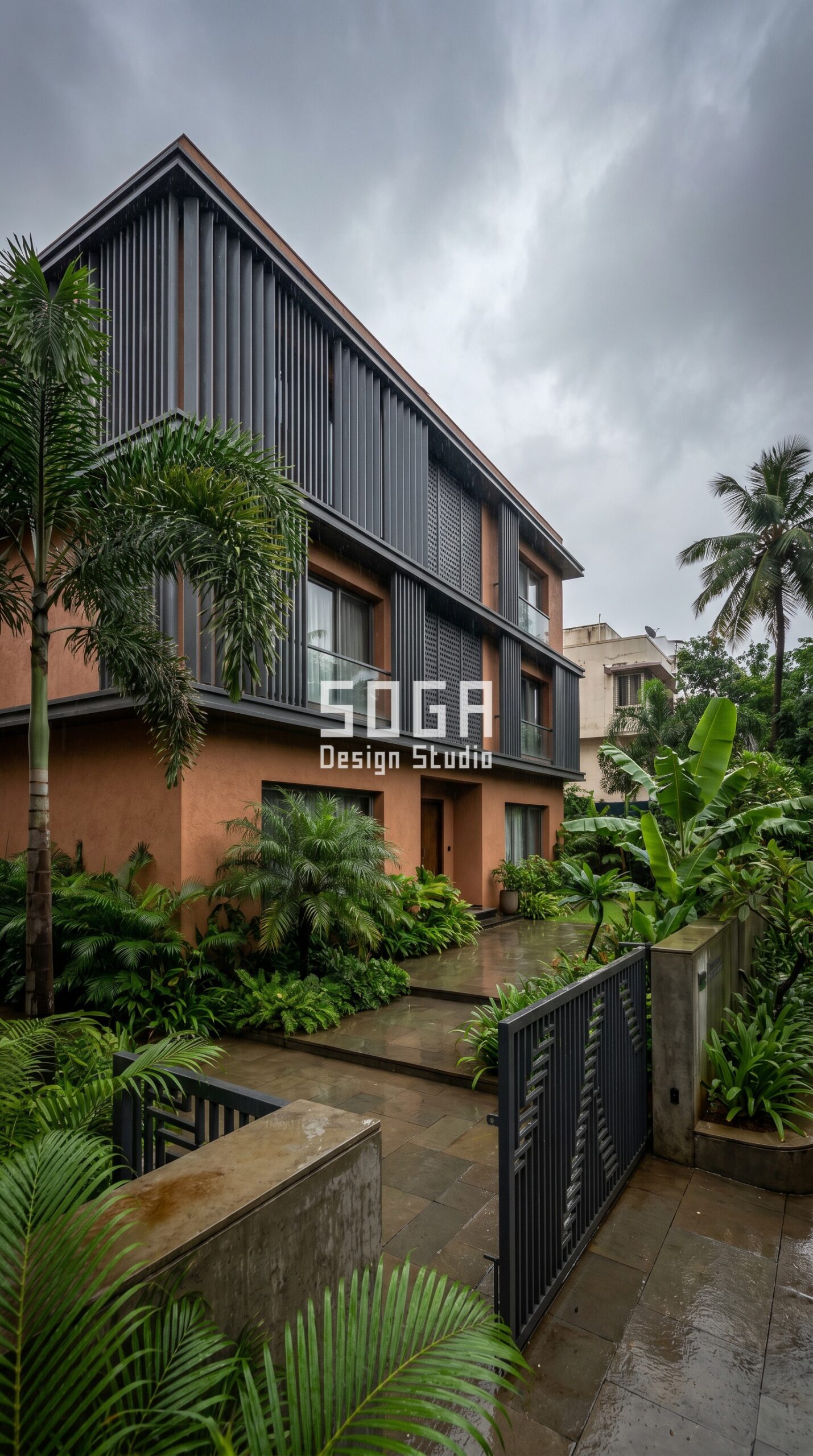
1. Parametric Aluminium Panel Systems — ₹1,200 to ₹3,500/sqft (installed)
Aluminium-based parametric facades — CNC-machined or extruded aluminium panels arranged in geometric or organic patterns — represent the fastest-growing category in Indian luxury villa design. They are lightweight (critical for Indian soils and older structural systems), completely weatherproof, maintenance-free for 15–20 years, and available in any powder-coat or anodised finish.
The cost range is wide because complexity drives price: a flat aluminium composite panel (ACP) system starts around ₹300/sqft but offers no design differentiation. A bespoke parametric system like SOGA’s diamond-panel SogaGrid™ or organic wave SogaShell™ ranges ₹1,200–₹3,500/sqft depending on panel complexity, substrate, and anchoring system.
For a 3,000 sqft villa facade, budget ₹36 lakh to ₹1.05 crore for a full parametric aluminium system.
2. Natural Stone Cladding — ₹250 to ₹1,800/sqft (installed)
Indian sandstone, Kota stone, Jaisalmer yellow, and granite remain popular for villas seeking a traditional or transitional aesthetic. Stone is visually warm, durable when properly sealed, and widely understood by local contractors.
The problem: natural stone is heavy (requiring reinforced substrate), absorbs moisture (causing efflorescence and staining in coastal and high-rainfall zones), and looks dated against the sharper geometry of contemporary villa architecture. Premium imported stones (travertine, basalt) push costs to ₹1,200–₹1,800/sqft installed.
Stone works best as an accent material — a feature wall, plinth cladding, or entry portal — rather than as the primary facade system.
3. Aluminium Composite Panel (ACP) — ₹180 to ₹600/sqft (installed)
ACP remains the most widely used villa facade material in India because it is cheap, fast to install, and available everywhere. But it has a ceiling: ACP signals a mid-market finish regardless of how expensive the villa’s interior is. Fire safety concerns with lower-grade ACP have also led several municipalities to tighten norms on its use in residential facades above ground level.
For villas targeting ₹2 crore-plus resale value, ACP as the primary facade material is a positioning mistake. Use it for soffits, service areas, or internal screens — not the street-facing facade.
4. Structural Glass and Glass Louvres — ₹2,500 to ₹6,000/sqft (installed)
Glass-dominant facades — floor-to-ceiling curtain walls, frameless glass louvres, or structural glass fins — work beautifully for villas in mild climates (Bangalore, Pune hills, Ooty, Coorg) or where the plot orientation allows north-facing glass. In Delhi NCR, Mumbai, and Hyderabad, an unshaded west or south glass facade is a thermal disaster: the villa becomes an oven and air-conditioning bills become a monthly argument.
Glass should be combined with solar shading — either external louvres or parametric screen systems — to be viable in most Indian climates. Cost for a properly specified glass facade with shading: ₹3,000–₹6,000/sqft installed.
5. Terracotta Panels — ₹600 to ₹1,400/sqft (installed)
Machine-pressed terracotta panels — thin (25–35mm), hollow-section, ventilated-facade system — are gaining significant ground in the Indian luxury segment. They offer the warmth and texture of natural clay, are UV-stable (no fading), and self-clean in rain. Their ventilated installation creates an air gap that reduces heat gain.
Manufacturers like NBK (Germany), Agrob Buchtal, and increasingly Indian producers offer terracotta panels in sizes from 300x600mm to 600x1200mm. The system requires a competent contractor familiar with ventilated facade technology — which is still relatively rare outside major metros. Budget ₹600–₹1,400/sqft installed.
SOGA Systems for Villas: Matching the Right System to Your Villa Style
SOGA’s parametric facade systems are designed to be manufacturable and installable across India — not just in metros. Here is how each system maps to villa typologies:
SogaGrid™ (diamond aluminium panels): Best suited to contemporary and minimalist villas with strong geometric lines. The diamond-grid pattern creates visual rhythm across large flat facades — particularly effective on double-storey or triple-storey street-facing elevations. Ideal for Gurugram and Hyderabad villa communities where the street view is the developer’s primary marketing tool.
SogaWeave™ (twisted vertical fins): An excellent choice for villas in high solar-gain zones (south-west or west-facing walls). The twisted fin geometry shades the wall surface while allowing diffused light and air movement. Works especially well in Mumbai and Hyderabad climates. Also creates a striking shadow-play effect at different times of day.
SogaScreen™ (shadow screen panels): For villas where privacy is a priority — street-facing bedrooms, ground-floor living spaces on busy roads. SogaScreen creates a semi-opaque outer layer that blocks sightlines from the street while preserving cross-ventilation and natural light. Popular with clients in dense urban plots in Delhi NCR and Bangalore.
SogaShell™ (organic wave panels): For clients who want a landmark exterior — a villa that is unmistakably different on its street. SogaShell’s flowing, sculptural geometry is statement architecture. Typically applied to feature sections: the main entry bay, the primary bedroom projection, or the boundary wall.
SogaPulse™ (algorithmic responsive): For technically sophisticated clients and architects working on large villa projects or villa communities. The panel geometry is algorithmically derived from site-specific inputs (sun path, wind direction, view orientation) and varies panel-by-panel across the facade for maximum climate performance.
For a detailed look at what these systems cost for your specific project, see our parametric facade cost guide for India 2026.
City-Wise Villa Facade Trends 2026
Delhi NCR (Gurugram, Noida, Faridabad): The market here is intensely competitive and image-driven. Builders and independent owners alike are moving toward bold, identifiable facades. Parametric screens and geometric panel systems dominate new construction. White and off-white base tones with dark grey or bronze metallic accents are the dominant palette. SogaGrid and SogaWeave see strong uptake.
Mumbai (Alibaug, Lonavala, Powai, Thane): The coastal and high-humidity context demands materials with excellent salt-spray and moisture resistance. Terracotta panels, marine-grade powder-coated aluminium, and glass louvres are popular. Compact plots push design creativity — more vertical expression, cantilevered volumes, and thin-profile facades.
Hyderabad (Kokapet, Jubilee Hills, Gandipet): The city’s villa market has the highest average price points in India right now and clients are the most internationally exposed. Fully parametric facades are no longer unusual here. SogaShell organic forms and SogaGrid diamond patterns are both in strong demand.
Bangalore (Sarjapur, Whitefield, Devanahalli): The mild climate allows more adventurous glass integration than other cities. Green-certified facades — those with GRIHA or IGBC credits — are valued by the tech-sector buyer base. Timber-look aluminium, terracotta, and glass combinations are characteristic of Bangalore’s 2026 luxury villa aesthetic.
Pune (Kothrud, Baner, Kalyani Nagar): A market that blends Pune’s traditional preference for understated good taste with increasing NRI influence. Natural stone accents combined with contemporary metal screen systems are popular. Budgets are typically ₹30–₹80 lakh for a full villa facade renovation.
Common Mistakes Villa Owners Make with Facade Design
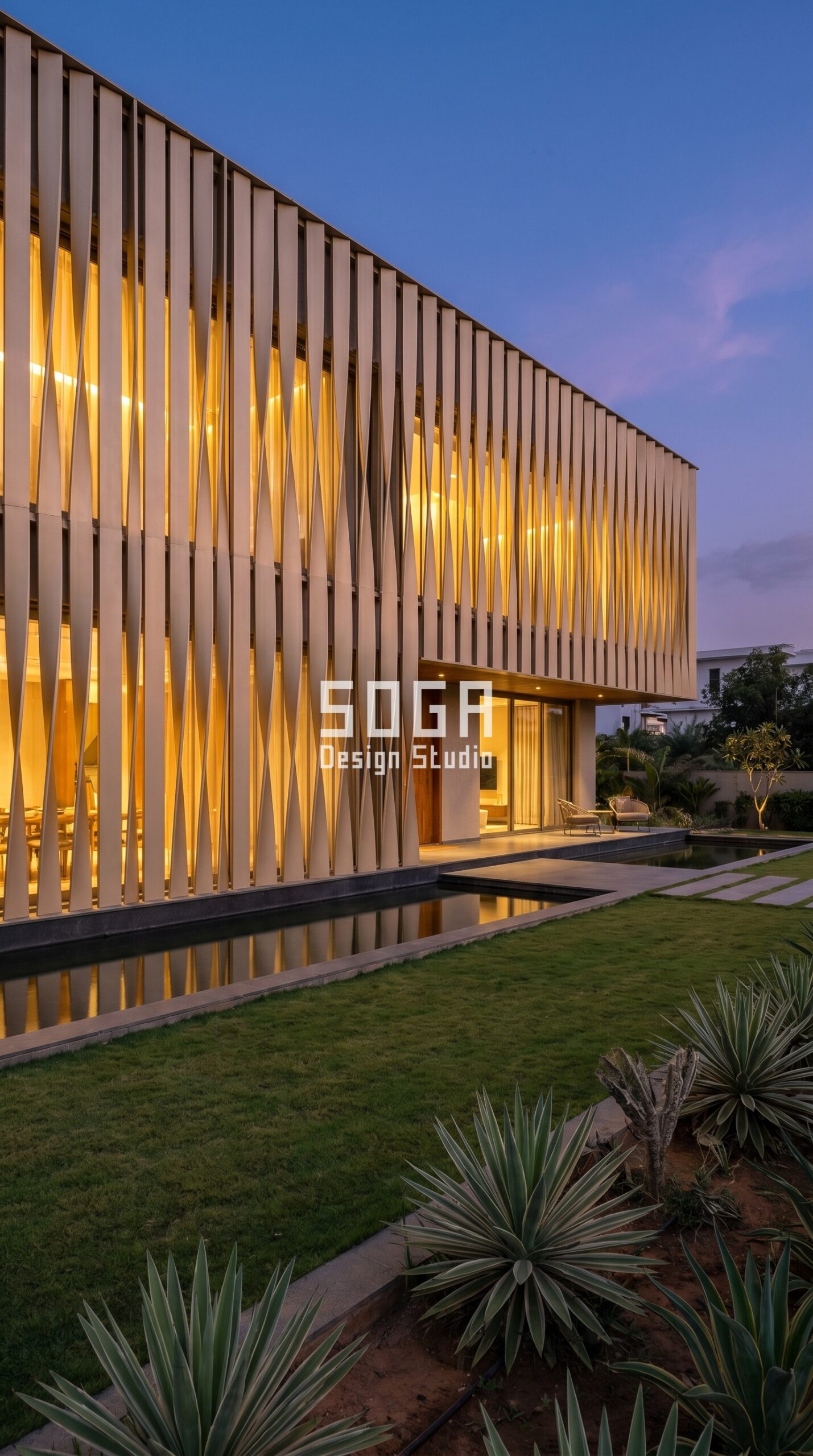
1. Choosing the material before choosing the design: Many villa owners pick a material (stone, ACP, glass) and then ask their contractor to “do something with it.” The result is a technically adequate but aesthetically incoherent facade. Design logic should drive material selection — not the other way around.
2. Ignoring orientation: A west-facing glass wall in Hyderabad is not a design feature. It is a recurring utility bill. Facade design must account for solar angles, prevailing wind, and the specific microclimate of the plot.
3. Underestimating the structural substrate cost: The visible facade panel is only part of the cost. The anchoring system, weather membrane, insulation (where specified), and structural framing behind the panel can add 30–50% to the raw panel cost. Contractors who quote only the panel price are giving you an incomplete number.
4. Using multiple materials without a unifying logic: Mixing stone, ACP, glass, and exposed concrete because each looks good individually results in a confused elevation. A coherent facade uses one primary material and one or two carefully considered accents.
5. Skipping the maintenance plan: Beautiful facades stay beautiful only with maintenance. Aluminium panels need periodic cleaning. Stone needs resealing every 3–5 years. Glass louvres need gasket replacement. Ask your designer for a 10-year maintenance schedule before you finalise the material.
FAQ
Q: What is the minimum budget for a quality villa facade renovation in India? A: For a meaningful upgrade — moving from ACP to a premium material with proper design — budget a minimum of ₹15 lakh for a standard 2,000–2,500 sqft villa facade. Premium parametric systems for larger villas (3,500–5,000 sqft facade area) typically range ₹45 lakh to ₹1.5 crore. Our cost guide gives detailed breakdowns by system type.
Q: How long does a parametric facade system last in Indian conditions? A: A properly installed powder-coated aluminium parametric system has a design life of 20–25 years with minimal maintenance. The powder coat finish carries a typical manufacturer warranty of 10–15 years against colour fade. Terracotta panel systems are effectively maintenance-free and last 30+ years. Both significantly outlast ACP, which typically shows degradation (sealant failure, panel delamination) within 7–12 years in harsh Indian climates.
Q: Can a parametric facade be added to an existing villa during renovation, or is it only for new construction? A: Parametric facades can absolutely be retrofitted to existing villas. The key engineering question is whether the existing wall structure can support the anchoring loads of the facade system — which for lightweight aluminium systems is typically not a problem. A structural check is part of SOGA’s standard process. See our design process guide for more detail.
Q: Which SOGA system is best for a villa in a hot, west-facing plot in Delhi NCR? A: SogaWeave™ or SogaScreen™ are the first choices for a hot west-facing facade. SogaWeave’s twisted fins provide dynamic solar shading — reducing direct solar gain by 40–60% depending on fin geometry. SogaScreen creates a full shading layer while maintaining visual interest. Both systems can be designed to allow adequate natural light while blocking the harsh afternoon sun. We recommend combining either system with light-coloured panel finishes to minimise heat absorption.
Q: How does a parametric villa facade compare to traditional stone cladding on resale value? A: Based on transactions in premium villa markets (Gurugram, Kokapet, Sarjapur Road), villas with distinctive parametric facades are selling at 15–25% premiums over comparable properties with standard stone or ACP cladding. Beyond the premium, parametric facades generate significantly more buyer interest and shorter days-on-market. For a detailed comparison, see our parametric vs stone vs ACP analysis.
Ready to Design Your Villa Facade?
SOGA Design Studio works with villa owners, architects, and developers across India on bespoke parametric facade projects. Every project begins with a no-obligation consultation where we assess your plot orientation, budget, and aesthetic goals before recommending a system.
Contact SOGA Design Studio to start your villa facade project. Our team is based in Gurugram and works on projects across India.
Explore our full range of parametric systems at sogadesignstudio.com/soga-parametric-systems/
AIOSEO Settings
Focus Keyphrase: villa facade design india 2026 SEO Title: Villa Facade Design India 2026: Best Materials, Styles & Cost Guide | SOGA Design Studio Meta Description: Complete guide to villa facade design in India 2026. Compare parametric aluminium, stone, glass & terracotta with real ₹ costs per sqft. City-wise trends for Mumbai, Delhi NCR, Hyderabad & Bangalore. By SOGA Design Studio, Gurugram.
FAQPage JSON-LD
“`json { “@context”: “https://schema.org”, “@type”: “FAQPage”, “mainEntity”: [ { “@type”: “Question”, “name”: “What is the minimum budget for a quality villa facade renovation in India?”, “acceptedAnswer”: { “@type”: “Answer”, “text”: “For a meaningful upgrade — moving from ACP to a premium material with proper design — budget a minimum of ₹15 lakh for a standard 2,000–2,500 sqft villa facade. Premium parametric systems for larger villas (3,500–5,000 sqft facade area) typically range ₹45 lakh to ₹1.5 crore.” } }, { “@type”: “Question”, “name”: “How long does a parametric facade system last in Indian conditions?”, “acceptedAnswer”: { “@type”: “Answer”, “text”: “A properly installed powder-coated aluminium parametric system has a design life of 20–25 years with minimal maintenance. The powder coat finish carries a typical manufacturer warranty of 10–15 years against colour fade. Terracotta panel systems last 30+ years. Both significantly outlast ACP, which typically shows degradation within 7–12 years in harsh Indian climates.” } }, { “@type”: “Question”, “name”: “Can a parametric facade be added to an existing villa during renovation, or is it only for new construction?”, “acceptedAnswer”: { “@type”: “Answer”, “text”: “Parametric facades can absolutely be retrofitted to existing villas. The key engineering question is whether the existing wall structure can support the anchoring loads of the facade system — which for lightweight aluminium systems is typically not a problem. A structural check is part of SOGA’s standard process.” } }, { “@type”: “Question”, “name”: “Which SOGA system is best for a villa in a hot, west-facing plot in Delhi NCR?”, “acceptedAnswer”: { “@type”: “Answer”, “text”: “SogaWeave™ or SogaScreen™ are the first choices for a hot west-facing facade. SogaWeave’s twisted fins provide dynamic solar shading — reducing direct solar gain by 40–60% depending on fin geometry. SogaScreen creates a full shading layer while maintaining visual interest.” } }, { “@type”: “Question”, “name”: “How does a parametric villa facade compare to traditional stone cladding on resale value?”, “acceptedAnswer”: { “@type”: “Answer”, “text”: “Based on transactions in premium villa markets (Gurugram, Kokapet, Sarjapur Road), villas with distinctive parametric facades are selling at 15–25% premiums over comparable properties with standard stone or ACP cladding. Parametric facades also generate significantly more buyer interest and shorter days-on-market.” } } ] } “`