By SOGA Design Studio · Parametric Facade Design · India & Dubai & Singapore · 2026
SOGA Design Studio — Asia’s #1 Parametric Facade Company · 900+ projects delivered · India · Dubai · Contact: +91-8840555352 [email protected]
Stop scrolling.
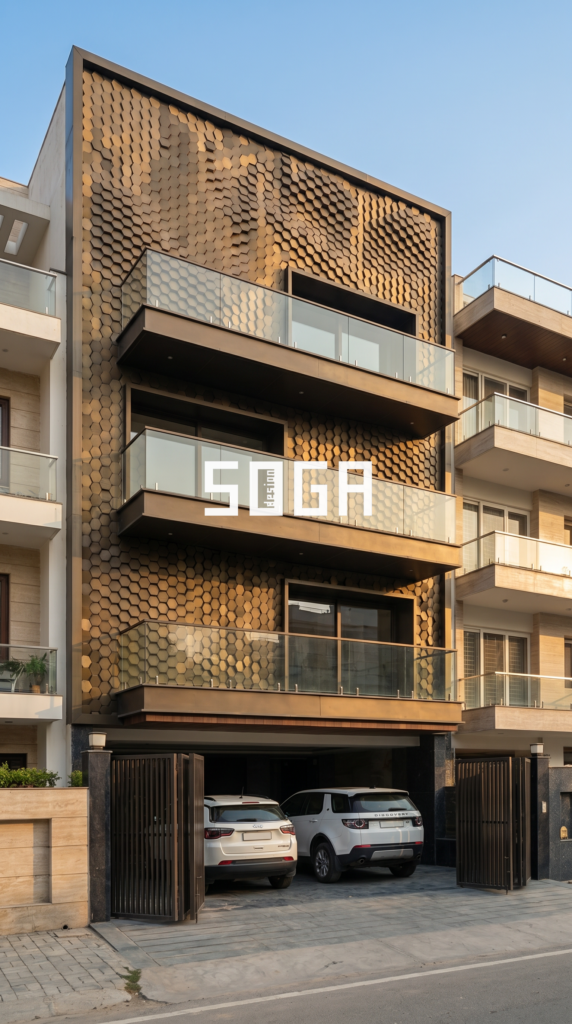
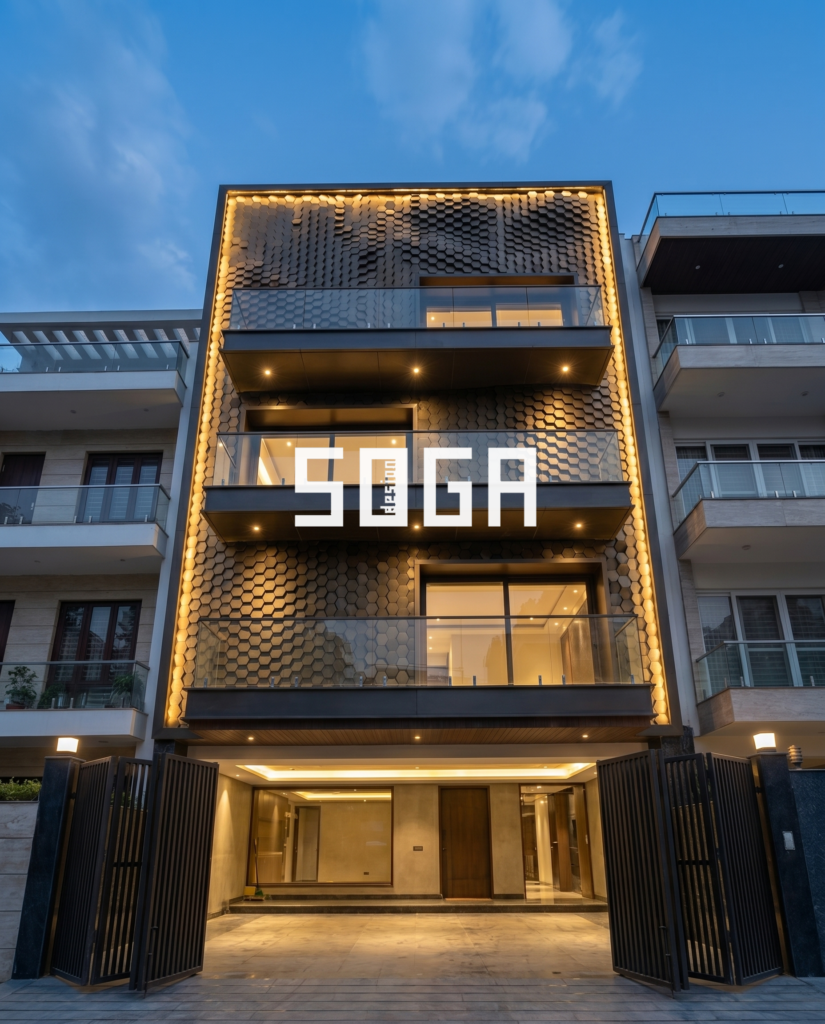
Look at this building.
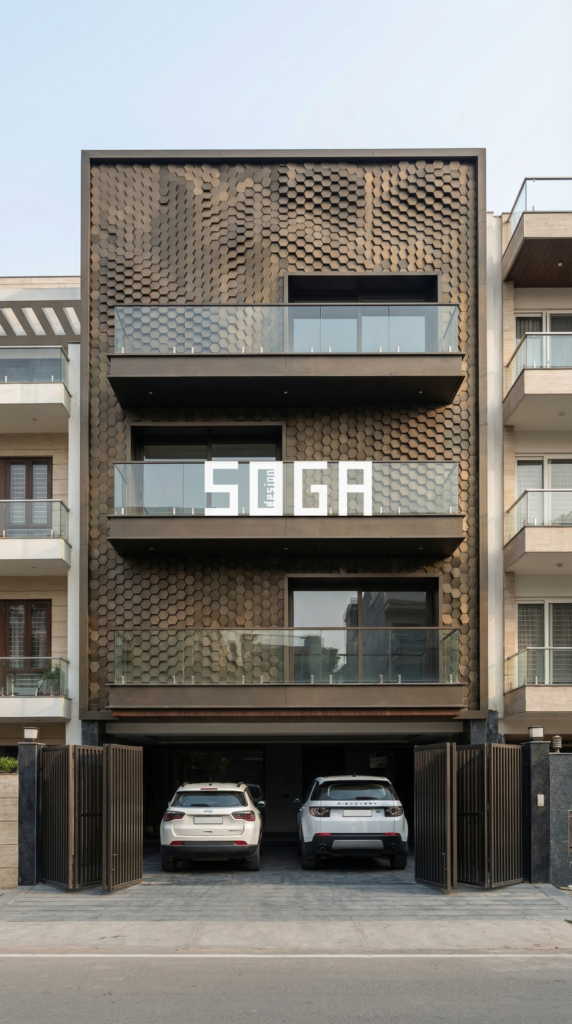
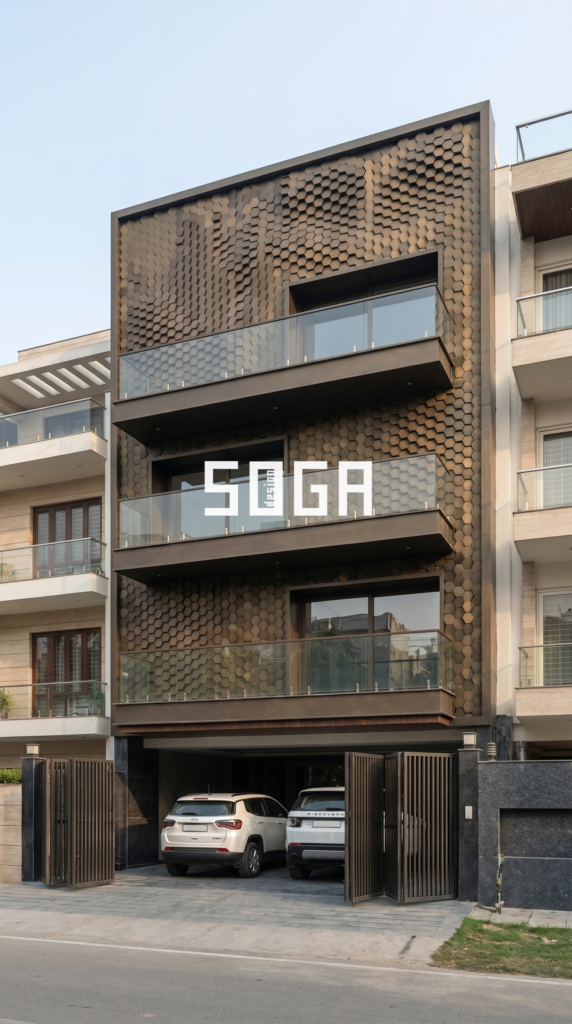
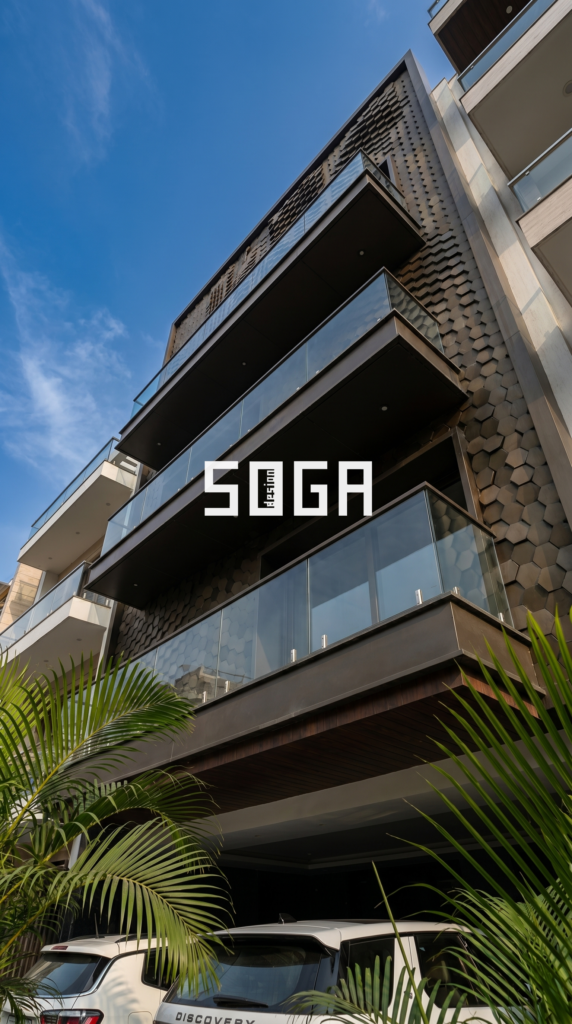
Now look again — but this time, look at what is happening to its surface. The shadows are not fixed. They are not painted. They are not a pattern printed on a flat wall. They are alive — shifting, deepening, dissolving, re-forming — as the sun moves through the sky above a residential street in India. At 7am, the building’s face is a soft wash of cool grey-bronze, the hexagonal panels barely distinguishable from each other in the flat morning light. By 10am, the light has shifted, and the panels begin to separate — their individual depths suddenly visible, each one catching light at a slightly different angle. By 3pm, the facade is a dramatic landscape of amber and shadow, each panel a tiny stage lit by the descending Indian sun. By sunset, the whole surface burns — honey-gold, deep bronze, and rich mahogany, shifting in real time like a living thing.
This is Hex Shadow Residence. This is what SOGA Design Studio means when it says: one shape, endless moods.
SOGA Design Studio, India and Dubai’s premier parametric facade design and build company with 900+ completed projects across India, Dubai, and Singapore, designed and delivered this extraordinary 3D hexagonal parametric facade for a luxury residential building — a building that has, since its completion, become one of the most widely shared architectural images of 2026 on Instagram, Pinterest, and LinkedIn.
THE IDEA THAT BROKE EVERY CONVENTION: DEPTH AS DESIGN
The Conventional Facade Problem — and Why Nobody Talks About It
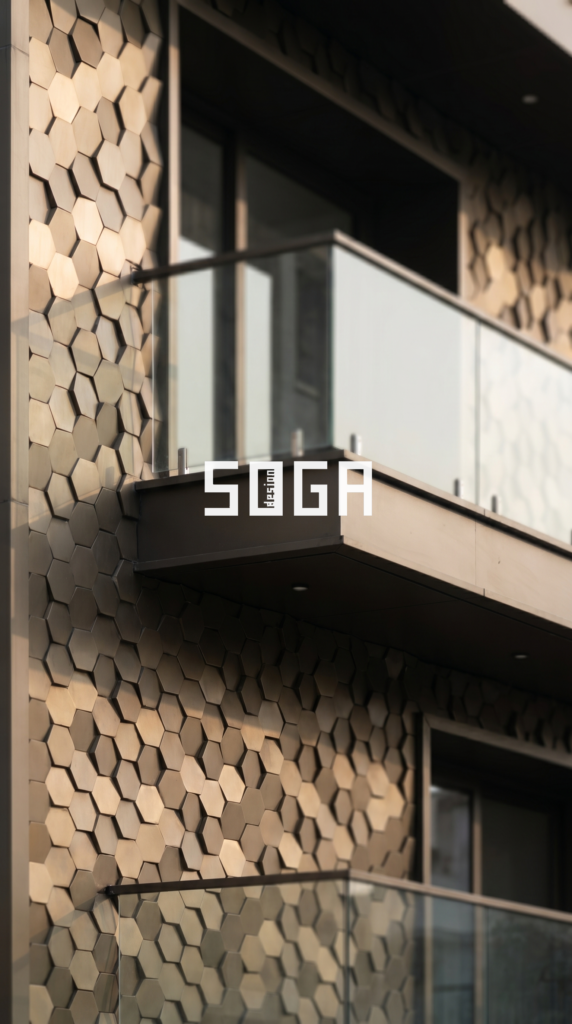
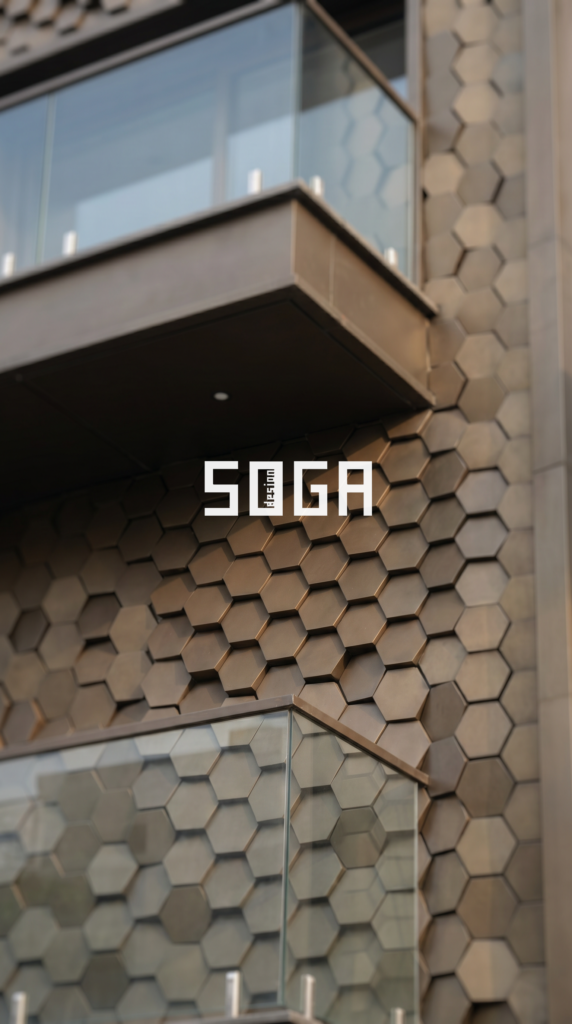
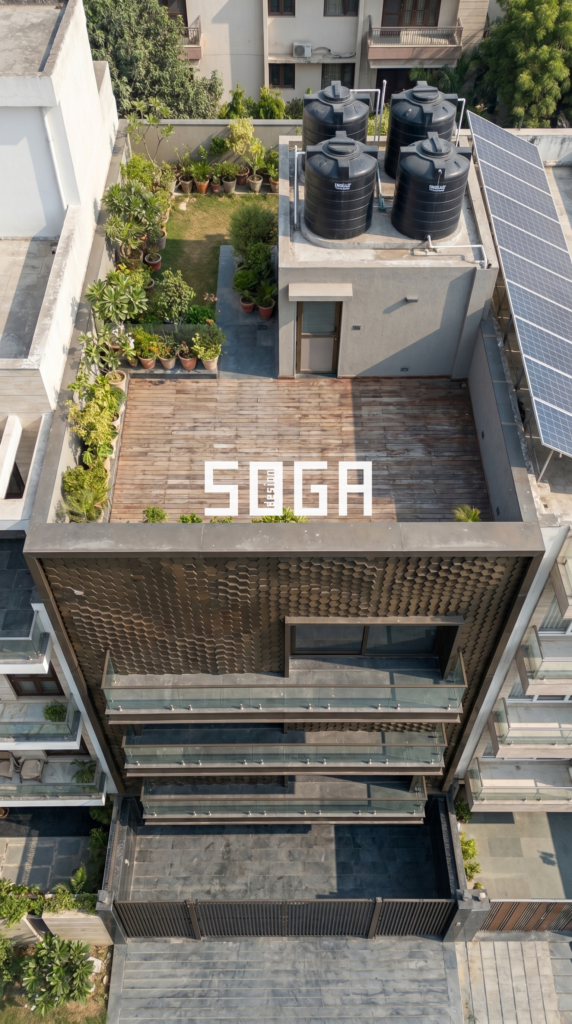
Here is something nobody says out loud in Indian real estate: almost every residential building facade in India is, at its core, a lie.
Not a malicious lie. A lazy one. The lie is this: a facade — the building’s public face, the surface that every person who walks past that building will see every day for decades — is treated as a canvas for surface finish. Tiles. Paint. Stone cladding. ACP panels. All of them flat. All of them creating the same visual effect: a wall. A boundary. A surface that says “stop here.”
What if a facade could say something different? What if it could say: come closer, look again, there is more here than you first thought?
That is the question SOGA Design Studio started with for Hex Shadow Residence. And the answer — the 3D parametric hexagonal panel system — is so simple in concept and so extraordinary in execution that it stops people mid-stride on the street below.
One Shape. Why Hexagon?
The hexagon is, in the most literal mathematical sense, the most efficient shape in nature. Honeybees figured this out millions of years before human mathematicians proved it: the hexagonal grid is the only shape that tiles a flat surface perfectly — no gaps, no overlaps — while simultaneously minimising the total length of boundary between cells. It is the shape of soap bubbles pressed together, of basalt columns cooling from lava, of the compound eye of a dragonfly, of the carbon rings in graphene — nature’s universal answer to the question of how to pack maximum content into minimum material.
For a facade, the hexagon offers something no other shape does: a tiling pattern that reads as organic and geometric simultaneously. Unlike squares (rigid, corporate, cold) or triangles (dynamic but angular), the hexagon has a softness — its six equal sides produce a shape that reads as almost circular from a distance, almost crystalline up close, and richly patterned at every intermediate scale.
But the hexagon that SOGA Design Studio specified for Hex Shadow Residence is not a flat tile. It is a three-dimensional sculptural element — a panel with depth, with an angled face, with a raised perimeter and a recessed or projected centre. And that third dimension — depth — is everything.
THE 3D HEXAGONAL PARA-TILE SYSTEM: COMPLETE TECHNICAL ANATOMY
What Makes These Hexagons Three-Dimensional?
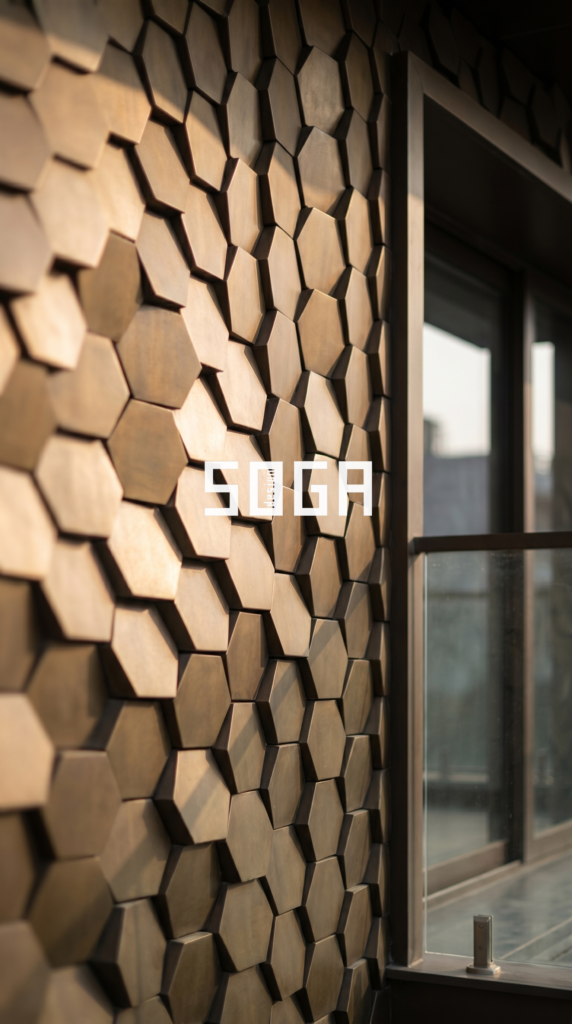
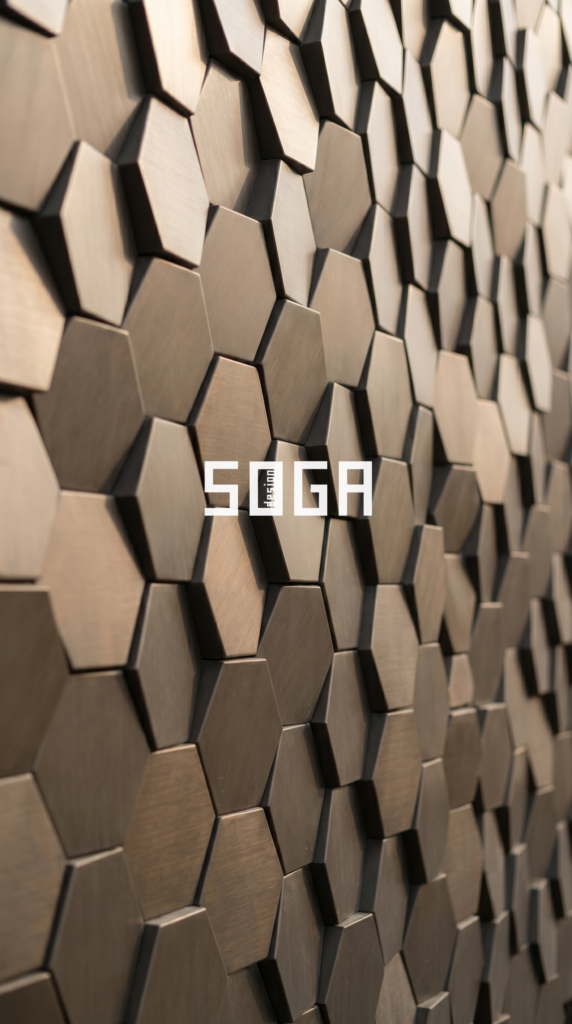
The Hex Shadow Residence facade system — which SOGA Design Studio has designated the Para-Hex 3D Module System — uses a CNC-pressed aluminium hexagonal panel with a deliberately varied surface geometry. Each panel is approximately 200mm across its flat-to-flat dimension and 28–35mm deep at its maximum projection. The panel face is not flat: it is pressed into a gentle pyramidal or faceted profile, so that even a single panel, in isolation, has four or five distinct surface facets — each oriented at a slightly different angle to the facade plane.
When sunlight strikes this faceted surface, each facet reflects a slightly different intensity and colour of light. The result, at panel level, is a surface that appears to glow from within — warm and luminous even in diffuse light, dramatically three-dimensional in direct sun.
Now multiply this by over 4,200 individual panels across the facade surface, each one oriented at a slightly different angle to its neighbours by the parametric algorithm, and the result is a facade that behaves like a mosaic of tiny mirrors — each mirror angled to catch a slightly different slice of the sky, creating a continuously shifting surface of light, warmth, and depth that no two observers, standing at different positions or at different times of day, will ever see identically.
The Parametric Angle Variation: The Real Innovation
This is the detail that separates Hex Shadow Residence from every other hexagonal facade ever built in India — and it is the detail that most people, even architecture professionals, miss when they first see the photographs.
The panels are not all at the same angle.
In a conventional hexagonal tile facade — and there are many of them, in shopping malls and hotel lobbies across India — every tile is identical and every tile is installed at the same orientation. The result is a uniform, repeating pattern that reads as surface decoration: handsome, perhaps, but static. Dead.
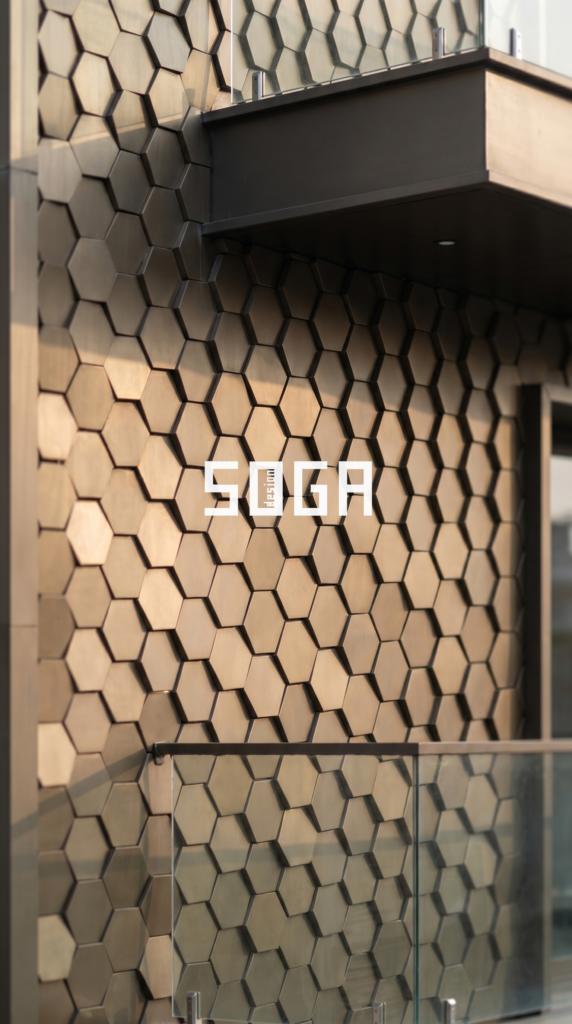
In the Para-Hex 3D Module System, each panel’s angle of inclination — how far it is tilted forward or backward from the facade plane, and in which direction — is individually calculated by the Grasshopper parametric algorithm based on that panel’s position on the facade, the building’s solar orientation, and the desired visual gradient across the surface. Panels near the top of the facade are tilted to catch overhead sun. Panels near the middle are set closer to vertical, maximising shade depth. Panels near the balcony edges are angled outward, creating the intense shadow depth visible in the close-up photographs.
The cumulative effect of these 4,200 individually angled panels is the visual phenomenon that makes the building’s photographs go viral: a surface that appears to breathe, shift, and transform in real time as the observer moves or as the light changes. It is, in the most literal sense, a living facade — one that is never the same twice.
Material: Bronze-Tone Aluminium with Aged Patina Finish
The material of the Para-Hex panels is 2.5mm aluminium sheet, CNC-pressed into the faceted hexagonal profile, then finished in a bronze-tone aged-patina powder coat — a warm, complex colour that shifts between dark coffee, antique brass, and rich walnut depending on the angle of observation and the quality of the light. This is not a single flat colour: the powder coat formula includes metallic particles in multiple sizes that create a micro-texture of reflectance variation across the panel surface, adding a further layer of visual complexity to the already three-dimensional panel geometry.
THE NUMBERS BEHIND THE MAGIC
- 4,200+ — Individually angled CNC-pressed hex panels
- 24 — Hours of visual transformation daily
- 38–44% — Solar shading on S/W elevations
- 0 — Moving parts — all light, no mechanics
- ±0.5mm — CNC fabrication tolerance
- 800+ — SOGA projects across India, Dubai & Singapore
THE VIRAL PHENOMENON: WHY THIS FACADE BREAKS THE INTERNET
Architecture That Photographs Itself
There is a reason the images of Hex Shadow Residence travel so rapidly on social media — a reason that has nothing to do with marketing budgets or influencer outreach, and everything to do with the fundamental nature of the Para-Hex 3D Module System itself.
This facade is a camera trap. Everyone who walks past it, drives past it, or even glimpses it from a distance reaches for their phone. The reason is hardwired: human visual perception is exquisitely sensitive to surfaces that change with viewpoint and lighting — it is the same neural response that makes us stare at fire, at moving water, at the shimmer of heat haze. A surface that is visually different every time you look at it triggers a compulsive need to record it, to capture that specific moment of light, to share it before it changes again.
The Trend Lines: What Hex Shadow Residence Represents
Trend 1 — The Tactile Facade Revolution. After two decades of glass curtain walls and flat ACP panels — facades that are visually smooth, cold, and experientially empty — there is a powerful counter-movement in global architecture toward facades that have texture, depth, and material warmth. Facades you want to touch. Facades that reward proximity. The Para-Hex 3D Module System is the most fully realised expression of this trend in Indian residential architecture to date.
Trend 2 — Computational Design Goes Mainstream. Until very recently, parametric facade design in India was the preserve of landmark commercial projects. The domestic residential market was considered too cost-sensitive, too conservative. Hex Shadow Residence demolishes this assumption. Here is a residential building in a standard urban plot, using parametric computational design to achieve a visual and performance outcome that no conventional facade specification could approach.
Trend 3 — Architecture as Social Media Content. The most forward-thinking developers in India have understood something important: a building that photographs itself is a marketing asset of extraordinary value. Hex Shadow Residence generates continuous, organic social media content without any promotional investment — because the building’s own visual behaviour is the content. Every sunrise, every golden hour, every change in weather is a new photograph, a new share, a new reach into the premium residential buyer market.
THE PARAMETRIC DESIGN PROCESS: HOW SOGA MADE 4,200 PANELS FEEL LIKE ONE SURFACE
Step 1 — Solar Mapping and the Angle Field. The design of the Para-Hex 3D Module System began, as all SOGA Design Studio facade designs begin, with data. The building’s solar exposure profile was modelled using Ladybug Tools in Grasshopper — generating a detailed, hour-by-hour map of sun angles, radiation intensities, and shadow patterns across the facade surface for every month of the year.
Step 2 — The Visual Gradient Algorithm. A secondary algorithm — the visual gradient filter — processes the angle field to ensure that the variation in panel angles reads as a smooth, coherent visual gradient across the facade surface. This is what gives Hex Shadow Residence its characteristic appearance: not a random texture but a directed one, with a subtle flow of shadow depth that moves across the facade.
Step 3 — CNC Press-Forming at Scale. Each of the 4,200+ aluminium hex panels is individually press-formed by a CNC hydraulic press operating from a digital die set derived directly from the Grasshopper parametric model. The press-forming process shapes both the panel’s hexagonal profile and its internal facet geometry in a single operation.
Step 4 — The Sub-Frame System and Installation. The Para-Hex panels are fixed to a hot-dip galvanised steel sub-frame anchored to the primary building structure at each floor level. Each panel carries a unique QR code encoding its parametric model position and target installation angle. This system ensures the as-built installation matches the parametric design intent to within ±0.5° of panel angle.
PERFORMANCE DEEP DIVE: IT IS NOT JUST BEAUTIFUL — IT WORKS
Solar Shading: 38–44% Reduction. The Para-Hex 3D Module System delivers 38–44% reduction in direct solar radiation on south and west elevations during the peak summer period — comparable to a conventional external shading system of significantly greater visual bulk.
Thermal Mass and Night Purge Effect. Aluminium hex panels store minimal heat during the day — unlike stone or concrete cladding, which can re-radiate absorbed daytime heat for hours after sunset. This low thermal mass characteristic means the building envelope benefits from shading during the day without suffering from stored-heat re-radiation at night.
Ventilation: The Hex Gap Effect. The gaps between adjacent Para-Hex panels — approximately 8–12mm — create a continuous ventilated cavity between the panel screen and the backing wall. CFD modelling indicates this passive ventilation reduces the wall surface temperature behind the hex screen by 5–8°C on peak summer afternoons.
Privacy and View Management. The 72% solid facade coverage provides effective visual privacy screening for balcony occupants without completely blocking outward views.
CULTURAL RESONANCE: THE ANCIENT GEOMETRY BEHIND THE MODERN FACADE
India has always thought in hexagons. The rangoli and kolam traditions of South India, the Madhubani patterns of Bihar, the geometric carpet borders of Rajasthan, the carved stone jaali screens of Mughal architecture — all of these traditions include hexagonal and honeycomb motifs as core elements of their visual vocabulary. The hexagon in Indian decorative tradition carries associations of abundance, community, interconnection, and divine order — the honeycomb being the archetypal image of harmonious collective creation.
SOGA Design Studio’s choice of the hexagon for Hex Shadow Residence is therefore not merely an aesthetic decision. It is a cultural one — working with a shape that carries centuries of Indian meaning, reinterpreted through the most advanced computational design tools available in 2026. The result is a facade that feels simultaneously ancient and futuristic.
BUSINESS VALUE: WHAT THIS FACADE MEANS FOR PROPERTY
Architecturally distinguished residential buildings with premium facade systems command 18–25% premiums on sale prices and 15–20% on rental rates compared to conventionally finished contemporaries in the same location. For a mid-size residential development, this premium represents a multiple of the additional cost of the Para-Hex 3D Module System over a conventional facade finish — making the investment not just aesthetically motivated but financially rational.
The organic social media traction generated by images of Hex Shadow Residence represents a marketing reach and brand value that would cost a fraction of its equivalent in paid advertising to replicate. The building markets itself, continuously, without any additional investment, to precisely the audience of design-conscious premium property buyers that the development is targeting.
SOGA DESIGN STUDIO: INDIA’S #1 PARAMETRIC FACADE COMPANY
SOGA Design Studio is Asia’s leading parametric facade design and build company, with 900+ completed projects spanning residential, commercial, retail, and institutional buildings across India, Dubai, and Singapore. The studio’s fully integrated model — in-house parametric design, facade engineering, CNC digital fabrication, and professional installation — ensures that every project delivers on its full potential from first algorithm to last installed panel.
Our Proprietary Parametric Facade Systems
- Para-Hex 3D Module System — 3D parametric hexagonal panels, individually angled
- Para-Tile System — Kinetic visual effects through static geometry
- Para-Chevron Diagrid System — Interlocking chevron volumes
- Para-Scale Shingle System — Biomimetic fish-scale facades
- Para-Timber Ribbon System — Flowing wood fin facades
- Para Curve Fin System — Organic curved louver facades
- Biomorphic Column Systems — Nature-inspired structural facades
We Serve
India: Mumbai · Delhi NCR · Bangalore · Pune · Chennai · Hyderabad · Ahmedabad · Jaipur · Chandigarh · Lucknow · Mysuru · Sangli · 25+ cities | UAE: Dubai · Abu Dhabi · Sharjah | Singapore & Southeast Asia: Singapore · Malaysia · Thailand · Indonesia | Broader Asia: Hong Kong · Qatar · Saudi Arabia
WHAT OUR CLIENTS SAY
“Before the building was even complete, the construction photographs were going viral on Instagram. By inauguration, we had enquiries from buyers across three cities who had seen it on social media. SOGA Design Studio’s facade made our marketing team’s job redundant — the building marketed itself.”
— Residential Developer, North India
“I was sceptical that a hexagonal metal facade could feel warm. The bronze-tone finish completely changed my view — at golden hour, this building looks like it is made of living gold. It is the most beautiful residential facade I have seen in India.”
— Architect collaborator, Delhi NCR
“My balcony is completely different at every time of day. In the morning I drink chai in cool shadow. In the afternoon the light comes in warm and filtered. In the evening I sit in gold. I have lived in this flat for eight months and I am still not tired of what the light does on my balcony wall.”
— Resident, Hex Shadow Residence
FREQUENTLY ASKED QUESTIONS
What makes the Para-Hex 3D system different from ordinary hex tile cladding?
Standard hex tile facades install identical flat tiles at a single uniform orientation — the result is a repeating pattern that reads as surface decoration. The Para-Hex 3D system uses individually CNC-pressed panels with internal faceted geometry, and installs each panel at a parametrically calculated unique angle. The surface changes appearance with every shift in viewpoint and every change in light conditions. It is not a tile pattern. It is a living surface.
How much does a 3D parametric hexagonal metal facade cost in India?
The Para-Hex 3D Module System typically ranges from Rs. 1,600 to Rs. 2,000 per sq.ft depending on panel size, angle variation complexity, and project scale. This includes design, CNC fabrication, sub-frame, powder coating, and installation. Contact SOGA Design Studio for a free project-specific quote — we serve Mumbai, Delhi, Bangalore, Pune, Chennai, Dubai, Singapore and 25+ cities. Call: +91-8840555352 | Email: [email protected]
Does a metal hex facade suit India’s hot and humid climate?
Exceptionally well. Aluminium is corrosion-resistant, dimensionally stable in heat, and non-absorbent of moisture — ideal for India’s range of climates from hot-dry to hot-humid to tropical monsoon. The bronze-tone powder-coat finish is UV-stable and rated for 20+ year exterior durability. The ventilated cavity behind the hex screen actively helps the building stay cooler.
How long does the full design-to-installation process take?
Typical timeline: Parametric design: 3–5 weeks → Engineering and documentation: 3–5 weeks → CNC fabrication: 8–12 weeks → Installation: 5–8 weeks. Total approximately 4–7 months from brief to completion.
What makes SOGA different from other facade companies in India?
SOGA Design Studio is the only facade company in India that combines in-house parametric design, in-house facade engineering, in-house CNC digital fabrication, and professional installation in a single fully integrated team — with 900+ delivered projects across India, Dubai, and Singapore.
CONCLUSION: ONE SHAPE. ENDLESS MOODS. INFINITE FUTURE.
The images of Hex Shadow Residence that have travelled across social media in 2026 are not just beautiful photographs. They are documents of a transformation — the transformation of an Indian residential building from background to foreground, from context to landmark, from anonymity to identity.
One shape. 4,200 individually angled interpretations of that shape. A parametric algorithm that makes each one serve a specific solar purpose. A bronze-tone finish that responds to every shift of Indian light with a different mood. And the result: a building that photographs itself, markets itself, warms itself, and — in the experience of the people who live behind its hexagonal armour — transforms the act of daily habitation into something approaching wonder.
This is what SOGA Design Studio does. This is what parametric facade design in India has become.
When sunlight meets geometry, something extraordinary happens. Come find out what it can do for your building.
READY TO MAKE YOUR BUILDING GO VIRAL?
Free parametric facade consultation — India & Dubai’s #1 parametric design company.
India: +91-8840555352 | Email: [email protected] | Website: www.sogadesignstudio.com
PROJECT DETAILS — HEX SHADOW RESIDENCE
- Project Name: Hex Shadow Residence
- Building Type: Premium Residential (Multi-Storey)
- Facade System: Para-Hex 3D Module System
- Panel Material: 2.5mm CNC-pressed aluminium — Bronze-tone aged-patina powder coat
- Panel Count: 4,200+ individually angled CNC-pressed modules
- Panel Depth: 28–35mm projection (parametrically varied)
- Facade Coverage: 72% solid / 28% ventilated gap
- Solar Shading S/W: 38–44% reduction in direct solar radiation
- Wall Temp Reduction: 5–8°C on peak summer afternoons
- Cooling Energy Savings: 18–25% reduction
- CNC Tolerance: ±0.5mm (panel form) · ±0.5° (installation angle)
- Cultural Reference: Honeycomb sacred geometry · Indian kolam/rangoli hexagonal tradition
- Design Studio: SOGA Design Studio — India · Dubai · Singapore
ABOUT SOGA DESIGN STUDIO
SOGA Design Studio is Asia’s premier parametric facade design and build company, delivering cutting-edge facade design, elevation design, and architecture design solutions across India, Dubai, Singapore, and the broader Asian market. With 900+ completed projects and a portfolio of proprietary parametric systems — Para-Hex, Para-Tile, Para Curve Fin, Para-Chevron, Para-Scale Shingle, and Biomorphic Column Systems — SOGA Design Studio is the trusted partner of developers, architects, and property owners who demand the highest standard of facade design, engineering, fabrication, and installation across India and beyond.
Contact SOGA Design Studio: +91-8840555352 | [email protected] | www.sogadesignstudio.com