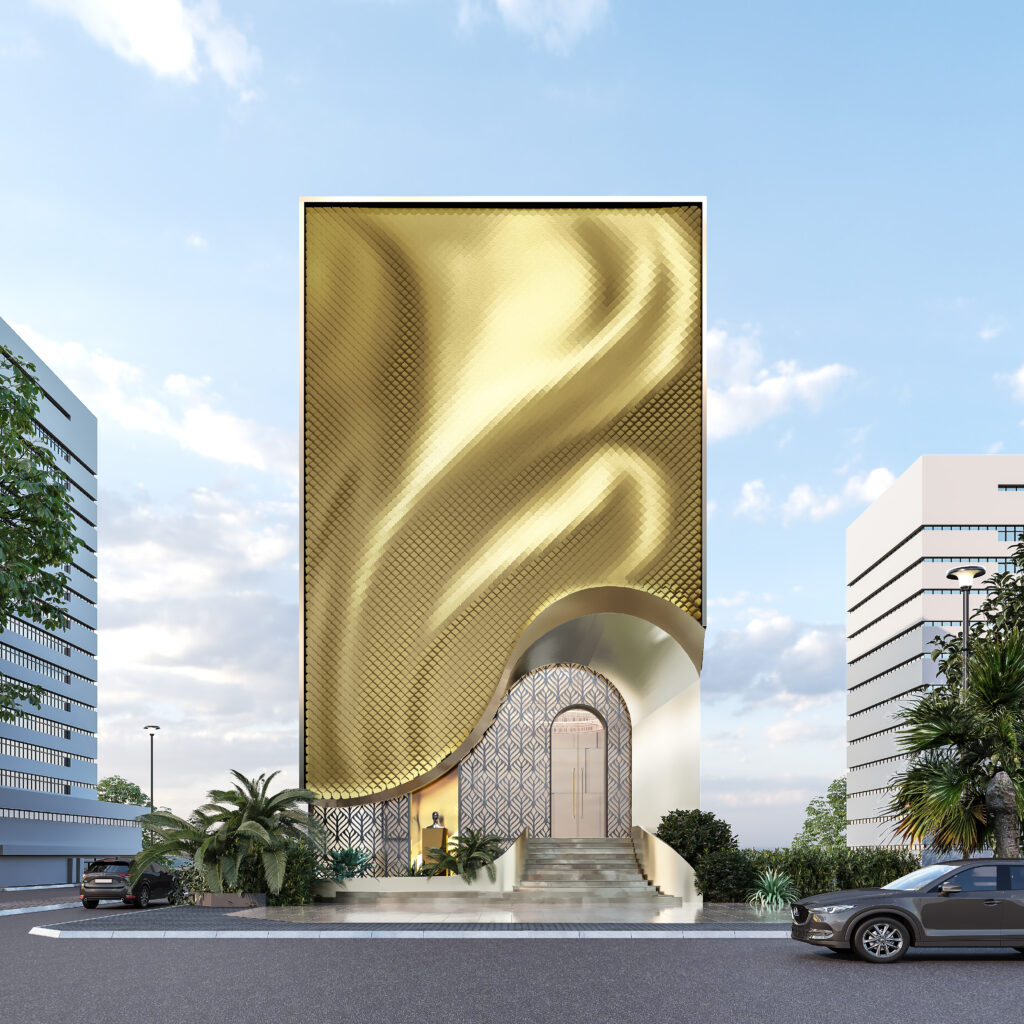
T R Jewels in Bangalore represents a bold vision in contemporary jewelry retail architecture. This concept design by Soga Design Studio showcases a stunning parametric metal facade that redefines luxury retail aesthetics through innovative technology and geometric precision.
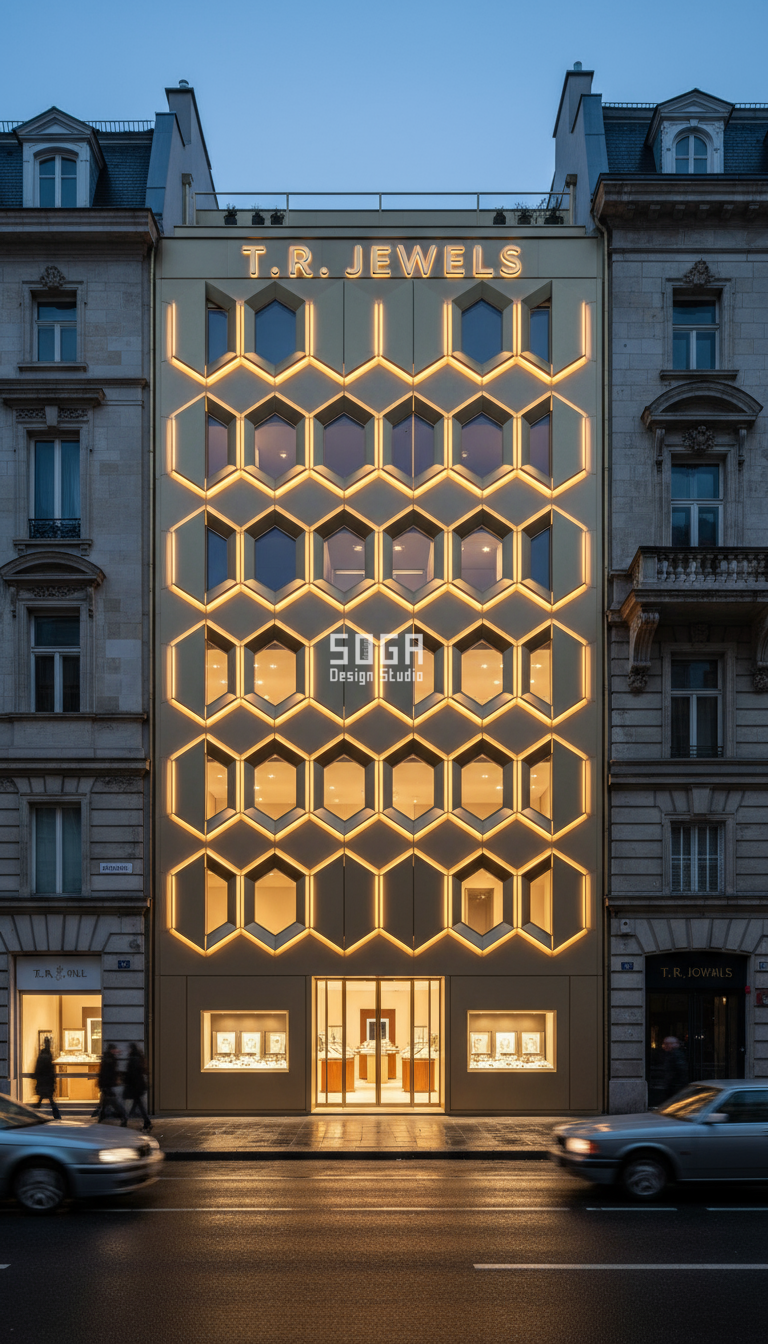
The centerpiece of this architectural marvel is the hexa block pattern—a sophisticated geometric arrangement that creates visual depth and dynamic shadow play throughout the day. This parametric approach utilizes computational design algorithms to generate an intricate metal facade system that is both structurally efficient and visually captivating.
The metal facade features precision-engineered panels arranged in a hexagonal tessellation, creating a honeycomb-like structure that symbolizes the craftsmanship and precision synonymous with fine jewelry. Each hexagonal module is carefully calibrated to optimize material usage while maximizing aesthetic impact.
Integrated LED lighting transforms the facade into a luminous canvas after sunset. Strategically placed within the hexa block pattern, these LED systems illuminate the parametric geometry, creating an enchanting interplay of light and shadow that draws attention and elevates the store’s street presence.
Soga Design Studio’s expertise in parametric architecture ensures this T R Jewels concept combines cutting-edge facade technology with timeless design principles, establishing a landmark destination in Bangalore’s retail landscape.
The Design Concept
T R Jewels uses a hexagonal “hexa block” pattern as the organising logic of its facade. The hexagon — efficient, repeatable and naturally faceted — is parametrically scaled and rotated across the elevation so the surface tightens into a dense, jewel-like cluster around the entrance and opens up towards the edges. The result is a metal facade that feels crafted rather than manufactured, appropriate for a jewellery brand in Bangalore.
Material & Fabrication
Each hexagonal cell is a parametric metal module, its face angle varied to catch light differently across the wall. The panels are CNC-cut and folded from aluminium, powder-coated in a warm metallic finish, and mounted on a concealed sub-frame that allows the pattern to run cleanly around corners and openings. Because every cell derives from one parametric family, fabrication stays economical even though the finished surface never looks repetitive.
Why the Hexa Pattern Suits Bangalore Retail
Bangalore’s moderate climate lets a facade be expressive without heavy shading demands, so the hexagonal screen can prioritise identity and daylight play. The tessellated pattern reads as precision and value — exactly the associations a jewellery showroom wants — and creates a memorable, ownable shopfront in a crowded high street.
Frequently Asked Questions
Why a hexagonal pattern? Hexagons tessellate without gaps, are structurally efficient, and their facets naturally animate light — ideal for a parametric metal facade.
Is the pattern the same across the whole facade? No. The cells are parametrically scaled and rotated, so density and light-play change across the elevation while using one fabrication family.
How is it fixed to the building? Panels hang on a concealed aluminium sub-frame, which keeps fixings hidden and allows individual cells to be serviced.
About This Project
This is one of the parametric facade projects by SOGA Design Studio, a parametric architecture and facade practice founded in 2021 in Gurugram, Haryana by architects Sonali Jaiswal and Gajender Sharma. The studio designs and engineers parametric metal facades across India and the Gulf, working in Rhinoceros 8 and Grasshopper and issuing fabrication-ready CAD with numbered panel schedules.
Facades are delivered from five costed, factory-ready systems — SogaGrid, SogaWeave, SogaShell, SogaScreen and SogaPulse — in aluminium and GFRC, with powder coat, PVDF or anodised finishes. Finishes carry a 10-year colour and adhesion warranty and the aluminium substrate a 25-year warranty. Design-only fees run ₹80–₹250 per sq ft of facade area; full design-to-handover engagements are 5–9% of facade construction cost.
Explore Further
- All projects: SOGA parametric facade case studies by city and typology
- City guide: Facade design in Bangalore
- How it works: Parametric facade design — systems, materials and cost per sq ft
- Costs: Parametric facade cost in India 2026
- Background: Parametric architecture in India — the complete guide