By SOGA Design Studio | 550+ Parametric Facade Projects Across India
Every architect has access to a louver. Very few know what to do with it.
A louver is the most basic element in facade design. A vertical fin. Extruded aluminium. Any fabricator in any Indian city can produce one. There is nothing rare, imported, or proprietary about it as a raw element.
And yet — it is the single most powerful tool a facade designer has. Not despite its simplicity, but because of it.
The six projects in this article all start at the same point: one aluminium louver produced from one system — SOGA Louver. Same material. Same manufacturer. Same zero-maintenance promise. But no two facades look alike. No two create the same spatial experience. No two solve the same problem the same way.
The difference is never the louver. The difference is always what you decide to do with it.
This is the story of six decisions.
Project 1: The Angular Cantilever
Design move: Structural fins that twist and cantilever outward, creating angular drama from ground to rooftop.
Most louver facades sit flat against the building face like a screen. This project does the opposite — the fins push outward at aggressive angles, extending past the building edge to create deep cantilevers that double as sun shading and visual volume.
The effect is confrontational in the best sense. The building doesn’t recede politely into its neighborhood. It pushes forward. The angled fins catch morning light on one surface and throw shadows on the other, creating a facade that is never the same twice in a single day.
What makes it work: The louvers here are doing structural work, not just screening work. Each fin is anchored at a calculated angle that distributes load while maximizing overhang depth. The twist across the facade is parametrically controlled — not random, not decorative, but engineered to create the maximum angular variation from the minimum number of unique components.
The design lesson: A louver doesn’t have to sit flat. Angle it, and it becomes a cantilever. Cantilever it, and it becomes architecture.
Project 2: The Quiet Rhythm
Design move: Clean vertical louvers in warm wood-shade — uniform spacing, no drama, pure material confidence.
Not every facade needs to shout. This project proves that a louver arranged simply — vertical, evenly spaced, consistent height — can still carry tremendous presence when the material finish does the talking.
The warm wood-shade aluminium gives the building a warmth that reads as timber from the street but performs as maintenance-free metal behind the scenes. The evening light catches the grain texture and turns the entire elevation into amber. No curves. No variable heights. No computational gymnastics. Just one decision made well: vertical louvers, warm finish, floor to sky.
What makes it work: Restraint. In a market where every builder wants to add “one more material” to the facade, this project strips everything back to one element and lets it breathe. The confidence comes from committing fully to a single idea rather than hedging with five.
The design lesson: You don’t need complexity to create impact. You need conviction. A simple louver, applied with total commitment, creates a facade that ages better than any combination of competing materials ever will.
Project 3: The Diamond Cut
Design move: Louvers arranged in a diamond-cut pattern, creating geometric negative spaces that throw dramatic shadows across the elevation.
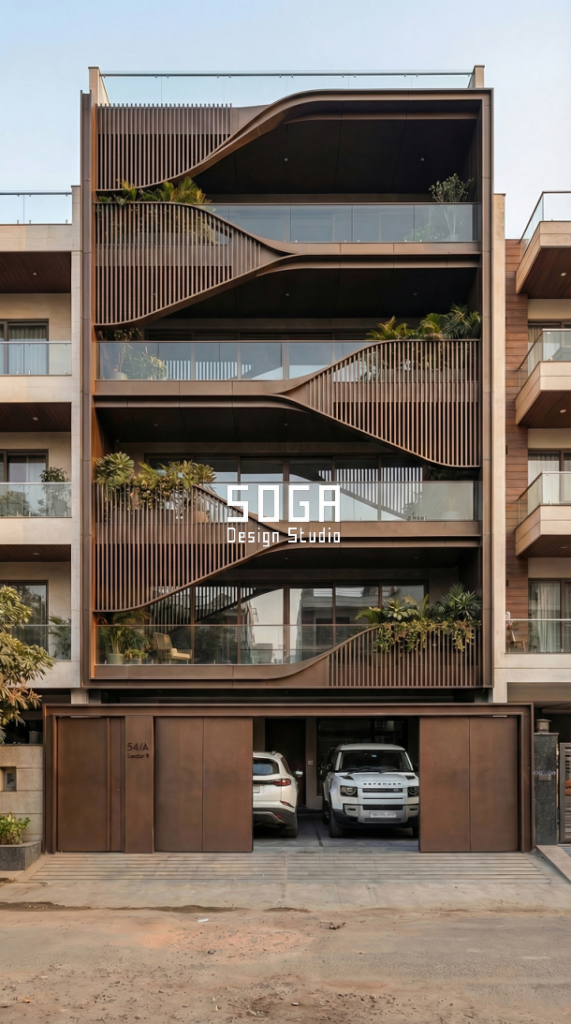
This facade reads differently from every other project in this series — and it should. The louvers here aren’t arranged vertically. They’re positioned in a diagonal cross-pattern that creates diamond-shaped voids, turning the facade into a screen of geometric light and shadow.
During the day, the diamond voids let controlled light into the interiors. From outside, the pattern creates a visual depth that makes a standard residential building feel like a crafted object. The warm finish ties it to the other projects in materiality, but the geometry is entirely its own language.
What makes it work: The diamond pattern isn’t arbitrary. Each void is sized and positioned to correspond with the window openings behind it — larger diamonds where more light is needed, tighter where privacy takes priority. The pattern is the privacy strategy, the sun control strategy, and the aesthetic identity all in one layer.
The design lesson: A louver doesn’t have to be vertical. Rotate it, cross it, create negative space — and the same fin becomes a completely different design element. The geometry is the variable, not the material.
Project 4: The Heritage Dialogue
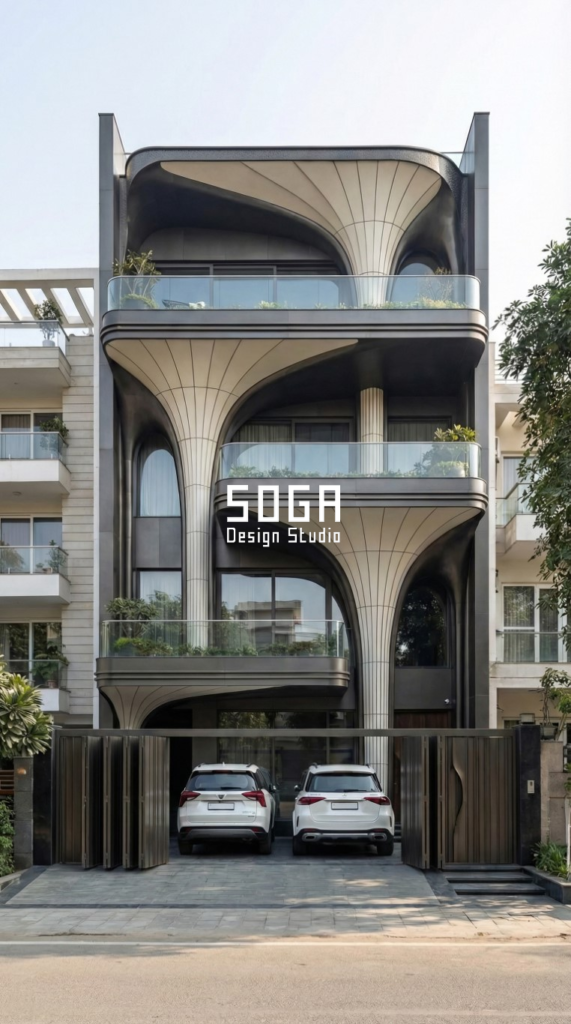
Design move: Louvers framing pointed arches — a direct conversation between parametric precision and traditional Indian architectural vocabulary.
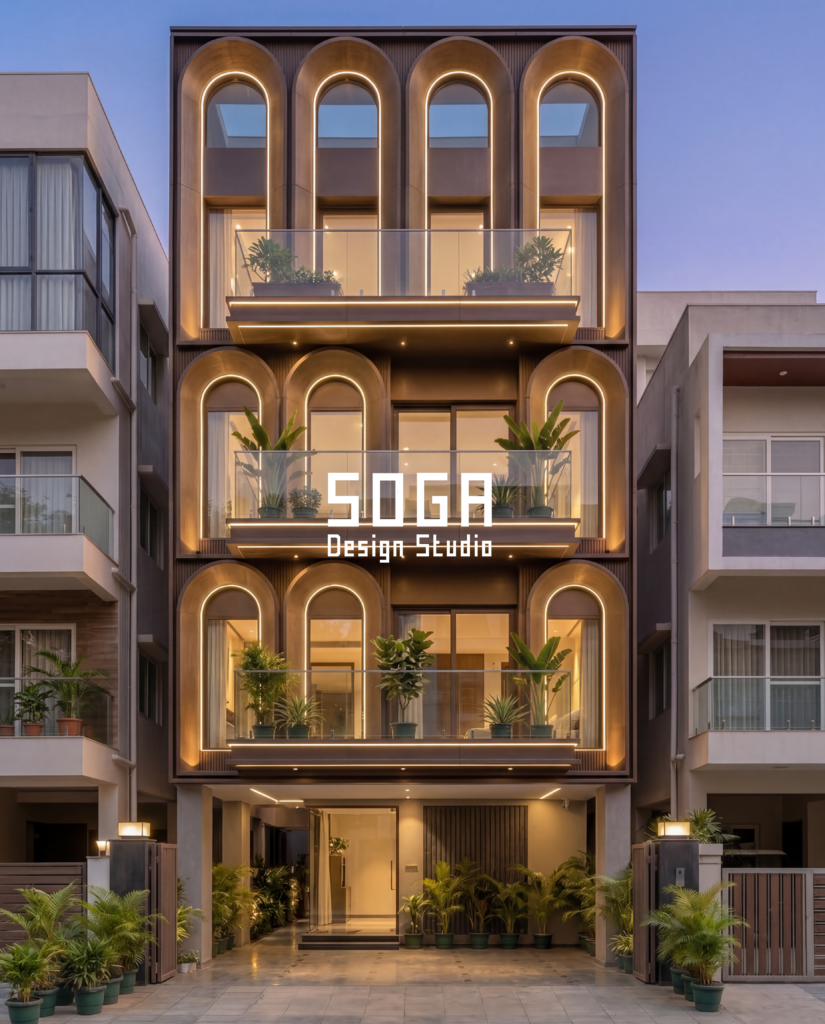
This is the project that surprises people most. Because it doesn’t look like what people expect from a parametric design studio. It looks like heritage architecture — arched openings, warm stone tones, proportions that reference Mughal and Rajasthani building traditions.
But look closer. The arches are formed by aluminium louvers, not carved stone. The pattern is computationally generated, not hand-drafted. The material is zero-maintenance aluminium with a heritage-finish coating, not sandstone that needs annual cleaning and re-pointing.
The project answers a question many Indian homeowners carry: Can my home feel rooted in Indian architectural tradition without looking dated?
What makes it work: The louver system adapts to any geometric vocabulary — including curves, arches, and pointed profiles — because the parametric model doesn’t care about style. It cares about geometry. Feed it an arch profile, and it generates the louver arrangement to create that profile precisely. The computational tool is style-agnostic. The design intent is cultural.
The design lesson: Parametric design is not a style. It is a method. It can speak any architectural language — including deeply traditional ones — with modern materials and permanent durability. The tool serves the idea, not the other way around.
Project 5: The Living Facade
Design move: Vertical louvers integrated with suspended planter pods — architecture and greenery growing together as one system.
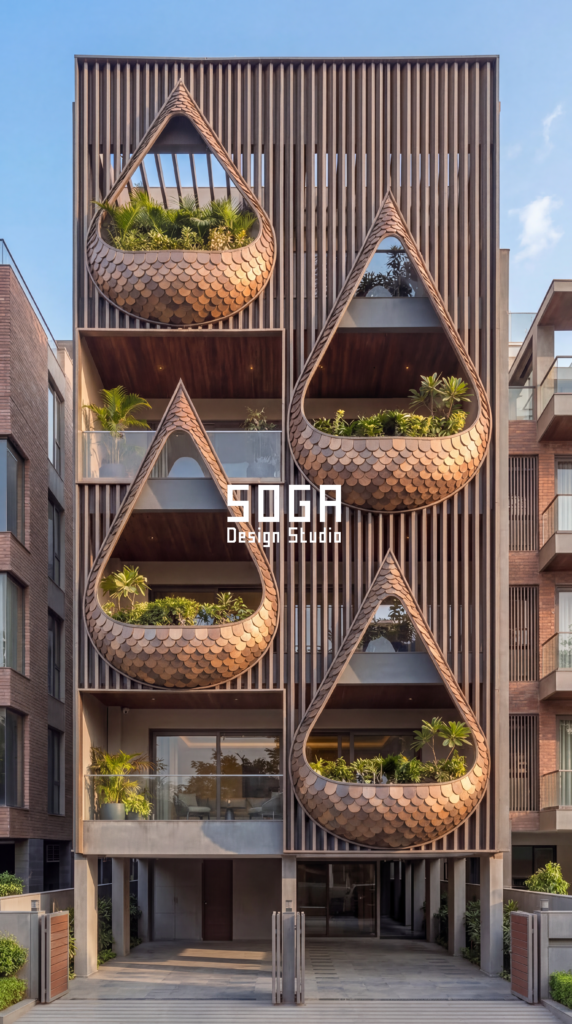
Biophilic design is a term that gets used loosely. Most “green facades” are buildings with plants added after the architecture is finished — creepers on a railing, pots on a ledge, a token vertical garden panel.
This project integrates planting into the louver system itself. Suspended pod-like planters emerge from within the louver rhythm, creating a facade where architecture and nature aren’t separate layers but one continuous composition.
The louvers provide the structural framework and the privacy screen. The planter pods occupy specific openings within that screen, placed where they receive adequate sunlight and create visual softness at the balcony edges. The building breathes in both senses — air moves through the louver gaps, and living plants metabolize within the facade surface.
What makes it work: The planter locations aren’t decorative choices. They’re parametrically positioned based on sun exposure mapping — each pod sits where it will receive the light hours needed for the plant species selected. The louver system is the host structure for both the screening function and the biological function. One system, dual purpose.
The design lesson: A louver system can carry more than just fins. It can become a framework for integrating living elements into the facade — turning a building skin from a passive barrier into an active, breathing surface.
Project 6: The Sculptural Flow
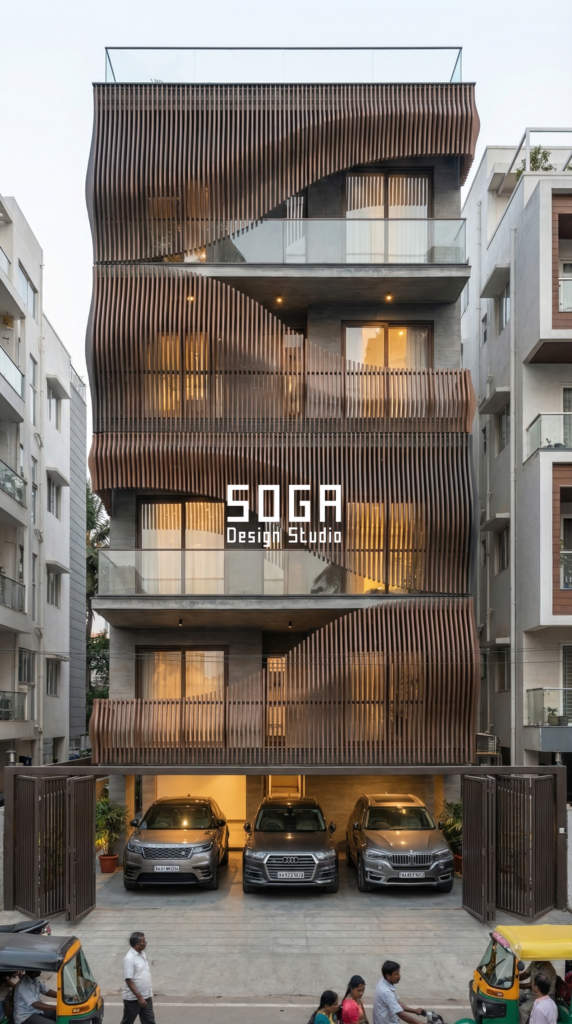
Design move: A continuous flowing S-form that wraps the building like a sculptural ribbon, transforming a standard residential plot into a three-dimensional landmark.
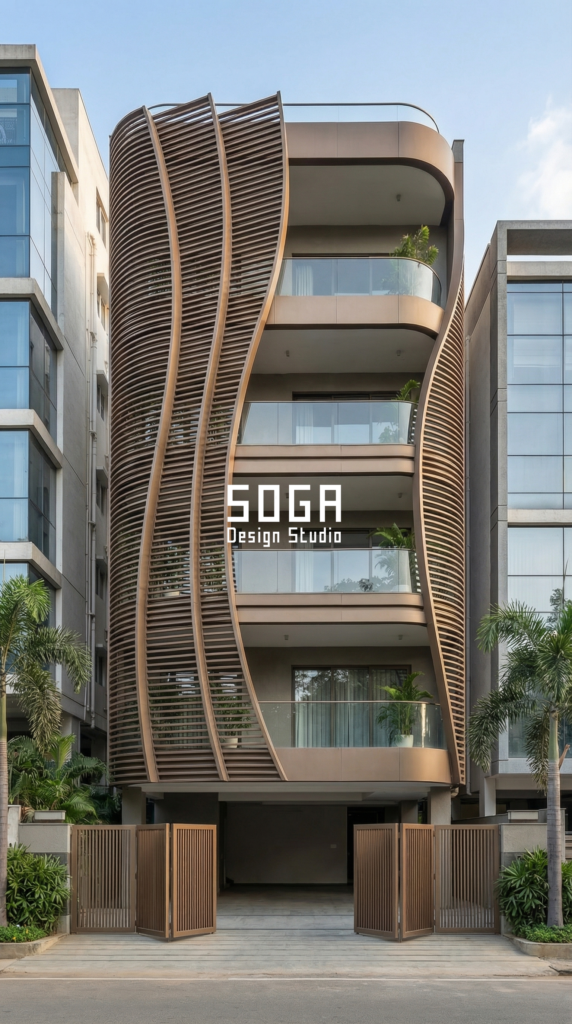
This is the project that pushes the louver the furthest from its origins. What started as a straight vertical fin has been curved, swept, and sculpted into a continuous flowing form that wraps the building’s corner and cascades across three floors.
The S-curve creates variable depth across the facade — deeper where it bulges outward (more shade, more privacy), shallower where it recedes (more light, more view). Every floor gets a different spatial experience from the same continuous gesture.
At dusk, the warm interior light filters through the flowing louver screen, and the building transforms from a daytime sculpture into a glowing lantern. The flow continues through the planters, the balcony edges, and into the building’s entry sequence below.
What makes it work: The curve is parametrically generated from a single sine-wave profile that was optimized for three criteria simultaneously: maximum shade at peak sun hours, minimum structural cantilever stress, and consistent louver spacing for fabrication efficiency. The resulting form looks organic and intuitive. Beneath it is rigorous computational logic.
The design lesson: There is no upper limit to what a louver can become. Bend it far enough, with enough precision, and it stops being a fin and starts being a form. That transition — from element to architecture — is where parametric design finds its fullest expression.
The common thread: same product, different thinking
Six projects. Six neighborhoods. Six clients with different tastes, budgets, orientations, and aspirations. And six facades that share nothing in common visually — except the one thing that matters most.
They all use SOGA Louver.
Same aluminium. Same zero-maintenance finish. Same fabrication pipeline. Same product system engineered for Indian climate conditions — monsoon-resistant, UV-stable, thermally efficient, permanently finished.
The material stayed constant. The design thinking changed. And that’s the entire point.
The Indian residential market has spent decades chasing facade identity through material accumulation — stone here, ACP there, wood cladding on the balcony, a different railing on every floor. More materials, more complexity, more maintenance, more visual noise.
These six projects represent the opposite philosophy: less material, more thinking. One element, deeply understood, computationally varied, and applied with conviction.
The result isn’t minimalism — several of these facades are visually rich and complex. The result is coherence. Each building speaks one language fluently rather than six languages badly.
What to ask before choosing your facade
If you’re planning a residential or commercial building, these six projects offer a framework for thinking about your own facade decision:
What is the one element you’re willing to commit to? Not three. Not five. One. The element that will carry your entire elevation and define your building’s identity.
What is that element doing beyond looking good? Is it controlling sun? Managing privacy? Enabling ventilation? Creating depth? The facade elements that last are the ones that earn their place through function, not just form.
Does your material choice match your maintenance reality? A material that looks beautiful on day one but needs annual upkeep is a liability, not an asset. Choose for the long run — decade-scale, not season-scale.
Is your design a collection of borrowed ideas, or one clear idea of your own? The most memorable facades in any neighborhood are the ones that commit to a singular vision. The forgettable ones are the ones that tried to combine everything they saw on Pinterest into one elevation.
About SOGA Louver
SOGA Louver is a premium aluminium louver system designed and manufactured by SOGA Design Studio. Engineered for parametric variation — curves, gradients, variable heights, angular profiles, heritage geometries — in Indian climate conditions.
Available finishes: wood-shade (multiple grains), white matte, dark bronze, heritage tones, custom RAL colors
Applications: residential facades, commercial buildings, boundary walls, gates, pergolas, balcony screens, planter integration systems
Performance: zero maintenance, rust-free, monsoon-proof, UV-stable, 50+ year lifespan, 100% recyclable
About SOGA Design Studio
SOGA Design Studio is a parametric and computational architecture firm based in Gurugram, India, founded by Gajender Kumar Sharma and Sonali Jaiswal. With 900+ facade projects delivered across India, Dubai, and Singapore, the studio specializes in transforming simple, buildable elements into facades that perform and stay memorable.
Core belief: The simplest element, designed with the strongest thinking, produces the most iconic results.
Website: sogadesignstudio.com Instagram: @sogadesignstudio
→ One Louver, Six Facades: Part 1 → 12 Facades, 1 Studio: Part 2 → 18 Facades, 1 Studio: Part 3 → How Much Does a Building Facade Cost? → Modern vs Traditional Facade Designs → How to Make Your Facade More Interesting → Facade Trends 2026 → Why Hire a Facade Specialist vs General Contractor?
FAQ
Q: Can one louver product create completely different facade designs? A: Yes. SOGA Louver is engineered for parametric variation — the same aluminium profile can be curved, angled, varied in height, arranged in geometric patterns, or combined with planter systems to produce entirely different facades from the same base product.
Q: Is aluminium louver suitable for traditional Indian architectural styles? A: Absolutely. As demonstrated in Project 4 (The Heritage Dialogue), SOGA Louver can be parametrically configured to create arched profiles, heritage patterns, and traditional Indian architectural vocabulary — with zero-maintenance modern materials.
Q: How much does a parametric louver facade cost compared to standard cladding? A: A SOGA Louver facade typically costs 1000 sqft more than standard ACP or stone cladding at installation, but delivers significant lifecycle savings through zero maintenance requirements over 20+ years. The total cost of ownership is typically lower than maintenance-heavy alternatives.
Q: What finishes are available for SOGA Louver? A: Wood-shade (multiple grain options), white matte, dark bronze, heritage tones, and custom RAL colors. All finishes are permanent anodized or powder-coated treatments that require no repainting.
Q: Can SOGA Louver integrate with biophilic/planter systems? A: Yes. As shown in Project 5 (The Living Facade), the louver framework can host suspended planter pods positioned parametrically based on sun exposure mapping, creating facades where architecture and greenery function as one integrated system.
Q: How long does it take to install a parametric louver facade? A: SOGA Louver facades are modular — fabricated off-site, delivered pre-finished and pre-drilled, and assembled on-site. Typical residential installations complete within 8 weeks, within standard construction timelines.