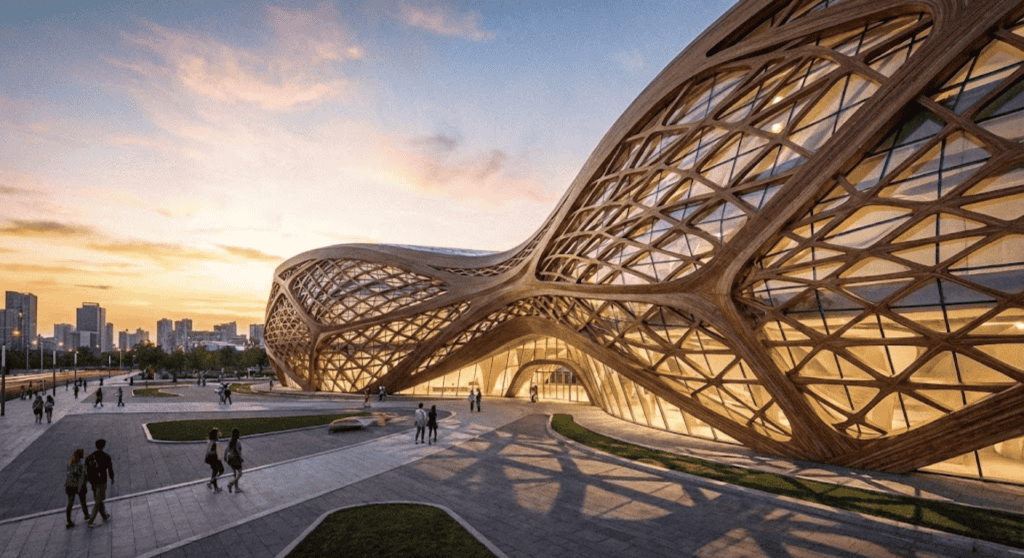
Walk down a quiet Model Town lane in Amritsar in 2026 and one G+5 makes you stop: its whole face is wrapped in a rhythm of interlocking mahogany-brown metal loops that throws a shifting shadow across the balconies as the Punjab sun moves. That is what good facade design in Amritsar looks like now – not applied decoration, but a parametric metal skin engineered to shade, screen and give a plain RCC frame a real identity. In this guide we walk through four parametric metal facade concepts, one for Amritsar and three more from Hyderabad, Mumbai and Chennai, so you can see how the same design thinking adapts to very different plots, orientations and climates across India.
Facade Design in India: Why Amritsar Is Choosing Parametric Metal
Facade design in India has moved from an afterthought to the single most important decision on a residential project. Today, demand for parametric facade design in India is rising fastest in cities such as Amritsar, Mumbai, Bangalore, Delhi, and Pune, where homeowners and developers want elevations that are both performance-driven and instantly recognisable. SOGA Design Studio specialises in facade design in India — from G+3 individual homes to G+7 residential blocks — pairing algorithmic geometry with matte powder-coated ral 8016 mahogany and fabrication-ready detailing. Whether you are comparing metal facade design in India for a new build or a retrofit, the concepts below show how a considered facade redefines a building’s identity and its long-term value.
1. Amritsar Parametric Loop Screen: Mahogany-Brown Steel Facade
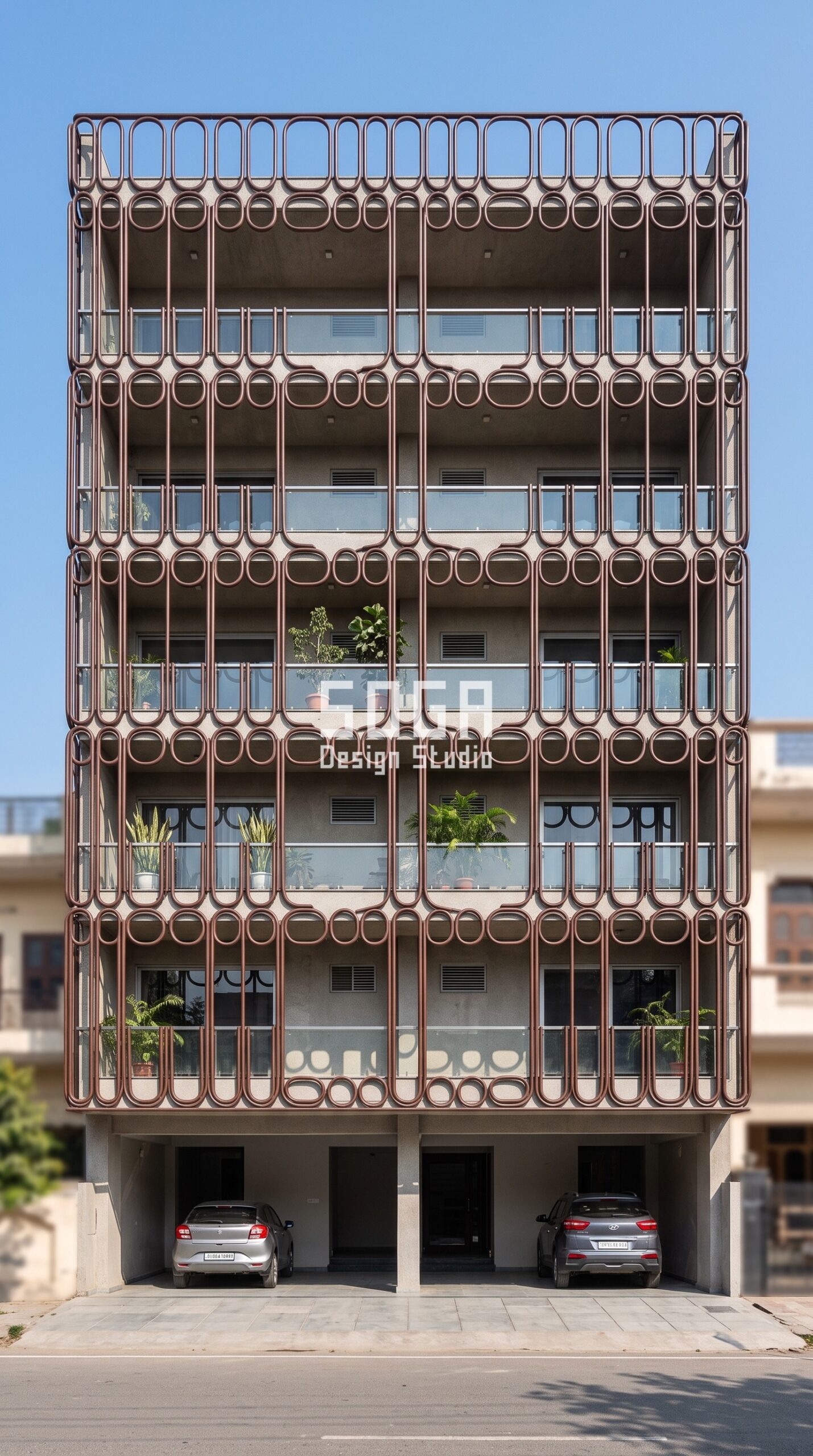
Amritsar’s wide-frontage residential plots get strong, dusty north-Indian sun and sit close to the street, so this G+5 uses a Parametric Loop Screen – an ordered array of bent tubular-steel loops in matte powder-coated RAL 8016 mahogany brown – as a deep outer veil across every floor. The loops stand off the glass line, so they shade the balconies and soften the afternoon glare while still letting the family see the street through the openings. Because the rhythm is discrete and repeating, it reads as crafted and buildable, not chaotic, and the warm brown tone flatters the low golden light of a Punjab winter. Powder-coated steel shrugs off Amritsar’s dust and temperature swings and needs almost no upkeep. Behind it, recessed glass balconies and a clean stilt-parking base keep the ground calm and usable. It is privacy, shade and street presence solved in one skin.
2. Hyderabad Parametric Petal Screen: Forest-Green Aluminium Fins
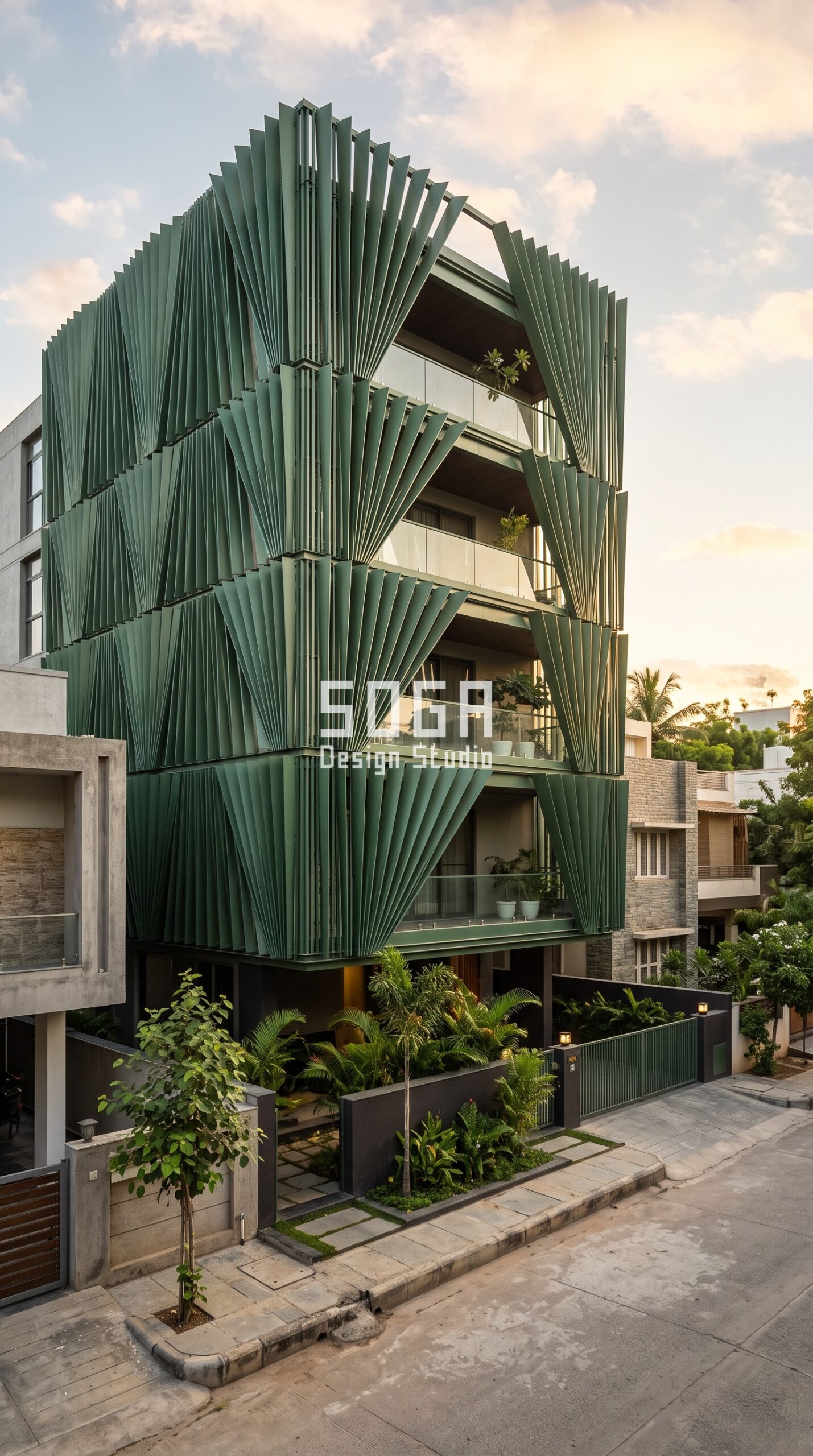
On a Jubilee Hills plot the hard problem is the low west sun, so this concept fans sculptural petal-shaped fins outward floor by floor as a Parametric Petal Screen in matte forest-green anodized aluminium. Each fin is angled to intercept the harsh late-afternoon light and cut glare and heat gain on the west rooms, while the gaps between fins stay open to north light and Hyderabad’s breeze. Anodized aluminium is the right call here: it is light, it will not corrode, and the anodizing holds its deep green colour without fading under years of Deccan heat. Seen in golden three-quarter light the fins catch the sun as a soft green fan; by midday they are a working brise-soleil. The result is a facade that performs as shading and reads as jewellery. It turns a climate constraint into the building’s signature move.
3. Mumbai Parametric Ripple Shell: Wine-Red Steel Waves
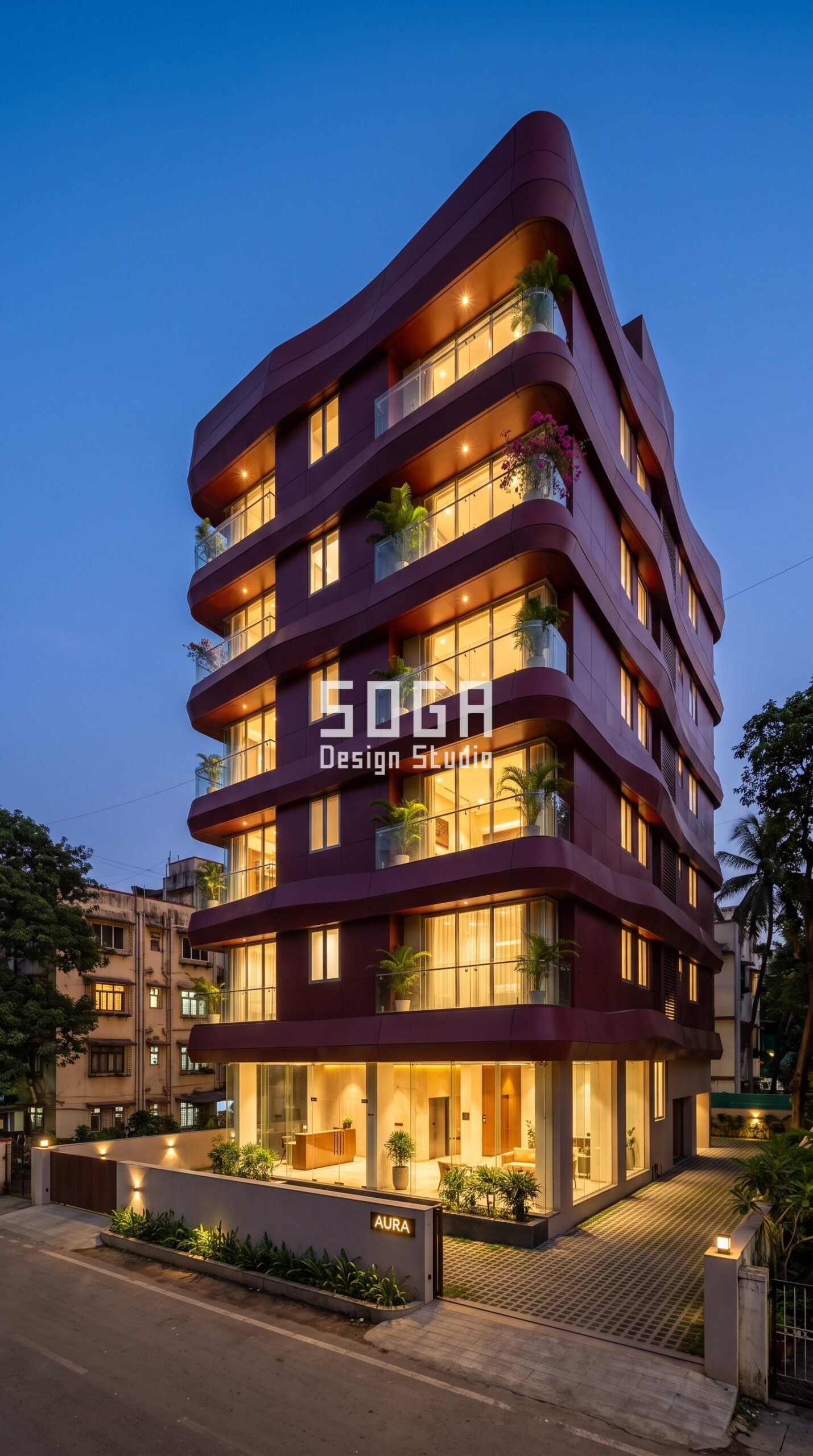
Mumbai plots are tight, overlooked and hit by heavy monsoon, so this Santacruz G+5 wraps a Parametric Ripple Shell – large powder-coated steel panels layered in soft rolling waves – in deep wine-red RAL 3005 around the corner of the building. The flowing relief gives the narrow setback real depth and movement, so the home stands out on a congested lane without adding bulk, and the smooth panel faces shed monsoon water cleanly instead of trapping it. The continuous shell also screens the interiors from the neighbours’ overlooking sightlines while keeping the sea-facing glass open. At blue hour the warm interior glow spilling through the waves makes the building a quiet landmark on the street. Deep wine red is a confident, low-glare colour that hides Mumbai grime far better than pale cladding. It is presence, privacy and weather all handled by one moving surface.
4. Chennai Parametric Bond Grid: Honey-Copper Rainscreen Tiles
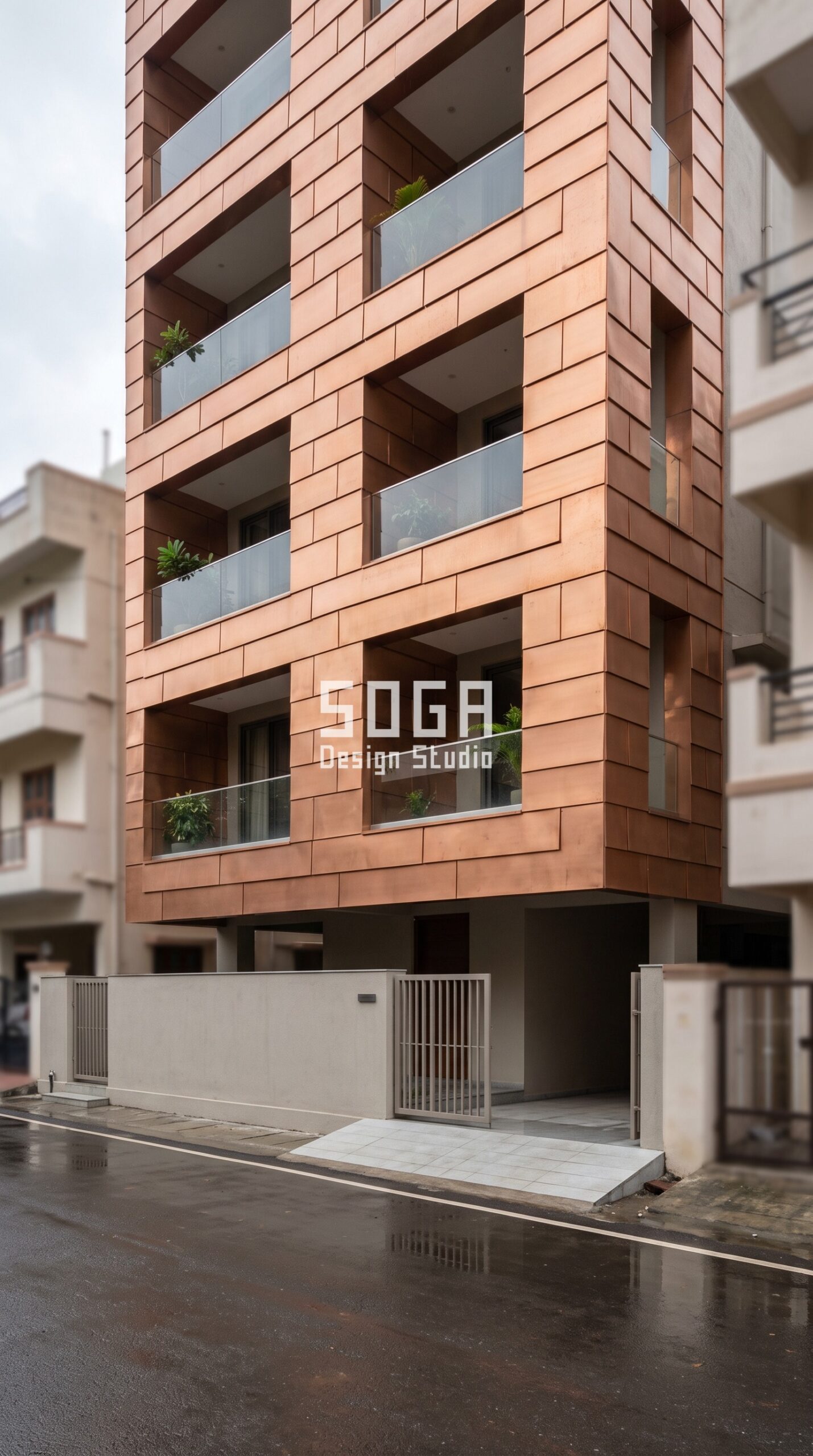
Chennai’s coastal humidity, salt air and sudden monsoon call for a breathing rainscreen, so this Boat Club Road home uses a Parametric Bond Grid – staggered brick-bond large-format tiles in warm honey copper with deep shadow joints. The offset module rhythm and recessed joints let the wall ventilate and drain behind the tiles, which keeps the RCC cooler and manages the humidity that destroys ordinary paint and plaster here. Copper is almost made for the coast: it is naturally corrosion-resistant and only grows richer with age, so the facade ages gracefully instead of staining. The tight corner view shows how precise the bond pattern and shadow lines are up close – the detail that separates a real designed facade from flat cladding. After a monsoon shower the wet copper reads deep and glowing against the grey sky. It is a low-maintenance, climate-tuned skin dressed as warm, timeless material.
Cost Benchmarks for Indian Parametric Metal Facades
One of the most-asked questions on a Amritsar project brief is budget. The current all-in installed rates for parametric metal facades in India sit in the following ranges:
- Steel facade (full design + install): ₹1,200–₹2,800 per sq ft
- Aluminium, anodised or powder-coated: ₹800–₹2,500 per sq ft
- Zinc cladding: ₹1,500–₹3,000 per sq ft
- ACM panels (3 mm basic): ₹200–₹250 per sq ft (basic)
- ACM panels (4 mm): ₹250–₹350 per sq ft
- Solid aluminium panels: ₹800–₹1,800 per sq ft
- Installation labour: ₹50–₹150 per sq ft (varies by height + access)
- Conventional cladding (for comparison): ₹400–₹1,200 per sq ft installed (stone veneer / ceramic / standard ACM)
These figures are baseline; actual project cost depends on facade area, panel complexity, fabricator location, and finish specification. SOGA Design Studio prepares an itemised cost estimate as part of every consultation so the budget conversation starts with hard numbers rather than guesses.
Parametric Facade Design Across India, Dubai & Singapore
For NRI clients building or renovating in India, SOGA Design Studio runs a complete remote workflow. Clients in Dubai, Singapore, the UK, the US, and Australia routinely commission parametric facades for properties in their hometowns — Coimbatore, Indore, Hyderabad, Pune, and Chandigarh are particularly active corridors. The pipeline is fully virtual: site survey by our local team, design development over weekly video reviews, fabrication-ready drawings shared on cloud storage, and on-site supervision relayed through dated photo updates. NRI projects now make up a growing share of our parametric facade portfolio.
Why Trust SOGA Design Studio for Facade Design in Amritsar
- Experience: SOGA Design Studio designs and visualises parametric metal facades for real Indian G+3 to G+7 residential plots every day, and has run a daily facade study series since 2023 across cities from Amritsar to Chennai.
- Expertise: Each concept is built on SOGA’s parametric facade systems with orientation-by-orientation climate analysis and fabrication-ready detailing, so a screen is chosen for west sun, monsoon or coastal salt – not for trend.
- Authority: Positioned as India’s parametric facade design experts, SOGA works in powder-coated steel, anodized aluminium, zinc and copper and details every skin to be genuinely buildable with vetted Indian fabricators.
- Trust: We share honest 2026 cost ranges per sq ft, itemised estimates, and a free no-commitment consultation, with a remote workflow proven for NRI clients building in India from abroad.
Frequently Asked Questions
Which metal is best for a facade in India – steel, aluminium or copper?
It depends on the plot’s climate. Powder-coated steel is strong and cost-effective for dry, dusty north-Indian cities like Amritsar; anodized aluminium is light, non-corroding and colour-stable for hot cities like Hyderabad; and copper or zinc excel in coastal, humid Chennai and Mumbai because they resist salt and age gracefully. SOGA picks the metal by orientation and climate rather than by fashion.
Does a parametric metal facade reduce heat inside the house?
Yes. An outer metal screen or fin system shades the glass and walls and creates a ventilated cavity, so the sun’s heat is intercepted before it reaches the RCC. Angled fins or a deep loop screen can noticeably cut west-sun glare and lower the internal heat load, which reduces cooling costs – one of the main reasons Indian homeowners choose these facades over flat cladding.
Is a parametric facade suitable for a G+4 or G+5 residential plot?
Absolutely – most of SOGA’s residential work is exactly this G+3 to G+5 range. A parametric screen scales cleanly across four or five floors, gives privacy from the street, and turns an ordinary RCC frame into a distinctive elevation without changing the structure. The system is chosen to suit the plot’s frontage, setback and orientation.
Can SOGA design a facade for an NRI building remotely?
Yes. SOGA runs a remote workflow proven with NRI clients: we work from your plans and photos, share 3D concepts and fabrication-ready drawings online, and coordinate with vetted Indian fabricators, so you can commission and approve a facade for your India project entirely from abroad.
Does a metal facade reduce heat inside the house?
Parametric precision-cut facades reduce solar heat gain by 25-40% on west and south orientations in Indian conditions, lowering interior surface temperatures by 4-7 degrees Celsius compared to bare RCC. Panel perforation density is tuned per orientation.
Can NRIs design and build a parametric facade in India remotely?
Yes. SOGA Design Studio runs end-to-end remote consultations for NRI clients in Dubai, Singapore, the UK, and the US. The workflow — site analysis, design development, client review, fabrication-ready drawings, and on-site supervision — is delivered virtually. NRI projects in tier-2 cities like Coimbatore, Indore, and Chandigarh make up a fast-growing share of our portfolio.
What is parametric facade design?
Parametric facade design uses algorithmic rules — light, climate, orientation, and structural parameters — to generate a building skin where every panel is mathematically calibrated. The result is a facade that performs (heat control, ventilation, daylighting) while expressing a unique sculptural identity. It is the direct computational descendant of traditional Indian metal screens.
What is the typical timeline from design to installed parametric facade?
For a G+3 to G+4 residence: 3 weeks for concept and approval, 4 weeks for fabrication-ready drawings, 6–8 weeks for fabrication, and 3–5 weeks for site installation — total 16–20 weeks from go-ahead to occupancy. Retrofit projects on existing buildings compress this to 10–14 weeks because no structural coordination is needed.
How long does a powder-coated metal facade last in Indian conditions?
Quality powder-coated aluminium or galvanised steel facades, when correctly detailed and ventilated, last 25–30 years before recoating is needed — even in coastal Mumbai, Chennai, and Kochi. Anodised aluminium and pre-patinated zinc/copper can exceed 40 years. Maintenance is annual rinse-down only; no repainting like traditional plaster facades.
How much does a parametric metal facade cost in India 2026?
Aluminium parametric facades range ₹800–₹2,500 per sq ft (full design + install), steel ₹1,200–₹2,800 per sq ft, and zinc ₹1,500–₹3,000 per sq ft. Basic ACM cladding (3–4 mm) starts at ₹200–₹350 per sq ft; solid aluminium panels run ₹400–₹600 per sq ft. Installation labor adds ₹50–₹150 per sq ft depending on building height. SOGA Design Studio provides itemised cost estimates as part of every consultation.
Can a parametric metal facade be retrofitted onto an existing Indian building?
Yes, and it is one of the fastest-growing segments. A lightweight aluminium parametric screen can be mounted on stand-off brackets over existing brick, RCC, or even tired plaster facades — completely transforming the elevation in 4–8 weeks without disturbing tenants or interiors. Retrofit is particularly cost-effective for 1990s-2010s Indian apartments where the original facade has aged.
What is a sculptural petal-shaped metal fin facade?
SOGA Design Studio addresses this question in detail during the design consultation. For Amritsar projects, we provide a fully customised answer based on plot, orientation, and budget — typically within 48 hours of receiving the brief.
Related Reading
- our complete parametric facade design guide for India
- metal facade cost per square foot in India
- Mohini Jewels Rajkot: Parametric Facade Design by SOGA Design Studio
- Vikram Ahuja Residence: Parametric Innovation in South Bombay’s
- What Is Parametric Design? The Complete Guide for 2026
Start Your Facade Project With SOGA Design Studio
The best facade is not the boldest pattern – it is the parametric system whose geometry and metal are matched to your plot’s sun, street and climate.
Book a free 30-minute discovery call with SOGA Design Studio to discuss how a giant interlocking loop forms in be or similar parametric concept can work on your Amritsar plot. NRI clients welcome — full remote workflow available.