Somebody always says it at the wrong moment. The drawings are approved, the fabricator has quoted, and an uncle standing in the half-built porch looks up at the elevation and says the metal will kill your phone signal. It is the single most common late objection to a metal facade in India, and it is almost always aimed at the wrong thing. The metal is not the variable. Radio does not care very much what a screen is made of; it cares how big the holes are and whether the screen stands in front of a window or in front of a wall that was already opaque to it. Get those two questions right and a facade screen is a non-event for reception. Get them wrong on one bedroom and you will notice it for years.
\n\n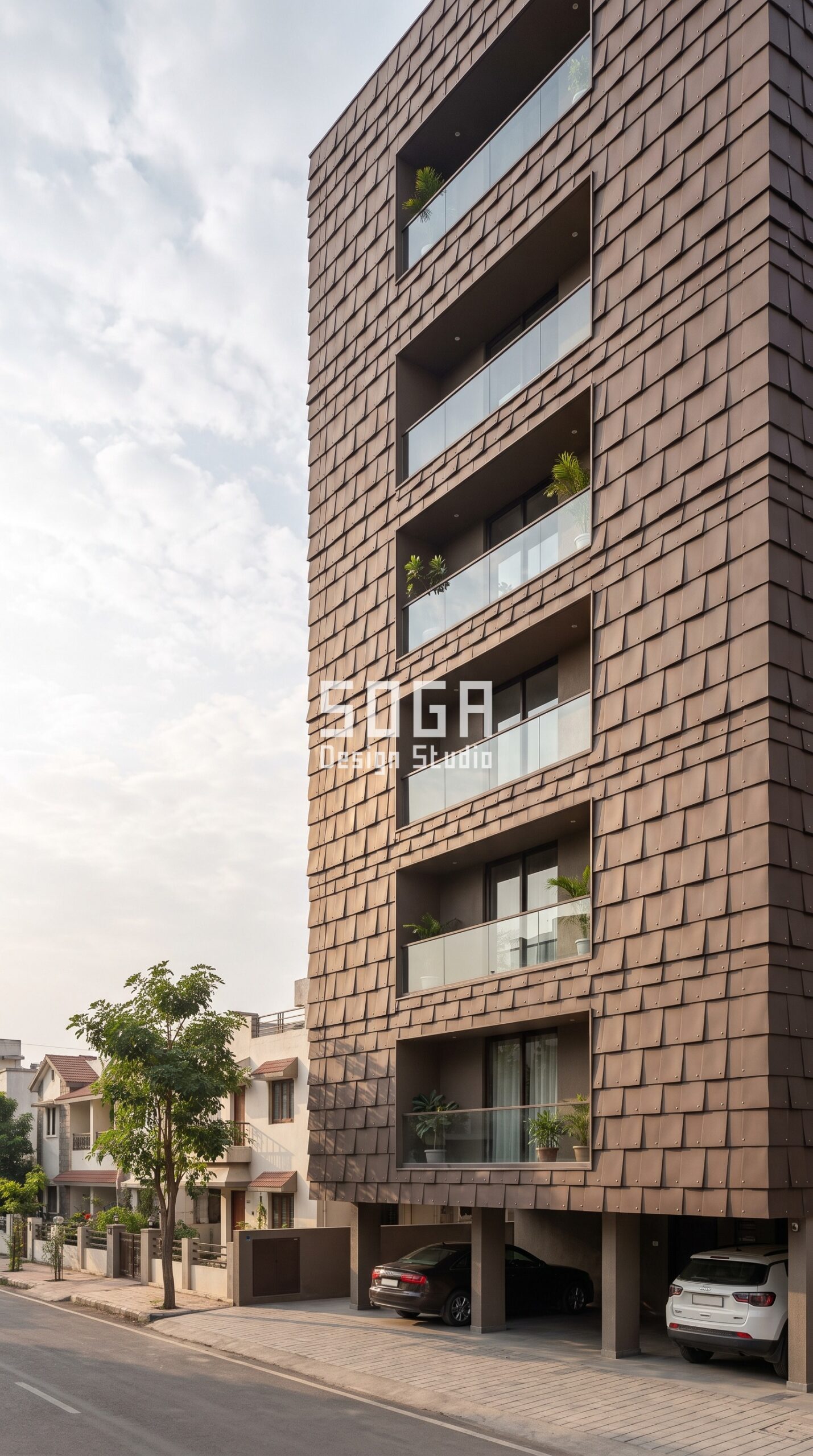
Facade Screens and Mobile Signal in India: What Actually Decides It in 2026
Ask whether a facade screen blocks mobile signal in India and you will almost always get an answer about the metal. It is the wrong variable. Reception is decided by two things you can read straight off a drawing: whether the screen crosses glazing or only solid wall, and the smallest clear gap where it does. A wall was already opaque to radio, so cladding it changes nothing measurable; an opening several times wider than half a wavelength lets a phone signal through more or less untouched. The four concepts below are resolved to sub-frame, bracket and fixing level using the same parametric facade systems the studio builds across India, Dubai and Singapore, and between them they span the whole range, from a fully lapped shingle skin to a screen standing 220 mm clear of the glass.
1. Surat Parametric Scallop Shell: A Solid Skin That Never Crosses a Window
The Piplod study is a G+7 wrapped in overlapping convex shingle tiles, each one bowing about 60 mm at its centre and lapping 40 mm over the tile below, in a matte sepia-brown powder-coated steel. Electrically this is the most closed facade of the four, a lapped field of conductive tiles with no deliberate opening anywhere in it. That sounds like the worst case for reception, and it is exactly why it is the useful one to start with. Look at where the shingles actually go: they run across the solid wall and stop cleanly at every balcony reveal and every window opening. A radio wave was never coming through that wall anyway, so covering it with metal costs nothing. The signal path into the flat is the glazing, and the glazing is untouched. A closed skin only becomes a reception problem when somebody carries it across an opening for the sake of a continuous look.
2. Chandigarh Parametric Ellipse Screen: Holes Bigger Than Half a Wavelength
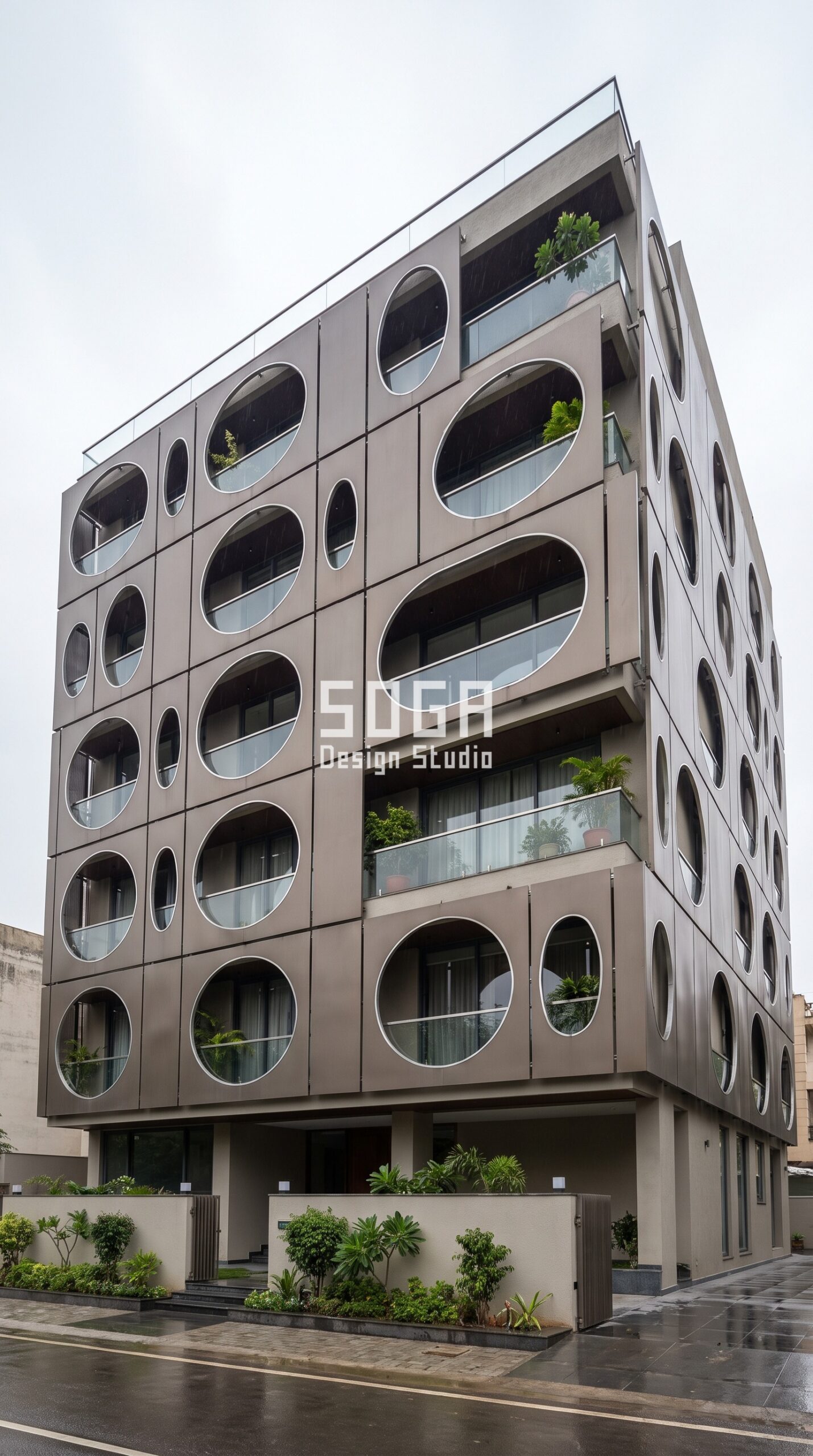
The Sector 9 study does the opposite, a thin smoky-bronze plate hung 220 mm clear of the glazing on slim brackets and pierced with large circular and oval holes cut right through. Here the screen genuinely does stand across the windows, so the geometry has to earn it. The arithmetic is the ordinary one: wavelength equals the speed of light divided by frequency, which puts the 900 MHz band near 333 mm, the 1800 MHz band near 167 mm, 2100 MHz near 143 mm and the 3.5 GHz 5G band near 86 mm. The working rule from shielding practice is that an opening starts to bite only once it drops below roughly half a wavelength, and these holes are far larger than the 43 mm to 167 mm that would imply. A screen like this is effectively transparent to a phone. What it costs you is not signal but cleaning access behind the plate, which is a real and separate argument.
3. Chennai Parametric Cascade Weave: What Vertical Blades Do to a Vertical Wave
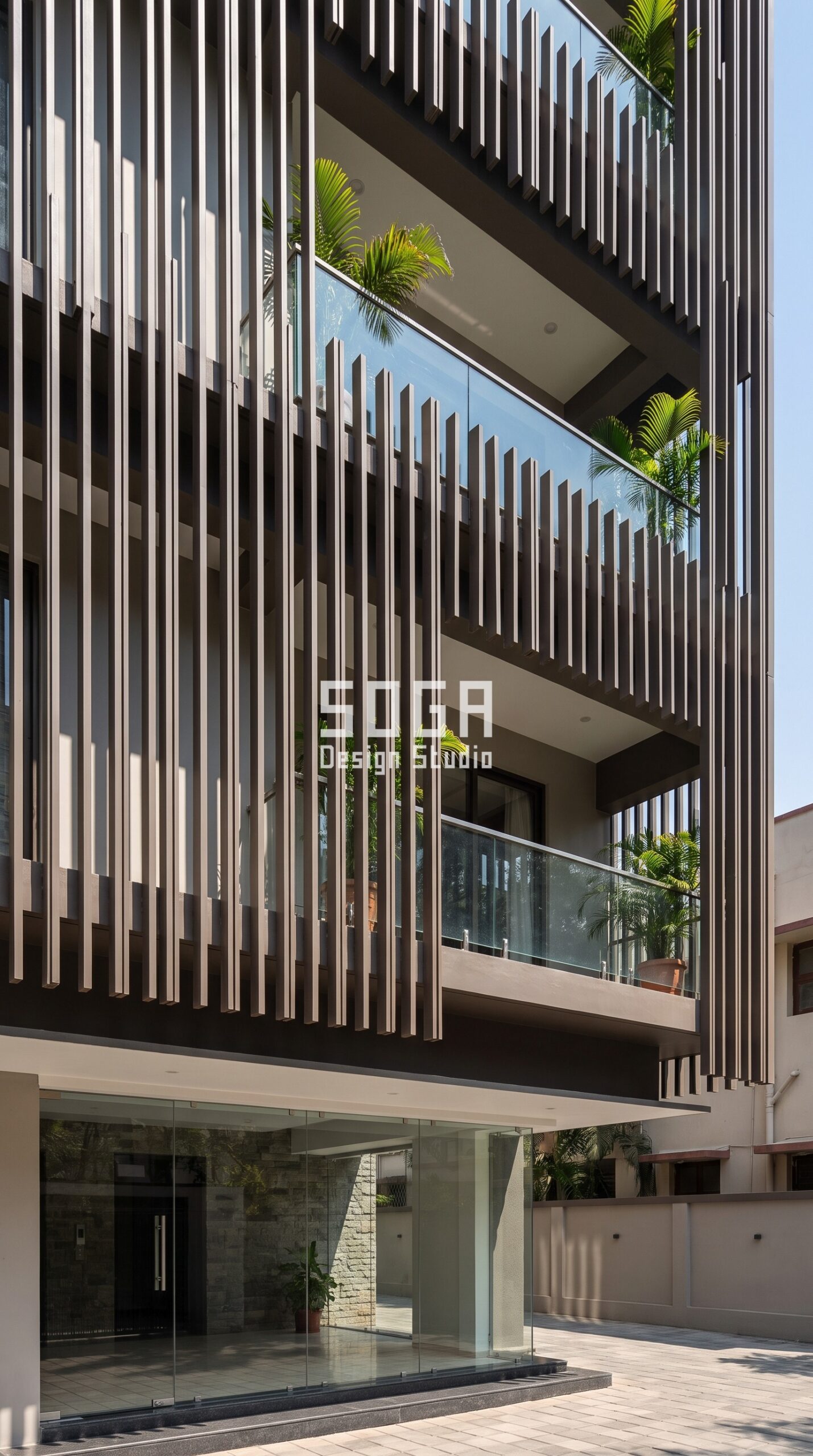
On Boat Club Road the skin is a cascade of slim vertical blades in brown-grey powder-coated steel, each standing about 180 mm off the wall and dropping to a different height so the field steps down like falling water. Slots behave differently from round holes, and this is the one case worth being careful about. A row of parallel conductors is mildly polarising: it interacts more strongly with waves whose electric field runs along the blades than with waves running across them. Mobile signals arrive in mixed and changing polarisation, so in practice this shows up as small variation rather than a dropout, and the open gaps here are wide enough that it stays small. The honest framing is that blade direction is a second-order effect you should know about, not a reason to redesign. If a room is already marginal on coverage, run the blades across the window rather than along it, and keep the gap generous.
4. Amritsar Parametric Swell Shell: Horizontal Bands and the Gap That Counts
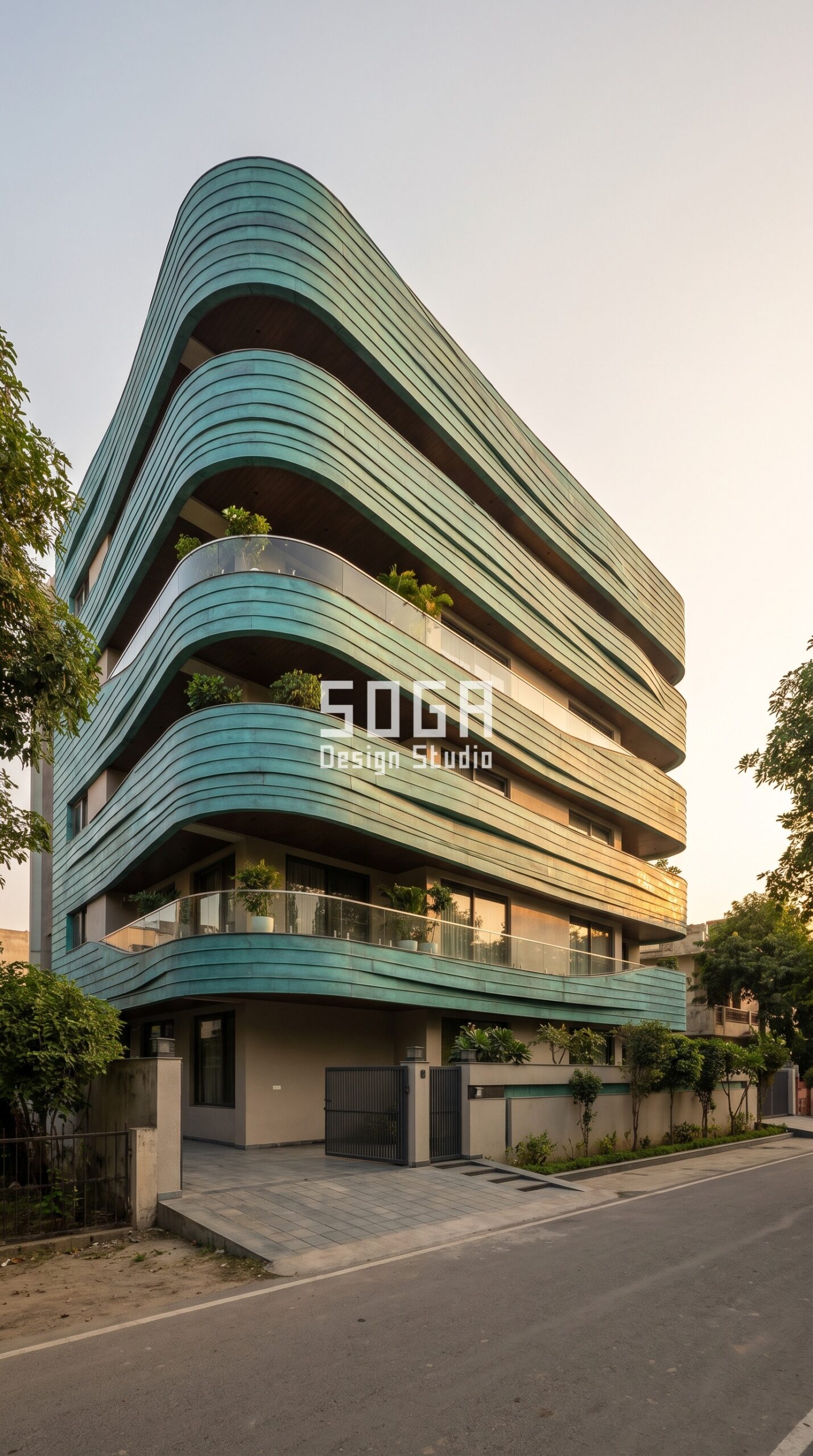
The Model Town study stacks horizontal bands of pre-patinated copper, each bowing out about 90 mm at its centre and returning at the floor line. It is the same slot question as Chennai turned through ninety degrees, and it makes the general rule easy to state: on any banded or bladed screen the number that decides reception is the smallest clear gap between the members, not the depth of the bow and not the metal it is made from. Depth changes shadow, weight and cost; it does not change what radio sees. Copper is a better conductor than coated steel, and it makes no practical difference here for the same reason, because the wave is going through the gap rather than through the band. Where the bands close up tight across a window head, that is the detail to open out, and it is a five-minute conversation at drawing stage rather than a change order later.
What a Parametric Metal Facade Costs in India in 2026
Budget is usually the second question on a Surat brief, right after whether the idea is buildable at all. These are the current all-in installed rates in India:
- Steel facade (full design + install): ₹1,200–₹2,800 per sq ft
- Anodised or powder-coated metal panels: ₹800–₹2,500 per sq ft
- Zinc cladding: ₹1,500–₹3,000 per sq ft
- ACM panels (3 mm basic): ₹200–₹250 per sq ft (basic)
- ACM panels (4 mm): ₹250–₹350 per sq ft
- Solid metal panels: ₹800–₹1,800 per sq ft
- Installation labour: ₹50–₹150 per sq ft (varies by height + access)
- Conventional cladding (for comparison): ₹400–₹1,200 per sq ft installed (stone veneer / ceramic / standard ACM)
These are baseline ranges, not a quotation. What moves a real number is the facade area, how many distinct pieces the design needs, where it is fabricated and how it is finished. SOGA Design Studio itemises that at consultation rather than quoting a single figure.
Where SOGA Design Studio Works: India, Dubai and Singapore
Building a house in India from another country is mostly a problem of trust, not drawing. Clients in Dubai and Sharjah commissioning work in Vadodara, Nashik, Mysuru and cities like Surat get the same scope as a local client, restructured so nothing depends on them being present: measured survey by our people, decisions taken on recorded calls so they can be revisited, shop drawings released only after written sign-off, and photographic evidence at each stage.
Why Trust SOGA Design Studio for Facade Design in Surat
- Experience: SOGA Design Studio has been running a daily facade study series on real Indian G+3 to G+7 plots since 2023, and takes metal screen systems from concept through fabrication-ready detailing with vetted Indian fabricators. The four studies in this post are worked at real depths of 60 mm, 90 mm, 180 mm and 220 mm, because those are the numbers that get argued about on site.
- Expertise: Facade geometry is set against orientation, daylight and now aperture, using computational modeling rather than pattern catalogues. The wavelength arithmetic in this post is the standard relation between frequency and wavelength, applied to the bands Indian networks actually run.
- Authority: SOGA Design Studio, Gurugram, co-founded by Gajender Jaiswal and Sonali Jaiswal, designs parametric metal facades for projects across India, Dubai and Singapore, and is one of the few Indian studios detailing these systems to fabrication.
- Trust: Published 2026 cost bands rather than a quoted-on-request blank, an explicit statement of what this post does not claim, and a free no-commitment consultation with a remote workflow for NRI clients. Where a precise figure would need site measurement, this post says so instead of inventing one.
Frequently Asked Questions
Does a metal facade screen block mobile signal?
In almost every real case, no. Two things decide it: whether the screen actually crosses a window, and how big the smallest gap in it is. Over a solid wall a metal skin changes nothing, because the wall already stopped the signal. Over glazing, an opening only begins to attenuate meaningfully once it falls below roughly half the wavelength of the band, which is about 167 mm at 900 MHz and about 43 mm at 3.5 GHz. Ordinary architectural screens have gaps far larger than that.
Will a facade screen affect Wi-Fi inside the house?
Your indoor router is in the same room as your devices, so an external screen is irrelevant to it. The screen sits between your phone and the operator’s tower, not between your phone and your router. The only Wi-Fi worth thinking about is an outdoor link, such as a camera, a gate intercom or a garden access point, and there the fix is placement rather than facade redesign.
Do vertical blades affect signal differently from round holes?
Slightly, and it is worth knowing. A row of parallel blades is mildly polarising, interacting more with waves whose electric field runs along the blades. Because mobile signals arrive in mixed polarisation this shows up as small variation rather than loss. Round holes have no preferred direction and are the simplest case. If a room is already marginal on coverage, run blades across the window rather than along it.
Does the air gap behind the screen matter for reception?
Not in the way people expect. A 180 mm or 220 mm standoff is set by shadow, ventilation, cleaning access and fixing, and it does not meaningfully change what gets through the openings. Depth is a daylight, maintenance and cost decision. Gap width across the glazing is the reception decision. They are separate conversations and should be specified separately.
What should I ask my facade contractor to check before installing?
Three things. First, mark on the elevation exactly where the screen crosses glazing rather than solid wall. Second, state the smallest clear gap dimension at those places as a number on the drawing. Third, if any room in the house is already weak on coverage today, test it before the screen goes up so there is a baseline. Any real attenuation figure for a specific screen has to be measured on site, so treat a supplier who quotes a precise decibel loss from a brochure with caution.
Is copper or steel better if I am worried about signal?
Neither choice matters for this. Both are good conductors, and the wave passes through the gaps rather than through the metal, so swapping the finish does not change reception. Choose the material on appearance, coastal exposure, maintenance and budget. A pre-patinated copper band system and a powder-coated steel one behave the same way to a phone.
What does a parametric metal facade screen cost in India in 2026?
Steel facade systems supplied and installed run about Rs 1,200 to Rs 2,800 per sq ft, and powder-coated or anodised metal systems about Rs 800 to Rs 2,500 per sq ft, with installation labour of roughly Rs 50 to Rs 150 per sq ft depending on height and access. Conventional cladding sits lower at about Rs 400 to Rs 1,200 per sq ft installed. Aperture size does not move these numbers much, so designing the gaps properly is effectively free.
Related Reading
- how deep a screen can go before the room gets dark
- using a facade screen instead of window grills
- what a facade screen does and does not do for road noise
Start Your Facade Project With SOGA Design Studio
Specify the smallest gap where the screen crosses glazing, and the phone question answers itself.
Book a free 30-minute discovery call with SOGA Design Studio to discuss how a fish scale overlapping convex metal or similar parametric concept can work on your Surat plot. NRI clients welcome — full remote workflow available.