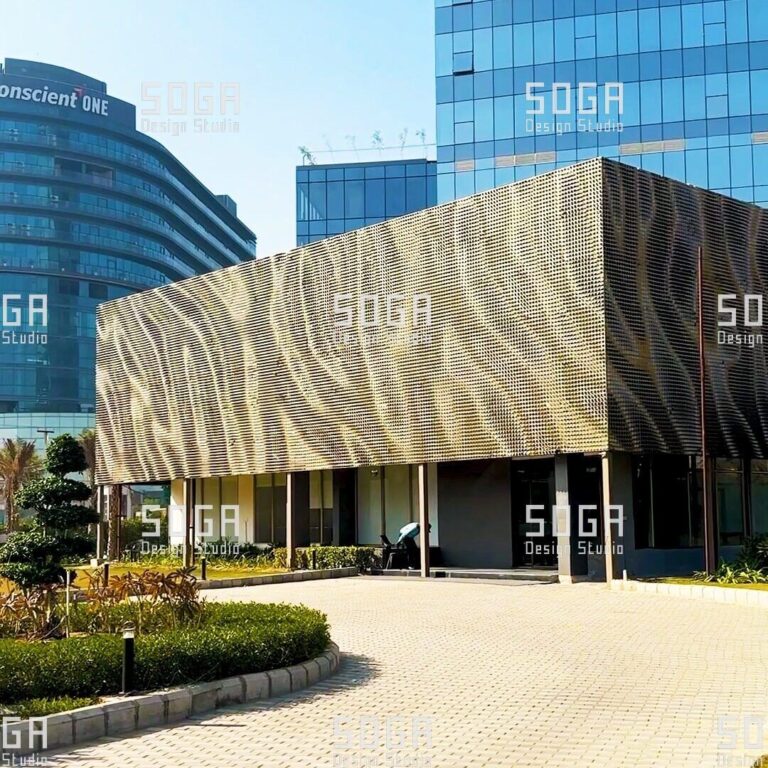
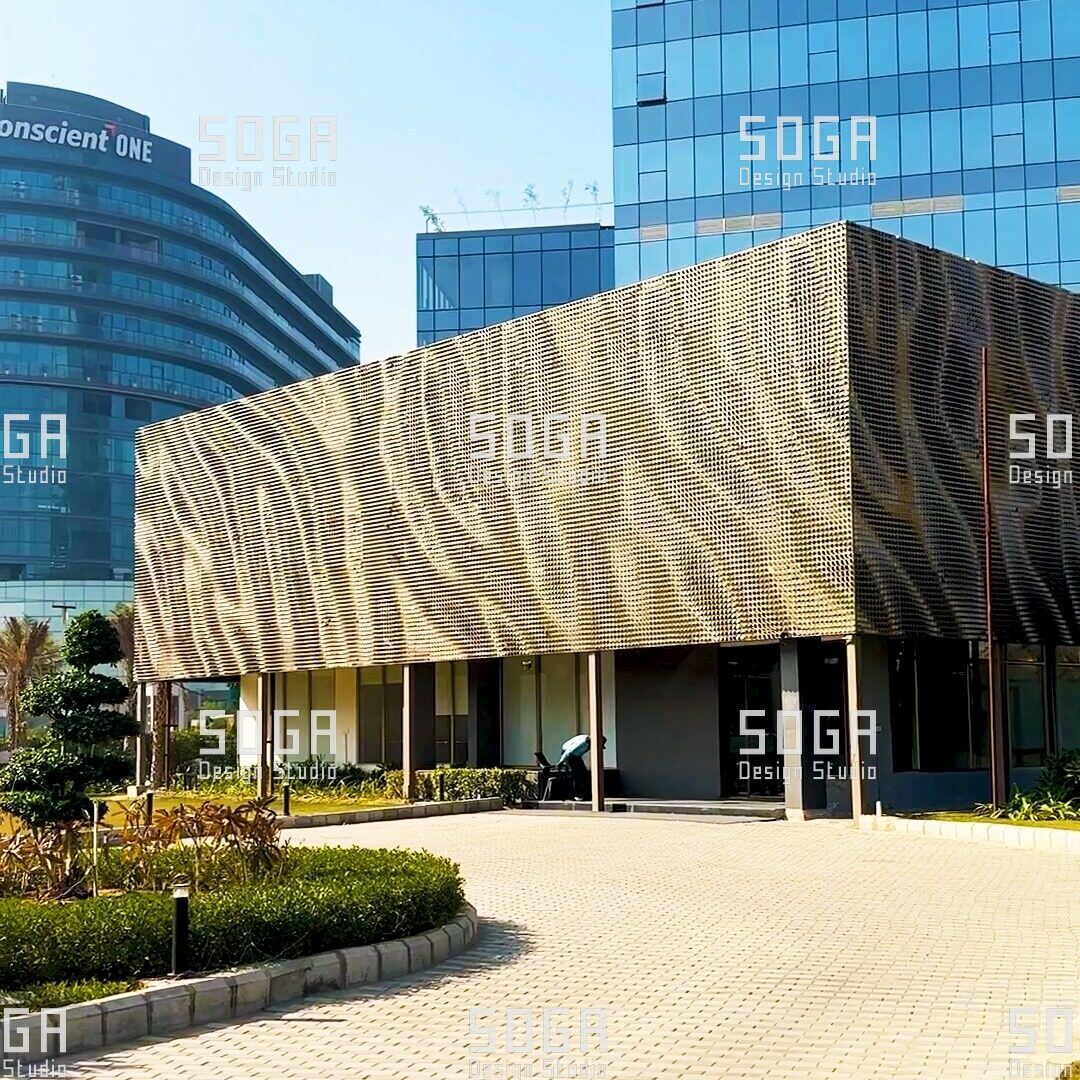
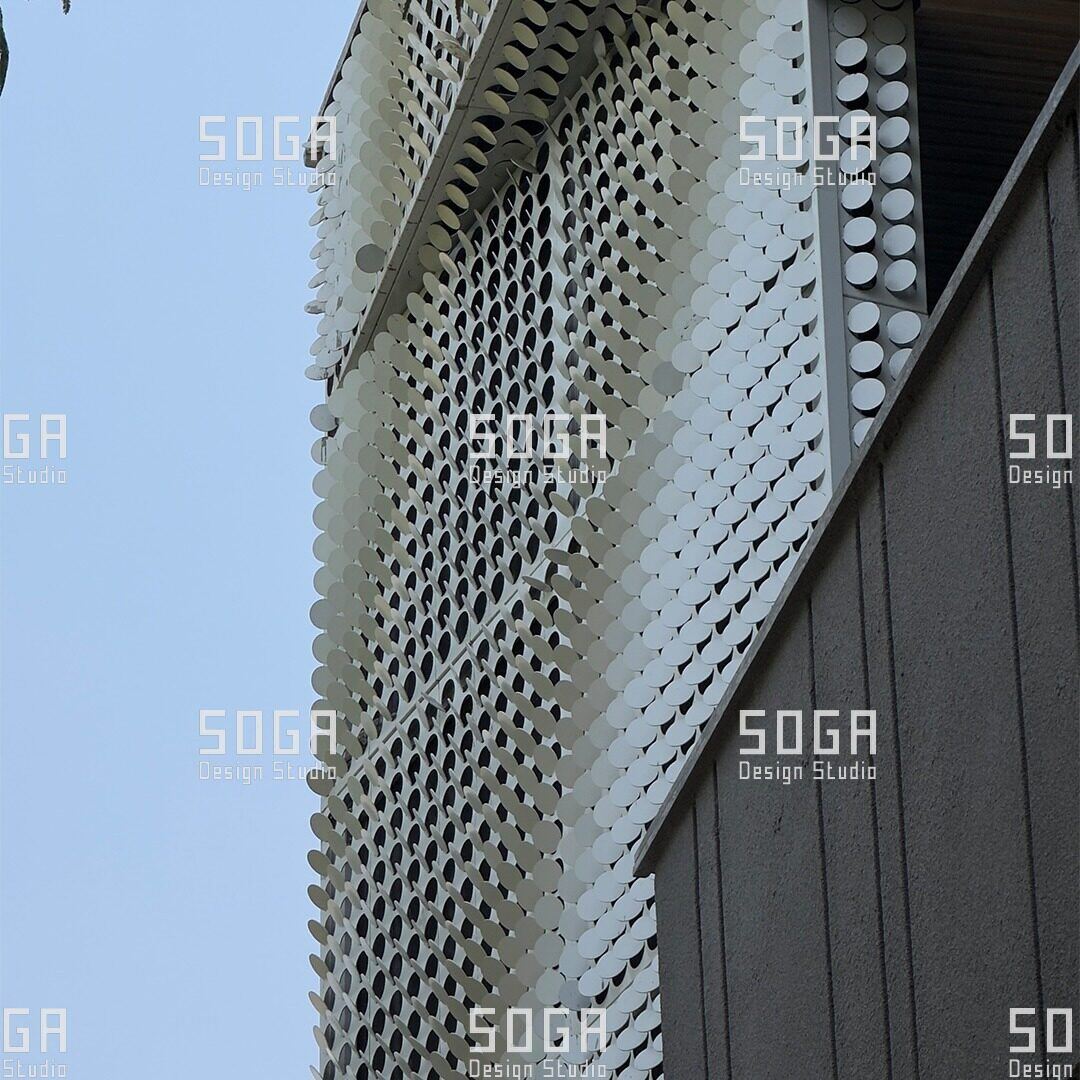
At ten in the morning, on a commercial street in Gurgaon, the elevation reads as a scatter. Low eastern light strikes it at a shallow angle and only some of it comes back. One disc is a flare of white; the disc beside it is a flat grey; the one above has gone almost dark. There is no obvious order to which is which, and yet the eye keeps looking for one, because the brightness is clearly not random. It drifts into loose diagonal bands that cross the face of the building and dissolve before they resolve into anything nameable.
By four in the afternoon the same elevation has reorganised itself. The discs that were burning at breakfast have gone quiet, a different population has woken up, and the bands have moved and changed their slope. Nothing about the building has altered. Someone who saw it in the morning and again on the way home would describe two facades, and would not be wrong.
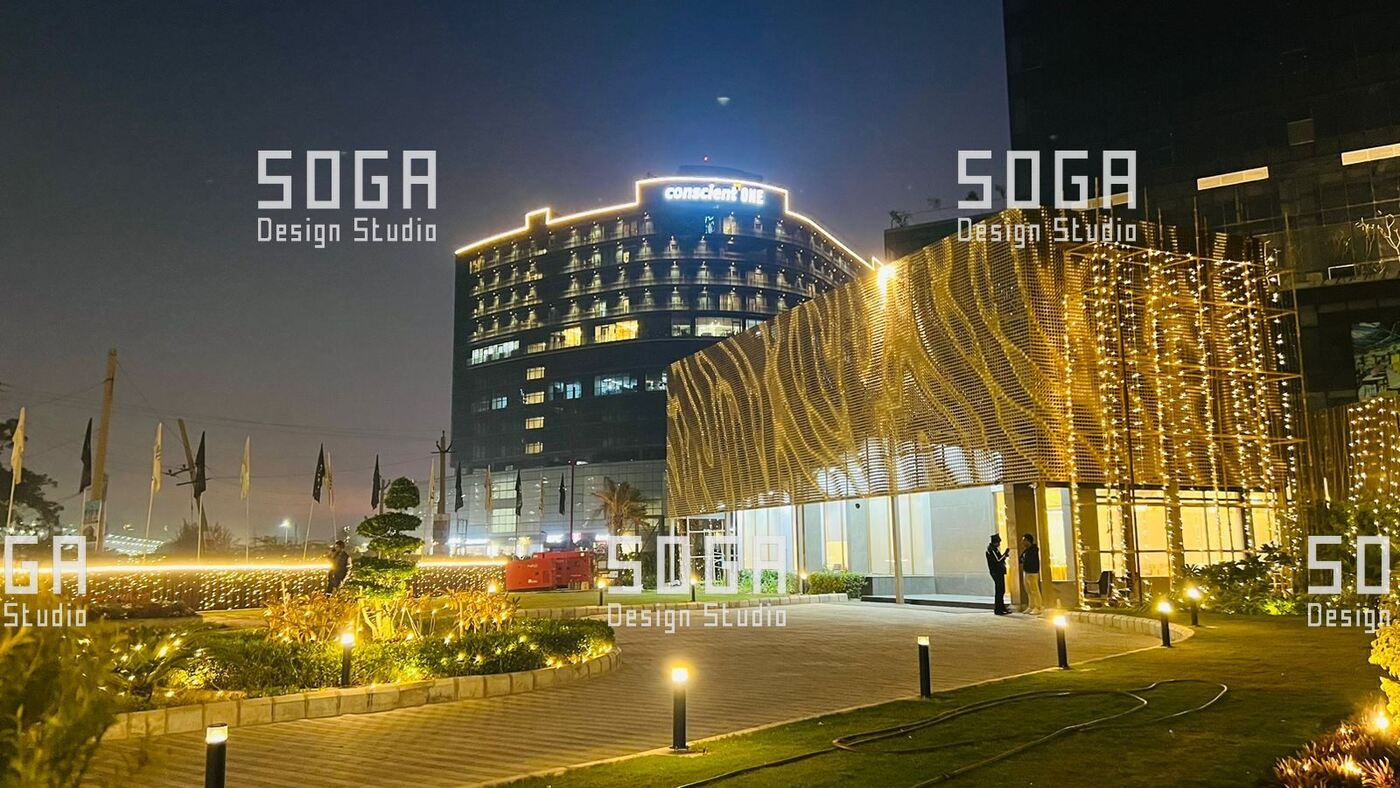
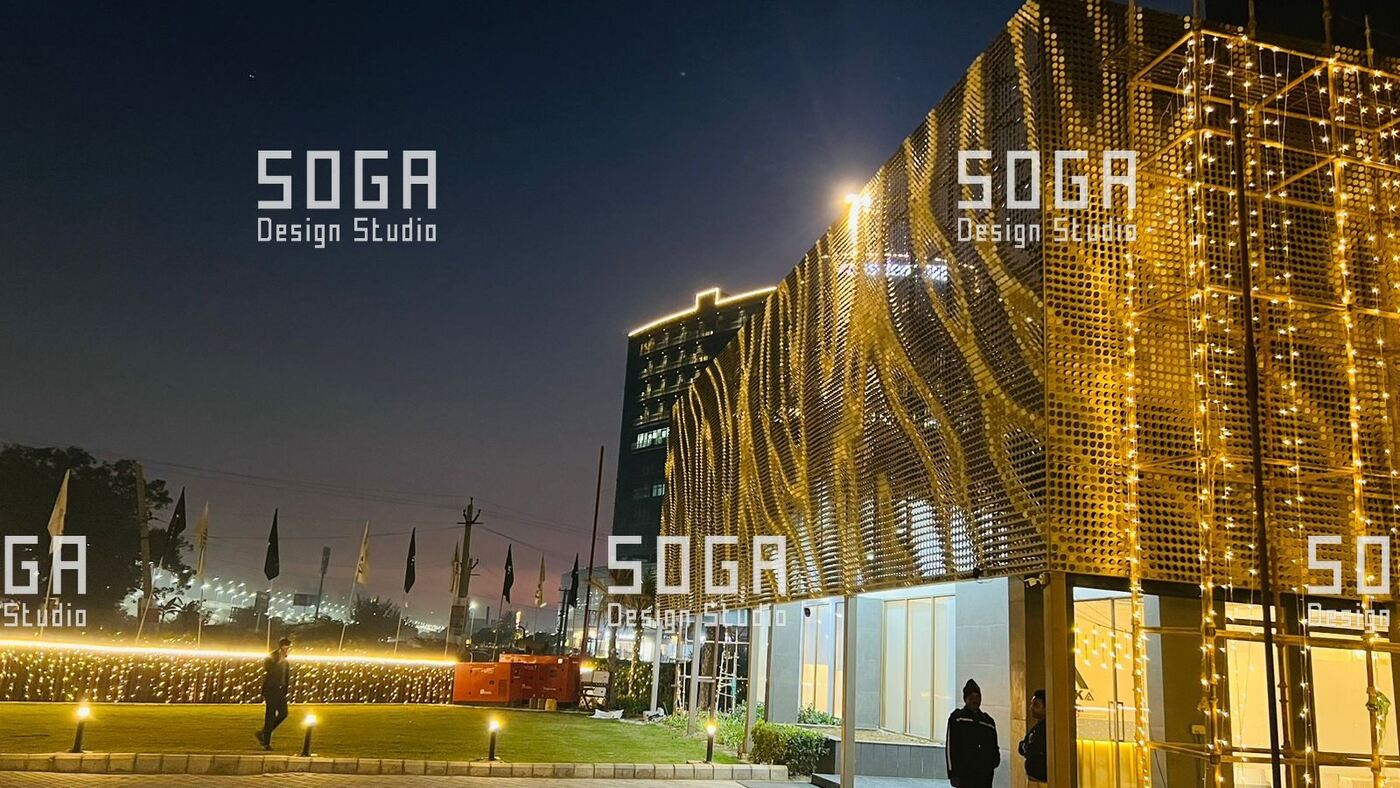
After dark, under its lighting, it changes register again. Daylight had treated the surface as a set of mirrors; artificial light treats it as relief. The discs stop being bright or dull and start being near or far, each throwing a small crescent of shadow onto the plane behind it. The depth that was invisible at noon becomes the main event.
Here is the part that surprises people who stop to look properly. Nothing on it moves. No motors, no actuators, no sensors, no tracking, no mechanism of any kind. Every disc was set at a fixed angle, fastened, and left alone.
So the movement everyone describes is supplied by something else: the sun crossing the sky, the sky brightening and dimming, and the fact that most people see this building from a moving car. The facade does not perform. It presents a field of surfaces aimed in carefully differing directions and lets the day and the street do the animating.
The parametric coin facade in Gurgaon, India was designed by SOGA Design Studio as parametric designer, fabricated by Metaguise, with Archium Design Studio as project architect and Yashika Group as client; photography is by Metaguise. The published project record gives 216 rectangular panels across 242.3 square metres of facade.
The brief and the site
A commercial elevation in Gurgaon has a short and unforgiving list of things to do, and they pull against each other.
It has to deal with sun. On the exposed faces of a building here the envelope is the first line of defence, and anything applied to it either helps with solar gain or makes it worse. Depth brings self-shading, which is not an afterthought in this climate.
It has to be read at speed. Few people study a commercial frontage here on foot. They see it through a windscreen, at an oblique angle, in traffic, for a few seconds. That condition punishes fine detail and rewards field effects. A pattern that depends on close reading of individual components is invisible from the road; a pattern that organises the whole elevation into something that shifts as the car moves is legible before the viewer has consciously looked.
It has to help the building register. A developer commissioning a frontage of this kind is buying recognition: the practical ability of a building to be remembered, described and found again.
And it has to sit on somebody else’s envelope. This is the most underestimated constraint. There is already an architect’s envelope with its own geometry, its own openings, its own floor lines and its own structural logic, and a facade system has to accept all of it rather than demand its own. That single requirement eliminates a great many attractive ideas before drawing begins.
| Item | As published |
|---|---|
| Location | Gurgaon, India |
| Facade area | 242.3 m² |
| Panel count | 216 rectangular panels |
| Panel construction | Modular metal sheet, fabricated without soldering or welding |
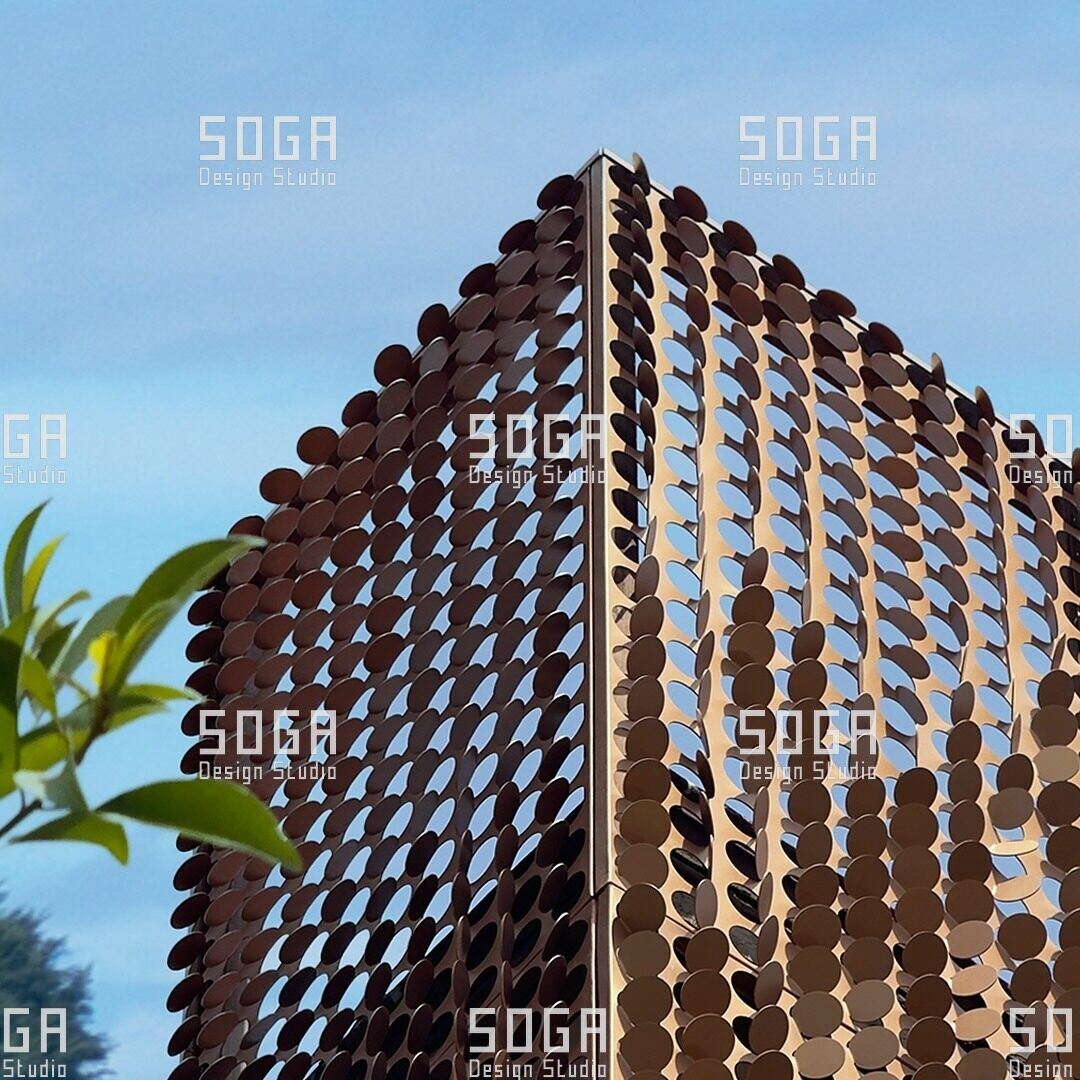
| Coins | Static circular coins, each placed and rotated at a unique angle |
| Pattern reference | Ocean wave movement |
| Handling | Lightweight, allowing straightforward installation and removal |
Those facts are as published in the project feature.
Why a coin, and why a rectangular panel
The central decision in this project is not the shape of the disc. It is the decision to separate the thing that repeats from the thing that varies.
Consider the two obvious ways to make an elevation interesting, and why both fail. A facade in which every element is different is expressive and almost impossible to deliver: each piece becomes its own drawing, its own cutting file and its own opportunity for error. A facade in which every element is identical is cheap, fast and, on a wall of any size, inert; identical modules read as a grid, and a grid stops being looked at within seconds.
The resolution SOGA arrived at is a split. The rectangular panel is the unit of production and setting-out: one geometry, repeated, with consistent edges, consistent fixing and consistent behaviour against the substrate. The circular coin inside that rectangle is the unit of expression: same component, different angle, every time. Production sees repetition. The eye sees variation.
Stated plainly that sounds obvious, and it is not obvious beforehand. Designers reach instinctively for variation at the level of the panel, because the panel is the thing you draw. Varying the panel is the expensive move. Varying something inside it is almost free in production terms and considerably more powerful visually, because the circle has no preferred direction: a rotated rectangle looks like a mistake, while a rotated circle looks the same from the front and entirely different in reflection.
The pairing is convenient geometrically. A rectangle tiles a plane without gaps and takes setting-out dimensions cleanly; a circle inside it leaves a margin that keeps each coin visually separate and gives the field its rhythm. The rectangle manages the building, the circle manages the light, and the system engineering companion article goes further into how that division is held together in the assembly.
The wave: pattern as a rule rather than a drawing
The published project record describes a pattern referencing ocean wave movement, with the coins placed and rotated at a unique angle to optimise the interplay of light and shadow through the day. The word “wave” there is doing something more precise than it looks.
A wave read across a facade is not a picture of water. It is a field of related angles. At any point on a wave surface there is a slope, and that slope changes smoothly as you move across; neighbours are almost the same, distant points very different, and the whole field is governed by a few parameters. On a wall of coins that becomes what the record describes: every coin at its own angle, no two the same, and nothing arbitrary anywhere.
The distinction between a pattern that is drawn and a pattern that is ruled changes how the design is made and how it is reviewed. A drawn pattern is a set of decisions, one per element; to change it, a designer redraws it. On a field of this size that means the pattern gets frozen early and then defended rather than developed.
A ruled pattern behaves differently. The studio writes the relationship — how the angle at any point follows from where that point sits — and then evaluates it. Parametric modelling generates the field, and the field can be regenerated with different inputs in the time it takes to look at it. The amplitude of the wave, the direction it runs, how tightly it turns, how much angular range the coins may take: each becomes a dial rather than a redraw. That is a very different conversation to have with a client and an architect than presenting one scheme for approval.
There is a downstream consequence that matters as much. Because the field is computed rather than drawn, the angle of every coin exists as data rather than as an annotation on a sheet, and that data is what becomes the fabrication information. Moving from computational design to fabrication drawings is a discipline in its own right.
Light, and the illusion of movement
Each coin is, functionally, a small reflector aimed in a particular direction. What it returns to an observer depends on where the sun is, where the observer stands and how the coin is tilted. Because the coins are bent at different angles across the field, at any instant they are not all doing the same thing: a scattered subset is catching the sun and throwing it towards the road, their neighbours are sending it elsewhere, and the rest read as shadow or as sky.
Move the sun and the membership of that bright subset changes. Because the angles vary continuously rather than randomly, the bright region does not jump about; it slides. The published record describes this as an interactive effect created as the sun moves. Over a morning the brightness migrates across the elevation continuously, which is why static coins produce an impression of ripple.
Add the second kind of movement and the effect sharpens. A viewer in a moving car changes position relative to every coin on the wall several times a second, and the field reorganises in real time by the same smooth logic that generated it. A facade designed around a wave rule, seen from a car, behaves like a wave.
| Condition | What the elevation tends to do |
|---|---|
| Low morning sun | Shallow incidence; brightness held in few coins, against deep shadow |
| High midday sun | Depth and self-shading dominate; texture rather than reflection |
| Low afternoon sun | Brightness returns from other coins, the bands at a new slope |
| Overcast sky | Diffuse light flattens the specular effect; depth and edge shadow only |
| After dark, lit | Fixed directional light; the wall reads as relief, coin by coin |
The honest qualification belongs here rather than buried at the end. The effect is conditional. It depends on orientation: a plane the sun never strikes at a useful angle will never produce it. It depends on sky condition, because heavy overcast removes the directional light the mechanism relies on. A facade like this behaves; it does not perform on demand. On a flat grey afternoon it is a well-made textured wall, and that is the floor the design has to stand on, which is why the depth and the shadow work matter as much as the reflectivity.
Drawing it so it could be built
Everything above is design argument. The hinge from argument to building is where facade projects are won or lost, and the published record gives a few facts that say what had to be true upstream.
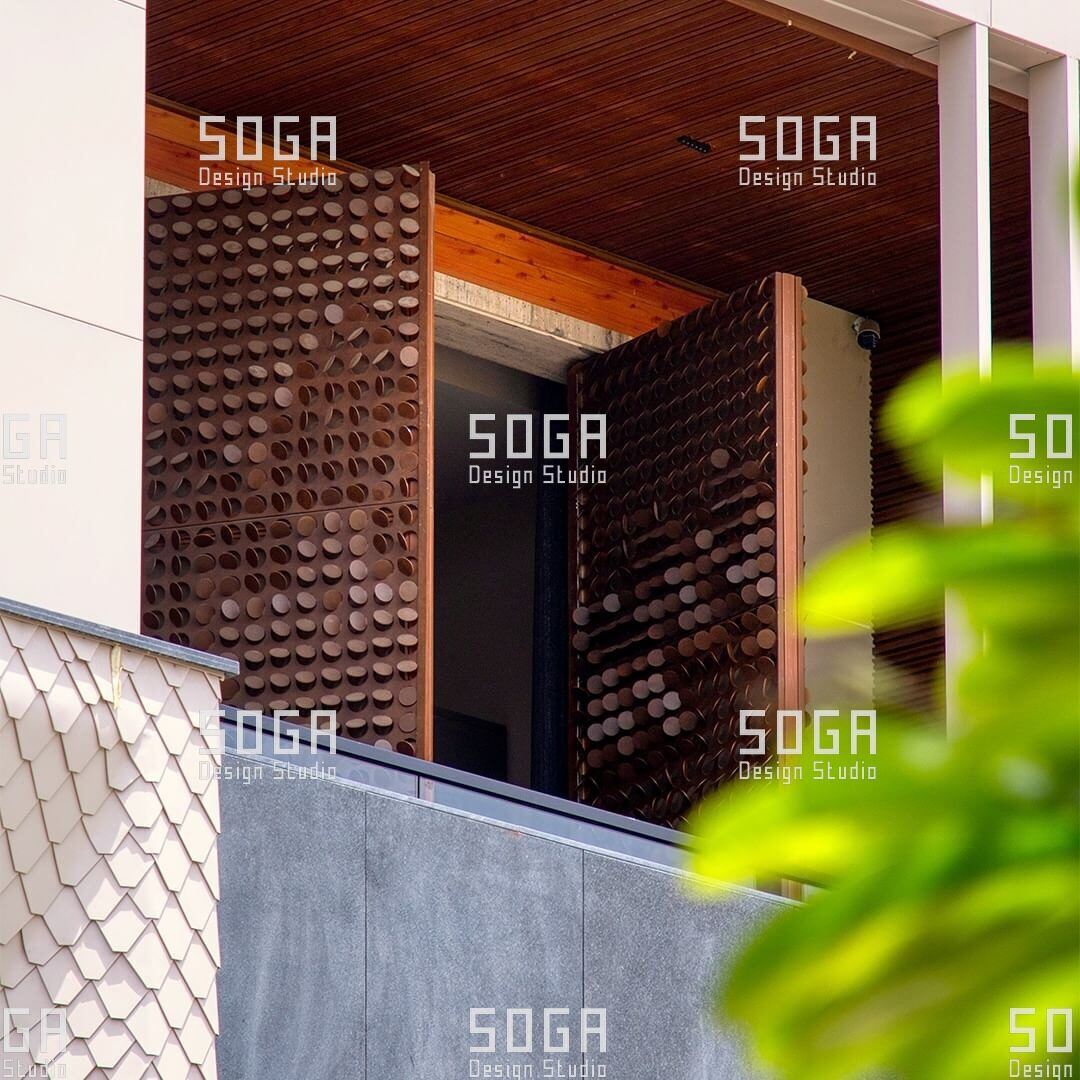
The record gives 216 rectangular panels across 242.3 square metres. A panelised field of that order, carrying a unique coin angle in every position, has a setting-out problem that is simple to state and ruthless in practice: every panel has an address, every address an orientation on the wall, and every coin an angle belonging to that address and no other. Lose the correspondence between the model and the physical piece and the wave stops being a wave. Nothing can be corrected on site by eye, because the pattern only makes sense globally. The design therefore had to reach the workshop as unambiguous, piece-level information, with identity carried from model to drawing to the label on the part.
The record also gives the construction: modular metal sheet, fabricated without soldering or welding. That is a demanding constraint, and it deserves stating as the achievement it is. Producing 216 panels with formed geometry and a controlled finish, holding each coin at its own angle, with no soldered or welded joint anywhere in the assembly, is a genuine piece of fabrication engineering. Joints that cannot be welded have to be folded, interlocked and mechanically fixed, which means the forming has to be right the first time and the sheet development exact. Metaguise fabricated the panels to that standard, and the project would not exist in its published form without that work.
And the record gives the handling condition: lightweight, allowing straightforward installation and removal. Light panels are faster and safer to fix on a live commercial frontage. Panels that come off again without destruction are serviceable, which is what an owner wants from a facade many years in. Designing for removal also disciplines the fixing strategy upstream: a panel that can be taken down is a panel whose fixings were never buried. That detail sits in the material on coin facade installation sequencing and tolerance, and how a coin facade is manufactured has a piece of its own.
Who did what
SOGA Design Studio designed the parametric coin facade system: the panel and coin logic, the angular field, and the geometry that carried it. Metaguise fabricated it, and is credited in the published feature as the fabrication team and as the photographer. Archium Design Studio was project architect. Yashika Group was the client. The system Metaguise markets as MetaCoin™ is the fabricator’s product and the fabricator’s name; the design authorship of this facade sits with SOGA, and both of those things are true at once.
Facade work is necessarily a multi-party business, for structural reasons rather than cultural ones. A facade is at once an architectural surface, a manufactured product, a piece of building envelope with real performance consequences and a commercial decision. No single office holds all four competences, and the projects that go well are the ones where each party does what it is genuinely good at. Naming the parties properly matters for the same practical reason: an architect wondering who could do something similar needs to know which office resolved the geometry and which workshop formed the sheet, because those are two different phone calls. Credit, in this industry, is mostly just accurate information.
Project credits and trade marks
| Role | Party |
|---|---|
| Parametric Designer | SOGA Design Studio |
| Fabrication Team | Metaguise |
| Project Architect | Archium Design Studio |
| Client | Yashika Group |
| Photography | Metaguise |
The project was published by Parametric Architecture on 30 April 2024 under the title ‘Parametric Coin Facade Made of Rectangular Panels with Circular Coin Mechanisms’, and the feature is online at https://parametric-architecture.com/parametric-coin-facade-made-of-rectangular-panels-with-circular-coin-mechanisms/ . Metaguise and MetaCoin are trade marks of their respective owner and are used here only to identify the fabricator and the product they name. SOGA Design Studio makes no claim to those marks. This article describes the studio’s own part of the work: the parametric design of the coin facade system.
Frequently asked questions
Who designed the parametric coin facade in Gurgaon?
SOGA Design Studio designed the parametric coin facade in Gurgaon, India, and is credited as parametric designer in the published project feature. Metaguise is credited as the fabrication team and as photographer, Archium Design Studio as project architect and Yashika Group as client. The project was published by Parametric Architecture on 30 April 2024 with that full credit list.
Where is the parametric coin facade located?
The facade is in Gurgaon, India, on a commercial elevation. The published project record gives the location as Gurgaon and the facade area as 242.3 square metres. Because the effect depends on direct sun striking the surface at a useful angle, orientation within the site matters to how the elevation behaves through the day and in different sky conditions.
How many panels are in the coin facade?
The published project record gives 216 rectangular panels, covering 242.3 square metres of facade. The panels are the repeating unit of production and setting-out; the circular coins held within them are the varying element, each one placed and rotated at a unique angle. That split is what allows continuous visual variation to be built from a single repeated panel geometry.
Do the coins move?
No. The coins are static. They are fixed at individually set angles, and there are no motors, actuators, sensors or moving parts in the facade. The apparent movement comes from outside the building: the sun changes position through the day, and most viewers see the elevation from a moving vehicle. The geometry makes both produce a continuous, wave-like shift rather than a flicker.
What is the facade made of?
The published project record describes modular metal sheet construction, fabricated without soldering or welding. The panels are formed sheet metal, assembled by folding, interlocking and mechanical fixing rather than welded or soldered joints, and the finish is what produces the specular behaviour the design depends on. The record also notes that the panels are lightweight, allowing straightforward installation and removal.
Who fabricated the coin facade?
Metaguise fabricated the facade and is credited in the published feature as the fabrication team, and also as the project photographer. The system Metaguise markets as MetaCoin is the fabricator’s own product name. Producing 216 panels with formed geometry and individually angled coins, without any soldered or welded joints, is a substantial piece of fabrication engineering, and it belongs to Metaguise.
Can a coin facade be used on a residential building?
The underlying logic is not specific to a building type: a repeating panel carrying an individually angled element adapts to whatever envelope it is applied to. What governs suitability is the situation rather than the programme. The approach needs a plane that receives directional sun, a viewing distance and speed suited to a field effect, and an envelope that can accept an applied system.
Designed in India, for an Indian street
It is worth being clear about what this facade was designed for. Not a competition board, not a render, not a northern European sky. It was designed for a commercial street in Gurgaon, with the sun that street gets, the speed it carries, the dust it accumulates and the way buildings have to work to be noticed in it. The wave logic, the panel and coin split, the decision to put all the variation into a rotated circle rather than the panel: each answers something about this condition rather than a general design ambition.
That is also why the project is worth other practices looking at and borrowing from. The thinking transfers in a way a one-off sculptural gesture does not, because it is a system, and the system was resolved here and manufactured here. Architects, fabricators and developers working on a coin facade can write to the studio for the system’s drawing-set index, and the complete coin facade guide covers the rest of the ground in more depth.
Designed in India. Engineered by Indian hands, in Indian workshops. Built to stand up anywhere in the world.