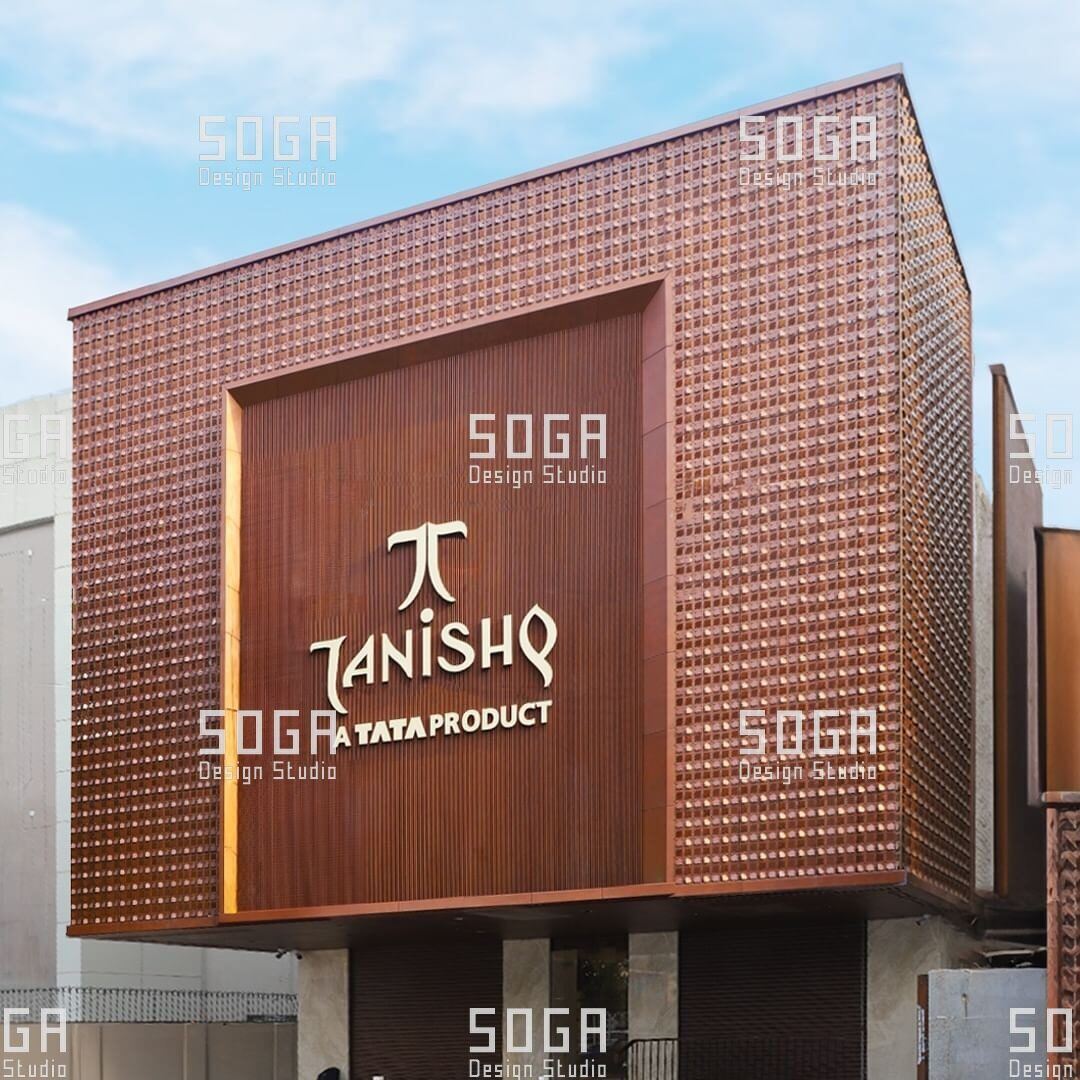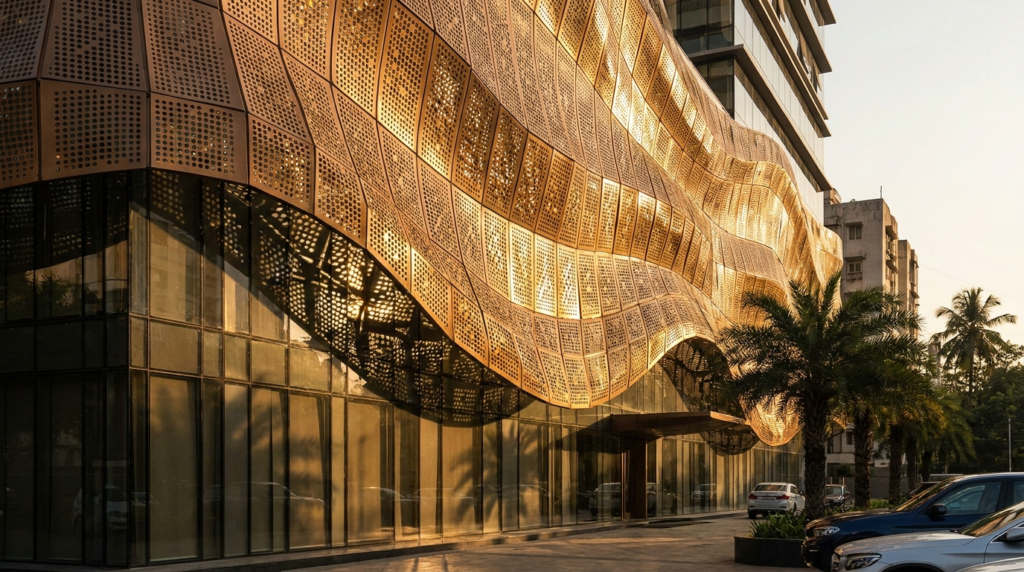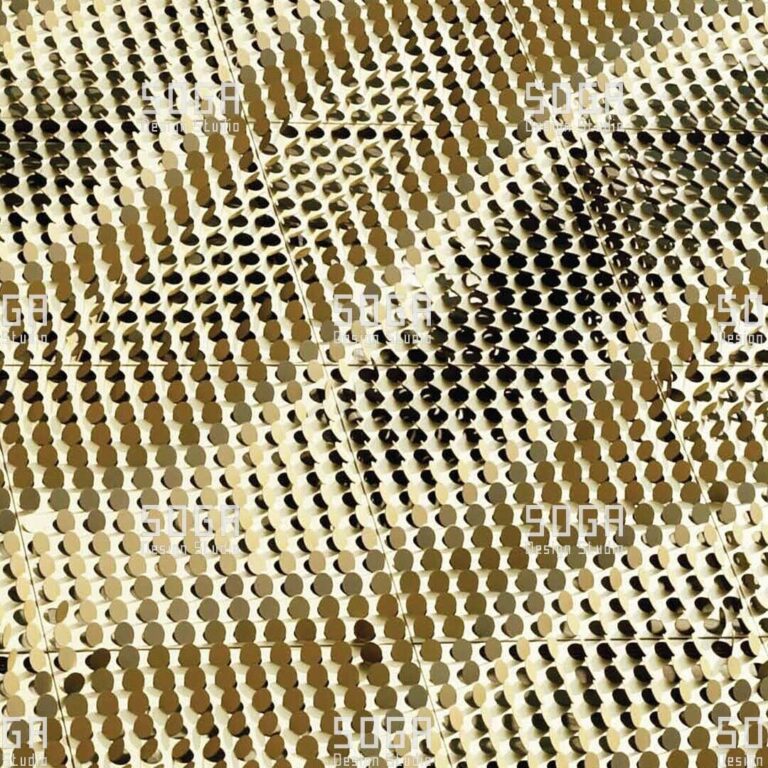
A rectangular panel is a flat thing. It returns whatever light the sky gives it, evenly, across its area. Cut a circle into it, set in a disc, tilt the disc out of the panel plane, and that changes. The panel still reads as flat. The disc does not. It faces somewhere the panel does not, so it is lit when the panel is in shade.
That one move — a circle set at an angle inside a rectangle — is the whole mechanism of a coin facade. Repeat the panel and the facade has a grid. Change the coin angle from position to position and it has a gradient. Hold both consistent and the elevation’s reading shifts through the day with nothing moving.
So the system has two parts doing two jobs. The panel is the module: constant, repeatable, identical wherever it lands. The coin is the variable: rotation and bend differ position by position, and it carries the visual information. Separating those jobs makes the rest buildable.
What follows is the teardown: how the geometry resolves, how the field is set out, how the panels are made and fixed, and what each decision costs. The worked example is a coin facade in Gurgaon, India, published by Parametric Architecture on 30 April 2024; the project story behind this facade is told elsewhere.
A coin facade is a rectangular panel system with circular metal discs set into each panel. The panels repeat on a regular grid; each coin is placed, rotated and bent to its own angle. Nothing moves. As the sun travels, each coin catches the light differently, so the elevation appears to shift through the day while the facade stays static.
The two-part logic: the panel is the module, the coin is the variable
The alternative is a bespoke panel at every position: if the pattern varies, make every panel match the pattern where it sits. It is a reasonable instinct, and it is what makes a facade of this kind hard to deliver. A bespoke panel means a unique cutting file, a unique forming setup, a unique fixing condition and a place it cannot leave. Nothing batches, and one setting-out error becomes material that cannot be reused.
Separating the carrier from the insert removes that problem without removing the variation. The carrier is one component made many times; the coin is what differs. Because the variation sits inside a constant outline, the outline can be standardised: one sheet size, one forming sequence, one edge detail, one fixing pattern.
| Panel — the constant | Coin — the variable |
|---|---|
| Fixed rectangular outline, repeated across the field | Circular insert, individually rotated and bent |
| One forming and edge-return setup for long runs | Angle changes position by position |
| Regular fixing centres at every position | Carries the visual gradient of the elevation |
| Interchangeable: any panel suits any grid cell | Position-specific, set by the geometric rule |
| Governs load path, tolerance and installation | Governs light, shadow and apparent depth |
What that buys is worth stating plainly. Fabrication becomes repeatable, because long runs of an identical component are what a sheet-metal shop is organised to produce. Setting out becomes a grid rather than a drawing exercise. Fixing becomes predictable: the bracket sees the same panel every time. And parts become replaceable, because a panel is a type and a spare is another unit from the same run.
The published record for the Gurgaon facade gives 216 rectangular panels across 242.3 m² of elevation. At that scale one-off panels would be a liability; repeated panels are inventory.
How the coin creates movement without moving
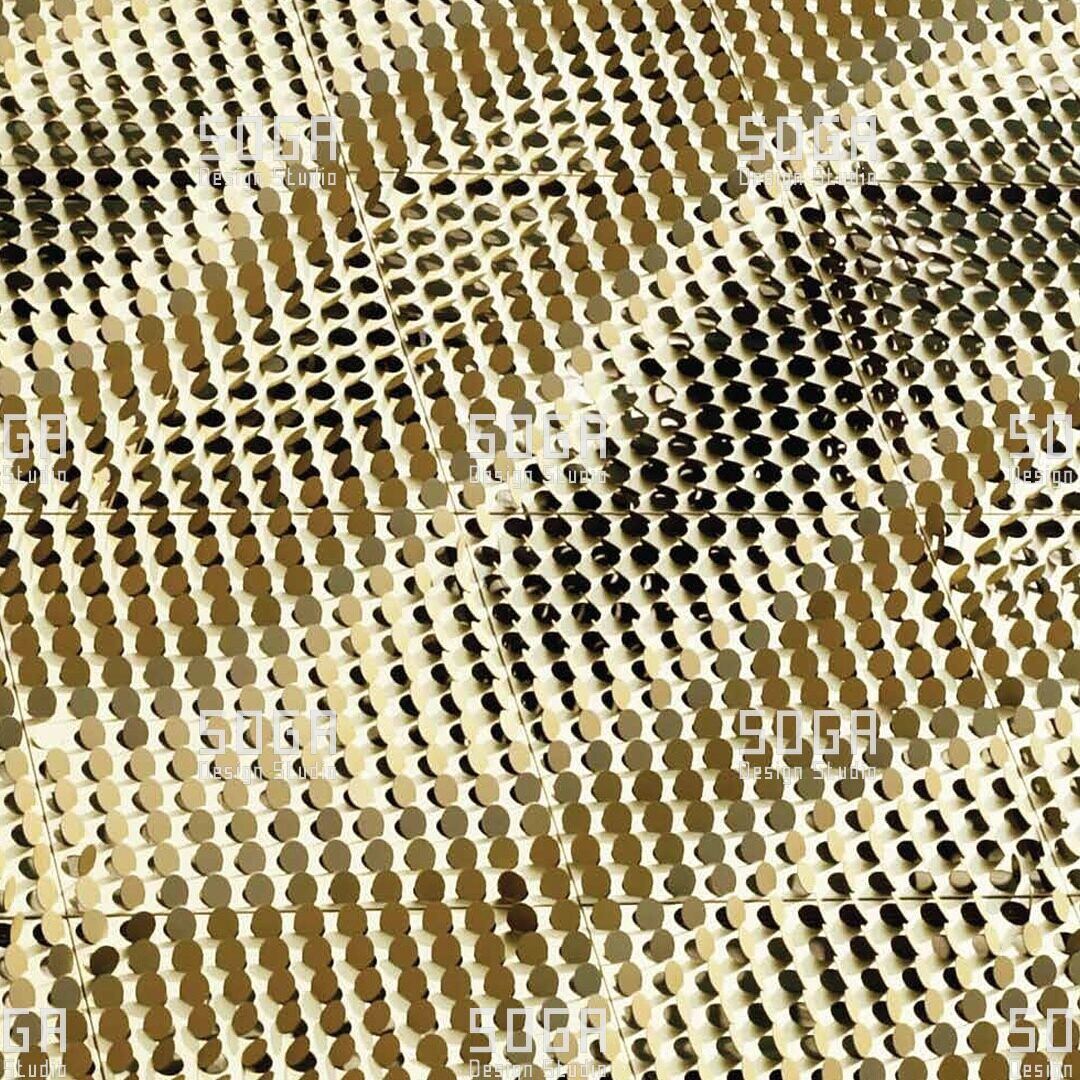
The published project record is explicit on this point. The coins are static. They are placed and rotated at a unique angle to optimise the interplay of light and shadow through the day, and they are bent at different angles, which is what produces the interactive effect as the sun moves. The facade does not track the sun: no drive, no sensor, no control logic.
The movement is in the light source, not the building. At any moment only those surfaces whose normals fall within a narrow band relative to sun and viewer return a bright specular reading. As the sun moves that band sweeps across the field, and coins enter and leave it. What appears to travel across the elevation is the band, not the coins. The published description relates the pattern to ocean wave movement — a wave field being another still surface of varying inclination under a moving light.
The consequences run both ways.
| What static-coin construction gains | What it gives up |
|---|---|
| No bearings, pivots or actuators to source | No tuning of the effect after installation |
| No wear cycle, so no servicing of moving parts | Performance is fixed when the geometry is frozen |
| No noise, and no wind-induced rattle | No response to a changed context, such as a new building opposite |
| Nothing to seize, corrode or jam long term | Angle errors in fabrication are permanent |
One line there deserves spelling out. Because the effect is a function of orientation, time of day and sky condition, the system does not perform identically on every elevation. A west-facing field under a low afternoon sun gets raking light, long shadows and high contrast. A north elevation in the northern hemisphere receives mostly diffuse sky, so the coins read as shifts in tone and depth rather than bright flashes. Under heavy overcast the field flattens towards a single value, because diffuse light arrives from everywhere and coin angle stops mattering.
That is a constraint rather than a defect. The rule has to be written against the orientation it will be built on, and a shaded elevation should be judged on depth and texture rather than glint. A kinetic facade would behave differently, at the cost of everything in the left-hand column. The static coin is a trade: a fixed effect for a facade with nothing that can fail.
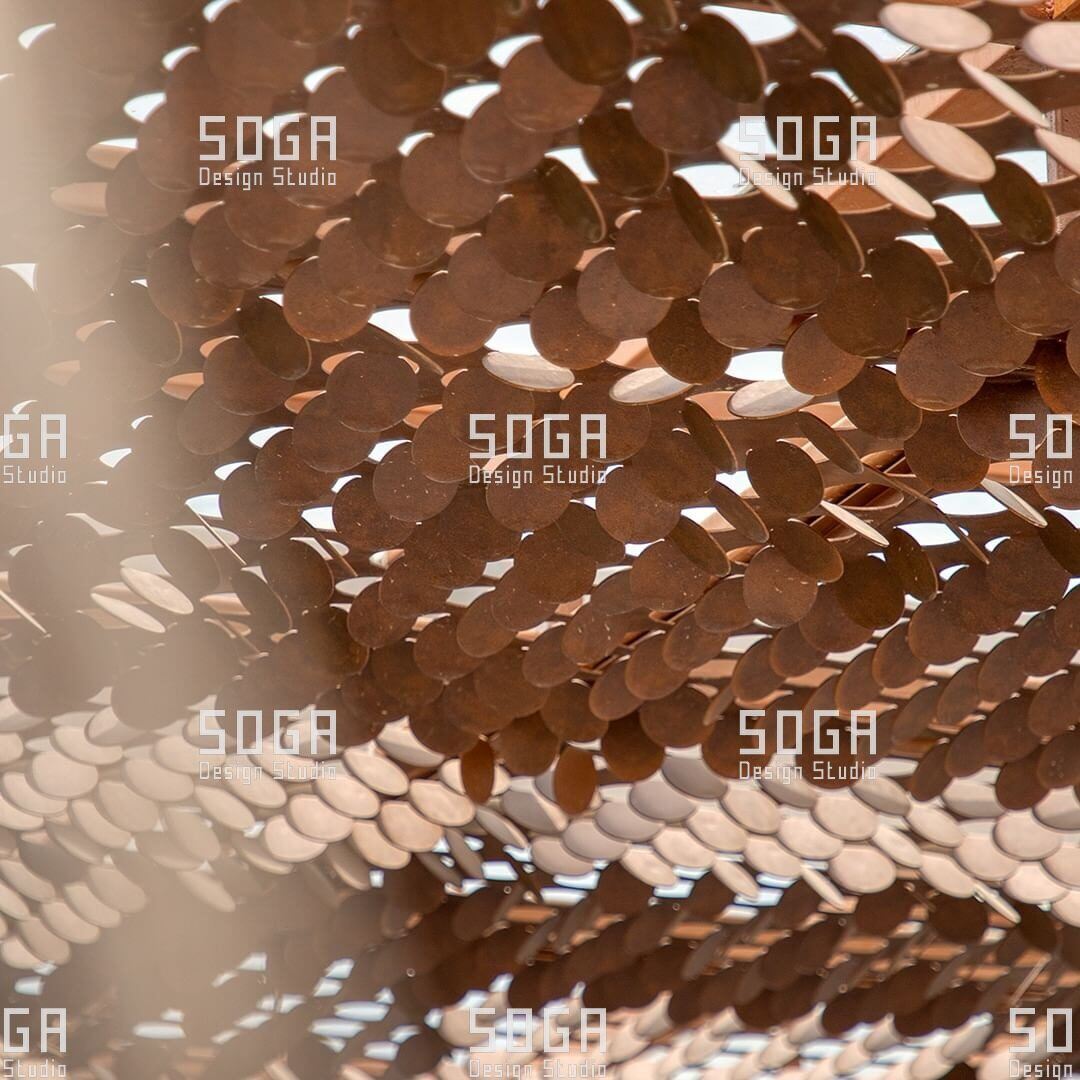
Setting out: the grid, the panel and the coin positions
A field like this is laid out twice: once as a panel grid, once as a coin rule. The two are related but not the same exercise, and conflating them is where such facades go wrong.
The panel grid against the structural grid
The panel grid is dimensional. It reconciles the panel module with the structural grid behind it, which is almost never a convenient multiple of anything. The brackets and carrier framing the panels hang from have to land on structure, so panel grid and bracket grid are resolved together, not in sequence.
The setting-out origin belongs at the most visually disciplined condition on the elevation — a principal corner, or the head of a continuous opening — because that is where accumulated error is least forgiving. Working outwards from there sends tolerance where it can be absorbed.
Why panel-level repetition keeps the pattern from drifting
Repetition is a tolerance strategy, not only a cost strategy. If every panel is identical, the coin positions inside it are identical relative to its own edges, so the pattern is a function of panel placement plus coin angle and the panel’s internal geometry contributes no cumulative error. Position coins relative to the elevation instead and an internal error shows as a visible kink. Repetition localises error: a misplaced panel is a discrete fault, not a drift.
Coin positions from a rule, not from a drawing
Coin rotation and bend are generated, not drawn one at a time. A rule takes each coin’s position in the field and returns its angle — a continuous function sampled at the coin centres. The pattern can then be adjusted as a pattern, and stays consistent because every value comes from the same expression.
Parametric modelling does two jobs here: resolving the geometry and emitting the data fabrication needs. The useful output is not a rendering but a schedule — panel type, location, coin positions, coin angles — a shop can work from. How that chain runs from computational design to fabrication drawings is a topic in its own right.
Edges, openings and corners
Everything interesting happens where the grid meets something off module.
| Condition | What has to be resolved |
|---|---|
| Field edge | Where the module runs out: a cut panel, a dedicated edge type, or a closure absorbing the remainder |
| Opening reveal | Head, jamb and sill returns, and whether a coin may sit near the opening line |
| Corners | Mitre or a dedicated corner unit, how the coin rule reads around a change of plane, and clearance to withdraw a panel at an internal angle |
Movement joints belong in the same category: a deliberate break on a grid line rather than one found on site. The principle is the same in every case. Resolve it in the model, not on the scaffold — a condition decided on site is decided without the rule.
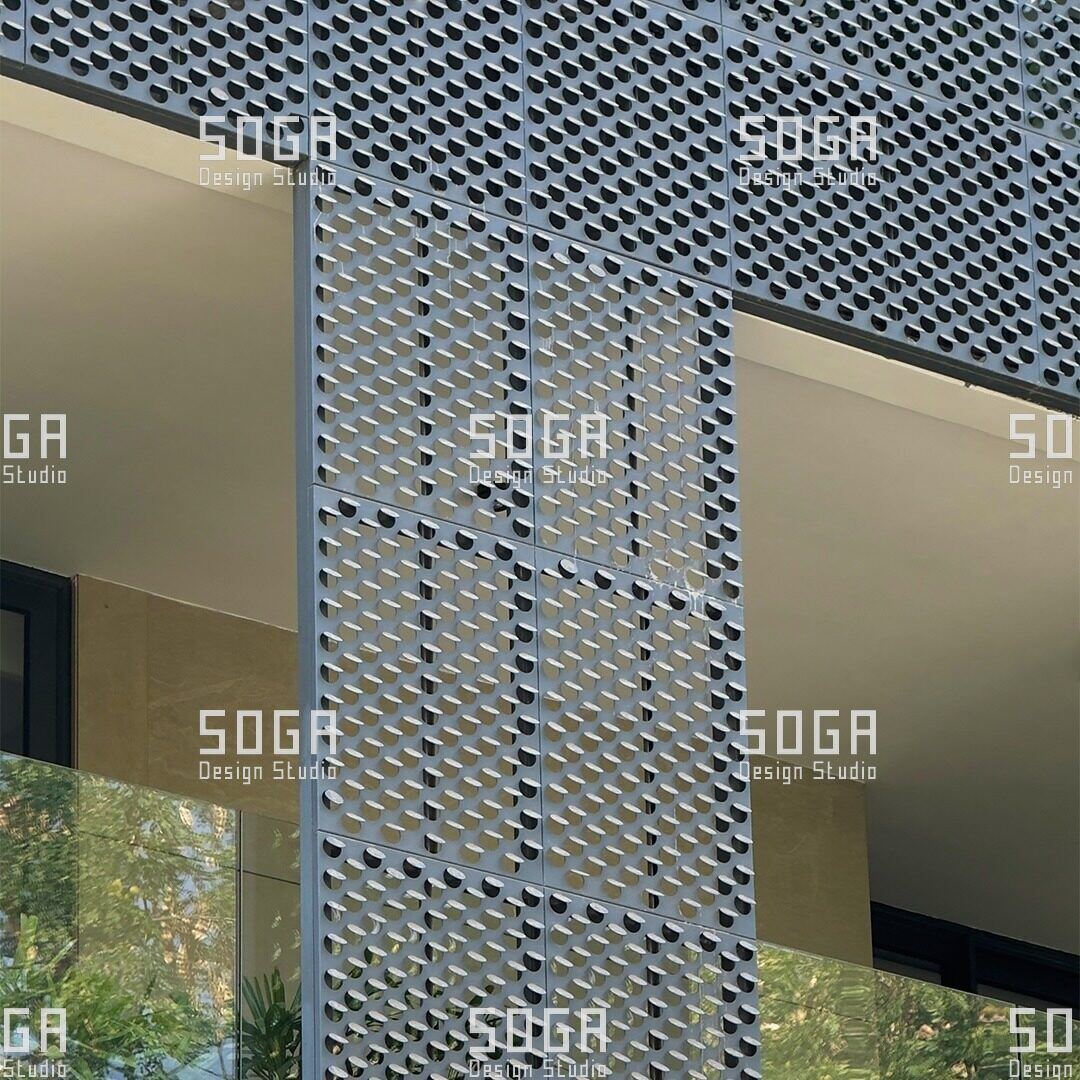
Fabrication without soldering or welding
The published project record states that the panels are modular metal sheet construction, fabricated without soldering and welding techniques. That is a significant fabrication decision, worth unpacking as engineering rather than as a compliment.
Heat is the problem. Thin sheet has little mass to absorb a weld’s heat input, so metal near the joint expands, metal further away restrains it, and the residual stress shows as a bowed or oil-canned face. On a flat panel that is directly visible, because a flat surface at a grazing angle is unforgiving. A coin facade makes it worse, because the coins establish a reference: a distorted carrier panel behind precisely angled inserts reads as an error, not as texture.
Finish is the second problem. Most architectural metal finishes do not survive localised heat. A welded or soldered joint burns, discolours or delaminates the coating around it, so finishing has to follow joining, and the panel goes through it as an assembly — larger, more awkward and more easily damaged than a flat component.
| Heat-based joining | Forming and mechanical assembly |
|---|---|
| Heat input distorts thin sheet locally and permanently | No thermal distortion; the sheet keeps the flatness it was formed with |
| Finish must follow joining, as an assembly | Components are finished flat, then assembled |
| Joint quality varies with operator and position | Repeatability comes from tooling and jigs |
| Rework means grinding, refinishing, colour matching | A component can be remade or swapped on its own |
| Long runs accumulate variation | Long runs reproduce the setup |
Take joining out and the structure must come from elsewhere. Here it comes from form: folds, returns and stiffening geometry give thin sheet its rigidity, and the edge return that makes a panel look crisp also stops it behaving like paper. Assembly becomes mechanical — fixings, captive details, engineered engagement — work that can be jigged and checked dimensionally rather than judged by eye.
The payoff is a panel a sheet-metal shop can produce in long runs: cut, form, finish, assemble, inspect, stack. That is a different industrial activity from welded fabrication, with its own equipment and quality regime. Delivering 216 panels to a consistent standard by that route is real fabrication work, and Metaguise, the fabrication team on the project, did it. More on how a coin facade is manufactured belongs with the shop sequence.
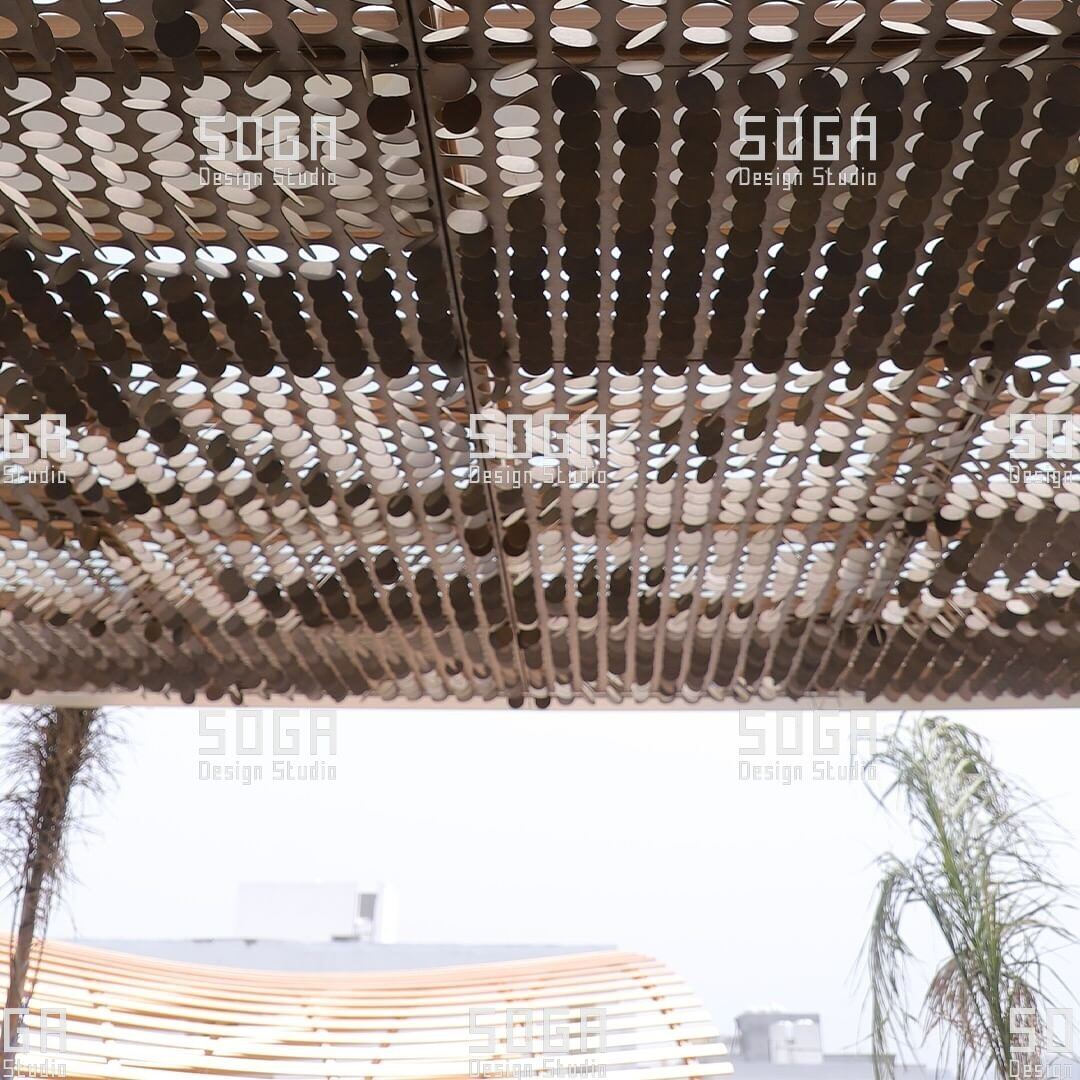
Weight, fixing and the case for a lightweight panel
The published record notes that the lightweight construction allows straightforward installation and removal. Panel weight looks like a specification line and is in fact a decision that propagates through the whole job.
It starts at the bracket, sized for the dead load of the panel plus wind and transferring that load to structure through a connection whose own capacity has to be demonstrated. Heavier panels mean larger brackets, more substantial fixings, sometimes local strengthening behind. Lighter panels mean load stops governing, and the bracket can be designed for what matters in a rainscreen: adjustability, thermal movement, isolation of dissimilar metals.
Then handling. There is a real threshold between a panel two people can lift and position by hand and one that needs mechanical handling. Crossing it turns installation from an access-platform operation into a lifting operation, bringing in plant, exclusion zones, lift planning and weather windows.
| What panel weight governs | Why it matters |
|---|---|
| Bracket size and fixing specification | Pushes the bracket towards a structural rather than adjustment component |
| Load back to primary structure | May require local strengthening, and limits what the facade can hang from |
| Access equipment | Platform capacity, and whether a mast climber or crane is needed |
| Installation sequence | Light, independently fixed panels can go up out of strict order |
| Replacement and maintenance | Whether a damaged panel can be withdrawn at height by hand |
The last line marks a difference between two kinds of field that look identical from the street. In an individually releasable field, each panel can be undone from the front or an accessible edge without disturbing its neighbours: a damaged unit comes off, a replacement goes on, the rest of the elevation is untouched. In an interlocked field, panels retain each other, so getting one out means working back from a free edge, releasing everything in between. A single replacement becomes a partial dismantling, and that cost sits with the building for life.
Which of the two a facade is gets decided early, in the fixing detail, and is nearly impossible to change later. Modular panels on a repeated fixing pattern are well placed to be the first kind, and lightweight construction makes a front-released panel practical at height. Decisions about coin facade installation sequencing and tolerance follow from this.
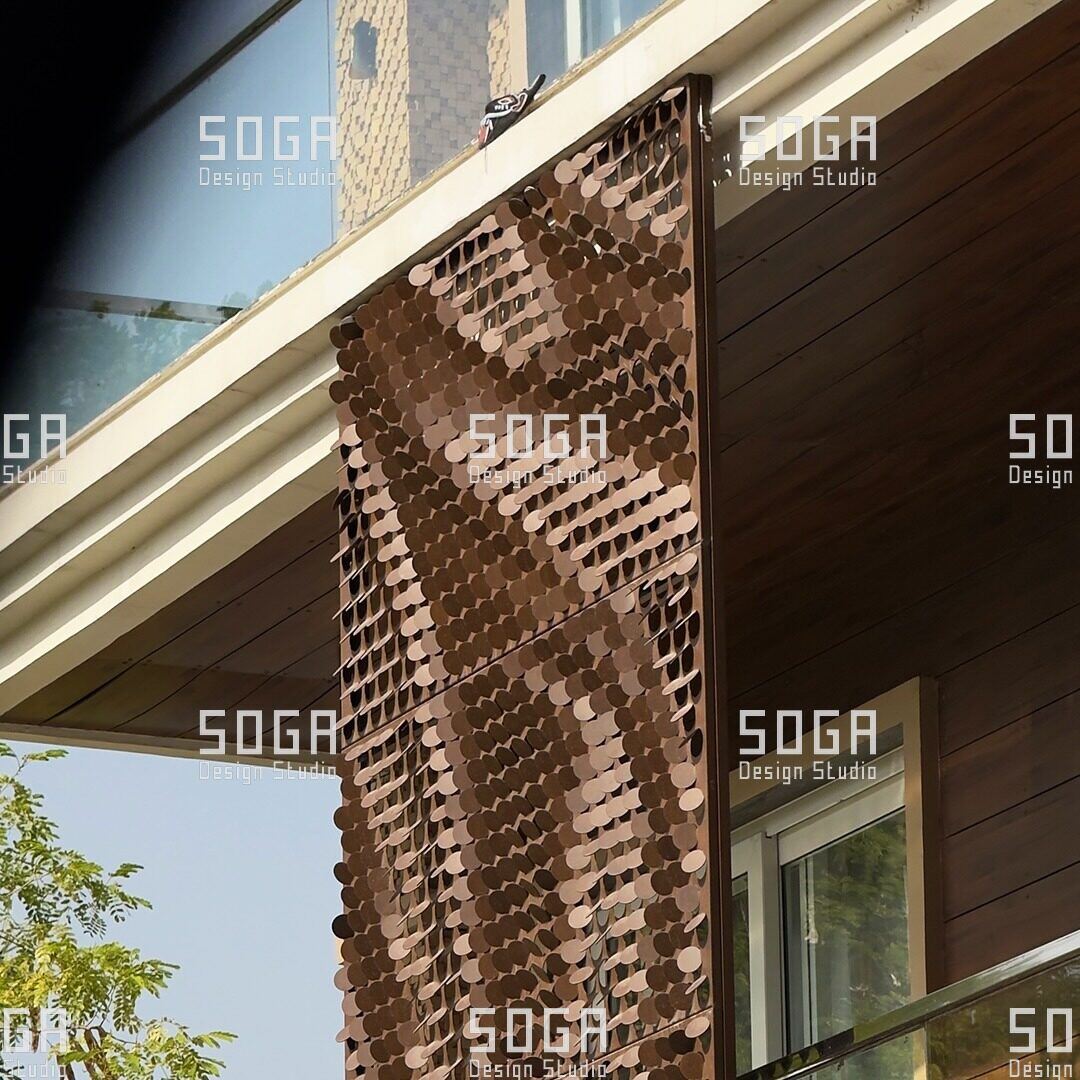
Where SOGA’s design work sits in this system
SOGA Design Studio designed the parametric coin facade system described above: the panel-and-coin logic, the rule that sets each coin’s rotation, and the geometry that resolves into a producible panel family rather than a field of one-off components. Holding the panel constant and letting the coin vary is the studio’s part, along with turning that logic into something a shop can batch and a site can set out. The published record credits SOGA Design Studio as parametric designer, Metaguise as fabrication team and Archium Design Studio as project architect.
The fabricated product corresponding to this panel type is the system Metaguise markets as MetaCoin™; the name belongs to the fabricator, and the design work described here was SOGA’s. The studio’s coin facade work sits alongside its sequin, slicing fin and 3D block systems, which apply the same carrier-and-variable thinking to different insert geometries. A broader treatment of the type sits in the complete coin facade guide.
Project credits and trade marks
| Role | Party |
|---|---|
| Parametric Designer | SOGA Design Studio |
| Fabrication Team | Metaguise |
| Project Architect | Archium Design Studio |
| Client | Yashika Group |
| Photography | Metaguise |
The project was published by Parametric Architecture on 30 April 2024 under the title ‘Parametric Coin Facade Made of Rectangular Panels with Circular Coin Mechanisms’, and the feature is online at https://parametric-architecture.com/parametric-coin-facade-made-of-rectangular-panels-with-circular-coin-mechanisms/ . Metaguise and MetaCoin are trade marks of their respective owner and are used here only to identify the fabricator and the product they name. SOGA Design Studio makes no claim to those marks. This article describes the studio’s own part of the work: the parametric design of the coin facade system.
Frequently asked questions
How does a coin facade work?
A coin facade is built from rectangular carrier panels with circular discs set into them. The panels repeat on a regular grid and stay dimensionally identical. Each coin is rotated and bent to an angle set by a geometric rule, so neighbouring coins face different directions. Nothing moves: as the sun travels, different coins catch the light.
Who designed the coin facade system in this project?
The published record credits SOGA Design Studio as parametric designer, Metaguise as fabrication team, Archium Design Studio as project architect and Yashika Group as client. SOGA designed the parametric system: the panel-and-coin logic and the rule governing coin angles. Metaguise fabricated the panels. Parametric Architecture published the project on 30 April 2024.
Do the coins in a coin facade move?
No. The coins are static. The published record describes them as placed and rotated at a unique angle, and bent at different angles, producing an interactive effect as the sun moves. The apparent motion comes from the sun travelling across a field of differently angled reflectors, not from anything changing position. There are no bearings, actuators or moving parts to service.
What are coin facade panels made of?
The published record describes modular metal sheet construction, fabricated without soldering and welding techniques. The panels are formed sheet metal: cut, folded and mechanically assembled, with stiffness coming from the formed geometry rather than welded joints. Finish is applied to flat components before assembly, one reason the heat-free route is used: localised heat distorts thin sheet and damages coatings.
How are coin facade panels fixed to a building?
Panels hang from brackets and carrier framing that transfer load back to the primary structure, like a rainscreen. Because the panel is a repeated module the fixing pattern repeats too, so the bracket sees the same panel everywhere. Lightweight construction keeps the bracket an adjustment component, and the published record notes it allows straightforward installation and removal.
Can a single coin facade panel be replaced?
In a field of individually releasable panels, yes. Each panel is fixed so it can be undone without disturbing its neighbours: a damaged unit is withdrawn and a replacement fitted while the rest of the elevation stays in place. That depends on the fixing detail, decided early and hard to change later. Because every carrier panel is one type, a spare is another unit from the run.
What size is a coin facade panel grid?
The published record for the Gurgaon project gives 216 rectangular panels across a facade area of 242.3 m², and does not publish panel dimensions. In general the module is set by the sheet widths available to the shop, the handling weight a crew can manage at height, and the structural grid the brackets land on. It is resolved against all three before the coin rule is written.
Designed in India, built in India
The system in this article was designed, modelled, fabricated and installed in India, by an Indian studio, an Indian fabricator and an Indian project architect, for an Indian client, then published internationally with those credits intact. The geometric rule, the panel family, the production route and the installation detail were worked out in one place, by people who could talk to each other, which is why they resolve together rather than fighting each other.
None of it required new technology. It required a clear separation between what repeats and what varies, a rule written well enough that every component could be generated from it without drift, a fabrication route chosen to suit thin sheet, and a panel light enough to be put up and taken down again by hand. Those are ordinary engineering decisions in the right order.
Architects, fabricators and developers working on a coin facade can write to the studio for the system’s drawing-set index.
Designed in India, engineered in India, and built to work on any elevation the sun crosses.