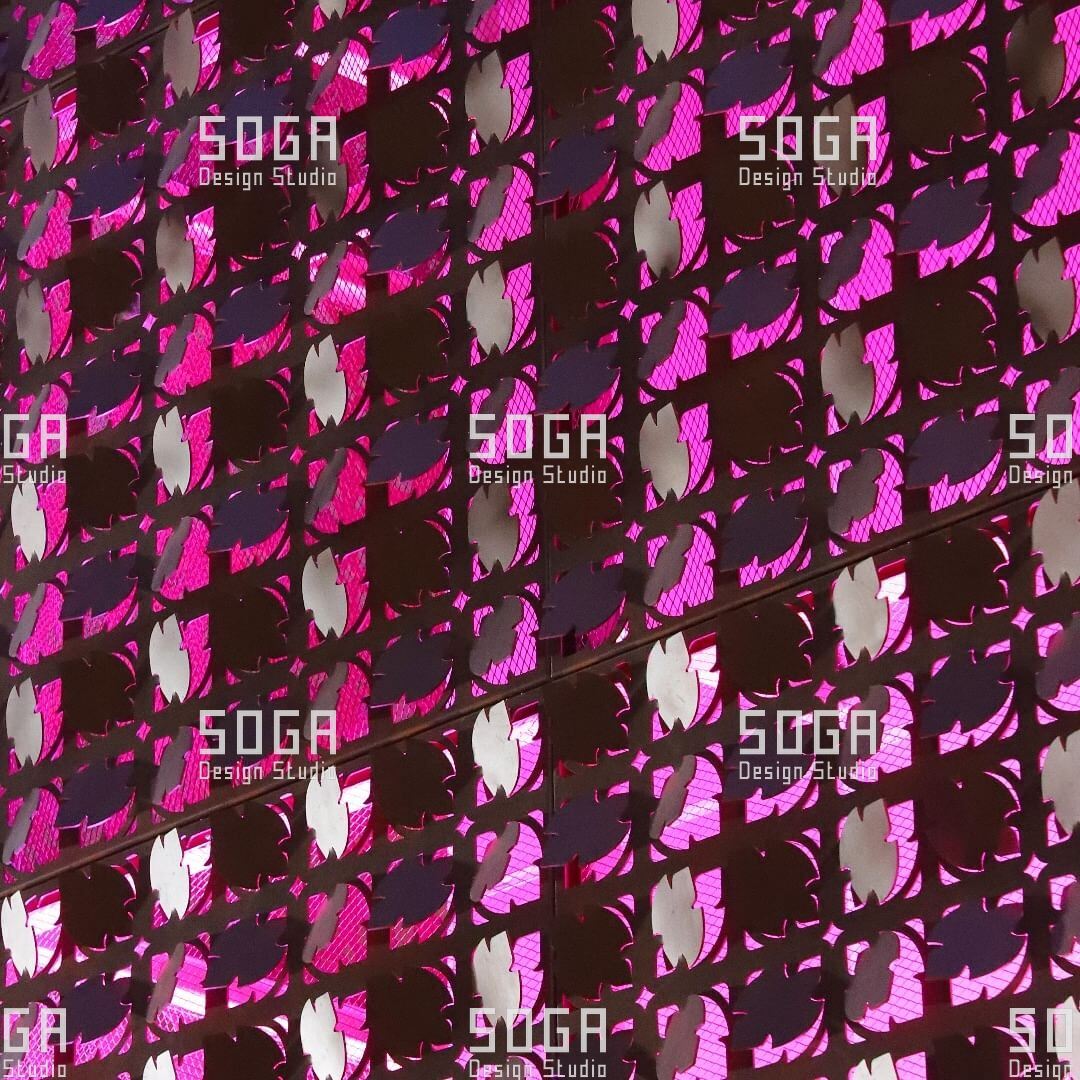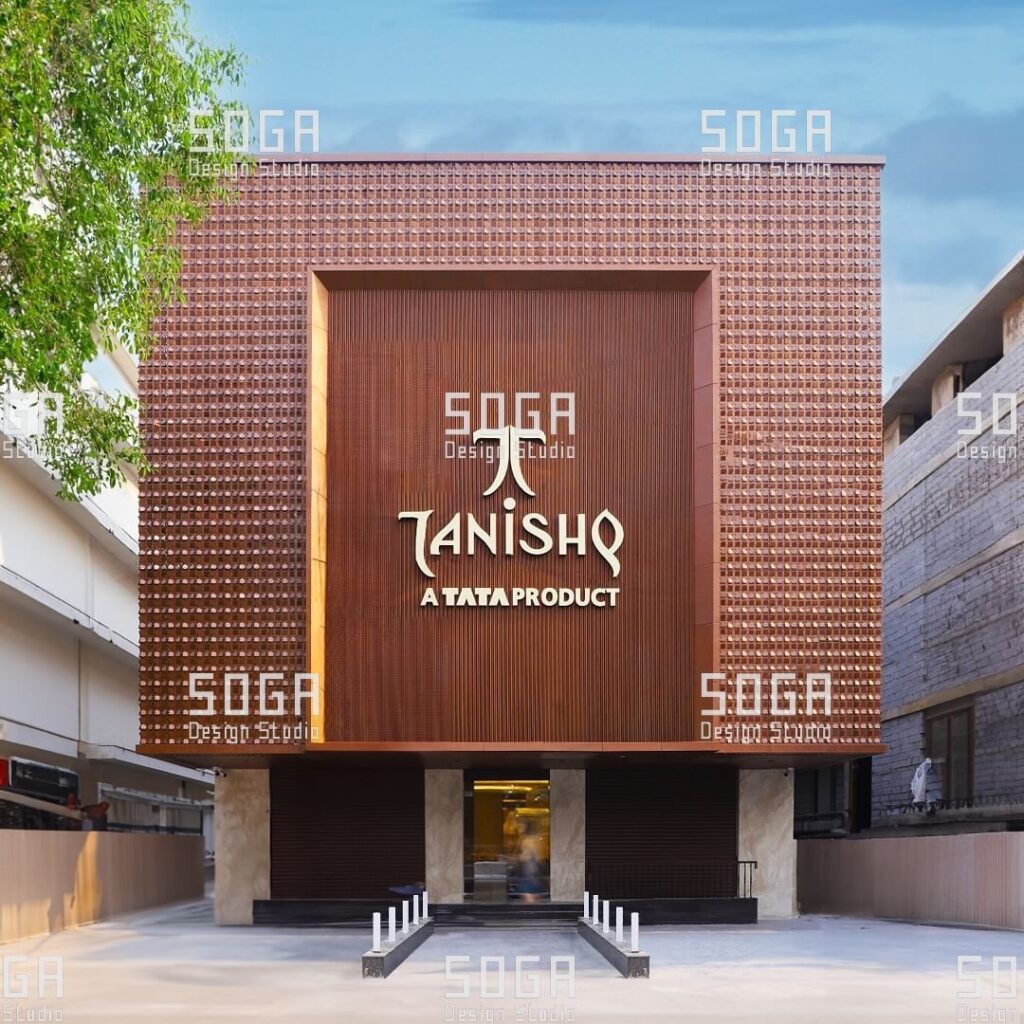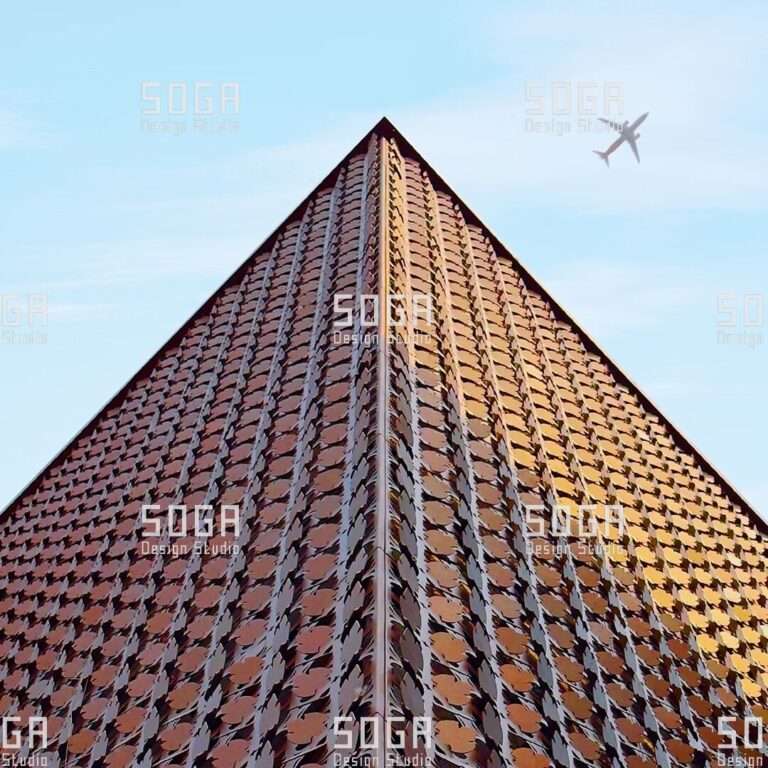
A client approves a rendering: an elevation of small metal discs catching low light. What has been approved is not an image. It is a set of values — a size, a spacing, a range of angles, a distance off the plane behind, a reflectivity. Alter one and the rendering describes another building.
The difficulty is that almost every conversation about a coin facade happens in adjectives. Shimmery. Dramatic. Quiet. Alive. Those words describe the intention accurately, but nothing in a fabrication drawing responds to an adjective. That gap is where coin facades go wrong: nobody turned “shimmery” into a rule, so the geometry settled by default.
The decisions, though, are genuinely open. A coin facade is not a catalogue product with variants but a small set of parameters with wide ranges, and the same system will produce soft woven texture or hard metallic scatter. Most schemes inherit several of those values from a reference image and then argue only about the pattern. What follows are the parameters SOGA sets when designing a coin facade, and what each does to the result — visually, from inside, and where it carries a consequence found out late. The complete coin facade guide covers the system itself.
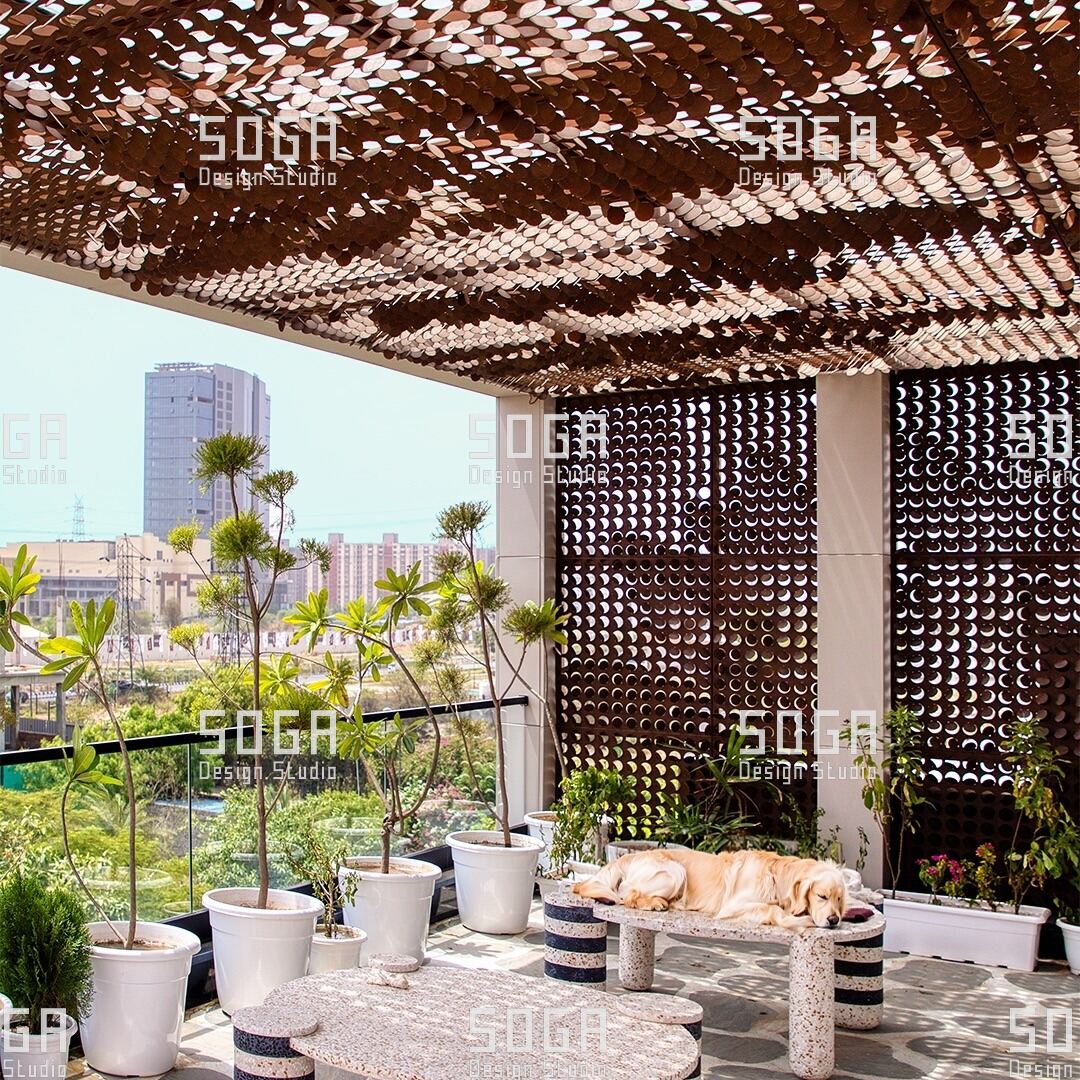
How a coin facade looks is decided by a few parameters, not by drawing: the size of each coin, how densely the coins sit, the angle each faces, how far it projects from the backing plane, and how its finish returns light. The rule that varies those values across the elevation does the rest.
The five parameters that do the work
Treat them as a set, because they interact: unit size changes what a given density looks like, depth changes what a given rotation does, finish decides whether rotation dominates. No values appear below — the right one depends on the elevation — but the direction of effect can be stated precisely.
| Parameter | What it principally governs |
|---|---|
| Unit size | Field scale, and the distance at which it resolves into separate coins |
| Density and spacing | Openness, view-through, how solid the elevation reads |
| Rotation and tilt | What each coin reflects, and the character of the light effect |
| Depth and projection | Shadow, apparent relief, how far the field closes in oblique view |
| Finish and reflectivity | Whether the facade is driven by light or by geometry |
Unit size: how big each coin is
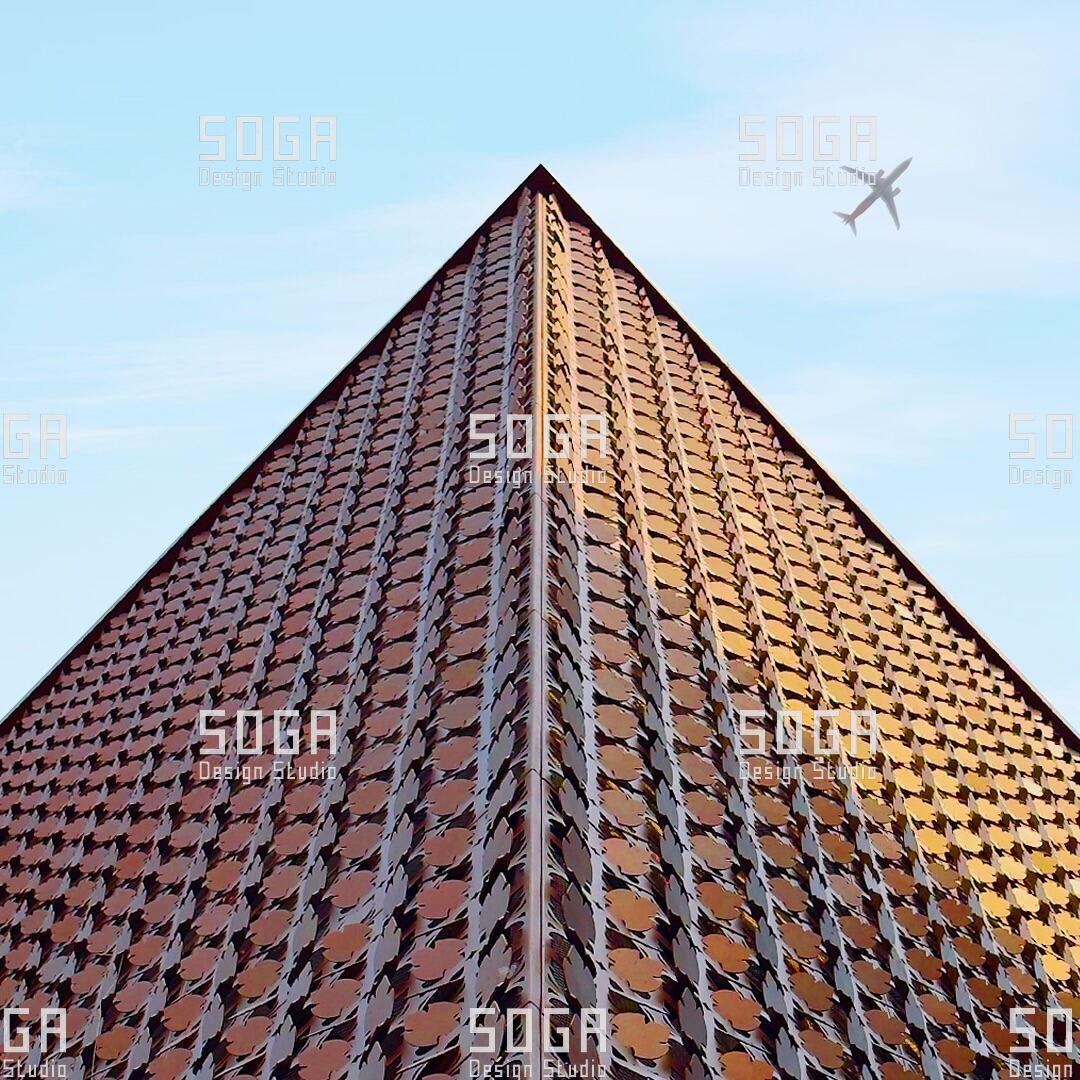
Unit size is the hardest decision to reverse, because it sets the grain of everything else. A large coin gives few elements with strong individual presence, so the elevation reads as a composition of parts; a small coin gives a field the eye stops resolving, closer to textile than cladding.
The underestimated consequence is resolving distance. A small unit dissolves into a grey wash before a viewer across a road can read it; a large unit seen close up reads as a handful of plates. Setting unit size before the viewing distance is the commonest sequencing error.
From inside, a larger coin gives bigger occlusions between bigger gaps and a smaller one a finer veil — two experiences occupants describe differently at identical openness.
The late discovery is tolerance: a large coin shows a forming inconsistency plainly, while a small coin forgives the unit and punishes the field, as setting-out drift accumulates into a wander in the rows.
Density and spacing: how close the coins sit
Density is the openness control, and the one clients misjudge most, because openness is not a property of the facade but of a viewing angle.
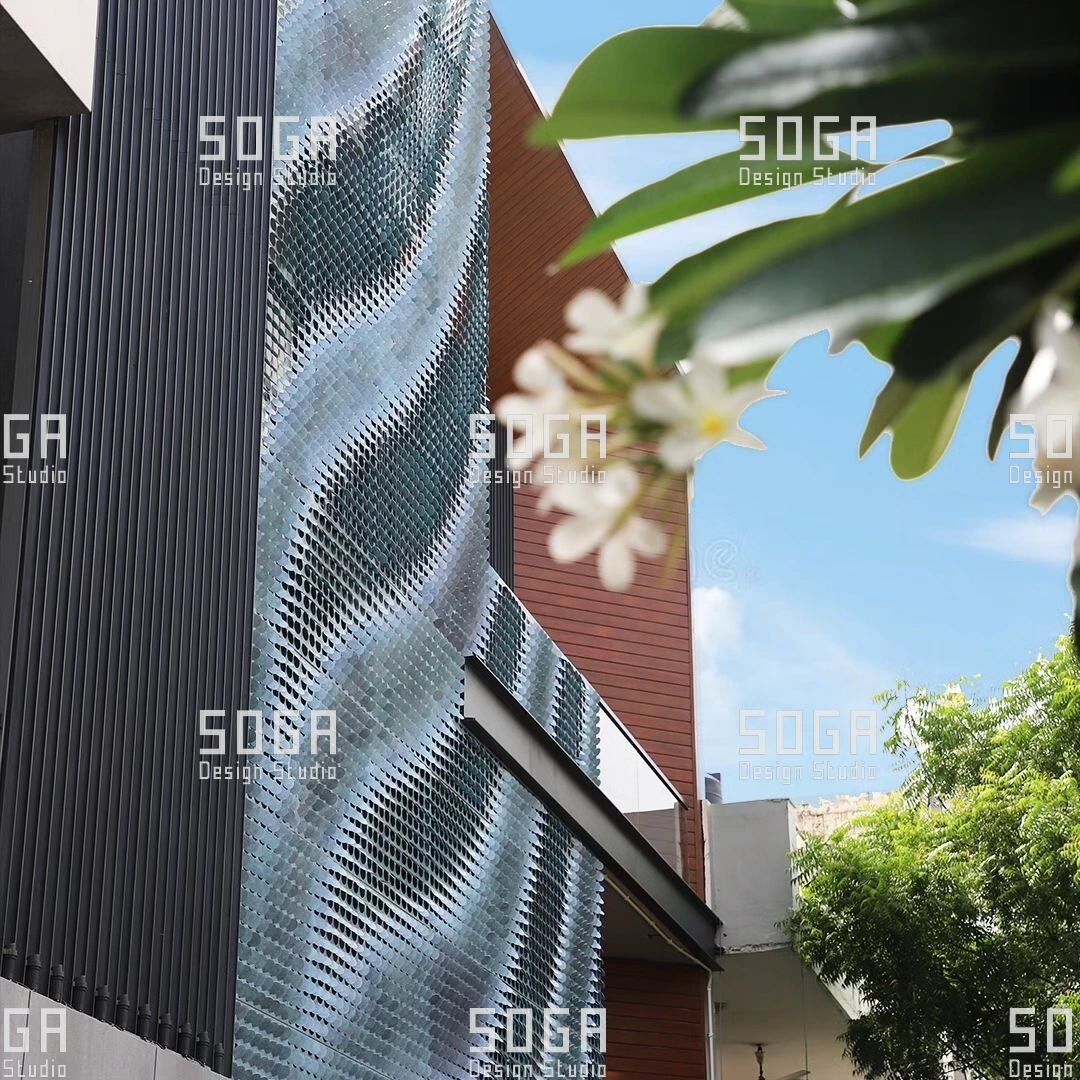
A field that reads open square-on closes up as the viewer moves off axis, because the gaps shorten in projection until the coins overlap. That is the most useful behaviour the system has: the facade can stay open to sky and view for the occupant and still read as solid mass from the street — but only if the oblique condition is reviewed rather than assumed.
| Moving density | What happens to the result |
|---|---|
| Denser, tighter spacing | More solid and more uniform; the field flattens towards one surface; view-through drops sharply, fastest in oblique view; more units to make, fix and clean |
| Looser, more open spacing | Lighter and more linear; coins and backing both visible; view-through holds at wider angles; the backing has to be finished as a design surface |
The late consequence is what the gaps reveal: an open field exposes plant, drainage and blockwork, and an elevation drawing hides the problem by showing the coins and not the gaps.
Rotation and tilt: which direction each coin faces
A coin lying flat in its plane takes the same light as everything around it; turned out of that plane, it becomes a small mirror aimed somewhere specific.
Widen the angular range and the elevation becomes active and scattered, some coins flaring while neighbours go dark; narrow it and the field calms, brightness moving in masses rather than speckle. Direction matters as much as amount: a field tilted towards one side of the approach has a good side and a quiet side, so a symmetrical default wastes much of it.
From inside, tilt decides whether the screen is a filter or a wall: coins turned away from the sightline leave it clear, coins turned into it block it at identical spacing.
The non-obvious consequence is colour: for much of the day a coin tilted upwards reflects the sky rather than the sun, so the facade is often sky-coloured, shifting with the weather.
Depth and projection: how far the coin stands off the backing
Depth is the quietest parameter and does the most work on an average day. Rotation and finish produce the dramatic effects and both need direct sun; projection produces shadow, available in any directional light.
Increase projection and the field gains relief: each coin throws a crescent of shadow onto the plane behind, and in oblique view the coins occlude one another so the elevation closes into a deep mass. Reduce it and the facade becomes a pattern on a plane rather than a screen — right when it should be quiet, wrong when it needs presence.
From inside, projection governs the edge of the view: deeper coins intrude into the reveal as objects, shallower ones stay a pattern on the glass line.
Two late consequences. A ledge on every coin collects dust, so deeper projection ties appearance to a maintenance regime somebody must agree to. And once a coin casts a shadow, a backing plane chosen as substrate is read as a design surface.
Finish and reflectivity: how the surface returns light
Finish decides which of the other parameters the viewer experiences. A highly specular finish puts the facade at the mercy of the light, making geometry nearly invisible and the elevation a field of bright and dark events: spectacular in raking sun, almost blank under a flat sky. A diffuse finish keeps the geometry legible.
Increase reflectivity and contrast rises, dependence on orientation and weather rises, and apparent depth falls, because a mirror shows what is around it rather than its own form. Specular finishes make rotation the dominant control and projection nearly irrelevant; matte finishes invert that.
From inside, a reflective coin reads as a bright object drawing the eye to the screen, while a matte one recedes and lets the view dominate.
The late consequence is consistency. A coin field is a comparison machine, setting units at differing angles beside one another — the condition under which small differences between batches show as patches. Specify to the field, not the sample.
Pattern: the difference between a texture and a composition
So far the parameters have been treated as single values. The step up separates a surface treatment from a piece of architecture.
If every coin carries the same values, the result is a texture: even, calm, a material rather than a composition. If a parameter varies across the field according to a rule, it becomes a composition, with regions, direction and emphasis that participate in the building’s form.
| Approach | How the rule works | What it reads as | Where it gets difficult |
|---|---|---|---|
| Gradient | One parameter shifts steadily across the field | A change in weight giving the elevation direction, with no visible pattern | The shift needs a reason, or it reads as an arbitrary fade |
| Image-mapping | An image or curve sampled at each position | A figure in the field — wave, flow, gesture — dissolving into texture up close | Fine detail is lost to the unit grain |
| Zoning | Different parameter sets over different parts, following what is behind | A facade that answers the building: open across glazing, dense across wall | The joins are the problem; a hard density edge must be blended away |
What matters is that all three are written rather than drawn. The designer does not place coins but defines the relationship — how a coin’s values follow from where it sits — and the field follows. The object of design is the rule, not the panels: a parameter changes and the whole field regenerates. Carrying that through is the discipline covered in computational design to fabrication drawings.
Designing with light rather than colour
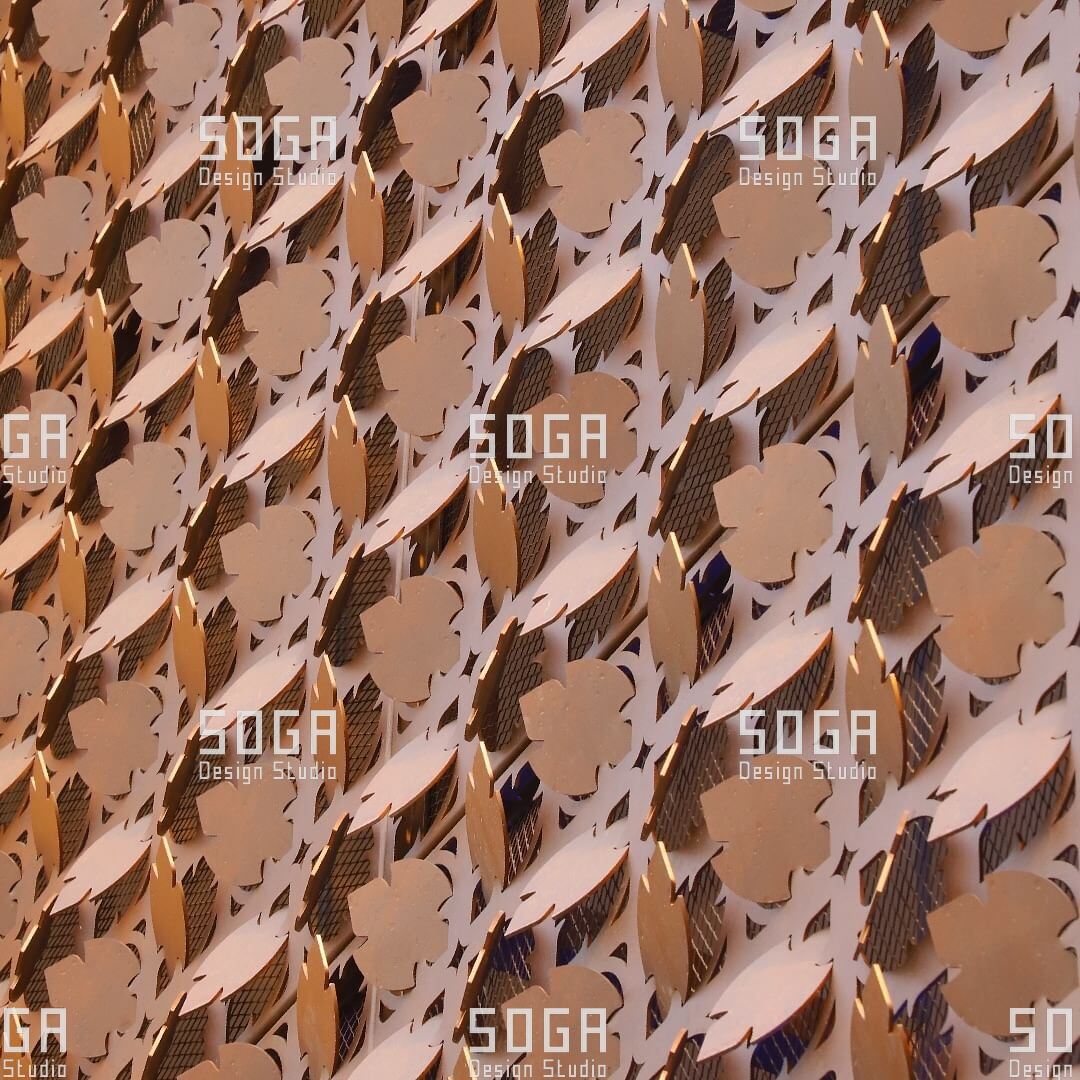
The reason the studio keeps returning to this system is one property: a coin field generates its own visual information. Where a flat panel has only what is applied to it, a field of angled discs has brightness, shadow, orientation and depth, produced by the geometry from whatever light falls on it. That is what depth without ornament means, and it changes all day without moving.
The consequences are not all comfortable. Orientation decides the character of the effect, not merely its intensity. A plane receiving low, raking light is where specular behaviour lives: shallow incidence on tilted discs makes bright coins against dark neighbours, and brightness migrates as the sun moves. A plane taking high, frontal light gets more self-shading — depth rather than light.
Then the overcast condition, where honesty is more useful than enthusiasm. Under a uniformly bright sky there is no directional light, so what remains is projection, shadow at the coin edges and the finish: a well-made textured metal wall, nothing more. That is the floor the design must stand on.
Put plainly, a coin facade is a system that behaves, not one that performs on demand. Nothing switches it on, and it cannot be made to do its best thing when a client arrives; it takes the light it is given. On a north elevation in India, in a permanently shaded court, or on a plane boxed in by a tower, that light will rarely include the raking sun the effect depends on, and the honest expectation is a quiet, finely textured screen rather than the reference photographs.
Night is a separate problem. By day the source moves and the facade is animated for free; after dark a fixed source freezes the field into one permanent condition. Light raking closely across the surface reveals the relief; light thrown from in front flattens it into a blank. Night-lighting intent has to be settled while depth and projection are still open.
Where the design has to meet the fabricator
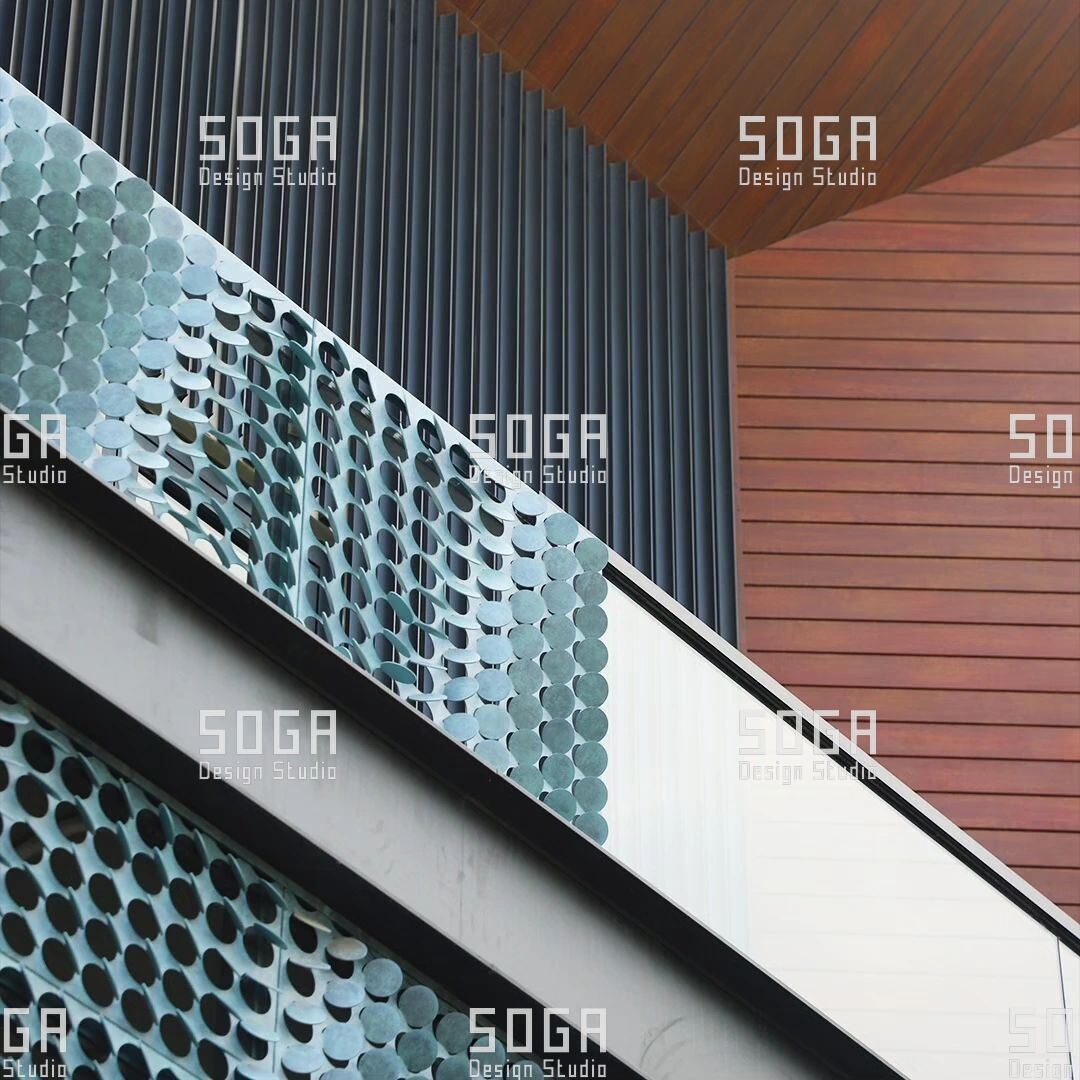
The first constraint is unit families. A field of individually angled coins is producible at scale because it is a small, countable set of unit types repeated many times, not a field of one-offs. Variation in how a standard unit is placed is close to free; variation needing a new unit geometry is a new development. So buy variety through placement, and spend the bespoke budget at a corner or an entrance.
The second follows: keep the carrier panel constant and let the coin carry the variation. The panel is the unit of setting out and fixing, identical throughout; the coin is the unit of expression, a division the engineering teardown of the panel-and-coin system takes further. Whether a coin is formed as a feature of the blank or added as a separate part shapes the depth and tilt available, and how a coin facade is manufactured follows it through the shop.
SOGA’s coin facade work was developed with Metaguise: the studio led the parametric design, the panelling logic and the facade geometry, and Metaguise handled the fabrication and panel-forming, including the system Metaguise produces under the name MetaCoin™. Precision metal forming is what makes a field of individually angled units a deliverable rather than a rendering: producing 216 panels in modular metal sheet, without a soldered or welded joint anywhere, is a genuine piece of fabrication engineering. The published Gurgaon project covers 242.3 m² of facade; the Gurgaon coin facade project story tells it, and coin facade installation sequencing and tolerance takes up what follows on site.
A design checklist before the pattern is frozen
Each item changes a parameter, and settling one after the pattern is resolved means resolving it again.
- Orientation, and the hours of direct sun on the plane. This decides whether the design is built around reflection or depth, and the pattern cannot correct it.
- Primary viewing distance and speed. Unit size has to suit how the facade is met, and at the G+3 to G+7 residential band that is usually both on foot and from a car.
- What sits behind the screen. An open field shows services and drainage unless density, zoning or the backing finish handles it.
- View-through required from inside, room by room. Openness acceptable in a corridor is not acceptable in a bedroom, and resolving it late costs the elevation or the occupant.
- Whether the field is one zone or several. One parameter set is a texture, a zoned field a composition, and the choice directs the design effort.
- Night-lighting intent and the fixture position. Fixed light freezes the field into one condition, so settle it while depth and projection are open.
- Maintenance and cleaning access. Projection creates a ledge on every coin, so appearance depends on an access strategy an owner will use.
- The edge and opening conditions. Reveals, returns, soffits and terminations are where a pattern rule stops answering for itself, and a bad end undoes a good field.
- Whether the unit family is batched. Confirm how many distinct unit geometries the design needs, as against how many it appears to.
- Who owns the rule file afterwards. The pattern is a parametric relationship, not a drawing, so somebody must hold it to regenerate a panel later.
Project credits and trade marks
| Role | Party |
|---|---|
| Parametric Designer | SOGA Design Studio |
| Fabrication Team | Metaguise |
| Project Architect | Archium Design Studio |
| Client | Yashika Group |
| Photography | Metaguise |
The project was published by Parametric Architecture on 30 April 2024 under the title ‘Parametric Coin Facade Made of Rectangular Panels with Circular Coin Mechanisms’, and the feature is online at https://parametric-architecture.com/parametric-coin-facade-made-of-rectangular-panels-with-circular-coin-mechanisms/ . Metaguise and MetaCoin are trade marks of their respective owner and are used here only to identify the fabricator and the product they name. SOGA Design Studio makes no claim to those marks. This article describes the studio’s own part of the work: the parametric design of the coin facade system.
Frequently asked questions
What decides how a coin facade looks?
Five parameters do most of the work: the size of each coin, how densely the coins are spaced, the angle each is rotated and tilted to, how far it projects from the backing plane, and how reflective the finish is. Above those sits the pattern, the rule by which those values vary across the elevation.
How dense should a coin facade be?
There is no single correct density, because openness is a function of viewing angle rather than a fixed property: a field that reads open square-on closes up as the viewer moves off axis, so density is set against both conditions at once. In practice it follows the view-through occupants need and whether the elevation should read as screen or mass.
Can you see through a coin facade from inside?
Yes, if it is designed to be. View-through is governed by density and by the direction the coins are tilted: coins turned away from the sightline leave it clear, while coins turned into it block the view at the same spacing. The same screen is more transparent looking straight out than along the facade.
Does a coin facade work on a north-facing elevation?
It will be a well-made textured metal screen rather than a facade of migrating highlights, because the reflective behaviour depends on direct raking sun that a north elevation in India rarely receives. The design then shifts weight onto deeper projection, a less specular finish, and a backing plane whose contrast works.
Can a coin facade pattern be changed after design?
During design, readily, and that is the point of writing the pattern as a rule rather than drawing it: a parameter is adjusted and the whole field regenerates consistently, including the production information. After fabrication the coin angles are fixed in the units, so a changed pattern means changed parts.
What finish works best on a coin facade?
It depends how much variation in appearance the project can accept. A highly specular finish gives the most spectacular result in raking light and the flattest under an overcast sky, and makes rotation the dominant control. A diffuse finish is never as brilliant and never blank. Either way the specification must hold consistency across batches.
Who designs coin facade patterns?
The patterning is parametric design work rather than a fabrication selection. On the published Gurgaon project it was SOGA Design Studio’s, credited as parametric designer, with Metaguise credited as fabrication team for the system it produces as MetaCoin. The design side authors the rule and the geometry; the fabrication side forms the angled units.
The simplest element, the strongest thinking
A coin is close to the simplest thing an architect can specify. It is a disc: no preferred direction, nothing to it beyond a size and a surface. Everything that makes a coin facade worth building comes from the decisions made about that disc — how large, how close to its neighbours, which way it faces, how far off the wall, how it takes the light, and what rule varies those values across an elevation.
That is worth knowing at concept stage, because the quality of the result is not bought. It is decided. Two projects can order the same system from the same workshop and get different buildings, and the difference was settled in conversations most schemes never have.
Architects and developers working on a coin facade are welcome to write to the studio about the parameter decisions on a specific elevation.
The simplest element. The strongest thinking.
Designed in India. Engineered in Indian workshops. Made to hold up anywhere.