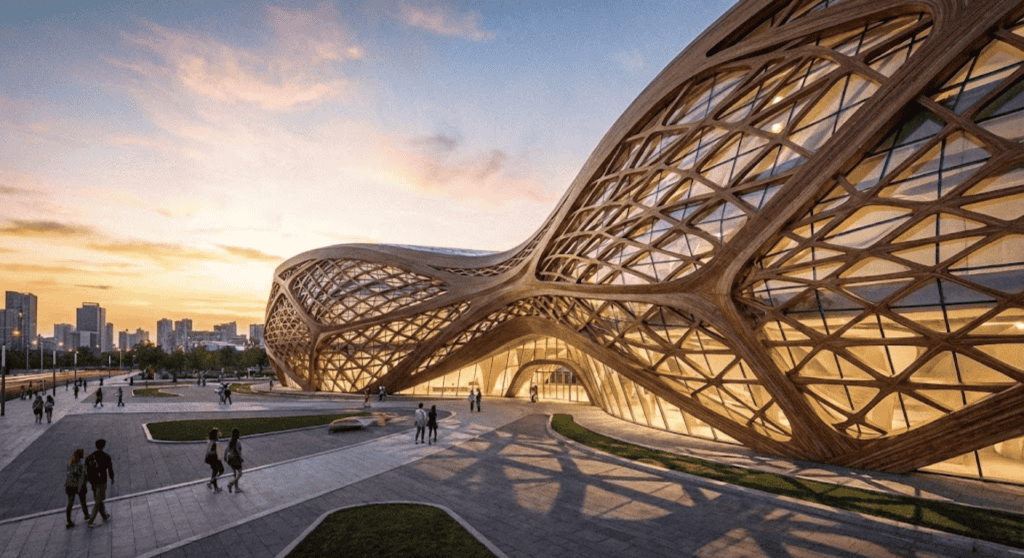
Almost every parametric facade India builds today is metal. Terracotta facade design in India is the quieter option that keeps getting overlooked, and that is a genuine miss: fired clay is one of the few skins that gets warmer as the building ages, needs no coating cycle, and sits perfectly happily in a 45 degree summer. It is also properly parametric. A baguette can rotate, a band can deepen, a cassette can step out, and because the clay is extruded or pressed to a fixed section, the variation costs you a rail setting rather than a new mould. Below are four concepts, one per climate region, with the parameters we would actually issue for fabrication.
These are concept designs by SOGA Design Studio, produced as design visualisations rather than photographs of completed buildings.
Why Terracotta Is Worth a Second Look in 2026
Three things changed. Extruded terracotta is now made in India rather than only imported, so the landed rate has come down into the same band as a good powder-coated aluminium screen. Second, the clip-rail systems have matured — a baguette screen is now a dry, ventilated, demountable rainscreen with a proper cavity, not a wet tile finish, which means a single damaged section is a ten-minute swap. Third, and most useful for the way we work at SOGA Design Studio on parametric facade design in India, clay takes parametric variation without cost punishment: rotation, spacing and projection are all set at the rail, so a facade with a visible gradient uses the same extrusion die as a flat one. The material has caught up with the geometry.
1. Ahmedabad: Parametric Ember Baguette Terracotta Facade Concept
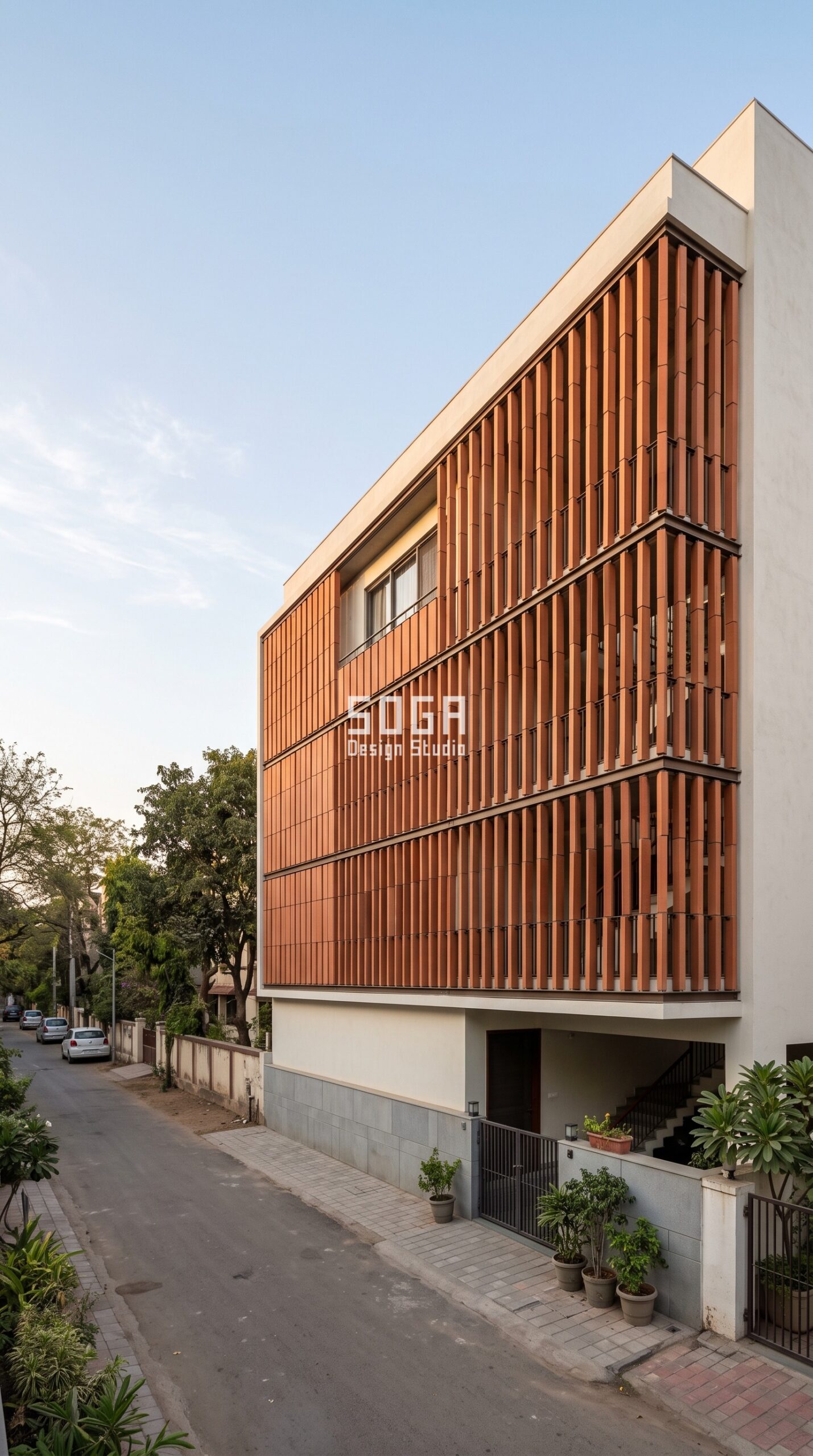
Design seed: Compact urban massing x clay-screen skin x rotation field x terracotta + bronze aluminium x hot-dry west shading. This G+3 private residence in Bodakdev, Ahmedabad wears a Parametric Ember Baguette skin in extruded terracotta baguettes on dark bronze aluminium clip rails. Ahmedabad is hot and dry, so the west elevation does the work: as the baguettes rotate closed they cut low afternoon sun without losing the cross-breeze the cavity carries away. The parametric variation is written into the fabrication drawings, not sprayed on afterwards.
How the Parametric Ember Baguette is built
| Design parameter | Specification |
|---|---|
| Module | 50 x 50 mm extruded terracotta baguette, 600 mm long, natural matte finish |
| Driver | Sun-path attractor at the west stair bay; rotation remapped from distance to the attractor |
| Variation | Each baguette rotates about its own vertical axis, 0 degrees to 36 degrees across the elevation |
| Density | Constant 140 mm centre spacing; visual porosity falls 62% to 24% open as the rotation closes |
| Panels & substructure | 1.2 x 3.0 m clip-rail cassettes, 40 x 40 mm aluminium SHS grid, 4 rotation families across ~980 baguettes (0.4% unique) |
| Cavity & base | 150 mm ventilated cavity with weep and top vent; 600 mm grey stone plinth |
Material & colour: hero skin in natural matte earth-red terracotta (RAL 8023) with dark bronze rails and off-white lime plaster, kept to a restrained palette so the geometry does the talking. Indicative facade cost: Rs 1,600-2,700 per sq ft, fully designed and installed, with an itemised estimate produced per project.
2. Kolkata: Parametric Reed Gradient Terracotta Facade Concept
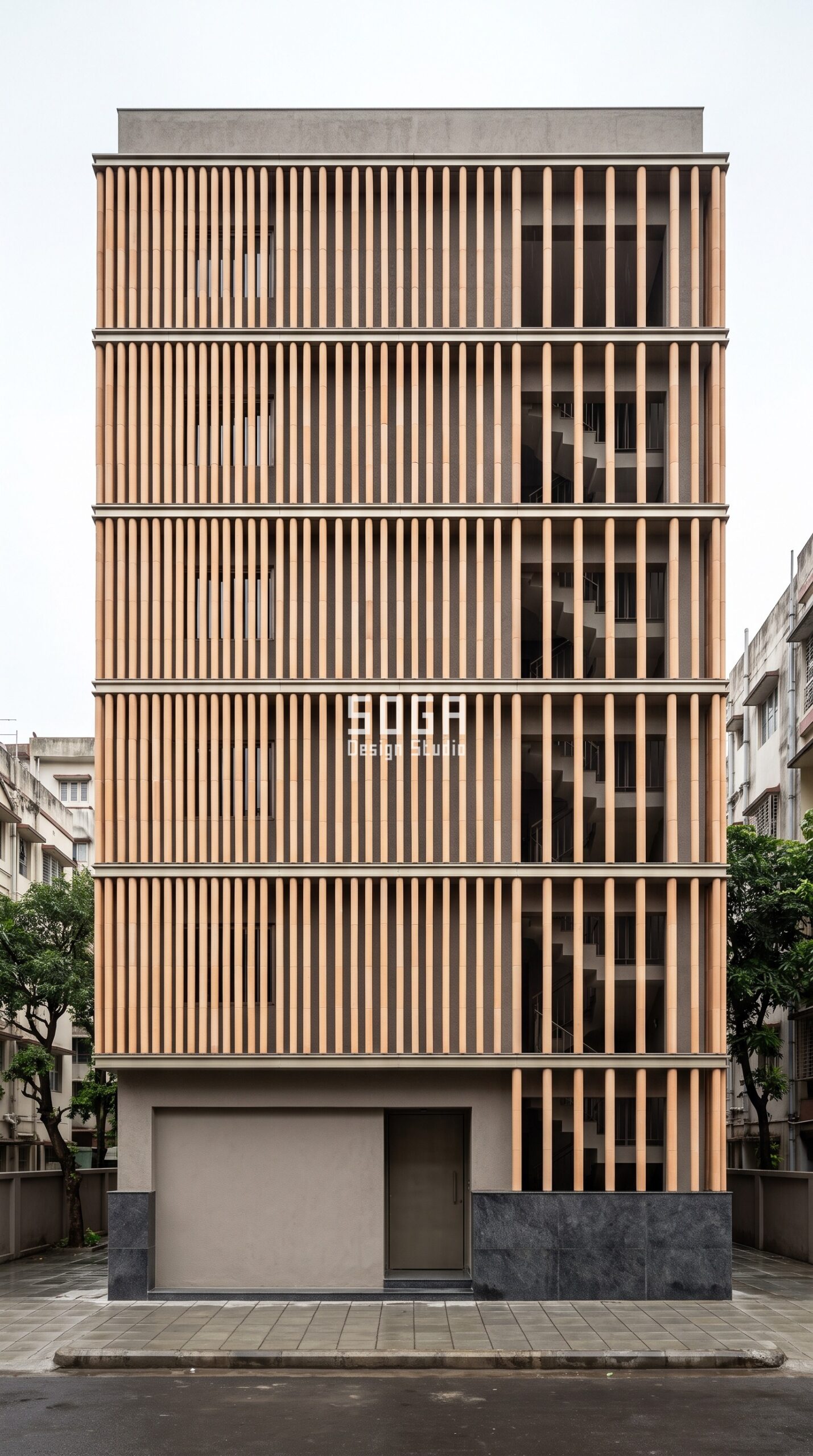
Design seed: Stacked urban block x vertical clay-reed skin x density gradient x terracotta + champagne aluminium x warm-humid cross ventilation. This G+5 boutique apartment building in Ballygunge, Kolkata wears a Parametric Reed Gradient skin in round extruded terracotta baguettes on champagne anodised aluminium rails. Kolkata is warm and humid for most of the year, so the screen is tuned for air rather than for shade alone: the wide-spaced living bays keep the monsoon breeze moving while the tight bedroom zone buys privacy from the street. The parametric variation is written into the fabrication drawings, not sprayed on afterwards.
How the Parametric Reed Gradient is built
| Design parameter | Specification |
|---|---|
| Module | 60 mm diameter round extruded terracotta baguette, 900 mm long, sanded matte |
| Driver | Program map — bedroom privacy versus living-room daylight and view |
| Variation | Centre spacing opens gradually from 90 mm at the bedrooms to 280 mm at the living bays and stair |
| Density | Open area shifts 30% to 68% across the elevation in one continuous rhythm, full-height coverage on every floor |
| Panels & substructure | 1.5 x 2.7 m rail cassettes, 50 x 50 mm aluminium SHS grid, 3 spacing families across ~1,340 reeds |
| Cavity & base | 120 mm ventilated cavity, drained and vented at each slab; 750 mm dark stone base |
Material & colour: hero skin in sand-ivory fired clay with champagne anodised rails, warm grey plaster and a dark stone base, kept to a restrained palette so the geometry does the talking. Indicative facade cost: Rs 1,500-2,500 per sq ft, fully designed and installed, with an itemised estimate produced per project.
3. Mysuru: Parametric Terra Ledge Terracotta Facade Concept
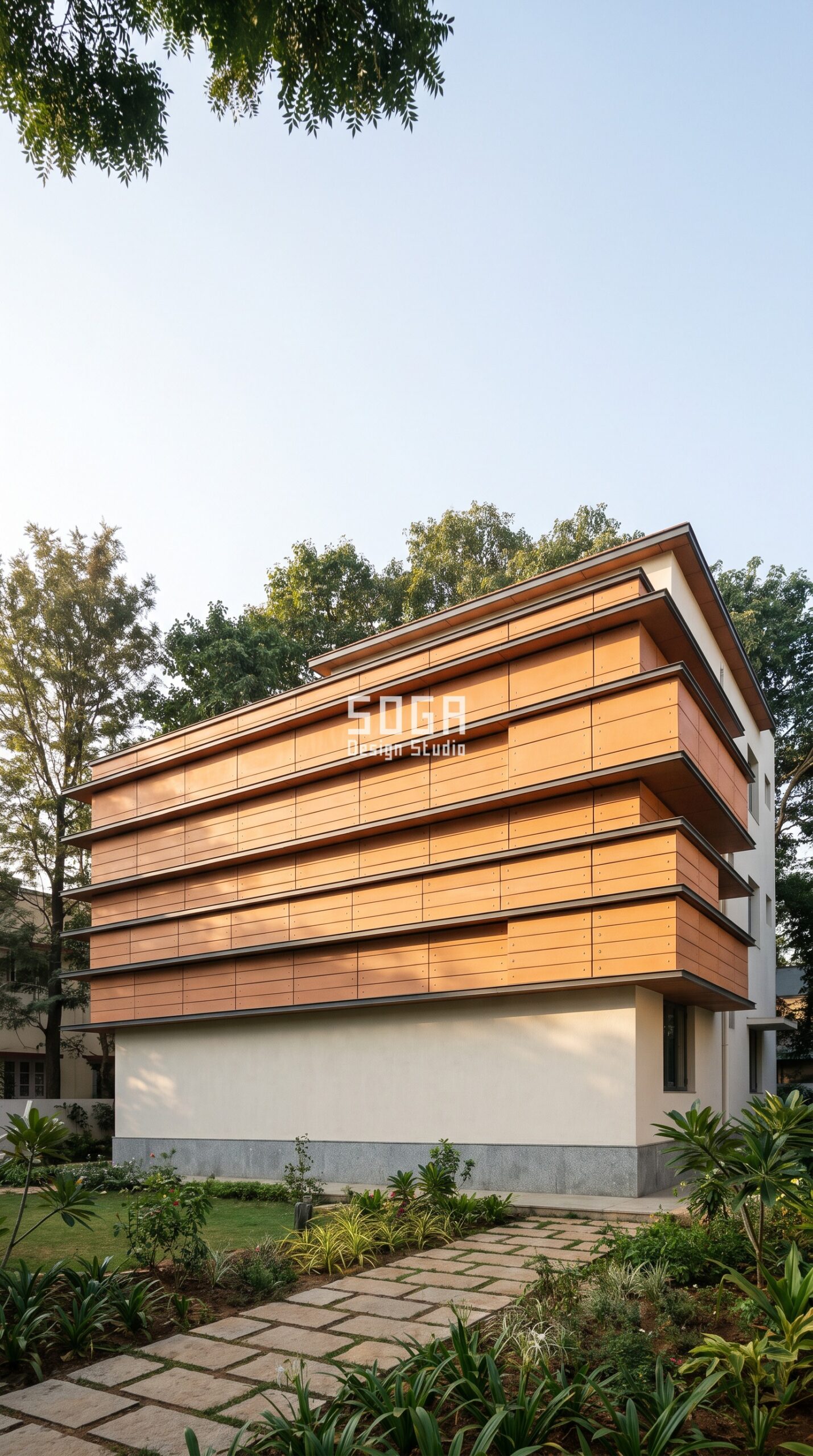
Design seed: Low horizontal massing x banded clay ledge skin x contour banding x terracotta + graphite aluminium x temperate west shadow-line. This G+3 private residence in Vijayanagar, Mysuru wears a Parametric Terra Ledge skin in pressed terracotta band panels with graphite aluminium reveals. Mysuru is temperate and rarely extreme, so the ledges are sized for glare and driving rain rather than heat: the projection deepens only where the west bedrooms need it, and every band doubles as a drip edge in the monsoon. The parametric variation is written into the fabrication drawings, not sprayed on afterwards.
How the Parametric Terra Ledge is built
| Design parameter | Specification |
|---|---|
| Module | Pressed terracotta band panel, 1,200 mm long, sharp straight edge, discrete rectangular unit |
| Driver | Floor levels and west sun angle; band depth remapped from the afternoon radiation map |
| Variation | Band face height grows 250 mm to 700 mm; projection deepens 120 mm to 420 mm along the same run |
| Density | Constant 750 mm band pitch so the grid stays legible; shaded wall area rises 22% to 58% |
| Panels & substructure | Clip-fixed on a 40 x 80 mm aluminium rail grid with concealed brackets, 5 band families across ~210 panels |
| Cavity & base | 100 mm ventilated cavity; 600 mm grey granite plinth to keep clay off splash level |
Material & colour: hero skin in warm ochre matte clay with graphite reveals, off-white plaster and a grey granite plinth, kept to a restrained palette so the geometry does the talking. Indicative facade cost: Rs 1,400-2,400 per sq ft, fully designed and installed, with an itemised estimate produced per project.
4. Lucknow: Parametric Clay Relief Terracotta Facade Concept
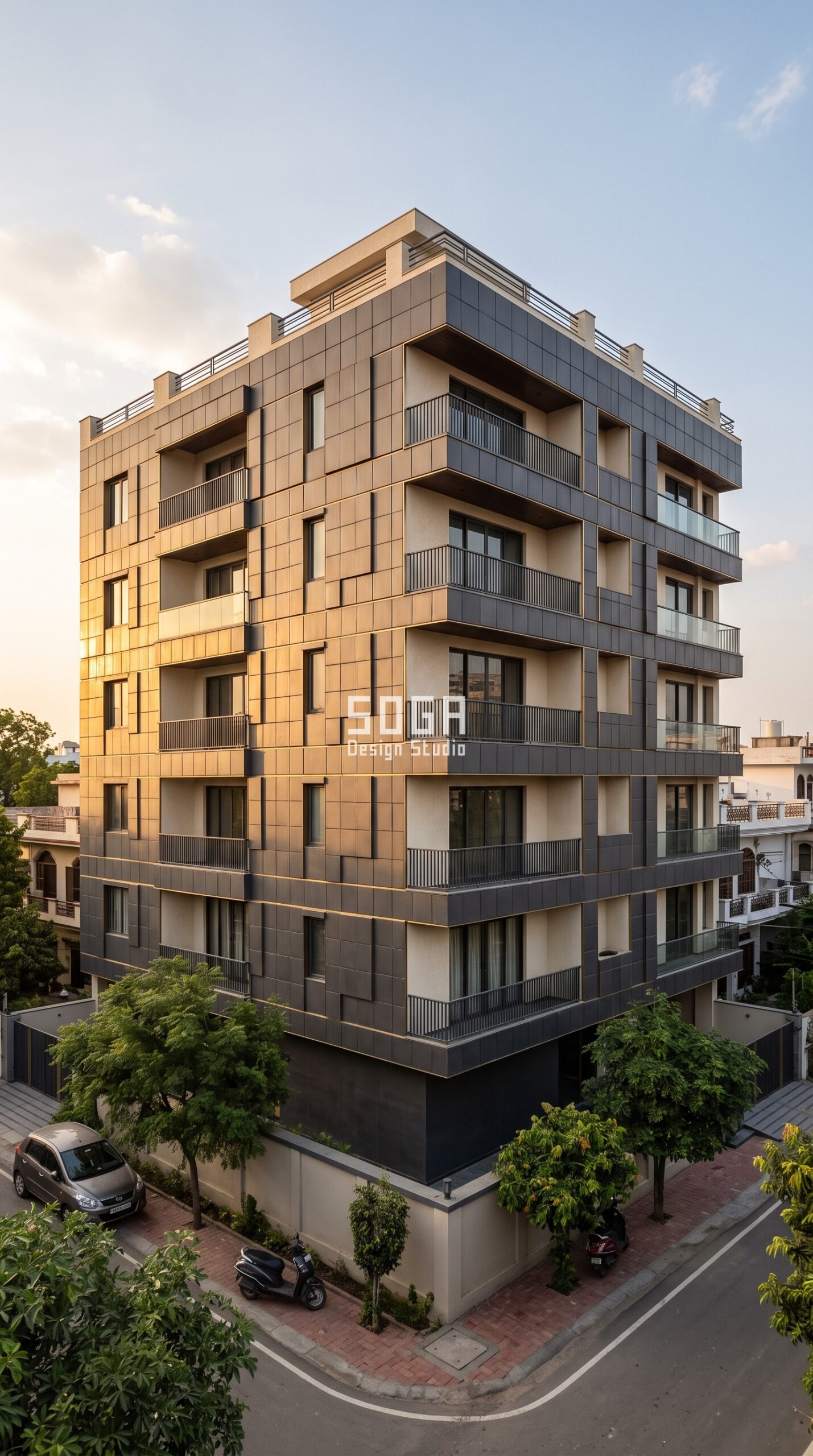
Design seed: Stacked block with balcony carve x glazed clay cassette skin x depth extrusion x glazed terracotta + brushed brass x composite-climate self-shading. This G+4 residential apartment building in Gomti Nagar, Lucknow wears a Parametric Clay Relief skin in glazed terracotta tile cassettes with brushed brass reveals. Lucknow runs hot in summer and genuinely cold in winter, so the relief is worth more than a flat wall: the deeper families sit where the afternoon sun lands, and the shallow families stay open where winter warmth is welcome. The parametric variation is written into the fabrication drawings, not sprayed on afterwards.
How the Parametric Clay Relief is built
| Design parameter | Specification |
|---|---|
| Module | 600 x 600 mm glazed terracotta tile cassette on an aluminium tray, satin glaze |
| Driver | Noise seed weighted toward the balcony bays; grayscale map dispatched to five depth steps |
| Variation | Pop-out depth steps in five discrete families from 30 mm to 190 mm off the wall face |
| Density | Full-coverage relief field on a clear 600 mm grid; self-shaded area rises 18% to 46% at the balconies |
| Panels & substructure | Aluminium tray cassettes on a 50 x 50 mm SHS grid with adjustable brackets, 5 depth families across ~1,150 cassettes |
| Cavity & base | 150 mm ventilated cavity with cavity barriers at each slab; 900 mm honed stone base |
Material & colour: hero skin in charcoal-graphite and warm sand glazed clay with brushed brass reveals over off-white plaster, kept to a restrained palette so the geometry does the talking. Indicative facade cost: Rs 1,700-2,900 per sq ft, fully designed and installed, with an itemised estimate produced per project.
Terracotta Facade Cost in India (2026)
These are the rates we work with for budgeting in 2026, all-in for supply, substructure and installation on a normal G+2 to G+5 job with reasonable access. Height, site access and the number of unique panel families move the number more than the clay itself does — which is why the repetition economy in each concept above matters.
| System / material | Indicative rate |
|---|---|
| Extruded terracotta baguettes (square or round, clip rail) | Rs 950 – 1,600 per sq ft |
| Glazed terracotta tile cassettes | Rs 1,200 – 1,900 per sq ft |
| Pressed terracotta band / ledge panels | Rs 1,100 – 1,700 per sq ft |
| Aluminium clip-rail substructure, brackets and anchors | Rs 250 – 450 per sq ft |
| Installation labour (varies with height and access) | Rs 50 – 150 per sq ft |
| Lime plaster or textured body finish | Rs 90 – 200 per sq ft |
| Stone plinth / base band | Rs 400 – 1,200 per sq ft |
| Complete terracotta rainscreen, designed and installed | Rs 1,400 – 2,900 per sq ft |
How We Keep a Clay Facade Buildable
Every concept above is drawn against the same six checks we run on any SOGA facade before it leaves the studio. The extrusion die stays standard — the variation lives in rotation angle, rail spacing and bracket projection, never in a bespoke section, which is why the unique-part count in each parameter table stays under one percent. Panel cassettes are kept to a two-person lift so a small site does not need a crane. The cavity is a real ventilated cavity at 100 to 150 mm with weeps at the bottom and a vent at the top, with a cavity barrier at every slab. Clay is kept off splash level with a 600 to 900 mm stone or granite plinth, because the one genuine failure mode in Indian conditions is monsoon splash-back staining the lowest course. Fixings are stainless, and every screen bay is demountable from the outside so a single broken baguette is replaced rather than a panel being cut out. Where a detail cannot pass all six, we value-engineer it and show the client both options with the cost difference written down.
Related Reading
- Parametric facade design in India — the complete guide
- How parametric facade design works in Indian conditions
- Bungalow Exterior Design India 2026: Modern Facade Ideas, Cost & Materials
Related Reading
Frequently Asked Questions
How much does a terracotta facade cost per square foot in India?
Budget Rs 1,400 to Rs 2,900 per sq ft for a complete terracotta rainscreen in 2026 — that covers the clay, the aluminium clip-rail substructure, brackets, anchors and installation. The clay alone is Rs 950 to Rs 1,600 per sq ft for extruded baguettes and Rs 1,200 to Rs 1,900 for glazed cassettes. Height and site access move the labour component more than the material choice does.
Is terracotta better than ACP or aluminium for an Indian climate?
For a hot climate it usually performs better than ACP and roughly matches good aluminium. Fired clay has high thermal mass and low conductivity, so it stays cooler to touch and passes less heat into the cavity, and it carries no coating that can chalk or fade after eight to ten years. Aluminium still wins where you need very long spans or very light weight. ACP is cheaper up front but is a coated composite, and post-Grenfell it must be FR-grade in any case.
Does a terracotta facade need maintenance?
Very little. There is no repainting or recoating cycle because the colour is fired into the body of the clay, not applied to the surface. A wash once or twice a year is enough in most Indian cities. The only real detail to get right is keeping the lowest course above splash level with a stone plinth, and because the system is a dry demountable rainscreen, a damaged section unclips and is swapped individually.
Can a terracotta facade actually be parametric?
Yes, and it is one of the better materials for it. The clay section stays standard — the parametric variation is carried by rotation angle at the clip, spacing along the rail, and bracket projection off the wall. That means a facade with a visible gradient uses exactly the same extrusion die as a flat one, so you get the geometry without a mould cost. Each concept on this page varies rotation, spacing, band depth or panel pop-out within a range a fabricator can actually set.
How long does a terracotta rainscreen last in India?
Expect 40 years plus from the clay itself — fired terracotta is chemically stable and does not degrade in UV, which is the usual killer of coated finishes in India. The realistic service life of the system is set by the aluminium substructure and the fixings rather than the clay, so specify stainless fixings and a properly anodised or mill-finish rail. Design for cavity ventilation and splash protection and the facade will outlast most of what sits behind it.
Design Your Terracotta Facade With SOGA
If you are planning a house, villa or apartment building anywhere in India and want a facade that ages well without a maintenance cycle, we can work up a terracotta scheme with the parameters, the panel schedule and an itemised cost before anything goes to a fabricator. We design across India as well as Dubai, the UAE and Singapore. Write to [email protected], or start with our guide to parametric facade design in India to see how the geometry is set up before the material is chosen.