A vaulted elevation design in India is not priced by the drawing – it is priced by how many of its pieces are actually different from each other. Four fresh concepts this week make that point directly: a twisting tray stack in Noida, a folded-vault villa in Jaipur that is the clearest cost case of the four, an attractor-driven louver field in South Delhi, and a ring-framed house in Lucknow. We start with the vault, because arches are where clients most often guess wrong on budget.
Vaulted Elevation Design Cost India: What Actually Decides It in 2026
Owners in Noida, and in Mumbai, Bangalore, Delhi and Hyderabad, tend to arrive at vaulted elevation design cost india late — after the elevation is agreed and the quote is in hand. That is the expensive moment to find an answer. The concepts below are worked to fabrication level rather than left as renders, using the parametric facade systems the studio details across India, Dubai and Singapore, in silver.
1. Noida: A Twisting Tray Stack, and Why Rotation Alone Doesn’t Drive Cost
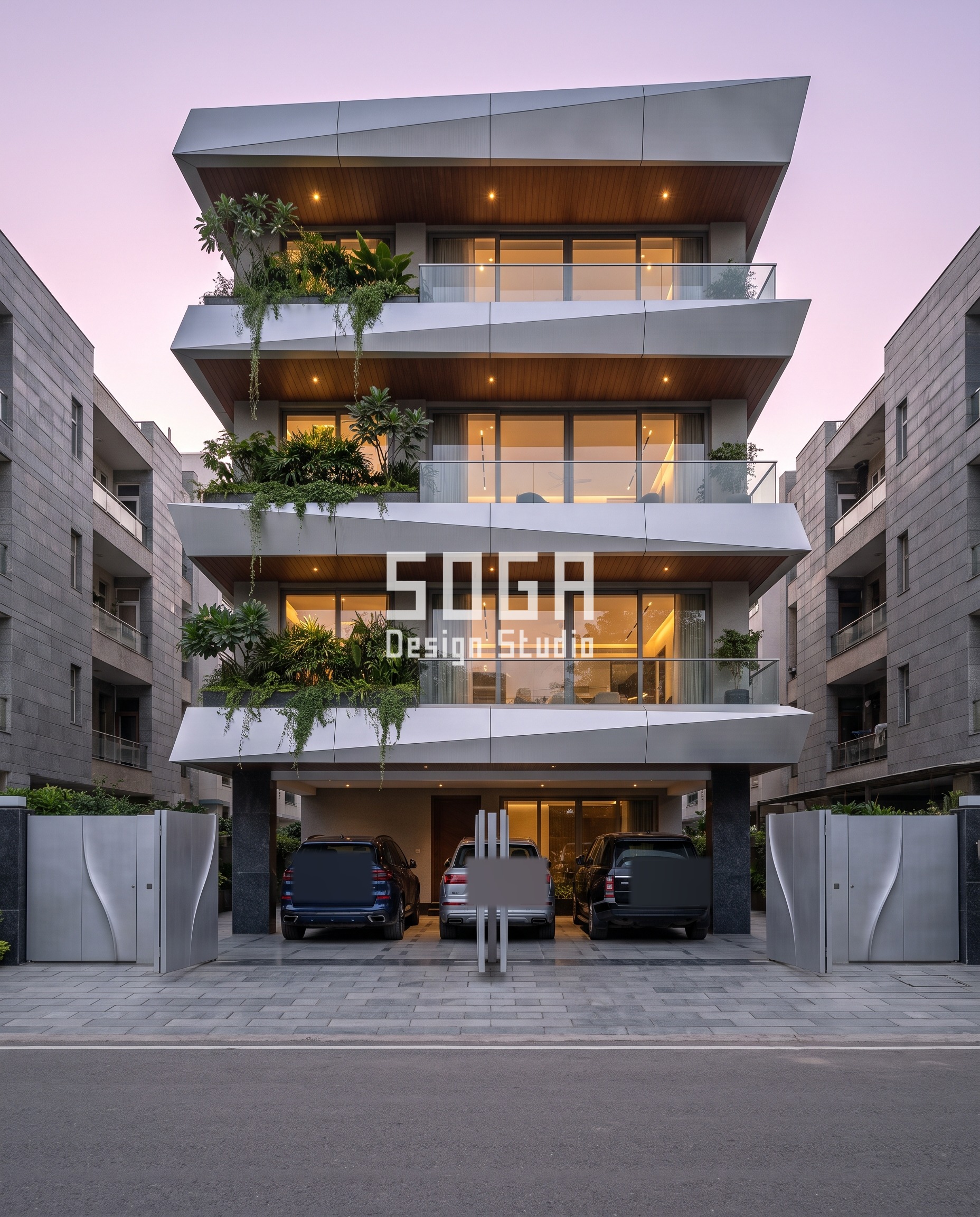
The Noida concept stacks four G+3 floor slabs, each rotated twelve degrees against the one below it, so the building reads as a single slow twist from the street. It’s a striking move, but worth separating from cost: rotation is a geometry decision, not a panel count. What actually prices this facade is the number of genuinely different tray shapes the fabricator has to cut – in this case, four, one per floor, each identical in silver-finish metal detailing. That’s a four-piece system dressed as something far more complex, and it’s the cheapest kind of complexity to build.
2. Jaipur: What a Vaulted Elevation Actually Costs
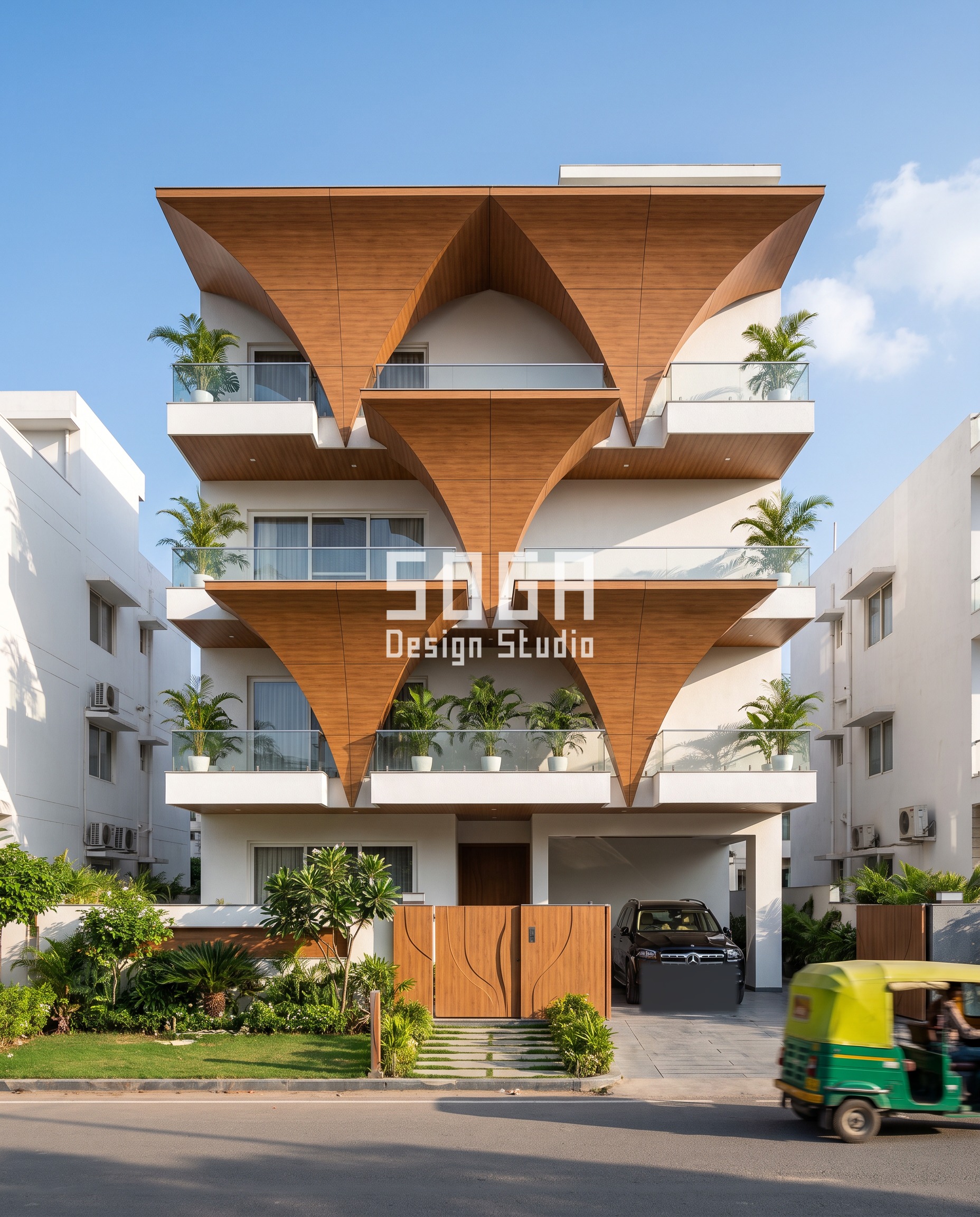
This is the concept the keyword is about. The Jaipur villa hangs folded vaults between its G+3 floors – each one a four-sided inverted pyramid that opens into a five-metre arch in teak-grain metal. Vaulted forms carry a reputation for being expensive, and sometimes they are, but the real cost driver isn’t the curve, it’s the mould. A vault built from identical repeating units, as this one is, shares formwork across every bay; a vault where every arch is a different size does not. Ask any contractor quoting one to confirm, before the drawing is finalised, how many of the vault units actually repeat – that single number moves the estimate more than the span does.
3. South Delhi: An Attractor Point, Not an Even Grid
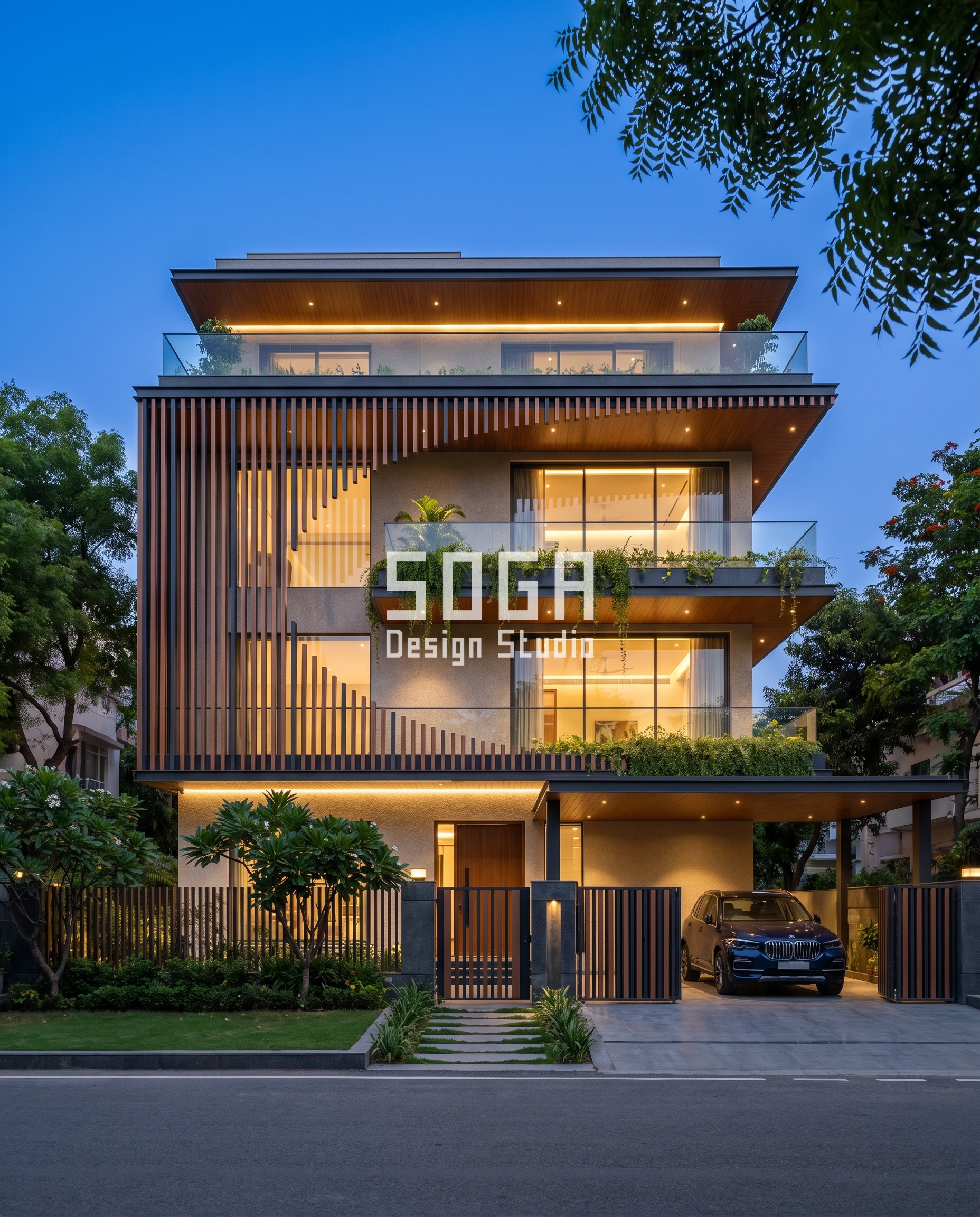
The South Delhi villa uses a single attractor point near the base to drive every louver’s length – fins closest to it run 500 mm, the ones furthest away stretch to full storey height, opening a crater-shaped window onto the balcony behind. It’s built in the SOGA Louver system, in a two-tone charcoal-and-copper mix, and the gradient is the whole idea: the facade would read as a flat screen without it. Pricing this kind correctly means costing it as a run of individually-cut lengths, not as one repeating louver spacing – the variation is the product, not a finishing touch.
4. Lucknow: One Ring, Cut Through Every Floor
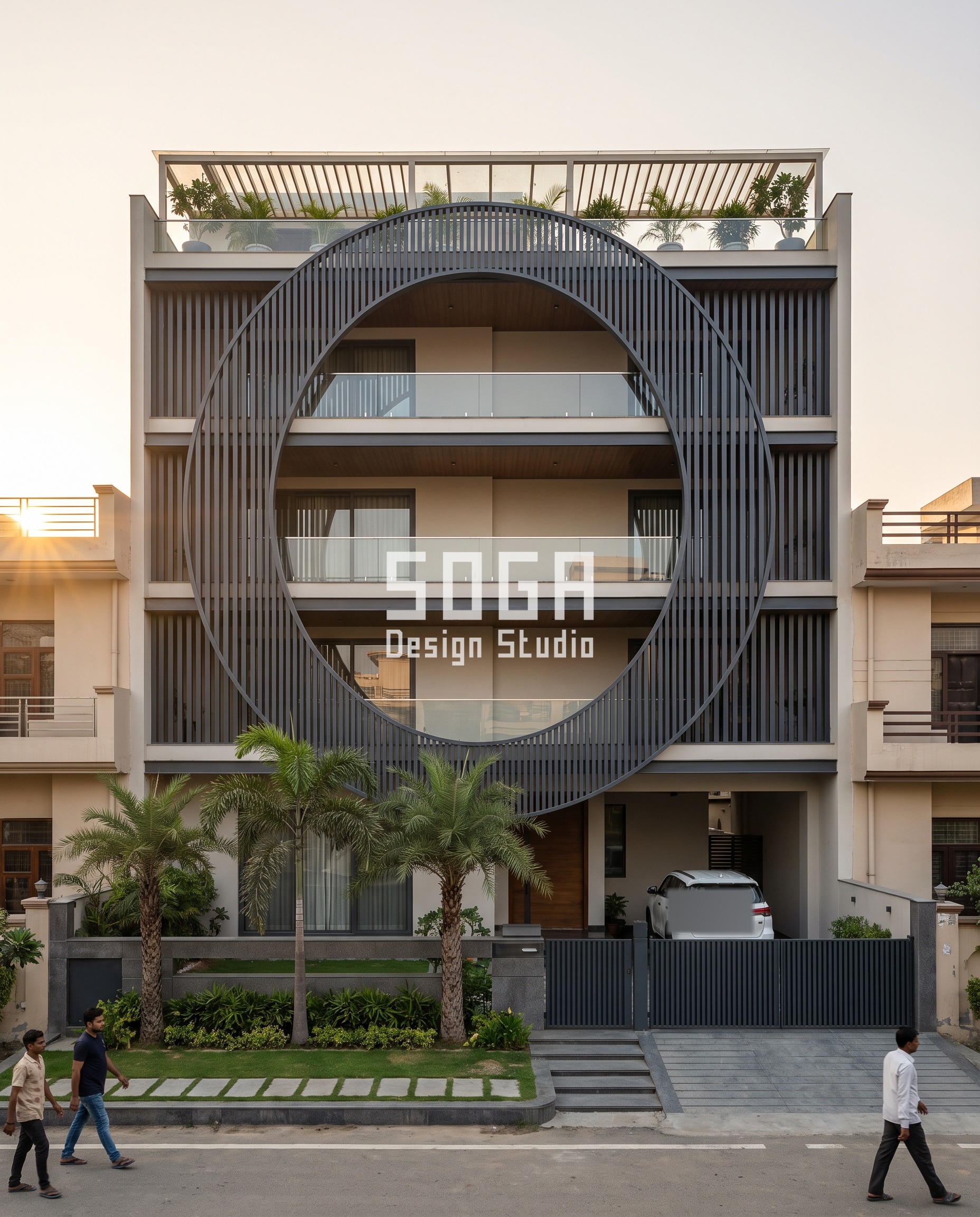
In Lucknow, a single oval ring roughly twelve metres tall is inscribed straight through the slab edges, so balconies inside its curve sit open to the street and the ones outside it are screened behind matte charcoal louvers. It’s the most singular gesture of the four – one shape, applied once – and that simplicity is also what keeps it buildable: a ring this size is still assembled from straight and gently curved louver lengths, not a continuous cast form, so it prices closer to the South Delhi screen than its scale suggests.
What a Vaulted (or Any Parametric) Elevation Costs in India in 2026
Jaipur’s folded-vault villa above is the clearest example on this page of why cost and complexity aren’t the same thing. These are the current all-in installed rates in India, repeated here because they are the numbers SOGA Design Studio actually quotes against, not a one-off estimate:
- Steel facade (full design + install): ₹1,200–₹2,800 per sq ft
- Anodised or powder-coated metal panels: ₹800–₹2,500 per sq ft
- Zinc cladding: ₹1,500–₹3,000 per sq ft
- ACM panels (3 mm basic): ₹200–₹250 per sq ft (basic)
- ACM panels (4 mm): ₹250–₹350 per sq ft
- Solid metal panels: ₹800–₹1,800 per sq ft
- Installation labour: ₹50–₹150 per sq ft (varies by height + access)
- Conventional cladding (for comparison): ₹400–₹1,200 per sq ft installed (stone veneer / ceramic / standard ACM)
These are baseline ranges, not a quotation. What moves a real number is the facade area, how many distinct pieces the design needs, where it is fabricated and how it is finished. SOGA Design Studio itemises that at consultation rather than quoting a single figure.
Where SOGA Design Studio Works: India, Dubai and Singapore
A large share of the Noida enquiries that reach SOGA Design Studio start from abroad. Owners in Qatar and Oman are building or upgrading a family house back home, and the corridors running warmest right now are Kochi, Vadodara, Nashik. Distance changes the process rather than the design: the plot is surveyed and photographed by our team on the ground, the elevation is resolved over scheduled video reviews, and fabrication drawings are issued to the local workshop with dated site photographs closing the loop each week.
Why Trust SOGA Design Studio for Facade Design in Noida
- Experience: SOGA Design Studio has taken vaulted and other sculptural parametric facades from AI-visualised concept through fabrication-ready shop drawings for Indian residential clients, working with vetted fabricators on mould-sharing and panel repetition to keep installed cost predictable.
- Expertise: The studio’s in-house computational-design team resolves every concept – including the folded-vault system shown here – to sub-frame, bracket and fixing level before it is costed, not left as a render.
- Authority: SOGA Design Studio is led by co-founders Gajender Jaiswal and Sonali Jaiswal and works across India, Dubai and Singapore, with the SOGA Louver product used on several of the studio’s own built facades.
- Trust: Every cost band on this page is the current all-in installed rate SOGA Design Studio quotes against, revisited as material and labour prices move, never a single invented figure.
Frequently Asked Questions
What does a vaulted elevation design cost in India?
A vaulted elevation typically prices in the same band as other parametric metal facades – roughly Rs 800-2,500 per sq ft for powder-coated or anodised panels, or Rs 1,200-2,800 per sq ft for steel, installed. The real swing factor is how many of the vault units repeat, not the curve itself.
Are arched or vaulted facades more expensive than flat panel facades?
Not inherently. A vault built from repeating identical units shares formwork across bays and can cost close to a flat panelled facade. Cost rises when every arch is a different size, since each then needs its own mould or jig.
How many different vault or arch sizes should a facade design repeat?
SOGA Design Studio typically designs vault or arch systems around two to four repeating module sizes per building – enough variation to avoid a mechanical rhythm, few enough to keep tooling cost down. Ask for this number explicitly before a vaulted concept is finalised.
Does a parametric louver or screen cost more than a plain cladding system?
A gradient louver screen, like the attractor-driven system shown here, usually costs close to a conventional metal cladding system of the same area, since it is still built from straight cut lengths – only their individual sizes vary, not the fixing method.
How long does a vaulted or ring-form facade take to fabricate and install?
This depends on repetition count, access and floor height, so SOGA Design Studio confirms it at the design consultation – typically within 48 hours of receiving a brief, we return a realistic fabrication and installation timeline.
Can an existing Noida or Delhi NCR house be retrofitted with a vaulted or faceted facade?
Yes, provided the existing structure’s edge beams can take the new sub-frame’s point loads – this is checked at site survey. Vaulted and rotated-tray systems both tend to retrofit well because their fixing points land at floor-slab edges, not mid-span.
What is the cheapest parametric facade system for an Indian home?
SOGA Design Studio addresses this question in detail during the design consultation. For Noida projects, we provide a fully customised answer based on plot, orientation, and budget — typically within 48 hours of receiving the brief.
Does a vaulted facade need extra structural support?
SOGA Design Studio addresses this question in detail during the design consultation. For Noida projects, we provide a fully customised answer based on plot, orientation, and budget — typically within 48 hours of receiving the brief.
Start Your Facade Project With SOGA Design Studio
The number that moves a parametric facade’s price is how many of its pieces repeat – not how dramatic the curve looks in a render.
If any of the rotated faceted trays concepts above resonate with your project, send us your brief. SOGA Design Studio delivers customised parametric facade concepts for India, Dubai, Singapore, and the UK.