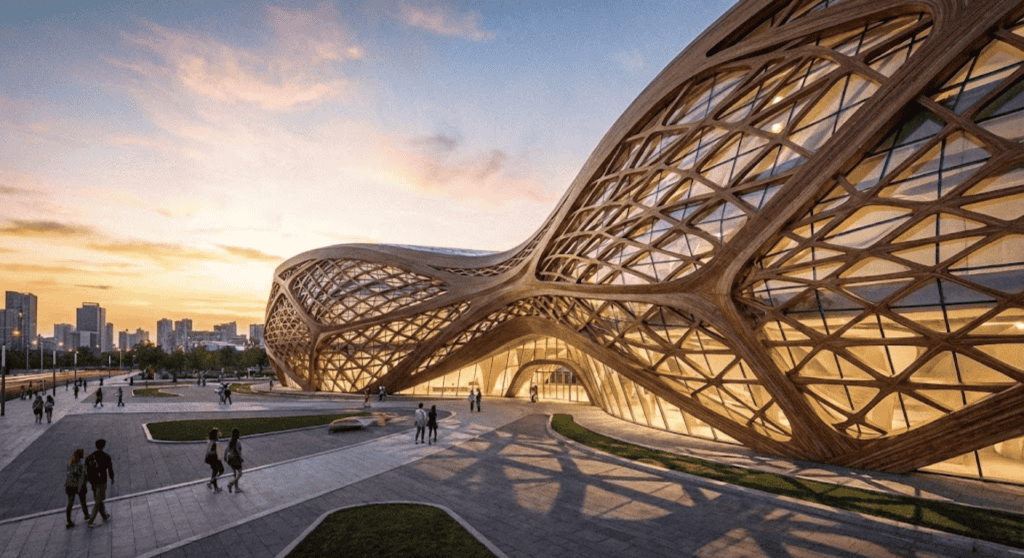
If you are planning a residential or boutique commercial facade in India in 2026, aluminium is now the dominant material choice — and for good reason. It is light, corrosion-resistant, comes in three completely different finish systems (powder coat, anodised, PVDF), and lasts 25 years on Indian elevations with minimal maintenance. This complete guide walks you through every variable that matters for an aluminium facade design in India: the three finish systems compared, per-square-foot cost in 2026, lifespan and warranty, climate behaviour across Indian metros, and which of the five SOGA Parametric Systems™ uses which finish.
Q1. Why is aluminium the dominant facade material in India in 2026?
Five reasons aluminium has displaced steel, ACP and stone as the default facade material across Indian metros in 2026:
- Weight: aluminium at 2.7 g/cm³ is one-third the weight of steel. A parametric facade panel system loads the sub-frame and the RCC structure dramatically less.
- Corrosion resistance: aluminium forms a self-healing oxide layer. There is no rust risk on coastal Mumbai or humid Chennai sites, and no painting cycle every five years.
- Finish flexibility: aluminium accepts powder coating, anodising and PVDF coating equally well — covering every visual range from matte black to anodised champagne to fluoropolymer metallic.
- Fabricability: aluminium can be CNC-cut, CNC-bent and CNC-formed in Indian factories with sub-millimetre tolerance. This is what makes parametric facades viable in India in 2026.
- Sustainability: aluminium is 100% recyclable without quality loss; recycled aluminium uses 95% less energy than primary production. Increasingly relevant for IGBC and GRIHA project certification.
Q2. Powder-coated aluminium facade — when and how to specify it in India
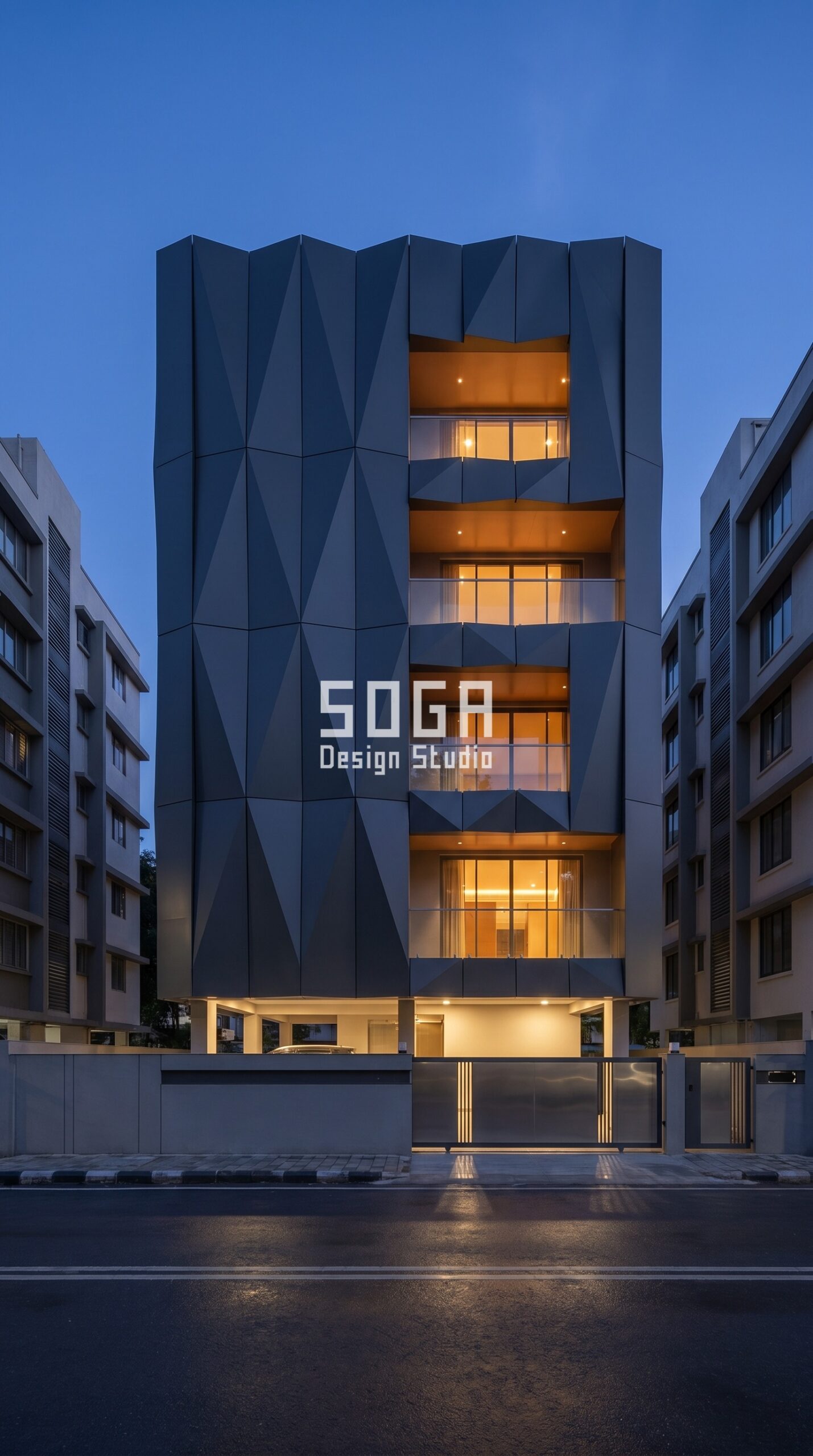
Powder coating is the most popular aluminium facade finish in India in 2026 — and it is the default finish across four of the five SOGA Parametric Systems™. The Mumbai G+4 SogaGrid™ visualisation above (anthracite grey RAL 7016 powder coat) is the typical use case: a 3D parametric panel where the colour discipline and surface uniformity matter as much as the geometry.
Specifications you should write into the contract
- Powder system: Akzo Nobel Interpon D2525, Jotun Drygalv, or Asian Paints PPG Duranar (specify by brand and product code, not generic ‘polyester powder’).
- Pretreatment: Chromate-free zirconium pretreatment (RoHS-compliant) — mandatory for warranty.
- Film thickness: 60-80 microns minimum, applied in a single coat.
- Cure: Oven-cured at 180-200°C for 20 minutes minimum.
- Warranty: 10-year colour and adhesion warranty on the powder applicator’s letterhead.
- Terracotta Facade Design India 2026: Cost & Concepts
- Commercial Facade Renovation Cost Guide India 2026: Retrofit ROI & Material Pric
Powder coat cost and lifespan in India 2026
- All-in installed rate: Rs 1,200 to 2,800 per sq ft of facade (SogaGrid™ sits at Rs 1,400-2,400; SogaScreen™ at Rs 1,500-2,800).
- Colour fastness: 10 years before any visible chalking or fade.
- Adhesion: 25 years on Indian elevations with annual rinse maintenance.
- Best for: the entire SOGA library except SogaShell™ (which uses PVDF for the curved geometry)
Q3. Anodised aluminium facade — the premium architectural finish
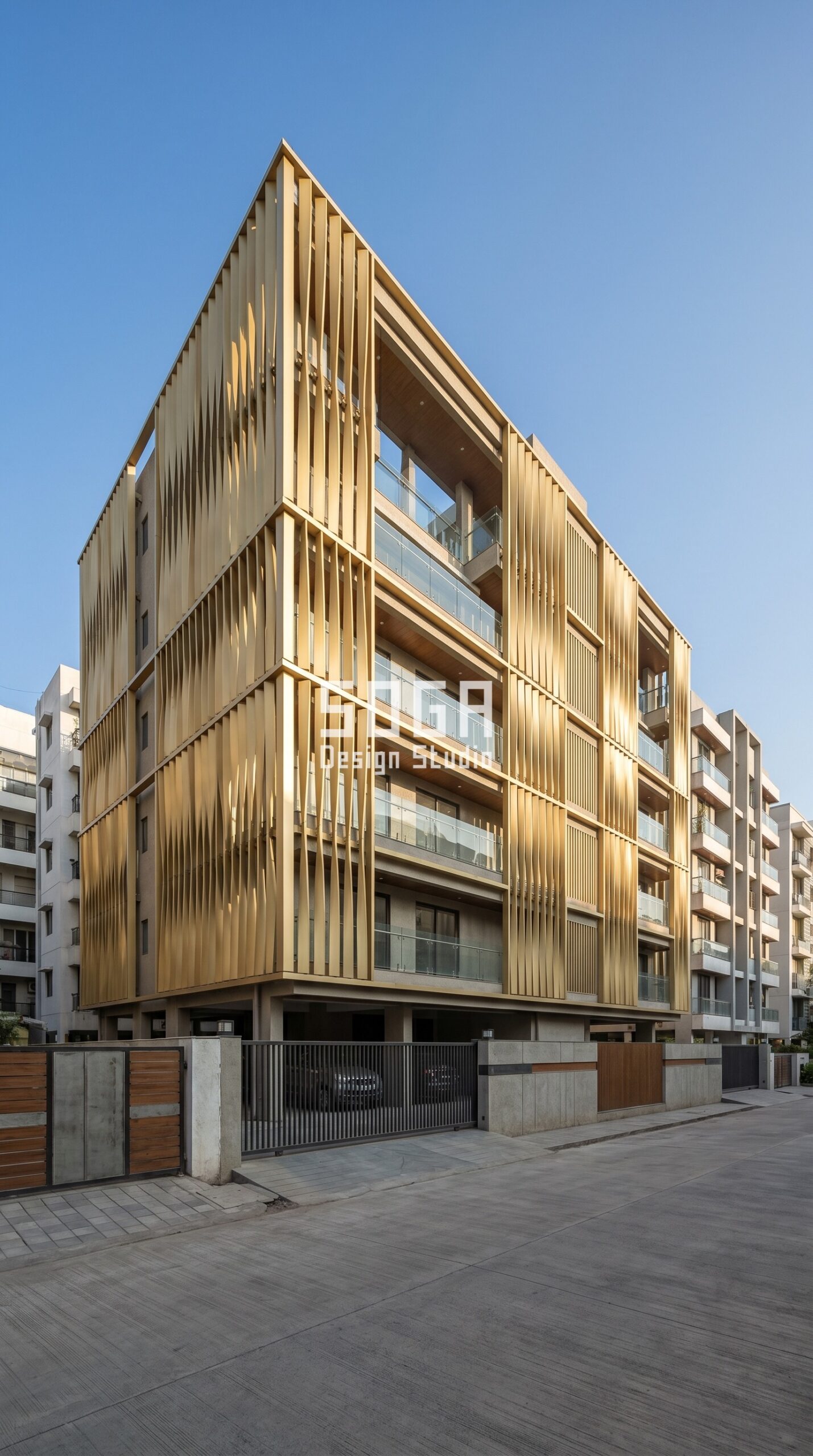
Anodised aluminium is the most architecturally distinguished finish in the Indian market — it is an electrolytic conversion of the aluminium surface rather than a paint coating. The result is a transparent oxide layer that retains the metallic depth of the aluminium underneath while adding hardness and corrosion resistance. The Pune G+4 SogaWeave™ visualisation above (anodised champagne gold) shows what anodising does that powder coat cannot — the surface catches light from different angles differently, producing a depth that reads as ‘real metal’ rather than ‘painted metal’.
Specifications for anodising in India 2026
- Process class: Class 1 anodising — 25 microns minimum oxide layer (don’t accept Class 2 at 18 microns for exterior facades).
- Colour: achieved via integral colouring (during anodising) or two-step electro-colouring. Champagne gold, dark bronze, silver and black are the four most-specified Indian residential colours.
- Sealing: hot water nickel-acetate sealing — mandatory for corrosion warranty.
- Applicator standard: compliance with QUALANOD or equivalent (Indian applicators: Jindal Aluminium, Hindalco’s Sangam Anodising line).
Anodised cost and lifespan in India 2026
- All-in installed rate: Rs 1,400 to 3,000 per sq ft of facade — roughly 10-20% above standard powder coat.
- Colour fastness: 25 to 40 years — anodised colours genuinely outlast painted finishes.
- Hardness: 2-3x harder than powder coat. Anodised aluminium resists scratching, graffiti and impact damage far better.
- Best for: SogaWeave™ twisted fin systems (the surface depth complements the fin geometry), and premium residential elevations where colour permanence justifies the 15% cost premium.
Q4. PVDF-coated aluminium facade — the high-performance fluoropolymer system
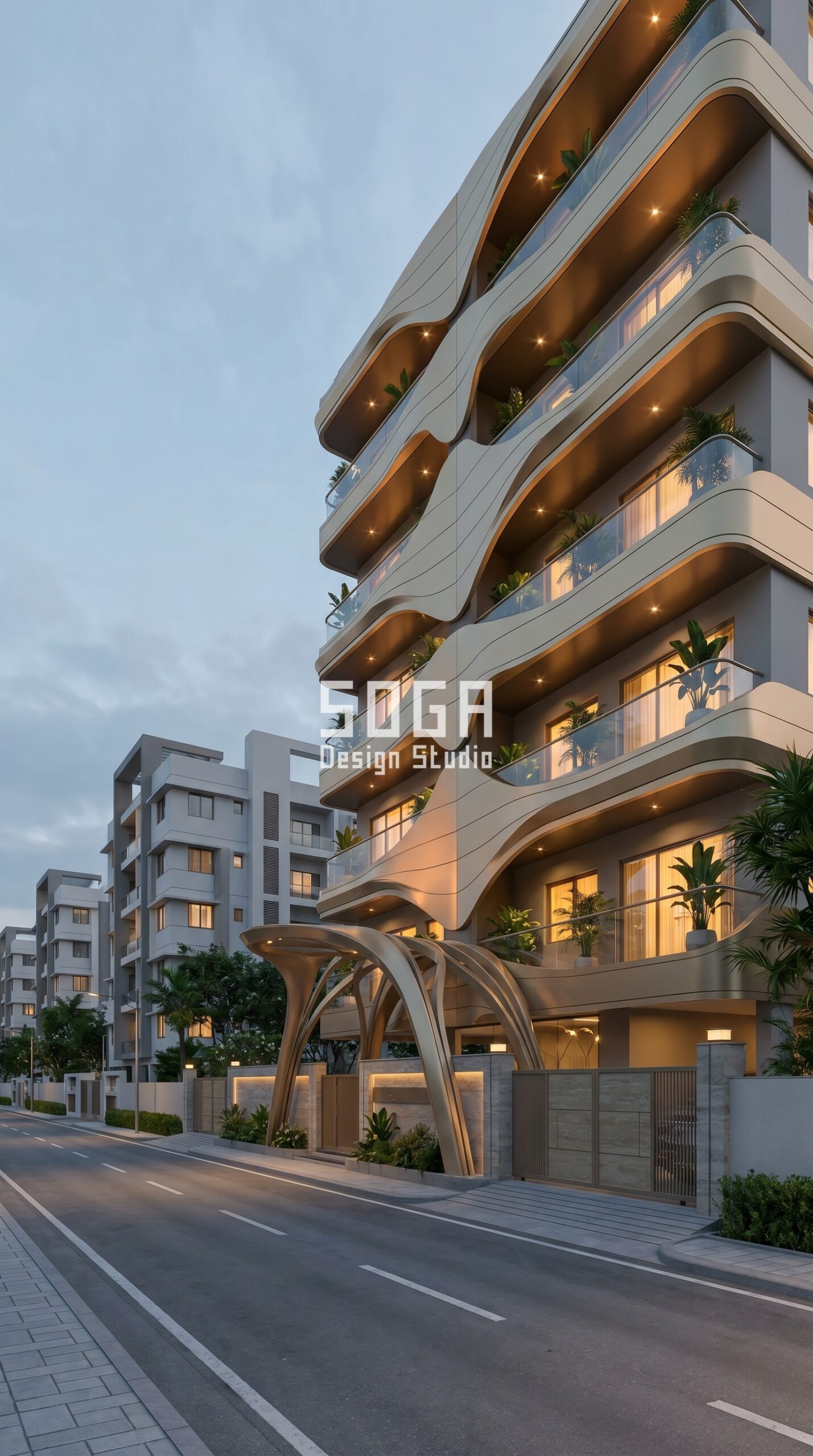
PVDF (polyvinylidene fluoride) is the highest-performance aluminium facade coating system available in India in 2026. It is a factory-applied fluoropolymer paint system, typically 70% PVDF resin by weight, engineered for 25+ year colour retention on exterior elevations. The Chennai G+5 SogaShell™ visualisation above (matte champagne metallic PVDF) is the prototypical use case — a sculptural wave geometry where you cannot afford the coating to chalk, flake or fade over 20 years of tropical exposure.
PVDF specifications for India 2026
- Resin content: 70% PVDF minimum (specify 70/30 PVDF/acrylic). Lower-grade 50% PVDF systems exist; don’t use them on facades.
- Coating architecture: three-coat system — primer, colour coat, optional clear coat. Two-coat systems are acceptable for matte finishes; three-coat is mandatory for metallic finishes.
- AAMA standard: AAMA 2605 voluntary specification (the architectural gold standard for fluoropolymer coatings).
- Film thickness: 25-35 microns combined dry film thickness.
- Applicator: coil-coated or spray-coated by an AAMA-licensed Indian applicator (Nippon Paint Coil Coatings, JSW Paints Architectural, or Indian Aluminium Coil Coatings).
PVDF cost and lifespan in India 2026
- All-in installed rate: Rs 1,800 to 3,800 per sq ft of facade — the premium pricing in the SOGA library.
- Colour fastness: 25 years against fade, chalking and gloss loss — verified by Florida exposure testing.
- Climate resistance: the best Indian-market finish for coastal Chennai, Mumbai and Goa where salt spray plus monsoon plus UV are combined loads.
- Best for: SogaShell™ organic wave cladding and SogaPulse™ algorithmic responsive facades — both systems carry premium geometry that justifies the premium finish.
Q5. Powder coat vs anodised vs PVDF — which aluminium facade finish should you pick?
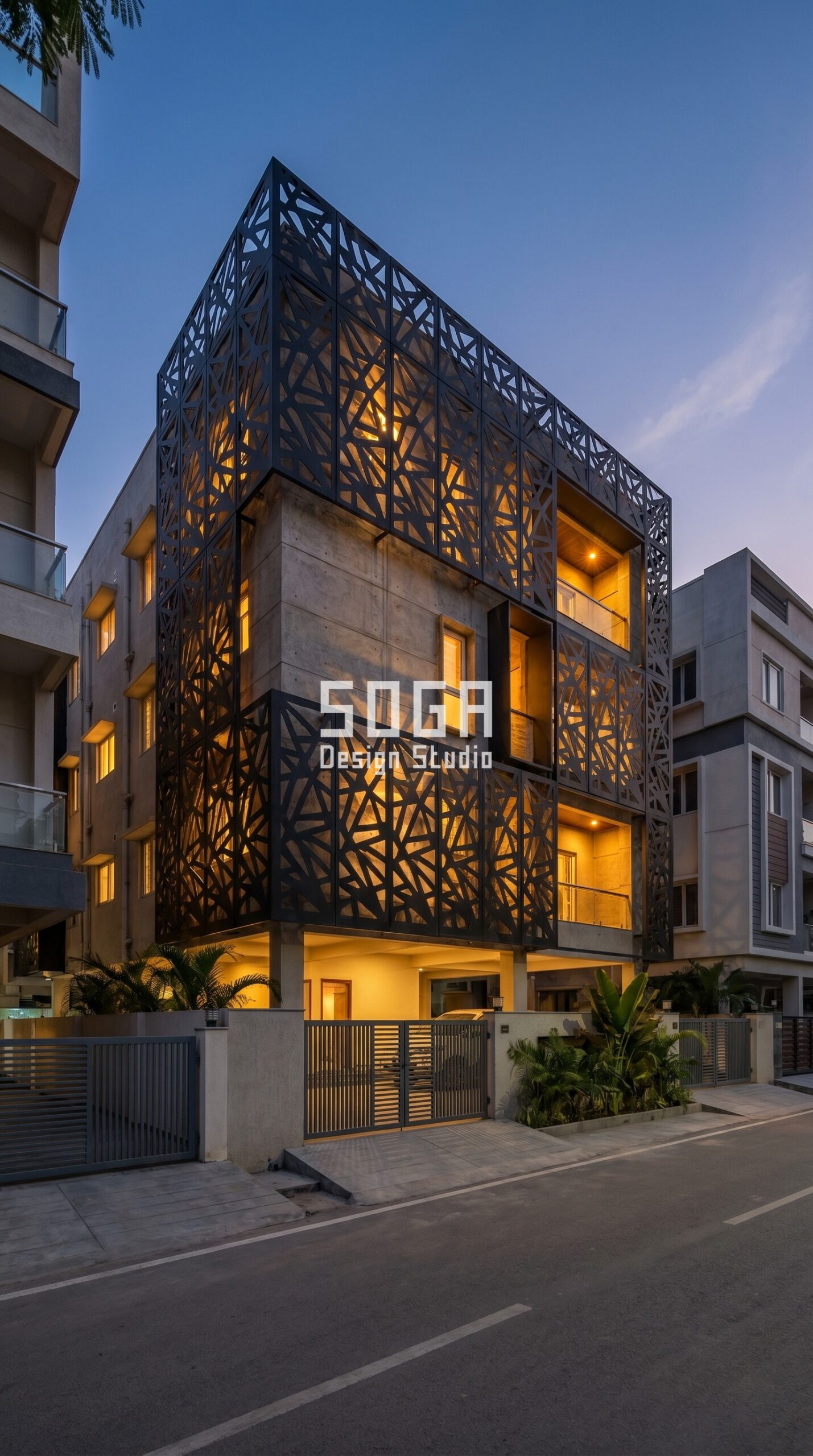
The Hyderabad G+3 SogaScreen™ (matte black RAL 9005 powder coat) above is the right answer for many Indian residential projects — but not every project. Use this decision matrix:
- Pick powder coat when: the project budget is moderate (Rs 1,200-2,800 per sq ft), the colour is one of the popular RAL options (anthracite grey 7016, jet black 9005, off-white 9001, dark bronze), the site is not coastal, and the geometry is flat-fold or fin-based (SogaGrid™, SogaWeave™, SogaScreen™).
- Pick anodised when: the architectural language demands genuine metallic depth (not painted look), the project values 25-40 year colour permanence over upfront cost saving, and the budget tolerates 10-20% above powder coat. Best fit for SogaWeave™ in champagne gold or dark bronze.
- Pick PVDF when: the site is coastal or high-UV (Chennai, Mumbai, Goa, Visakhapatnam), the geometry is curved or sculptural (SogaShell™, SogaPulse™), or the project is a landmark build where 25-year colour warranty is part of the brand value.
What about ACP? Aluminium composite panel (ACP) is not the same product. ACP is two thin aluminium skins bonded to a plastic core. ACP is cheaper (Rs 350-700 per sq ft) but inferior on every measurable axis — fire performance, panel thickness, parametric folding capability, warranty. ACP belongs on tight-budget commercial elevations, not on parametric residential facades.
Q6. How does aluminium facade design behave across different Indian climates?
India is not one climate — and aluminium facade performance varies meaningfully across the metros. Specifications should be tuned per city:
- Mumbai (coastal, monsoon, high humidity): mandatory salt-spray-tested powder coat or PVDF. Avoid bare aluminium and standard polyester powder. Salt-spray test certification per ASTM B117 to 1,000 hours.
- Delhi NCR (dust load, extreme temperature swing): prefer matte or gloss finishes that don’t show dust accumulation. PVDF or anti-graffiti powder coat is ideal. Anodising performs well long-term.
- Bangalore (mild climate, high UV at altitude): any of the three finish systems performs well. Bangalore is the easiest Indian metro for aluminium facade specification.
- Chennai / Coimbatore (tropical, humid, salt-spray-adjacent): PVDF strongly preferred for finish longevity. The Chennai SogaShell™ visualisation above shows the right specification for the tropical context.
- Hyderabad / Bangalore (continental, dry): standard powder coat is reliable. The SogaScreen™ matte black above is a typical Hyderabad specification.
- Jaipur / Ahmedabad (hot, dry, high UV): anodised aluminium or PVDF for colour retention. Avoid darker powder coat colours that experience surface temperature buildup.
Q7. What about lifespan, warranty and maintenance for aluminium facades in India?
A properly-specified aluminium facade in India in 2026 carries the following warranty stack:
- Aluminium substrate: 25 years against perforation, structural failure and alloy degradation.
- Powder coat finish: 10 years against fade, chalking and adhesion failure.
- Anodised finish: 25-40 years — anodising rarely fails in non-coastal Indian conditions.
- PVDF finish: 25 years against fade, chalking, gloss loss — AAMA 2605 standard.
- Installation: 2 years standard, extendable to 5 years under annual maintenance contract.
- Water-tightness at joints: 5 years against ingress.
Annual maintenance: all three aluminium finish systems need only an annual rinse with pH-neutral detergent and a soft brush. No painting, no sealing, no specialist treatments. Maintenance cost in India: Rs 8-15 per sq ft per year for a covered facade.
Those durations are what the finish is capable of. What the coater will actually sign for is narrower — the film on the flat of the panel, in a stated exposure class, with cut edges, fabricating damage and the pre-treatment record all sitting outside cover. The exclusions that decide it, and how the same specification is written in Dubai, Singapore and Sharjah, are in what a villa facade warranty covers and what voids it.
Q8. Per-square-foot aluminium facade cost in India 2026 — full breakdown
All-in installed rates for aluminium facade design in India in 2026 by SOGA system and finish:
- SogaGrid™ powder-coated aluminium: Rs 1,400 to 2,400 per sq ft installed.
- SogaWeave™ powder-coated aluminium: Rs 1,200 to 2,200 per sq ft installed.
- SogaWeave™ anodised aluminium: Rs 1,500 to 2,600 per sq ft installed (premium for anodising).
- SogaScreen™ CNC-cut powder-coated aluminium: Rs 1,500 to 2,800 per sq ft installed.
- SogaShell™ PVDF-coated aluminium: Rs 1,800 to 3,200 per sq ft installed.
- SogaPulse™ PVDF or anodised aluminium: Rs 2,000 to 3,800 per sq ft installed.
These rates are all-in installed costs including design, fabrication-ready drawings, factory production, freight, scaffolding, installation labour, sealants, and warranty registration. They are calibrated for Mumbai, Delhi NCR, Bangalore, Pune, Hyderabad, Chennai, Ahmedabad and Jaipur. Tier-2 cities run roughly 5-8% below these rates due to lower installation labour cost. Dubai and Singapore delivery adds 6-10% for freight.
Q9. How does SOGA Design Studio approach aluminium facade design in India in 2026?
SOGA Design Studio’s SOGA Parametric Systems™ library is engineered around aluminium as the primary substrate. Every system in the library — SogaGrid™, SogaWeave™, SogaShell™, SogaScreen™, SogaPulse™ — is detailed for aluminium fabrication with one of the three finish systems documented above. The standard SOGA delivery scope on an aluminium facade project includes:
- Material specification — alloy grade (typically 6063-T6 or 6082-T6 for structural panels), sheet thickness, mill test certificate.
- Finish specification — powder coat product code / anodising class / PVDF system architecture, with applicator certification.
- Pretreatment specification — chromate-free zirconium pretreatment is mandatory; the contract references the chemistry by product code.
- Fabrication-ready CAD drawings — every panel numbered, with material, finish, and powder coat colour called out per panel.
- Installation method statement — handling, scaffolding, fixing sequence, sealant application.
- Warranty documentation — substrate, finish, installation and water-tightness on a single SOGA-branded certificate referencing the project name and address.
Frequently Asked Questions About Aluminium Facade Design in India
What is the cost of aluminium facade design in India in 2026?
All-in installed rates range from Rs 1,200 to Rs 3,800 per sq ft depending on the SOGA Parametric System and finish. Powder-coated aluminium SogaGrid sits at Rs 1,400-2,400; PVDF-coated SogaShell sits at Rs 1,800-3,200; PVDF or anodised SogaPulse at the top of the range.
Is powder-coated aluminium or anodised aluminium better for Indian facades?
Both are excellent. Powder-coated aluminium is cheaper (10-20% lower), comes in more colours, and lasts 10 years on the finish, 25 years on the substrate. Anodised aluminium is more expensive but lasts 25-40 years on the finish, is much harder, and has genuine metallic depth that powder coat cannot replicate.
How long does an aluminium facade last in Indian climate?
The aluminium substrate lasts 25 years minimum with proper specification. The finish lifespan is 10 years for powder coat, 25 years for PVDF, and 25-40 years for anodising. The complete facade system typically performs for 25+ years with only annual rinse maintenance.
Is PVDF aluminium facade worth the extra cost in India?
On coastal sites (Mumbai, Chennai, Goa, Visakhapatnam), curved or sculptural geometries (SogaShell, SogaPulse), and landmark builds where 25-year colour warranty is part of the brand value — yes, PVDF justifies the 30-40% premium over standard powder coat. For inland, flat-geometry, mid-budget projects, standard powder coat is the right answer.
Does aluminium facade design work for retrofit projects in India?
Yes. All five SOGA Parametric Systems can be specified as retrofit installs on existing RCC frames. Lightweight aluminium parametric screens mounted on stand-off brackets can transform a 1990s or 2000s building in 4-8 weeks without disturbing tenants or interiors.
Can NRIs commission an aluminium facade design for their Indian project?
Yes. SOGA Design Studio runs a fully remote workflow for NRI clients in Dubai, Singapore, the UK, the US and Australia — virtual site survey, weekly video reviews, cloud document storage, and dated on-site photo updates. NRI projects make up a growing share of SOGA’s aluminium facade portfolio in 2026.
What is the difference between aluminium facade and ACP cladding in India?
Aluminium facade is solid aluminium sheet (typically 3-6 mm thick), CNC-formable, parametrically designable, with 25-year substrate warranty. ACP is two thin aluminium skins (0.5 mm each) bonded to a 3-4 mm plastic core — cheaper but inferior on fire performance, panel thickness, parametric capability, and warranty. ACP belongs on tight-budget commercial; solid aluminium belongs on parametric residential.
Which SOGA Parametric System uses which aluminium finish?
SogaGrid, SogaWeave (standard) and SogaScreen use powder-coated aluminium. SogaWeave (premium variant) and SogaPulse offer anodised aluminium. SogaShell and SogaPulse (flagship) use PVDF-coated aluminium for the sculptural geometries that demand 25-year colour warranty.
Specify an Aluminium Facade With SOGA Design Studio
If you are planning an aluminium facade for a residential, hospitality or boutique commercial project in India, Dubai or Singapore in 2026, book a free 30-minute discovery call with SOGA Design Studio. We will recommend the right finish system (powder coat, anodised or PVDF), the right SOGA Parametric System for your geometry, and return a fixed-fee design proposal with per-sq-ft pricing within 48 hours. Full system library: SOGA Parametric Systems™.