There is no such thing as the villa facade warranty. There are three documents, signed by three different companies and expiring on three different dates – the coater’s film warranty, the system supplier’s warranty and the installer’s workmanship warranty – plus a fourth buried in a sealant data sheet and a statutory layer nobody signed. The brochure quotes the longest. Cover ends the day the shortest one expires, because after that no single party owes you a working wall. And the clauses that end them early are geometric, not legal: fixing type, drained cavity depth, dissimilar-metal contact, exposure class, pre-treatment. Every one is a line on a drawing, settled months before anyone signs. Below: all three in expiry order, then four villas drawn to keep four guarantees alive.
Why 2026 Is the Year the Facade Warranty Stack Changed
Three things moved at once. First, and biggest for anyone building in the Gulf: the UAE replaced its 1985 Civil Transactions Law with a new civil code that came into force on 1 June 2026, and decennial liability moved with it – re-enacted rather than removed, still ten years from handover, still binding the contractor and the supervising engineer jointly, still voiding any agreement that tries to limit it. The substance survived the re-codification; every specification written against the old article numbers did not. Second, the coating market’s move away from chromated pre-treatment finally showed up in the warranties themselves rather than in the marketing – one major manufacturer’s executed PVDF warranty now publishes two separate duration tables, twenty years over a chrome-phosphate pre-treatment against ten over chrome-free, and inside one mile of salt water the chrome-free column carries no film-integrity warranty at all. Third, non-combustible cavity build-ups stopped being a tall-building question and became a system-warranty question at every scale, because the assembly is now warranted as an assembly rather than as a panel. None of these three changed what a facade looks like. All three changed what has to be drawn before it can be guaranteed – the same design-stage discipline that runs through all of our parametric facade design in India work, and that we set out in our overview of residential facade design across India, Dubai and Singapore. Here is the benchmark worth holding on to: across the villa facades we detail, the shortest document in the stack runs 1 to 2 years and the longest runs 10 to 20. The gap between those two numbers is the risk nobody prices.
The Three Documents, Opened in Expiry Order
Ask for the warranty and you will usually be handed one page with one number on it. Ask for all of them and you get a stack. Here is the stack, ordered by how long each piece lasts, with the exclusion clause that ends each one early – and, in every case, the line on the drawing that answers it. Read this as a specification checklist, not as legal advice: your contract terms are your lawyer’s job, the geometry is ours. If you have not yet chosen who will sign these documents, the warranty clauses to put in front of a bidder are set out in our list of questions to ask a facade design contractor.
| The document, and who actually signs it | How long it really runs, and the clause that ends it early |
|---|---|
| 1. The coater’s film warranty – signed by the powder or PVDF applicator, not by your contractor | Usually the longest number on the page and the only one that reaches the brochure. It covers the film: colour change, gloss retention, chalking and adhesion, to a stated limit, in a stated exposure class, measured on the flat of the panel. It does not cover the panel, the fixing, or water. Two conditions sit under it that decide everything. It is written against the pre-treatment and process record for that batch – and a chrome-free pre-treatment can more than halve the duration on offer, or remove it entirely within a mile of salt water. And it excludes the edge: corrosion at cut or bare edges, damage from any fabricating operation, and minute fracturing that happens during proper fabrication are all outside cover. Drawing decision: batch-mark every panel on its back face, insist the process record is handed over with the O and M file, and treat every external arris as an uninsured edge – roll it where the exposure is worst. |
| 2. The system supplier’s warranty – signed by whoever owns the tested assembly | Usually the middle number. It covers the system as it was tested – panel, carrier, brackets, insulation, cavity barrier and gaskets together – and it stops describing your building the moment any one of those is substituted on site for something cheaper. Drawing decision: the cavity barrier, the joint pattern and the bracket type are warranty items, not detailing preferences. Draw the barrier at every floor line, stop the joint pattern where it lands, and name the bracket rather than leaving it to the fabricator. |
| 3. The installer’s workmanship warranty – signed by the company hardest to find in year four | Almost always the shortest of the three, and the one that carries most of your real risk, because the majority of facade failures are installation failures: a missed isolation washer, a bracket short of embedment, sealant gunned at the wrong temperature, a blade cut on site. Drawing decision: a fixing that cannot be inspected cannot be enforced. Put every anchor behind an open joint or a demountable panel, and draw nothing you cannot get eyes on. |
| 4. The sealant and gasket warranty – buried in a sub-supplier’s data sheet | The shortest clock on the building, routinely 1 to 5 years, and hardly anyone reads it. Drawing decision: keep sealant out of the primary water line entirely. A drained and back-ventilated cavity with an open joint demotes sealant to a secondary role, so the day its warranty expires is an inconvenience rather than a leak. |
| 5. The statutory layer sitting over all four | Longer than every product document in the stack, and owed by different people depending on the market – the promoter, the contractor, the supervising engineer, the developer. It does not replace a product warranty and it is not a substitute for one; it simply outlives them all. Drawing decision: the facade has to remain inspectable and repairable for the whole statutory period, which is commonly two to ten times longer than anything a manufacturer signed. |
| 6. The clock that actually decides your exposure | Write all four product expiry dates on one page and find the earliest. That is the date your villa facade stops being covered as a system, whatever the longest number says, because from then on no single party owes you a working wall. On the four villas below the earliest expiry is never the coating – it is the workmanship or the sealant, every time. |
1. Hyderabad Parametric Vee-Rise Cassette Course: A G+2 Independent Villa
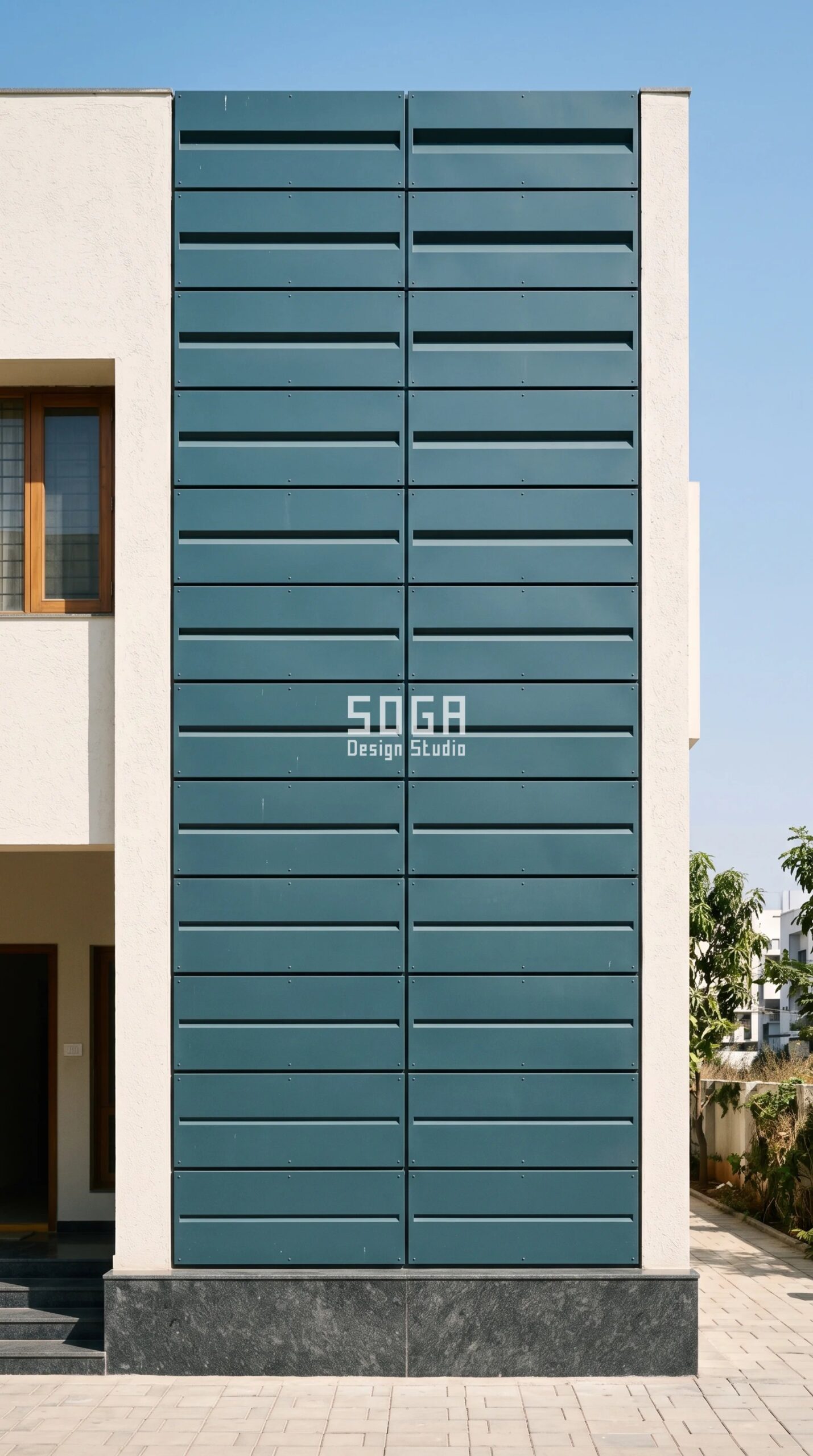
Design seed: Stacked flat-roof villa massing with a recessed stilt entry x folded sheet-metal cassette skin x a single pressed vee crease whose rise grows course by course x powder-coated ink-teal sheet metal over lime plaster and honed granite x a crease that is a drip line first and a shade line second. This G+2 independent villa in Kokapet, Neopolis, Hyderabad wears a Parametric Vee-Rise Cassette Course skin in 3 mm folded solid-metal cassettes in ink-teal matte, chrome-free conversion pre-treatment on a Qualicoat-approved product, Qualicoat Class 2 super-durable powder coat 60-80 micron, on a hot-dip galvanised MS carrier; off-white lime-plaster body; honed grey granite plinth. India puts a five-year defect liability on the promoter under RERA, but the coating warranty never sits there – it sits with the coater, and it is only as good as the pre-treatment and process record behind it. Those two clocks run at different speeds, which is why this villa is drawn so that any single cassette can be unhooked from the front and replaced against a batch number years after the installer has gone. The finish choice follows the same logic set out in our guide to aluminium facade finishes and their real lifespan: on the Deccan the enemy is UV and abrasive silt, so the specification is a super-durable polyester with a documented pre-treatment, not the thickest film anyone will quote. The parametric variation is written into the fabrication drawings, not sprayed on afterwards.
How the Parametric Vee-Rise Cassette Course is built
| Design parameter | Specification |
|---|---|
| Module | 1200 x 400 mm folded 3 mm solid-metal cassette with 30 mm returns, 4.9 kg each – a one-person lift. Six cassettes per course, three courses per floor, 18 per floor across the 7.2 m road frontage, 54 in total base to parapet. The course layout never varies: every cassette sits on the same 1200 mm grid, floor after floor. |
| The one variable: vee rise | A single horizontal vee crease is pressed across every cassette. Only its RISE changes – 8 mm at the plinth course, 4 mm deeper per course, up to 40 mm at the parapet. Nine discrete rises, 54 cassettes, zero bespoke panels. One press brake, nine stop settings, and the unique-part count stays at 9 of 54 – 17 percent, inside our 20 percent fabrication rule. |
| The warranty geometry: single-panel demountability | Every cassette hangs on two top hooks and one bottom retaining clip, all reached from the front with a 4 mm hex key. No cassette is captive behind its neighbour, so a warranty replacement is one panel and about 12 minutes, with no scaffold needed above 3.6 m. Each cassette is stamped on its back face with the coil batch number and the coating line date. That number is what a coater’s claim is actually paid against – a panel with no batch mark is an uninsured panel. |
| Pre-treatment: the clause that ends the coating warranty early | Chrome-free titanium-zirconium conversion coating on an eight-stage line, powder applied inside a 16-hour window, then 60-80 micron of Qualicoat Class 2 super-durable polyester. Two things about that sentence are warranty conditions rather than preferences. Qualicoat permits chrome-free conversion coatings, but only specific products that have passed its Appendix A6 approval programme – the chemistry alone is not enough, the named product has to be on the list. And the warranty is written against the batch pre-treatment and process record, not against the finished panel, so we specify that the record is handed to the owner with the O and M file rather than left at the coating plant. It cannot be reconstructed afterwards. |
| Cavity, drainage and fixing | 120 mm drained and back-ventilated cavity. 10 x 30 mm slotted weeps at 450 mm centres along every compartment base. 60 x 40 x 3 RHS hot-dip galvanised MS carrier at 80 micron on M10 chemical anchors into the RCC slab edge. A4-316 stainless fixings throughout with an EPDM isolation washer at every aluminium-to-steel contact. 15 mm thermal movement allowance per 6 m carrier run. |
| Climate move: the crease earns its shade | The deepest rises sit on the west and south-west elevations. A 40 mm vee throws a 51 mm shadow band on the wall below it at the 27 June 4 pm sun, altitude 38 degrees. Every crease soffit carries a 3 degree fall and a 10 mm drip groove at its outer lip, so Deccan road silt washes off the fold instead of banking on it – a dust decision and a water decision made with the same 10 mm. |
Material & colour: hero skin in Ink-teal matte RAL 5020 hero skin / off-white lime-plaster body / honed grey granite plinth / graphite anodised window frames, kept to a restrained palette so the geometry does the talking. Indicative facade cost: Rs 1,650 – Rs 2,450 per sq ft, fully designed and installed, with an itemised estimate produced per project.
2. Dubai Parametric Barrier-Joint Baguette Field: A G+1 Compound Villa
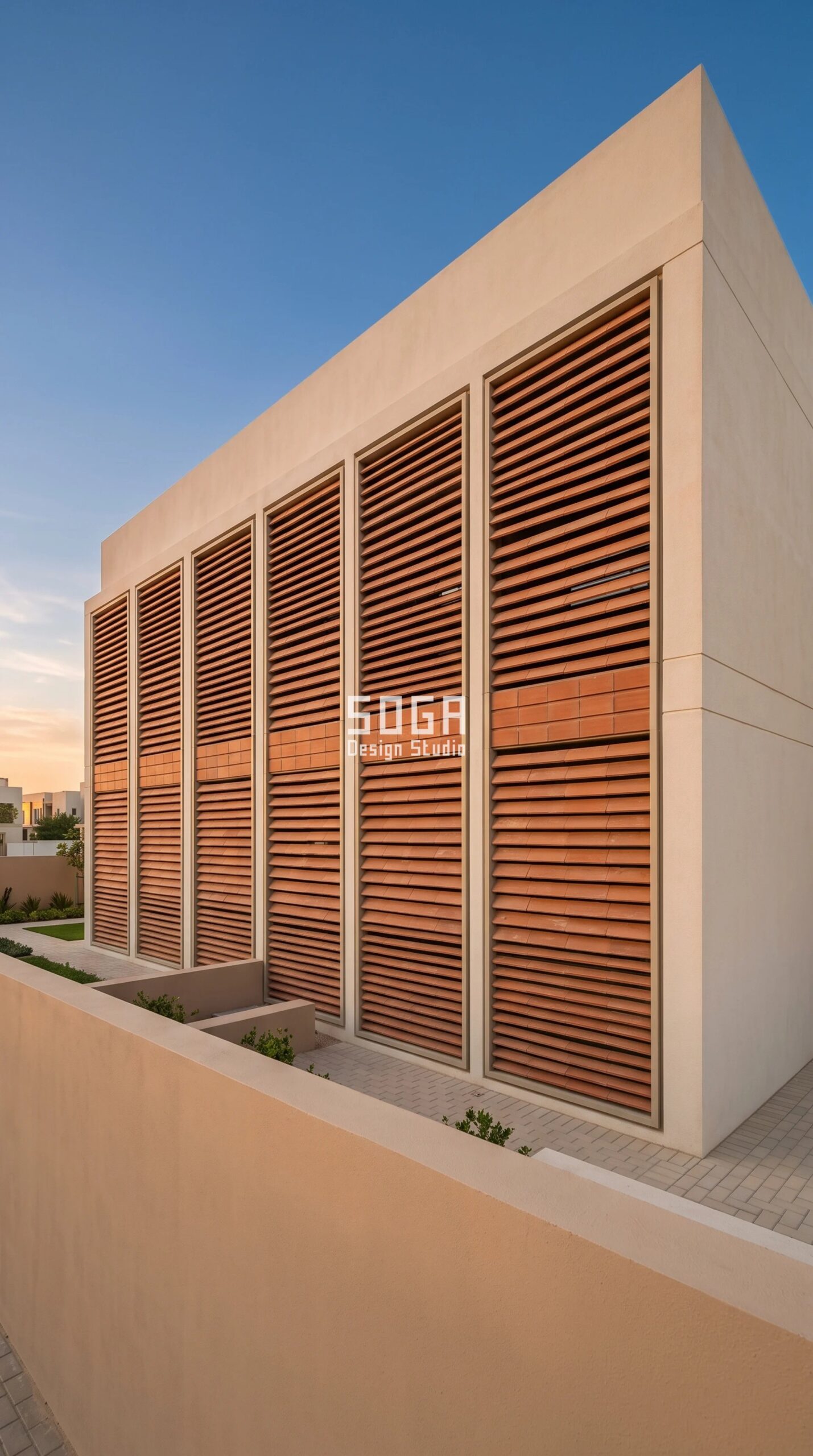
Design seed: Low horizontal compound-villa massing around a shaded court x horizontal extruded terracotta baguette field x one open joint that widens with height and closes solid at every barrier line x unglazed fired clay over warm off-white render x a pressure-equalised cavity that vents at the coping. This G+1 compound villa in Nad Al Sheba 3, Dubai wears a Parametric Barrier-Joint Baguette Field skin in Extruded fired-clay terracotta baguettes, A1 non-combustible, 250 x 50 mm section in 1500 mm lengths, unglazed kiln-natural; aluminium T-rail carrier on 316 stainless helping-hand brackets; 100 mm A2-rated mineral wool; certified open-state cavity barriers; warm off-white render body; sand-toned GRC plinth. Dubai is the market where the statutory clock outlasts everything printed on a product certificate, so the drawing has to assume somebody will be looking at these brackets in year nine. External cladding and insulation products also have to carry Dubai Central Laboratory certification before they can be used at all, so an approval list rather than a supplier’s brochure sets the material palette – and it moves the rate with it, which is why the Gulf bands in our villa facade cost benchmarks for the four markets sit where they do. The consequence on this villa is small and unglamorous: a solid capping course at every barrier line, and a clip that lets one baguette out without disturbing the next one. The parametric variation is written into the fabrication drawings, not sprayed on afterwards.
How the Parametric Barrier-Joint Baguette Field is built
| Design parameter | Specification |
|---|---|
| Module | 250 x 50 mm extruded fired-clay baguette in 1500 mm lengths, 8.4 kg each – a one-person lift – and one extrusion die for the entire villa. Sixty baguettes per bay per storey, six bays across the 21 m frontage, 720 baguettes in total. The bay layout never varies and every baguette is the same part. |
| The one variable: open joint width | Only the GAP between baguettes changes. It opens from 10 mm at the base of each storey to 20 mm at the head – six discrete widths, 2 mm per step, ten courses held at each width. Then it closes to a solid capping course, zero gap, for the three courses that sit over every cavity barrier line. Six widths, one part, zero bespoke units. |
| The warranty geometry: the barrier sits inside the tested build-up | A system supplier’s warranty is issued against an assembly that was tested as an assembly – panel, carrier, insulation and cavity barrier together. Open-state cavity barriers run at every floor line, within 600 mm of every external corner and around every opening reveal: 100 mm mineral wool with an intumescent edge seal. The joint pattern is not allowed to run continuously past a barrier, which is exactly why the pattern closes solid there. Substitute one component on site – a cheaper rail, a different barrier – and the certificate now describes a facade that no longer exists. |
| The ten-year clause: every bracket stays reachable | Decennial liability in the UAE runs far longer than any product warranty in this stack, so the facade has to stay inspectable for the whole of it. The 20 mm joint at each storey head passes a borescope, and a lift-and-slide clip lets one baguette come out to expose the rail behind it without disturbing its neighbours. No adhesive-only fixing appears anywhere on this facade. |
| Cavity, drainage and sub-frame | 150 mm drained and back-ventilated cavity, open at the base and vented at the coping. 100 mm A2-rated mineral wool on the RCC. Aluminium T-rail carrier on 316 stainless helping-hand brackets with a 5 mm thermal break pad at every anchor. 12 mm movement gap per 4 m rail run. Slotted weeps at every compartment base. |
| Climate move: mass in front, moving air behind | 48 degree summer air, shamal dust and a wide diurnal swing. The joint widens with height so the cavity behaves as a chimney – air enters at the base slots and leaves at the coping, and the heat reaching the insulation face drops with it. The baguettes are the only part of the wall allowed to get hot. The colour is fired in rather than sprayed on, which is deliberate: in the market where the liability period is longest, we specified a skin that has no coating film warranty to lose. |
Material & colour: hero skin in Kiln-natural sand-buff terracotta hero skin / warm off-white render body / sand-toned GRC plinth / graphite anodised rails and frames, kept to a restrained palette so the geometry does the talking. Indicative facade cost: AED 120 – AED 195 per sq ft (about Rs 2,800 – Rs 4,500), fully designed and installed, with an itemised estimate produced per project.
3. Singapore Parametric Cavity-Step Louvre Bay: A G+2 Detached Landed House
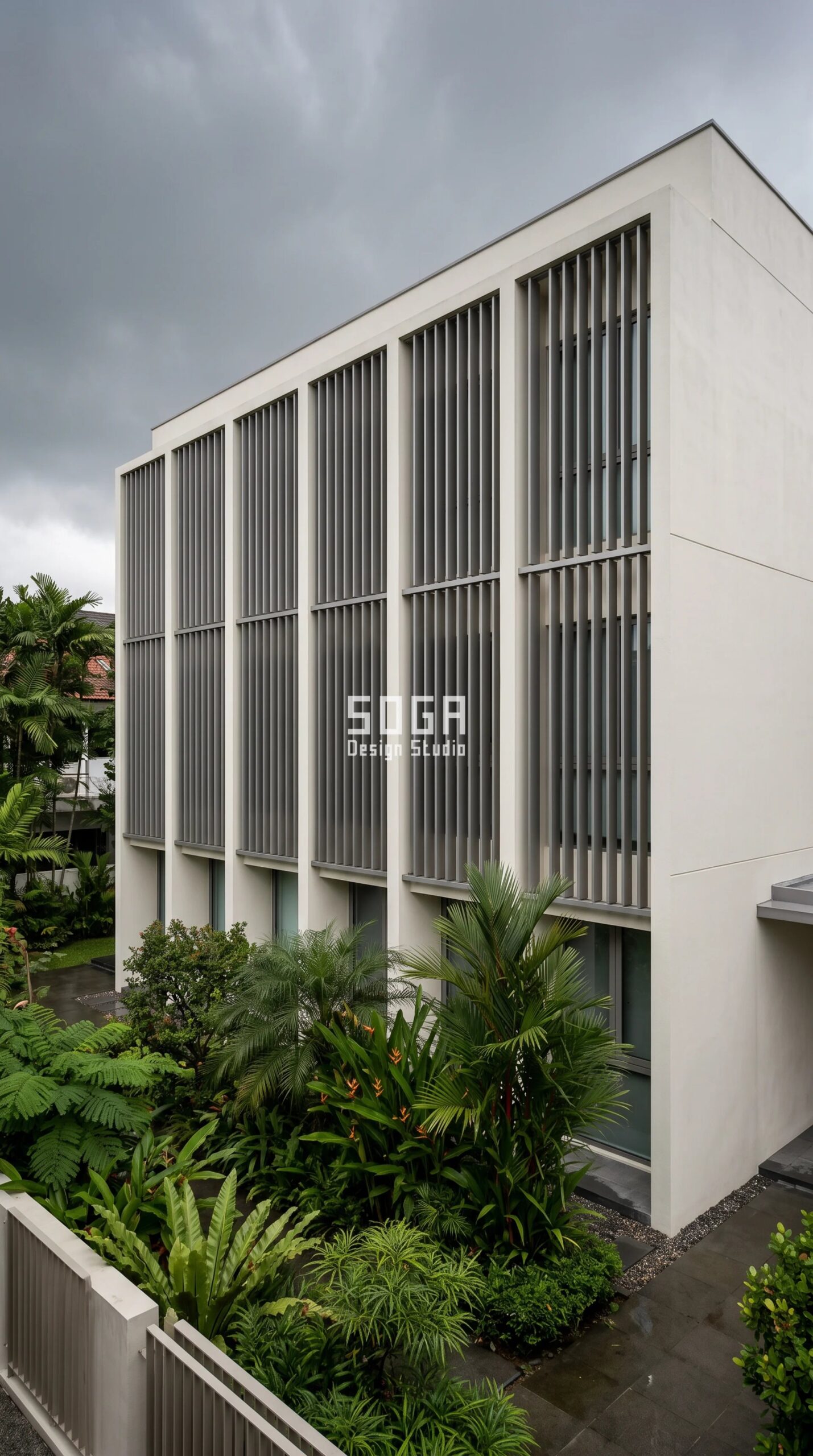
Design seed: Two-storey landed house with a deep planted setback x vertical extruded blade screen x one bracket standoff that steps outward course by course x architectural anodised pewter-grey metal over off-white render x a drained cavity that grows exactly where the run-down volume grows. This G+2 detached landed house in Bukit Timah, District 10, Singapore wears a Parametric Cavity-Step Louvre Bay skin in AA25 architectural anodised extruded 6063 blades, 25 micron anodic film to ISO 7599, 200 x 40 mm in 1800 mm lengths, on adjustable 316 stainless helping-hand brackets with nylon isolation bushes; off-white through-coloured render body; charcoal honed granite plinth. Singapore is the market people assume is the most heavily policed, and for a landed house it is the least. The periodic facade inspection regime that covers the island’s tall stock does not reach a two-storey house at all, so what is left is a contractual defects liability period – commonly twelve months from practical completion, though that is market convention rather than a figure the standard forms print – and then nothing. Shortest statutory protection of the four, shortest finish warranty of the four, and 2,340 mm of rain a year. That combination is why the waterproofing on this house is done by the section rather than by the paperwork, exactly as we set out in our guide to villa facade waterproofing and rain penetration – the panel face is allowed to let water past, and the drained cavity behind it is what keeps the house dry. The parametric variation is written into the fabrication drawings, not sprayed on afterwards.
How the Parametric Cavity-Step Louvre Bay is built
| Design parameter | Specification |
|---|---|
| Module | 200 mm deep x 40 mm wide extruded 6063 blade in 1800 mm lengths, 6.1 kg each – a one-person lift – from a single die. Twenty-four vertical blades per bay at a fixed 260 mm pitch, five bays across the 12 m frontage, 120 blades in total. The pitch and the bay layout never vary. |
| The one variable: cavity depth | Only the bracket STANDOFF changes. The blade line sits 38 mm off the wall at the ground-floor head and steps 4 mm further out at every blade course as it rises – ten discrete bracket lengths – to 75 mm proud at the parapet. The screen leans away from the wall in section while staying dead flat in elevation. Ten bracket lengths, 120 identical blades, zero bespoke blades. |
| The warranty geometry: the owner is the inspector, so nothing is concealed | Singapore’s periodic facade inspection regime, in force since 1 January 2022, reaches buildings over 13 m tall AND over 20 years old. A landed house is neither, and landed houses are exempt outright. So the honest position on this elevation is the opposite of what people assume: nobody is coming. There is no statutory inspector, and once the contractual defects period runs out the only person who will ever look at these fixings is the owner. That is precisely why every helping-hand bracket sits directly behind an open blade gap on the 260 mm pitch – visible and torque-checkable from a ladder without removing a single blade – and why there is no adhesive-only fixing on the building. A facade with the shortest documents needs the easiest inspection. |
| Anodising is not a coating, and its warranty is the shortest of the four | AA25 architectural anodising, a 25 micron anodic film to ISO 7599 – comfortably above the 18 micron floor that AAMA 611 sets for its Class I. Anodising is grown out of the metal rather than laid over it, so there is no film-adhesion clause to breach and no coater’s film warranty in the stack at all. What replaces it is a thickness certificate per batch and a much shorter finish guarantee: applicator warranties on architectural anodising typically run 5 years, extendable to around 10 by prior agreement, against 10 years and up for a 70 percent PVDF on the same metal. Plus one hard site rule – no cutting and no drilling of a finished blade on site, because every cut end is bare 6063. |
| Drained cavity, dissimilar metal and drainage | 38 to 75 mm back-ventilated drained cavity, open at the base and at the coping. A nylon isolation bush and an EPDM washer at every stainless-to-aluminium contact. Each blade carries a 6 mm drip arris on its leading edge and its foot stands 25 mm clear of the base flashing, so nothing in the section holds standing water. 15 mm movement gap per 4 m blade run. |
| Climate move: about 2,340 mm of rain a year and almost no drying time | The cavity grows with height because the run-down volume grows with height – the wetted zone is kept off the insulation face where it is worst, rather than uniformly everywhere. The blades run vertical at a 200 mm depth on a 260 mm pitch, a 38 degree cut-off in plan, so the low sun arriving across the garden late in the afternoon lands on blade sides rather than on glass. And because the finish warranty here is the shortest of the four villas, the cavity is carrying more of the load: the wall has to stay dry on geometry rather than on a document. |
Material & colour: hero skin in Pale pewter-grey AA25 anodised hero screen / off-white through-coloured render body / charcoal honed granite plinth / dark bronze glazing frames, kept to a restrained palette so the geometry does the talking. Indicative facade cost: SGD 58 – SGD 95 per sq ft (about Rs 3,650 – Rs 5,950), fully designed and installed, with an itemised estimate produced per project.
4. Sharjah Parametric Edge-Radius Hood Array: A G+1 Sea-Facing Villa
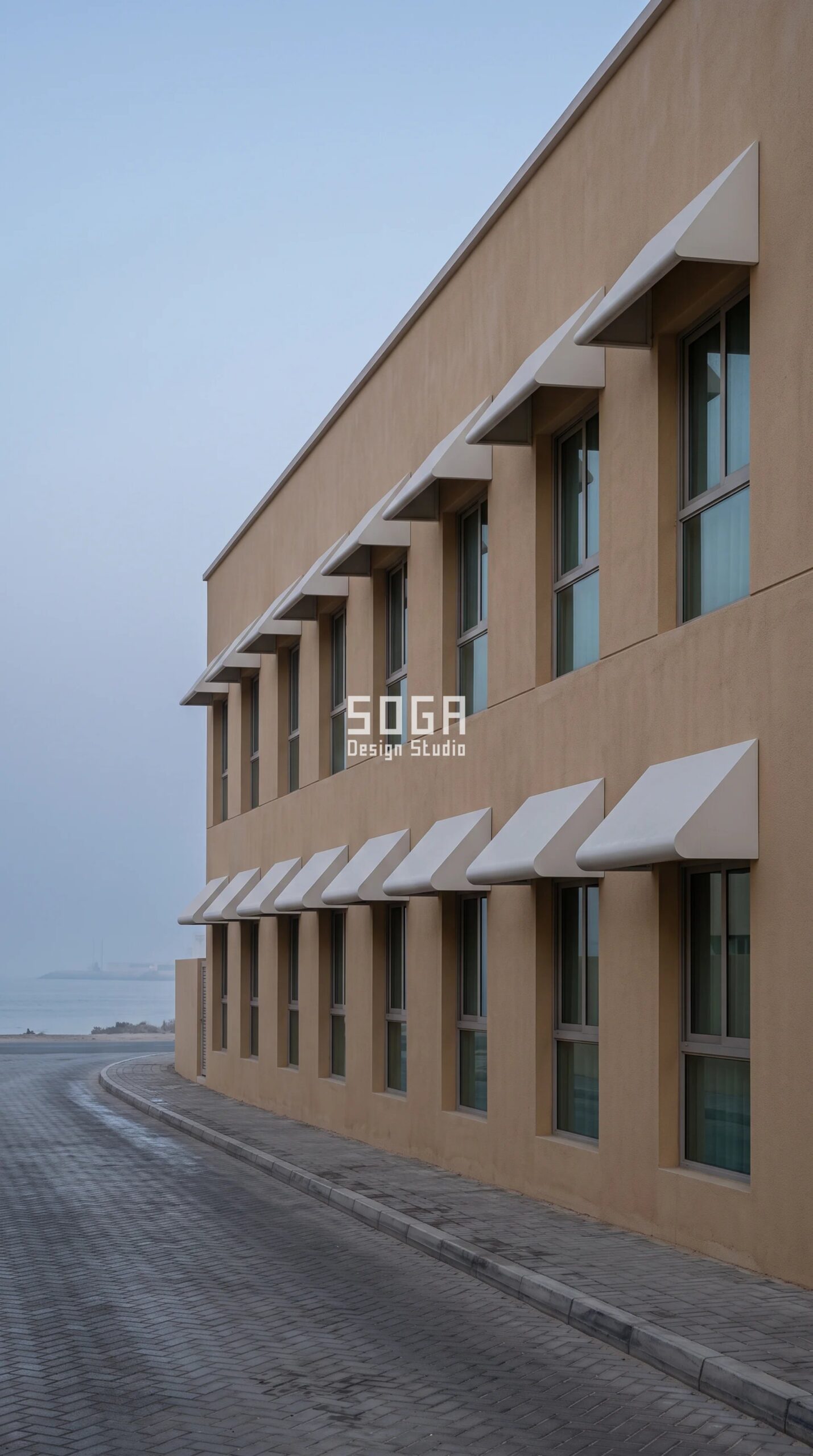
Design seed: Compact two-storey sea-facing villa with deep window reveals x pressed sheet-metal hood over every opening x one front-lip radius that rolls open as the elevation turns toward the water x marine-grade 5754 sheet coated on a SEASIDE-endorsed applicator line over warm sand render x a soffit fall that refuses to hold salt water. This G+1 sea-facing villa in Al Heerah, Sharjah corniche, Sharjah wears a Parametric Edge-Radius Hood Array skin in Pressed marine-grade 5754 hoods, 2.5 mm, Qualicoat Class 2 super-durable powder coat 60-80 micron applied by a QUALICOAT SEASIDE-endorsed applicator; A4-316 stainless fixings with EPDM washers and nylon bushes; warm sand render body; sand-toned GRC plinth. Sharjah carries the same federal ten-year decennial liability as Dubai, and the UAE Fire and Life Safety Code is federal too, so the legal frame is shared. What is not shared is the maintenance regime: Sharjah Municipality requires a permit to clean or wash a building facade and fines neglected buildings, which turns the coater’s wash-interval clause from a suggestion into an administrative task somebody has to own. Everything else about this villa follows from the exposure class – the alloy, the applicator’s endorsement, the isolation washers, and the radius on a lip. It is the same corrosion logic we work through in our guide to coastal villa facade design, applied here to the detail that decides whether the finish guarantee is still worth anything in year six. The parametric variation is written into the fabrication drawings, not sprayed on afterwards.
How the Parametric Edge-Radius Hood Array is built
| Design parameter | Specification |
|---|---|
| Module | One pressed 2.5 mm marine-grade 5754 hood, 1500 mm wide and projecting 650 mm, 9.8 kg – a one-person lift – from a single press tool. Sixteen hoods across the two street elevations, one over every opening, all on the same 1500 mm module. The opening layout never varies. |
| The one variable: pressed edge radius | Every hood is the same size with the same fixing. Only the ROLL on its front lip changes – a crisp 6 mm arris on the hoods to the sheltered courtyard side, opening in 4 mm steps to a full 40 mm bullnose on the two elevations facing the water. Nine radii, sixteen hoods, one press tool with nine radius inserts, zero bespoke parts. The variation is not decorative: it tracks the salt. |
| The warranty geometry: no coating warranty ever promises you an edge | This is the clause nobody reads, and it is not what people think. No architectural coating warranty sets a minimum bend radius. What the executed warranties actually do is exclude the edge: corrosion or substrate exposure at cut and bare edges is outside cover, damage caused by any fabricating operation voids it, and minute fracturing that occurs during proper fabrication is expressly not a covered condition. Powder also flows away from a sharp external arris as it melts, so the film is thinnest exactly where salt lands first. Put those together and the edge is the owner’s risk by contract – which makes it a design variable rather than a legal one. So the hoods facing the water get the fattest roll, and film build is checked on the radius rather than in the middle of the panel: 60-80 micron on the flat, 40 micron minimum measured on the bullnose. |
| Exposure class, and the two documents that argue about it | SEASIDE is not a powder grade – that is the single most common misreading on a Gulf project. Class approval belongs to the powder manufacturer; the SEASIDE endorsement belongs to the APPLICATOR, and it rests on enhanced pre-treatment – roughly double the standard etching removal – plus a filiform corrosion test on the line. So the exposure class is bought from the coater’s process, not from the tin. The pre-treatment argument gets sharper still on the PVDF side: one major manufacturer’s executed warranty publishes two separate tables, twenty years over a chrome-phosphate pre-treatment against ten over chrome-free – and inside one mile of salt water the chrome-free column reads no warranty at all on film integrity. This villa is inside that mile. That one fact decides the specification before any geometry is drawn. |
| The cleaning clause, and the permit you need to satisfy it | The clause most often breached on a Gulf coastal facade is not a material clause – it is the wash interval, and it is breached because nobody drew a way to reach the facade. Sharjah makes this unusually concrete: the municipality requires a permit for cleaning or washing a building facade, and neglecting building maintenance carries a Dh 10,000 fine, enforced through inspection campaigns on the main streets. So the maintenance regime is a permitted activity and a finable omission at the same time. The hoods are therefore set out on a fixed washdown route: every one reachable from a 2.4 m step platform standing on the compound path, a three-monthly fresh-water wash, no chemicals, logged in the O and M file where a claim can find it. |
| Dissimilar metal, drainage and the shade the projection also buys | A4-316 stainless fixings only, every one isolated from the aluminium with an EPDM washer and a nylon bush – stainless bearing directly on aluminium in a salt aerosol is a galvanic cell, and it consumes the aluminium rather than the steel. Every hood soffit falls 4 degrees away from the wall with a 12 mm drip groove set 20 mm back from the bullnose, so no upward-facing horizontal in the section holds standing salt water. The same 650 mm of projection over a 1500 mm opening puts the whole window in shade whenever the sun is above 67 degrees – roughly 10 am to 2.30 pm through May, June and July – and keeps wind-driven spray off the glazing line, which protects the shortest warranty on the building: the gaskets and the perimeter sealant. |
Material & colour: hero skin in Oyster-white Class 2 powder-coated hoods, SEASIDE-endorsed line / warm sand render body / sand-toned GRC plinth / graphite anodised window frames in deep reveals, kept to a restrained palette so the geometry does the talking. Indicative facade cost: AED 135 – AED 210 per sq ft (about Rs 3,100 – Rs 4,850), fully designed and installed, with an itemised estimate produced per project.
Same Villa, Four Jurisdictions: What Changes on the Drawing
This is where a single global warranty specification quietly fails. The product documents are broadly the same in all four markets – the same coaters, often the same extrusions. What differs is the statutory layer sitting over them, how long it runs, and who owes it. And because that layer is always the longest clock, it is the one that dictates geometry: whatever has to survive it has to be inspectable and repairable for its whole length. Four regimes, four different answers, four buildings that cannot be swapped.
| Market | The statutory layer, and the line it changes on the detail |
|---|---|
| Hyderabad, India | Five years, but it is a notification window and it binds the promoter. Where a villa is bought from a promoter, RERA gives the buyer five years from handover to bring a defect to the promoter’s notice – structural defects and defects in workmanship, quality or provision of services – after which the promoter must rectify without further charge within thirty days. Read it carefully and it is a window for raising the alarm, not a five-year guarantee that runs quietly in the background. And it binds the promoter, not the coater who finished your cassettes and not the fabricator who folded them. If you are building your own villa on your own plot rather than buying from a promoter, this layer does not reach you at all – your only protection is the contract you signed and the paperwork you kept. Line it changes on the detail: every cassette unhooks from the front on its own, and every one is stamped on the back with its coil batch and coating line date. A claim in year four is paid against that number, not against a photograph. |
| Dubai, UAE | Ten years, jointly owed, impossible to contract out of – and the only market that names the facade. Decennial liability runs ten years from handover and binds the contractor and the supervising engineer together, with any agreement excluding or limiting it treated as void. It was carried over intact into the new UAE civil code in force from 1 June 2026. Two things then make Dubai different from the other three. Its jointly-owned property law expressly lists facades among the structural common parts – black letter, not interpretation – and sets a ten-year developer liability for structural defects against a much shorter one-year clock from handover for defective installations. Two clocks, one wall, and a decade between them. Separately, external cladding and insulation products must hold Dubai Central Laboratory certification to be used at all. Line it changes on the detail: the brackets have to stay reachable for the full ten years – a 20 mm joint at every storey head that a borescope will pass, one baguette that lifts and slides out without disturbing its neighbours, and not one adhesive-only fixing anywhere on the building. |
| Singapore | The market everyone assumes is the strictest is, for a landed house, the thinnest. Singapore’s periodic facade inspection regime has been in force since 1 January 2022 and it is genuinely rigorous – a competent person, a seven-year cycle, hands-on inspection of every elevation. It also does not apply to you. It reaches buildings over 13 m tall and over 20 years old, and landed houses are exempt outright. So on a two-storey house the entire statutory layer disappears, and what remains is a contractual defects liability period – commonly twelve months from practical completion, though that is market convention rather than a figure the standard forms print – and after month thirteen, nothing. Shortest statutory protection of the four markets, and if the screen is anodised rather than PVDF-coated, the shortest finish warranty too. Line it changes on the detail: the owner is the inspector, so nothing may be concealed. Every helping-hand bracket sits behind an open blade gap on the 260 mm pitch, torque-checkable from a ladder without removing a single blade, and nothing on the elevation relies on adhesive. The wall is kept dry by its section, not by a document. |
| Sharjah, UAE | Same federal ten years as Dubai – and the only one of the four where maintaining the facade is itself regulated. The decennial layer and the federal fire code are shared with Dubai. What is not shared is the maintenance regime. Sharjah Municipality requires a permit to clean or wash a building facade, and neglecting building maintenance carries a Dh 10,000 fine, enforced through inspection campaigns. That collides directly with the coating warranty, because a marine-exposure finish guarantee is written against a stated cleaning interval – so in Sharjah the act that keeps your warranty alive is a permitted activity, and skipping it is a finable one. Line it changes on the detail: the specification is written from the coastline inward – marine-grade alloy, a SEASIDE-endorsed coating line rather than merely a well-known powder, an isolation washer at every stainless-to-aluminium contact, a fixed washdown route reachable from a 2.4 m platform on the compound path, and a lip radius on the seaward hoods more than six times fatter than on the sheltered ones. |
The Cost of Keeping Each Warranty Alive, Market by Market (2026)
Warranty-grade detailing is not a free upgrade, and it is not an expensive one either – it is a set of identifiable line items. These are indicative 2026 all-in rates, designed and installed, for the four systems shown above plus the supporting scopes that ride with them, and then the specific upgrades that buy you a longer or more defensible document. Villa facade area typically runs 1.1 to 1.4 times the built-up area, so apply these to the skin, not the floor plate. Every project gets an itemised estimate – these are the bands we start from, not a quotation.
| System / material | Indicative rate (per sq ft) |
|---|---|
| Folded solid-metal cassette rainscreen, ink-teal matte, 3 mm, Qualicoat Class 2 super-durable powder, on a galvanised MS carrier | Rs 1,650 – Rs 2,450 per sq ft |
| Unglazed extruded terracotta baguette rainscreen, non-combustible, on an aluminium T-rail with certified cavity barriers | AED 120 – AED 195 per sq ft (about Rs 2,800 – Rs 4,500) |
| AA25 architectural anodised blade screen, 25 micron to ISO 7599, on adjustable stainless brackets | SGD 58 – SGD 95 per sq ft (about Rs 3,650 – Rs 5,950) |
| Pressed marine-grade 5754 hoods, Class 2 powder on a SEASIDE-endorsed line, A4-316 stainless fixings | AED 135 – AED 210 per sq ft (about Rs 3,100 – Rs 4,850) |
| Bespoke ferrocement flowing balcony or parapet edge, armature-as-formwork, no repeat mould cost | Rs 1,500 – Rs 2,500 per sq ft |
| Drained and back-ventilated sub-frame, brackets, weeps, closers and flashings | Rs 290 – Rs 540 per sq ft |
| Upgrade from standard architectural powder to Qualicoat Class 2 super-durable | Add 6 – 11 percent to the coated-metal line |
| Moving the same Class 2 powder onto a SEASIDE-endorsed applicator line, on a marine-grade alloy | Add 12 – 20 percent to the coated-metal line |
| Certified cavity barrier package, non-combustible core and tested penetrations | Add 8 – 15 percent to the skin rate |
| Demountable single-panel fixing instead of a captive interlock, so one panel can be replaced alone | Add 4 – 8 percent to the skin rate |
| Batch marking, pre-treatment and process records, and a compiled O and M warranty file | Rs 35,000 – Rs 90,000 per villa, one time |
| Chrome-phosphate rather than chrome-free pre-treatment, where the manufacturer’s longer warranty table requires it | Add 5 – 9 percent to the coated-metal line |
How SOGA Draws a Facade the Warranty Can Survive
We are a design studio. We do not issue warranties, we do not certify anyone’s cladding, and nothing on this page is legal advice – your contract terms belong to your lawyer. What we own is the half of the problem that is drawn: the fixing type, the cavity depth, the joint width, the isolation washer, the bend radius and the access route. On every villa facade we release, the warranty exclusions are read before the pattern is set, and they are turned into four fixed rules. Every panel is demountable from the front on its own, so a single replacement never becomes a re-clad. Every anchor sits behind an open joint or a liftable unit, so a fixing can be inspected years later by somebody who was never on the project. Every upward-facing surface in the section is given a fall and a drip, so nothing in the detail holds standing water. And every parametric system holds its layout constant and varies exactly one measurable quantity – a vee rise, a joint width, a cavity depth, a pressed radius – which is not a stylistic preference. It keeps the part count down, keeps every module inside one tested and coated batch, and means the panel you replace in year seven is the same part number you installed in year one. That is the same discipline described in our walk-through of how a parametric facade goes from concept to construction, where material selection, prototyping and the O and M handover are named stages rather than afterthoughts. For the post-handover half of the same conversation – who is still answering the phone while the longest clock is running – see what to ask a parametric architecture studio before you hire one.
Related Reading
- Parametric facade design in India: the complete system guide
- Villa facade waterproofing and rain penetration across four markets
- Coastal villa facade design: corrosion, salt and the specification that survives it
- Villa facade design cost benchmarks for India, Dubai, Singapore and the UAE
- Aluminium facade design in India: materials, finishes, cost and real lifespan
- Retrofitting a facade onto an existing house: what actually decides feasibility
- villa facade panel replacement and spare stock
Frequently Asked Questions
What does a villa facade warranty actually cover?
Not one thing – three or four separate things, covered by separate documents. The coater’s film warranty covers the finish only: colour change, gloss retention, chalking and adhesion, measured on the flat of the panel in a stated exposure class. The system supplier’s warranty covers the assembly as it was tested – panel, carrier, brackets, insulation and cavity barrier together. The installer’s workmanship warranty covers how it was put up. A separate sealant and gasket warranty sits under all of them. No single one of these covers a leak, so the honest answer to “is my facade covered” is another question: covered against what, and by which document.
How long is a facade warranty on a villa?
Expect a stack rather than a number. The coating film warranty is typically the longest, and a super-durable or marine-class system in a suitable exposure class is where the biggest numbers come from. The system warranty usually sits below it. The installer’s workmanship warranty is normally the shortest of the three, and the sealant and gasket warranty is shorter still – often 1 to 5 years. Whatever the brochure says, the facade stops being covered as a whole on the day the shortest of these expires, because after that no single party owes you a working wall.
What voids a cladding warranty?
Overwhelmingly, geometry and record-keeping rather than anything legal. The recurring five: a fixing type other than the one tested; no drained and back-ventilated cavity, or one too shallow to drain; direct dissimilar-metal contact, most often stainless bearing on aluminium without an isolation washer; the wrong coating class for the actual exposure, which on a coastal site means a standard architectural powder where a marine class was required; and a missing pre-treatment or process record for the coating batch. Add two more that are pure site behaviour: cutting or drilling a finished panel on site, and missing the stated cleaning interval. Every one of those is decided on a drawing or in a method statement, not in a courtroom.
What is the difference between a facade system warranty and a workmanship warranty?
The system warranty says the assembly performs when it is built exactly as tested – it is a statement about the product family. The workmanship warranty says this particular installer built this particular wall correctly. They fail in different ways and they point at different people. If a panel chalks, that is the coater. If a tested build-up leaks even though it was installed correctly, that is the system supplier. If a bracket was never torqued, that is the installer – and that is also the shortest document, which is why an uninspectable fixing is such an expensive detail.
Is a villa facade covered by the defects liability period?
The defects liability period is a contractual mechanism between you and your contractor, and in most markets it is short – commonly twelve months from practical completion. It is not a product warranty and it does not extend one. Sitting above both, most jurisdictions add a statutory layer that runs much longer and binds the contractor, the supervising engineer or the promoter rather than the supplier. Those are three separate clocks with three different owners, and the scope of each is a question for your legal adviser, not for your architect. What your architect controls is whether the facade can still be inspected and repaired when the longest of them is still running.
Does a powder coating or PVDF warranty cover the whole facade?
No, and it does not even cover the whole panel. It covers the film, and it covers it where the film is thickest – on the flat. Executed architectural coating warranties expressly exclude the edge: corrosion or substrate exposure at cut and bare edges, damage caused by any fabricating operation, and minute fracturing that occurs during proper fabrication are all outside cover. Powder also flows away from a sharp external arris as it melts, so the film is thinnest exactly where salt and rain land first. That is a design instruction rather than a footnote: on the Sharjah villa above, the hoods facing the water carry a 40 mm bullnose instead of a 6 mm arris and the film is measured on the radius rather than in the middle of the panel. The other condition worth knowing is pre-treatment – one major manufacturer’s PVDF warranty runs twenty years over a chrome-phosphate pre-treatment and ten over chrome-free, and offers no film-integrity warranty at all on chrome-free within a mile of salt water.
Is a marine or seaside coating just a thicker paint?
No – and this is the most common misreading on a Gulf project. On the Qualicoat system, the durability class belongs to the powder manufacturer, but the SEASIDE endorsement belongs to the applicator. It rests on enhanced pre-treatment, roughly double the standard etching removal, plus a filiform corrosion test on that particular coating line. So a marine exposure class is bought from the coater’s process, not from the tin, and specifying a well-known powder without specifying an endorsed line gets you neither the endorsement nor the warranty that follows it. The substrate matters just as much: a marine-grade alloy, stainless fixings isolated from the aluminium at every contact, and a stated cleaning interval that somebody is actually able to reach.
Read the Exclusions Before You Set the Pattern
If you are about to sign off a villa facade and the drawings do not yet show where the cavity barrier lands, how a single panel comes off, or which anchors anyone can still see in year eight, that is the review worth doing this week rather than at handover. SOGA Design Studio designs villa and residential facades across India, Dubai and Sharjah in the UAE, Singapore and the UK, and we read the warranty exclusions into the detail at concept stage – fixing type, cavity depth, isolation, exposure class and coating radius – so the document you are handed at the end describes the wall that was actually built. Send us your elevation and your specification and we will come back with the exclusion list and an itemised estimate. Write to [email protected].