The decision usually arrives as a line in a budget: a facade area to clad, a figure against it, and three or four options on the table. A flat metal panel, which everyone has specified before. A perforated sheet, if the elevation needs air or a view through. A stone or composite rainscreen, if the building wants weight. Glazing, if the orientation can carry it. And a coin system — the option that looks most interesting in the reference images and is understood least well.
That gap is where expensive mistakes happen. A coin screen photographs extremely well, which is why it gets specified onto buildings it does not suit. It depends on light, on viewing distance and on being reachable later. Where those conditions hold it does what no flat panel can. Where they do not, it is a complicated route to a facade that could have been simpler.
This is written for whoever makes that call: a developer weighing a facade allowance, a contractor pricing options, an architect deciding what goes on an elevation. Being useful means being straight about where a coin system does not belong. There are elevations SOGA has recommended something else for, and those reasons are what make the system work when it does.
What follows is suitability, not design. The coin facade design parameters — the choices a designer sets once the system is chosen — are a separate subject.
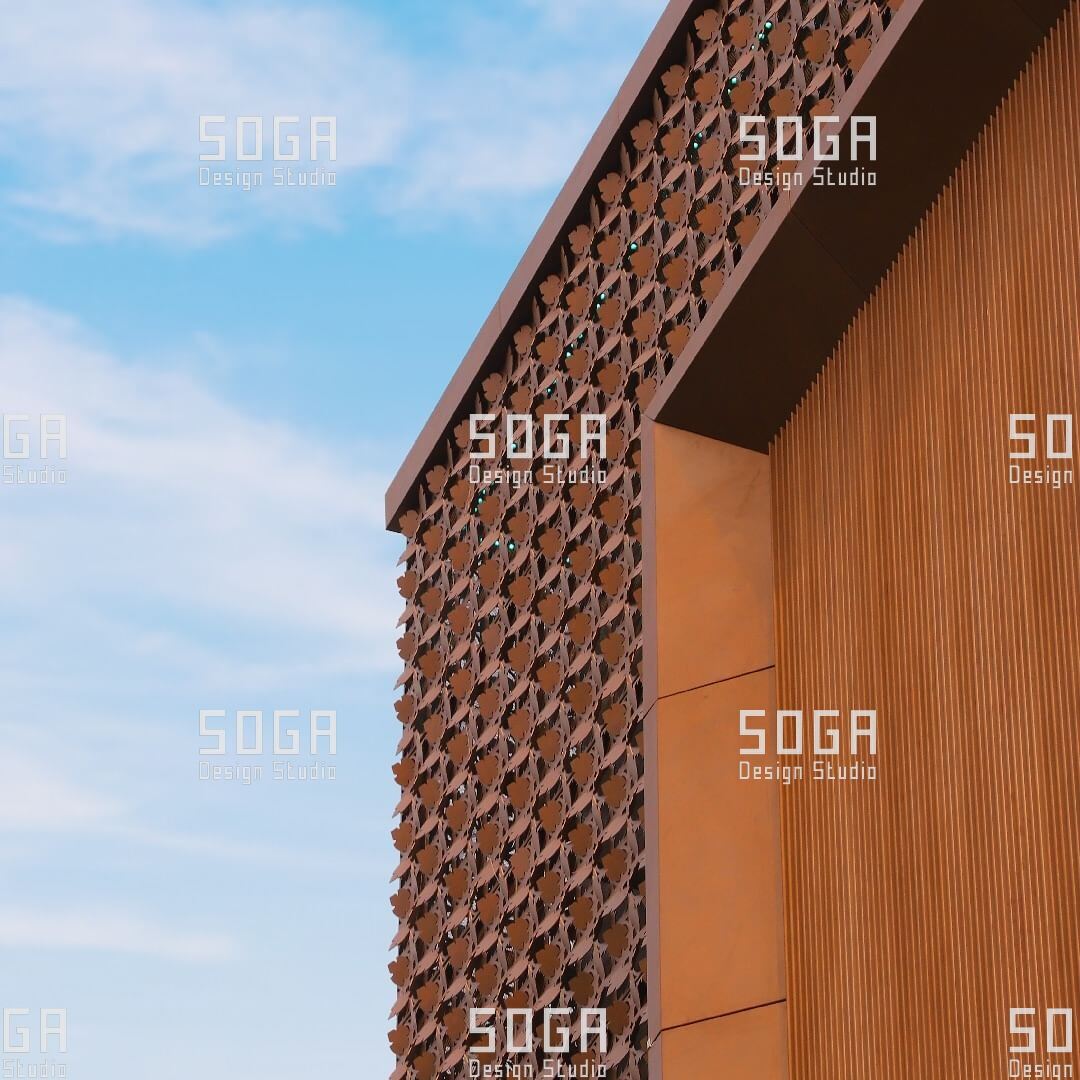
Metal coin cladding suits buildings that need to hold attention from a distance or at speed: retail, hospitality and showroom frontages, clinics and offices where identity matters, residential blocks in the G+3 to G+7 band wanting screened balconies, sun-exposed elevations needing moderation without solidity, and refurbishments where a new screen can change an existing facade without touching its structure.
What metal coin cladding actually is, in one section
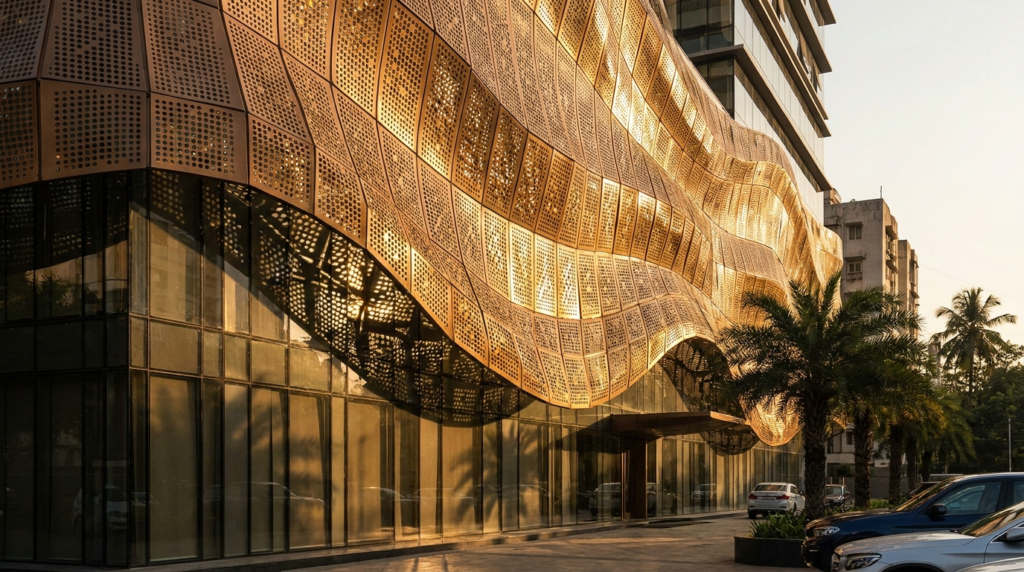
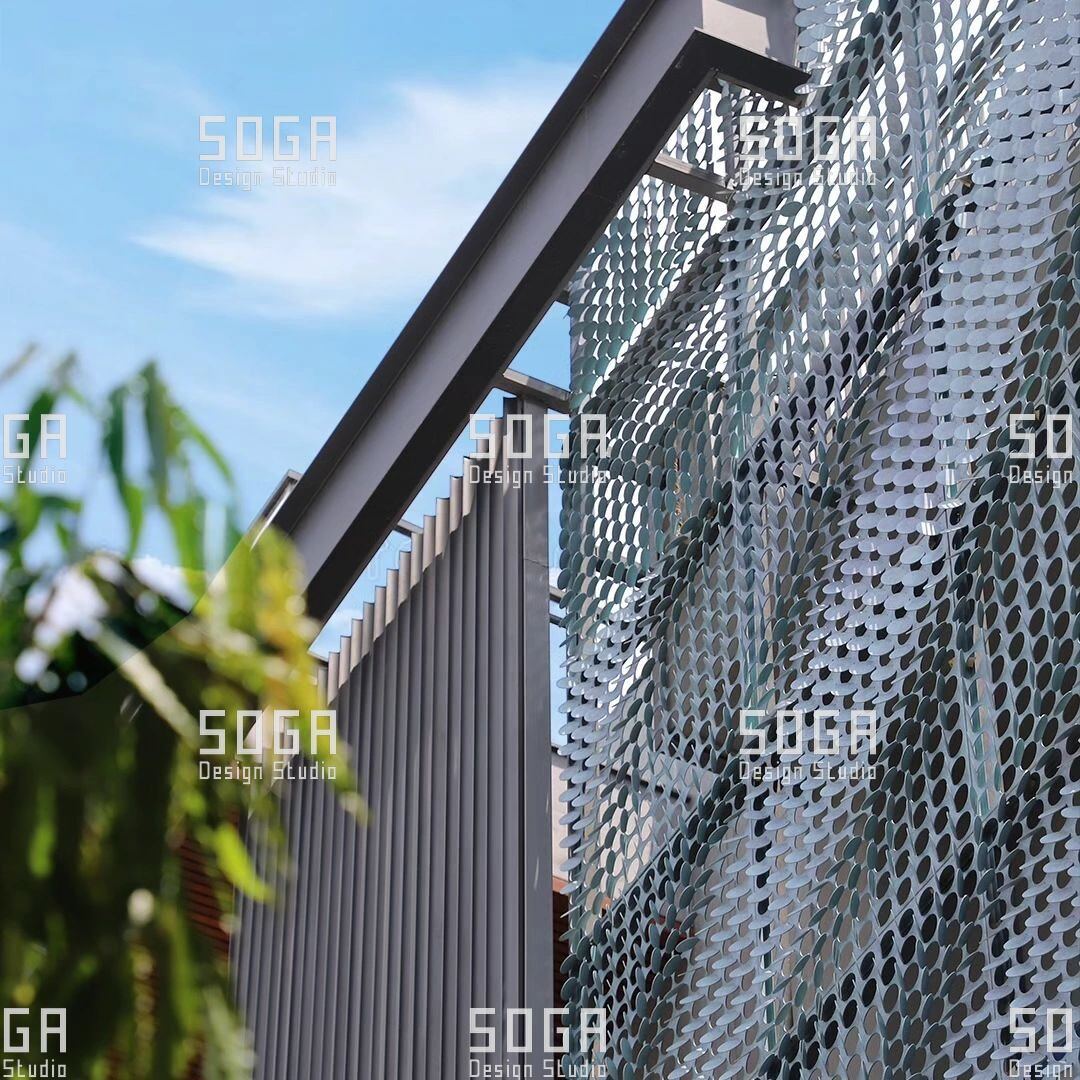
A coin facade is an envelope of many small metal discs — coins — fixed to a substructure in a worked-out pattern. Each disc sits at its own angle, so each returns light differently. From a distance the field reads as one shimmering skin whose tone shifts as the sun moves; up close it resolves into repeated, individually placed units on a frame.
What matters for anyone pricing it is what sits behind that field. A coin screen is a ventilated screen, not a sealed wall. It belongs to the rainscreen family: it sheds the bulk of the water, shades the wall behind it, and is open to air. It is not a waterproofing layer and not an insulated one.
So the wall behind it still does the whole weather and thermal job. Blockwork or concrete, the waterproofing, the insulation, the air barrier, the window interfaces — all of it stays in scope as it would if there were no screen. The coin field is an outer layer with its own substructure, priced on top of a complete wall.
That is the most common misunderstanding in early conversations, and correcting it moves the budget. Set against a sealed system as if the two were interchangeable, a coin screen looks like good value, because the comparison has dropped a wall out of one side. For the carrier logic and the load path, the complete coin facade guide is the deeper read.
Where a coin system earns its place
The fits are specific, and each has a reason behind it.
Buildings read at speed or at distance. An arterial road, a plot across a junction, a frontage passed at vehicle speed: these elevations have a short window to register. A coin field shifts its apparent tone as the viewing angle changes, so the building reads as a surface moving relative to the viewer rather than one fixed image.
Frontages where identity matters more than floor area. Retail, hospitality, showrooms, clinics, experience centres. Here the facade is doing commercial work: the client is not buying square metres of cladding, they are buying recognition, and a screen that behaves unlike anything else on the street delivers that without signage or applied decoration.
Residential in the G+3 to G+7 band. This is where the system sits most naturally on housing. At that height balconies are close enough to the street to feel exposed and high enough to be worth using. A screen across a balcony line gives privacy while staying open: residents keep the light and the air. A solid parapet achieves the privacy and kills the balcony.
Elevations needing sun moderation while staying visually light. A screen in front of glazing or a balcony intercepts part of the direct sun reaching the surface behind it while remaining a screen rather than a wall. Where a solid shading device would read as heavy, a coin field moderates the sun and still looks porous. That is a shading contribution, not a thermal performance claim.
Refurbishment. The fit most often overlooked. A building with a tired, patched envelope can be re-read entirely by hanging a new screen in front of it, with no work to the primary structure and often with the building still occupied. For an owner holding an ageing asset, that changes its standing without rebuilding it.
| Building type | What the coin screen is actually doing |
|---|---|
| Retail, showroom, hospitality frontage | Commercial recognition, without signage |
| Residential, G+3 to G+7 | Balcony privacy that keeps light and air |
| Office on a main road | Registers at vehicle speed |
| Sun-exposed elevation | Moderates direct sun, keeps the elevation open |
| Refurbishment | Changes the reading without touching structure |
Where it is the wrong choice
This section matters more than the one above: the fits are easy to guess, and the misfits cost money.
Elevations with no direct sun and no night lighting. The effect comes from raking light across angled surfaces. On a permanently shaded elevation — a tight side boundary, a face overshadowed by a taller neighbour — the field gets mostly diffuse sky and reads as textured grey, flatter still under overcast. With nothing lighting it after dark, the building has paid for behaviour that never appears. A flat panel in a good colour would look better for less.
Buildings seen only from very close. A coin field has a reading distance. Beyond it the units merge into a surface; inside it they separate into parts. On a narrow lane, a tight courtyard or a boundary wall nobody can step back from, the viewer is always inside it. The facade then reads as repeated components rather than a skin, and slight variation shows at arm’s length.
Projects with no maintenance access plan. Any screen needs cleaning, and on an Indian site it collects dust, bird fouling and monsoon staining. A coin field has more surface and more edges, so it collects more and shows it, and panels need replacing after impact. Without a cradle, anchor provision and a cleaning regime, it will look worse in a few years than a flat panel hosed down from a ladder. If nobody holds spares, a damaged panel stays damaged.
Sites where the cladding itself has to do acoustic or thermal work. It does not: a screen open to air cannot be an acoustic barrier and it does not insulate. Beside a flyover or a railway line, or where the brief sets a hard envelope target the cladding must carry, the right answer is a sealed and insulated system, with or without something decorative in front.
Very tight budgets where a flat panel genuinely does the job. A coin screen carries design input, a substructure, more components and more installation time than a flat sheet. Where the allowance is thin and the elevation secondary — a rear face, a service run, a building whose value is in its plan — the flat panel is not a compromise but the correct specification, and the money saved does more at the entrance.
Heritage and context-sensitive settings. On a street of old masonry, in a conservation area, or in a precinct with a settled material language, a precise metal screen reads as an intrusion. It is not a quieter version of what surrounds it; it is a different argument. SOGA does little conservation work for this reason: the honest response is a material that belongs there.
On any of those projects, something else is the right answer. A studio that cannot say so is not advising, it is selling.
Coin cladding against the alternatives
The useful comparison is against the systems actually on the same shortlist.
| Dimension | Coin screen | Flat metal panel | Perforated sheet | Solid rainscreen |
|---|---|---|---|---|
| Visual depth | High; from unit angle | None | Moderate; from pattern | Low; from joints |
| Behaviour through the day | Changes continuously | Static | Changes at pattern scale | Static |
| View through | Partial, oblique | None | Yes, controllable | None |
| Panel replacement | Practical, if the fixing allows | Practical | Practical | Harder |
| Substructure demand | Significant; a second layer | Moderate | Moderate | High |
| Design input | High; resolved before fabrication | Low; a known spec | Moderate | Moderate |
Read that honestly and the flat panel wins more rows than most facade articles admit. It is cheaper, faster to specify, easier to price, and needs almost no design input before it can be ordered. Where a facade only has to be a competent weather-facing surface, those are what matter, and a coin screen loses on each. The one row it decisively wins is what the surface does with light.
The perforated sheet deserves more respect than it gets. Where the brief has a real requirement for air movement, a controlled view out or a defined degree of transparency, perforation answers it directly and can be set against a target. A coin field screens obliquely and partially; it is not the choice when view-through or ventilation is the real requirement rather than a side effect.
What separates a coin screen is a narrow condition: light on the elevation, a viewing distance that lets the field resolve, and a brief that needs the building recognised. Weathering, dust and monsoon upkeep belong in the same decision, which is why choosing a facade material in India is worth reading alongside it.
Scale, orientation and context: the three questions to answer first
Three questions decide most of it, and they rule out more projects than any budget conversation.
Scale: how tall, and therefore how far away
The G+3 to G+7 band is where coin systems sit most comfortably, for geometric rather than stylistic reasons. Height sets how far back a viewer must stand to see the whole elevation, and that distance decides whether small units read as a surface or as parts. In that band the standing distance across a street is close to where it resolves.
Go taller and the upper field is seen from so far that fine variation is lost, while the lower field separates — one screen working at two ranges at once. Go lower, to a single or double-storey frontage, and the viewer sits inside the resolving distance. Neither is impossible; both stop being straightforward.
Orientation: where the sun comes from
This is a go or no-go question, not a detail for later. The system’s behaviour is entirely a function of how light reaches it. An elevation receiving direct sun for a usable part of the day shows what the system does. One receiving only diffuse sky shows tone and texture, nothing more.
So orientation is settled at selection. If the main elevation is permanently shaded and nothing lights it after dark, the honest advice is to spend the money elsewhere. If it is sun-exposed, the next question — which part of the day matters here — belongs in the design conversation that follows.
Context: what is opposite, and how fast people pass
Context decides whether the facade has a job at all: what stands across the street, how far back a viewer can get, how fast people pass, and whether the building must register at a distance or only look well made. A slow lane behind mature trees is a different proposition from a corner plot on an arterial road.
| First question | Rules the system in when | Rules it out when |
|---|---|---|
| Scale | Around the G+3 to G+7 band, with normal viewing distance across the street | Read at two very different ranges at once, or only from close up |
| Orientation | A main elevation gets direct sun for part of the day, or night lighting is in the brief | Permanently shaded, nothing lighting it after dark |
| Context | Somewhere to stand back, and a building that must register at distance | The viewer is always close, or the setting calls for its own material |
What it takes to commit to one
If the three questions come out in favour, four practical realities follow.
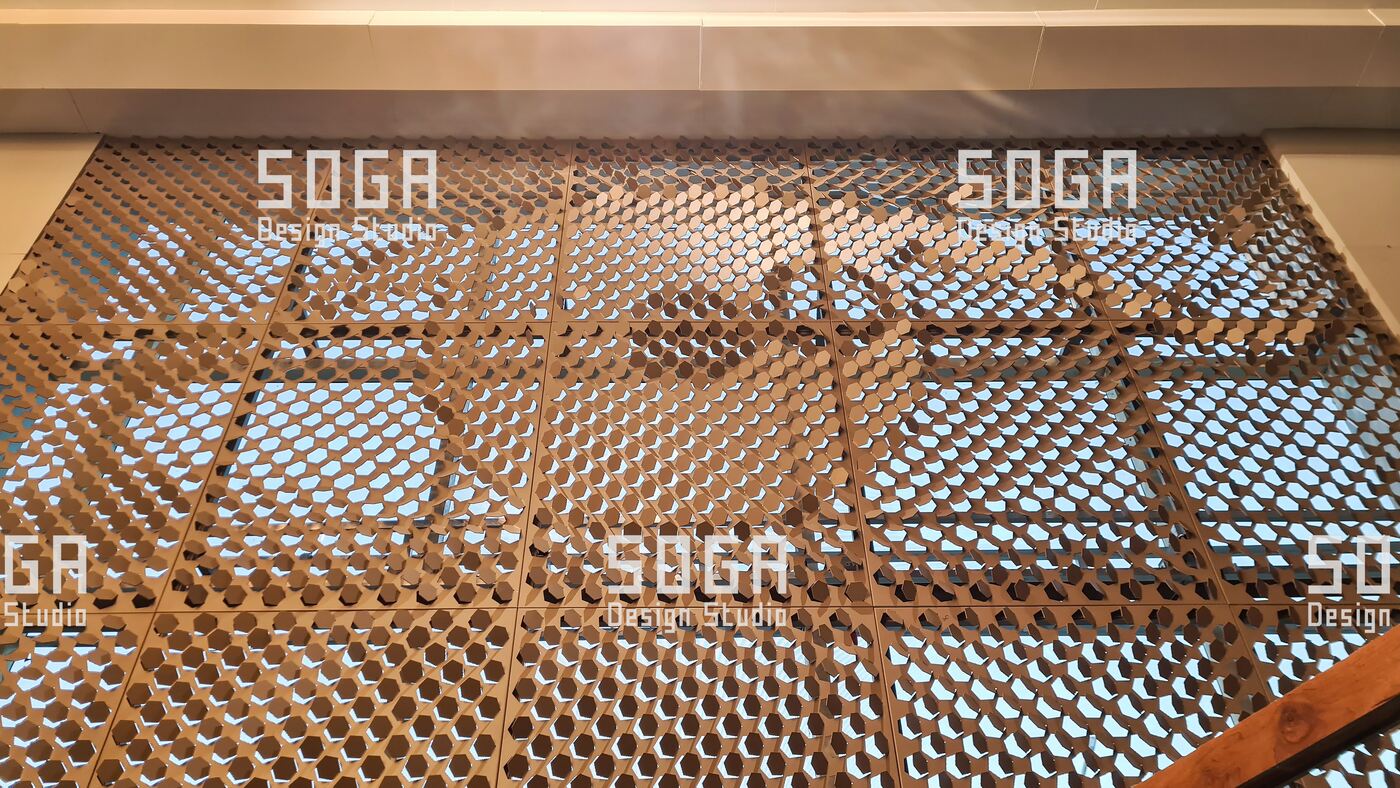
The first is design input, upfront. A parametric screen cannot be ordered from a catalogue. The field has to be resolved — geometry, carrier logic, edges, openings, corners — before anything is cut, and what fabrication needs is a schedule, not an image. A project that defers it will delay procurement or build something less resolved than it was shown.
The second is the substructure. Brackets, carrier framing and the fixing back to structure are part of the system cost, not an afterthought at the bottom of a bill. A screen budgeted as a surface finish arrives as a two-layer assembly, and that gap is where facade packages overrun.
The third is maintenance and spares. Access provision, a cleaning regime and spare units should be settled while the system is chosen, because all three are cheap to plan and expensive to retrofit. For how such a field is set out and erected, coin facade installation sequencing and tolerance covers it.
The fourth is ownership of the rule. The field is generated from a geometric rule, and somebody has to hold it afterwards. If a balcony is added, a unit is damaged beyond the spares, or a later phase has to match, that rule keeps the change consistent. A project that loses it matches a pattern by eye.
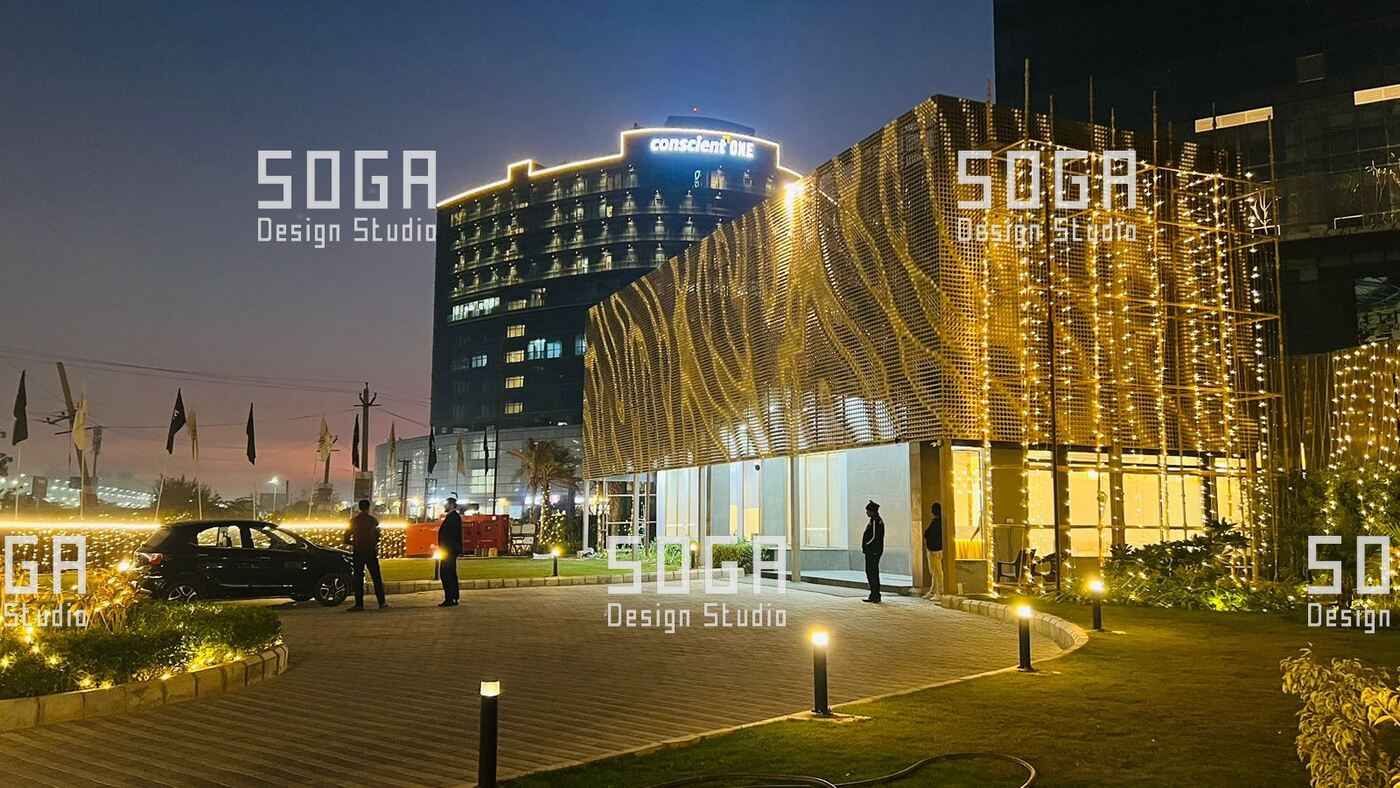
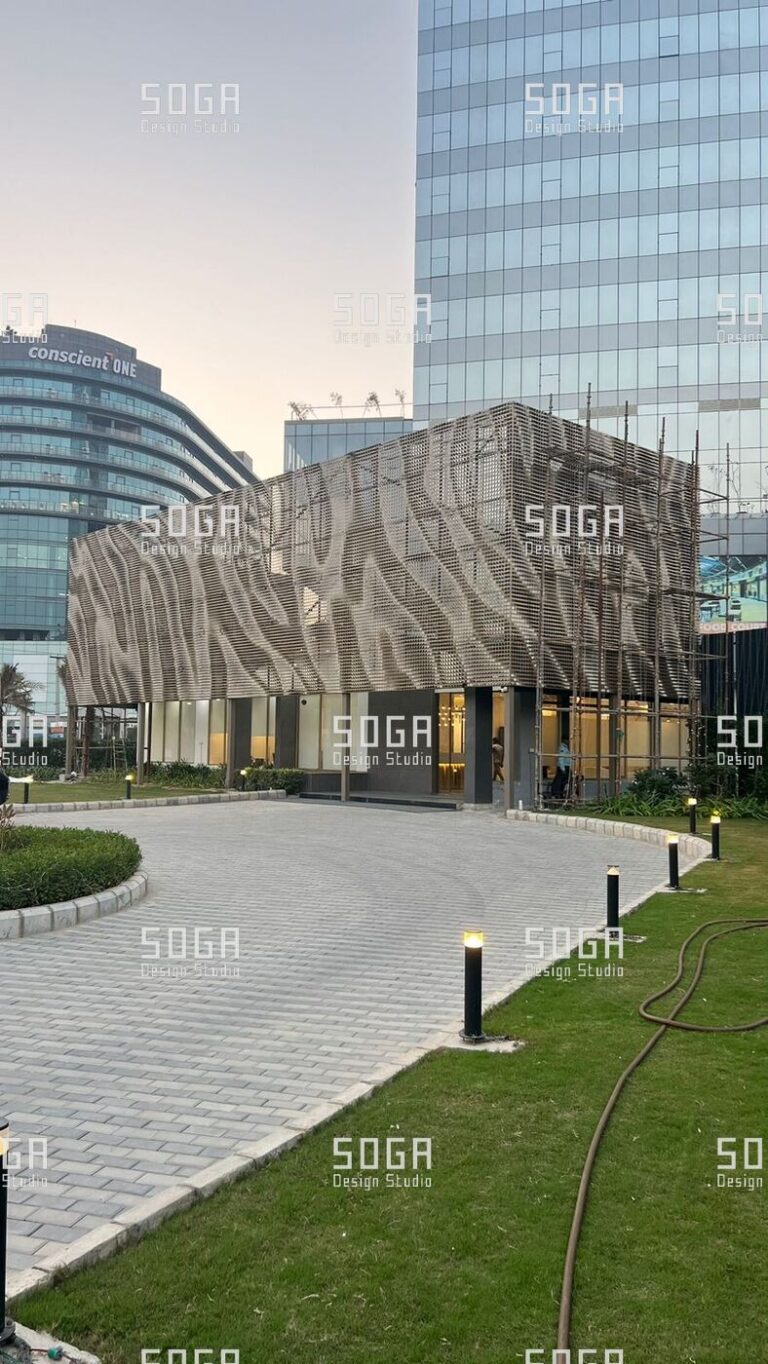
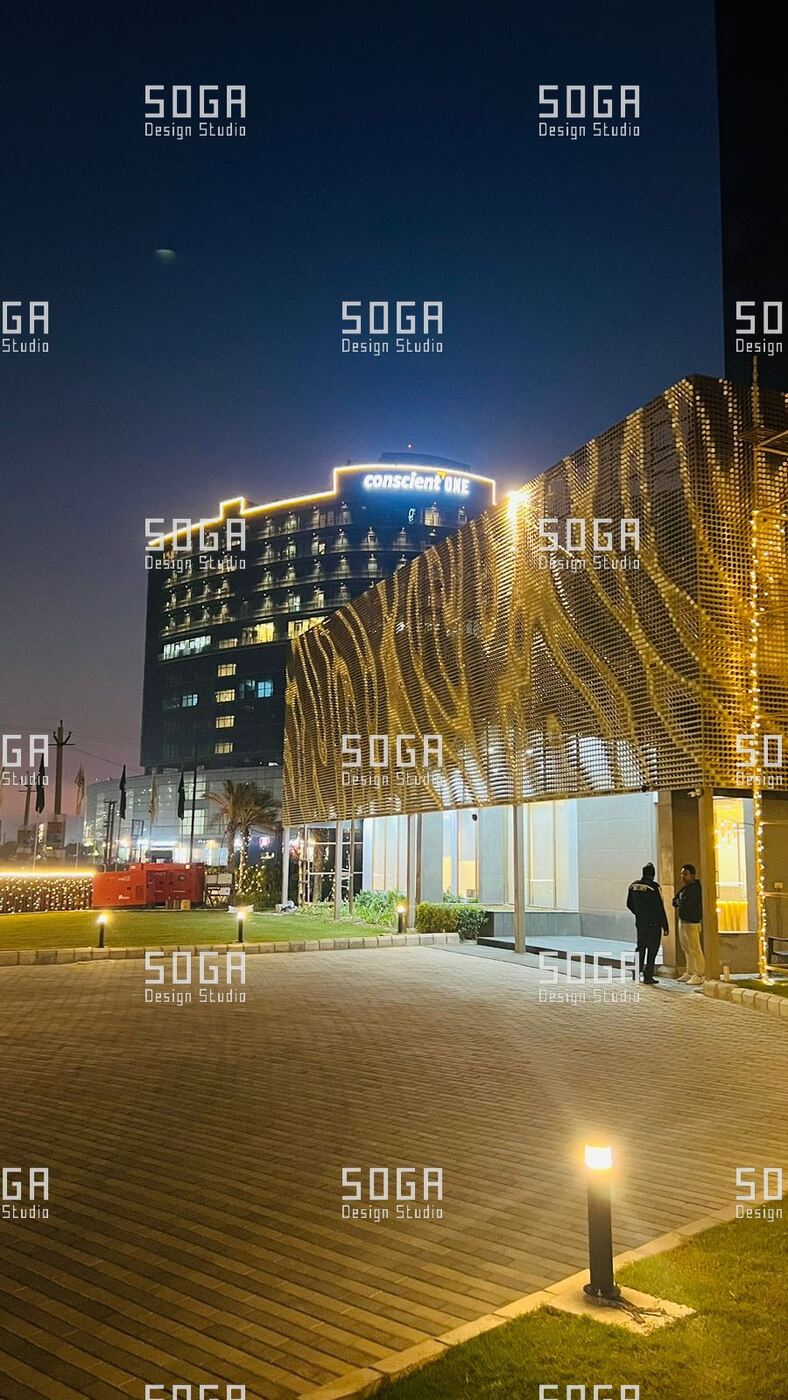
On the Gurgaon project, SOGA led the parametric design, the panelling logic and the overall facade geometry, while Metaguise handled fabrication and panel-forming — the system Metaguise produces under the name MetaCoin™. Producing modular metal sheet panels to a consistent standard without soldering or welding is real fabrication engineering, and it decides whether a resolved geometry survives into built work. The published record gives 216 rectangular panels across 242.3 m² in Gurgaon, published by Parametric Architecture on 30 April 2024. The brief and the wave logic are told in the Gurgaon coin facade project story; the shop route, in how a coin facade is manufactured.
Project credits and trade marks
| Role | Party |
|---|---|
| Parametric Designer | SOGA Design Studio |
| Fabrication Team | Metaguise |
| Project Architect | Archium Design Studio |
| Client | Yashika Group |
| Photography | Metaguise |
The project was published by Parametric Architecture on 30 April 2024 under the title ‘Parametric Coin Facade Made of Rectangular Panels with Circular Coin Mechanisms’, and the feature is online at https://parametric-architecture.com/parametric-coin-facade-made-of-rectangular-panels-with-circular-coin-mechanisms/ . Metaguise and MetaCoin are trade marks of their respective owner and are used here only to identify the fabricator and the product they name. SOGA Design Studio makes no claim to those marks. This article describes the studio’s own part of the work: the parametric design of the coin facade system.
Frequently asked questions
What buildings is metal coin cladding suitable for?
It suits buildings whose facade has commercial work to do: retail, showroom and hospitality frontages, clinics, offices on main roads, and residential blocks in the G+3 to G+7 band where balconies need screening without being closed in. It also suits refurbishment. The conditions are direct sun or night lighting, and somewhere to stand back from.
Is a coin facade suitable for a house?
Sometimes, and the deciding factor is viewing distance rather than size. A house set back behind a gate, or seen across a street, can carry a screen on a balcony line or a feature elevation. One whose boundary wall sits at the pavement edge usually cannot, because every viewer is close enough to read individual units rather than a surface.
Does coin cladding waterproof a wall?
No. A coin screen is a ventilated rainscreen layer, deliberately open to air. The wall behind it still carries the waterproofing, the insulation, the air barrier and the window interfaces as it would without a screen. The screen sheds most of the water and shades the wall, but it is priced on top of a complete wall, not instead of one.
Coin facade versus perforated panel, which is better?
Neither is better; they answer different briefs. Perforation is right when there is a real requirement for air movement, a controlled view out or a defined degree of transparency, because it addresses those directly and can be measured. A coin field is right when the facade has to hold attention and change through the day.
Does a coin facade need maintenance?
Yes, like any screen. It collects dust, bird fouling and monsoon staining, and it has more surface and more edges than a flat panel, so it collects more and shows it. It needs a cleaning regime, a safe access route and spare units for impact damage — all cheap to plan and expensive to retrofit.
Can coin cladding be added to an existing building?
Yes, and refurbishment is one of its strongest applications. The screen hangs from a substructure bracketed back to the existing wall or frame, so the primary structure is usually untouched and the building can often stay occupied. Check first the wall’s capacity to take the brackets, the waterproofing behind it, and how the screen meets existing openings.
What height of building suits a coin facade?
Roughly the G+3 to G+7 band, because at that height the distance a viewer naturally stands back is close to the distance at which a field of small units reads as one surface. Much taller, and one screen must work at two very different ranges at once. Much lower, and the viewer is always too close.
The simplest element, the strongest thinking
A coin screen is a specific answer to a specific problem: a building that must be recognised, on an elevation the sun reaches, seen from far enough back for small units to become a surface. Where those conditions hold it does what no flat sheet can, without moving parts, ornament or dependence on colour. Where they do not, it is an elaborate route to a worse result than a flat panel.
The honest version of the advice is unglamorous. The studios that get the most out of this system are not the ones most taken with the images; they are the ones who knew which problem they had before they went looking for a solution. Scale, orientation and context first. System second.
Developers, contractors and architects weighing a coin system against their other options can write to the studio, including when the answer turns out to be one of the alternatives.
The simplest element. The strongest thinking.
Designed in India, engineered in India, and built to stand up anywhere the work is judged on its merits.