Three finishes dominate metal facades in India, and the honest ranking on durability is PVDF first, anodising second, powder coating third — but that order flips the moment you weigh repairability, colour range or coastal exposure. There is no finish that wins on every axis, which is why the question “which is best” has no useful answer and “which is right for this elevation, in this city” has a very precise one.
The difference matters more in India than in most markets. UV load is high for most of the year, the monsoon delivers months of wetting, coastal cities add chloride, and inland industrial belts add sulphates. A finish specified from a European datasheet will behave differently here, usually at the top end of its fade range rather than the bottom.
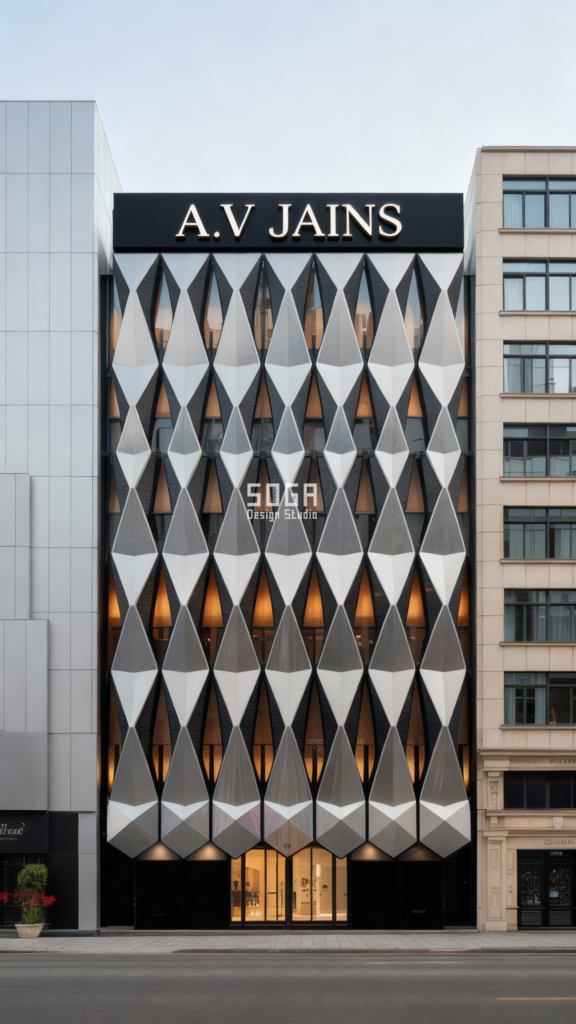
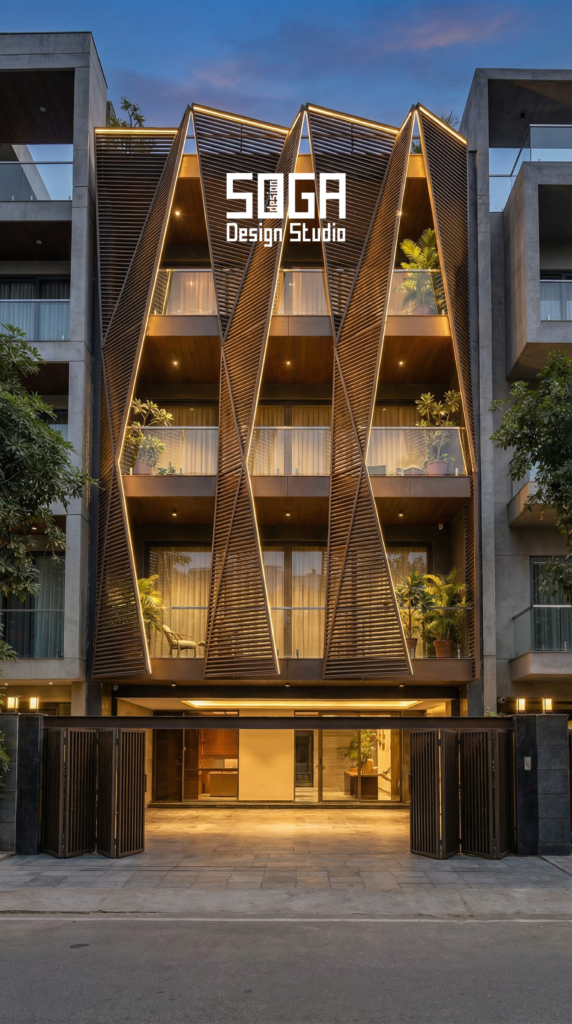
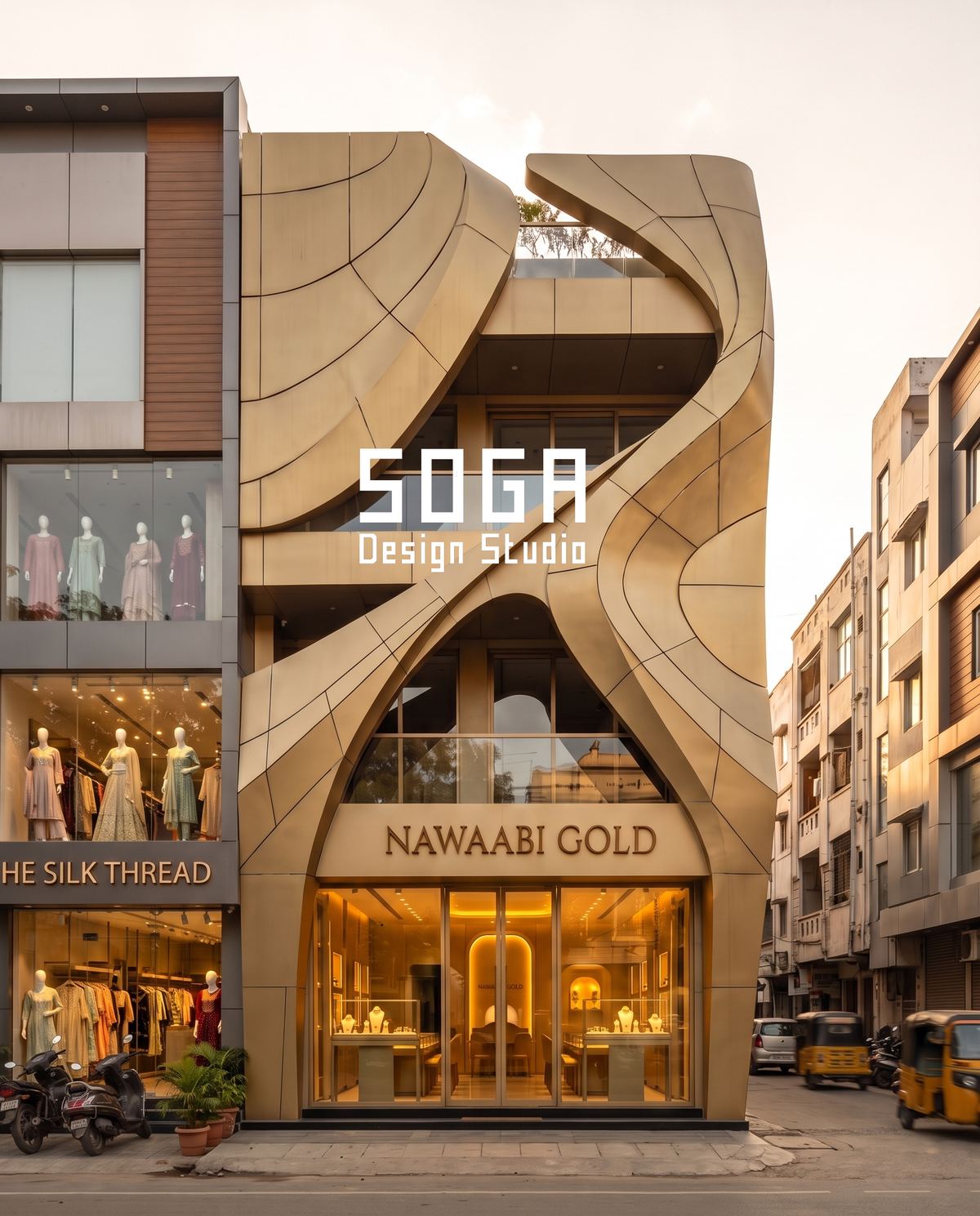
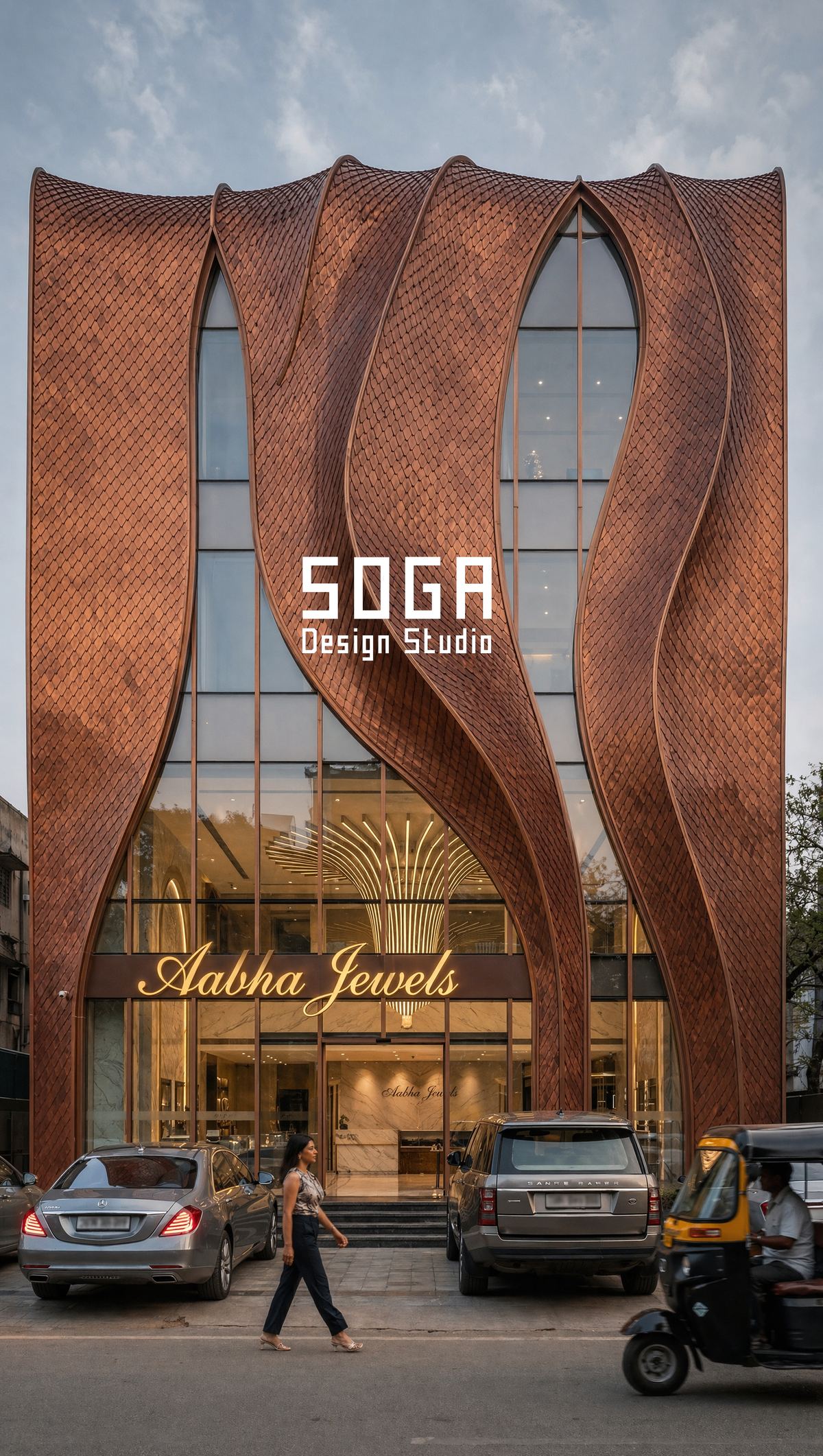
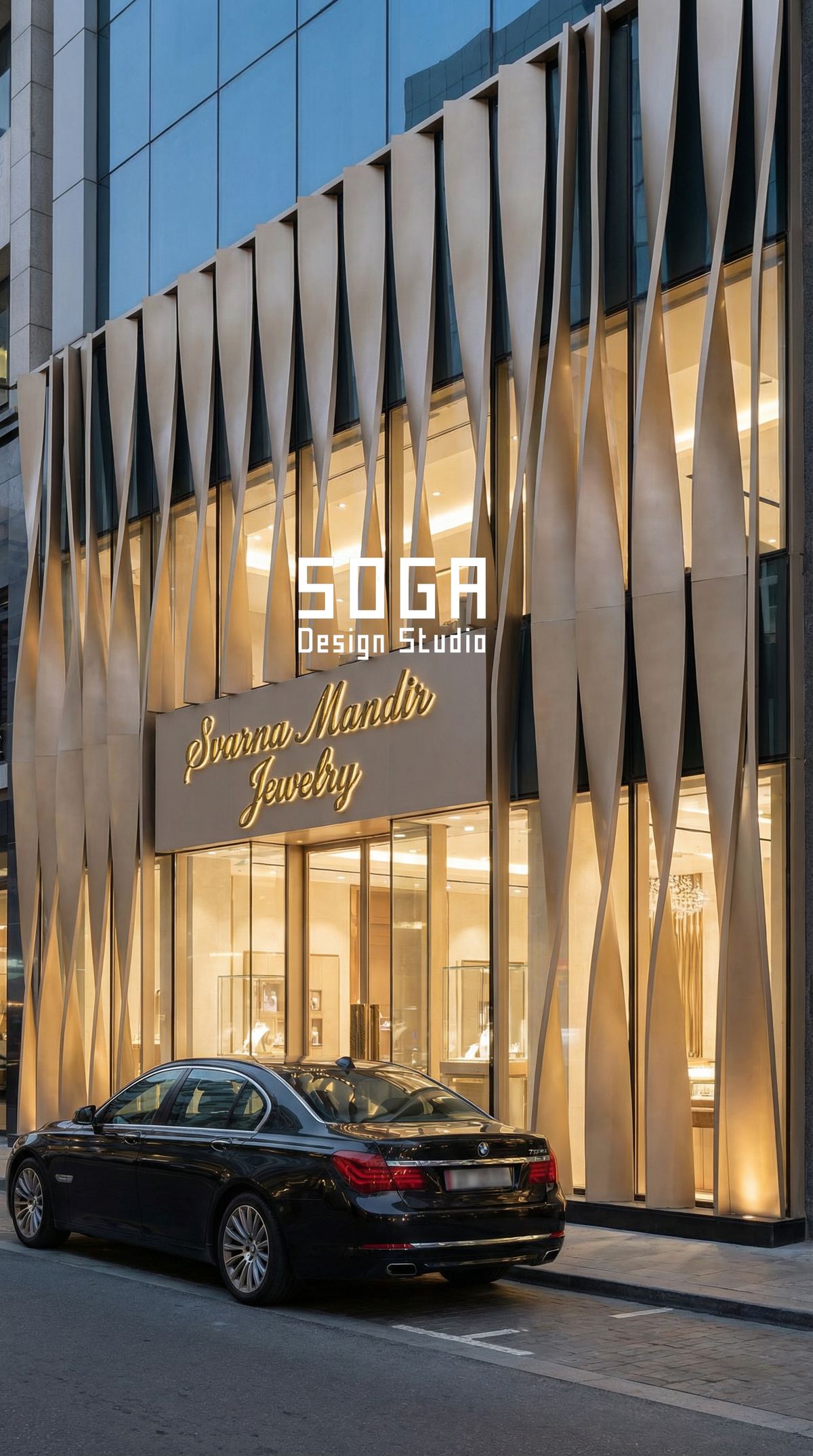
This guide compares the three on how they are actually made, realistic life by climate zone, UV and colour behaviour, what happens when they are damaged, and which finish suits which elevation. Design studies shown are SOGA concepts.
What The Three Finishes Actually Are
They are not three versions of the same thing. One is a conversion of the metal surface itself; two are coatings applied on top of it. That single distinction explains most of their differences in behaviour.
Anodising is an electrochemical process that grows an oxide layer out of the metal. The finish is part of the substrate, not sitting on it. Powder coating is a dry polymer powder applied electrostatically and fused in an oven. PVDF is a liquid fluoropolymer coating applied in coats and baked, and its resin chemistry is what gives it its UV performance.
| Anodising | Powder coating | PVDF | |
|---|---|---|---|
| What it is | Grown oxide layer, integral to the metal | Fused polymer film on the surface | Baked fluoropolymer film on the surface |
| Typical thickness | 15–25 microns for architectural grade | 60–80 microns | 25–40 microns in 2 or 3 coats |
| Colour range | Limited — metallics, bronzes, blacks, champagne | Effectively unlimited, any RAL | Wide, though metallics cost more |
| Finish character | Metallic, translucent, shows the grain | Opaque, uniform, can be textured | Opaque, flat to satin, very even |
| Where it is applied | Specialist anodising plant | Most coating shops | Fewer plants; a specialist line |
| Cost position | Middle | Lowest | Highest |
The row that decides the most arguments is the first. Because anodising is grown into the metal, it cannot peel or flake — there is no film to detach. Powder coat and PVDF are films, and films can be damaged down to the substrate. That is anodising’s structural advantage and it is real.
But the same property is its limitation. A grown oxide layer takes colour from dyes and from the metal itself, which is why the anodised palette is metallic and restrained. If a design needs a specific saturated colour, anodising simply cannot deliver it and the conversation moves to the other two.
Realistic Life By Climate Zone
Manufacturer warranties describe laboratory conditions. These are working expectations for Indian exposure, to first noticeable fade or first attention rather than to failure.
| Exposure | Anodising | Powder coating | PVDF |
|---|---|---|---|
| Inland, moderate — Jaipur, Indore, Bhopal | 20–25 years | 8–12 years | 18–25 years |
| Urban, high pollution — Delhi NCR, Kanpur | 15–20 years | 7–10 years | 15–20 years |
| Hot and humid — Kolkata, Guwahati | 15–20 years | 6–10 years | 15–20 years |
| Coastal — Mumbai, Chennai, Kochi, Goa | 8–15 years | 5–8 years | 15–20 years |
| Industrial, high sulphate | 10–15 years | 5–8 years | 12–18 years |
| South and west elevations, any city | Reduce the above by roughly a quarter | Reduce by a third | Reduce slightly |
The coastal row is where the ranking changes, and it is the most important line in this article. Anodising is excellent almost everywhere and comparatively weak in chloride: salt attacks the oxide layer through any pit or scratch and produces localised white bloom that cannot be polished out. PVDF, being an inert fluoropolymer film, is largely indifferent to salt. Within a few kilometres of the sea, PVDF is usually the right answer even though anodising outperforms it inland.
The last row is the one most often ignored. Orientation is a bigger variable than city for UV-driven fade. A powder-coated south elevation in Bengaluru can fade faster than a north elevation in Jaipur, so specifying a single finish for a whole building and expecting uniform ageing is optimistic — and it is a reason to choose a more stable finish for the exposed faces even where budget forces a compromise elsewhere.
UV And Colour: What Actually Fades
Fade is not uniform across colours, and this catches people out more than the finish choice itself. The pigment matters as much as the coating carrying it.
Reds, bright oranges and deep blues use organic pigments that break down under UV faster than the inorganic pigments behind earth tones, greys and metallics. A saturated red in standard polyester powder coat on a south elevation in India is a short-life decision regardless of how good the application is.
- Standard polyester powder coat: visible fade on strong colours from year 4–6 on exposed elevations. Fine for sheltered or north faces, and for muted colours.
- Super-durable polyester powder coat: a meaningfully better formulation, roughly doubling colour hold. If powder coat is the budget answer, this is the grade worth insisting on — the cost difference is small and the performance difference is not.
- PVDF: designed for colour retention. Chalking is gradual and even rather than patchy, which is why it still looks deliberate at year fifteen.
- Anodising: does not fade in the pigment sense at all, because most of the colour is the metal. Bronze and black anodising can lighten slightly over decades; champagne and natural are very stable.
- Any finish, any grade: gloss levels drop before colour shifts. A facade often looks tired before it looks discoloured, and that is the gloss going.
One practical consequence worth designing around: uneven fade is far more visible than uniform fade. A facade where one bay was replaced from a later batch, or where a canopy shades part of an elevation, will show the difference sharply at year eight. If part of an elevation is permanently shaded, expect it to stay darker, and either accept it as a feature or avoid a finish that fades quickly.
This is also the argument for holding spares from the original batch. A replacement panel matched to a faded facade is a compromise; a replacement panel from the original run fitted into a faded facade is visible from across the road.
What Happens When It Gets Damaged
Every facade takes damage at ground level. How a finish behaves when scratched is a practical selection criterion and it is rarely discussed.
| Anodising | Powder coating | PVDF | |
|---|---|---|---|
| Scratch resistance | Hard surface, good | Softer film, moderate | Moderate |
| Can it be touched up on site? | Effectively no | Yes, visibly | Yes, visibly |
| Does a touch-up match? | Not applicable | Rarely matches sheen | Rarely matches sheen |
| Behaviour of a deep scratch | Metal exposed; localised bloom in coastal air | Film breached; corrosion can creep under it | Film breached; creep is slower |
| Realistic repair | Replace the unit | Replace the unit, or accept the touch-up | Replace the unit, or accept the touch-up |
| Consequence for design | Make the ground-floor band replaceable | Same, and hold more spares | Same |
Notice that the honest repair for all three is the same: replace the unit. Site touch-up on any architectural finish is a compromise that reads as a patch in raking light, and it is worth telling an owner that at specification stage rather than at year four.
Which turns the finish question into a spares question. Whatever finish you choose, the ground-floor band will be damaged, so it should be detailed as individually replaceable and supported by spares from the original coating batch. That single decision matters more to how the facade looks at year ten than the choice between these three.
Which Finish For Which Elevation
A practical selection, assuming the design has already fixed the geometry.
| Situation | Recommended | Why |
|---|---|---|
| Coastal, any elevation | PVDF | Indifferent to chloride; anodising blooms at any breach |
| Inland, exposed south or west, long life wanted | Anodising or PVDF | Both hold; choose on whether the palette is metallic or coloured |
| Inland, a specific saturated colour required | PVDF, or super-durable powder coat | Anodising cannot deliver the colour |
| Sheltered, north-facing, or a courtyard elevation | Super-durable powder coat | Exposure is low; spend the budget elsewhere |
| Budget-led, whole building | Super-durable powder coat, PVDF on south and west | Mixing by exposure is legitimate and common |
| Metallic or bronze appearance wanted | Anodising | Reads as metal because it is metal; coatings imitate it |
| Fine perforation or a complex pressed profile | Anodising | No film thickness to bridge small holes or sharp arrises |
The last row is a fabrication point that decides more specifications than people expect. A thick powder coat film bridges fine perforations and softens sharp folds, which quietly destroys the crispness a pressed or perforated design depends on. Where the geometry is delicate, the thinner finish wins on appearance before durability is even considered.
The fifth row — mixing finishes by exposure — is a reasonable engineering decision but must be handled with care visually. Two finishes in the same colour rarely match exactly in sheen, so the transition should fall on a corner or a recess rather than in the middle of a visible face.
The Honest Limit
Every figure on this page is a band, and application quality moves a finish within its band further than the choice between finishes moves it between bands.
A badly pre-treated powder coat will fail in three years whatever the powder cost, because adhesion is decided before the colour is ever applied — in the degreasing, etching and conversion stages that nobody photographs. A well-applied super-durable powder coat on a sheltered elevation can comfortably outlast a poorly-anodised panel on an exposed one. So the applicator matters at least as much as the specification, which is why naming the coating applicator is one of the questions worth asking your fabricator.
The second limit is that these three are not the whole field. Through-body terracotta, ceramic, natural stone, weathering steel and pigmented concrete all sidestep the fade conversation entirely because the colour is the material rather than a layer on it. If twenty-five year colour stability is the dominant requirement and the design allows it, a body-coloured material is a more direct answer than any coating — and this page is only about the three finishes people usually mean when they ask the question.
Frequently Asked Questions
Which lasts longer in India: anodising, powder coating or PVDF?
Inland, anodising and PVDF are comparable at roughly 15–25 years to first attention, with powder coating at 6–12. Coastal changes the ranking: PVDF holds 15–20 years while anodising drops to 8–15, because salt attacks the oxide layer through any scratch and produces white bloom that cannot be polished out. South and west elevations reduce all three.
Why can anodising not give me the colour I want?
Because anodising is an oxide layer grown out of the metal itself rather than a coating applied on top, its colour comes from dyes and from the metal, which limits it to metallics, bronzes, blacks and champagne tones. If a design needs a specific saturated colour, the realistic options are PVDF or a super-durable powder coat.
Is powder coating a bad choice for an Indian facade?
No, but the grade matters. Standard polyester shows visible fade on strong colours from year 4–6 on exposed elevations; super-durable polyester roughly doubles colour hold for a small cost difference and is the grade worth insisting on. It suits sheltered, north-facing and courtyard elevations well, and mixing it with PVDF on the south and west faces is a legitimate budget strategy.
Can a damaged facade finish be touched up on site?
Powder coat and PVDF can be touched up, but the repair rarely matches in sheen and reads as a patch in raking light. Anodising cannot meaningfully be touched up at all. The honest repair for all three is replacing the unit, which is why the ground-floor band should be detailed as individually replaceable and supported by spares from the original coating batch.
Does the finish choice affect fine perforations or sharp folds?
Yes, and it decides more specifications than people expect. A thick powder coat film bridges fine perforations and softens sharp arrises, which destroys the crispness a pressed or perforated design depends on. Where the geometry is delicate, the thinner finish — anodising, or PVDF over powder coat — wins on appearance before durability is considered.
Related Reading
- Parametric architecture in India 2026 — the future of facade design
- Parametric facade maintenance in India: the 20-year reality
- Facade substructure and wind load: MS framework and anchoring
- How to choose a facade fabricator: 9 red flags
- The elevation mockup: build one bay before the whole face
- Parametric facade design in India — the pillar guide
Specify The Finish For The Elevation, Not The Building
SOGA Design Studio specifies finish by exposure — orientation, coastal distance and geometry — names the coating system in the drawing package and sets the spares quantity from the same batch. Talk to us about your facade.