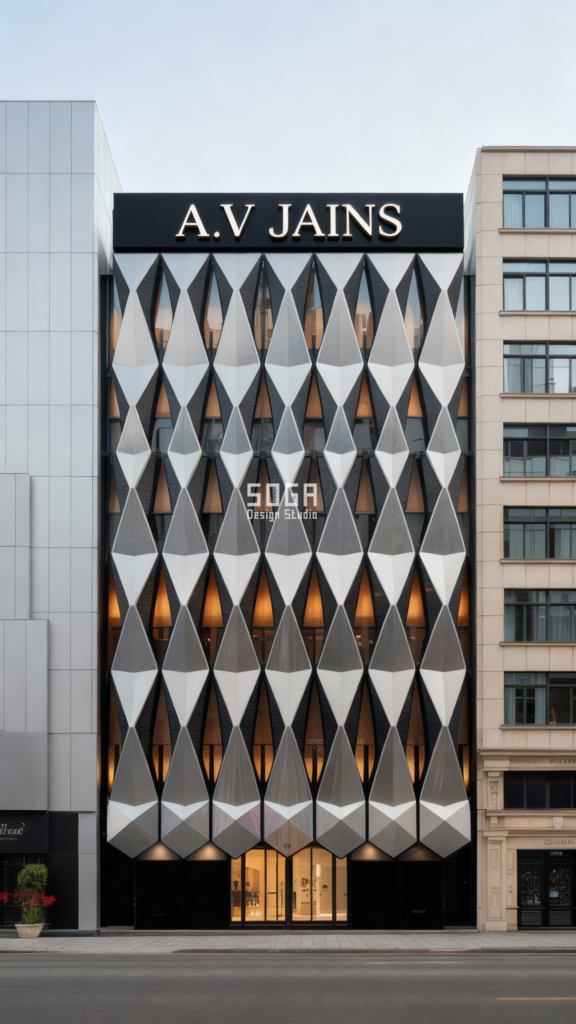
The studio that draws your facade and the company that builds it are two different appointments, and the second one decides what you actually get. A good drawing set fabricated badly produces a poor facade. A modest design fabricated well produces a decent one. Owners spend most of their attention on the first appointment and almost none on the second.
This page is about the second. Not who designs the elevation — that is a separate check, covered in how to tell whether a design firm can build what it shows — but who presses the metal, coats it, brings it to your street and fixes it to your building.
Nine red flags, the questions that reveal capability rather than confidence, what to look at on a workshop visit and a reference visit, and how to compare bids that are not comparable as written. Design studies shown are SOGA concepts.

Nine Red Flags
None of these is proof of a bad fabricator on its own. Two or more together, on a facade with any geometry in it, is a pattern worth acting on.
| # | Red flag | What it usually means |
|---|---|---|
| 1 | Quotes without asking for the drawings | Pricing an assumption; the variation claim is already forming |
| 2 | Cannot state a tolerance in millimetres | Has never been held to one |
| 3 | “We will manage the design also” when you already have a designer | Wants to redraw your facade into what its workshop finds easy |
| 4 | No shop drawings offered, or offered as an extra | Intends to fabricate from your general arrangement, which is not dimensioned for cutting |
| 5 | Will not name the coating applicator | Coating is often subcontracted; an unnamed applicator is an unmanaged risk |
| 6 | Refuses a reference site visit | The strongest single signal on this list |
| 7 | Quotes far below the others without a scope reason | Something is out of scope, and it is usually the substructure |
| 8 | No mention of a mockup or a first-article sample | Plans to discover problems during the production run |
| 9 | Wants full payment before delivery to site | Cash-flow risk transferred entirely to you |
Flag 7 deserves the most care because it feels like good news. A bid materially below the others is almost never better value — it is a different scope. The two items most commonly excluded are the substructure, which is the expensive half, and the coating, which is quietly downgraded from a factory-applied system to a site-sprayed one.
Flag 3 is the subtlest. A fabricator offering to handle the design too may genuinely be capable, or may be planning to substitute your detail for a standard one it already tools for. Ask directly whether the design would change, and what would change — the answer is usually honest when the question is specific.

The Questions That Reveal Capability
Confidence is easy to project and capability is not. These questions are hard to answer well without having done the work.
| Question | A good answer sounds like | A worrying answer |
|---|---|---|
| What tolerance do you hold on a folded panel? | A number, typically ±1.5 to ±3 mm, and how it is checked | “Very accurate” |
| What is your maximum fold length and press capacity? | A dimension and a tonnage, immediately | Vague, or has to ask someone |
| Who applies the coating, and where? | A named applicator and a named system | “We arrange it” |
| How do you keep one colour batch across the visible face? | Orders the whole face in one lot and records the batch | Has not considered batch variation |
| What do you do if the frame is out of tolerance? | Survey first, re-cut or adjust at the bracket | “We will adjust on site” with no method |
| How many shop drawing cycles do you expect? | One to three, and who does them | Does not produce shop drawings |
| What do you protect the panels with in transit? | Interleaving, edge protection, a stated film removal window | Nothing specific |
| Who does the installation — your crew or a subcontractor? | Either, but named, with supervision stated | Evasive |
The film removal question in row seven catches more real problems than it looks. Protective film left on coated panels through an Indian summer bakes onto the surface and can become almost impossible to remove without damaging the finish. A fabricator who volunteers a removal window before you raise it has been burned by this and learned from it.
Row five is the one that separates a fabricator from a supplier. Every frame is out of tolerance to some degree, and the correct answer involves the survey and the bracket rather than force. “We will adjust on site” with no method usually means packing, scribing or cutting, all of which stay visible.

What To Look At On A Workshop Visit
Half a day at the workshop tells you more than any brochure. You are not auditing machinery you do not understand — you are reading how the place is run.
Six things are visible to anyone.
- Is finished stock protected and separated from raw stock? Coated panels stacked against bare steel is a scratch waiting to happen, and it says how the delivery will arrive.
- Is there a marked inspection area? A dedicated bench for checking dimensions before dispatch means checking is a step, not an afterthought.
- Are parts labelled with part numbers? Panels stacked with no identification will be identified on your site instead, by guesswork.
- Is there a jig or a fixture for repeat units? Repeatability comes from tooling. A workshop making identical parts freehand will deliver parts that are nearly identical.
- Is the floor tidy? An unfashionable observation that correlates strongly with dimensional discipline.
- Ask to see a rejected part. A workshop with a reject bin has a standard. A workshop that produces no rejects either does not check or does not care.
The last one is the most revealing question you can ask, and it should be asked warmly rather than as a challenge. A good fabricator will show you a rejected part and explain what was wrong with it, often with some pride. The answer “we never have rejects” is not the reassurance it sounds like.
The Reference Visit: What To Actually Look At
Ask for a completed facade at least two years old, and go and see it. Recent work looks good regardless; two years in an Indian climate is where workmanship shows.
Look at the same places an experienced eye goes, none of which require technical knowledge.
| Where to look | What good looks like | What to worry about |
|---|---|---|
| Joint between two panels | Consistent width along the whole run | Tapering from one end to the other |
| External corner | Coherent, deliberate, same joint as elsewhere | Improvised mitre, packers visible |
| Under the parapet | A clean stop or a deep reveal | A cut half-unit filling the gap |
| Ground floor, at eye level | Same quality as the upper floors | Scratches, dents, mismatched replacements |
| Below every horizontal ledge | Even weathering | Dark streaks concentrated at fixings, suggesting rust |
| Fasteners | Consistent, aligned, no staining | Rust bleed, missing screws, mixed types |
Then find the owner and ask two questions: has anything needed replacing, and did the fabricator come back. The second answer is worth more than the first, because everything needs something eventually and what distinguishes a good supplier is whether they returned.
If a fabricator cannot produce a two-year-old reference in your region, that is not automatically disqualifying — new firms exist and some are excellent — but it shifts weight onto the mockup and onto a tighter payment schedule.
Comparing Bids That Are Not Comparable
Facade bids arrive in different shapes and the totals rarely describe the same work. The fix is the same one that works for design proposals: force a common scope before comparing anything.
Issue every bidder the identical drawing set and ask each to price against a fixed line list.
| Line to price separately | Why it must be separate |
|---|---|
| Substructure — brackets, framework, anchors | The most commonly excluded item, and the expensive half |
| Panel fabrication | The part everyone assumes the quote covers |
| Coating or finish, with the system named | Where a specification gets quietly downgraded |
| Installation and access equipment | Scaffold or platform cost varies enormously by site |
| Mockup | Should be priced, not assumed away |
| Spares, 8–10 per cent of clad area | Cheap now, unobtainable later |
| Transport and site storage | Damage in transit is a real line item |
| Warranty period and what it covers | A number and a scope, not a sentiment |
Once bids are on that structure, the differences become legible: one has excluded the substructure, another has priced a cheaper coating system, a third has assumed scaffold you were going to provide. None of that is dishonest — it is what happens when nobody fixed the line list first.
Where two bids remain close after that exercise, the tiebreakers worth using are the reference visit and the shop drawing quality, not the last few per cent of price. On a facade the difference between adequate and good fabrication shows on the street for thirty years, and it is a small fraction of the total build.
Capacity And Programme: Can They Actually Take Your Job?
A fabricator can be excellent and still be the wrong choice, because the workshop is already full. Capacity is the question nobody asks at the quotation stage and everybody discovers in month three.
Five questions settle it, and all five have factual answers.
| Question | Why it matters |
|---|---|
| What else is in the workshop during my production window? | A large commercial job running alongside yours will take priority |
| How many square metres a week can you actually turn out? | Divide your area by it. That is your production window, not their estimate |
| Is the coating line yours or a subcontractor’s queue? | An outsourced coater’s backlog is invisible on the fabricator’s schedule |
| What is your lead time on the raw material for this profile? | Material procurement often exceeds fabrication itself |
| Who is my point of contact when the owner is travelling? | One named person prevents the decision vacuum that stalls jobs |
The second row is the most useful number you can extract. A workshop that turns out 200 square metres a week and is quoting a 900 square metre facade is describing at least a five-week production run before coating, transport or installation — and if that does not match the programme you were given, the mismatch is worth raising before signing rather than after.
A fabricator who answers all five without defensiveness is one who has been held to a programme before. Vagueness here usually means the schedule was never really calculated.
Payment Terms That Protect Both Sides
Facade fabrication is material-heavy, so a fabricator genuinely needs money up front to buy metal. The mistake is not paying an advance — it is paying in a structure that leaves you with no leverage once the material is in their yard.
A workable structure for a house, in line with normal Indian trade practice:
| Stage | Typical share | What it buys |
|---|---|---|
| On order confirmation | 20–30 per cent | Raw material procurement |
| On approved shop drawings and material at works | 25–30 per cent | Proof the job has actually started |
| On mockup approval | 10 per cent | Ties a payment to a quality gate, not a date |
| On delivery to site | 20–25 per cent | Material is yours and on your plot |
| On completion of installation | 10–15 per cent | Finishing and snagging actually happen |
| Retention, released after the defects period | 5–10 per cent | The only thing that brings anyone back in month eleven |
The retention line is the one most often dropped on residential work, and it is the one that matters most. A defects liability period of twelve months with five to ten per cent held is standard on commercial work and entirely reasonable on a house. Without it, the incentive to return and fix a rattling clip in month nine is goodwill alone.
Tie the mockup payment to approval rather than to construction of the mockup. It is a small distinction that turns a quality gate into a commercial one, and it costs nothing to write.
The Installation Crew Is A Separate Question
A perfectly fabricated panel becomes a poor facade in the hands of an untrained crew, and installation is the part of the chain buyers see least before committing.
It is also frequently subcontracted, which is not a problem in itself — many good fabricators use specialist erection teams — but it should be a known fact rather than a discovery.
- Ask who installs, by name. Own crew or subcontractor, and who supervises them day to day.
- Ask how many facades this crew has installed, and of what type. A team that has only fitted flat ACP will struggle with a deep three-dimensional system.
- Ask about working at height certification and insurance. On a G+3 with rope or scaffold access this is a safety question before it is a quality one.
- Ask who sets out the substructure. The setting-out decides alignment for the whole facade, and it is the step most often handed to the least experienced person on site.
- Ask what happens to a panel damaged during installation. The honest answer names the spares stock; the worrying answer is silence.
Insist on inspecting the first installed bay before the crew continues, and make that an explicit hold point in the order. The first bay sets the standard every later bay is matched against, and it is far cheaper to correct one bay than fourteen — the sequence is set out in the elevation site checklist.
A Scoring Sheet For Three Fabricators
Once you have three bidders on a common scope, the decision tends to collapse into whoever felt most confident in the meeting. This is a way of resisting that.
Score each out of 5, then look at the spread rather than the total — a bidder scoring 5, 5, 5, 1 is riskier than one scoring 4, 4, 4, 4, because a single-digit weakness on a facade is usually the thing that goes wrong.
| Criterion | What a 5 looks like |
|---|---|
| Shop drawing quality | Dimensioned, part-numbered, returned within a stated cycle |
| Stated tolerance | A number in millimetres, with how it is checked |
| Coating chain | Named applicator, named system, single batch per face |
| Two-year-old reference | Visited, joints consistent, corner resolved, owner content |
| Workshop discipline | Jigs, marked inspection area, labelled parts, a reject bin |
| Capacity in your window | A weekly output figure that matches your area and programme |
| Installation crew | Named, experienced in this system, certified for height |
| Commercial terms | Milestones tied to gates, retention accepted |
Two practical notes on using it. Score immediately after each meeting rather than at the end of the week, because confidence fades faster than facts. And weight the reference visit and the shop drawings above everything else — those two are the hardest to fake and the most predictive of what arrives on your site.
If all three score poorly on the same criterion, that is usually a signal about your own documentation rather than about the market. Fabricators cannot state a tolerance against a drawing that does not carry one.
How SOGA Design Studio Works With Your Fabricator
We design facades; we do not fabricate them. That separation is deliberate, and it is worth explaining because it changes what we can do for you here.
Because we are not bidding for the fabrication, we have no interest in which fabricator you appoint beyond whether they can build the drawing. That is what lets us do the following:
- Define the capability required before anyone is invited — press capacity, fold length, coating system, tolerance, so the shortlist is drawn on the right basis.
- Issue one identical drawing set to every bidder, with a fixed line list, so the quotes you receive are actually comparable.
- Review the shop drawings of whoever you appoint, marked up and returned, for a stated number of cycles.
- Attend the mockup and judge it against the drawings rather than against expectations.
- Name the fabricators we have worked with in your state, and hand you a reference to call — without requiring you to use them.
Where a studio also fabricates, that independent check disappears, because the party checking the work and the party doing it are the same commercial interest. Design-and-build under one roof is a legitimate model with real advantages in coordination, and plenty of good facades are delivered that way. It simply means the quality audit has to come from somewhere else, and it is worth deciding consciously where that will be.
If you appoint a fabricator we have never worked with, that is entirely normal and usually right — the local relationship matters more than our familiarity. Our job is to make sure the drawings are unambiguous enough that an unfamiliar fabricator can still build them correctly.
The Honest Limit
Nine red flags and a workshop visit reduce risk. They do not eliminate it, and it would be wrong to suggest otherwise.
A fabricator with an excellent workshop can still put an inexperienced crew on your installation, and installation is where a well-made panel becomes a badly-fitted facade. Ask who installs and whether they are staff or subcontracted, but accept that this is the part of the chain you have least visibility into, and cover it with the first-bay inspection rather than with due diligence beforehand.
The second limit is about power. On a single house you are a small customer, and small customers do not get a fabricator’s best crew by asking nicely. What you can do is be an easy client to work for — complete drawings, decisions made on time, payments released on schedule — because that genuinely does change the attention a job receives. It is not leverage, but it is the closest thing to it available on a project this size.
Frequently Asked Questions
What are the biggest red flags when choosing a facade fabricator?
Quoting without asking for the drawings, being unable to state a tolerance in millimetres, refusing a reference site visit, not offering shop drawings, declining to name the coating applicator, and quoting far below the others without a scope reason. That last one feels like good news and rarely is — the two items most commonly excluded are the substructure, which is the expensive half, and the coating system.
What should I look for on a facade workshop visit?
Whether finished stock is protected and separated from raw stock, whether there is a marked inspection area, whether parts carry part numbers, whether repeat units are made on a jig, and general tidiness. Then ask to see a rejected part — a workshop with a reject bin has a standard, and “we never have rejects” is not the reassurance it sounds like.
How do I compare facade quotations that look completely different?
Issue every bidder the same drawing set and require pricing against a fixed line list: substructure, panel fabrication, named coating system, installation and access, mockup, spares at 8–10 per cent, transport, and the warranty period. The differences then become legible — one excluded the substructure, another priced a cheaper coating, a third assumed scaffold you were providing.
Is it better to use a fabricator who also designs?
Both models work. Design-and-build removes coordination risk and can be the right choice, but the party checking the work and the party doing it become the same commercial interest, so the independent quality check disappears. If you go that way, decide consciously where the audit comes from — often an independent review at shop-drawing and mockup stage.
How old should a fabricator’s reference project be?
At least two years. Recent work looks good regardless; two years in an Indian climate is where workmanship shows. Look at joint consistency along a run, the external corner, the stop under the parapet, the ground floor at eye level, and staining below fixings. Then ask the owner whether anything needed replacing and whether the fabricator came back — the second answer matters more.
Related Reading
- Parametric architecture in India 2026 — the future of facade design
- Can they actually build it? Vetting a parametric facade design firm
- Facade substructure and wind load: MS framework and anchoring
- The elevation mockup: build one bay before the whole face
- Elevation site checklist: what to inspect at each stage
- Anodising vs powder coating vs PVDF: which finish lasts in India
Get The Bids On One Scope Before You Compare Them
SOGA Design Studio defines the fabrication capability, issues one identical drawing set to every bidder, reviews the shop drawings and attends the mockup — without bidding for the fabrication ourselves. Talk to us about your facade.