We choose a facade finish by the manufacturing process behind it — PVD-coating, powder-coating, anodising, or a wood-grain transfer print — not by the colour it happens to produce. Walk into most facade conversations in India and the question on the table is still “what colour do you want”, as if champagne-gold and charcoal were two tins of paint rather than two different industrial processes with two different failure modes. Almost nobody specifying metal facades in India treats that distinction as load-bearing. We do, because it decides how the building ages, long after it stops being new in a photograph.
A facade finish is the surface treatment applied to the metal substrate of a parametric screen or cladding system — PVD coating, powder-coating, anodising, or a wood-grain transfer print — and it is chosen for glare control, maintenance and legibility against the sky, not for colour alone.
The right facade finish depends on what it has to survive, not taste. Light, reflective finishes — champagne-gold PVD, brushed silver anodised — cut glare and stay legible against a bright sky; dark matte finishes — charcoal, bronze — hide fingerprints and dust at touch height but need extra UV protection on a west-facing wall.
Paint Earns Its Flexibility Honestly
Paint earns that shortcut honestly. A painted wall in India costs roughly Rs 18-75 per sq ft depending on the brand, and a client who decides three years in that they hate the colour can have it repainted a different colour next week, for roughly the same money again. No PVD-coated, powder-coated, anodised or wood-grain-transfer finish on a metal facade can do that — once the pigment and the process leave the factory booth, the colour is fixed for the finish’s working life, not for a season. That is a real, legitimate advantage, and it is the reason “just pick a colour” survives as an instruction for a painted plaster wall. The mistake is carrying that same instruction over to a metal screen, where it stops being true the moment the panel leaves the coating line.
What Did Aranmula Kannadi Already Know About A Metal Finish?
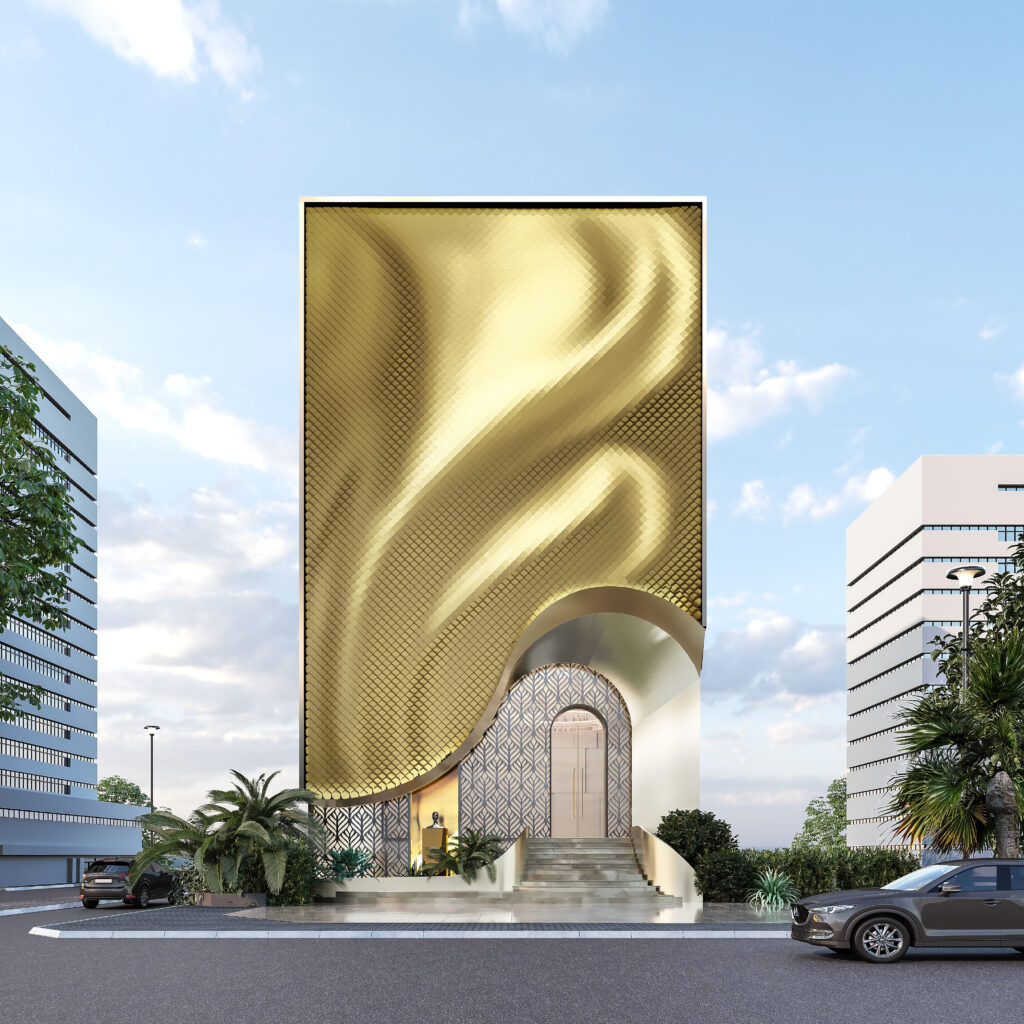
Aranmula Kannadi (ആറന്മുള കണ്ണാടി) is a handmade metal-alloy mirror made in Aranmula, Pathanamthitta district — the same state Kochi sits in. Its reflective surface is the polished bell-metal itself, a copper-tin alloy, not a glass sheet with a silvered backing. Because there is no glass layer in front of the reflective metal, the mirror throws one true image with none of the faint double-reflection an ordinary backed-glass mirror shows. Which polishing sequence and which exact alloy ratio produce that single clean reflection is a closely guarded, multi-generation family process — the entire value of the object sits in how the metal surface is finished, not in its shape or its frame. Kerala’s own craft tradition already treated a metal finish as a functional process with its own chemistry, not a colour chosen off a swatch, centuries before PVD coating or anodising existed. The S-Ribbon facade in Kochi, finished in champagne-gold PVD-coated stainless steel, is answering the same question today with a vacuum chamber instead of a hand-poured alloy — reflectivity as a property of process, not of paint.
The Rule: Spec The Process, Not The Colour
Spec the process, not the colour. PVD-coating, powder-coating, anodising and wood-grain transfer are four different industrial processes — different substrate preparation, different adhesion chemistry, different vacuum-chamber, electrochemical-bath or oven conditions, and four different failure modes: chalking, crazing, visible fingerprint-show, print-wear. Treating them as four swatches on a sample board means the orientation, the climate and the touch-height question that actually decide which one survives never get asked until the panels are already bolted up. Naming the process first — before the colour — is what forces that question onto the table while a change is still a line on a drawing, not a factory re-run.
Which Facade Finish Performs Best, By The Numbers?
Four processes cover nearly every coloured or textured metal finish used on an Indian facade today. PVD coating deposits a thin metallic film, roughly 0.3-1 micron, onto the metal inside a vacuum chamber — the route for gold, champagne, bronze and black-chrome tones on stainless steel. Powder-coating sprays a charged dry polymer and bakes it on at 180-200°C, the standard route for charcoal, bronze and most RAL colour-coded tones on aluminium. Anodising thickens aluminium’s own naturally occurring oxide layer electrochemically to roughly 15-25 microns, used for brushed, natural and lightly tinted tones that need to resist scratching through to bare metal. Wood-grain transfer printing sublimates a timber-pattern print into a baked polymer topcoat — the only one of the four that is really about texture rather than colour.
The five cities in this guide sit in three distinct climate zones, and each finish answers a different part of it. Kochi is coastal and humid, where salt-laden air attacks an untreated base metal faster than UV ever will. Bengaluru and Pune sit on the Deccan plateau, with strong, direct sun and a sharper day-night swing than the coast. Noida sits in the flat, dust-heavy north-plains belt, where overcast winter light is common and dust, not salt, is the real maintenance driver. Ahmedabad is hot and dry, where UV and surface heat gain dominate over humidity. A finish chosen for Kochi’s salt load is not automatically the right finish for Ahmedabad’s heat load, even when the colour looks identical in a sample photograph.
No public guide on Indian facade finishes puts a number on light versus dark, or on one coating process against another — paint guides quantify colour by colour, metal guides stop at “various finishes available.” Here is the comparison across the five systems in this guide, process by process.
On a parametric metal facade, light reflective finishes — champagne-gold PVD, brushed silver anodised — read clearly against a bright sky and control glare at apartment height. Matte dark finishes — charcoal, dark bronze — kill reflections off deeply sculpted panels and hide street-level fingerprints far better than a light tone.
| Finish / process (system) | Reflectance · cleaning interval · fade life · cost · best light |
|---|---|
| Champagne-gold PVD-coated stainless steel (Kochi, S-Ribbon Weave) | ~60-65% LRV · clean every 2-4 weeks at touch height · fade risk beyond 15-20 years with a stable topcoat · Rs 950-1,600/sq ft · best under golden hour and dusk light |
| Charcoal-anthracite powder-coated aluminium (Bengaluru, Carved Monolith Wrap) | ~8-12% LRV · clean every 6-10 weeks · fade risk in 5-8 years without a UV-stable topcoat, 15-20 years with one · Rs 450-750/sq ft · best under hard midday sun |
| Brushed natural-silver anodised aluminium (Noida, Louver Diagonal Reveal) | ~55-60% LRV · clean every 2-4 weeks · electrochemically stable, resists UV fade past 20 years · Rs 500-850/sq ft · best under flat overcast daylight |
| Dark bronze powder-coated aluminium (Pune, Faceted Diamond Lattice) | ~8-10% LRV · clean every 6-10 weeks · fade risk in 5-8 years without a UV-stable PVDF topcoat, 15-20 years with one · Rs 450-750/sq ft, plus topcoat premium · best at blue hour against a cobalt sky |
| Walnut wood-grain transfer-print aluminium (Ahmedabad, Monumental U-Frame) | ~20-25% LRV, mid-range and timber-like · clean every 4-6 weeks · zero refinishing across a 15-20 year life, versus 2-3 years for real timber · Rs 650-1,000/sq ft · best under soft, even overcast light |
What Actually Sets The Reflectance, Cleaning Interval And Fade Life?
Four relationships repeat across all five systems below, each tied to a real number, not a preference.
| Driver | What it sets, and to what |
|---|---|
| Visible-light reflectance (LRV) of the finish | surface heat gain in direct sun — roughly 8% LRV (matte charcoal, dark bronze) to roughly 65% LRV (champagne-gold PVD, brushed silver anodised), an 8x spread; metal-cladding building-science data commonly shows a 15-25°C surface-temperature gap between a dark matte panel and a light reflective one in the same hour of direct sun |
| Touch-height fingerprint and dust show, below roughly 2.1m | the cleaning interval needed to keep the finish presentable — roughly every 2-4 weeks for reflective PVD/anodised surfaces in dusty inland cities, versus every 6-10 weeks for matte dark powder-coat |
| UV exposure on a west-facing elevation | fade and chalking risk, and the topcoat spec required — a standard polyester powder-coat on a dark pigment visibly fades in roughly 5-8 years under full west sun, versus 15-20 years with a UV-stable PVDF topcoat |
| Refinishing cycle of a wood-look surface | how often the “wood” has to be redone — real exterior timber needs resealing every 2-3 years in monsoon-exposed Indian conditions, versus zero refinishing across a 15-20 year life for a wood-grain transfer print on aluminium |
Dark metal finishes on a west-facing facade carry more UV fade risk than light ones over a 10-15 year horizon; a powder-coated or PVD-coated finish on a west elevation should be specified with a UV-stable topcoat rather than a standard anodised layer. The sharpest version of this trade-off sits on the Pune corner system — a dark bronze powder-coated diamond-facet lattice on a west/south corner. The glare-and-heat driver argues for lightening the finish; the architectural read argues the opposite. The 3-to-24-degree facet-tilt gradient only reads as a countable gradient because the dark, saturated bronze throws a hard shadow inside each facet in direct sun — a light reflective finish on the same geometry washes those shadows out in daylight, and the tilt stops being legible at street distance. The facade stays dark; the heat and UV cost is managed, not avoided — paid down with a UV-stable PVDF topcoat, and by keeping the sharpest-tilted, most self-shaded facets off any habitable glazing line, rather than by lightening the finish and losing the move.
Five Facade Finish Options Across Five Indian Cities
These are five concept buildings, drawn to carry the finish argument city by city — not completed projects, but buildable to the numbers below. Each holds its plot, massing and opening pattern fixed and varies only the finish, the process behind it, and, on three of the five, one stated geometric driver.
Parametric S-Ribbon Weave
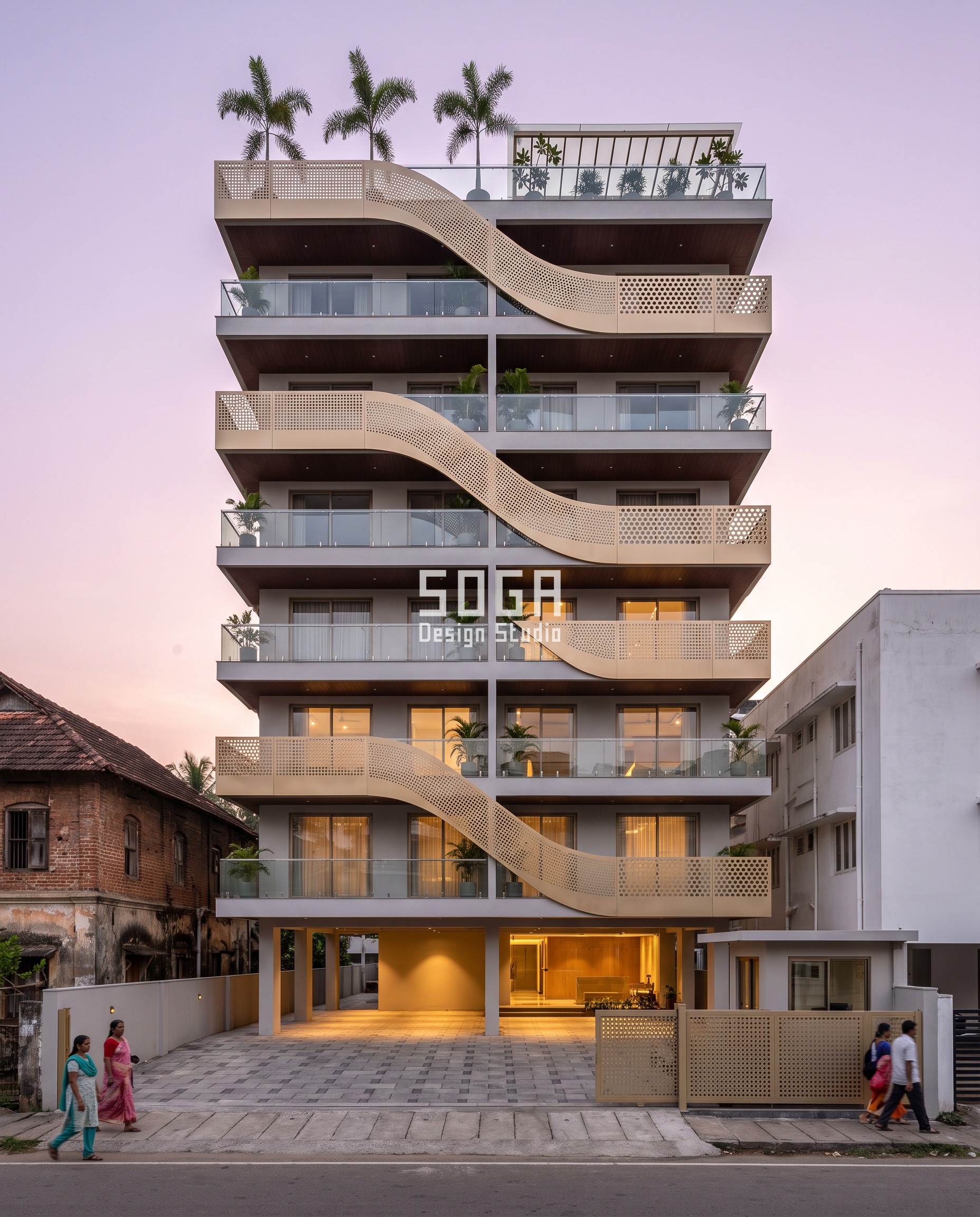
On this G+9 Kochi apartment, a 250mm-deep ribbon sweeps in a single S-curve down the balcony fronts, its perforation hole diameter grading 12mm at the fine end to 100mm at the fist-sized end, an 8x spread, the ribbon’s own width tapering 1,100mm to 400mm as it peels away from the slab edge and merges back into it. The finish is PVD-coated stainless steel — physical vapour deposition, where the metal sits in a vacuum chamber and a thin metallic film, roughly 0.3-1 micron thick, is deposited onto the surface under heat and an electric charge, producing the champagne-gold colour as a property of the film’s own thickness and composition rather than a pigment sitting on top of it. Kochi sits in a coastal, humid climate zone where salt-laden air accelerates corrosion on an untreated base metal faster than UV ever does, and a stainless substrate resists that corrosion in the base metal itself, independent of whatever sits on its surface. Against the sunset afterglow and lilac-pink sky this system was drawn in, the reflective gold reads clearly from the street rather than disappearing into shadow the way a matte dark finish would at the same hour. The reflectance that makes it legible at dusk is the same reflectance that shows a fingerprint at midday — a trade this finish accepts on a tower this tall, where legibility at distance matters more than close-up grooming.
| Specification | Parametric S-Ribbon Weave |
|---|---|
| Product | Parametric S-Ribbon Weave, champagne-gold PVD-coated stainless steel |
| Module | 250mm deep ribbon, width tapering 1,100mm to 400mm, perforation hole diameter 12mm to 100mm within it |
| What varies | perforation hole diameter — 12mm to 100mm, an 8x spread |
| Indicative rate | Rs 950-1,600/sq ft for the PVD-coated stainless system, installed, indicative, itemised per project |
Parametric Carved Monolith Wrap
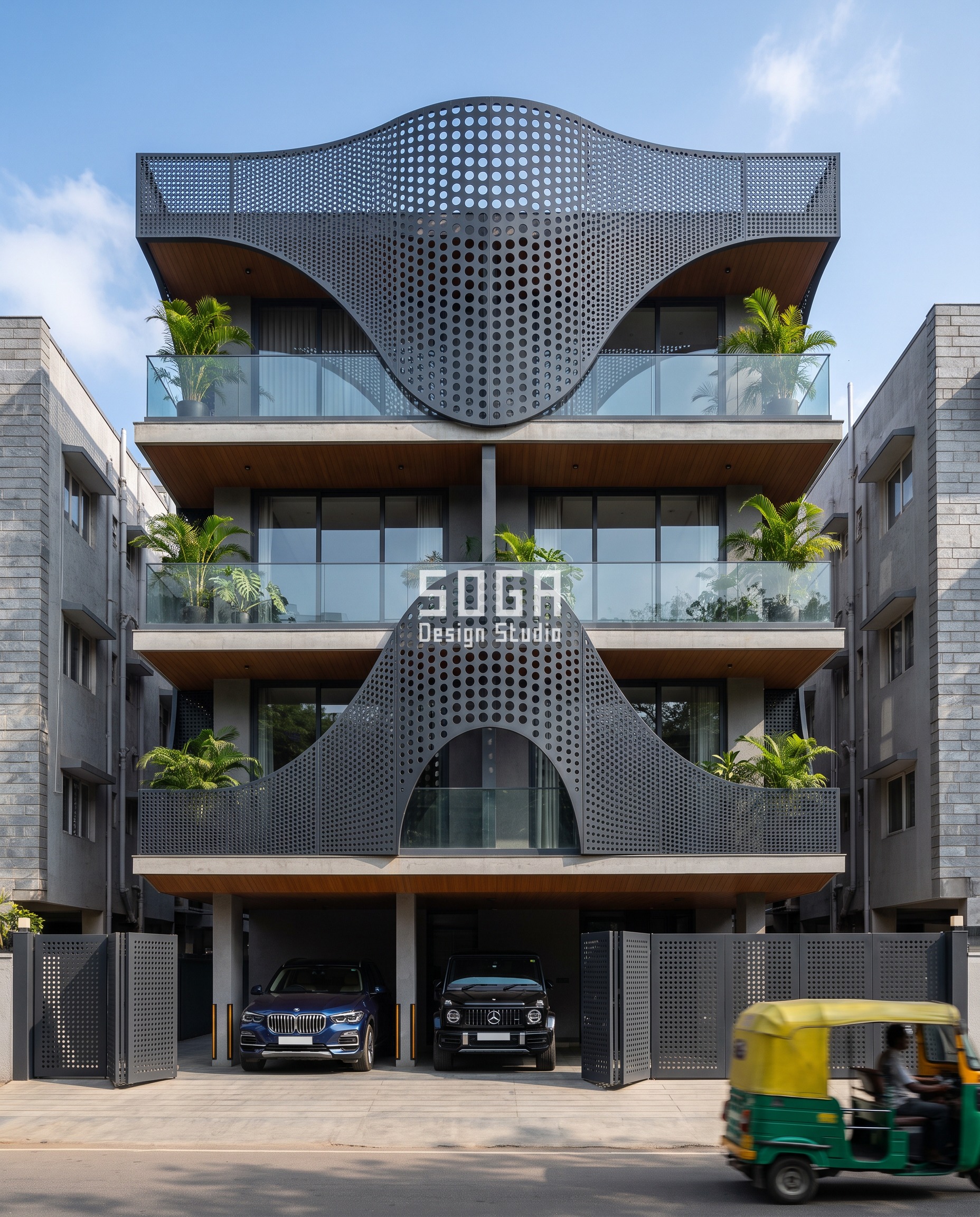
This Indiranagar builder floor wraps fluid, sculpted panels around the building in sweeping curves that meet at a crest, with an arch-shaped entrance cut into the base; the perforation hole diameter grades 8mm to 65mm, an 8x spread, across the wrap. The finish is powder-coated aluminium in charcoal-anthracite — a dry polymer powder, electrostatically charged and sprayed onto the panel, then baked in an oven at roughly 180-200°C until it melts and cures into a continuous film 60-120 microns thick, thicker and more chip-resistant than a typical wet paint coat. Bengaluru sits on the Deccan plateau, and its clear late-morning sun throws hard-edged shadows across a curved wrap like this one; a matte dark finish absorbs that light instead of bouncing it back as glare off every curve, the same reason a flat reflective finish on this much curvature would read as a confusing field of hot spots rather than one continuous sculptural form. Matte dark also does the quieter job of hiding the street-level fingerprinting and dust film a builder floor at this height actually collects, at the cost of a 6-10 week cleaning interval instead of 2-4, because dirt reads as a dull patch on a matte dark panel rather than a bright contrast change.
| Specification | Parametric Carved Monolith Wrap |
|---|---|
| Product | Parametric Carved Monolith Wrap, charcoal-anthracite powder-coated aluminium |
| Module | sculpted wrap panel on a continuous curved sub-frame, perforation hole diameter 8mm to 65mm within it |
| What varies | perforation hole diameter — 8mm to 65mm, an 8x spread |
| Indicative rate | Rs 450-750/sq ft for the powder-coated aluminium system, installed, indicative, itemised per project |
Parametric Louver Diagonal Reveal
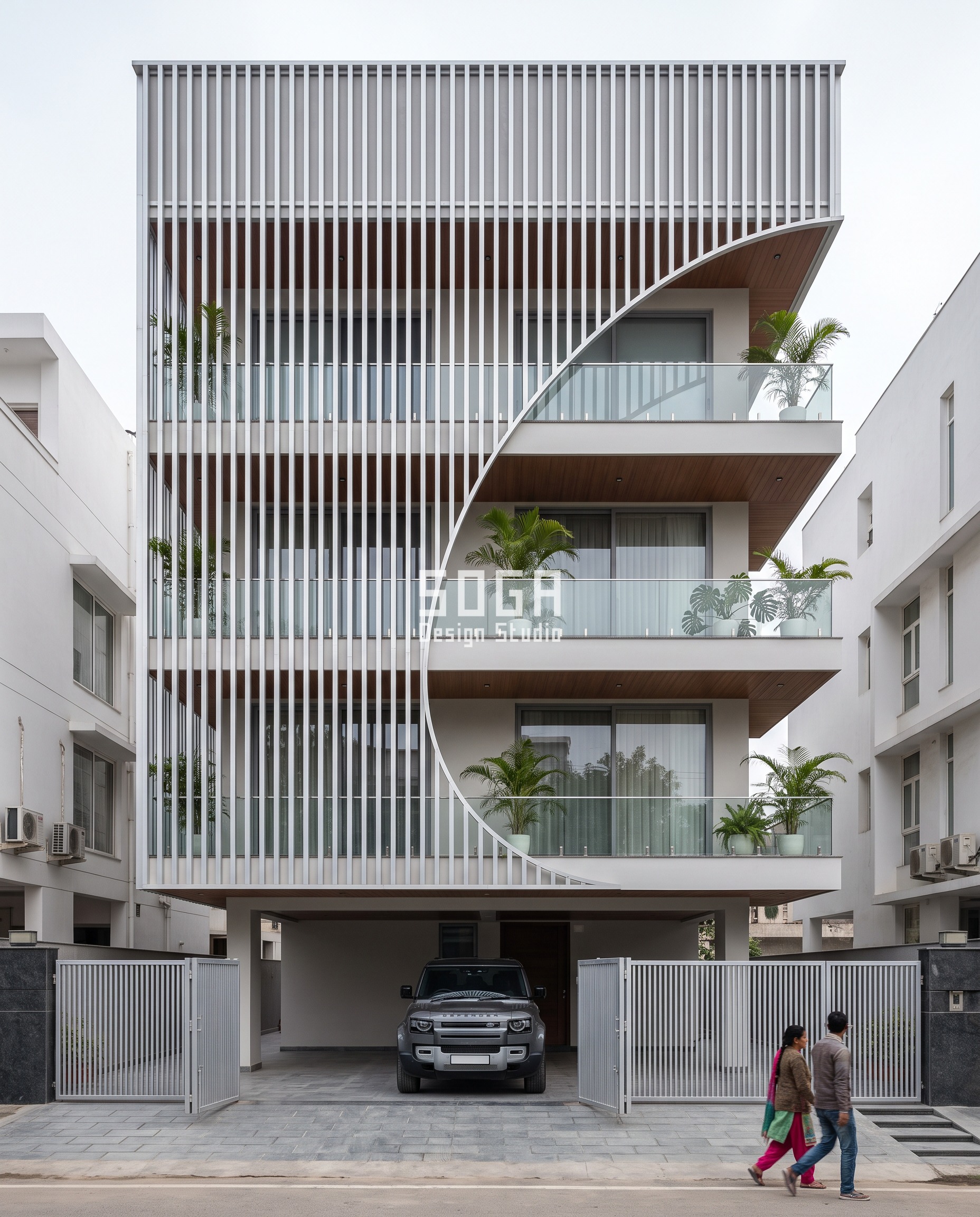
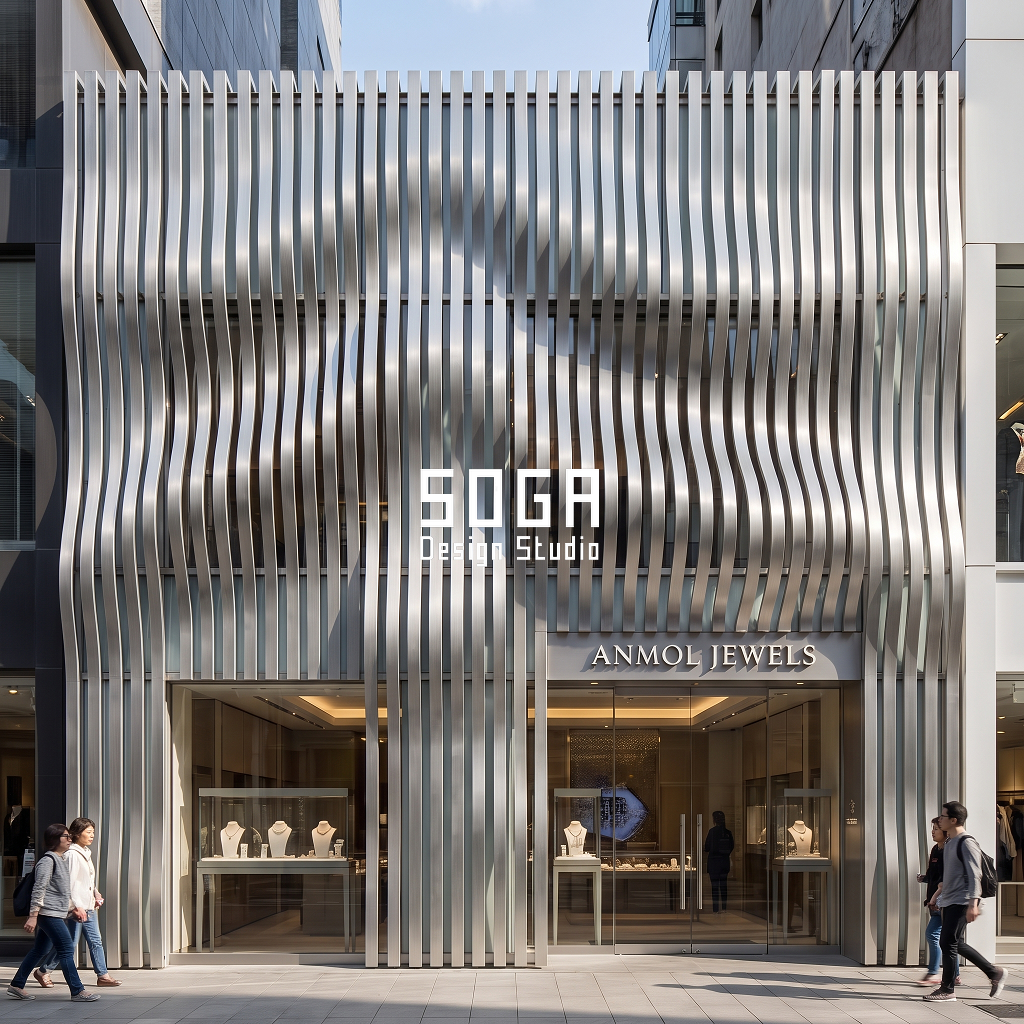
On this Noida builder floor, a vertical louver screen of 50mm x 150mm aluminium fins at 110mm centres is governed by one diagonal S-curve crossing three floors — fins above the curve run full height, fins below stop exactly on the curve, producing a sweeping diagonal reveal rather than a numeric gradient. The finish is anodised aluminium in brushed natural silver — an electrochemical process, not a coating applied on top of the metal: the aluminium is submerged in an acid electrolyte bath and an electric current passed through it, thickening the metal’s own naturally occurring oxide layer to roughly 15-25 microns, which is then sealed. Because the finish is the metal’s own oxide rather than a separate film, anodising cannot chip or peel the way a powder coat can, though it can scratch through to bare metal if struck hard enough. Noida sits in the flat, dust-heavy north-plains belt, and the overcast daylight this system was drawn in reads a neutral silver as crisp, legible metal rather than shifting it warm or cold the way a strongly coloured sky would — which is exactly why the diagonal threshold line stays sharp and countable here instead of dissolving into the sky behind it.
| Specification | Parametric Louver Diagonal Reveal |
|---|---|
| Product | Parametric Louver Diagonal Reveal, brushed natural-silver anodised aluminium |
| Module | 50mm x 150mm aluminium louver fins at 110mm centres, full height above the diagonal threshold curve |
| What varies | louver run-length relative to the diagonal threshold curve — a threshold gesture, not a numeric gradient |
| Indicative rate | Rs 500-850/sq ft for the anodised aluminium system, installed, indicative, itemised per project |
Parametric Faceted Diamond Lattice
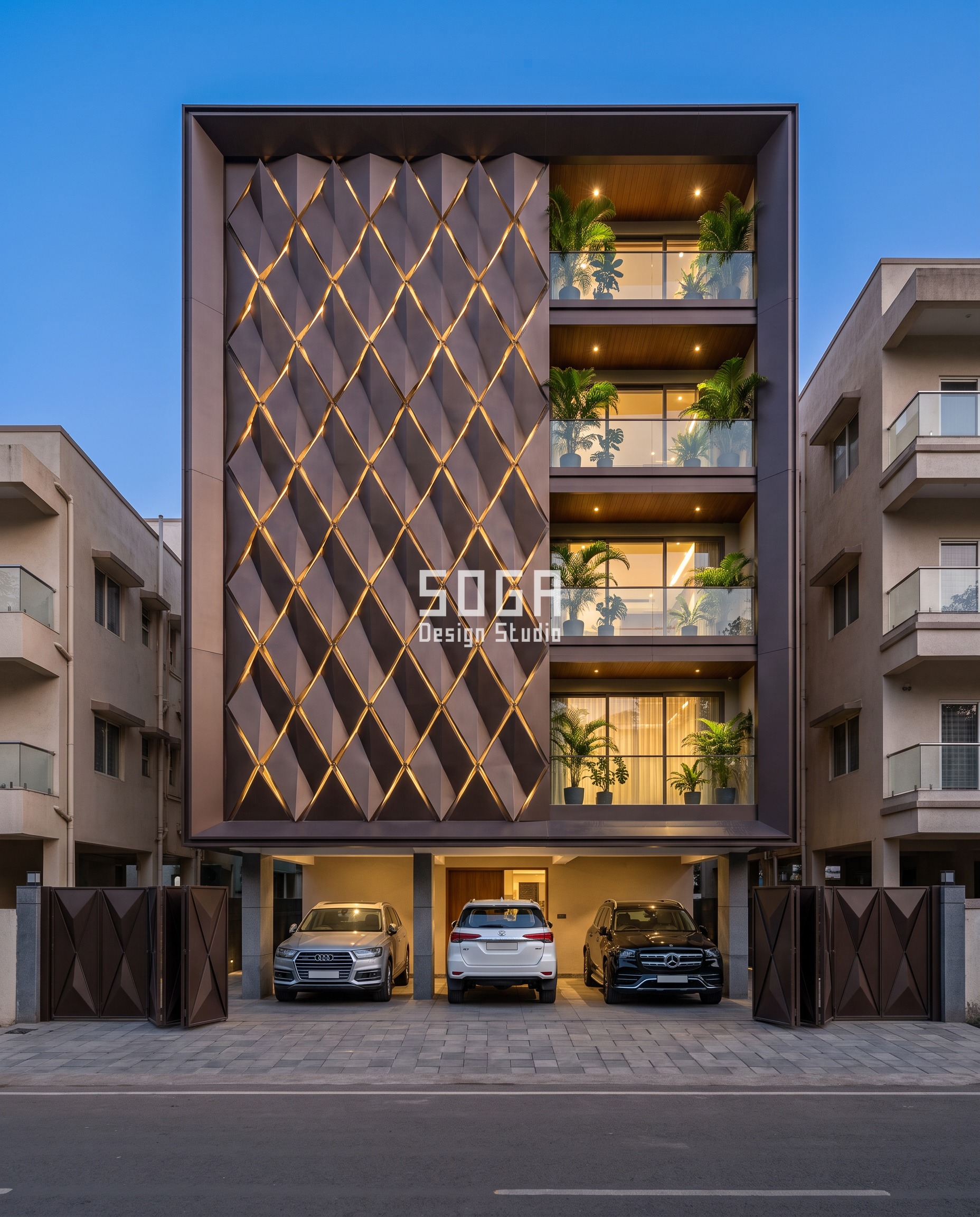
This Pune corner residence runs diamond-quilted folded-plate panels with glowing warm LED joints across the whole front in a crisscross lattice, framed by an 800mm-deep outer border; the facet tilt grades 3 degrees at the near-flush end to 24 degrees at the sharply proud end, an 8x spread. The finish is dark bronze powder-coated aluminium with a satin metallic sheen — the same oven-cured polymer process as the charcoal finish in Bengaluru, formulated here with a metallic pigment and, because this corner faces west and south on the Deccan plateau, specified with a UV-stable PVDF topcoat rather than a standard polyester coat, pushing the visible-fade horizon from roughly 5-8 years out to 15-20. At blue hour, against a cobalt sky with a warm 2,700K interior glow behind the glazing, the dark saturated bronze lets the hidden LED grazing light do the contrast work instead of fighting a light-coloured panel for attention — the facet-tilt gradient reads as a countable sequence of shadow and highlight precisely because the base finish is dark enough to hold a shadow in the first place.
| Specification | Parametric Faceted Diamond Lattice |
|---|---|
| Product | Parametric Faceted Diamond Lattice, dark bronze powder-coated aluminium |
| Module | diamond-quilted folded facet panel, 800mm deep outer border, facet tilt 3 to 24 degrees |
| What varies | facet tilt angle — 3 to 24 degrees, an 8x spread |
| Indicative rate | Rs 450-750/sq ft base powder-coat, plus a UV-stable PVDF topcoat premium for this west-facing corner, installed, indicative, itemised per project |
Parametric Monumental U-Frame
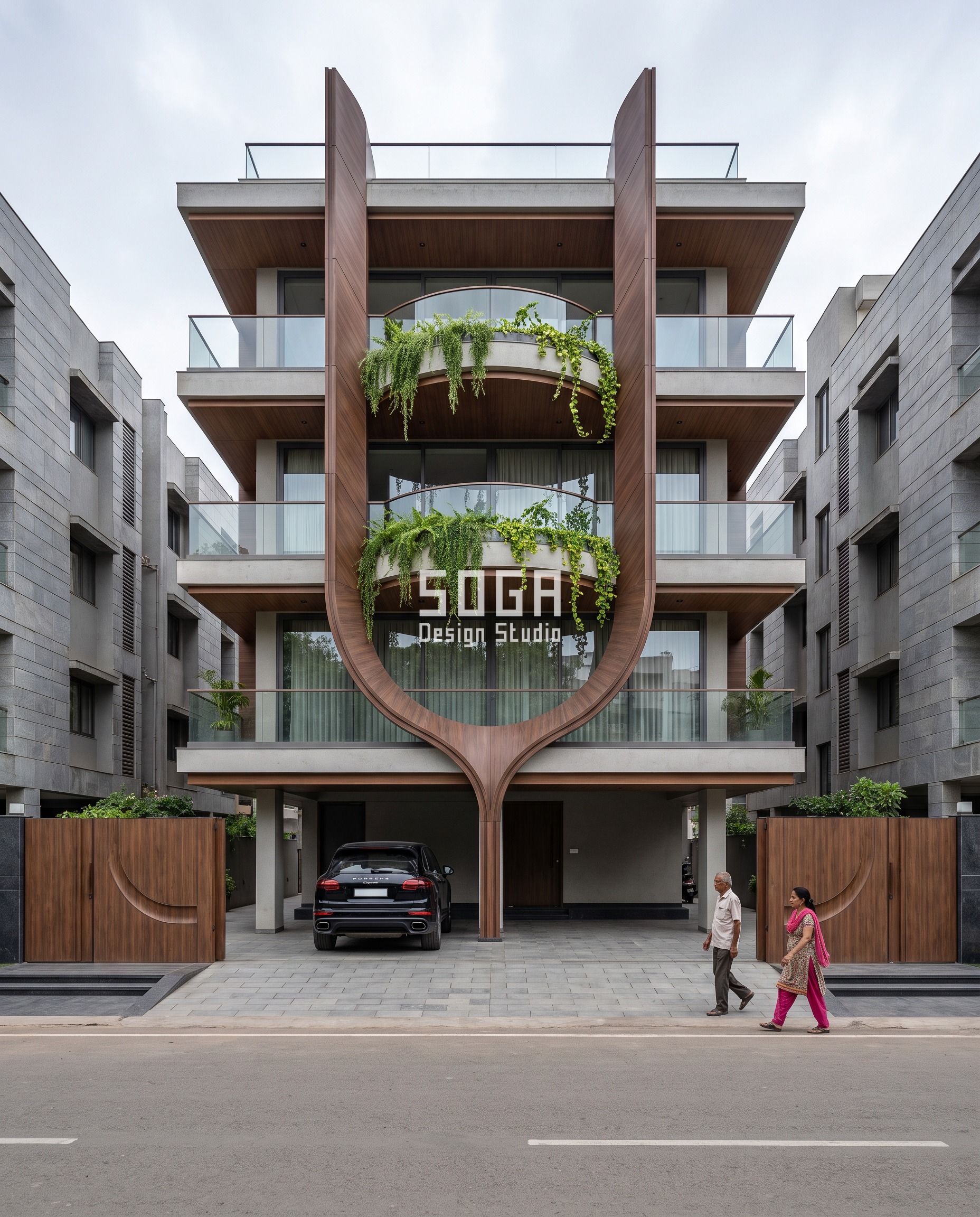
On this Ahmedabad builder floor, a single monumental U-shaped frame grows from one slender root at the ground and splits into two leaf-like arms rising past the parapet, framing stacked curved garden balconies — one sculptural gesture, not a repeated-module sweep, so there is no stated numeric driver here the way there is on three of the other four systems. The finish is wood-grain transfer-print aluminium in dark walnut — a sublimation process where a printed timber-grain pattern is heat-transferred into a polymer topcoat baked onto the aluminium at roughly 180-200°C, the same oven temperature range as a powder coat, fusing the print into the surface rather than sitting on top of it as ink. Ahmedabad is hot and dry, and real exterior timber is punished by that heat, needing resealing every 2-3 years to survive it; the transfer-printed aluminium needs none, because the pattern cannot absorb moisture, swell or grey the way organic wood does. A single sculptural gesture this large, with no stated gradient to carry visual interest on its own, needs a warm, textured-looking finish to hold the whole facade on form alone under Ahmedabad’s soft, even overcast light — a flat metallic colour here would read thin.
| Specification | Parametric Monumental U-Frame |
|---|---|
| Product | Parametric Monumental U-Frame, walnut wood-grain transfer-print aluminium |
| Module | single monumental U-shaped frame, one root at grade splitting into two arms past the parapet |
| What varies | n/a — a single sculptural gesture, not a repeated-module sweep |
| Indicative rate | Rs 650-1,000/sq ft for the wood-grain transfer-print aluminium system, installed, indicative, itemised per project |
How Every Finish Is Actually Fixed To The Building
Whatever the finish, the physical unit behind all five systems is the same: a 450mm x 1,800mm flat, perforated or faceted aluminium or stainless panel, repeating across the elevation. Only the surface treatment, and on three of the five systems one stated numeric driver, changes from panel to panel. A site crew does not install four different systems; it installs one panel-and-cleat system five times, finished differently each time before it ever reaches site. The finish decides the colour and the maintenance; the fixing underneath it decides whether the finish survives long enough for either to matter.
| Design parameter | Specification |
|---|---|
| Panel module | 450mm x 1,800mm flat, perforated or faceted aluminium or stainless panel |
| Fixing | concealed stainless-steel cleats bolted to a secondary aluminium sub-frame |
| Isolation | nylon or EPDM isolation washer at every fixing point, stopping galvanic bleed-through |
| Movement joint | 8-10mm open joint with backer rod at every panel edge, sized for aluminium’s roughly 2.3mm-per-metre movement over a 50°C day-night swing |
The Two Details That Decide Whether The Finish Survives
- A PVD or anodised layer is only a few microns thick, so direct contact between the panel and a dissimilar fastener — mild steel into aluminium, for instance — sets up galvanic corrosion that bleeds a rust stain through the thin finish within two to three years if the isolation washer is left out.
- Coatings and prints are most likely to chip or craze right at a tight, unmoving edge, so every panel is set with an 8-10mm open joint and a backer rod sized for aluminium’s own thermal movement, drawing the joint to move before the finish has to.
The Honest Limit
None of these four processes can be touched up by hand on site. A scratched or chipped PVD, anodised or powder-coated panel cannot be spot-repaired invisibly — each depends on a controlled vacuum chamber, electrochemical bath or oven that a site brush cannot reproduce, so the fix is pulling the whole panel and sending it back to the factory booth, not rolling on a matching colour. A wood-grain transfer panel is no better off: the print layer cannot be patched without leaving a visible line. Paint can be touched up in an afternoon for the cost of a tin; these four processes cannot, and that cost should be priced into the decision before approval, not discovered at the first scratch three years in. It is also the line most facade budgets underestimate, ours included, because a sample panel in a showroom never shows what a scratch actually looks like in year four.
What Does Each Facade Finish Cost Per Square Foot In India?
Cost follows the process, not the colour. A dark bronze and a dark charcoal finish on the same powder-coat line cost close to the same per sq ft, while a PVD-coated finish costs more than either regardless of colour, because the process itself is more expensive to run and control. Every rate below is indicative and itemised per project, never a flat figure carried over from an unrelated job.
| System / material | Indicative rate (per sq ft) |
|---|---|
| Champagne-gold PVD-coated stainless steel | Rs 950-1,600 per sq ft, installed (indicative, itemised per project) |
| Charcoal / dark bronze powder-coated aluminium | Rs 450-750 per sq ft, installed (indicative, itemised per project) |
| Brushed natural-silver anodised aluminium | Rs 500-850 per sq ft, installed (indicative, itemised per project) |
| Walnut wood-grain transfer-print aluminium | Rs 650-1,000 per sq ft, installed (indicative, itemised per project) |
Related Reading
- parametric facade design in India
- the complete facade and elevation design FAQ guide
- anodising vs powder coating vs PVDF, which lasts in India
- elevation colour combination ideas across four Indian cities
- what a parametric facade actually costs to maintain over 20 years
Frequently Asked Questions
Which facade finish lasts longest against Indian sun and monsoon?
A PVD-coated or anodised light finish resists UV fade well on its own, typically past 15-20 years. A dark powder-coated finish needs a UV-stable PVDF topcoat to reach that same 15-20 year horizon, versus roughly 5-8 years with a standard polyester coat on a west-facing wall.
How much does a facade finish cost per square foot in India?
Indicative installed rates run roughly Rs 450-750 per sq ft for powder-coated aluminium, Rs 500-850 for anodised aluminium, Rs 650-1,000 for wood-grain transfer-print aluminium, and Rs 950-1,600 for PVD-coated stainless steel, itemised per project.
How often does a metal facade finish need cleaning?
A reflective PVD-coated or anodised finish needs cleaning roughly every 2-4 weeks at touch height in a dusty inland city to stay fingerprint-free, while a matte dark powder-coated finish can usually go 6-10 weeks before dirt reads as visibly dirty.
Can a scratched or chipped facade finish be touched up on site?
No. All four of these finishing processes are applied in a vacuum chamber, an electrochemical bath, or an oven, so a scratched panel has to be pulled and refinished at the factory, not patched on site, unlike paint, which can be touched up in an afternoon for the cost of a tin.
Is wood-grain transfer-print aluminium as durable as real timber cladding?
It outlasts real timber on upkeep: a wood-grain transfer-print aluminium panel needs zero refinishing across a 15-20 year life, while real exterior timber in monsoon-exposed Indian conditions typically needs resealing every 2-3 years.
Start Your Project
If a facade finish is still an open colour-swatch decision on your project, SOGA Design Studio specifies the process first — PVD, powder-coat, anodising or wood-grain transfer — against your building’s orientation, climate and touch height, then fixes the colour inside that choice. Share your city, elevation and finish preference, and we will size the process to the building.