Walk down a Worli lane in 2026 and one G+5 stops you cold: a wall of slim, pointed-arch openings in deep-rust Corten steel, the midday sun carving crisp shadows across it while the flats behind stay cool and private. It does not look painted on or pasted from a render — it looks built, seamed and fixed like real metal. That is the shift happening across Indian cities right now: facade design in Mumbai and beyond is moving from flat paint and basic cladding to parametric metal screens that are tuned, panel by panel, to a plot’s exact sun, street and privacy problem. This guide walks through four such concepts — one for Mumbai and three from other Indian cities — and the honest 2026 numbers behind them.
Facade Design in India: Why Mumbai Is Choosing Parametric Metal
Facade design in India has moved from an afterthought to the single most important decision on a residential project. Today, demand for parametric facade design in India is rising fastest in cities such as Mumbai, Mumbai, Bangalore, Delhi, and Pune, where homeowners and developers want elevations that are both performance-driven and instantly recognisable. SOGA Design Studio specialises in facade design in India — from G+3 individual homes to G+7 residential blocks — pairing algorithmic geometry with matte raw corten steel in deep rust to and fabrication-ready detailing. Whether you are comparing metal facade design in India for a new build or a retrofit, the concepts below show how a considered facade redefines a building’s identity and its long-term value.
1. Mumbai Parametric Arch Screen: Corten Steel Facade Concept
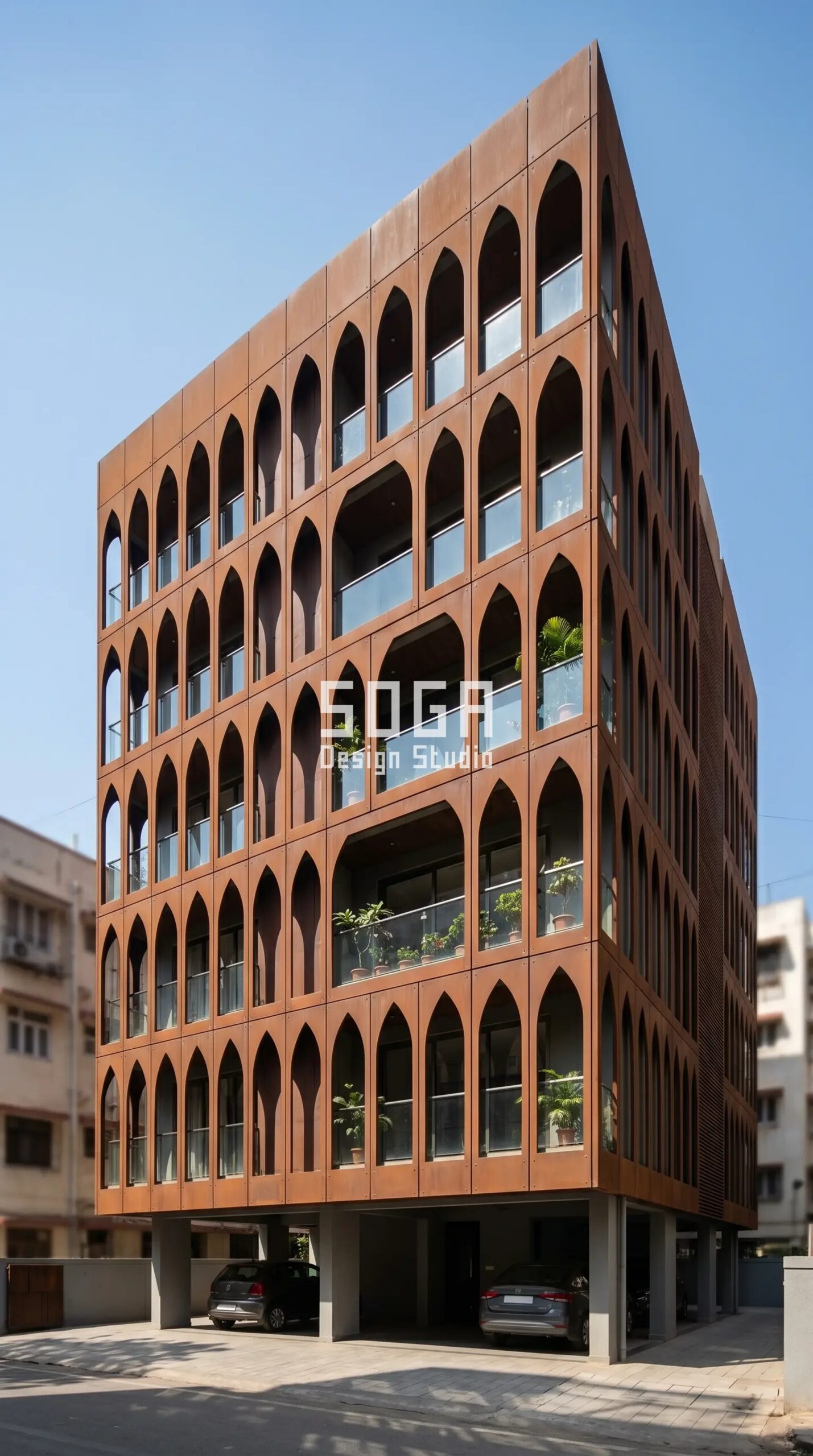
Mumbai’s problem is a familiar one: a narrow plot on a busy lane, strong west light, and neighbours close enough to see straight in. This G+5 concept answers it with a full-height Parametric Arch Screen of slim pointed-arch openings in raw Corten steel, deep rust in tone and matte in finish. The arch rhythm lets light and air through while the depth of each opening throws the harsh afternoon sun into shadow, so interiors stay bright but never glaring. From the street the screen reads as one confident, ordered surface; from inside, the arches frame the city without exposing the rooms. The Corten’s warm rust also shrugs off Mumbai’s salt-heavy monsoon air far better than a painted wall that streaks within two seasons. It is privacy, shade and identity solved in a single skin.
2. Dehradun Parametric Diagonal Pulse: Angular Metal Panel Facade
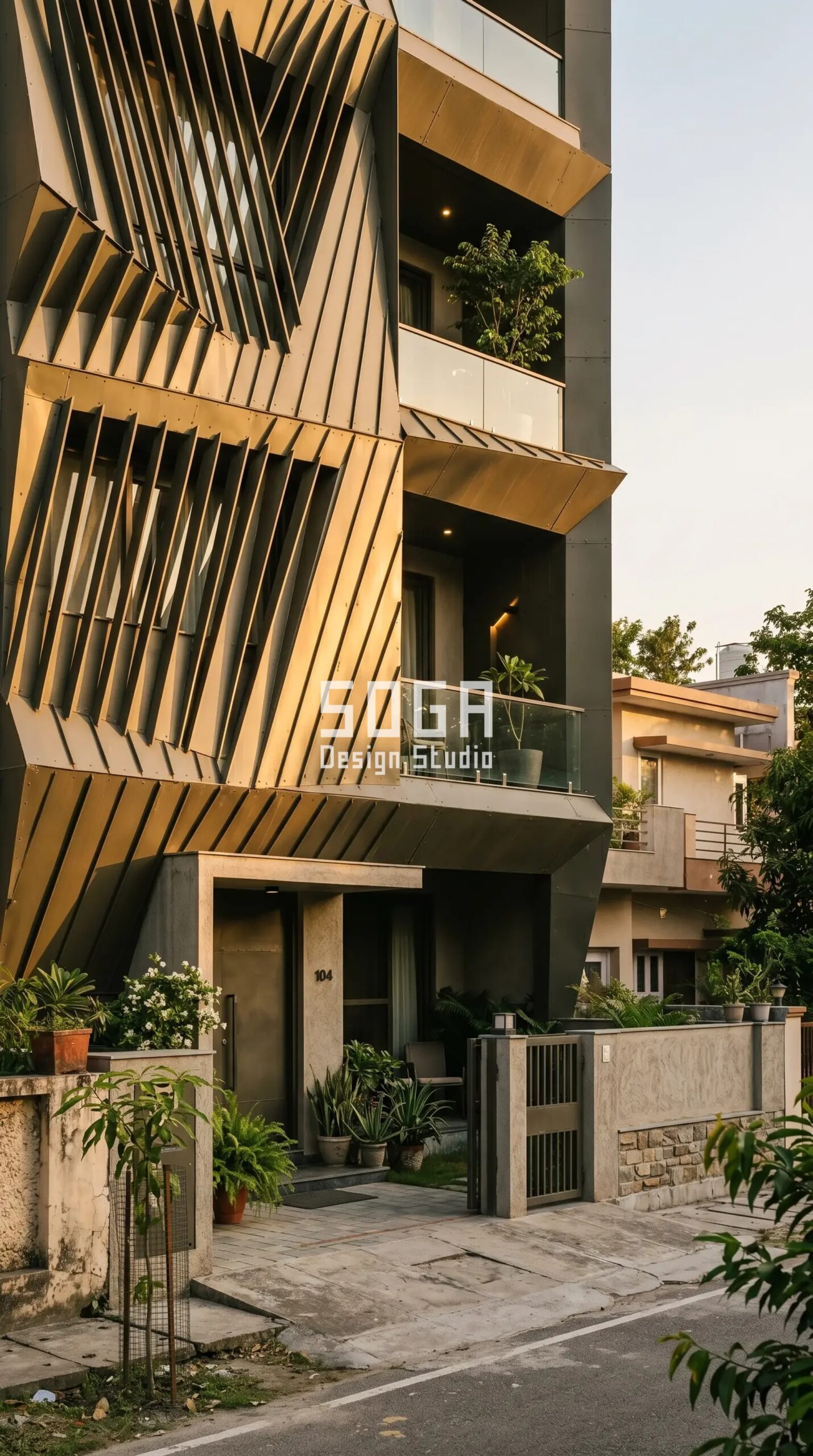
Dehradun sits lower and calmer, so this G+4 leans into a quieter, more sculptural move: a Parametric Diagonal Pulse of slash-cut metal panels in matte powder-coated RAL 6008 brown-green that settles the building into its leafy street. The panel angle and density shift gradually across the elevation, opening up where the lower floors need shade from low, raking afternoon light and tightening where privacy matters most. Angular overhangs catch that golden hill-town light and turn the facade into a slow play of light and shadow through the day. The earthy brown-green is chosen to sit with Dehradun’s greenery rather than fight it. Against modest neighbouring houses, the building looks considered, not loud. This is how a small-plot home earns a distinct identity without shouting for it.
3. Chennai Parametric Skyline Screen: Patinated Copper Facade
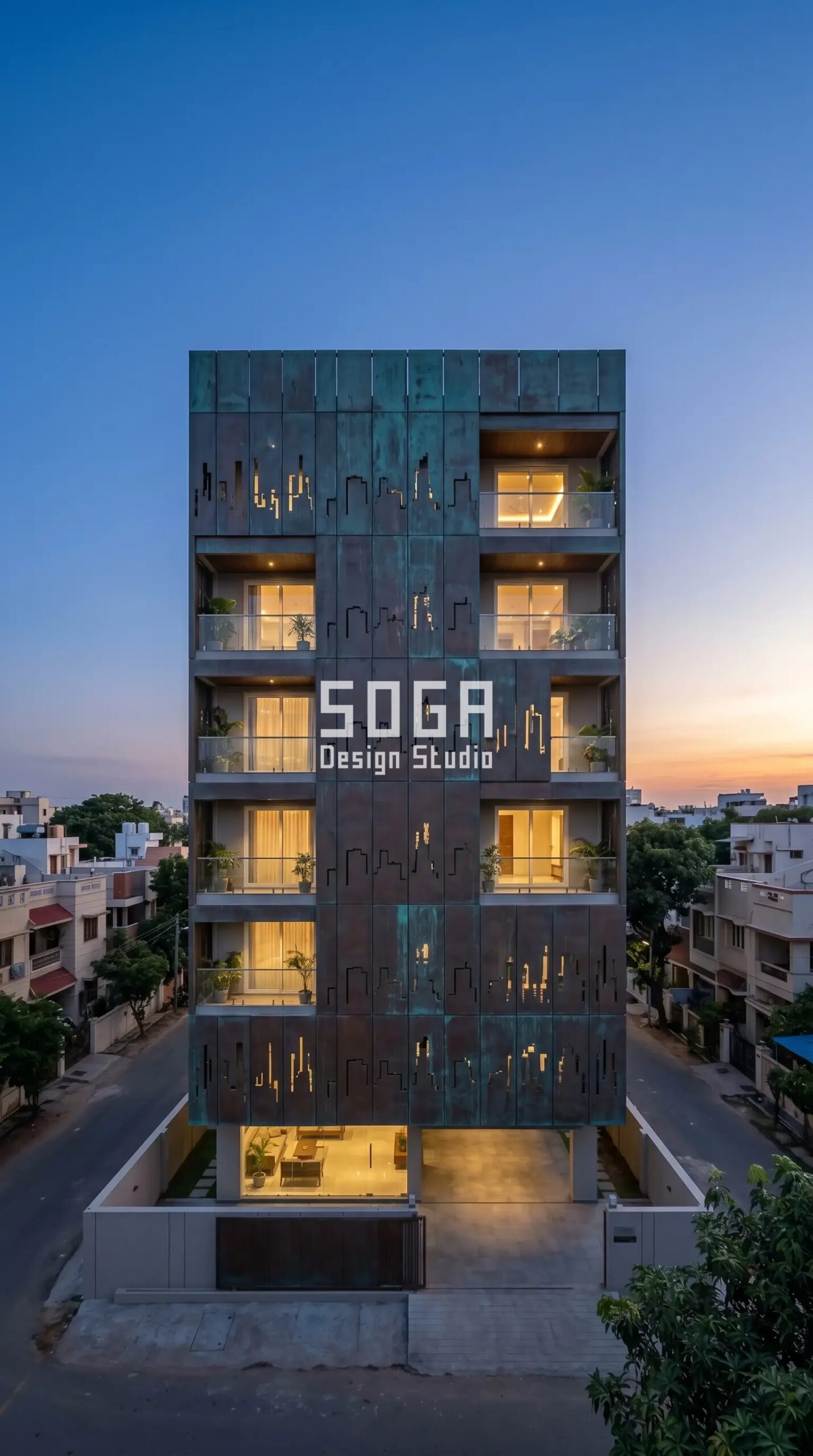
Chennai brings heat, humidity and salt air, plus a desire for an evening identity that glows. This G+5 wears a Parametric Skyline Screen — an abstract city-skyline silhouette laser-cut into large panels of oxidized patinated copper, its green-flecked verdigris reading as both contemporary and rooted. By day the screen shades the glass behind it and cuts solar gain on Chennai’s relentless afternoons; by blue-hour twilight, warm interior light spills through the cut-outs and the whole facade becomes a soft lantern over the street. The ground floor opens into a glass lobby behind a low compound wall, keeping the entrance welcoming but defined. Patinated copper is one of the few metals that actually improves in coastal humidity, ageing gracefully where painted surfaces fail. The result is a home that earns a second look after dark.
4. Bangalore Parametric Wave Shell: Slate-Grey Steel Facade
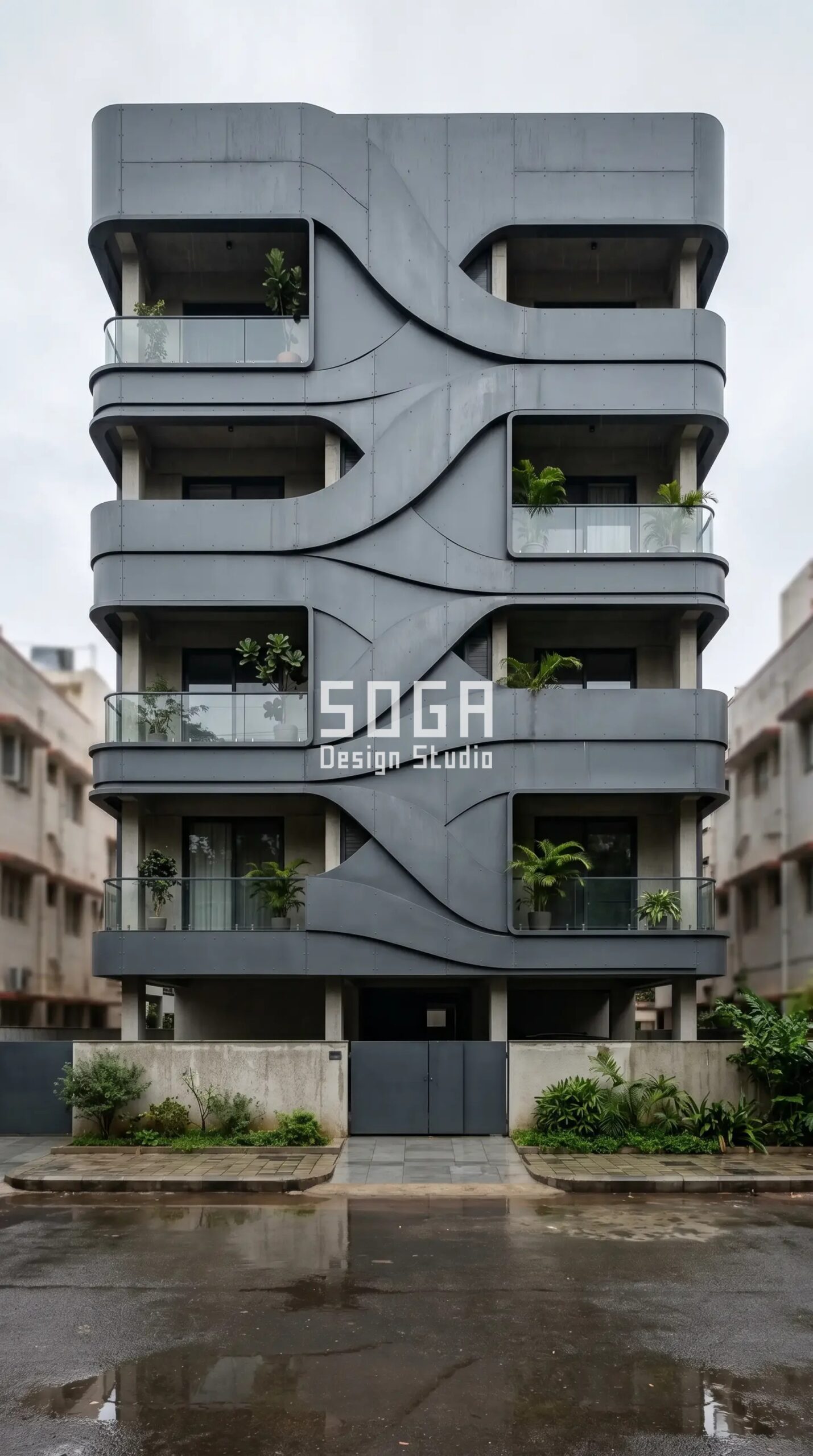
Bangalore’s mild, rain-washed climate invites softer geometry, so this G+5 takes a Parametric Wave Shell: large powder-coated panels in matte RAL 7015 slate grey, layered to wrap each floor plate in a slow rolling relief. The curves do real work — they deepen the balconies into shaded outdoor rooms for a city that lives half-outdoors, and they shed the frequent monsoon rain cleanly off the recessed glass behind. Seen straight-on after a shower, the wet street mirrors the grey waves and the building reads calm and grounded. The flowing form also disguises an ordinary rectangular plot, giving a modest footprint real presence. Slate grey keeps it timeless against Bangalore’s green backdrop. It is proof that parametric does not have to mean spiky — sometimes the smartest move is a quiet wave.
Cost Benchmarks for Indian Parametric Metal Facades
One of the most-asked questions on a Mumbai project brief is budget. The current all-in installed rates for parametric metal facades in India sit in the following ranges:
- Steel facade (full design + install): ₹1,200–₹2,800 per sq ft
- Aluminium, anodised or powder-coated: ₹800–₹2,500 per sq ft
- Zinc cladding: ₹1,500–₹3,000 per sq ft
- ACM panels (3 mm basic): ₹200–₹250 per sq ft (basic)
- ACM panels (4 mm): ₹250–₹350 per sq ft
- Solid aluminium panels: ₹800–₹1,800 per sq ft
- Installation labour: ₹50–₹150 per sq ft (varies by height + access)
- Conventional cladding (for comparison): ₹400–₹1,200 per sq ft installed (stone veneer / ceramic / standard ACM)
These figures are baseline; actual project cost depends on facade area, panel complexity, fabricator location, and finish specification. SOGA Design Studio prepares an itemised cost estimate as part of every consultation so the budget conversation starts with hard numbers rather than guesses.
Parametric Facade Design Across India, Dubai & Singapore
Climate is the unspoken brief on every Indian project. Mumbai, with its specific solar geometry and humidity profile, demands facades that perform — not just facades that look striking. At SOGA Design Studio, every parametric concept is run through climate analysis early: solar radiation per orientation, wind exposure, and monsoon water-shedding paths all feed back into panel angle and perforation density. The concepts you see above already incorporate this layer of analysis for Mumbai’s sun path; adapting them for Mumbai’s rain, Delhi’s dust, or Bangalore’s milder conditions is part of the standard scope.
Why Trust SOGA Design Studio for Facade Design in Mumbai
- Experience: SOGA Design Studio has designed and visualised parametric metal facades for real Indian G+3 to G+7 plots across Mumbai, Chennai, Bangalore and the hill towns, running a daily facade study series since 2023 to pressure-test geometry, climate response and buildability.
- Expertise: Each concept is built on SOGA’s parametric systems — arch screens, diagonal pulse panels, skyline screens and wave shells — with per-orientation solar analysis and fabrication-ready detailing in Corten, powder-coated aluminium and steel, anodised metal and patinated copper.
- Authority: SOGA positions as India’s facade design specialists, pairing computational design with a vetted network of Indian metal fabricators so a screen that looks good on screen is one that can actually be cut, coated and hung on site.
- Trust: Every project starts with transparent 2026 cost ranges and an itemised estimate, a free no-commitment consultation, and a remote NRI-friendly workflow so owners abroad can design and build back home with full visibility.
Frequently Asked Questions
How much does a parametric metal facade cost in India in 2026?
As a 2026 guide, full steel facade systems run about Rs 1,200-2,800 per sq ft installed, anodised or powder-coated aluminium about Rs 800-2,500, and zinc about Rs 1,500-3,000, while basic ACM cladding is only Rs 200-350. A parametric metal screen therefore costs more than plain cladding but delivers shade, privacy and identity that paint cannot. SOGA provides an itemised estimate for your exact plot area and chosen system.
Which metal facade is best for Mumbai’s coastal monsoon climate?
For Mumbai’s salt air and heavy monsoon, weathering steel (Corten), patinated copper and quality powder-coated aluminium perform best because they resist corrosion and streaking far better than painted surfaces. The Corten arch screen and copper skyline screen shown here are both chosen specifically for coastal durability while cutting west-sun heat gain.
Is parametric facade design suitable for G+3 and G+4 plots?
Yes. Most SOGA concepts are designed for G+3 to G+5 residential plots of roughly 2,400-8,000 sq ft, exactly the Indian small-to-mid plot. Parametric metal screens are modular, so the same system scales down to a compact G+3 or up to a wider G+5 without redesign, and the panel density is tuned to each elevation’s sun and privacy needs.
Can NRIs design and build a parametric facade in India remotely?
Yes. SOGA runs a remote, NRI-friendly workflow: design development, 3D visualisation, costing and fabricator coordination are all handled online, so owners in Dubai, Singapore, the UK or the US can scope, approve and build a facade on their Indian plot with full visibility and a single point of contact.
What is a kinetic facade and is it practical for Indian residences?
A kinetic facade has moving panels — louvres, rotating fins, or actuated screens — that respond to sun angle, occupancy, or wind. For mid-rise Indian residences, the practical version is ‘pseudo-kinetic’: a static parametric pattern that creates the visual illusion of motion as the sun tracks across it. True actuated kinetic systems are typically reserved for premium G+10 and above commercial buildings.
Is parametric design suitable for G+3 and G+4 residential plots?
Absolutely — it is in fact the highest-growth segment in India. G+3 and G+4 plots benefit most because the entire facade is visible from the street, so a sculptural parametric treatment yields maximum identity per rupee invested. SOGA Design Studio specialises in this typology, with concepts adapted to standard 30×40, 40×60, and 50×80 ft plots across Indian metros and tier-2 cities.
How long does a powder-coated metal facade last in Indian conditions?
Quality powder-coated aluminium or galvanised steel facades, when correctly detailed and ventilated, last 25–30 years before recoating is needed — even in coastal Mumbai, Chennai, and Kochi. Anodised aluminium and pre-patinated zinc/copper can exceed 40 years. Maintenance is annual rinse-down only; no repainting like traditional plaster facades.
How much heat does a parametric metal facade actually reduce?
Independent studies on Indian residential applications show double-skin parametric metal facades reduce direct solar heat gain by 25–40% on west and south orientations, dropping interior surface temperatures by 4–7°C compared to bare RCC. The shaded gap also enables passive cross-ventilation. SOGA Design Studio specifies perforation percentage based on each orientation’s solar load.
What is the typical timeline from design to installed parametric facade?
For a G+3 to G+4 residence: 3 weeks for concept and approval, 4 weeks for fabrication-ready drawings, 6–8 weeks for fabrication, and 3–5 weeks for site installation — total 16–20 weeks from go-ahead to occupancy. Retrofit projects on existing buildings compress this to 10–14 weeks because no structural coordination is needed.
What is parametric facade design?
Parametric facade design uses algorithmic rules — light, climate, orientation, and structural parameters — to generate a building skin where every panel is mathematically calibrated. The result is a facade that performs (heat control, ventilation, daylighting) while expressing a unique sculptural identity. It is the direct computational descendant of traditional Indian metal screens.
How much does a parametric metal facade cost per square foot in Indore?
Currently, all-in parametric metal facade rates in India range from ₹800–₹2,500 per sq ft for aluminium and ₹1,200–₹2,800 per sq ft for steel, installed. SOGA Design Studio prepares itemised estimates as part of the consultation.
What is a sculptural petal-shaped metal fin facade?
SOGA Design Studio addresses this question in detail during the design consultation. For Mumbai projects, we provide a fully customised answer based on plot, orientation, and budget — typically within 48 hours of receiving the brief.
Related Reading
- facade design in Kochi
- Ahmedabad parametric metal facade guide
- Perforated Metal Facade in Mumbai 2026: Aluminium Jali Design
- Hyderabad vs Mumbai 2026: How Each City Reads Circular Pod-Like Metal Balcony Facades
- Parametric Facade Design for Shreyas Jewellers, Jaipur | SOGA Design Studio India
Start Your Facade Project With SOGA Design Studio
Four cities, four suns, one idea: a parametric metal facade is climate engineering you can see — and in 2026 it is within reach of an ordinary Indian plot.
If any of the gothic-inspired pointed arched cuto concepts above resonate with your project, send us your brief. SOGA Design Studio delivers customised parametric facade concepts for India, Dubai, Singapore, and the UK.