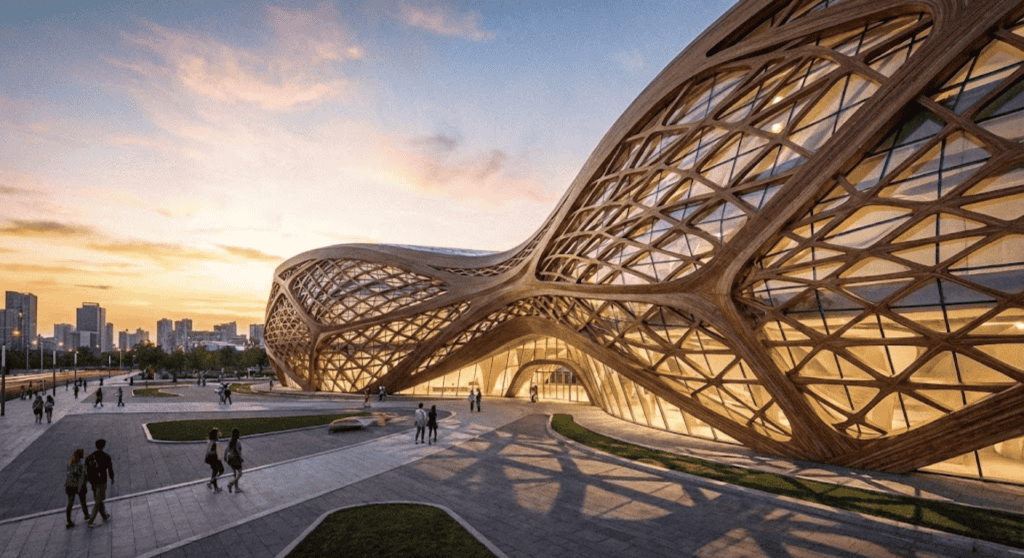
Ask ten people in Kolkata what parametric design means and you will get ten answers about curves. Stand in front of a G+4 in Alipore at noon, though, and the question answers itself: the balconies are not curved for drama, they are curved because a shallower tray on the north side would have been wasted metal. That is the whole idea. Parametric facade design in Kolkata and across India is not a look you order from a catalogue – it is a rule you write once and let the building solve. Below are four residential concepts, two in Kolkata and two in Pune, and each one shows a different way that rule gets used on a real plot.
Facade Design in India: Why Kolkata Is Choosing Parametric Metal
Facade design in India has moved from an afterthought to the single most important decision on a residential project. Today, demand for parametric facade design in India is rising fastest in cities such as Kolkata, Mumbai, Bangalore, Delhi, and Pune, where homeowners and developers want elevations that are both performance-driven and instantly recognisable. SOGA Design Studio specialises in facade design in India — from G+3 individual homes to G+7 residential blocks — pairing algorithmic geometry with matte iridescent bronze panels and fabrication-ready detailing. Whether you are comparing metal facade design in India for a new build or a retrofit, the concepts below show how a considered facade redefines a building’s identity and its long-term value.
1. Use One – Shading Written as Geometry: Parametric Wing Ledge in Alipore, Kolkata
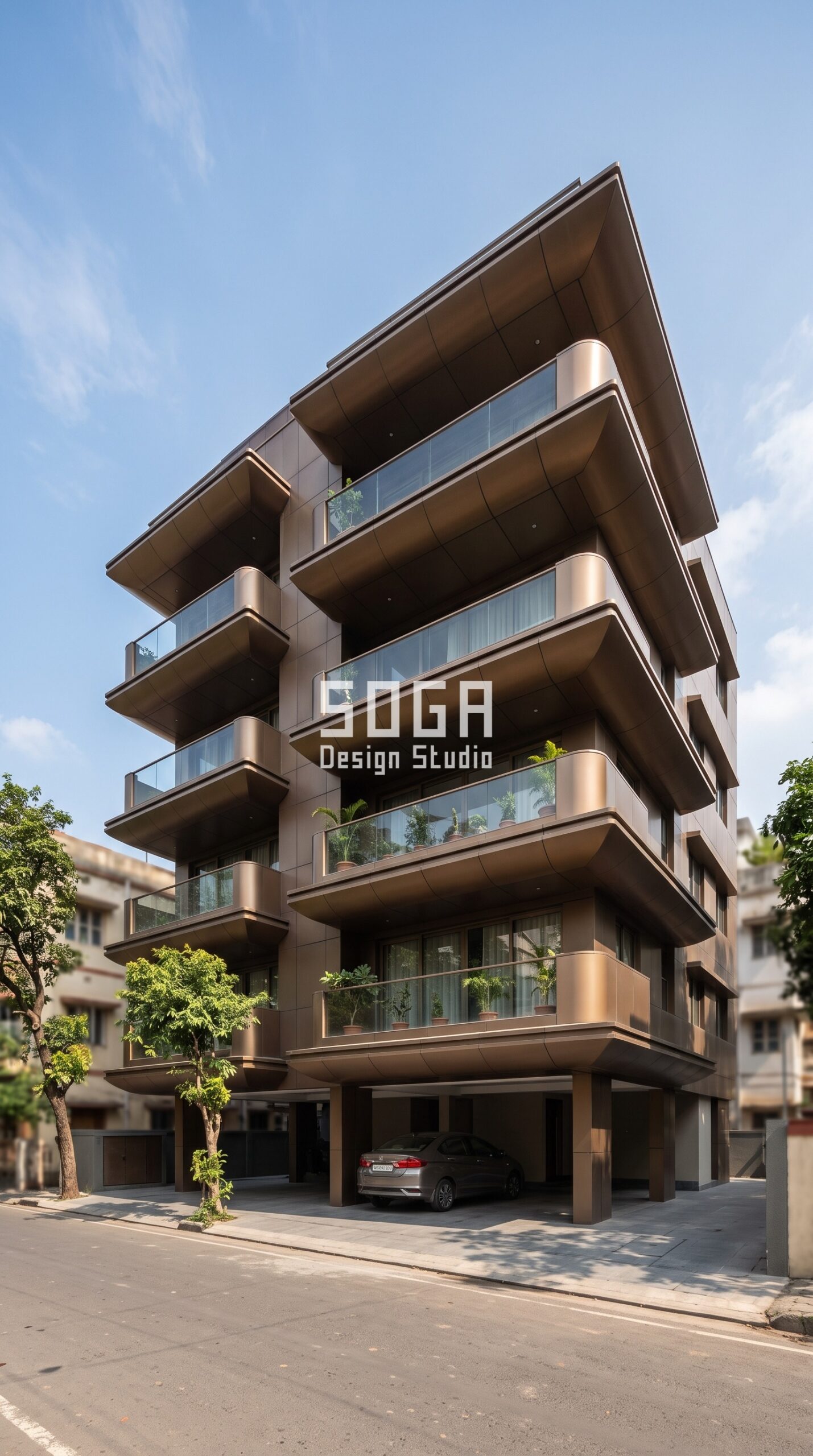
The first and most honest use of parametric design is turning sun angles into shape. On this G+4 in Alipore the rule is simple: balcony tray depth is driven by the sun each face actually receives, so the west and south trays reach out far enough to keep the afternoon off the glass while the quieter faces pull back and stop wasting metal. The curved press-braked soffits in matte iridescent bronze are the visible result of that single parameter, not a stylistic flourish. Because only the depth changes and the tray itself stays one repeated part, the fabricator quotes one detail and varies a dimension. Through the day the facade shifts from crisp midday shadow to a low bronze glow, and inside, the rooms behind those deep trays stay usable in a Kolkata summer afternoon.
2. Use Two – One Panel, Many Depths: Parametric Mosaic Pulse in Baner, Pune
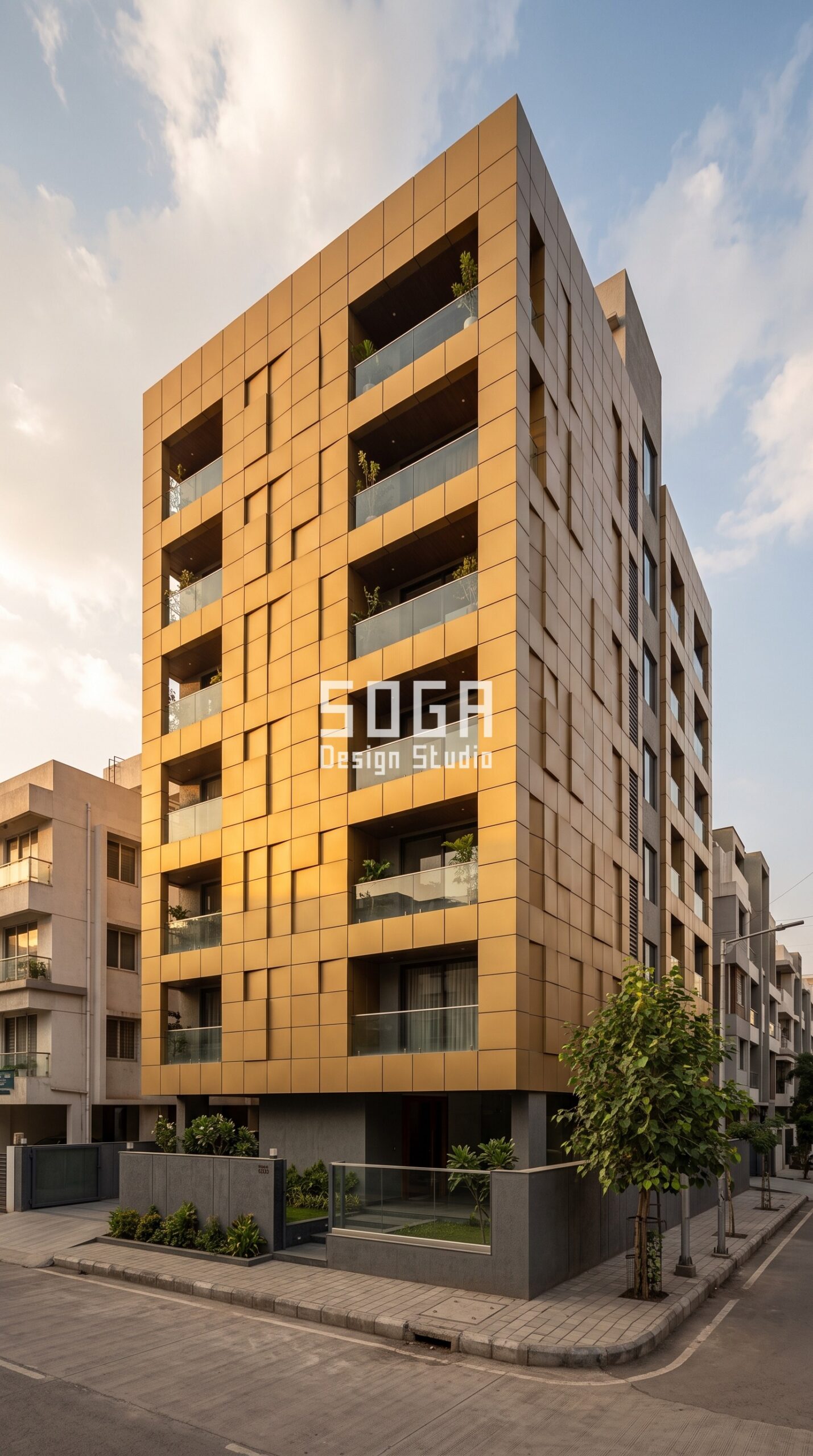
The second use is the one that keeps budgets intact: vary a single component instead of designing a thousand unique ones. This G+6 in Baner is clad in one square metal cassette in matte warm amber gold anodized aluminium, repeated across the whole elevation, with only its projection depth stepping between roughly 40 and 140 millimetres. That small range is enough to break up a large flat wall into a field that reads differently every hour, yet the module grid never distorts and no panel is a special. It matters commercially: one tooling setup, one fixing detail, one installation sequence, and depth as the only variable line item. Under Pune’s late-afternoon light the shallow tiles wash out and the deep ones throw hard shadow, so the building appears to change texture without changing a single material.
3. Use Three – Letting the Floor Plate Speak: Parametric Crest Shell in Ballygunge, Kolkata
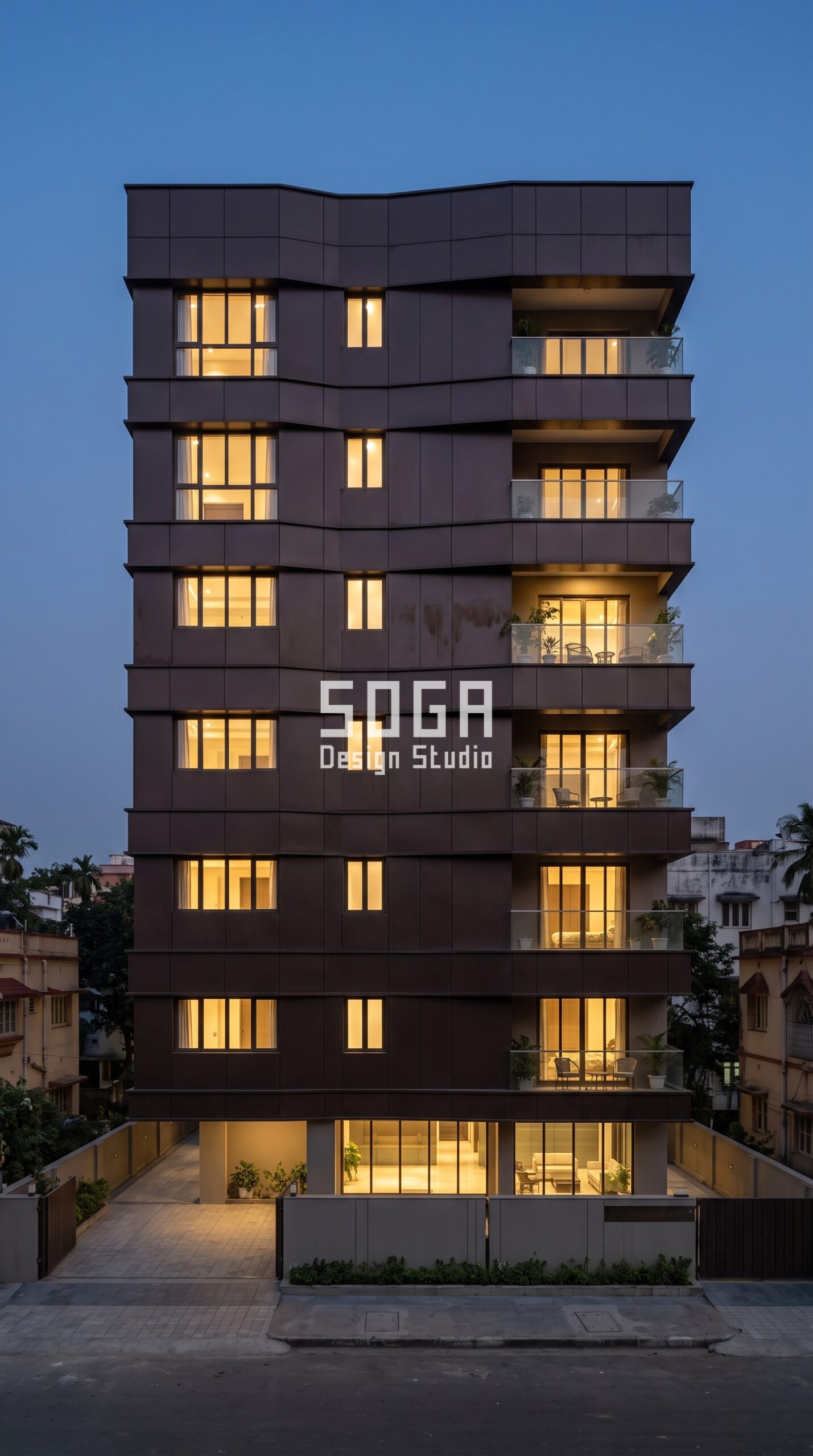
The third use is expressive rather than climatic: parametric rules can make the structure legible. On this G+5 in Ballygunge every slab edge is picked up by a horizontal band of matte dark espresso brown oxidized steel, each band a discrete press-braked panel with a shallow crest whose depth eases bay to bay. Stacked, the bands turn floor levels into the building’s rhythm, which is why the elevation still reads as ordered rather than restless. The narrow Ballygunge frontage was the constraint here – a busy screen would have felt claustrophobic from the footpath, so the rule was kept to one gentle move repeated cleanly. At blue hour the crests catch the last daylight along their top edge while warm interior light spills below, and the building reads as bands of light rather than a dark mass.
4. Use Four – Opening and Closing the Same Module: Parametric Delta Grid in Kalyani Nagar, Pune
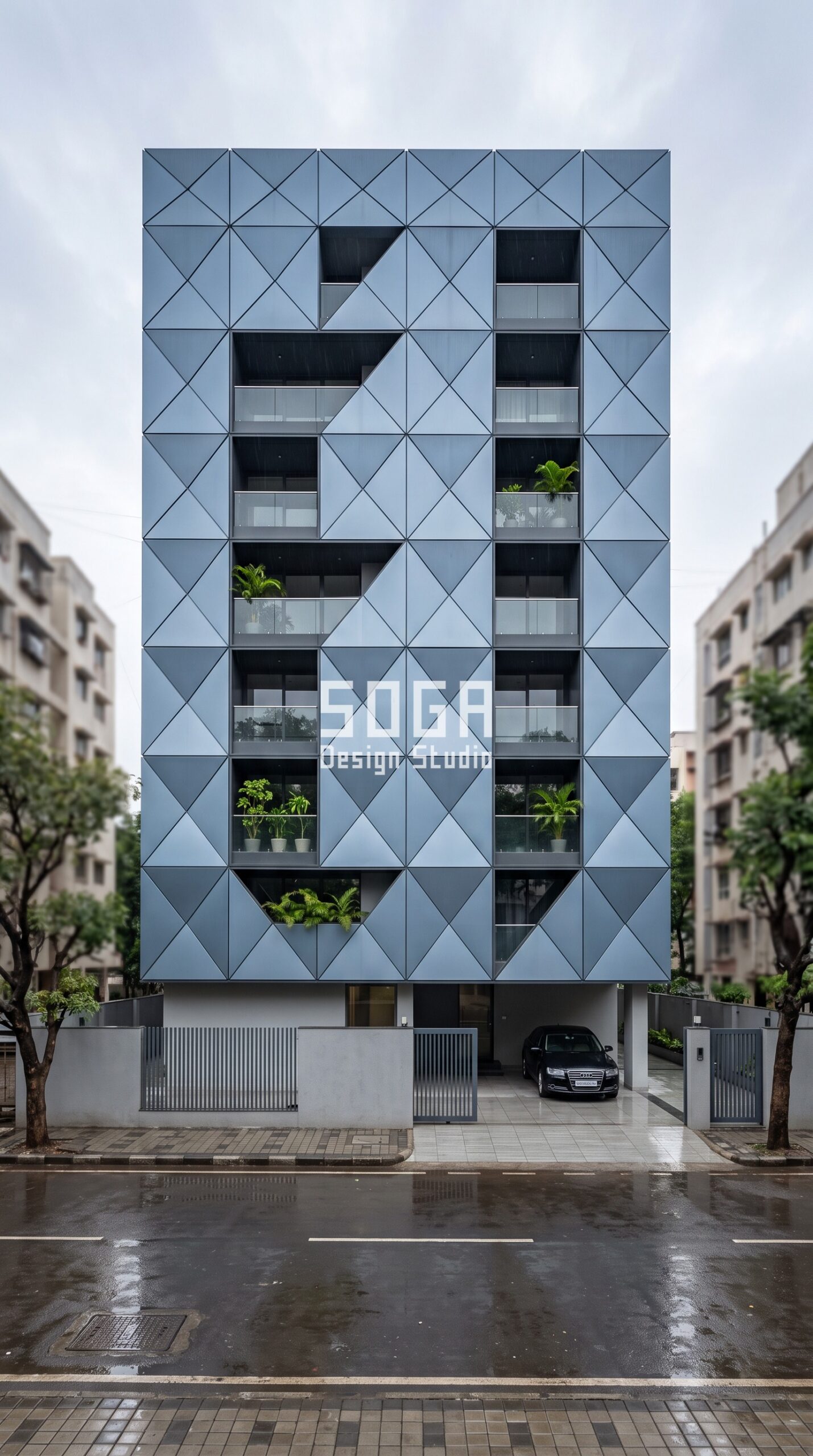
The fourth use decides where a facade is solid, glazed or planted without ever leaving the grid. This G+7 in Kalyani Nagar uses one flat triangular cassette in matte cool steel blue anodized aluminium, and the rule simply chooses each triangle’s state: closed where a neighbour overlooks, open where a room needs the view, recessed where a planter earns its place. That is how a dense Pune plot gets privacy on one side and daylight on the other without two different facades. Alternating matte and lightly satin faces keeps the pattern legible even under flat monsoon cloud, when a single finish would have gone dead. After rain the wet street doubles the elevation, and the triangles stay crisp because each one is a discrete folded panel, not a curve pretending to be metal.
Cost Benchmarks for Indian Parametric Metal Facades
One of the most-asked questions on a Kolkata project brief is budget. The current all-in installed rates for parametric metal facades in India sit in the following ranges:
- Steel facade (full design + install): ₹1,200–₹2,800 per sq ft
- Aluminium, anodised or powder-coated: ₹800–₹2,500 per sq ft
- Zinc cladding: ₹1,500–₹3,000 per sq ft
- ACM panels (3 mm basic): ₹200–₹250 per sq ft (basic)
- ACM panels (4 mm): ₹250–₹350 per sq ft
- Solid aluminium panels: ₹800–₹1,800 per sq ft
- Installation labour: ₹50–₹150 per sq ft (varies by height + access)
- Conventional cladding (for comparison): ₹400–₹1,200 per sq ft installed (stone veneer / ceramic / standard ACM)
These figures are baseline; actual project cost depends on facade area, panel complexity, fabricator location, and finish specification. SOGA Design Studio prepares an itemised cost estimate as part of every consultation so the budget conversation starts with hard numbers rather than guesses.
Parametric Facade Design Across India, Dubai & Singapore
Retrofit is the fastest-growing segment of today’s Indian facade market and SOGA Design Studio is investing heavily in it. A lightweight aluminium parametric screen mounted on stand-off brackets can transform a tired 1990s or 2000s Kolkata apartment block in 4 to 8 weeks without disturbing tenants or interiors. The economics often surprise owners: a retrofit facade can reset rental yield, reposition a building in the listings, and add visible value at a fraction of the cost of a full reclad. Several of the concepts shown above have direct retrofit variants available on request.
Why Trust SOGA Design Studio for Facade Design in Kolkata
- Experience: SOGA Design Studio has been producing daily parametric facade studies for Indian G+3 to G+7 residential plots since 2023, including narrow-frontage Kolkata plots and dense Pune corner sites like the ones shown here.
- Expertise: Every concept is developed as a system – module size, variation range, fixing method and finish – and analysed per orientation for solar exposure, monsoon drainage and maintenance access before it is drawn as an elevation.
- Authority: SOGA Design Studio works as a facade design specialist across India, with parametric metal systems detailed to fabrication-ready shop drawings and coordinated with vetted Indian fabricators.
- Trust: Cost bands quoted here are 2026 Indian market ranges and every project gets an itemised estimate. Initial consultation is free and carries no commitment, with a remote workflow used regularly for NRI clients in Dubai, Singapore and the UK.
Frequently Asked Questions
How is parametric design used in architecture?
Parametric design is used to let a rule generate the geometry instead of drawing every element by hand. In facade work that rule is usually tied to something measurable – sun angle, privacy, view, floor level – and it drives one variable across a repeating module, such as balcony depth, panel projection, band crest or whether a module is open or closed. The four concepts in this post each demonstrate one of those uses on a real Indian residential plot.
How much does a parametric metal facade cost in India in 2026?
In 2026 aluminium parametric facades run roughly Rs 800 to Rs 2,500 per sq ft for full design and installation, steel Rs 1,200 to Rs 2,800 per sq ft, and zinc Rs 1,500 to Rs 3,000 per sq ft. Basic ACM cladding at 3 to 4 mm starts around Rs 200 to Rs 350 per sq ft, and installation labour adds Rs 50 to Rs 150 per sq ft depending on building height and access. SOGA Design Studio provides an itemised estimate with every consultation.
Is a parametric facade more expensive than normal cladding?
It sits above conventional cladding, which runs about Rs 400 to Rs 1,200 per sq ft installed, but the gap is smaller than most clients expect when the design is built as a system. The cost driver is not the parametric geometry – it is how many unique parts you create. A facade that repeats one module and varies a single parameter, like the four here, is tooled and installed almost like standard cladding, while a facade of thousand unique panels is genuinely expensive.
Does a parametric metal facade survive Kolkata humidity and Pune monsoon?
Yes, provided the specification matches the climate. For humid Kolkata and monsoon-heavy Pune we detail anodized or PVDF powder-coated aluminium, oxidized or galvanised steel substructures, drained and ventilated cavities behind the panels, and stainless fixings, with drip edges on every projecting element so water leaves the facade instead of tracking across it. Properly specified, these systems hold their finish for 20 to 25 years with routine washing.
Can a parametric facade be added to an existing building?
Often yes. A lightweight metal screen or cassette system can be hung off a new secondary framework fixed back to the existing slab edges or columns, which is a common retrofit route for ageing G+3 to G+6 buildings in Kolkata and Pune. The feasibility check is structural capacity at the slab edge, setback and building-line compliance, and access for installation. SOGA reviews existing drawings and site photographs before proposing a retrofit system.
What is the typical timeline from design to installed parametric facade?
For a G+3 to G+4 residence: 3 weeks for concept and approval, 4 weeks for fabrication-ready drawings, 6–8 weeks for fabrication, and 3–5 weeks for site installation — total 16–20 weeks from go-ahead to occupancy. Retrofit projects on existing buildings compress this to 10–14 weeks because no structural coordination is needed.
Where are parametric metal facades fabricated in India?
The main fabrication clusters are Mumbai-Pune (precision aluminium and steel), Chennai-Coimbatore (laser cutting and powder coating), Delhi-NCR (large-format ACM and screens), and Ahmedabad (brass and copper specialty). SOGA Design Studio works with vetted fabricators in each cluster to keep transport cost and lead-time low for any project location.
Is parametric design suitable for G+3 and G+4 residential plots?
Absolutely — it is in fact the highest-growth segment in India. G+3 and G+4 plots benefit most because the entire facade is visible from the street, so a sculptural parametric treatment yields maximum identity per rupee invested. SOGA Design Studio specialises in this typology, with concepts adapted to standard 30×40, 40×60, and 50×80 ft plots across Indian metros and tier-2 cities.
How is AI changing facade design in India in 2026?
AI is now a routine input at the concept stage: generative tools propose dozens of parametric variations from a single brief, and computational performance simulators predict heat gain, daylight, and material cost before any drawing is finalised. SOGA Design Studio uses AI-assisted visualisation to accelerate the concept phase from 4 weeks to 4 days, while the engineering and fabrication detailing remain human-led.
How long does a powder-coated metal facade last in Indian conditions?
Quality powder-coated aluminium or galvanised steel facades, when correctly detailed and ventilated, last 25–30 years before recoating is needed — even in coastal Mumbai, Chennai, and Kochi. Anodised aluminium and pre-patinated zinc/copper can exceed 40 years. Maintenance is annual rinse-down only; no repainting like traditional plaster facades.
Can NRIs design and build a parametric facade in India remotely?
Yes. SOGA Design Studio runs end-to-end remote consultations for NRI clients in Dubai, Singapore, the UK, and the US. The workflow — site analysis, design development, client review, fabrication-ready drawings, and on-site supervision — is delivered virtually. NRI projects in tier-2 cities like Coimbatore, Indore, and Chandigarh make up a fast-growing share of our portfolio.
How much does a parametric metal facade cost per square foot in Indore?
Currently, all-in parametric metal facade rates in India range from ₹800–₹2,500 per sq ft for aluminium and ₹1,200–₹2,800 per sq ft for steel, installed. SOGA Design Studio prepares itemised estimates as part of the consultation.
What is a sculptural petal-shaped metal fin facade?
SOGA Design Studio addresses this question in detail during the design consultation. For Kolkata projects, we provide a fully customised answer based on plot, orientation, and budget — typically within 48 hours of receiving the brief.
Related Reading
Start Your Facade Project With SOGA Design Studio
Judge a parametric facade by the parameter, not the picture: if you cannot name the one thing that varies, neither can the fabricator.
Ready to give your Kolkata residence the same parametric treatment? Talk to SOGA Design Studio — share your plot dimensions, a few reference images, and your build timeline, and we will return a tailored facade concept within 48 hours.