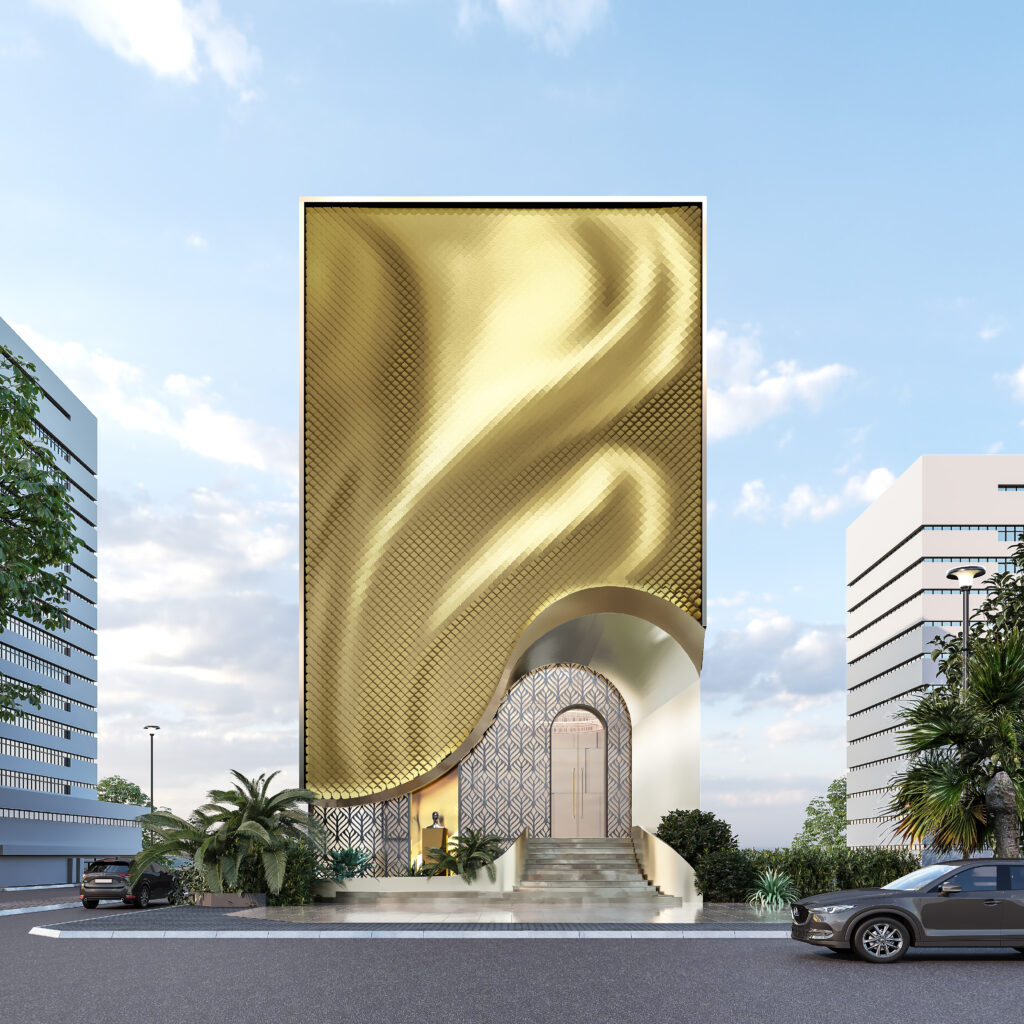
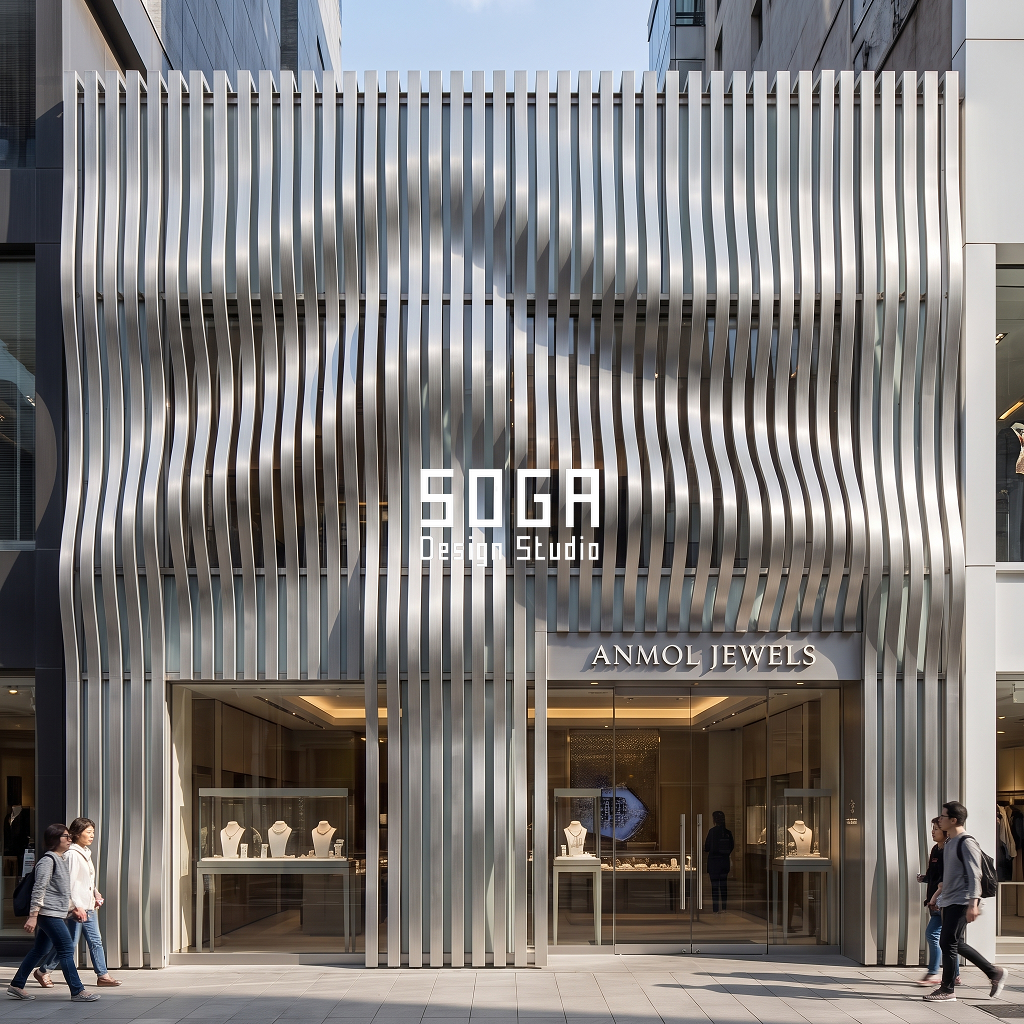
By SOGA Design Studio | Part 3 of Our Facade Series
The question changed somewhere around project fifteen.
For the first dozen projects, the question people asked us was: “Can you really do all of this?”
Organic ribbons, angular volumes, heritage arches, flowing S-curves, diamond-cut screens, minimal louver bands — all from one studio based in Gurugram. The range felt hard to believe. People assumed different projects meant different designers, different teams, maybe different firms under one brand.
It didn’t. It was the same process. The same computational design methodology. The same two founders making decisions at every step.
Somewhere around project fifteen, the question changed. It stopped being “Can you do all this?” and became “What can’t you do?”
We still don’t have a complete answer to that. Every new project pushes us somewhere we haven’t been — darker materials, bolder sculptures, quieter minimalism, busier streets, taller towers. The range keeps expanding because the process allows it to.
This article covers six more facades — bringing the total to eighteen projects with zero visual repetition. Each one tells a different story. Together, they tell one story about what computational design actually makes possible.
Project 13: The Organic Ribbon
Design language: Flowing organic ribbons with integrated greenery — architecture that grows rather than just stands.
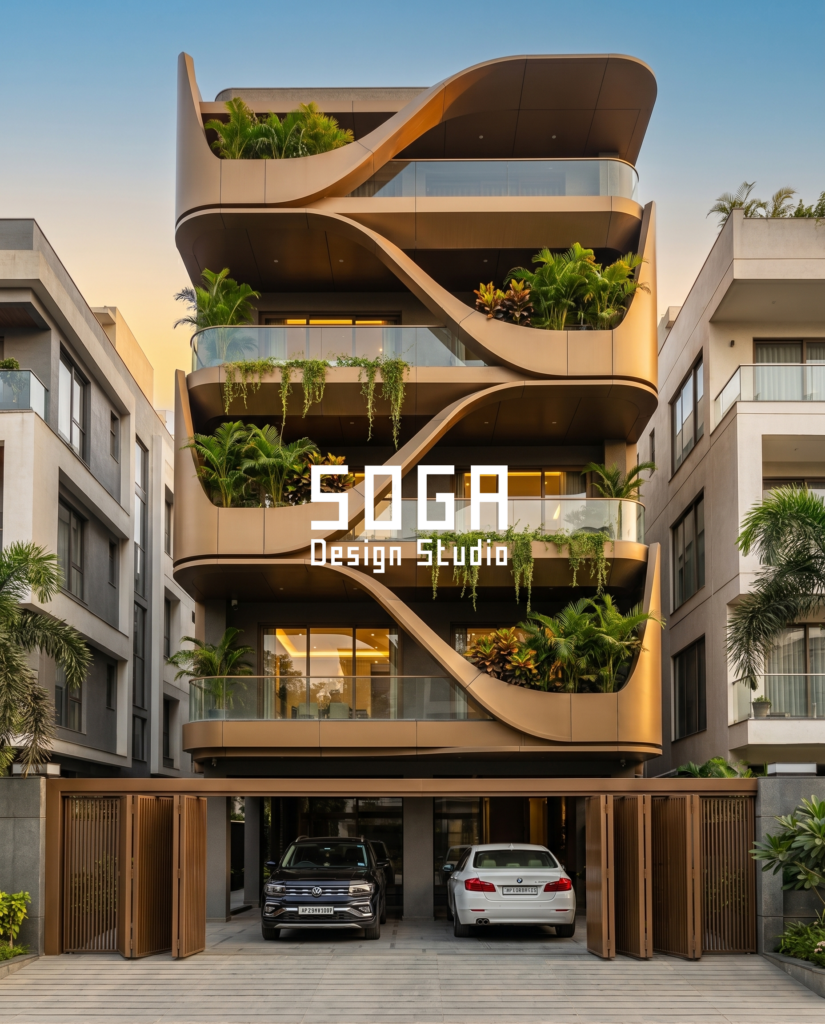
This facade dissolves the boundary between building and landscape. Warm-toned ribbons spiral upward through the elevation, curving outward to create deep planter shelves at every turn. The greenery isn’t added after the architecture is finished — it’s designed into the ribbon geometry from the first parametric sketch.
The effect is a building that looks less constructed and more cultivated. Like something that grew out of the ground and kept reaching upward, carrying soil and plants with it as it rose.
What the design is actually solving: Residential buildings in dense Indian neighborhoods face a persistent problem — the desire for greenery in a context with no garden space. Traditional solutions (balcony pots, railing planters) feel like afterthoughts because they are afterthoughts. This project makes planting a structural commitment, not a decorative one. The ribbons create permanent, deep planting beds at every level. The greenery is as much a part of the facade as the material itself.
The deeper principle: A facade can be a garden if you design it that way from the start. But you have to commit to it at the structural level, not the finishing level. The ribbon geometry here was computationally generated to create planting surfaces with adequate soil depth, drainage, and sun exposure — not just curves that look organic.
Project 14: The Dark Tower
Design language: Sleek dark vertical fins rising through a tall commercial form — restrained, confident, urban.
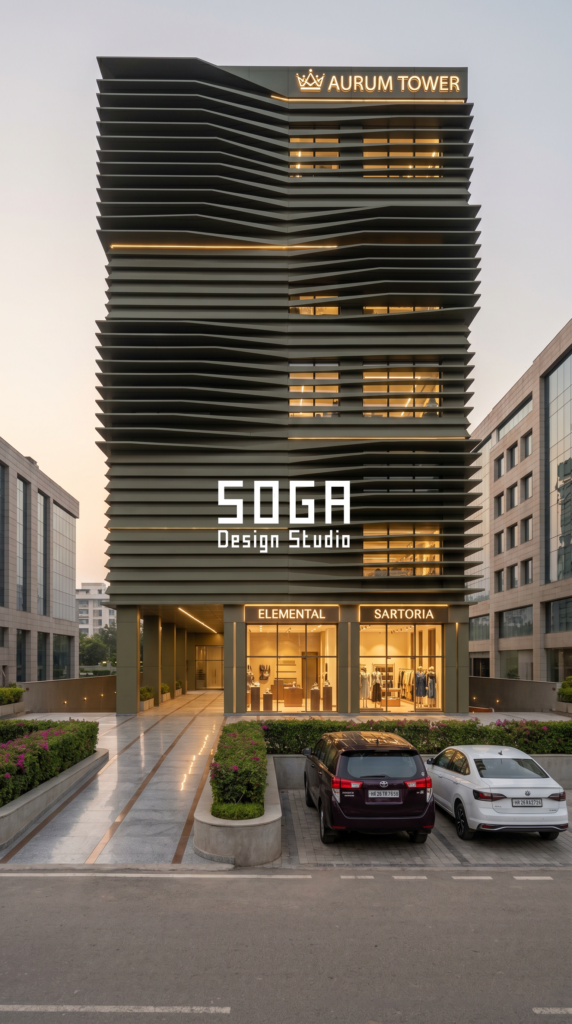
After thirteen projects in warm wood tones and organic curves, this one lands like a cold glass of water. Dark. Vertical. Sharp. No warmth, no greenery, no flowing curves. Just disciplined vertical fins in a dark palette rising through a commercial tower form.
The building sits in an urban commercial context where the goal isn’t to feel like a home — it’s to feel like serious business. The dark fins create a monolithic presence that reads as authority from the street. At night, the interior lighting filters through the dark screen, reversing the daytime reading entirely — the building goes from solid and imposing to luminous and inviting.
What the design is actually solving: Commercial tenants need a building that signals credibility to their clients before anyone walks through the door. This facade does that work. The dark palette, the precise vertical rhythm, the absence of ornament — every choice says “professional” without a single word of signage. The facade is the brand.
The deeper principle: Not every facade needs to be warm. Not every facade needs to flow. Sometimes the most powerful design move is restraint — removing everything unnecessary until only intention remains. This project proves that the computational process works as effectively in subtraction as it does in expression.
Project 15: The Horizontal Quiet
Design language: Clean horizontal louver bands in warm wood-shade — minimal, precise, no drama.
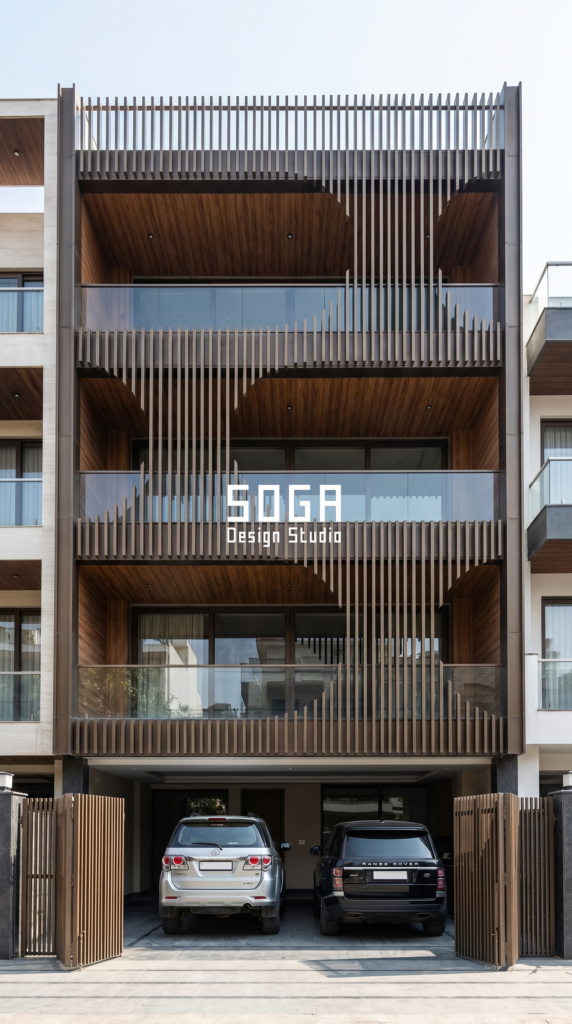
If the organic ribbon is the loudest project in this series, this is the quietest. Horizontal louvers run across the facade in even, parallel bands. No curves. No variable heights. No diagonal sweeps. Just clean lines, warm finish, and a confidence that comes from knowing when not to push.
The building doesn’t compete with its neighbors. It doesn’t try to be the most interesting thing on the street. It simply presents itself with clarity and lets the material quality speak.
What the design is actually solving: Not every client wants a landmark. Some want a home that feels considered, well-made, and calm — without turning heads or starting conversations with every passerby. This project serves that client honestly. The horizontal louvers create shade, manage privacy, and unify the elevation — the same functional benefits as the more expressive projects, delivered without the volume.
The deeper principle: Quiet design is not lazy design. It takes more confidence to choose simplicity than complexity. Anyone can add another layer, another curve, another material. Choosing to do less — and making that “less” feel complete rather than unfinished — is a harder design problem than most people realize.
Project 16: The Market Anchor
Design language: Warm vertical fins on a busy commercial street — refined computational design in a raw urban context.
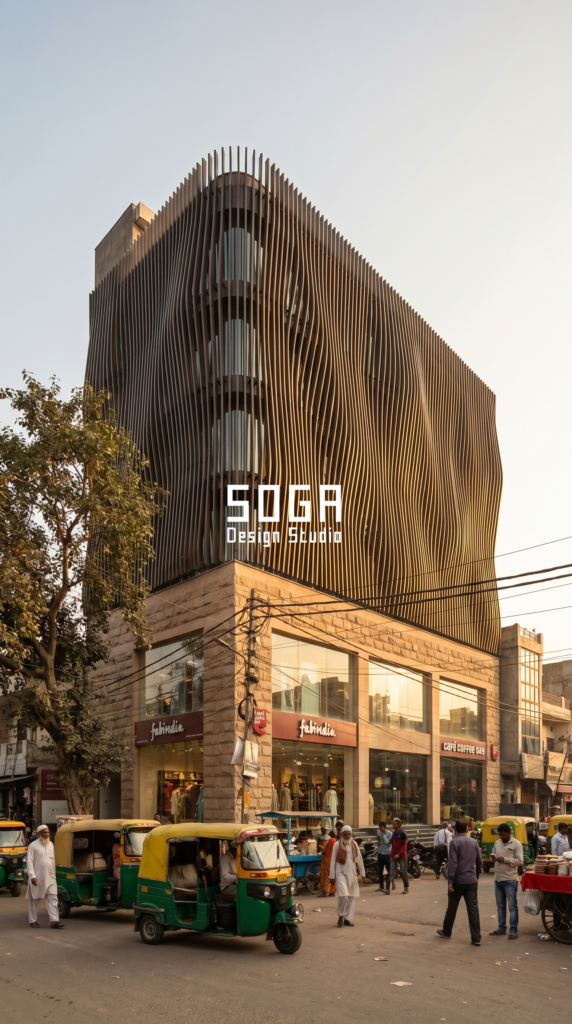
This project sits on the kind of street where architecture usually gives up. Auto-rickshaws, street vendors, tangled power lines, buildings shouting over each other with signage and color. Most architects respond to this context by either hiding behind plain walls or trying to outshout the chaos.
This facade does neither. It stands with quiet authority — warm-toned vertical fins creating a rhythmic screen that feels considered and permanent against the temporary chaos around it. The ground floor opens up to the street with retail glazing. The upper floors are wrapped in the fin screen, creating a distinct identity that holds its own without raising its voice.
What the design is actually solving: Commercial buildings on busy market streets face a unique challenge — the facade needs to attract attention (for the retail tenants) while also projecting quality (for the property’s long-term value). Shouting louder than the surroundings works short-term but ages badly. A considered, timeless facade becomes more valuable over time as the neighborhood around it evolves. This building will look better in ten years, not worse.
The deeper principle: Context doesn’t dictate quality. A noisy street doesn’t mean you need a noisy facade. Some of the strongest architectural moves we’ve delivered are on the busiest, most chaotic sites — because the contrast between the raw surroundings and the refined design is what creates the landmark. You don’t need a quiet neighborhood to build something beautiful.
Project 17: The Sculptural S
Design language: Bold concrete S-form wrapping the facade — when the facade stops being a screen and becomes the structure itself.
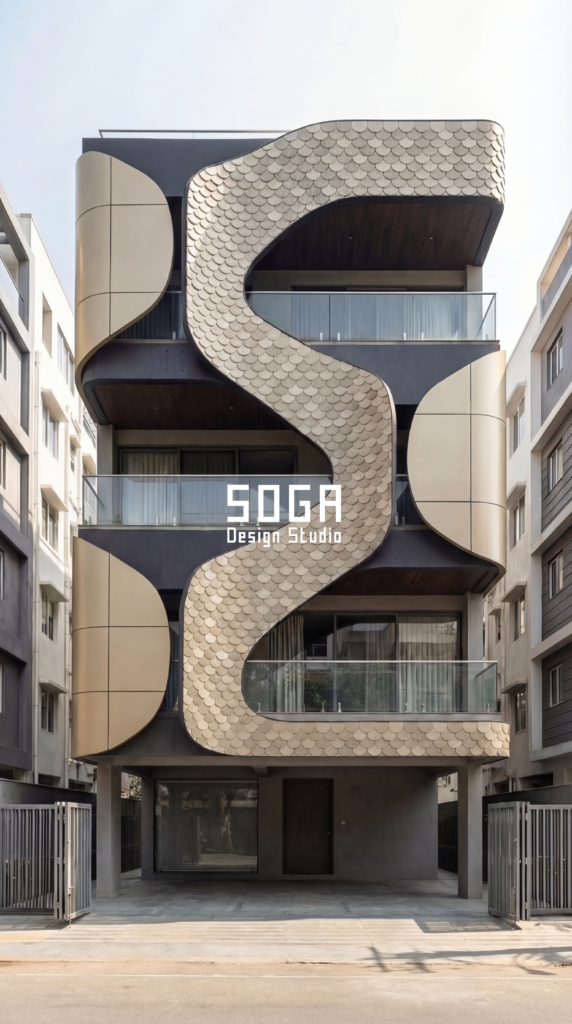
This project crosses a line that most facades don’t. The S-shaped form isn’t a screen attached to a building — it IS the building’s face. The curves are structural, creating deep recesses and dramatic overhangs that define the living spaces behind them. Where every other project in this series separates the facade layer from the building structure, this one merges them.
The result is heavier, bolder, and more sculptural than anything else in the portfolio. It reads less like architecture and more like an urban sculpture that happens to have rooms inside it.
What the design is actually solving: Some buildings need presence that can’t be achieved with screens, fins, or cladding. They need mass. This project is on a narrow urban plot where the facade is the only architectural surface visible — the sides are party walls shared with neighbors. Every ounce of design energy had to be concentrated on one face. The S-curve concentrates visual weight at the center, creating maximum impact from a single frontage.
The deeper principle: A facade doesn’t have to be a layer applied to a building. It can be the building itself. When structure and expression merge, you get something that no amount of cladding or screening can replicate — genuine architectural mass. The computational process here wasn’t generating fin positions — it was generating structural geometry. Same tools, completely different output.
Project 18: The Perforated Frame
Design language: Geometric perforated panels with sharp rectangular cuts — controlled, precise, zero excess.
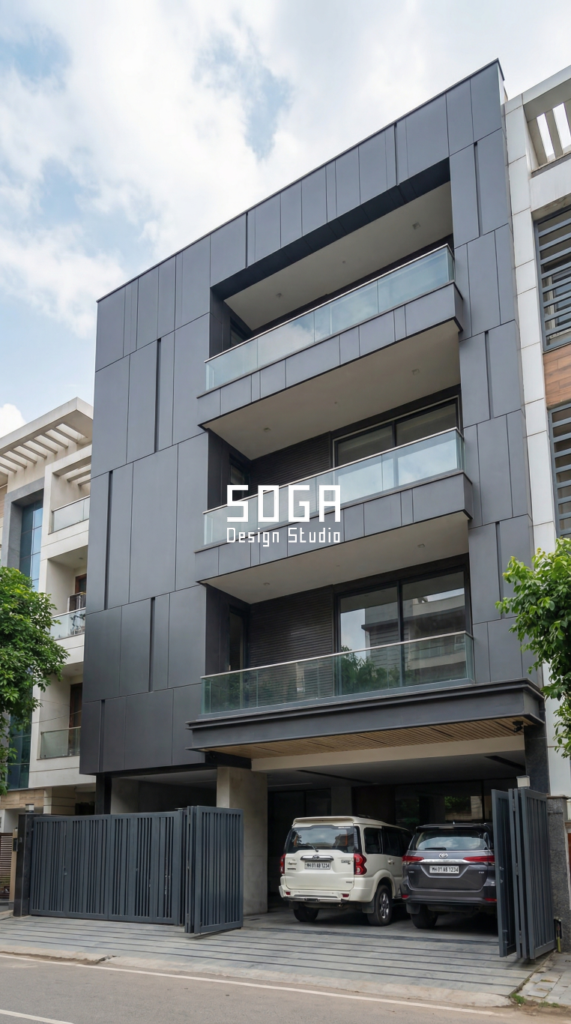
The final project in this series is also the most restrained in palette. Grey perforated panels with sharp rectangular openings create a facade that reads as a single composed surface rather than a collection of separate elements. The cuts are precise — some vertical, some horizontal, creating a controlled pattern that manages light entry while giving the building a graphic, almost typographic quality.
There are no curves. No warm tones. No organic references. Just sharp geometry, neutral color, and an unwillingness to add anything that doesn’t earn its place.
What the design is actually solving: This project targets the client who values precision above expression. The perforated panels aren’t trying to be beautiful in a conventional sense — they’re trying to be exact. Every cut controls a specific light condition for the room behind it. Every solid panel protects a specific privacy requirement. The facade is a diagram of the building’s relationship to its environment, expressed in material rather than drawn on paper.
The deeper principle: A facade can be a diagram. Not every project needs poetry or metaphor. Some buildings communicate best through precision — saying exactly what they mean, nothing more, nothing less. That clarity has its own beauty, even if it doesn’t photograph as warmly as a flowing ribbon or a golden louver.
What eighteen projects teach about facade design
Across three installments and eighteen projects, a few patterns emerge that are worth more than any individual design:
The process matters more than the style. Every project in this series was generated through the same computational design methodology — parametric modeling, environmental analysis, fabrication-ready output. The process is the constant. The styles are the variables. A studio built on process can serve any client. A studio built on style can only serve clients who want that style.
Range is not inconsistency. Some people look at eighteen different facades from one studio and see confusion. We see evidence of a process robust enough to adapt to eighteen different clients, sites, budgets, and aspirations without defaulting to a template. Consistency lives in the quality and the thinking, not in the visual output.
Quiet projects are as valuable as loud ones. The horizontal louver band and the perforated panel frame are doing the same caliber of design work as the organic ribbon and the sculptural S. They’re just doing it at lower volume. A portfolio that only shows loud work is a portfolio that secretly doesn’t trust its own quieter capabilities.
Context is material. The dark commercial tower, the busy market street facade, the narrow urban plot sculpture — each project is shaped as much by what’s around it as by what the client asked for. Ignoring context produces buildings that look good in renders and awkward in reality. Responding to context produces buildings that get better with time.
The gap between ordinary and iconic is always narrower than it appears. None of these projects required exotic materials, international fabricators, or budgets ten times the neighborhood average. They required design intent — the decision to think computationally about a problem that most builders solve by default. That decision is available to anyone. The tools exist. The materials exist. The only variable is whether someone chooses to use them with intention.
About SOGA Design Studio
SOGA Design Studio is a parametric and computational architecture firm based in Gurugram, India, co-founded by Gajender Kumar Sharma and Sonali Jaiswal. With 900+ facade projects delivered across India, Dubai, and Singapore, the studio works across residential, commercial, and institutional scales.
Core belief: One studio. Every facade language.
Products: SOGA Louver — proprietary aluminium louver system engineered for parametric variation in Indian climate conditions.
Website: sogadesignstudio.com Instagram: @sogadesignstudio
Related reading
→ One Louver, Six Facades: Part 1 → 12 Facades, 1 Studio: Part 2 → 18 Facades, 1 Studio: Part 3 → How Much Does a Building Facade Cost? → Modern vs Traditional Facade Designs → How to Make Your Facade More Interesting → Facade Trends 2026 → Why Hire a Facade Specialist vs General Contractor?
FAQ (Schema markup ready)
Q: How does SOGA Design Studio create completely different facades for every project? A: SOGA uses a computational design process — parametric modeling in Rhino and Grasshopper — that generates facade solutions from each project’s unique constraints (site, orientation, climate, client vision, budget). The process adapts to any requirement rather than applying a preset template, which is why no two SOGA facades look alike across 900+ completed projects.
Q: Does SOGA Design Studio only work with louvers? A: No. While SOGA Louver (the studio’s proprietary aluminium louver system) features in many residential projects, the studio also designs facades using ACP panels, perforated metal screens, sculptural concrete forms, composite material systems, and hybrid approaches. The computational design process is material-agnostic — it adapts to whatever system best serves each project.
Q: Can SOGA Design Studio do minimal or restrained facade designs? A: Yes. The studio’s portfolio includes both highly expressive facades (organic ribbons, sculptural S-forms) and deliberately quiet designs (horizontal louver bands, perforated panel frames). Restraint is a design choice, not a limitation. Several of SOGA’s most considered projects are among its quietest.
Q: What is the difference between a facade specialist and a general architect for facade design? A: A facade specialist like SOGA Design Studio brings dedicated computational tools, material expertise, and fabrication knowledge specifically to the building envelope. General architects design entire buildings but may not have the parametric modeling capability, material testing experience, or fabricator relationships that a specialist studio develops over hundreds of facade-specific projects.
Q: How many facade projects has SOGA Design Studio completed? A: SOGA Design Studio has completed over 550 parametric facade projects across residential, commercial, and institutional buildings in India, Dubai, and Singapore. The studio continues to expand its portfolio across these regions.
Q: Does SOGA Design Studio work on commercial and retail facades? A: Yes. The studio’s portfolio includes commercial towers (Lumena Galleria, Dubai), retail street facades, and mixed-use buildings alongside its residential work. The computational process scales from G+3 residential homes to multi-storey commercial developments.