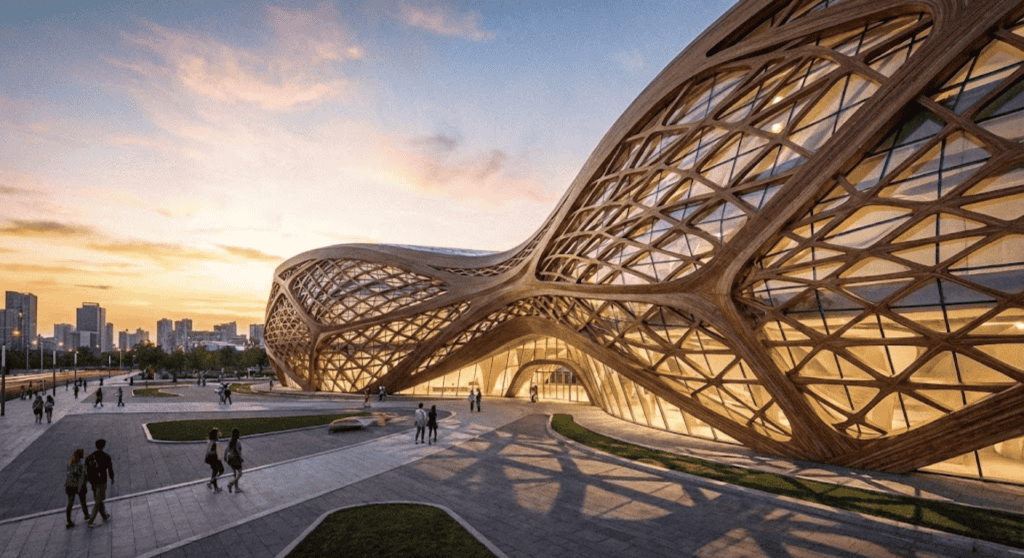
Stand on a Gurugram sector road in 2026 and count the elevations that have aged badly. Almost none of them failed because the design was ugly on paper – they failed because the paper never had to survive a fabricator, a west sun, or a second monsoon. That is the uncomfortable truth behind facade design in India: the drawing that wins the client meeting and the drawing that gets built are rarely the same drawing. A good facade is the one that stays itself all the way through. In this study we take four concepts – two in Gurugram, one in Chandigarh, one in Mumbai – and use each to isolate a single test a facade has to pass before an Indian architect will call it good.
Facade Design in India: Why Gurugram Is Choosing Parametric Metal
Facade design in India has moved from an afterthought to the single most important decision on a residential project. Today, demand for parametric facade design in India is rising fastest in cities such as Gurugram, Mumbai, Bangalore, Delhi, and Pune, where homeowners and developers want elevations that are both performance-driven and instantly recognisable. SOGA Design Studio specialises in facade design in India — from G+3 individual homes to G+7 residential blocks — pairing algorithmic geometry with matte powder-coated ral 7021 dark blac and fabrication-ready detailing. Whether you are comparing metal facade design in India for a new build or a retrofit, the concepts below show how a considered facade redefines a building’s identity and its long-term value.
1. Gurugram Parametric Prism Grid: The Depth Test on a G+7 Plot
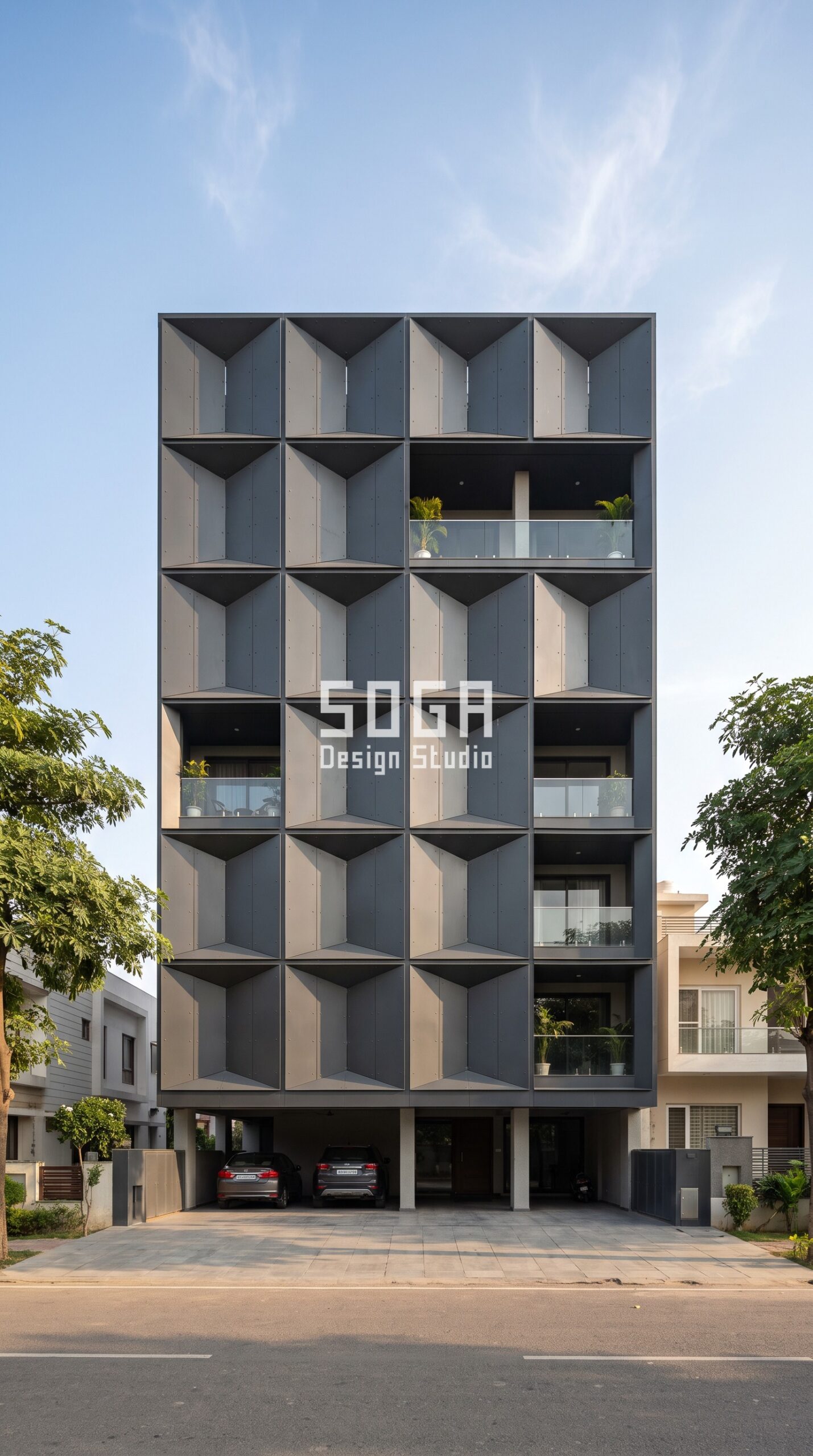
The first test a facade has to pass is depth, and it is the one flat cladding always fails. This G+7 study on a Golf Course Road plot uses a Parametric Prism Grid – shallow triangular prisms folded from matte powder-coated RAL 7021 dark black-grey steel, set out as discrete modules on a clean structural grid. Because every module is the same shallow fold repeated, the fabricator presses one profile and the site crew hangs one detail, so the geometry survives tender instead of being flattened into sheet. The reward is that the elevation is never the same twice in a day: hard triangular shadows at nine in the morning, a soft graphite field by two, edges catching again by five. On a deep narrow Gurugram plot where the front is the only elevation anyone sees, that self-shadowing is what stops a seven-storey block reading as a stack of balconies. Depth you can build beats depth you can only render.
2. Gurugram Parametric Bow Weave: Movement Without a Moving Part
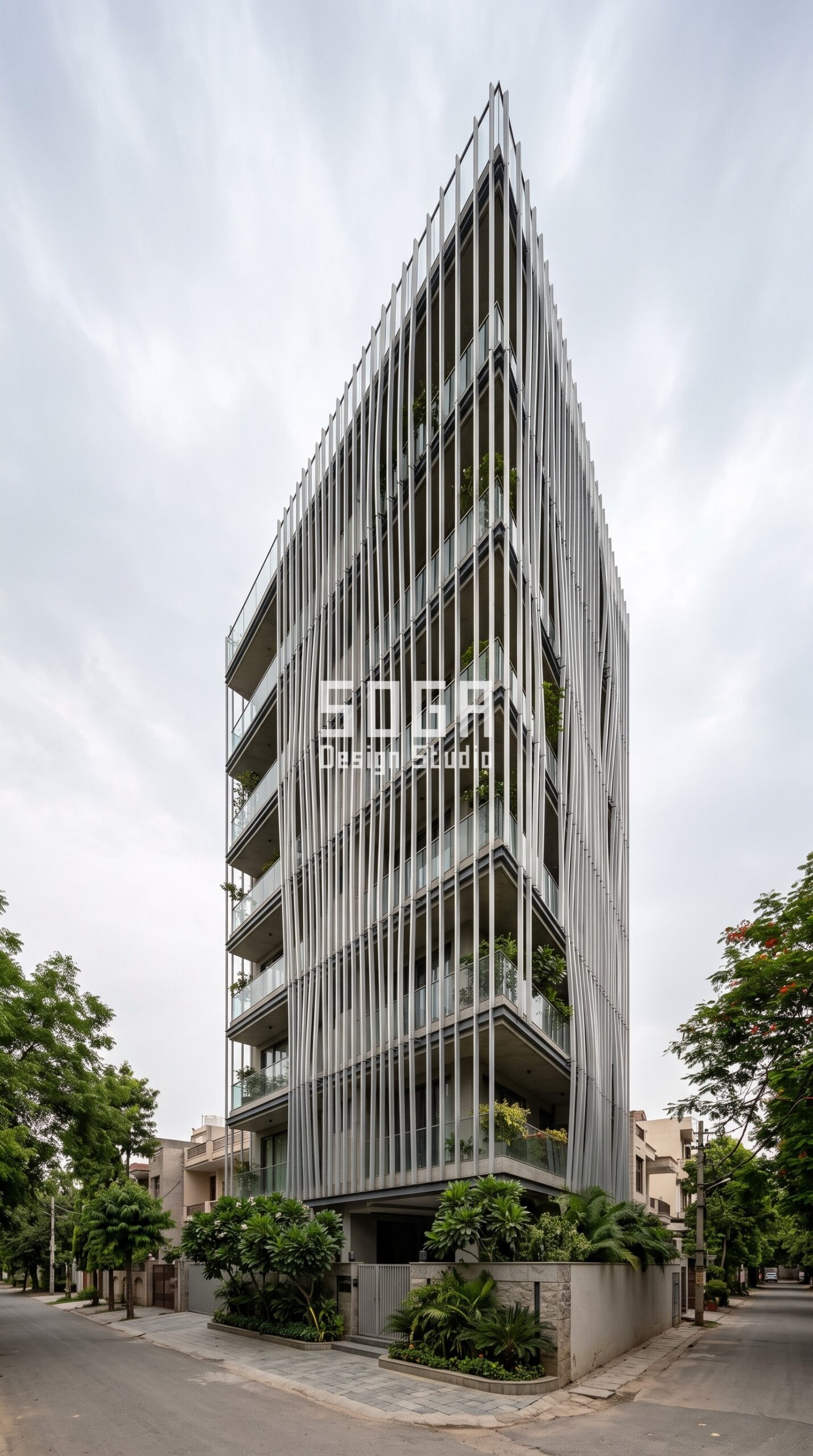
The second test is whether a facade can look alive without anything that needs maintaining. Kinetic facades photograph beautifully and then become an AMC line item nobody in an Indian housing society wants to renew. This G+6 study answers the same brief with a Parametric Bow Weave: slim vertical ribs in matte brushed silver aluminium, each fixed at a slightly different projection so the surface swells and relaxes across the elevation while every single rib stays a straight, standard extrusion. Nothing rotates, nothing is motorised, and the movement is entirely in the eye of someone walking past. The ribs also do real work on a Gurugram west face – they cut low afternoon sun off the glass line while leaving the view out from inside almost uninterrupted. A facade that moves only when you do will still be moving in 2046.
3. Chandigarh Parametric Contour Shell: Putting the Curve on the Edge
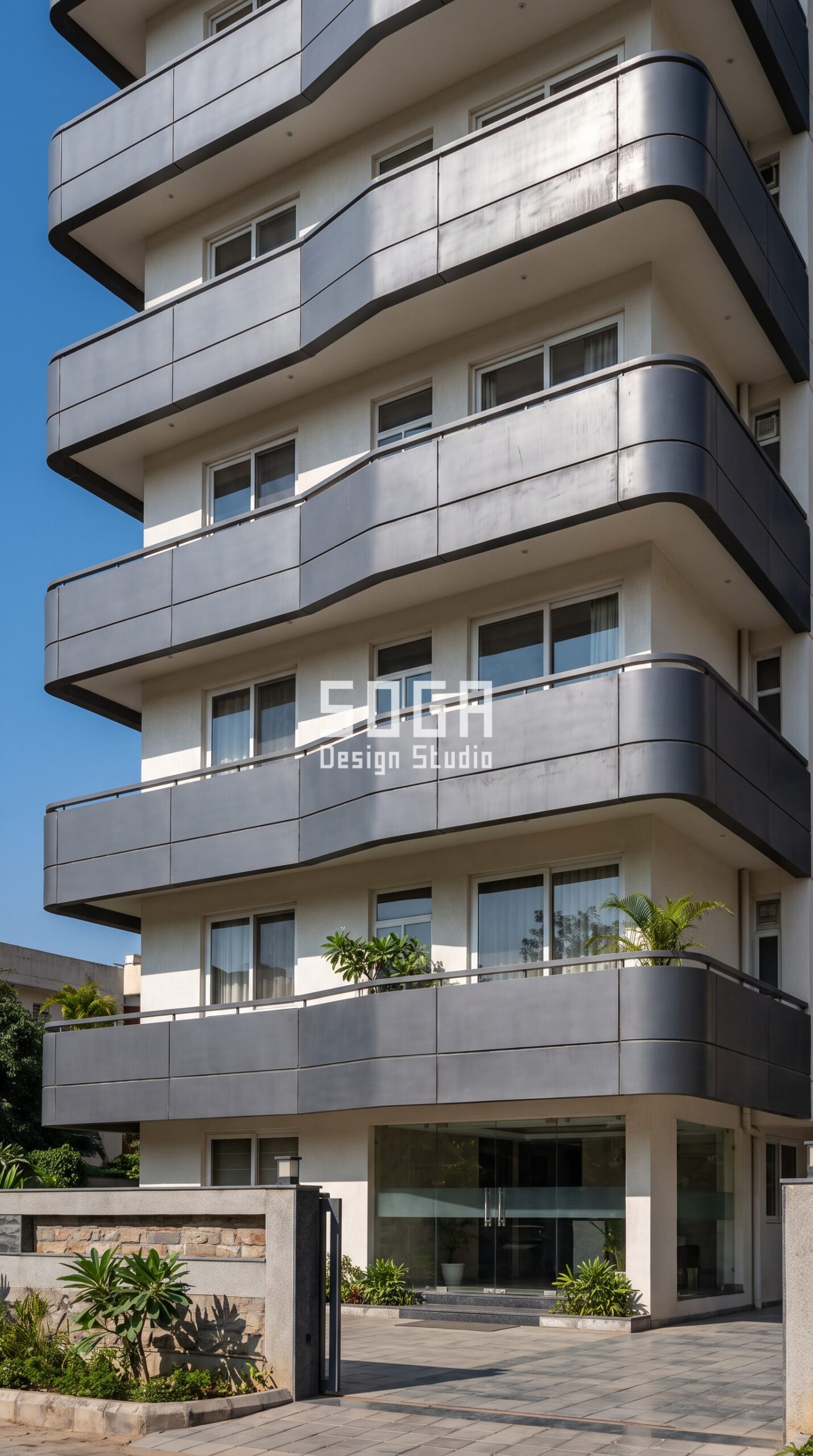
The third test is knowing where a curve belongs. Sculptural curved facades are the most requested and the most abandoned concepts in Indian residential work, because curving a wall means curving glazing, waterproofing and every service behind it. This Sector 9 Chandigarh study keeps the drama and drops the problem: a Parametric Contour Shell in matte powder-coated RAL 7024 graphite grey wraps only the slab and balcony edges, swelling outward at the balconies and drawing back between them, built from repeated curved segments with honest joints rather than one continuous melted surface. The wall behind stays a calm off-white frame with ordinary flat glazing, so the building costs like a rectangle and reads like a curve. In Chandigarh’s hard clear light those graphite bands throw a crisp horizontal shadow that flatters the sector-grid streetscape instead of fighting it.
4. Mumbai Parametric Etch Screen: Privacy That Still Lets Light In
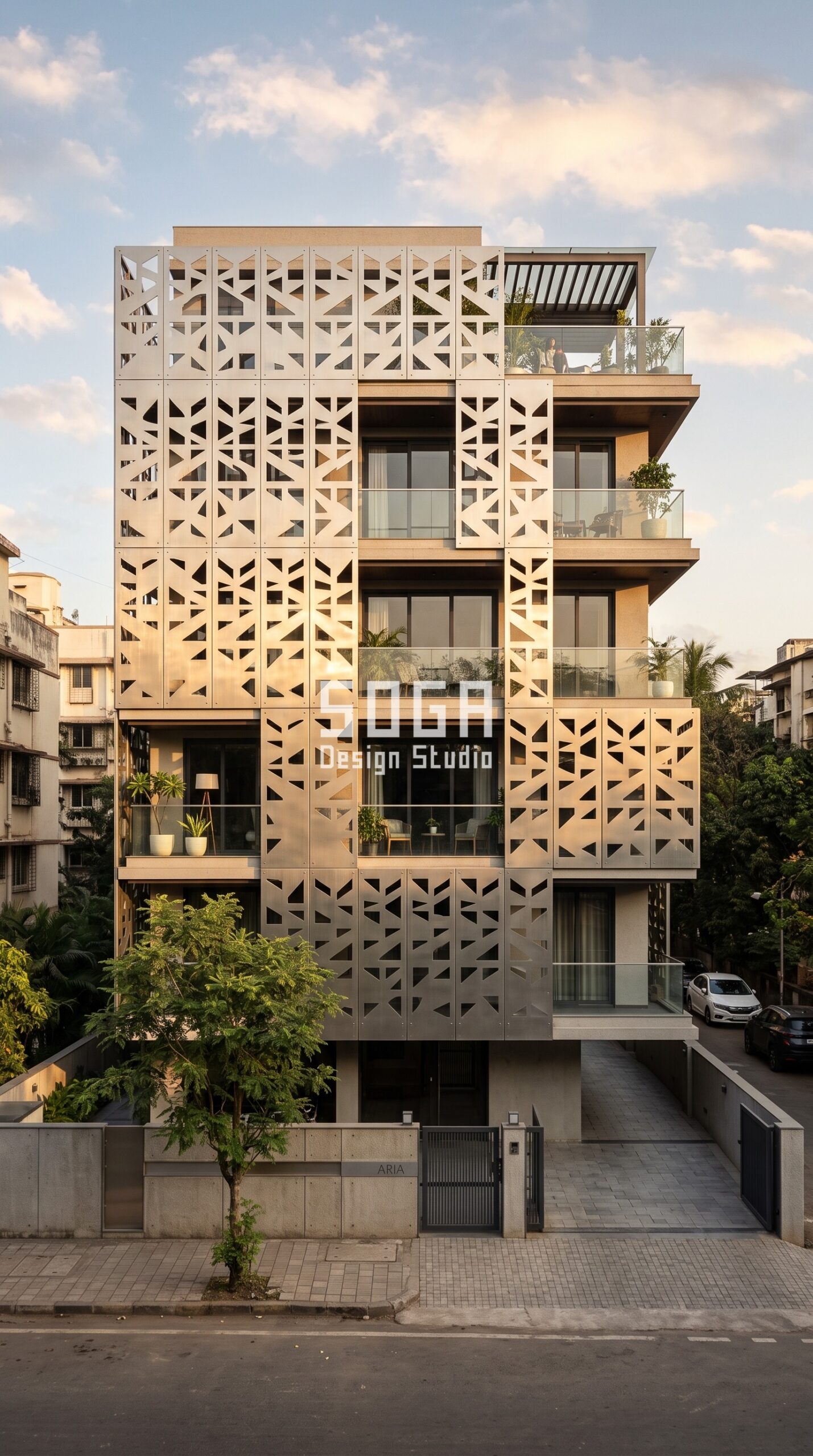
The fourth test is the one every Mumbai plot sets: how do you get privacy from the building eight metres away without living in the dark? This G+4 Powai study uses a Parametric Etch Screen – a precision CNC-cut screen in matte brushed stainless steel with a hairline finish, its angular openings shifting density across the elevation. The pattern is tight where bedrooms face the neighbour and opens up where the plot looks toward the lake, so a single panel family does two opposite jobs. Hairline stainless was chosen deliberately for coastal Mumbai, where powder coat on the wrong substrate chalks within a few monsoons. By late afternoon the screen stops being a barrier at all and becomes a light filter, laying a shifting geometric pattern across the floors inside. Privacy you can see out of is the whole point.
Cost Benchmarks for Indian Parametric Metal Facades
One of the most-asked questions on a Gurugram project brief is budget. The current all-in installed rates for parametric metal facades in India sit in the following ranges:
- Steel facade (full design + install): ₹1,200–₹2,800 per sq ft
- Aluminium, anodised or powder-coated: ₹800–₹2,500 per sq ft
- Zinc cladding: ₹1,500–₹3,000 per sq ft
- ACM panels (3 mm basic): ₹200–₹250 per sq ft (basic)
- ACM panels (4 mm): ₹250–₹350 per sq ft
- Solid aluminium panels: ₹800–₹1,800 per sq ft
- Installation labour: ₹50–₹150 per sq ft (varies by height + access)
- Conventional cladding (for comparison): ₹400–₹1,200 per sq ft installed (stone veneer / ceramic / standard ACM)
These figures are baseline; actual project cost depends on facade area, panel complexity, fabricator location, and finish specification. SOGA Design Studio prepares an itemised cost estimate as part of every consultation so the budget conversation starts with hard numbers rather than guesses.
Parametric Facade Design Across India, Dubai & Singapore
Retrofit is the fastest-growing segment of today’s Indian facade market and SOGA Design Studio is investing heavily in it. A lightweight aluminium parametric screen mounted on stand-off brackets can transform a tired 1990s or 2000s Gurugram apartment block in 4 to 8 weeks without disturbing tenants or interiors. The economics often surprise owners: a retrofit facade can reset rental yield, reposition a building in the listings, and add visible value at a fraction of the cost of a full reclad. Several of the concepts shown above have direct retrofit variants available on request.
Why Trust SOGA Design Studio for Facade Design in Gurugram
- Experience: SOGA Design Studio has been running a daily parametric facade study series since 2023, developing concepts for real Indian G+3 to G+7 plots across Gurugram, Chandigarh, Mumbai, Delhi NCR, Bangalore, Hyderabad and Pune – including the awkward ones: 24-foot frontages, west-facing elevations and buildings already under occupation.
- Expertise: Every study is developed as a parametric system rather than a picture: module size and repetition set for standard sheet widths, panel depth and angle tuned per orientation from a solar study, and a single repeatable fixing detail carried through to fabrication drawings with vetted Indian fabricators in powder-coated steel, anodised aluminium, stainless and zinc.
- Authority: SOGA Design Studio works as a specialist facade design practice for Indian residential and boutique commercial projects, publishing costed, buildable studies rather than mood boards – the same detailing logic the studio uses on live projects in India and for NRI clients in Dubai, Singapore and the UK.
- Trust: Cost bands quoted here are 2026 Indian supply-and-install ranges, given as ranges because height, access and finish move them; every enquiry gets an itemised estimate before any commitment. Free no-obligation consultation, and a fully remote drawing-approval workflow for NRI owners.
Frequently Asked Questions
What makes a good facade design?
A good facade passes four practical tests, not an aesthetic one. It has real depth so it self-shadows and changes through the day instead of reading flat. It is built from a repeating module that a fabricator can press and a site crew can hang with one detail, so it survives value engineering. It responds to its orientation – denser where the sun or the neighbour is, open where the view is. And its material suits the local climate: powder-coated steel or anodised aluminium inland, hairline stainless or marine-grade finishes on the coast. If a concept fails any of those, it is a good picture, not a good facade.
How much does a good metal facade cost per sq ft in India in 2026?
In 2026 Indian supply-and-install ranges are roughly ₹800–₹2,500 per sq ft for anodised or powder-coated aluminium, ₹1,200–₹2,800 per sq ft for steel, and ₹1,500–₹3,000 per sq ft for zinc. Solid aluminium panels run ₹800–₹1,800 per sq ft, while basic 3mm and 4mm ACM sits far lower at ₹200–₹350 per sq ft. Installation labour adds ₹50–₹150 per sq ft depending on building height and site access. For comparison, conventional cladding such as stone veneer or ceramic runs ₹400–₹1,200 per sq ft installed.
How do I know if a facade design can actually be built on my plot?
Ask for three things before you approve an elevation. First, the module drawing – what is the repeating panel size, and does it divide cleanly into your frontage? Second, the fixing detail – how does the panel meet the RCC frame, and is it the same detail everywhere or twenty special cases? Third, a panel count and an indicative rate per sq ft from an actual fabricator, not a lump-sum guess. If a designer cannot produce those, the concept has not been engineered yet and the cost you have been quoted will move.
Which facade material lasts longest in Indian weather?
Anodised aluminium and architectural-grade powder-coated aluminium typically hold colour and finish for 20–25 years inland with only periodic washing, which is why they dominate Indian residential work. Powder-coated steel performs similarly when properly galvanised and detailed for drainage. On coastal sites such as Mumbai, Chennai or Kochi, hairline or marine-grade stainless steel is the safer choice, since ordinary coatings chalk faster in salt-laden air. Zinc and copper weather rather than fail and last longest of all, at a higher initial cost.
Is a metal facade suitable for a G+3 or G+4 residential plot?
Yes, and small plots often benefit most. On a G+3 or G+4 the facade is usually the only elevation anyone sees, so a depth-bearing metal screen does more visual work per rupee than any other spend. Scale the module down so the pattern does not overwhelm a four-storey frontage, keep the system to one panel family to protect the rate, and concentrate density where privacy is needed. Two of the four studies here are G+4 and G+6 buildings on ordinary urban plots.
Can NRIs get a facade designed and built in India remotely?
Yes. SOGA Design Studio runs a fully remote workflow for owners in Dubai, Singapore, the UK and the US: concept and options shared as drawings and photoreal studies, revisions handled over scheduled calls, then fabrication drawings and a costed panel schedule issued directly to the fabricator and site team in India. Site progress is reported with photographs against the approved drawings, so approval never depends on you being in the country.
How much heat does a metal facade actually cut?
A ventilated metal screen set away from the wall or glass line works in two ways: it shades the surface behind it, and the cavity lets hot air rise away instead of soaking into the slab. On west and south-west elevations in cities like Gurugram and Hyderabad this typically produces a noticeable drop in surface temperature behind the screen and a measurable reduction in afternoon cooling load, with the exact figure depending on screen density, cavity depth and glazing spec. The benefit is largest on the elevations that currently get direct afternoon sun.
Why is parametric architecture suited to the Indian climate?
India’s combination of intense sun, monsoon humidity, and dense urban context demands a ‘smart skin’ rather than a static wall. Parametric facades let designers tune perforation density, panel depth, and orientation per building per orientation — cutting solar heat gain by 25–40% while boosting cross-ventilation. The approach also reinterprets centuries-old metal shadow screening for modern G+3 and G+4 buildings.
How long does a powder-coated metal facade last in Indian conditions?
Quality powder-coated aluminium or galvanised steel facades, when correctly detailed and ventilated, last 25–30 years before recoating is needed — even in coastal Mumbai, Chennai, and Kochi. Anodised aluminium and pre-patinated zinc/copper can exceed 40 years. Maintenance is annual rinse-down only; no repainting like traditional plaster facades.
What is a kinetic facade and is it practical for Indian residences?
A kinetic facade has moving panels — louvres, rotating fins, or actuated screens — that respond to sun angle, occupancy, or wind. For mid-rise Indian residences, the practical version is ‘pseudo-kinetic’: a static parametric pattern that creates the visual illusion of motion as the sun tracks across it. True actuated kinetic systems are typically reserved for premium G+10 and above commercial buildings.
How much heat does a parametric metal facade actually reduce?
Independent studies on Indian residential applications show double-skin parametric metal screen facades reduce direct solar heat gain by 25-40% on west and south orientations, dropping interior surface temperatures by 4-7 deg C compared to bare RCC. The shaded gap also enables passive cross-ventilation. SOGA Design Studio tunes the screen opening density based on each orientation solar load.
Is parametric design suitable for G+3 and G+4 residential plots?
Absolutely — it is in fact the highest-growth segment in India. G+3 and G+4 plots benefit most because the entire facade is visible from the street, so a sculptural parametric treatment yields maximum identity per rupee invested. SOGA Design Studio specialises in this typology, with concepts adapted to standard 30×40, 40×60, and 50×80 ft plots across Indian metros and tier-2 cities.
Parametric metal facade vs traditional stone or paint — which is better long-term?
Stone is heavy, expensive (₹600–₹1,500 per sq ft just for material), and difficult to repair when chipped. Paint requires repainting every 4–6 years in Indian conditions. A powder-coated parametric metal facade has higher upfront cost but a 25–30 year service life, zero repainting, and far stronger street identity — making total cost of ownership lower over a 20-year horizon. It is also significantly lighter, reducing structural cost on G+3 and above.
How much does a parametric metal facade cost per square foot in Indore?
Currently, all-in parametric metal facade rates in India range from ₹800–₹2,500 per sq ft for aluminium and ₹1,200–₹2,800 per sq ft for steel, installed. SOGA Design Studio prepares itemised estimates as part of the consultation.
What is a sculptural petal-shaped metal fin facade?
SOGA Design Studio addresses this question in detail during the design consultation. For Gurugram projects, we provide a fully customised answer based on plot, orientation, and budget — typically within 48 hours of receiving the brief.
Related Reading
- parametric facade design in India
- whether to reclad or rebuild an ageing facade
- facade design company in India
- Facade Design in Pune 2026: Parametric Metal Facade Guide
- Facade Design in Coimbatore 2026: Parametric Metal Facade Guide
- Hotel Facade Design in India 2026: Parametric Metal Facade Ideas for Hotels & Resorts
Start Your Facade Project With SOGA Design Studio
A good facade is not the most striking image in the presentation – it is the concept whose depth, module and fixing detail are still intact on the fabrication drawing.
If any of the 3d honeycomb triangular extruded pe concepts above resonate with your project, send us your brief. SOGA Design Studio delivers customised parametric facade concepts for India, Dubai, Singapore, and the UK.