The shade card is the happiest twenty minutes of an elevation project. Everybody agrees, somebody photographs the chip against the wall, and the colour is signed off in an afternoon. Three summers later the same family is standing on the same road asking why the top floor looks like a different building from the bottom one. Nothing was cheated. The panels are the ones that were ordered and the colour is the one that was chosen. What nobody discussed that afternoon is that a colour is not a decision you make once – it is a decision the sun keeps re-making, every day, at a rate set by how the elevation is built. Below are four residential elevations developed across Hyderabad, Gurugram, Mumbai and Pune, each in a deliberately difficult colour, and each showing a different part of why some Indian elevations hold their colour and some quietly surrender it.
Elevation Colour Fading in India: What Actually Fades, and Why
Elevation colour fading in the Indian sun is not the colour giving up – it is the coating giving up. Ultraviolet light breaks down the binder that holds the pigment on the panel; the surface chalks, the gloss dies, and only then does the colour appear to lighten. So elevation colour fading in India is settled by three decisions taken before anyone opens a shade card: the coating class the panel is finished in, the pigment family that colour belongs to, and the share of that colour actually pointed at the sky. The third one is architectural, and it is the one almost nobody prices. A screen whose surfaces are turned away from the vertical midday sun keeps its colour longer than a flat wall in the same finish, on the same street, facing the same way. That is why colour life belongs in the geometry conversation, not only the finishing one – a point we develop across our work in parametric facade design in India.
1. Hyderabad: The Blue That Survives Because It Looks Sideways
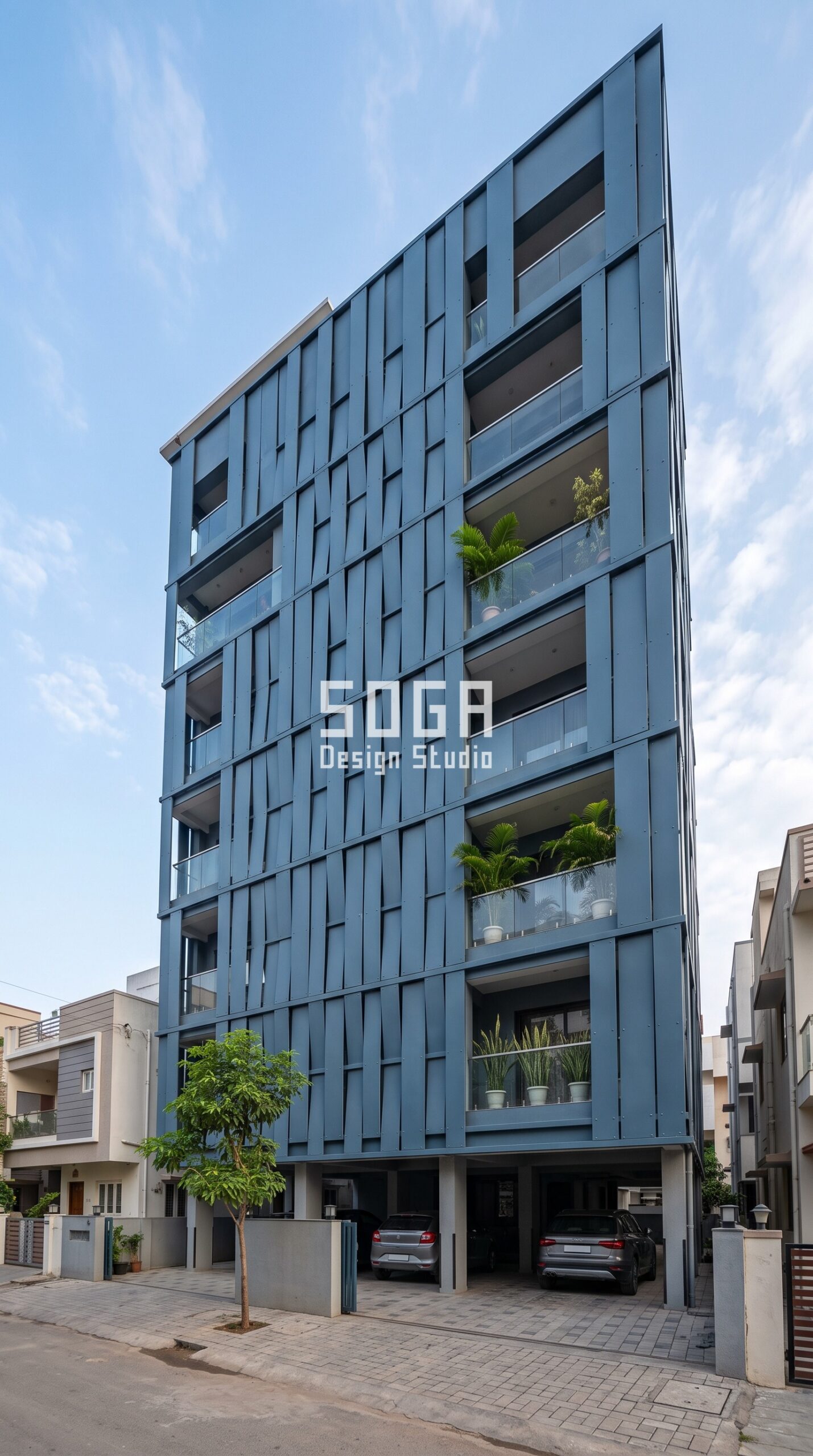
This G+8 in Kondapur is finished in a slate ocean blue, and blue is the colour most likely to disappoint a client in India – the pigment families that give you a deep saturated blue are, as a class, among the less stable under a sustained ultraviolet load. The interesting part is not the colour, it is where the colour sits. The screen is a woven field of flat strips, fourteen per floor on a grid that never changes; the only thing that varies is how far each strip steps forward off the wall, from dead flush to about 200 mm, roughly the width of an open hand. That step turns a large share of the blue into side faces – returns that see plenty of sky but almost never the vertical midday sun. Run the same blue on a flat wall in the same locality and you have put every square foot of it into the worst available orientation. Run it here and a meaningful fraction of the colour is standing in its own shade for most of the day. The geometry did not make the pigment better. It reduced how much of the pigment had to be brave.
2. Gurugram: Why a Metallic Bronze Punishes a Bad Coating Twice
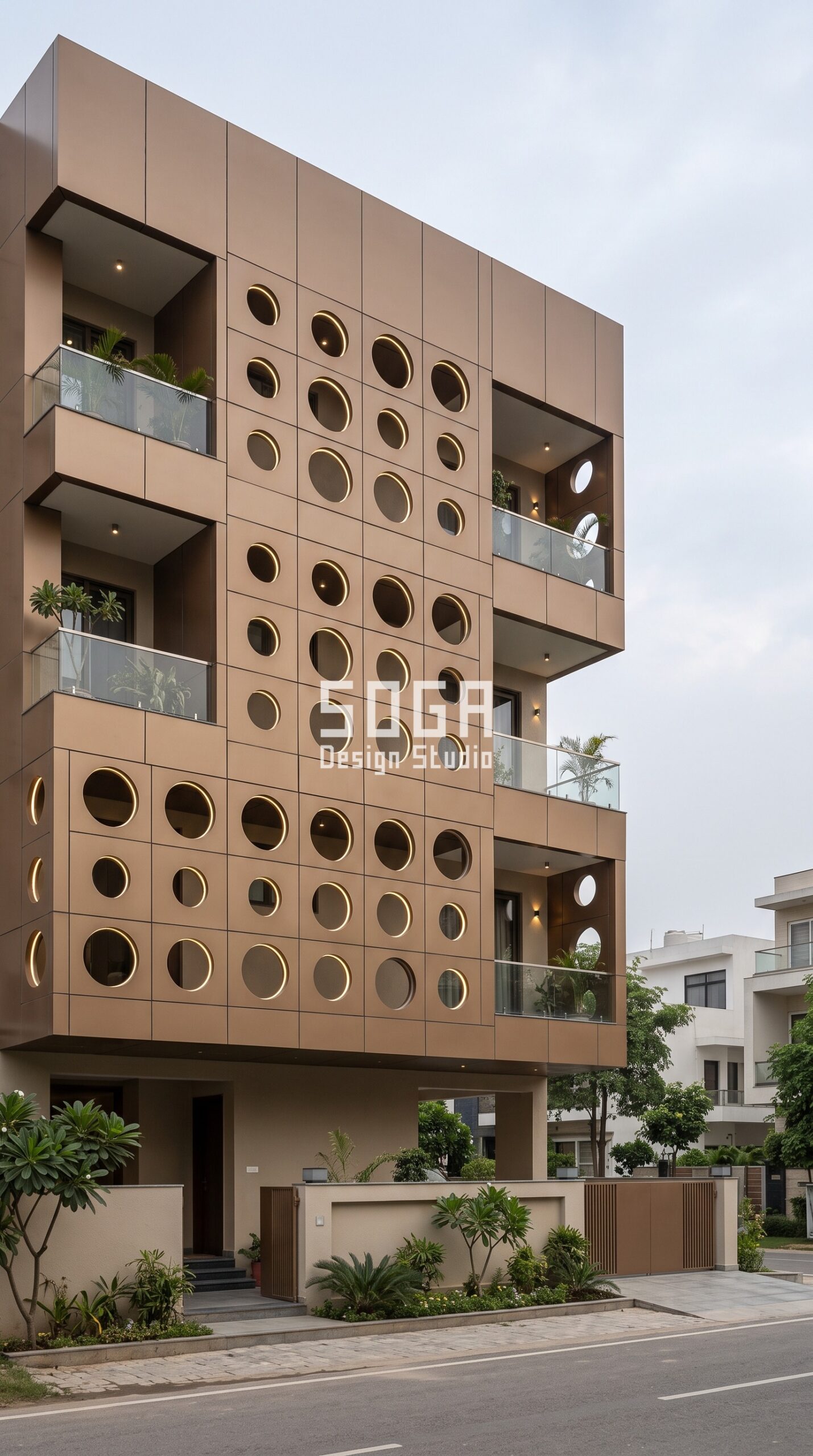
The Golf Course Road building carries a warm brushed bronze – a metallic finish, which ages differently from a solid colour. A solid colour lightens more or less evenly and reads as a slightly tired version of itself. A metallic does not: how it reads depends on how light strikes the flake in the coating, so when the surface chalks the building goes patchy and directional rather than simply paler. This facade puts that risk on display deliberately. The panel field is flat and sun-facing, pierced by round openings that step from about 200 mm – a dinner plate – up to about 700 mm, a car tyre, on a grid identical floor to floor. The flat field takes the full sun; the returns inside every opening sit permanently shaded. On a properly specified architectural coating the two stay together for the life of the panel. On an economy coating you get rings – a halo of original colour around every opening, on a field that has moved on without it. Which is why on a bronze we settle the coating class before we settle the shade, not after.
3. Mumbai: The Two-Tone Building You Can Read Off the Section
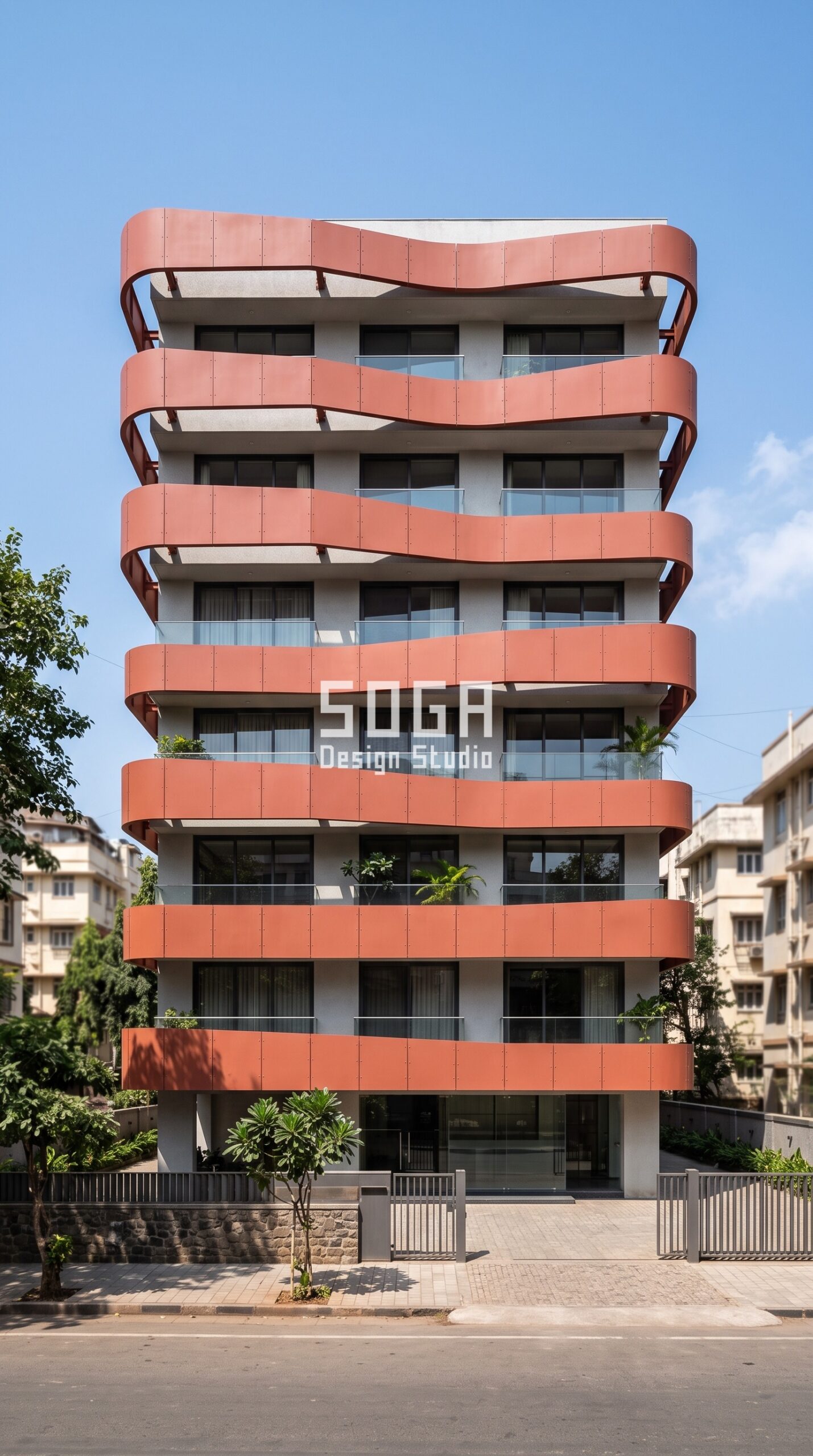
Terracotta red on a G+5 in Malabar Hill is the boldest colour in this set and the one with the longest local folklore – every Indian city has a red building that went pink. Mumbai adds two problems to the usual ultraviolet load: salt-bearing coastal air, and monsoon rain that scrubs a chalking surface far more thoroughly than a dry-city facade is ever scrubbed. The geometry here is a single continuous band at every floor, six in all, each sitting on the same slab-edge line; the only variable is how far the band bows outward, from about 250 mm – a forearm – to about 900 mm, a full arm’s reach. That bow permanently divides each band into a top face that never escapes the sun and an underside that never receives it. On a coating that is not up to the coastline, that division becomes legible from the street within a few seasons: pink on top, terracotta underneath, on one continuous piece of metal. It is an unforgiving detail, and that is exactly what makes it useful – a Mumbai elevation shaped like this tells you the truth about its own finish earlier than a flat one does.
4. Pune: The Honest Option – Choose a Colour That Does Not Advertise Its Age
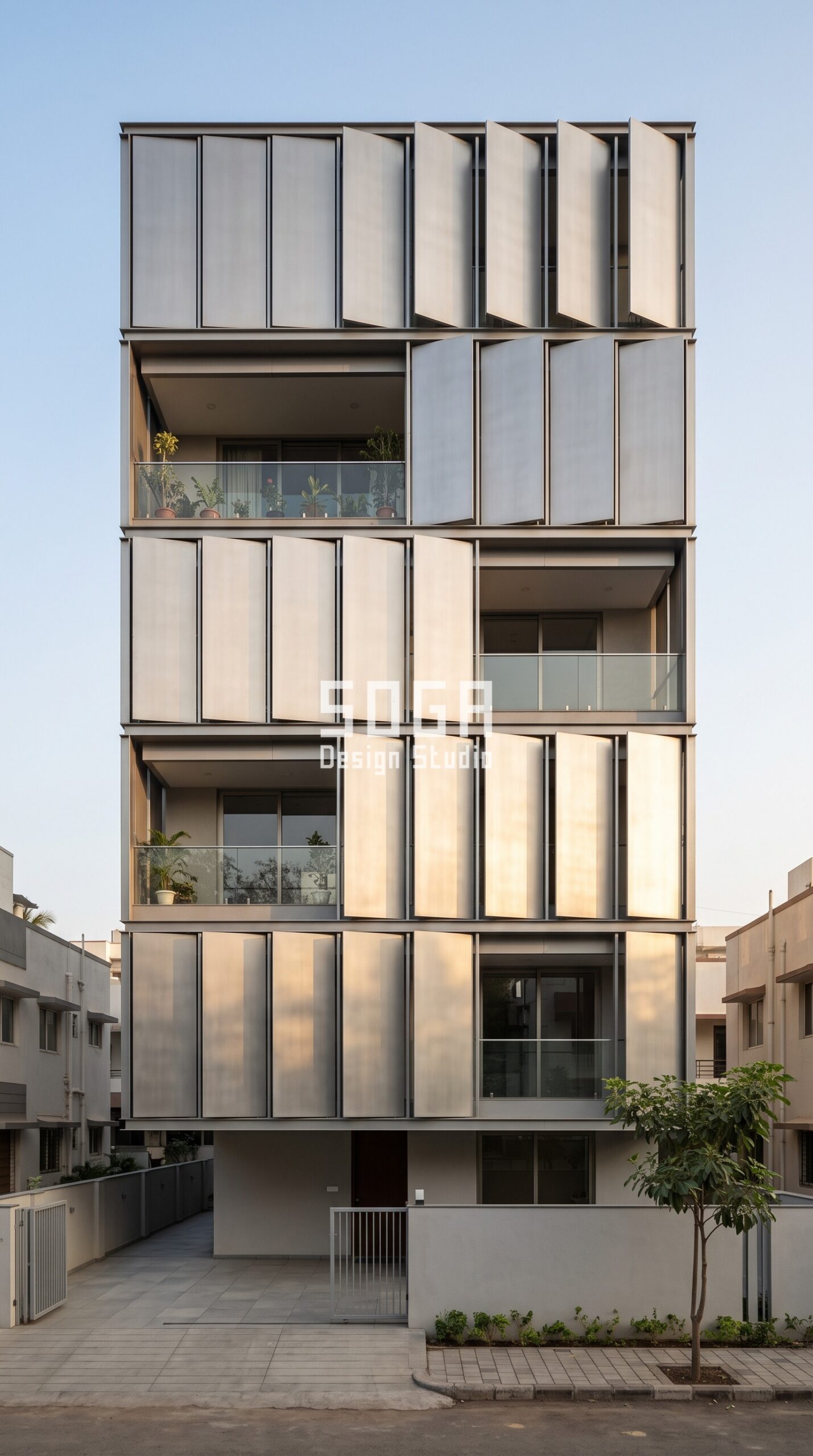
Not every project can carry a premium architectural coating, and pretending otherwise is how clients end up disappointed. The Koregaon Park building is the answer for that budget: a double-skin elevation whose outer panels are brushed silver, standing about 600 mm clear of the glass behind. Twelve identical panels per floor sit on a fixed grid and the only variable is the tilt on each vertical pivot, from flat to about 30 degrees, a little less than an open laptop lid. On a strongly coloured facade that tilt gradient would be a liability, because each panel presents a different angle to the sun and would therefore age at a different rate, printing the gradient permanently into the elevation. On a near-neutral metallic there is very little chromatic pigment to lose, so the same gradient reads as a gradient of light instead – different every hour, and no worse in year eight than in year one. That is the honest trade this building makes: if you cannot fund the coating that protects a saturated colour, do not buy the saturated colour. Buy the geometry, and let the light do the work the pigment was going to be asked to do.
What Colour Life Costs: 2026 Elevation Rates in India
Colour life is bought at the specification stage, so it is worth seeing where the money actually sits before deciding what to protect. These are our current all-in installed rates in India, and the spread inside each band is largely the finish, not the metal:
- Steel facade (full design + install): ₹1,200–₹2,800 per sq ft
- Anodised or powder-coated metal panels: ₹800–₹2,500 per sq ft
- Zinc cladding: ₹1,500–₹3,000 per sq ft
- ACM panels (3 mm basic): ₹200–₹250 per sq ft (basic)
- ACM panels (4 mm): ₹250–₹350 per sq ft
- Solid metal panels: ₹800–₹1,800 per sq ft
- Installation labour: ₹50–₹150 per sq ft (varies by height + access)
- Conventional cladding (for comparison): ₹400–₹1,200 per sq ft installed (stone veneer / ceramic / standard ACM)
Read those ranges as a coating story. The distance between the bottom and the top of the powder-coated band is not mostly panel thickness – it is the class of finish on the panel, which is precisely the decision that determines whether the elevation still looks like itself in year ten. A composite sheet at the ₹200-₹350 end can be a perfectly sound choice on a sheltered face and a regret on a west one, and the difference is a specification line, not a different building. When we cost an elevation we split it that way on purpose, so the conversation is about what each rupee is buying rather than one number at the bottom of a page.
Choosing a Colour From Dubai, Singapore or the UK
Colour is the hardest thing to sign off from another country, and a large share of our clients are doing exactly that – building in India from Dubai, Singapore, the UK, the US or Australia. A shade code photographed on a phone under a Gulf sky is not the colour that will stand on a Hyderabad street in May, and a chip approved on a laptop screen tells you nothing about how the finish will hold. So for remote clients we invert the order deliberately: we agree the coating class and the pigment family first, in writing, and only then look at shades within what that class can actually hold. Physical samples go to the client’s own city so the colour is judged in daylight rather than on a screen, and the large sample is photographed on site at the same hour on the same wall through the design period. It is a slower way to pick a colour and it is the only one that survives the distance.
Why Trust SOGA Design Studio for Facade Design in Hyderabad
- Experience: We have taken 900+ facade and elevation projects across India, Dubai and Singapore from concept through fabrication and site – which also means going back to elevations detailed years ago and seeing for ourselves which surfaces held their colour and which did not.
- Expertise: Our specifications name a coating class and a pigment expectation, not only a shade code, and we analyse orientation elevation by elevation, because a south or west face is a different durability problem from a north face on the same building.
- Authority: SOGA Design Studio is a Gurugram-based facade studio co-founded by Gajender Jaiswal and Sonali Jaiswal, and is one of the few studios in India that carries its own parametric geometry through to fabrication drawings.
- Trust: We will say when we are not willing to stand behind a colour on a particular elevation. Talking a client out of a saturated red on an unprotected west face costs us a line item and saves them a repaint.
Frequently Asked Questions
Will my elevation colour fade in the Indian sun?
Every exterior finish changes over time – the honest question is how fast and how visibly. The rate is set by the coating class the panel is finished in, the pigment family your colour belongs to, and the orientation and geometry of the surfaces carrying it. A well-specified architectural coating in a stable pigment on a partly self-shaded screen can look essentially unchanged for many years. The same colour in an economy coating on a flat, unshaded west wall is the case everybody remembers.
Which facade colours fade fastest in India?
As a family, the highly saturated colours are the demanding ones – deep reds, bright oranges, strong blues and vivid greens – because the pigments that deliver that intensity are generally the less ultraviolet-stable ones. The most forgiving are the earth and neutral ranges: greys, charcoals, bronzes, sand and stone tones, and near-neutral metallics such as brushed silver, where there is little chromatic pigment to lose in the first place. Treat this as a guide to risk, not a ban – a saturated colour in the right coating on the right geometry is entirely buildable.
Does the direction my elevation faces change how fast it fades?
Substantially. In India the south and west faces carry the heaviest annual sun load, so the same panel in the same colour ages fastest there and slowest on a north face. This is why we would rather run two coating specifications on one building than one specification everywhere – and why an elevation with real depth, where many surfaces are turned away from the vertical midday sun, buys colour life a flat wall in the same finish simply cannot.
Is powder coating or a fluoropolymer coating better against fading?
They are different classes. Standard polyester powder coating is the economy option and is entirely reasonable on sheltered or low-exposure elevations. Fluoropolymer architectural coatings are the class specified where colour retention on a fully exposed elevation genuinely matters, and they cost more per square foot. Warranty periods and colour-retention limits vary by manufacturer and by colour, so ask for the written warranty for your exact shade rather than the brochure headline – [confirm the specific system warranty with your applicator before you sign].
What does a fade-resistant metal elevation cost in India in 2026?
Using our published 2026 bands: an anodised or powder-coated metal facade runs about Rs 800 to Rs 2,500 per sq ft, a full steel facade installation about Rs 1,200 to Rs 2,800 per sq ft, and solid metal panels about Rs 800 to Rs 1,800 per sq ft, with installation adding roughly Rs 50 to Rs 150 per sq ft depending on height and access. Composite panels sit far lower, from about Rs 200 to Rs 350 per sq ft for the sheet, which is precisely why coating class is the question to ask at that end of the market. The upgrade from an economy coating to an architectural one is a small share of the total and is the single most effective rupee you can spend on how the building looks in year ten.
Can a faded facade be recoated instead of replaced?
Often, yes – and it is usually the right call. If the panels and the substructure are sound then the problem is the finish, not the facade, and a chalked surface can be prepared and recoated in place. A site-applied recoat will not match the durability of the original factory finish, so treat it as a genuine renewal rather than a reset, and expect it to work far better on simple flat fields than on deep screens where reaching every return is difficult. We look at the substructure first: if the fixings and framing are healthy, recoating is a fraction of replacement.
Related Reading
- window grill alternative for a house in India
- modern chajja design in India
- west facing house elevation design
- adding a facade to an existing house
- hiding clothes drying on a balcony
- Parametric Design in Indian Homes 2026: A Complete Guide for Homeowners
- Steel Blue Anodized Metal Cladding for Indian Residences 2026: Wide Undulating Panel Systems
- Arabesque Jali & Geometric Perforated Metal Facades — 4 Indian Residential Concepts 2026
Start Your Facade Project With SOGA Design Studio
You are not choosing a colour. You are choosing a coating class, a pigment family, and how much of that colour you point at the sun – in that order. Get the order wrong and the shade card becomes the most expensive twenty minutes of the project.
If the colour on your elevation is still an open question – or already signed off and quietly worrying you – send us your brief and we will tell you what that shade needs in order to survive your orientation, what coating class it points to, and what the difference costs per sq ft.