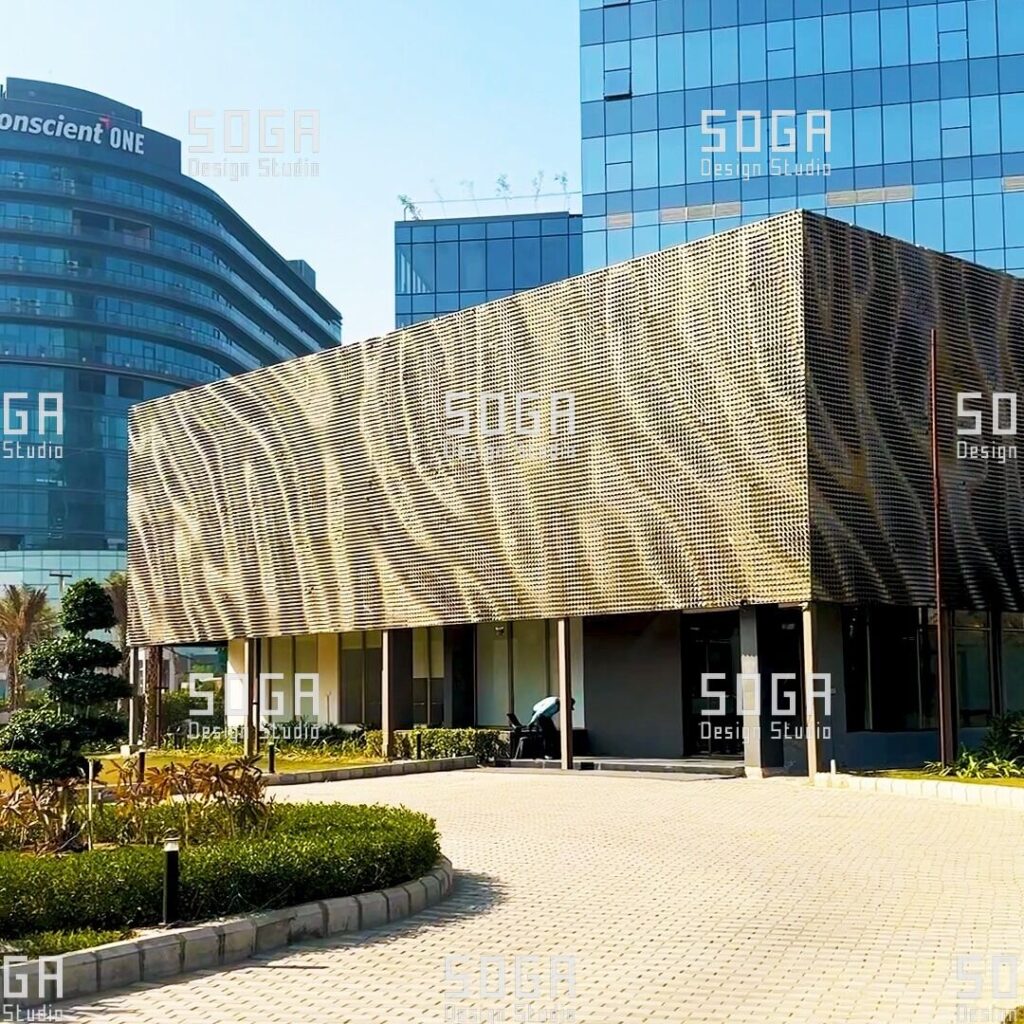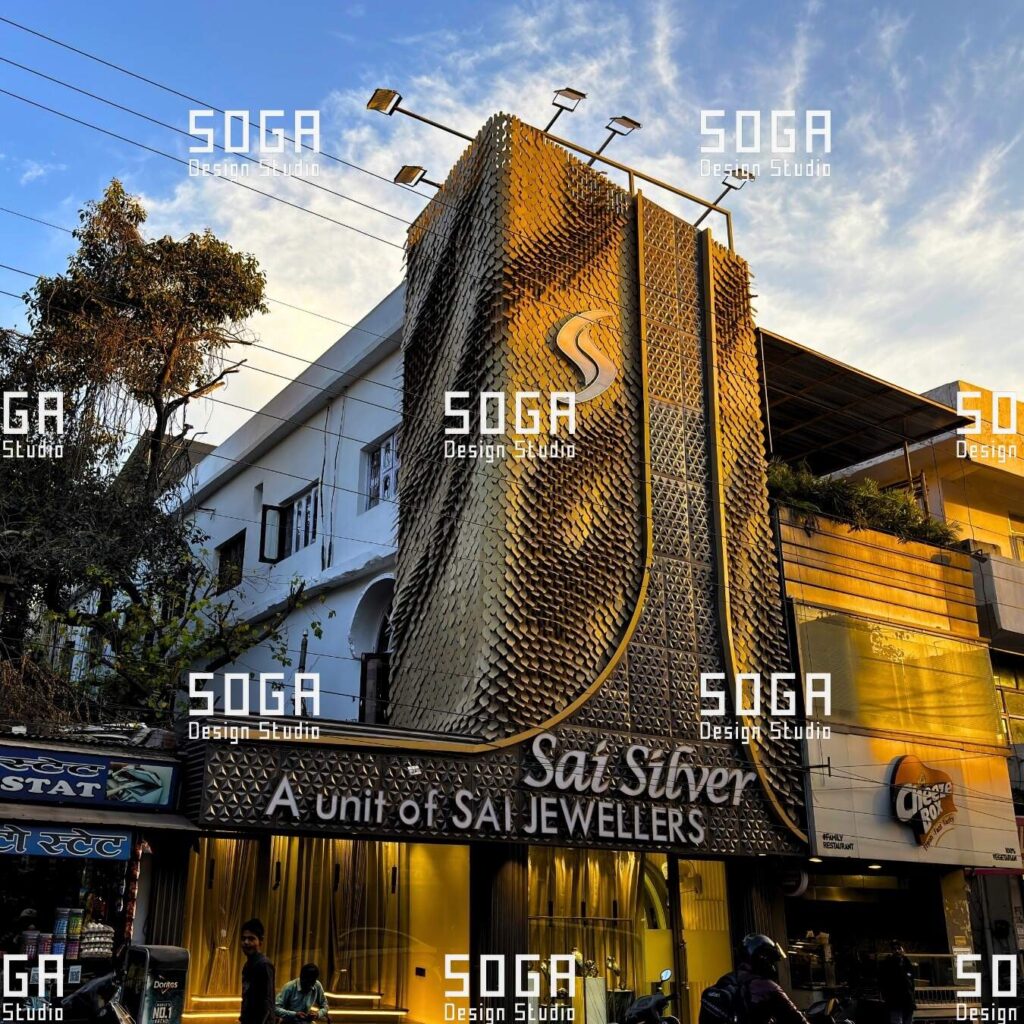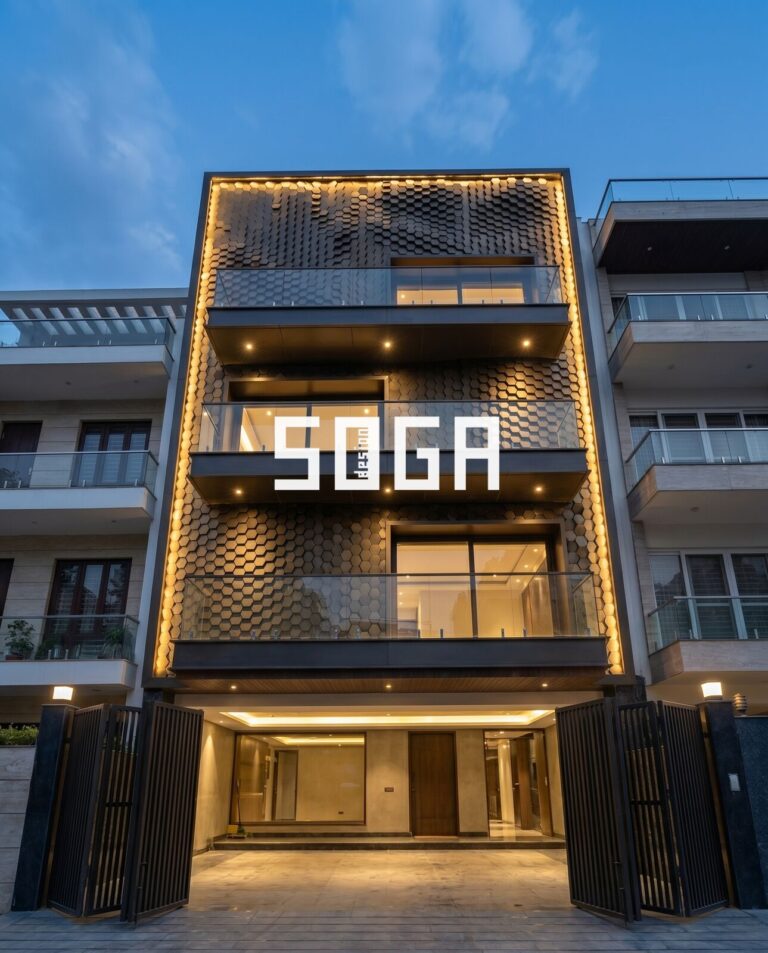
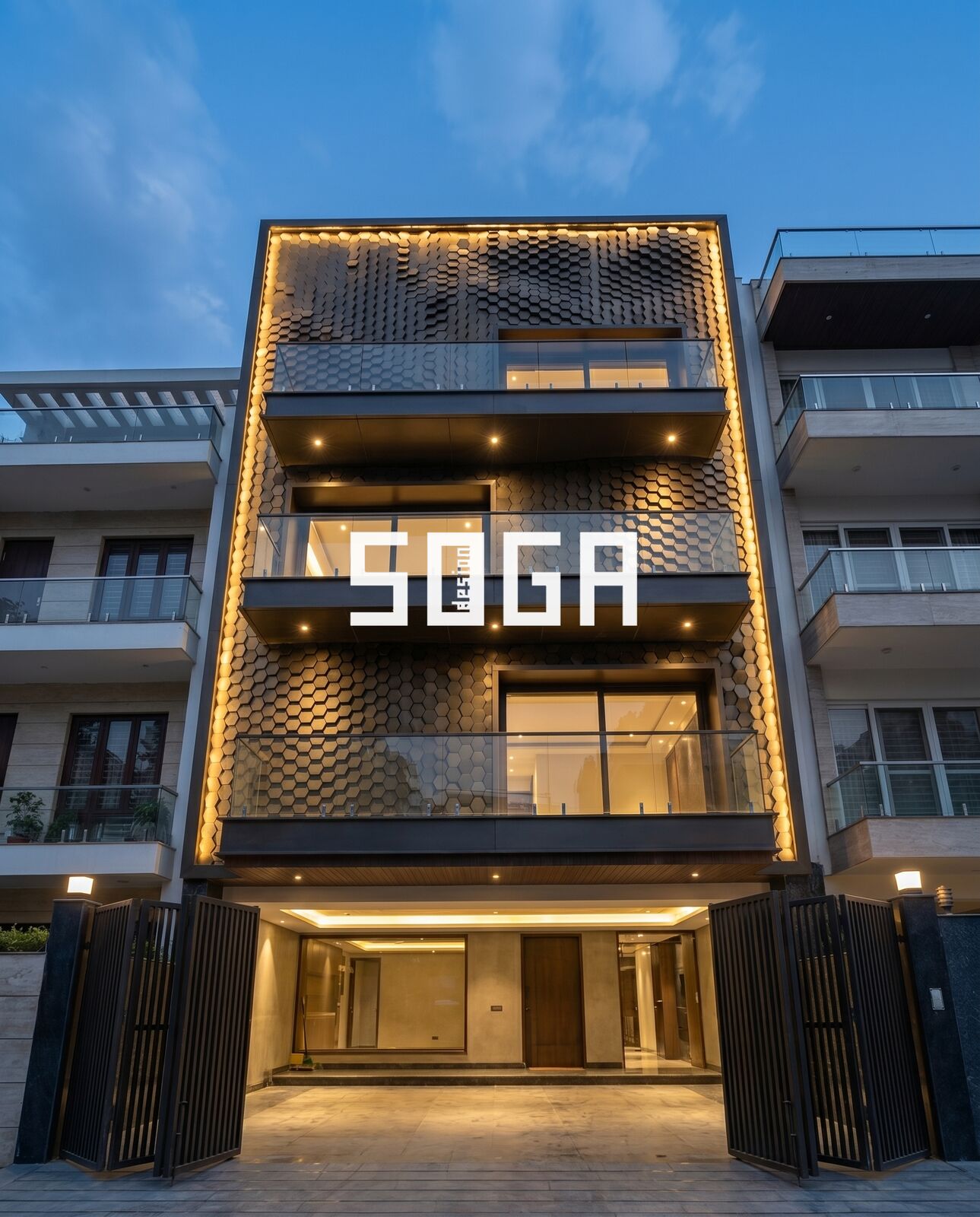
Depth is the only thing that changes. In a 3D block facade the panel outline, the joint and the fixing stay the same, while the face of each panel stands off the wall by a different amount. That one variable produces the whole image, and it is also the one that costs money: every distance the face travels is another setting on a machine.
3D facade panels are usually presented as a shape exercise. The more useful reading is structural. A large flat panel in thin material has almost no stiffness out of its own plane, and it shows every stress locked into it as waviness. Fold the same sheet into a faceted block and it becomes stiff about the axes of its folds. Depth is how the panel holds itself flat.
The SOGA 3D Block Facade is a 3D block facade system developed by SOGA Design Studio for Indian fabrication. What follows comes from that development rather than from a survey of the category: the forming trials, the flatness testing and the cassette work that settled how deep a panel can be folded and still hold a true face.
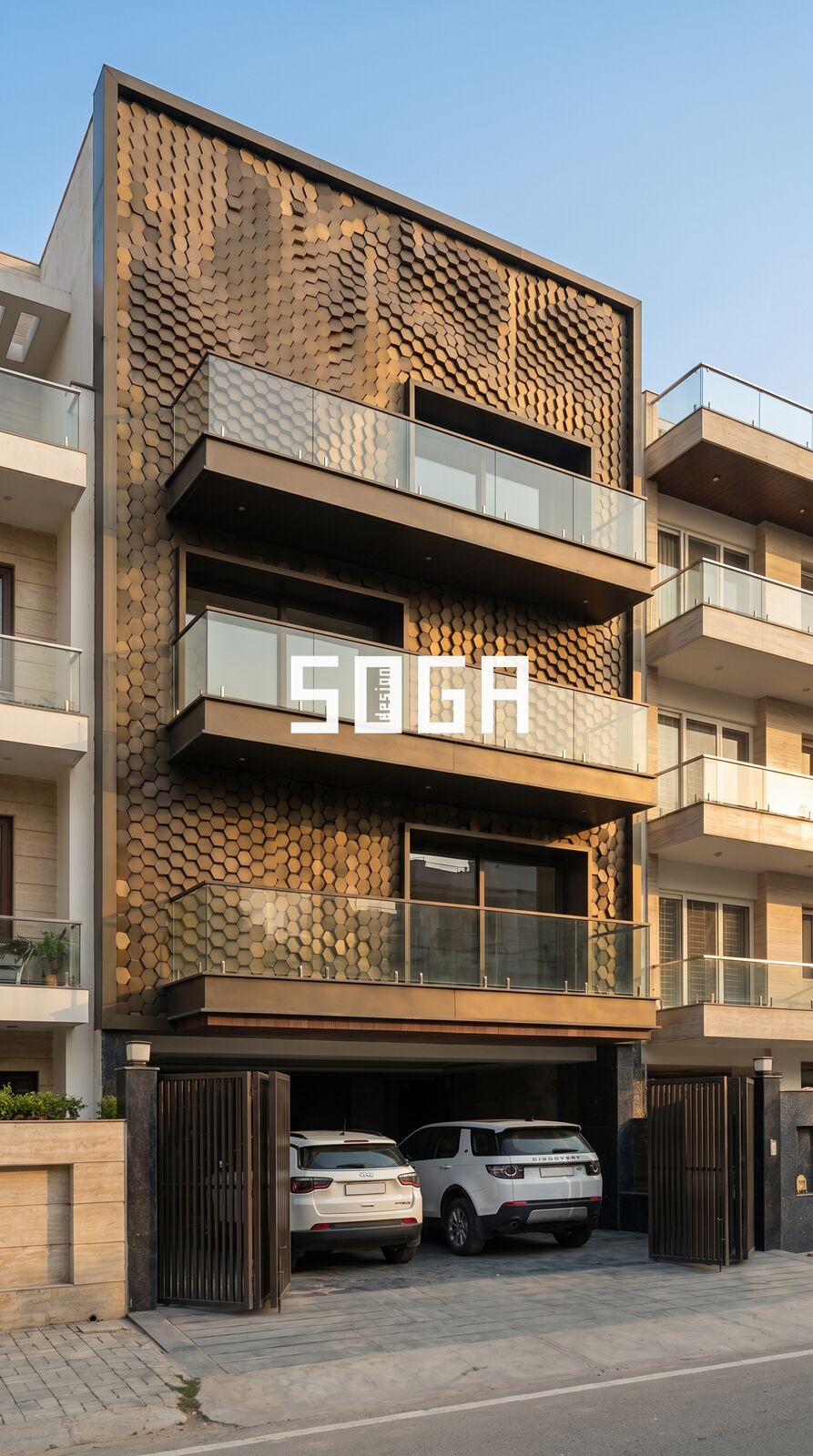
A 3D block facade is a cladding system of folded metal panels whose faces project at varying depths, creating a relief surface that changes with sunlight. Each panel is formed from a flat sheet into a faceted block, mounted as a cassette on a support frame, with joints set out to absorb tolerance and control shadow lines.
What a 3D block facade is
A 3D block facade is an opaque rainscreen layer built from formed panels. Each panel starts as a flat blank, folds into a faceted block, is fixed to or formed into a cassette, and hangs on a support frame off the building. Three distinctions matter more than the visual description. It is a closed surface rather than a screen, so it takes on the appearance obligations of a wall. It is formed rather than cast, so depth is bought in forming time and tool settings instead of mould count. And it is not the weather line: the joints are open and the assembly is drained and back-ventilated, so the wall behind holds the water and air line.
Depth as the primary design variable
The economics rest on a division of labour: the module carries the cost, the depth carries the image. The module is the panel outline, the grid, the joint width, the cassette perimeter and the hook geometry, and all of it repeats without variation, which is what allows long production runs and one fixing family. The depth is the distance the visible face stands proud of that perimeter, and it is the only thing permitted to differ from panel to panel.
That division has to be held strictly. Depth varies inside the panel outline and never at the outline: the cassette perimeter stays in one plane whatever sits in front of it. Let the perimeter move with the depth and every joint between two depths becomes a different shape, the joint line steps in and out along the elevation, and setting out has to be resolved panel by panel instead of once.
Depth is also the expensive parameter: rotation changes nothing about the part, while every extra depth step is another tool setting and another first-article check.
How depth changes shadow, scale and perceived mass
Shadow length on the face follows from the projection and from the angle between the sun and that face. When the sun is low and sweeping close to the plane of the wall, even a shallow projection throws a long shadow. When the sun is high or the sky overcast, the shadow collapses and the pattern survives only as a difference in tone between facets pointing in different directions. Facet orientation therefore has to carry the flat-light case, because under a uniform sky a facet tilted upward is brighter than one tilted downward, and a field that reads only in raking light is blank for most of the working day.
Viewing distance sets the depth, and the useful test is a formed sample seen from the distance the building will be seen from. A projection that reads from the pavement can be invisible across a road, and the error always runs one way: too shallow. Past a certain depth relative to panel width the blocks shade each other, the pattern stops gaining definition and the field darkens — a ceiling reached well before the forming one.
Panel geometry and the fold logic
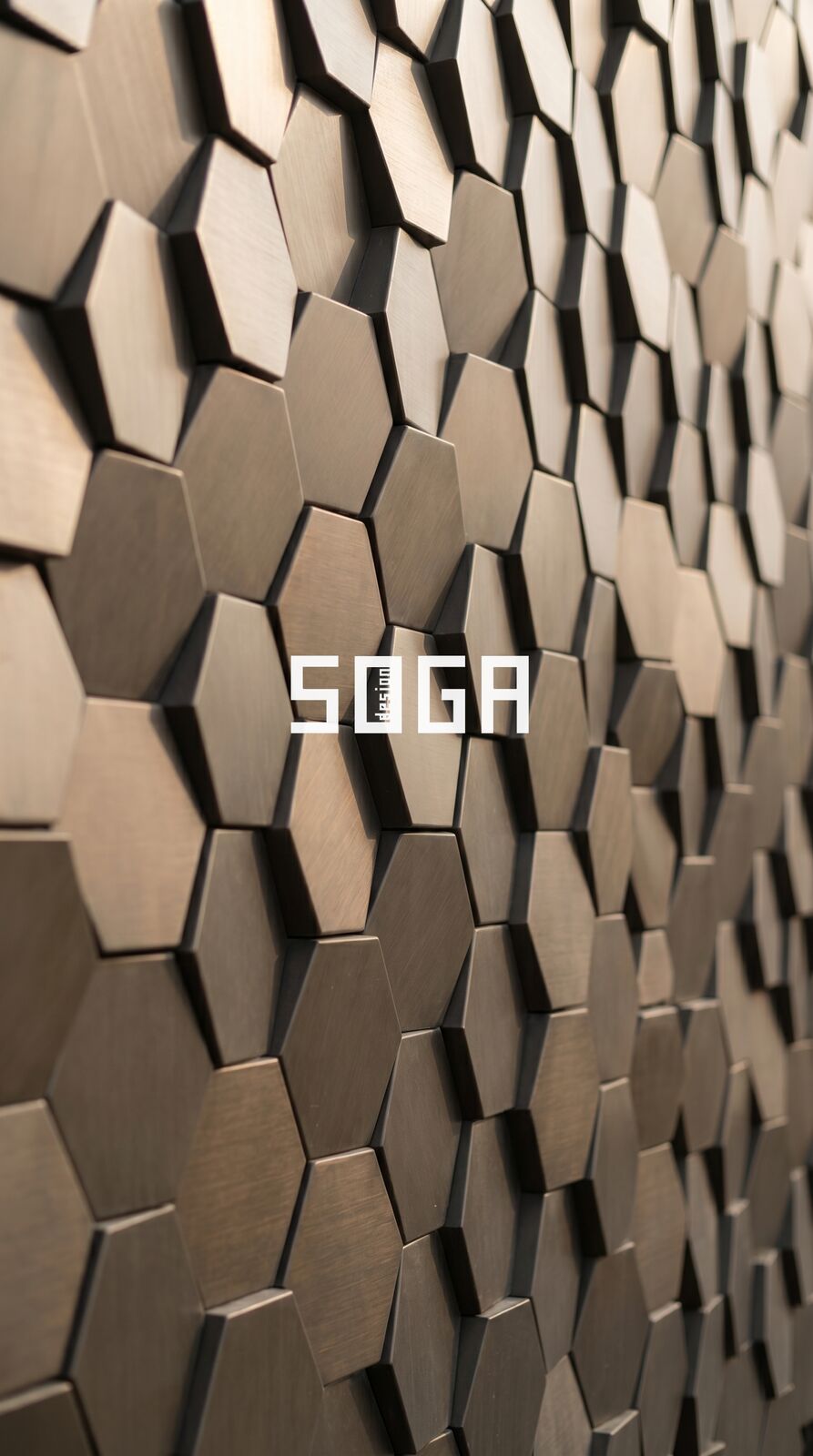
A block panel is a flat blank, a set of fold lines, a visible face, returns and a closed edge. Everything difficult about the system lives in the relationships between those five things.
Developable surfaces, fold lines and closure at edges
Every facet has to be flat or single-curved. A sheet can be bent, but it cannot be made doubly curved without stretching it, which is a different process on different equipment. A block is therefore a polyhedron, and a geometry that reads as a soft dome in a model has to be resolved into flat facets before it can be quoted.
Bend sequence is part of that geometry, because the tool has to reach each fold line without fouling the folds already made, and on a deep block the last bend is often unreachable. Checked while the layout is still adjustable it costs nothing; discovered after the elevation is approved it means a shallower panel or a visible seam.
Springback accumulates. Formed material relaxes after leaving the tool by an amount that varies with thickness, batch and temperature, and on a multi-fold panel each small error passes down the chain to whatever comes last. If the visible face is last in that chain it arrives out of plane. The set-out convention SOGA settled on after the forming trials runs the other way: the face is the datum, the folds are dimensioned back from it, and the take-up is absorbed at the return, where the joint hides it.
Edge closure decides how the panel reads at close range and how long the finish lasts. An unclosed edge shows the thickness of the sheet and presents a cut edge, where coating is thinnest and corrosion starts. Where two fold lines meet, material has to be removed or the corner cannot close.
Panel data required per unit
The panel schedule fails by being incomplete rather than wrong. Each row carries:
- Panel identification number, with elevation, bay and grid reference
- Blank outline and developed size, with nesting orientation
- Depth step designation, fold line positions and angles dimensioned from the visible face, with bend sequence
- Corner relief type, closure method, cassette type, stiffener and hook positions, with fixed and sliding points identified
- Joint width to each neighbour, the flatness requirement for the visible face, and the position mark
The entries most often absent are the fixed-and-sliding designation and the position mark.
Rigidity, flatness and the oil-canning question
Oil-canning is visible waviness in a flat region of a panel. It shortens the life of nothing, which is why it is waved through at design stage and becomes the only subject of conversation afterwards. It cannot be corrected in place: a panel that shows it is replaced or accepted.
The mechanism is stiffness. Bending stiffness in a flat sheet scales with the cube of thickness, so a thin sheet has almost none. Put that sheet under any in-plane compression — rolling stress retained in the coil, a perimeter held rigidly while the sheet expands on a hot afternoon, a fixing tightened unevenly — and it buckles into shallow waves. In raking light those waves are unmistakable from across a street.
A fold answers that directly, and this is the main engineering reason to use depth rather than an aesthetic one. A change of plane gives the panel section depth, and the second moment of area about an axis parallel to the fold rises out of all proportion to the material added.
The qualification matters more than the rule. A fold stiffens the panel about axes parallel to it and does very little about axes perpendicular to it, so a panel with parallel folds is stiff one way and no stiffer than flat sheet the other.
This is why flatness of the visible face is the hard tolerance in the system. The face is usually the largest single flat facet and the one the eye reads, so it carries all the risk a flat panel carries, reduced in area but not in kind. A block that is rigid overall can still oil-can there.
The cheapest response is to break a wide face with a shallow secondary fold: one bend, no extra part, and more stiffness than anything else at that price. Flatness is then specified as a quantity and a method: a permitted deviation over a stated length, measured across the diagonal of the visible facet, in raking light and after finishing. And a cassette held rigidly at every hook cannot expand, so one hook is the fixed point and the rest allow movement.
The cassette and its fixing family
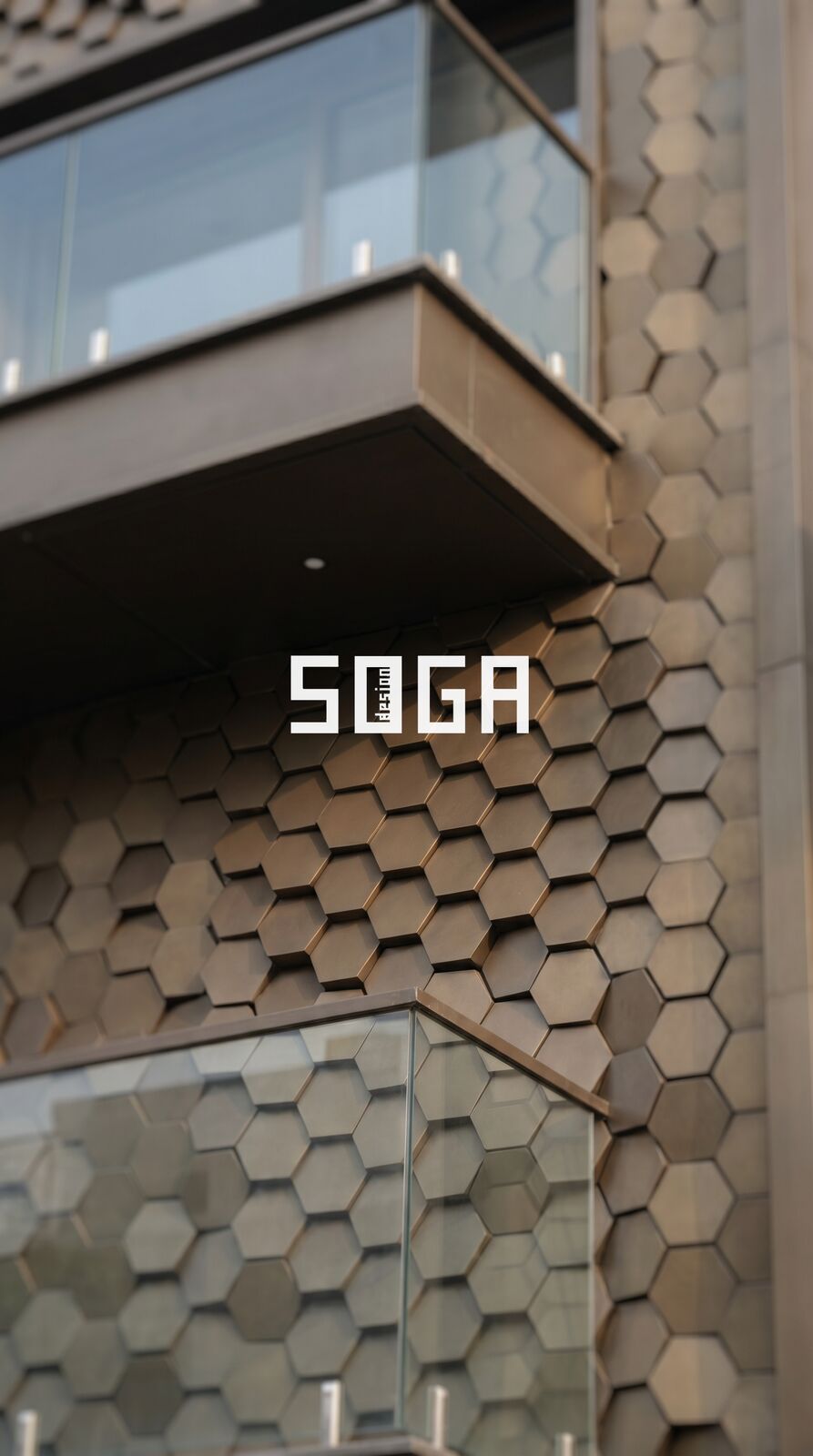
The cassette turns a folded block into something that can be hung, aligned and taken off again, and two arrangements are in use.
An integral cassette uses the panel’s own returns as its frame: the sheet folds back from the face, forms the perimeter and receives the hooks. It is lighter and cheaper, and its limit is the return depth the forming process allows.
An applied cassette carries the block on a separate frame behind it. It costs more and buys the thing that makes the system economical: the hook geometry stays identical however deep the block in front of it is, so the support frame and the setting out do not change when the pattern does. In the version SOGA develops, the depth family sits entirely in front of a constant cassette interface for that reason.
Behind it the fixing family is ordinary rainscreen practice: brackets fix to the structure with adjustment in three axes over a stated range, checked against the deviation the frame is actually being built to. The cassette hangs on the top hooks, with a retention device at the bottom holding it against suction.
The addition is eccentricity. A deep block puts its centre of mass forward of the plane it hangs in, so the hooks carry an overturning moment as well as a vertical load, and that moment grows with depth. In a graded field it varies panel to panel, and grading the fixing to match introduces a site error nobody can detect: the wrong bracket in the wrong bay looks identical to the right one. One hook family sized for the deepest panel is the practical answer.
Suction governs any rainscreen panel, and local coefficients at corners and free edges exceed field values, so edge-zone fixing spacing is not field spacing. Demountability is the requirement most often lost with it: a cassette lifts off its hooks only if the retention device releases from the front.
Joints, shadow gaps and setting out
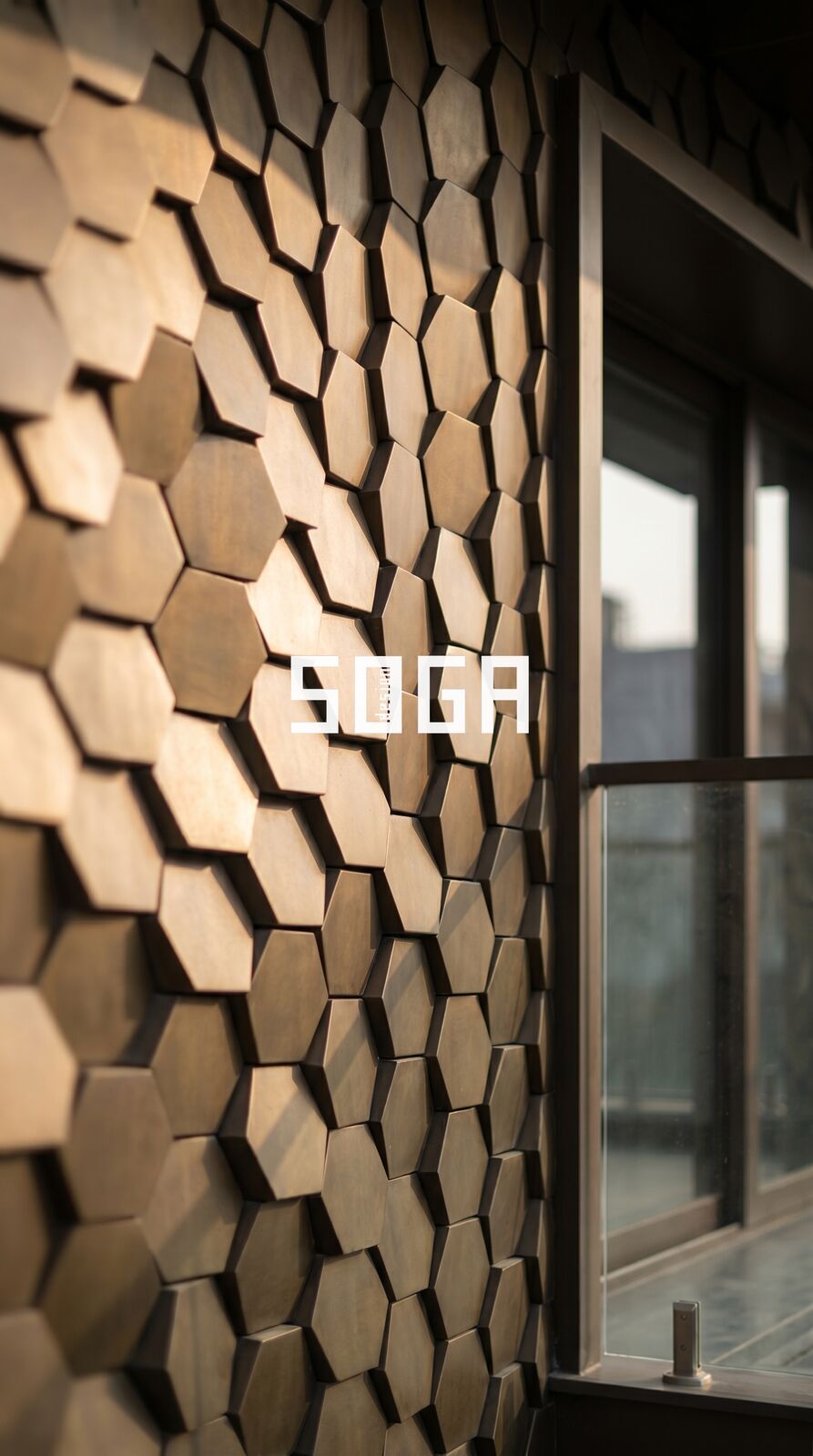
The joint absorbs tolerance, allows movement and draws a line. The third is what the client sees; the first two are what makes the facade fit, so the width is set by arithmetic and checked against appearance afterwards. That arithmetic adds four things: the deviation the structure is being built to, the manufacturing tolerance of the panel, thermal movement across the annual range, and the adjustment an installer needs to work at a reasonable rate. A joint sized only for appearance runs out of room in the corner bay, and the crew closes the gap by moving panels.
On a block panel the joint is a slot with depth, because the panel edges are returns rather than sheet edges. That slot reads as a dark line in almost any light, which is an advantage and a discipline: the line is legible without needing a shadow, and the eye measures the joint rather than the panel. The back of the slot is closed with a dark backing, so the joint reads as a line and not as a view into the cavity.
Setting out starts from a survey of the structure as built, and rails are checked as a set across the elevation before any panel is hung, because a rail line is adjustable while empty and expensive once loaded.
Weather, drainage and back ventilation
The panel stops most of the water and none of the responsibility. Rain crossing an open joint runs down the back of the panel onto the wall behind, so that wall carries a continuous membrane, sealed and taped, with flashings that return water out through the joint line.
Faceted geometry then adds a problem flat panels do not have. Any facet tilted upward is a shelf. Water stands on it, evaporates and leaves what it was carrying behind as a deposit, which streaks down the face below in the next rain; dust does the same more slowly. In most Indian and Gulf urban contexts this, rather than fading or corrosion, decides how the facade looks at five years.
The response is geometric and cheap if it is taken early: no facet is set level, and a small fall in a consistent direction moves water off before it can stand.
The cavity needs free area at bottom and top, mesh at openings that would admit birds or insects, and compartment lines at corners, changes of plane and fire barriers. Wherever the panel material meets a fastener of a different metal in the presence of moisture, isolation is required, or staining appears below every fixing by the third year.
Where depth pays for itself — and where it does not
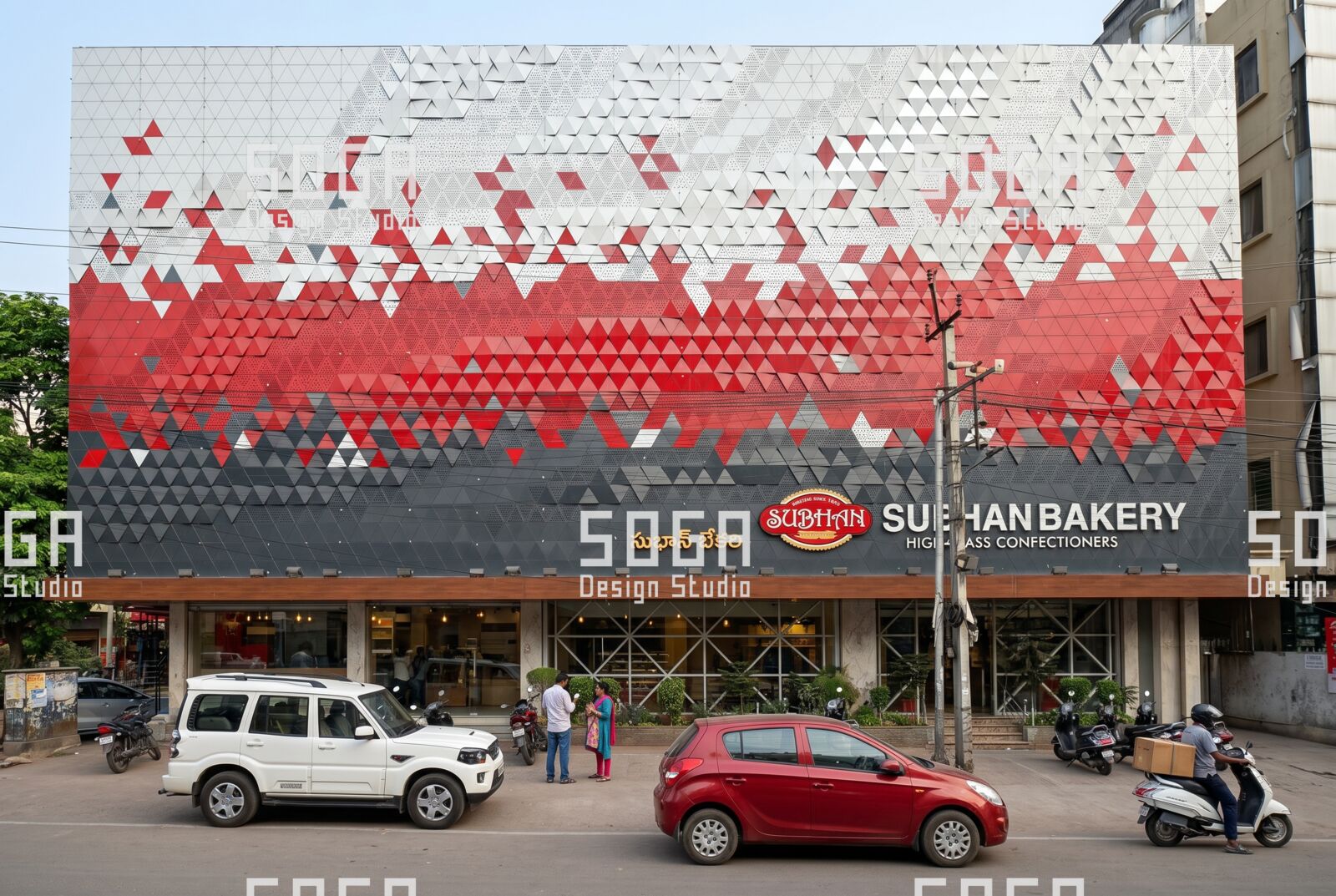
Depth earns its cost where an elevation is large, blank and lit. Podium wraps, car park enclosures, plant rooms, service cores and the solid ends of residential blocks all have to be treated and have nothing to organise them. It earns its cost a second way where a flat metal facade would oil-can, because the relief is bought with money that would otherwise have gone into thickness.
It does not pay in four situations, all visible at concept stage. Where the viewing distance is long and the projection shallow, nothing reads. Where the solid areas are narrow strips between glazing there is not enough surface for a pattern to establish, and where the facade faces away from direct sun there is no light to work with. Where it cannot be reached for cleaning, the facets will collect. Transport is the constraint met last: a deep panel occupies a large volume for a small mass, so freight is priced by space rather than weight.
| Depth band | Shadow strength | Panel rigidity | Forming difficulty | Cassette weight | Suggested use |
|---|---|---|---|---|---|
| Shallow | Short shadows; reads in raking light, flat at midday | Modest gain; the face still governs | Few folds, standard tooling, little springback | Close to a flat panel | Distant elevations, spandrel bands, long hauls |
| Medium | Reads through most of a sunlit day at street distance | The folds carry the panel; face flatness governs | Bend sequence and corner relief must be designed | Higher; two-person handling | The working band for most elevations |
| Deep | Strong in all but flat light; self-shading darkens the field | High about the fold axes; hook eccentricity governs | Tool access at the final folds sets the limit | Governs lifting and the fixing family | Close-range elevations, entrances, night-lit surfaces |
| Mixed graded field | Varies across the elevation; the gradient is the image | Varies panel to panel; the weakest step governs | One setting per step; setups drive the programme | The heaviest panel sizes the fixing family | Long elevations and open-to-closed transitions |
How many depth steps a pattern actually needs
This is the arithmetic that decides what the facade costs, and it is a shorter question than it looks: how many depth steps does the pattern need in order to read, and how few can the design get away with.
The test is physical. Stand two adjacent members of the proposed family side by side at the real viewing distance, in raking light; if the step is invisible, the two can be merged. SOGA fixes the depth family that way before an elevation is issued, because a gradient that convinces on a screen and one that survives daylight are rarely the same.
| Depth steps | What the elevation reads as | Consequence in the workshop | Consequence on site | Where it is the right answer |
|---|---|---|---|---|
| One | Uniform relief; texture rather than gradient | One setting, one first-article check, longest runs | One panel type; position marking barely needed | Blank walls and podium wraps |
| Two | Two zones or a coarse alternation; no gradient reads | Two settings and two inspection routines | Two crates, and the first chance to install the wrong one | Banding, or an entrance set apart |
| Three or four | A gradient, if steps are sized against viewing distance | Setup changes begin to interrupt the run | Position codes and packing sequence become mandatory | Most graded elevations |
| More than four | Little better than four; extra steps read only close up | Setup time approaches forming time; yield falls | Transposition errors rise with the type count | Short elevations seen from close range |
| Continuous | A smooth surface, if every panel is formed and checked alone | No batching; every panel is a first article | Every panel correct in one position only | Small feature areas only |
Specification and procurement checklist
These questions separate a system from an elevation drawing. Ask them before the pattern is fixed.
- How many depth steps are in this facade, and how was the number arrived at? A number from a viewing-distance test is a design. A number that fell out of a model is a cost.
- Does the cassette perimeter stay in one plane across every depth step? If not, every joint between two depths becomes a separate detail.
- Where does the panel set-out datum sit? It should run from the visible face inward, with forming tolerance absorbed at the return.
- What flatness deviation applies to the visible face, and how is it measured? Across the diagonal, in raking light, after finishing.
- What is the largest continuous flat facet, and what stiffens it? This is where oil-canning appears, not on the folds.
- Is the fixing family sized for the deepest panel, and how does the retention device release? A graded family hides a site error; a device releasing from behind removes panel-by-panel replacement.
A proposal answering all six is a system. Fewer than four and it is an image with joints drawn on it.
How SOGA developed this system
The problem that started the work was the visible face. Blank cutting and press braking are ordinary in Indian shops, so folding a faceted panel was never the difficulty. Holding the face true was. On a deep block the folds run in sequence, each relaxing after the tool by an amount that varies with batch and thickness, and the errors accumulate to whatever comes last. Where the face sat at the end of that chain it arrived out of plane, and waviness in raking light is not something a scaffold corrects. Every depth was also treated as a new part.
The work ran as a loop: prototypes to find how many folds a panel could carry before the face became unpredictable, fabrication experiments that took the blank layout, corner relief and bend sequence onto a production floor at real batch sizes, structural studies on suction and hook eccentricity, installation testing on a mock-up built in site order, and manufacturing optimisation once the depth family was fixed.
Two things changed between prototype and production. The first was the set-out datum: the prototype was dimensioned from the fixing plane outward, delivering every accumulated fold error to the face, while the production panel is dimensioned from the visible face inward, the take-up absorbed at the return. The second was the number of depth steps. The prototype graded depth in more steps than the elevation could show, so trials in raking light established how large a step must be before it registers, and the production family uses fewer, larger steps set at that threshold. The gradient still reads as continuous; the shop resets far less often.
Development sat within the six-months-to-a-year range the studio’s systems take. It is manufacturable in India because everything it needs — blanking, press braking, corner closure, welding, finishing — is work Indian shops run daily, with no press tool made for a project.
SOGA Design Studio is a parametric and computational architecture practice based in Gurugram, working across India, Dubai and Singapore, specialising in facade systems engineered for local fabrication.
Frequently asked questions
How deep can a 3D block panel go?
Depth is limited by forming capability, panel rigidity and cassette weight rather than by design intent, and the ceiling on a project is whichever of the three is reached first: the tool has to reach the last fold, the face has to stay flat at that projection, and a crew has to hang the panel safely. That ceiling is established with the fabricator on a first article, not carried over from another job.
Do 3D panels avoid oil-canning better than flat panels?
Generally yes. Folds add stiffness that flat sheets lack, and that is one of the main engineering reasons to use depth rather than a purely visual one. The caution is that folds stiffen the panel about axes parallel to them, so a block with a large flat face can still oil-can there while being rigid everywhere else.
How are 3D block panels replaced?
Individual cassettes unhook from the support frame, so replacement is panel-by-panel without disturbing the surrounding field. This depends on the retention device releasing from the front; where it releases from behind, neighbouring panels come off first.
Can depth vary continuously across a facade?
Yes, within a controlled family. Continuous variation is achieved by grading a limited number of panel types rather than making every panel unique, because the eye reads the trend across a run of panels, not the increment between two of them.
What the system is actually doing
A 3D block facade converts one repeated module into a surface that varies continuously, using projection instead of shape. The workshop makes one outline many times, the only condition under which metal fabrication is economical, and the elevation still changes from end to end and from morning to evening.
The engineering under it is unremarkable, and has to be done in order. Fold the panel so the face is stiff in more than one direction. Dimension from the face, not to it. Keep the cassette perimeter in one plane so the joint stays a single detail. Size the fixing for the deepest panel. Put a fall on every upward-facing facet. Count the depth steps and remove the ones the eye cannot resolve.
This system was drawn, folded and tested in India, on the presses and against the frames it was meant for, rather than translated from one built where the tolerances are different. What lets it travel is the absence of anything special in it: no project tooling, no imported component, and no assumption about site accuracy an Indian scaffold has not already been asked to meet.
Depth, weight and cassette data from our panel development can be shared if you are testing a 3D block facade on a live elevation.
For what this kind of shading is worth on an actual electricity bill, see does a facade reduce your AC bill.