Every balcony edge we draw has a flat top, and the net is what the owner buys to cover our drawing. A feral pigeon cannot stand on a ledge under 40 mm wide, and it needs roughly 100 mm of level surface before it will nest. A typical G+3 balcony hands it five such strips: the top rail, the parapet coping, the nose of the projecting floor course, the window sill and the planter edge. Four of the five are level because we drew them level, not because anything needed them level.
Pigeon proofing a balcony without a net means removing the flat surfaces a pigeon can stand and nest on, instead of screening the balcony off. It is a change to the profile of the railing, coping and sill — rounding every upward-facing edge — so that no horizontal strip wide enough to hold a bird survives above the height a broom comfortably cleans.
Pigeon proof a balcony without a net by leaving nothing flat to stand on. A pigeon cannot stand on a ledge under 40 mm wide, measured in Basel, and SOGA designs to 100 mm as the nesting limit. Round every upward edge to a crown radius under 118 mm on smooth finishes, 87 mm on plain concrete, 65 mm on rough stone.
What A Pigeon Net Actually Does Better
The net wins on the one thing a profile cannot touch, and that is worth saying before anything else. A 50 x 50 mm UV-stabilised HDPE net — kabutar jali, the term most readers actually search — costs Rs 15 to 150 per sq ft installed, is the cheapest item on any elevation, and is the only measure that delivers a genuinely bird-free balcony: floor, planters and air-conditioner platform included. Sparrow work drops the mesh to 25 x 25 mm. Nothing in this post does that. The flat top it covers is not laziness either. Under the National Building Code of India 2016 a guard stands about 1.0 m high, 1.05 m above three storeys, and passes no 100 mm sphere between its members, and its top is the one part of a building people put their whole weight on. Weight wants width, and width is cheapest flat. What the net does not have is time. Untreated plastic goes brittle in one to two years, UV-stabilised HDPE runs five to ten, and only 316 stainless reaches twenty. It carries a failure mode of its own: slack netting traps birds, so tension and edge fixing are the whole job, and a net nobody maintains is worse than no net. It is a sheet of plastic stretched across a geometry problem, and it ages on a UV clock while the geometry does not.
The Chabutro: A Building Drawn For The Birds
Gujarat settled this question in the courtyard, at the drawing stage, long before anyone sold a net. A chabutro is a raised stone or timber tower carrying a pentagonal or octagonal chamber pierced with nest holes under a carved canopy, stood in the courtyard of a pol; the name comes from kabutar, pigeon. Roughly 120 survive in Ahmedabad, many in disrepair, and the AMC Heritage Cell rebuilt one of the oldest, at Karanj near Bhadra Fort. In Kutch the Mistri clan of master craftsmen specialised in building them, and they stand in almost every village. What made it work was siting, not sentiment. One structure was designated, raised clear of the ground and made sweepable, so the birds had a building of their own and no argument with the ledges of every other house in the pol. The net is the modern inversion: a negative fix bolted onto a building drawn without any thought of birds at all. The counterweight has to be said plainly. We cannot rebuild the chabutro at scale, and Mumbai’s 2025 kabutarkhana closures show the concentrated-feeding model is now contested on public-health grounds. What survives is the intent — decide where the bird goes while you are still drawing.
The Rule That Replaces A Balcony Pigeon Net
Round what you cannot clean. That is the whole system, and the rest is arithmetic. A pigeon holds an incline by claw friction against surface texture, so a rough surface is a better grip, not a worse one. Measured on adjustable inclined boards at the University of Basel and published by Haag-Wackernagel and Geigenfeind in the European Journal of Wildlife Research 54(4):715-721 in 2008, the bird lets go at about 25 degrees on smooth materials such as tinplate, glass and plastics, at 35 degrees on wood and plain concrete, and only past 50 degrees on sandstone and rough concrete. The same paper gives 40 mm as the widest ledge a feral pigeon cannot sit on. Now convert an angle into something a fabricator can roll. On a convex crown of radius R the surface reaches slope theta at a horizontal offset of R x sin(theta), so the near-level standable strip across the crown is w = 2R x sin(theta_crit), and the largest safe radius is R_max = w / (2 x sin theta_crit). At the smooth limit that is 100 / (2 x 0.4226) = 118 mm. On plain concrete it is 100 / (2 x 0.5736) = 87 mm. On grit-wash it is 100 / (2 x 0.7660) = 65 mm. Measured along the arc instead of in plan the strip reads 104 mm against 100 mm, a three per cent difference that changes no specification, and the plan figure is the right one because a bird’s stance width and its centre of gravity are horizontal quantities.
What Radius Stops Pigeons Perching On A Railing?
The maximum crown radius is 118 mm on a smooth finish, 87 mm on plain concrete and 65 mm on rough stone or grit-washed concrete if the target is to deny a nest. To deny a perch outright, the same three finishes give 47 mm, 35 mm and 26 mm. The radius is downstream of the finish schedule, which means whoever writes the finish sets the pigeon performance, not whoever draws the profile.
| Surface finish class and example materials | Steepest slope a pigeon holds, and the maximum crown radius |
|---|---|
| Smooth — glass, powder-coated and PVDF aluminium, sheet metal, polished granite, polished Kota stone, anodised aluminium | 25 deg. Crown radius ≤ 118 mm to deny a nest (100 mm strip); ≤ 47 mm to deny a perch (40 mm strip) |
| Medium — timber, plain concrete, as-cast precast, float-finished screed, GI and pre-coated steel sheet | 35 deg. Crown radius ≤ 87 mm to deny a nest; ≤ 35 mm to deny a perch |
| Rough — bush-hammered and grit-washed concrete, exposed aggregate, Dholpur and Jaisalmer sandstone, textured render, sand-faced plaster | 50 deg. Crown radius ≤ 65 mm to deny a nest; ≤ 26 mm to deny a perch |
Four things this table will not say for itself
- The rougher the finish, the tighter the radius. Every designer’s instinct is the reverse. A 118 mm radius cast in grit-washed concrete is a nesting ledge; the same 118 mm in powder-coated aluminium is not.
- The angles are measured values from Haag-Wackernagel and Geigenfeind (2008), European Journal of Wildlife Research 54(4):715-721, DOI 10.1007/s10344-008-0201-z. The radii are SOGA’s conversion of those angles into a coping profile. The paper published no radii.
- The 40 mm perch width is published. The 100 mm nesting width is SOGA’s own design target, not research: it is the same 100 mm the NBC 2016 sphere rule already uses between guard members, it is a conservative fraction of a feral pigeon’s body width, and it is a number a mould can be held to. On most Indian balconies you never get to the 40 mm line anyway, because guard geometry and the hand want a wider top, so the honest design target is the nesting row.
- 45 degrees is folklore. The number the general web repeats carries no material with it. It is unsafe on rough concrete, which needs 50, and needlessly steep on glass, which needs 25. An Indian architectural survey — Jadhav and Narkhede, IJERT Vol 13 Issue 04, May 2025, BKPS College of Architecture, Pune — reached “circular slippery surfaces” as its recommendation and stopped there. The table above is the dimension that recommendation was missing.
Why Do Pigeons Choose Your Balcony?
A pigeon wants three things from a ledge and a balcony supplies all three: a near-level strip wider than about 100 mm to sit its body on, cover overhead, and a clear sightline out, because a bird will not settle where it cannot see a way off. Read it as geometry rather than behaviour. A parapet coping with a projecting floor course over it scores three out of three, which is why the first nest on any building appears there and not on the railing.
Food, spilt grain and loose nesting material matter, and they are the cheapest thing to fix in an afternoon. Clear the grain, empty the saucers, and sweep twigs off the floor before they become a foundation. But a pair will rebuild on the same 100 mm strip inside a week if the strip is still there. Housekeeping is a habit and the strip is a drawing, and only one of the two is permanent.
Do Bird Spikes, Gel And Ultrasonic Devices Actually Work?
Spikes, gel, wire and ultrasonic devices interrupt landing to different degrees and none of them removes the nest site, because the flat surface is still there underneath. Spikes are the clearest case: twigs, feathers and debris collect between the pins, and inside a season the nest is built on top of them. Every option below is judged on four things that decide whether it is still working in year five.
| Method, and the spec that matters | Stops landing / stops nesting / alters the elevation / what it costs you later |
|---|---|
| Pigeon net (kabutar jali) — 50 x 50 mm mesh for pigeon, 25 x 25 mm for sparrow, UV-stabilised HDPE, copolymer nylon or 316 stainless | Landing stopped. Nesting stopped. Elevation altered visibly, and the change needs somebody’s permission. Brittle in 1-2 years untreated, 5-10 years in UV-stabilised HDPE, 20 years plus in stainless. Rs 15-150 per sq ft installed. Slack netting traps birds, so tension and edge fixing are the whole job |
| Bird spikes — strip width against the depth of the ledge | Landing partly stopped. Nesting not stopped: debris packs between the pins and the nest is built on top of them. Elevation altered at close range. The strip has to be cleared by hand, and nothing above 3.6 m ever is |
| Repellent gel — a tacky film on the top face | Landing partly stopped while the film is fresh. Nesting not stopped. Elevation unaltered. Reapplied seasonally, and the film sits on exactly the flat top you were trying to remove |
| Tensioned wire — post height above the surface | Landing partly stopped, on a narrow top rail only. Nesting not stopped. Elevation barely altered. 5-10 years on the posts, less on the tension |
| Reflective tape, CDs, decoys — no spec worth quoting | Landing stopped briefly. Nesting not stopped: habituation runs in weeks. Elevation altered, badly. Weeks |
| Ultrasonic device — a frequency claim | Landing contested. Nesting not stopped. Elevation unaltered. Electronic, and no independent measurement surfaced this run showing that habituation does not occur |
| Rounded coping and rail (this post) — radius against finish class, from the table above | Landing not stopped: the bird still touches down. Nesting stopped, if the radius clears its finish row. Elevation unaltered, because it is the elevation. No replacement clock at all — it is the concrete or the metal, and it is a one-time profile change to an element already in the bill of quantities |
- Nothing in that table stops a bird landing except the net. Landing is not the problem. Staying is, and a nest on a 100 mm strip is a tenancy of four to six weeks per brood.
Where Does The Radius Go On A Real Balcony?
Seven upward-facing surfaces on an ordinary Indian balcony can hold a bird, and five of them can be rounded. The two that cannot are the balcony floor and the air-conditioner platform. Each of the five can be treated on its own, which is what makes this a retrofit strategy as well as a new-build one.
| Upward-facing element | Typical width, and the profile that removes the flat |
|---|---|
| Top rail of the guard (NBC 2016: about 1.0 m high, 1.05 m above three storeys, 100 mm sphere between members) | 40-50 mm wide. A full half-round at R 20-25 mm leaves a 17-21 mm strip on a smooth finish — under the 40 mm perch line. The one edge where the hand and the bird want the same number |
| Parapet coping | 150-300 mm wide. Smooth needs R ≤ 118 mm, plain concrete R ≤ 87 mm, grit-washed R ≤ 65 mm. Past about 300 mm no single crown clears it — cast or fold the top at 30 deg instead |
| Nose of a projecting floor course | 300-900 mm projection, nose 80-150 mm. R 90-110 mm on a smooth metal nose leaves a 76-93 mm strip |
| Window sill nose | 150-200 mm. A 180 mm precast sill needs a 90 mm half-round and an as-cast nose. Fine bush-hammered, the identical profile still holds 138 mm |
| Chajja nose | The soffit is not the problem; the top face is. Same finish rows as a coping, same radii |
| Planter trough rim | 50-120 mm. The rim can be rolled; the soil surface inside it cannot, and a radius does nothing for what lands there |
| Air-conditioner platform and balcony floor | A flat shelf of roughly 600 x 1000 mm, and a floor. No radius rescues either. These are two of the three surfaces this post cannot help with |
- Retrofit. A 1.2 mm aluminium capping rolled to a half-round over an existing parapet coping runs Rs 220-420 per sq ft, and it is the cheapest entry into this whole argument.
- One line on water, because it belongs to another post: a rounded nose still needs its drip, and if rain arriving on the floor is the real complaint, read our note on stopping rain water entering a balcony instead.
- Where the element is part of a balcony facade design being drawn from scratch, all five profiles are free. On a mould or a roll die the radius costs nothing; a sharp arris is the expensive mistake.
What Actually Sets The Radius On A Balcony Edge
Four things set it, and only one of them is the bird. The specified finish sets the critical slope. Height above the last line a broom gets to sets the margin the radius has to buy against that finish ageing. Coating film thickness at an arris sets the floor the whole system stands on. And the hand sets the radius wherever a person leans their weight. Three of the four are decisions somebody else on the team has already taken by the time the profile is drawn, which is why this argument belongs in the finish schedule and the bracket drawing rather than in a note on the elevation.
| Driver | What it sets, and to what |
|---|---|
| Surface roughness of the specified finish | Sets the critical slope, and through it the maximum crown radius. theta_crit runs 25 — 35 — 50 degrees as the finish goes smooth — medium — rough, so R_max falls 118 — 87 — 65 mm at the 100 mm nesting target and 47 — 35 — 26 mm at the 40 mm perch target |
| Height above the last line a broom gets to | Sets the margin the radius must buy as the finish ages. A 2.4 m pole broom worked off a floor stops at about 3.6 m. On the Jalandhar concept the nose crown runs 300 mm at +3.0 m, then 110, 100 and 90 mm at +6.2, +9.4 and +12.6 m — standable strip 254, 93, 85 and 76 mm, margin under the 100 mm target moving from minus 154 mm to plus 24 mm |
| Coating film thickness at an arris | Sets the minimum radius, the floor of the whole system. R at least 3 mm on any coated aluminium edge, R at least 20 mm on a cast concrete arris, because film build at an arris can fall to roughly a third of the flat-face figure and a 25-30 micron PVDF spec is a flat-face figure. A smooth system therefore lives inside R = 3-118 mm; a bush-hammered concrete one inside R = 20-65 mm, a working window only 45 mm wide |
| Hand contact, where people put their weight | Sets the radius on any edge a person holds. R 20-25 mm on a 40-50 mm top rail; below about 20 mm the edge concentrates load across the palm and reads as a knife. On a smooth finish that full half-round leaves a 17-21 mm strip, comfortably under the 40 mm perch line |
The bird wants the crown radius small. The hand and the coating want it generous, and on one edge of the Jalandhar concept they win outright. The porch-level nose course at +3.0 m is specified at R 300 mm, which by this post’s own table leaves a 254 mm standable strip — a nest. It keeps that radius because it is the one edge people lean on from the forecourt steps and the one edge a 2.4 m pole broom actually gets to from the paving. Below the broom line, at about 3.6 m, the hand wins and a nest there is a nuisance rather than a permanent tenancy. Above it the bird wins absolutely: nobody’s hand goes there and nothing is ever washed there, so the table binds with no negotiation. There is a second order of precedence and it has to be stated, or the table reads as self-contradictory. Where a surface can be tilted past its critical slope, tilt beats radius, and the radius drops back to its coating minimum. That is how the Jamshedpur and Vijayawada concepts are resolved. It also means a concave cove is not a convex crown: a level cove fillet of R 160 mm holds a 135 mm strip at its base, so on a cove “a bigger radius is safer” would be exactly wrong, and the control there becomes cant rather than radius.
Five SOGA Concepts, One Radius Varied On Each
Five buildings, five cities, one variable moved on each. The module, the opening size and the spacing are held constant on every one, and only the radius of the edge facing the sky changes up the elevation. Four are residences and one is a boutique showroom. All five are SOGA concepts drawn for this post, not built work. Each carries its product specification and an indicative rate, and each is checked back against the radius table above — including the two that do not pass cleanly, which are the two worth reading.
Parametric Barrel Nose
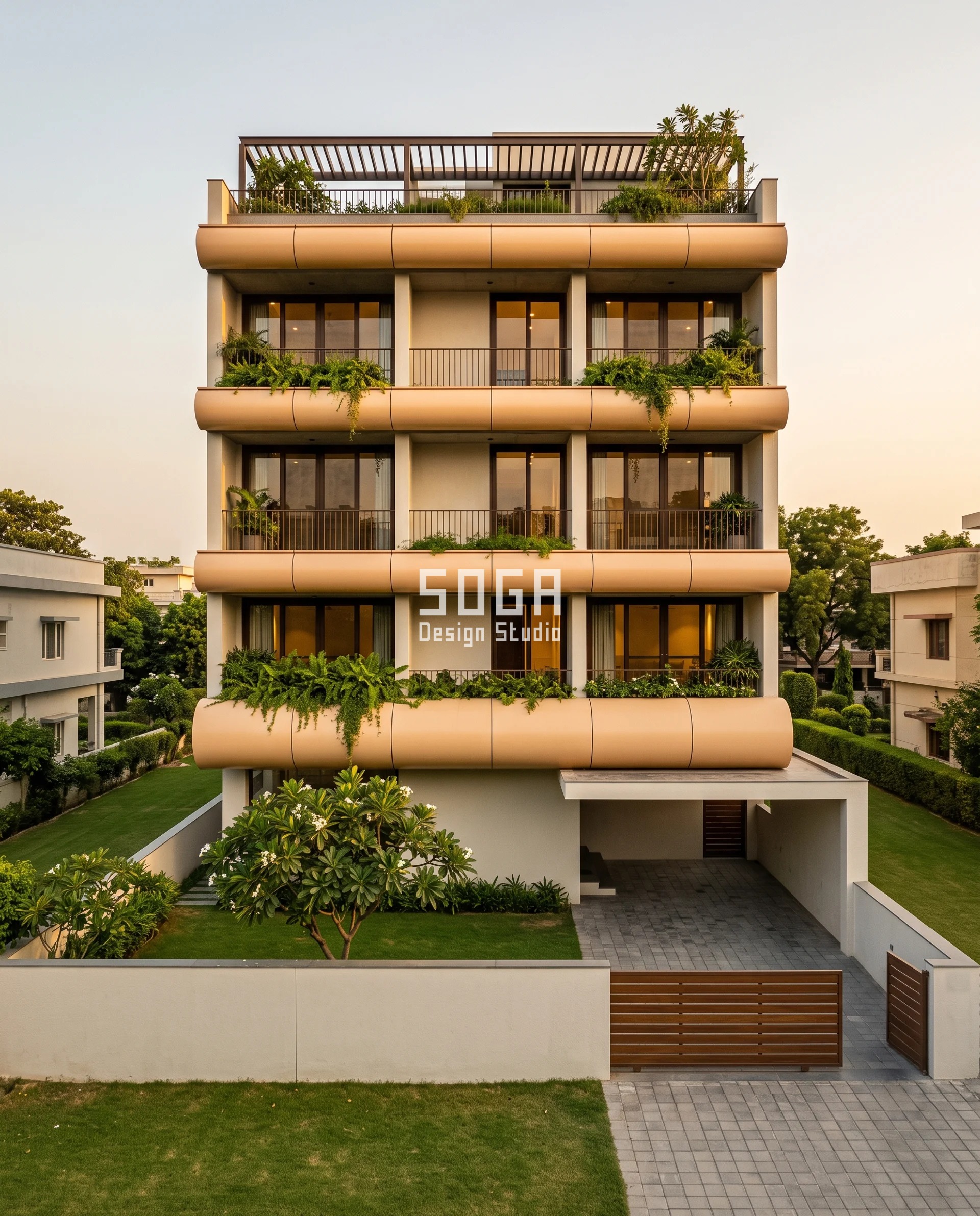
Parametric Barrel Nose varies the crown radius of the rolled nose that closes each balcony course, and nothing else. Every course on this G+3 keeps the same 450 mm face height, the same 900 mm projection and the same 1200 mm segment length. The crown runs 300 mm at the porch-level course at +3.0 m, then 110 mm, 100 mm and 90 mm at +6.2, +9.4 and +12.6 m. In pale apricot PVDF the finish sits on the smooth row, so the cap is 118 mm. The standable strips come out at 254, 93, 85 and 76 mm, and the margin under the 100 mm nesting target moves from minus 154 mm at the bottom to plus 24 mm at the top. The lowest course fails the table deliberately: it is the washed edge, and the one people hold. Everything above it is where a pigeon proof balcony without net is actually decided, and it is decided at the nose of the course, not at the railing behind it.
| Specification | Parametric Barrel Nose |
|---|---|
| Product | 1.5 mm 5005-H14 aluminium, full half-round nose rolled in 1200 mm segments, 12 mm shadow-gap joints, flat back return to the slab edge, hot-dip galvanised MS outriggers at 900 mm centres on stainless cast-in channels, 70 per cent PVDF 25-30 micron |
| Module | 1200 mm roll-formed nose segment, blind-clipped to outriggers at 900 mm centres over a 20 mm thermal isolator |
| What varies | Nose crown radius 300 — 110 — 100 — 90 mm; standable strip 254 — 93 — 85 — 76 mm on the smooth row |
| Indicative rate | Rs 700-1,150 per sq ft, falling to Rs 570-880 when the four roll dies are amortised across five houses |
Parametric Hem Scale
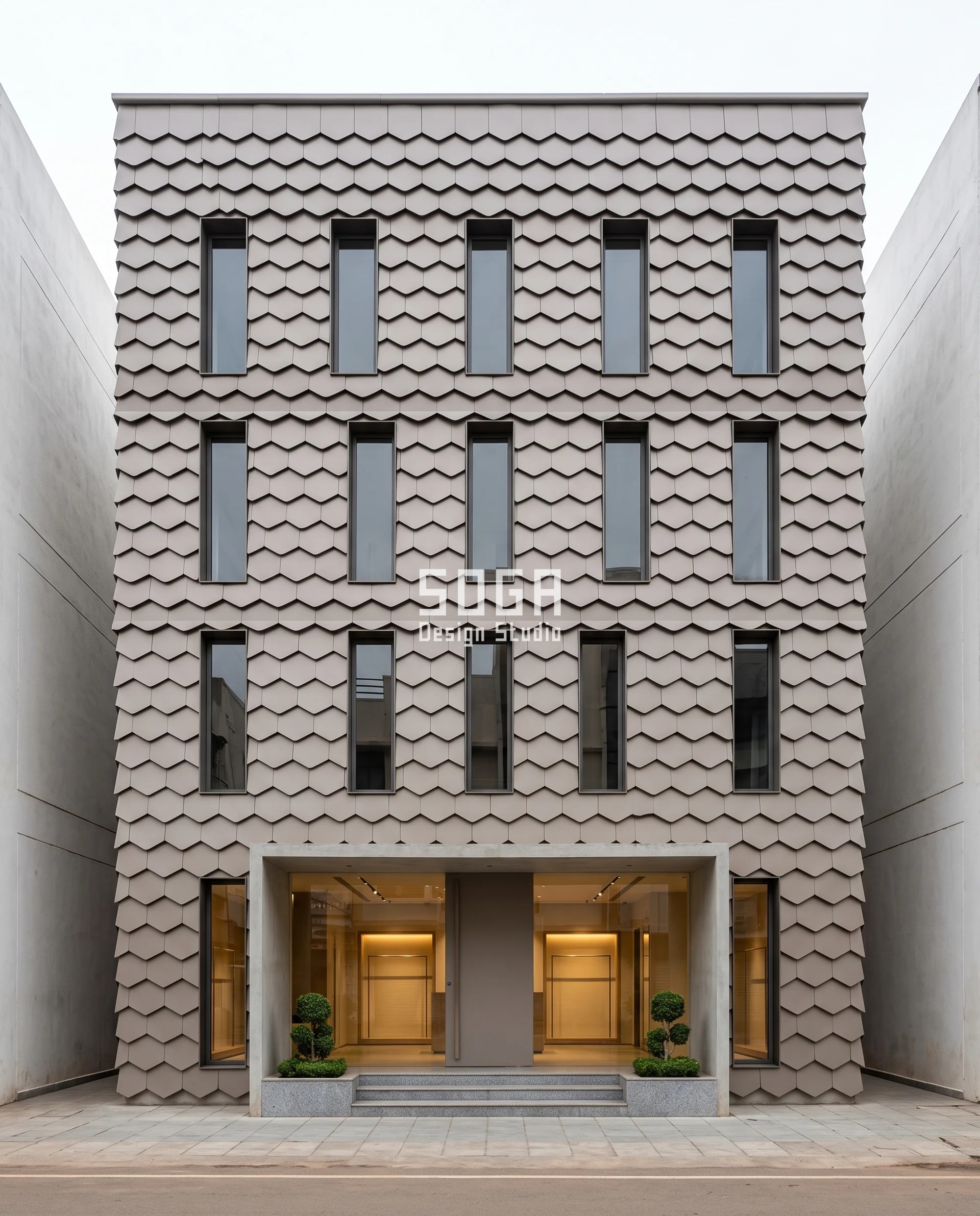
Parametric Hem Scale is on this page because its driver is fouling, not nesting. The showroom carries 2 mm pressed aluminium hexagons, 300 mm across flats, at a constant 40 mm lap on carrier rails at 260 mm centres. What changes is the radius rolled into the upper lap: 4 mm on the lowest course group, then 8, 14 and 18 mm going up. The shelf left under each lap shrinks from 16 mm to 12, 6 and 2 mm, every one of them at least two and a half times under the 40 mm perch line, so no course is a perch at any point in the gradient. The logic is simple: what a ladder and a brush can wash is allowed to keep a shelf, and what they cannot has none. The gradient is a specified dimension rather than a photographic one — between 4 mm and 18 mm it does not read from the pavement, which is why it is written into the schedule and not left to the elevation drawing.
| Specification | Parametric Hem Scale |
|---|---|
| Product | 300 mm across flats, 2 mm 3105 pressed scales, 40 mm lap, upper-lap hem rolled to the course-group radius, blind-fixed on aluminium carrier rails at 260 mm centres, polyester powder 60-80 micron in two close tones |
| Module | 300 mm across-flats pressed hexagon at a 40 mm lap, carrier rails at 260 mm centres |
| What varies | Upper-lap hem roll radius 4 — 8 — 14 — 18 mm; residual shelf under the lap 16 — 12 — 6 — 2 mm against a 40 mm perch line |
| Indicative rate | Rs 520-760 per sq ft |
Parametric Bullnose Wave
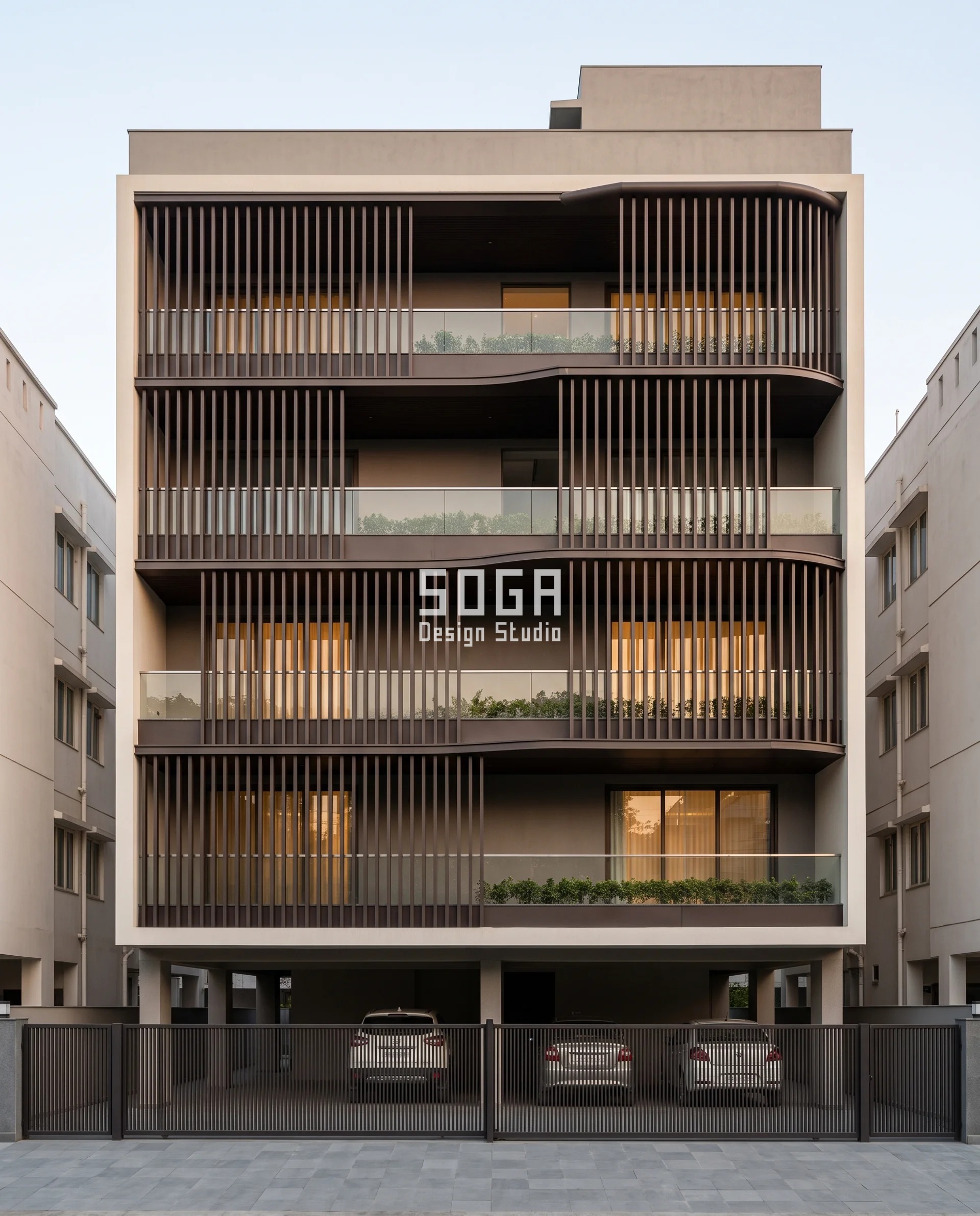
Parametric Bullnose Wave puts the entire argument into a capping rail. The slats are identical everywhere on this G+4 — 50 x 100 mm 6063-T6 extrusions at 110 mm centres on a concealed carrier — and each of the four wave courses is closed by the same 100 mm extruded capping with a different crown rolled into the die: 6 mm, 12 mm, 25 mm and a full 50 mm half-round at the top. On the smooth row those give standable strips of 93, 86, 71 and 42 mm. Every course denies the nest. Not one denies the perch, and the honest arithmetic is worth printing: on a smooth full half-round the cap would have to come down to about 94 mm to break the 40 mm line, and this cap is 100 mm because it is also a rail people lean on. To stop pigeons sitting on a balcony railing outright you have to give up the rail, and on a residence that is the wrong trade.
| Specification | Parametric Bullnose Wave |
|---|---|
| Product | 50 x 100 mm 6063-T6 slats at 110 mm centres on concealed carrier rails, continuous 100 mm extruded capping rail with the crown radius rolled into the die, four dies, one per course, polyester powder 60-80 micron |
| Module | 50 x 100 mm 6063-T6 slat at 110 mm centres, continuous 100 mm extruded capping rail |
| What varies | Capping-rail crown radius 6 — 12 — 25 — 50 mm on a 100 mm cap; standable strip 93 — 86 — 71 — 42 mm |
| Indicative rate | Rs 850-1,200 per sq ft |
Parametric Cove Branch
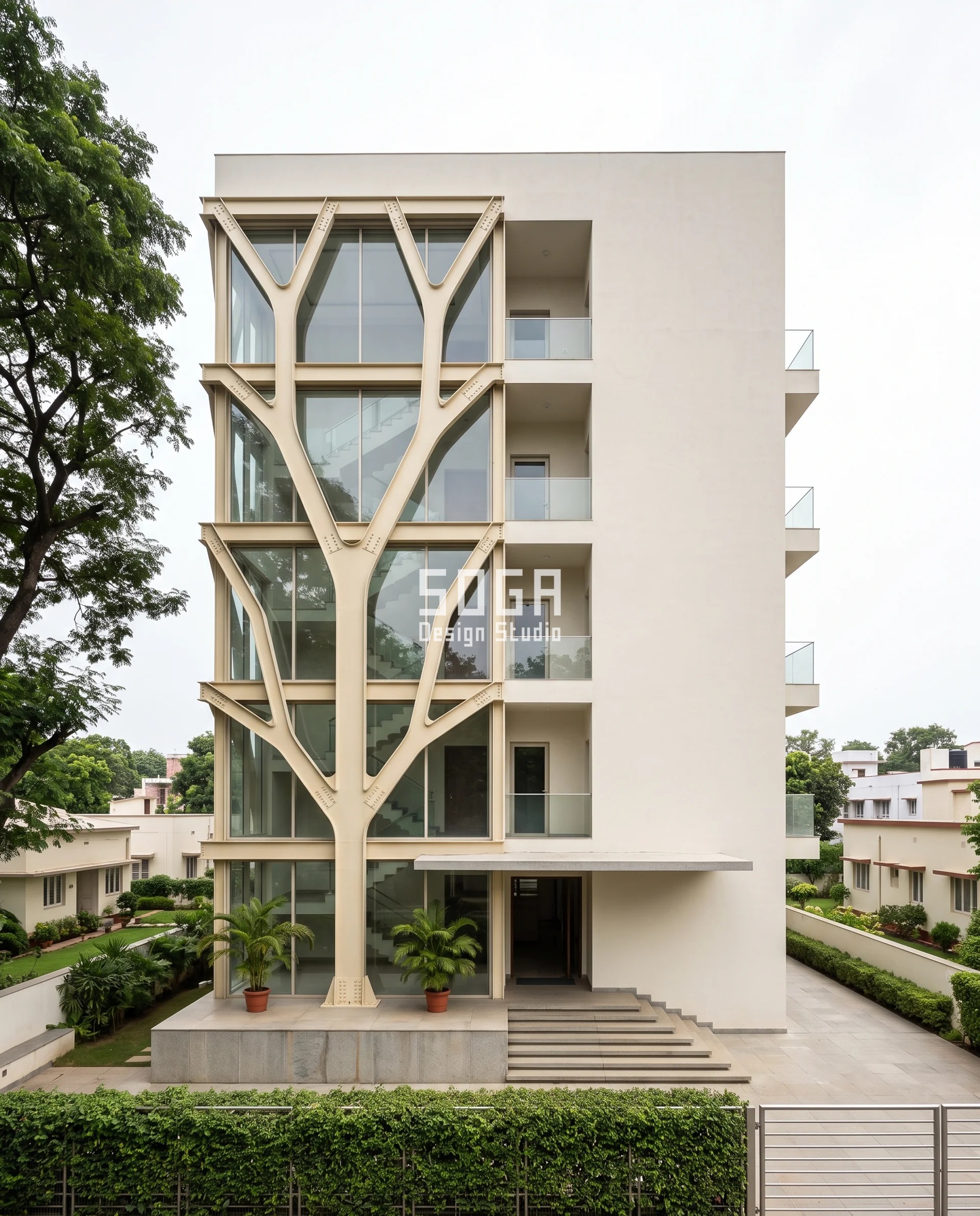
Parametric Cove Branch is the exception that proves the rule, and it has to be stated rather than glossed. Its crotches are concave, not convex, and the convex arithmetic does not transfer unchanged. Left level, the 160 mm cove at the third-generation nodes would hold a 135 mm strip at its base — a nest — so on a cove a larger radius is not safer. The control here is cant. Every node on this warm-ivory laser-cut frame is canted 30 degrees out of level, past the 25 degree critical slope for powder over hot-dip galvanising, so no line inside the cove is level and the standable strip is zero at 40, 90 and 160 mm alike. The radius then goes back to its structural job, which is fatigue at the crotch and film build in the corner. The frame stands clear of a full-height glass bay and the photograph catches it close to frontal with a returning flank just visible on one side; like the Hubballi scales, the 40 to 160 mm gradient is a specified dimension, not something you can measure off the image.
| Specification | Parametric Cove Branch |
|---|---|
| Product | 20 mm S355 plate, cove profiled into the laser cut, hot-dip galvanised 85 micron then polyester powder, bolted nodes with expressed 16 mm gussets, three branching generations maximum, every node canted 30 degrees out of level |
| Module | 20 mm S355 laser-cut plate member, bolted node with an expressed 16 mm gusset |
| What varies | Internal cove fillet radius 40 — 90 — 160 mm, concave; every node canted 30 degrees, so the standable strip is zero at all three |
| Indicative rate | Rs 700-1,050 per sq ft |
Parametric Splay Sill
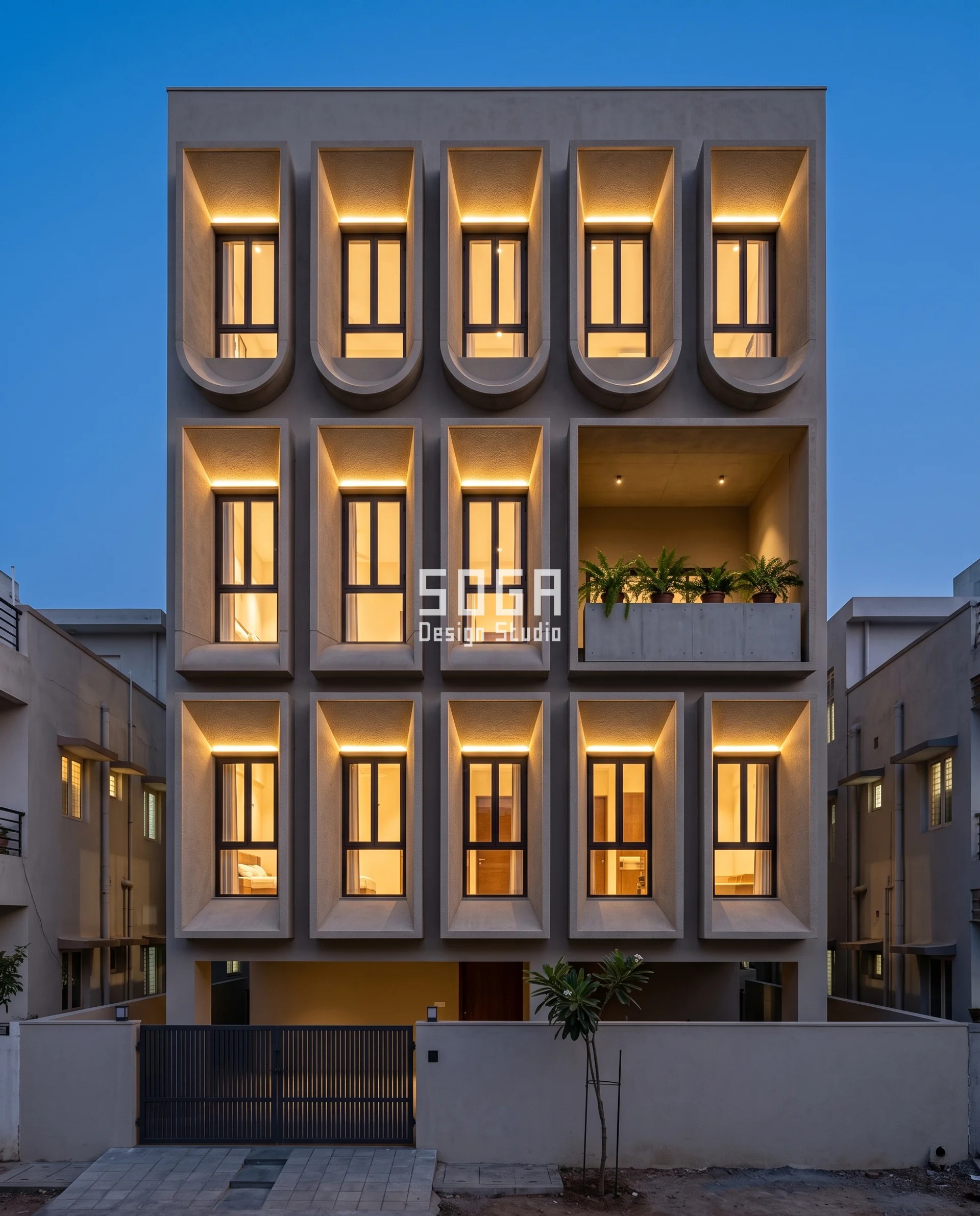
Parametric Splay Sill is the cautionary building, and it is here because it fails first. The reveal surrounds are 80 mm pigmented precast with a 450 mm splay on all four sides, and the 180 mm sill nose rolls 20 mm at the first floor, 45 mm at the second and a full 90 mm half-round at the third. The finish is fine bush-hammered, which puts it on the rough row at 50 degrees. Run the strips on that row and all three sills fail: 171, 159 and 138 mm. Mask the nose off the bush-hammer, leave it as-cast against the mould face, and the identical profile at identical cost moves to the smooth row — the third-floor sill drops to 76 mm and passes. The first and second still hold 157 and 128 mm even as-cast, so their tops are cast at 30 degrees instead of the customary 1:10. In a mould the radius is free and a sharp arris is the expensive mistake. A rough finish is what actually costs you the bird, and that is the sentence most bird proof facade design in India gets backwards.
| Specification | Parametric Splay Sill |
|---|---|
| Product | 80 mm pigmented precast reveal surrounds, 450 mm deep splay on all four sides, cast bullnose sill with the top cast at 30 degrees and the nose masked off the bush-hammer, stainless cast-in channels, concealed LED cove at the head |
| Module | 80 mm pigmented precast reveal surround, 180 mm cast bullnose sill, one mould per floor-type with a changeable nose insert |
| What varies | Cast sill-nose roll radius 20 — 45 — 90 mm on a 180 mm sill; standable strip 171 — 159 — 138 mm bush-hammered, 157 — 128 — 76 mm as-cast |
| Indicative rate | Rs 1,000-1,600 per sq ft of reveal surface |
How Is A Rounded Nose Course Actually Fixed?
It is fixed like a rainscreen, because that is what it is. The nose comes in 1200 mm roll-formed segments of 1.5 mm 5005-H14 aluminium: full half-round crown at the specified radius, flat back return to the slab edge, 12 mm shadow gap between segments. Behind it, hot-dip galvanised MS outriggers at 900 mm centres bolt to stainless cast-in channels in the slab edge, and each segment blind-clips to the outrigger over a 20 mm thermal isolator. The part that decides whether the profile is still true in year three is movement. A 1.5 mm aluminium section over a 60 K surface swing moves 1.7 mm per 1200 mm segment and 9.9 mm over a 7.2 m continuous run, so there is one fixed point per run, slotted holes at every other outrigger, and a movement joint every 6.0 m. A nose pinned at both ends buckles into a visible wave by the second summer — and that wave is exactly the flat spot the radius was bought to remove. On the precast systems the same discipline applies to the mould rather than the fixing: the radius is cut once into the mould nose insert and the finish is masked, not changed.
| Design parameter | Specification |
|---|---|
| Module | 1200 mm roll-formed nose segment, 1.5 mm 5005-H14 aluminium, full half-round crown at the specified radius, flat back return to the slab edge |
| Joint | 12 mm shadow gap between segments, closed by a 1.5 mm folded closer set at 30 deg into the cavity and mechanically fixed to the outrigger |
| Substructure | Hot-dip galvanised MS outriggers at 900 mm centres, bolted to stainless cast-in channels in the slab edge |
| Fixing | Blind clip to the outrigger over a 20 mm thermal isolator; one fixed point per run, slotted holes at every other outrigger |
| Movement | 1.7 mm per 1200 mm segment over a 60 K surface swing, 9.9 mm over a 7.2 m run; movement joint every 6.0 m |
| Coating | 70 per cent PVDF at 25-30 micron flat-face film. Minimum radius R at least 3 mm on any coated aluminium arris, R at least 20 mm on a cast concrete arris |
| Crown radius, above the broom line | R 90-110 mm on a smooth finish; R ≤ 87 mm on plain concrete; R ≤ 65 mm on bush-hammered or grit-washed concrete |
| Precast alternative | 80 mm pigmented reveal surround, 180 mm cast bullnose sill, nose masked off the bush-hammer, sill top cast at 30 deg where the radius alone cannot clear the table |
The three details that decide whether the radius survives
- The 12 mm shadow gap is where the rule gets undone. A 12 mm slot with a level bottom is a toe-hold and a seed trap. The geometry is fractal: every joint you cut into a rounded edge puts a small flat back. Close each gap with a 1.5 mm folded closer set at 30 degrees into the cavity, mechanically fixed to the outrigger, never sealant alone.
- Mask the sill nose before the bush-hammer. Jambs and head take the fine bush-hammer; the nose is left as-cast against the mould face. Same mould, same 90 mm radius, same money — and the standable strip drops from 138 mm to 76 mm. The finish schedule, not the profile drawing, is where this system is won or lost.
- One fixed point per run, slotted holes everywhere else. 1.5 mm 5005-H14 over a 60 K surface swing moves 1.7 mm per 1200 mm segment and 9.9 mm over a 7.2 m run, so break the run with a movement joint every 6.0 m. Pin a nose at both ends and it will find the movement somewhere you did not draw.
The Honest Limit: What A Radius Does Not Do
A radius stops a bird staying. It does not stop it landing, and it never will — a pigeon will touch down on a half-round nose, fail to settle and go. It does nothing at all for the balcony floor, the planter troughs or the air-conditioner platform, which are the three surfaces droppings actually land on, and it does not hand you the bird-free balcony a net hands you. If a bird-free balcony is the brief, buy the net: at Rs 15-150 per sq ft installed it is cheaper than the cheapest thing on this page, which is a bent aluminium capping rolled over an existing coping at Rs 220-420 per sq ft. The gradient is not free either. The radius itself costs nothing, but three radii cost three mould inserts at Rs 25,000-45,000 each, and four roll dies cost Rs 5-10 lakh — on one house that is Rs 170-345 per sq ft of tooling, and across a builder’s five houses it is Rs 35-70. The chabutro is not a proposal; we cannot rebuild it at scale. What a radius does that a net cannot is narrower and permanent: a net is an addition to the elevation, so it needs somebody’s permission, and permission can be withdrawn. A radius is the elevation. All five buildings on this page are SOGA concepts, not built work.
What This Costs To Build In India (2026)
Run the two options over ten years, because that is the only comparison that means anything. A UV-stabilised HDPE net at Rs 15-150 per sq ft installed is bought once and then bought again at least once inside a decade, which is Rs 30-300 per sq ft over ten years before any inflation, plus the access cost of every re-tension. A radiused coping is a one-time profile change to an element already in the bill of quantities, and its ten-year cost is the same as its day-one cost. Retrofit sits between the two at Rs 220-420 per sq ft, once. The rates below are indicative and itemised per project, derived this run from 2026 input rates — pre-coated aluminium coil Rs 380-480 per kg, mill 3105 sheet Rs 300-360 per kg, 6063 extrusion Rs 380-460 per kg, S355 plate Rs 85-110 per kg, hot-dip galvanising Rs 22-32 per kg — plus development, wastage, substructure, coating, access and tooling amortisation. Nothing here is inherited from an earlier post. Ferrocement is deliberately absent: at Rs 1,500-2,500 per sq ft it is not the cheap option and does not belong in this argument.
| System / material | Indicative rate (per sq ft) |
|---|---|
| Roll-formed 1.5 mm PVDF aluminium nose course, incl. HDG outriggers, fixings and erection – one G+3 house carrying four one-off roll dies | Rs 700-1,150 per sq ft |
| Same system, the four dies amortised across five houses (tooling falls from Rs 170-345 to Rs 35-70 per sq ft) | Rs 570-880 per sq ft |
| 2 mm pressed aluminium hexagon scale field, two-tone polyester powder 60-80 micron, on aluminium carrier rails at 260 mm centres | Rs 520-760 per sq ft |
| 6063-T6 extruded slat field, 50 x 100 mm at 110 mm centres, with a 100 mm capping rail off four dies | Rs 850-1,200 per sq ft |
| 20 mm S355 laser-cut branch frame, HDG 85 micron plus powder, bolted nodes with expressed 16 mm gussets | Rs 700-1,050 per sq ft |
| 80 mm pigmented precast splayed reveal surround, 450 mm splay, cast bullnose sill, stainless cast-in channels | Rs 1,000-1,600 per sq ft of reveal surface |
| Retrofit only: 1.2 mm aluminium capping rolled to a half-round over an existing parapet coping | Rs 220-420 per sq ft |
| What it replaces: 50 x 50 mm UV-stabilised HDPE bird net, installed, 5-10 year life | Rs 15-150 per sq ft |
| The radius itself, when one radius runs on every floor – no second die, no second mould insert | Rs 0 |
Does Each Of The Five Systems Clear The Radius Table?
Three clear it outright, one clears it only because of a finish decision, and one course on the fifth fails on purpose. Publishing a table and then five projects that quietly break it would be worse than publishing neither, so here is the audit, row by row.
| System, city and the element radiused | Radius range, finish row, and whether it clears the table |
|---|---|
| Parametric Barrel Nose, Jalandhar — balcony course nose | 300 — 110 — 100 — 90 mm. Smooth, 25 deg, cap 118 mm. Clears at every course above the broom line (strip 93, 85, 76 mm). The +3.0 m course at R 300 mm does not clear it, at a 254 mm strip, and keeps its radius because it is washed and it is held |
| Parametric Hem Scale, Hubballi — upper-lap hem of a pressed scale | 4 — 8 — 14 — 18 mm. Smooth, 25 deg. Clears, and clears the stricter perch line too: residual shelf 16 — 2 mm against 40 mm. Not a crown problem at all — the driver here is fouling |
| Parametric Bullnose Wave, Kanpur — 100 mm capping rail | 6 — 12 — 25 — 50 mm. Smooth, 25 deg. Clears the nest line at all four courses (93, 86, 71, 42 mm). Clears the 40 mm perch line at none, and cannot without dropping the cap below about 94 mm |
| Parametric Cove Branch, Jamshedpur — internal cove at a branch node | 40 — 90 — 160 mm, concave. Would not clear it if level (135 mm strip at R 160 mm). Clears because every node is canted 30 deg past the 25 deg critical slope, so the strip is zero. Cant, not radius |
| Parametric Splay Sill, Vijayawada — 180 mm cast sill nose | 20 — 45 — 90 mm. Rough if bush-hammered, 50 deg, cap 65 mm — all three fail at 171, 159 and 138 mm. Mask the nose to as-cast and the top sill clears at 76 mm; the lower two are cast at 30 deg instead |
Can My Housing Society Stop Me From Installing A Pigeon Net?
It can condition it, and in practice it often does. Society bye-laws routinely prohibit members from making modifications that alter or spoil the facade of the building, and from fixing anything to windows, balconies or parapets that changes external appearance. A net is an addition to the elevation, so it is permission-dependent — and that permission is discretionary, conditional and revocable, typically renegotiated the next time the building is painted. Nets are not banned or illegal in India, and nothing in the National Building Code 2016 prohibits them.
There is a counterweight and it belongs here. Legal opinion holds that a co-operative society cannot absolutely bar a member from fitting grills or safety measures where civic-authority permission exists, and refusals have been taken to consumer forums. In practice many societies allow only invisible nets or grills of an approved design, and often only on elevations facing inward. In a RERA-registered project the balcony railing forms part of the sanctioned elevation drawing, and replacements are expected to match the approved design and height.
A radius does not enter that conversation at all. Nobody has to approve the shape of a coping that was always going to be cast, or the crown rolled into a capping rail that was always going to be bought. It is not an addition to the elevation. It is the elevation, and that is the whole commercial case for it.
What Are The Health Risks Of Pigeon Droppings On A Balcony?
The reported burden in India is not small. Bird droppings and feathers are implicated in 21 per cent of hypersensitivity pneumonitis cases in India’s ILD registry, and Mumbai clinicians have reported a roughly fivefold rise in hypersensitivity pneumonitis cases over seven years. Hypersensitivity pneumonitis from avian antigen is the condition commonly called bird fancier’s lung or pigeon breeder’s lung; psittacosis and ectoparasites emanating from nest sites are the other two routes usually named. Those figures are reported by clinicians and the registry, not measured by SOGA.
The finish takes damage as well. Droppings are acidic, and uric acid and ammonia attack coatings, paint films and mill-finish metal, which is why a nested coping ages faster than the wall under it. That is a finish problem, and it is the one place in this argument where soiling matters.
It is also the reason the nesting threshold matters more than the perch threshold. A perching bird sits, fouls once and moves on. A nest is a tenancy of four to six weeks per brood, repeated, on the same 100 mm strip, with the material and the parasites that come with it. Removing the strip removes the tenancy, which is a different and larger result than removing the perch.
Related Reading
- Parametric facade design in India
- how a facade design company in India prices an elevation
- balcony facade design in India
- how deep a facade projection should be
- modern chajja design in India
- stopping rain water entering a balcony
Frequently Asked Questions
How do I pigeon proof a balcony without a net?
Round what you cannot clean. Give every upward-facing edge — top rail, parapet coping, sill nose, course nose, planter rim — a crown radius under 118 mm on a smooth finish, 87 mm on plain concrete or 65 mm on rough stone, so no level strip wider than about 100 mm survives above the 3.6 m a broom cleans.
How narrow does a ledge have to be so a pigeon cannot sit on it?
Under 40 mm. That figure is measured, from Haag-Wackernagel and Geigenfeind (2008), and it is the widest ledge a feral pigeon cannot sit on. On a balcony you rarely get there, because a guard rail is 40 to 50 mm wide for the hand, so the practical target is the 100 mm nesting width instead.
Do bird spikes actually stop pigeons nesting?
No. Spikes interrupt landing, but twigs, feathers and debris pack between the pins within a season and the nest is then built on top of them. The flat surface is still there under the strip, and above about 3.6 m nobody clears it. A 65 to 118 mm crown radius removes the surface instead of screening it.
How much does balcony bird netting cost in India and how long does it last?
Rs 15 to 150 per sq ft installed, depending on the mesh and the access. Untreated plastic goes brittle in one to two years, UV-stabilised HDPE runs five to ten, and 316 stainless twenty plus. Over ten years that is Rs 30 to 300 per sq ft, against Rs 220 to 420 once for a rolled retrofit capping.
Will a rounded coping keep pigeons off my balcony completely?
No, and any page that says otherwise is selling something. A radius stops a bird staying and nesting on that edge; it does not stop it landing. It does nothing for the balcony floor, the planter troughs or the air-conditioner platform, which are the three surfaces droppings actually land on. For a bird-free balcony, buy the net.
Draw The Radius Before You Buy The Net
SOGA Design Studio draws facades, balcony edges and elevations across India, and this is a profile decision that costs nothing if it is taken while the coping, the capping rail or the precast mould is still being drawn — and costs a retrofit if it is not. Send us the balcony elevation and the finish schedule, and we will mark the crown radius each upward-facing edge needs for the finish you have already chosen, together with the two or three edges where a radius cannot help. Write to [email protected]. All five buildings shown here are SOGA concepts drawn for this post, not built work.