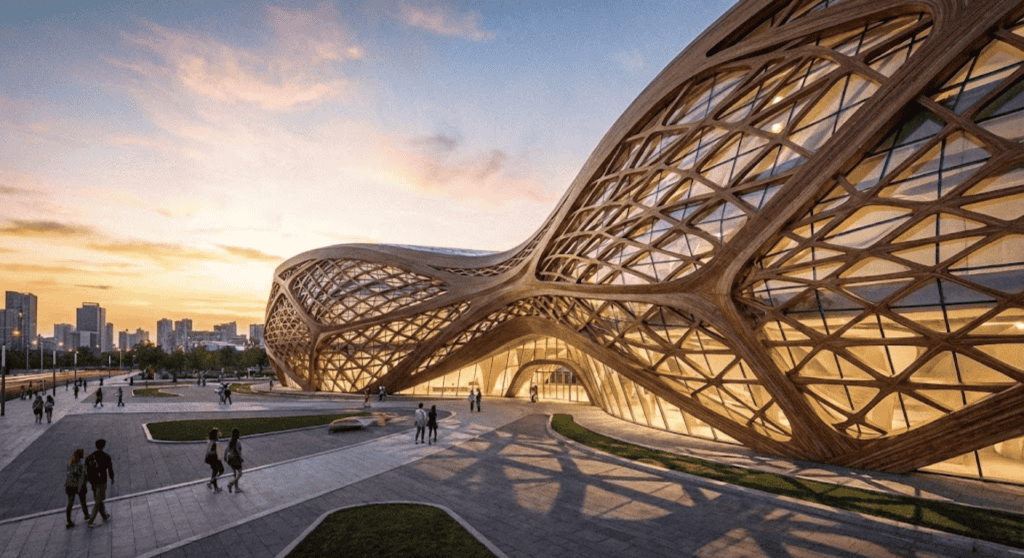
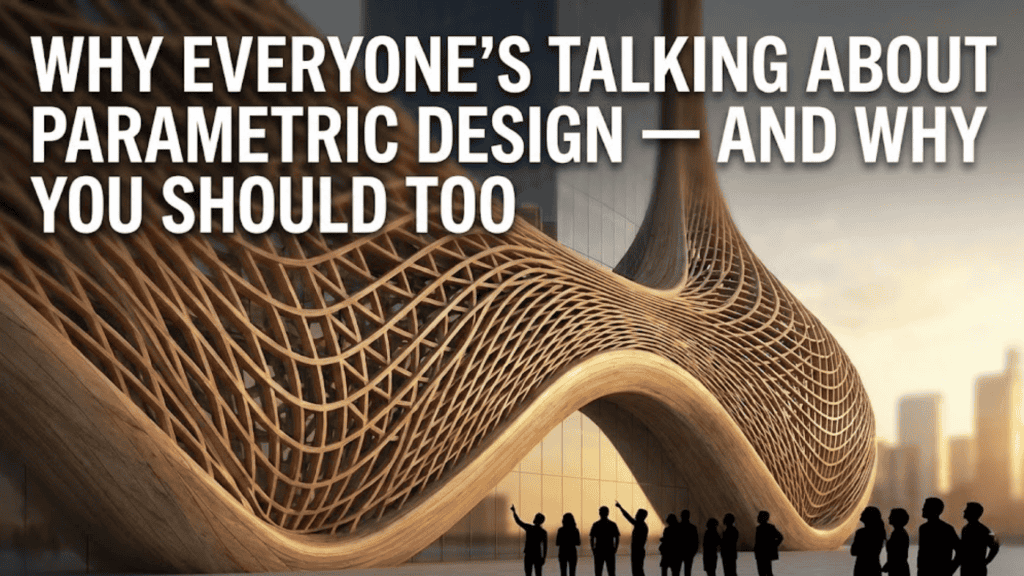
Drive through Ahmedabad, Pune, Bangalore or Coimbatore in 2026 and the buildings that make you slow down are almost never the ones with the most glass — they are the ones wearing a parametric metal skin that shifts as you move past it. Facade design in India has quietly crossed over from decorative cladding to engineered building skin: a layer that cuts solar heat, frames the balconies and gives a G+4 residence an identity you can read from the street. This guide walks through four buildable metal facade concepts we developed across four Indian cities — each a different parametric system, colour and climate response — and the honest 2026 cost-per-square-foot behind them. No fantasy renders: every concept here is detailed to be fabricated, shipped and installed on a real Indian plot.
Facade Design in India: Why Ahmedabad Is Choosing Parametric Metal
Facade design in India has moved from an afterthought to the single most important decision on a residential project. Today, demand for parametric facade design in India is rising fastest in cities such as Ahmedabad, Mumbai, Bangalore, Delhi, and Pune, where homeowners and developers want elevations that are both performance-driven and instantly recognisable. SOGA Design Studio specialises in facade design in India — from G+3 individual homes to G+7 residential blocks — pairing algorithmic geometry with matte warm terracotta-toned metal comp and fabrication-ready detailing. Whether you are comparing metal facade design in India for a new build or a retrofit, the concepts below show how a considered facade redefines a building’s identity and its long-term value.
1. Ahmedabad: A Terracotta Skyline Screen for the G+5 Street Facade
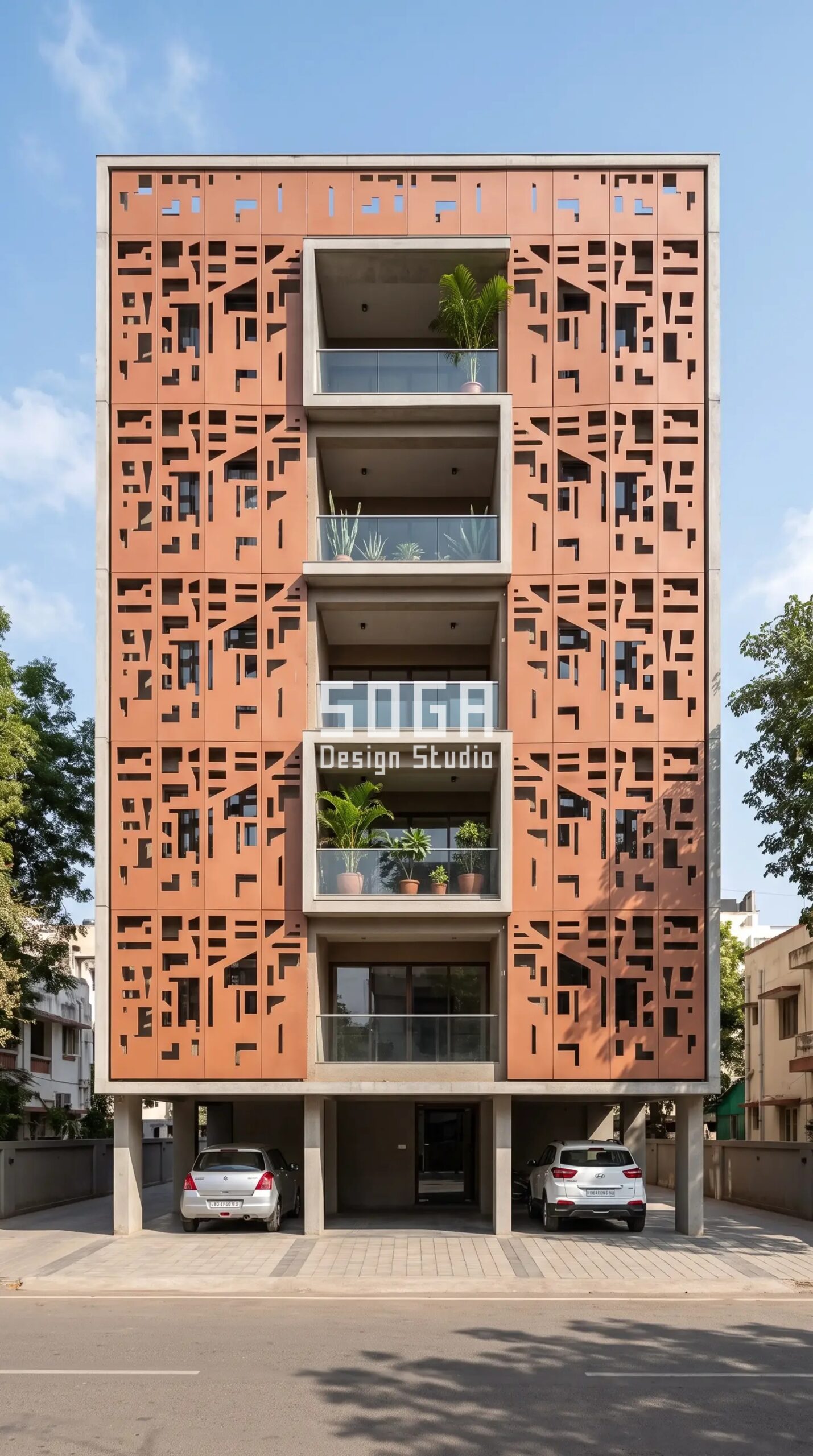
Our Ahmedabad concept answers the city’s hard, high-angle sun with a Parametric Skyline Screen — warm terracotta-toned metal composite panels laser-cut with an abstract city-skyline silhouette that reads as a continuous relief across the whole elevation. The openings are sized parametrically: denser and smaller where the west sun hits hardest, opening up where balconies need daylight and cross-ventilation. Behind the screen sits a conventional RCC frame with recessed balconies, so the dramatic skin costs far less than a full structural facade. In terracotta metal composite the finish stays true and matte for decades without the fade of paint, and the panel joints are honest and visible rather than hidden behind filler. Lifted on an open stilt for parking, the G+5 mass keeps a calm street presence while the screen does the visual work — the clearest illustration of why Ahmedabad developers are moving from plastered elevations to engineered metal skins.
2. Pune: Twisting Violet Fins That Turn a Flat Elevation Into Movement
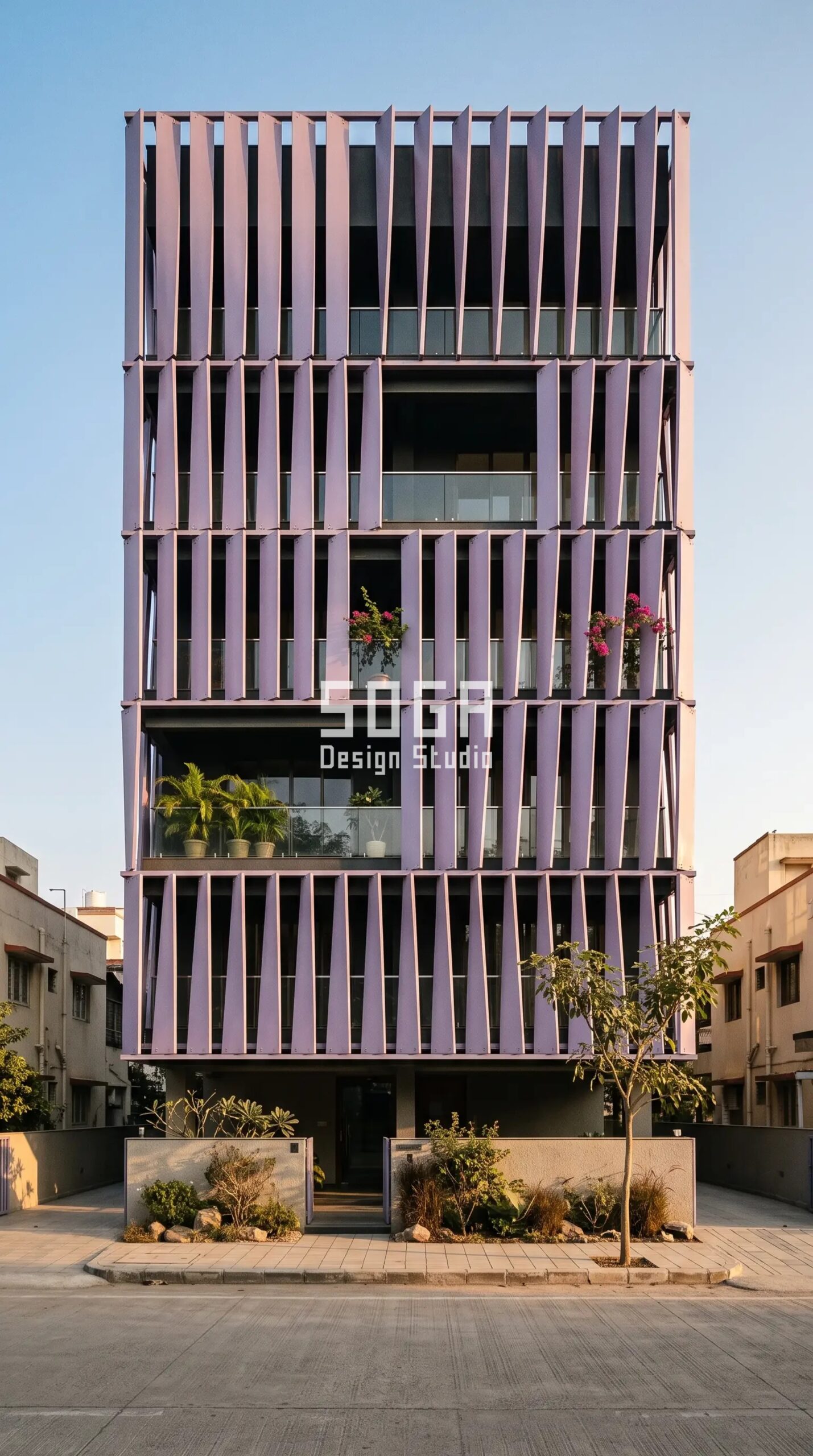
Pune’s milder climate and design-literate buyers let us push expression, so the Parametric Helix Weave uses an array of external metal stringer fins in matte powder-coated RAL 4009 pastel violet, each fin rotated a few degrees more than the one below it. From the street the fins appear to spiral up the building, catching the late-afternoon light differently on every floor — a purely geometric effect with no moving parts and no maintenance. The powder-coated steel is specified for Pune’s monsoon swings, with real fixings and honest seams rather than a glued-on look. Between the fins, recessed balconies with clear glass railings stay shaded through the harsh part of the day. A soft violet is a deliberate 2026 move away from the safe greys — distinctive, but grounded by the neutral RCC frame behind. This is parametric rhythm doing what paint and stone never can.
3. Bangalore: An Anthracite Contour Screen That Glows After Dark
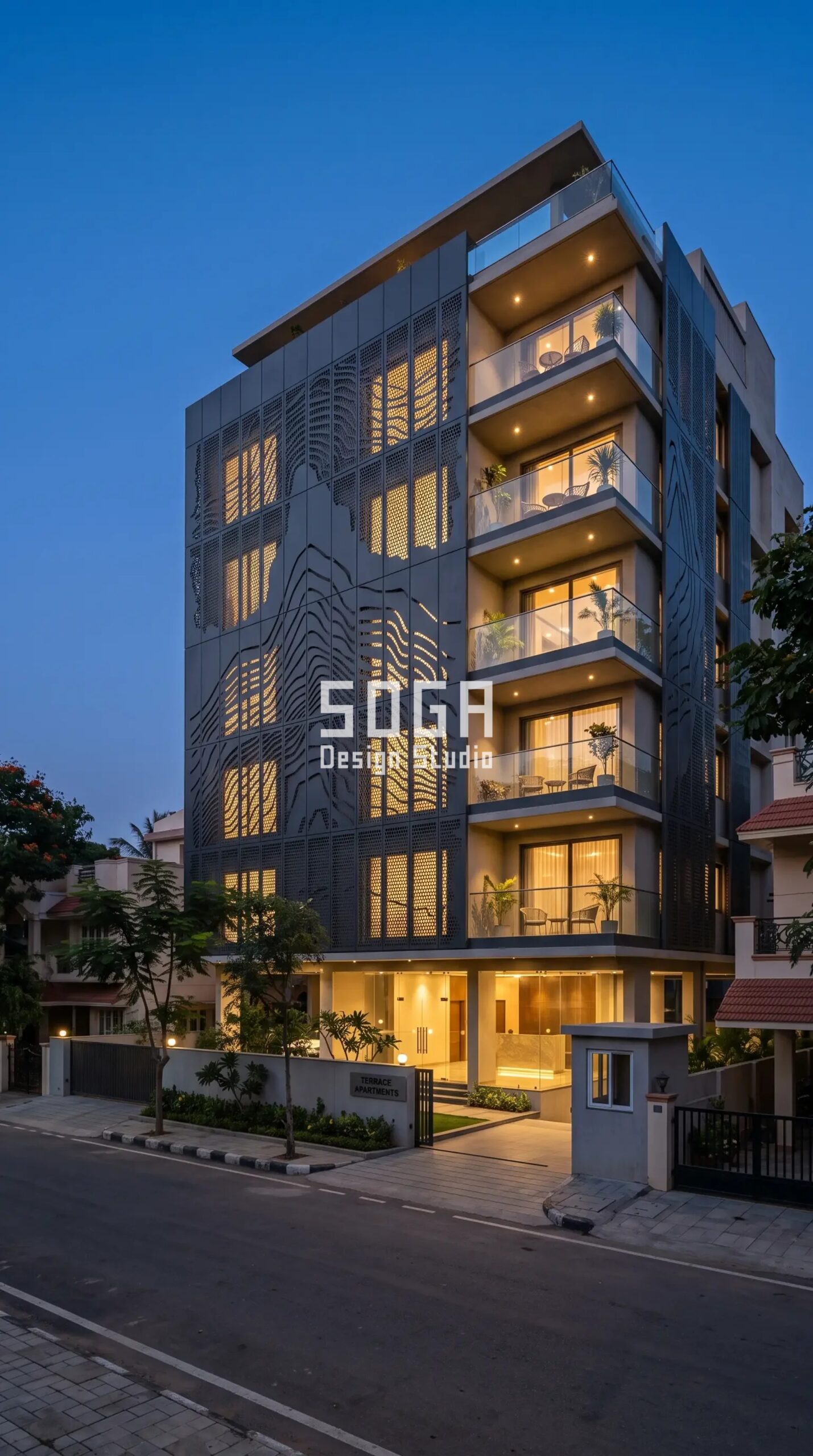
For Bangalore we designed the Parametric Contour Screen — matte RAL 7016 anthracite grey steel panels laser-cut with a layered contour-line pattern that ripples like a topographic map across the facade. In daylight it reads as a crisp, restrained grey skin suited to the city’s understated taste; at blue hour the warm interior light bleeds through the cut lines and the whole elevation switches on. The three-quarter street view shows how the screen wraps the corner without a visible break, held off a glass curtain wall so the building can breathe behind it. Anthracite powder-coating is one of the most durable specifications for Bangalore’s mild, humidity-free climate, needing little more than an occasional wash for years. A glass ground-floor lobby and quiet driveway keep the base calm and premium. It is proof that a parametric facade can be quiet by day and unforgettable by night.
4. Coimbatore: Stacked Rose-Gold Volumes With a Post-Monsoon Glow
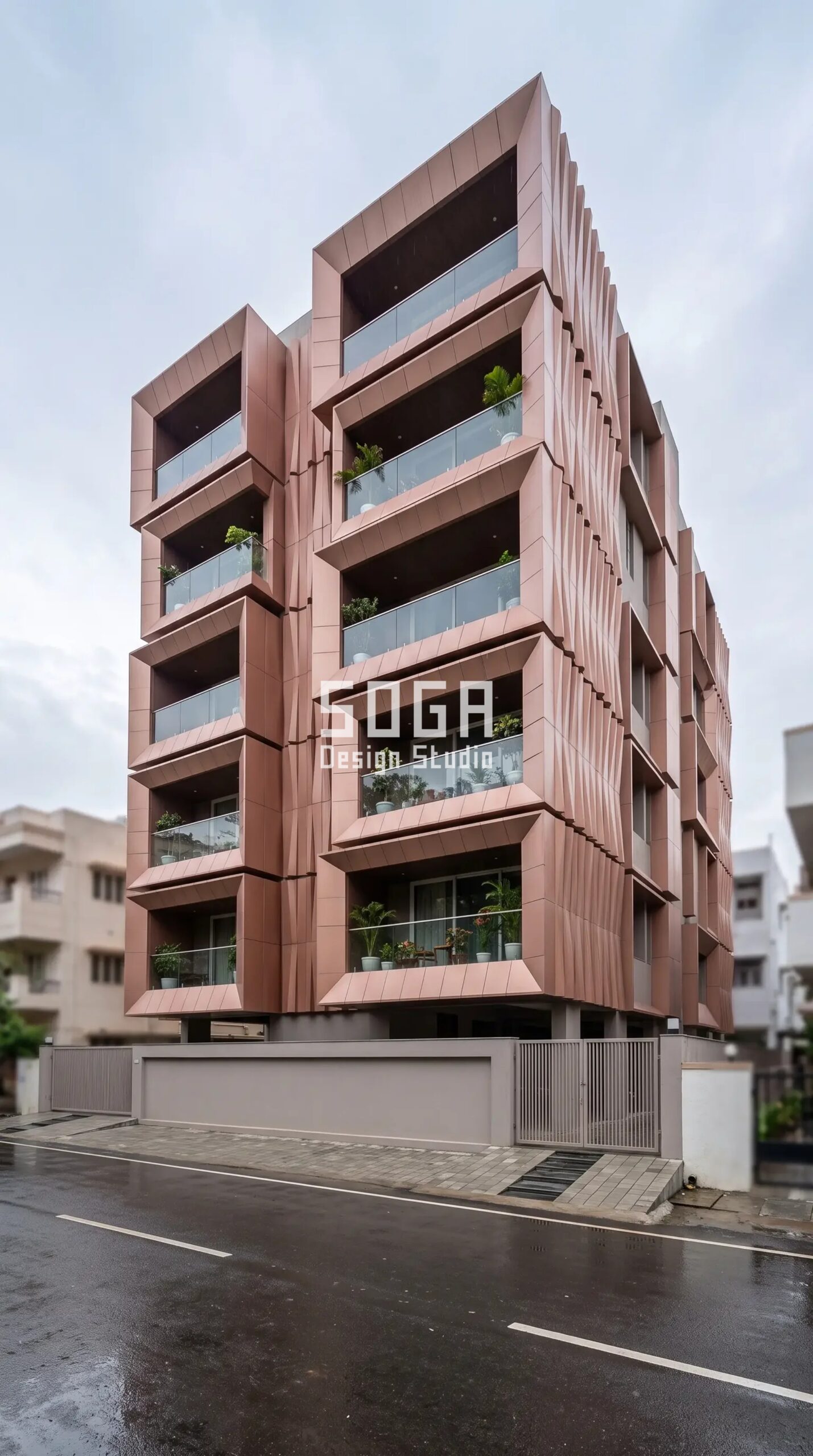
The Coimbatore concept, our Parametric Stack Grid, breaks the box entirely: interlocking stacked volumes in matte rose gold anodized aluminium, edged with protruding parametric fins that throw real shadow relief across a G+6 mass. Shot low after monsoon rain, the anodized skin picks up the wet-street reflections without ever looking glossy or CGI — anodising is chosen precisely because it holds its colour in Coimbatore’s humid climate and sits at the heart of the region’s laser-cutting and powder-coating belt. The staggered volumes give every apartment a deep, shaded balcony and a different view, so the parametric logic serves the plan and not just the picture. Concealed drainage and honest module joints keep the detailing buildable at a real budget, and a compound wall with a simple metal gate grounds the composition on an ordinary residential street. It shows how far a metal facade can go when the massing itself becomes the parametric system.
Cost Benchmarks for Indian Parametric Metal Facades
One of the most-asked questions on a Ahmedabad project brief is budget. The current all-in installed rates for parametric metal facades in India sit in the following ranges:
- Steel facade (full design + install): ₹1,200–₹2,800 per sq ft
- Aluminium, anodised or powder-coated: ₹800–₹2,500 per sq ft
- Zinc cladding: ₹1,500–₹3,000 per sq ft
- ACM panels (3 mm basic): ₹200–₹250 per sq ft (basic)
- ACM panels (4 mm): ₹250–₹350 per sq ft
- Solid aluminium panels: ₹800–₹1,800 per sq ft
- Installation labour: ₹50–₹150 per sq ft (varies by height + access)
- Conventional cladding (for comparison): ₹400–₹1,200 per sq ft installed (stone veneer / ceramic / standard ACM)
These figures are baseline; actual project cost depends on facade area, panel complexity, fabricator location, and finish specification. SOGA Design Studio prepares an itemised cost estimate as part of every consultation so the budget conversation starts with hard numbers rather than guesses.
Parametric Facade Design Across India, Dubai & Singapore
Indian residential architecture is shifting from decoration to performance. SOGA Design Studio’s residential work is built for the scale most clients actually build at: G+3 to G+7 homes on plots of 2,400 to 6,000 sq ft, where a parametric metal facade has to earn its place by controlling sun, dust, and privacy as well as it controls first impressions. The studio’s role is to compress what used to take a six-month traditional design cycle into a sharper, AI-accelerated process — without sacrificing the engineering rigour that separates a buildable facade from a rendering. Every concept is developed for the plot, the orientation, and the budget in front of us, not borrowed from a catalogue.
Why Trust SOGA Design Studio for Facade Design in Ahmedabad
- Experience: Over a decade designing and delivering parametric metal facades on real G+3 to G+8 plots across Ahmedabad, Pune, Bangalore, Coimbatore and the Gulf.
- Expertise: In-house parametric modelling in Rhino and Grasshopper paired with fabrication-ready detailing for aluminium, steel, zinc and anodised composite skins.
- Authority: SOGA Design Studio is recognised among India’s specialist facade design practices, with a published body of parametric residential and commercial work across Indian and NRI markets.
- Trust: Every concept we publish is detailed to be built — honest panel joints, real fixings, specified finishes and transparent per-square-foot cost bands, not fantasy renders.
Frequently Asked Questions
Is parametric facade design suitable for G+3 and G+4 residential plots?
Yes — it is India’s highest-growth facade segment. On a G+3 or G+4 plot the entire elevation is visible from the street, so a sculptural parametric metal screen delivers maximum identity for the money, as in our Ahmedabad Skyline Screen and Pune Helix Weave concepts.
How long does a powder-coated or anodised metal facade last in Indian conditions?
Correctly detailed and ventilated powder-coated aluminium or steel facades last 25–30 years before recoating, even in humid coastal and monsoon climates like Coimbatore and Pune; anodised finishes such as the rose-gold Coimbatore skin hold their colour especially well.
Which colours work for a modern Indian residential facade in 2026?
2026 is moving beyond safe greys: warm terracotta and bronze tones (Ahmedabad), desaturated accents like the Pune violet, durable anthracite (Bangalore) and anodised rose-gold (Coimbatore) all read as premium while a neutral RCC frame keeps them grounded.
How is AI changing facade design in India in 2026?
AI is now a routine input at the concept stage: generative tools propose dozens of parametric variations from a single brief, and computational performance simulators predict heat gain, daylight, and material cost before any drawing is finalised. SOGA Design Studio uses AI-assisted visualisation to accelerate the concept phase from 4 weeks to 4 days, while the engineering and fabrication detailing remain human-led.
What is parametric facade design?
Parametric facade design uses algorithmic rules — light, climate, orientation, and structural parameters — to generate a building skin where every panel is mathematically calibrated. The result is a facade that performs (heat control, ventilation, daylighting) while expressing a unique sculptural identity. It is the direct computational descendant of traditional Indian metal screens.
Can NRIs design and build a parametric facade in India remotely?
Yes. SOGA Design Studio runs end-to-end remote consultations for NRI clients in Dubai, Singapore, the UK, and the US. The workflow — site analysis, design development, client review, fabrication-ready drawings, and on-site supervision — is delivered virtually. NRI projects in tier-2 cities like Coimbatore, Indore, and Chandigarh make up a fast-growing share of our portfolio.
Is parametric design suitable for G+3 and G+4 residential plots?
Absolutely — it is in fact the highest-growth segment in India. G+3 and G+4 plots benefit most because the entire facade is visible from the street, so a sculptural parametric treatment yields maximum identity per rupee invested. SOGA Design Studio specialises in this typology, with concepts adapted to standard 30×40, 40×60, and 50×80 ft plots across Indian metros and tier-2 cities.
How much heat does a parametric metal facade actually reduce?
Independent studies on Indian residential applications show double-skin parametric metal screen facades reduce direct solar heat gain by 25-40% on west and south orientations, dropping interior surface temperatures by 4-7 deg C compared to bare RCC. The shaded gap also enables passive cross-ventilation. SOGA Design Studio tunes the screen opening density based on each orientation solar load.
How much does a parametric metal facade cost in India 2026?
Aluminium parametric facades range ₹800–₹2,500 per sq ft (full design + install), steel ₹1,200–₹2,800 per sq ft, and zinc ₹1,500–₹3,000 per sq ft. Basic ACM cladding (3–4 mm) starts at ₹200–₹350 per sq ft; solid aluminium panels run ₹400–₹600 per sq ft. Installation labor adds ₹50–₹150 per sq ft depending on building height. SOGA Design Studio provides itemised cost estimates as part of every consultation.
What is a sculptural petal-shaped metal fin facade?
SOGA Design Studio addresses this question in detail during the design consultation. For Ahmedabad projects, we provide a fully customised answer based on plot, orientation, and budget — typically within 48 hours of receiving the brief.
Related Reading
- Parametric Facade Design in India — the complete pillar guide
- Villa Facade Design: India, Dubai & Singapore 2026
- Commercial Facade Design: India, Dubai & Singapore 2026
Start Your Facade Project With SOGA Design Studio
Four cities, four parametric systems, one principle: in 2026 an Indian facade is engineered building skin, not decoration — and that is exactly why it out-performs paint and stone on cost, heat and lifespan.
Book a free 30-minute discovery call with SOGA Design Studio to discuss how a abstract city skyline silhouette la or similar parametric concept can work on your Ahmedabad plot. NRI clients welcome — full remote workflow available.