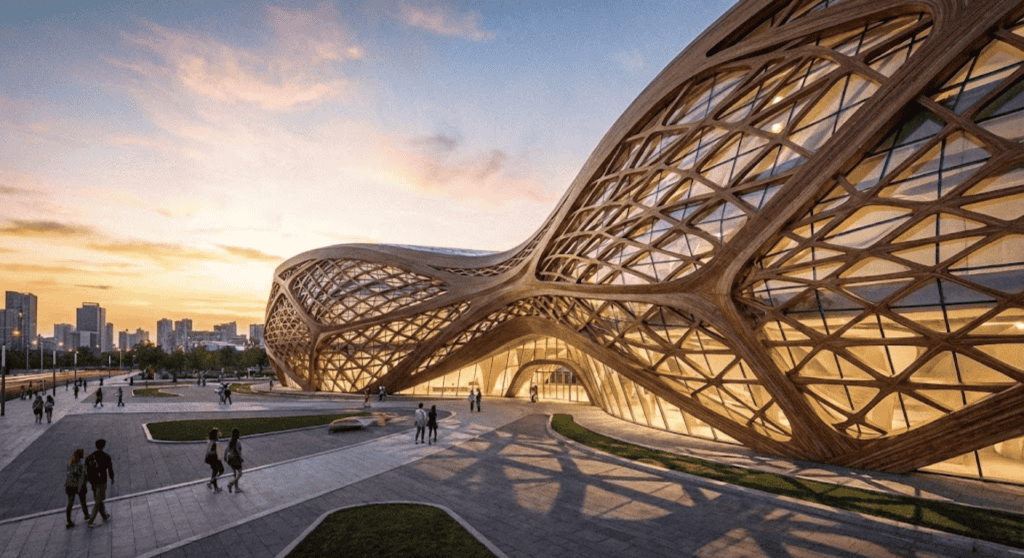
Every Indian street has the same view. Good building, considered elevation, decent proportions – and one balcony on the second floor with a bedsheet over the railing. It is the single most common thing that undoes an Indian facade, and almost nobody designs for it. Search the problem and you get drying racks, ceiling hangers and advice to dry the clothes indoors, which in an Indian summer is advice to waste the one free dryer you own. The real problem is a conflict nobody states: drying needs sun and moving air, hiding needs opacity, and every solid screen you can buy trades one for the other. It is solvable, but not with a curtain. It is solvable with angle. The street sees your balcony from below, at a steep rising angle. You use that balcony standing up, looking out roughly level. Those two lines of sight are twenty to forty degrees apart, and that gap is the entire design opportunity. A screen only has to be opaque across the narrow band of upward angles the street actually occupies. It can stay wide open to the sky above and to the cross-wind through it. Below are four ways to build that, drawn from four Indian cities with four different climates – and one of them is the wrong answer, which we will say plainly when we get to it.
Hide Clothes Drying on a Balcony in India: Why Angle Beats Opacity
To hide clothes drying on a balcony in India you do not need a solid screen, you need a directional one. From across a ten-metre street, a second-floor balcony is seen at roughly 26 degrees above the horizontal and a fifth-floor balcony at close to 50 degrees; standing inside that same balcony you look out at about 0 degrees. Because the street’s sightline and yours never overlap, a screen can be completely opaque along the upward angles and still be open to the sky and to the breeze. That single geometric fact is what separates a balcony screen from a balcony curtain, and it is the basis of every parametric facade system shown below. Laundry hangs in the lower part of the opening – roughly the first 1.7 metres above the balcony floor – so that is the only band that has to be handled. Everything above it can stay clear, which is exactly why the four concepts here look nothing like a boxed-in balcony.
1. Kochi: The Cantilevered Shelf, for When the Street Is Close
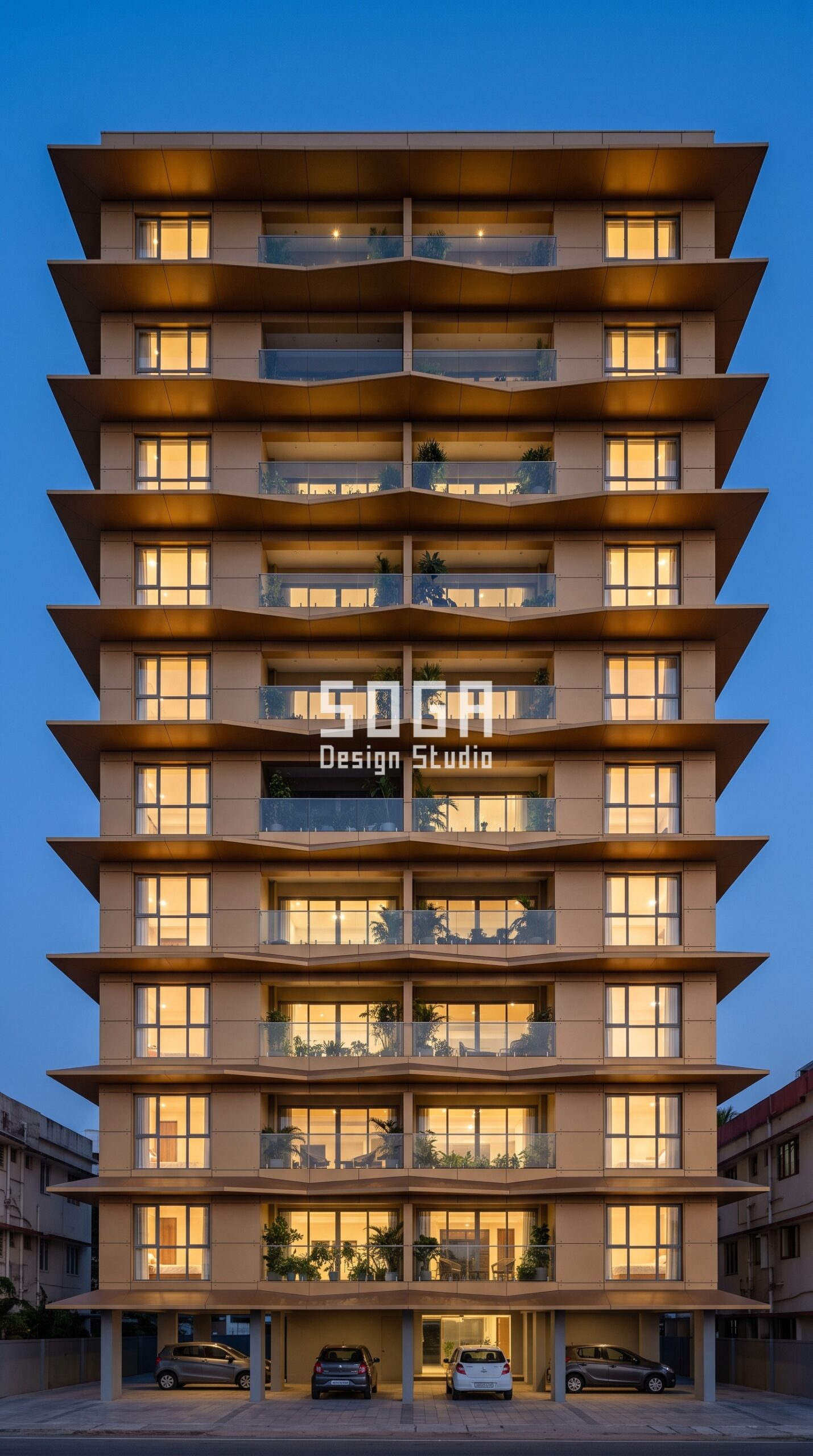
The Kochi concept is a Parametric Sawtooth Shelf in a matte warm amber-gold anodised finish: one continuous folded shelf at every floor, the zigzag module identical all the way up, only the cantilever projection changing from shallow at the base to deepest at the top. A horizontal shelf is the right device when the street is close, because a narrow setback is exactly the condition that produces the steepest viewing angles – stand three metres out from a G+2 balcony and you are looking up at close to 60 degrees, and a shelf projecting over the drying line cuts that sightline completely while leaving the balcony open on all four sides to the wind. This matters more in Kochi than anywhere else on this list, because coastal Kerala humidity means drying is driven by air movement far more than by sunlight, and a device that blocks the view without blocking the breeze is worth more here than a sunnier but stiller alternative. The projection also does the second Kochi job, which is keeping monsoon rain off the line during the four months when an unshaded balcony is useless for drying anyway. The honest catch is that a shelf is a horizontal surface at high level: it collects leaf litter and it wants a fall and a drip edge, or it will streak the panel below it within two monsoons. An anodised metal screen of this kind sits in the ₹800–₹2,500 per sq ft band installed, before the ₹50–₹150 per sq ft that access and height add.
2. Jaipur: The Arch Spandrel, Hiding the Line and Keeping the Sun
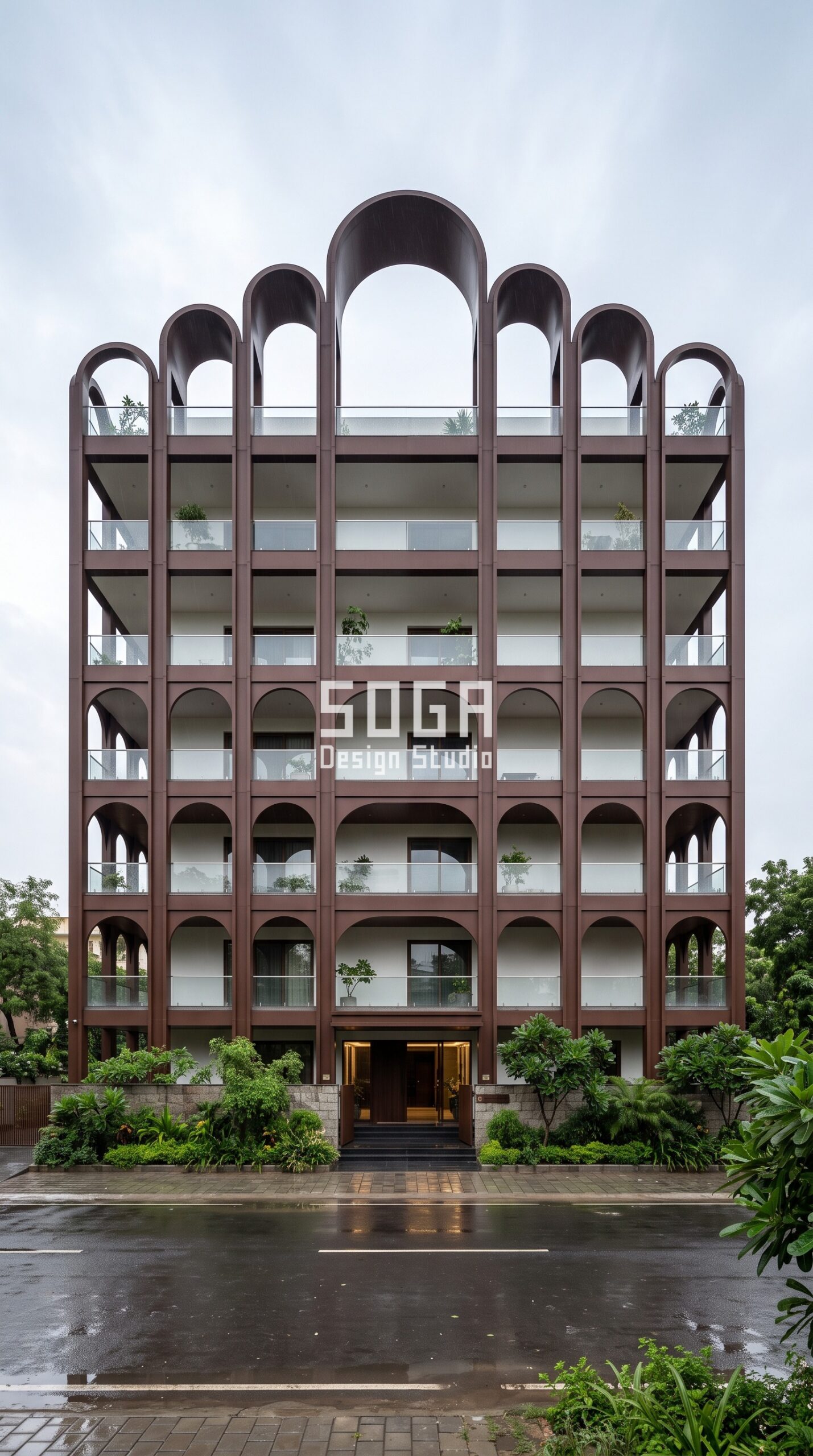
Jaipur gets a Parametric Crown Arcade in matte powder-coated RAL 8016 mahogany-brown steel – a full-height arched colonnade wrapping the perimeter, bay spacing and arch width constant on every floor, only the crown height changing, tallest at the centre and stepping down to each corner. The arch is useful here for a reason that has nothing to do with heritage styling: an arch gives you a solid, opaque spandrel at the bottom of every opening and a tall clear void above it. Laundry occupies the first 1.7 metres or so of the opening, which is precisely the band the spandrel covers, and everything above that stays open to a Jaipur sky that will dry a full load faster than any machine. In a hot, dry city the binding constraint is not sun – there is a surplus of it – but dust, and a masonry-backed spandrel gives the line a sheltered lower zone that a fully open railing never does. Vary the crown height rather than the bay width and the elevation reads as one designed system instead of a row of identical arches, which is the difference between this and the arched balconies on every second builder-floor in the city. Powder-coated steel of this kind runs ₹1,200–₹2,800 per sq ft installed.
3. Gurugram: The Set-Angle Fin, the One That Actually Uses the Sightline
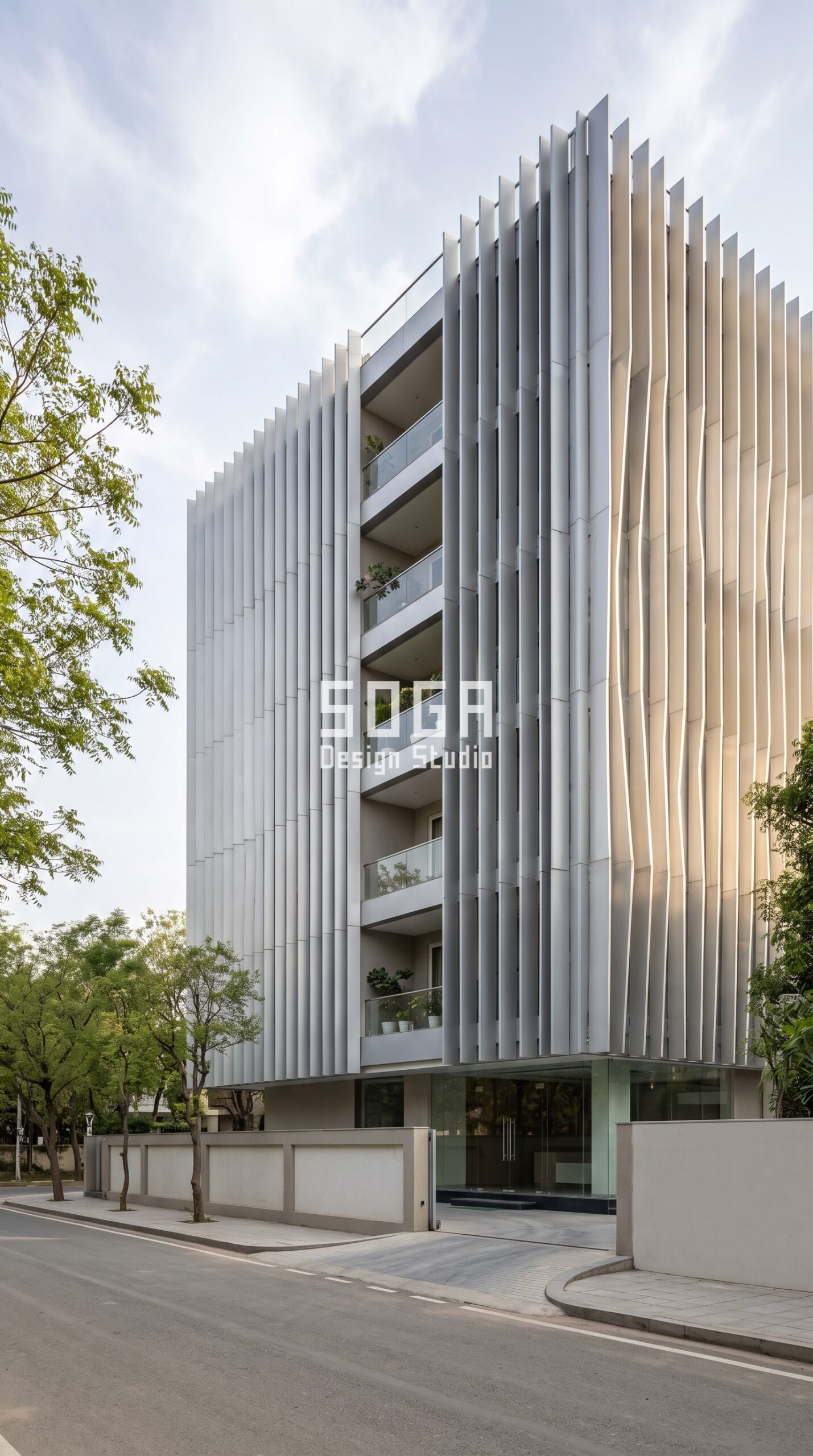
The Gurugram concept, a Parametric Concertina Blade in a matte brushed-silver finish, is the purest version of the argument: vertical folded fins alternating forward and back, fin spacing and fin width constant across the whole elevation, only the fold angle opening – nearly flat at the shaded edge and turning hardest towards the sun. Set a blade at an angle and you get directional opacity: the gap between blades is unchanged, so daylight and cross-ventilation through the screen are unchanged, but the line of sight from one particular direction closes completely. That is the whole trick, and it is why an angled fin screen beats a solid panel of the same porosity – you are not spending daylight to buy privacy, you are spending only the viewing angles you do not use. On a wide Gurugram sector road, where the observer stands fifteen to twenty metres back and the sightline flattens to twenty or thirty degrees, a vertical fin set against the street is the correct device, and a horizontal shelf would have to be impractically deep to do the same job. Angle the blades away from the prevailing summer wind and you lose some of the airflow you just protected, so the set direction is a decision, not a default. Metal fins in this finish sit in the ₹800–₹2,500 per sq ft installed band.
4. Ahmedabad: The Deep Relief Panel, and Why It Is the Wrong Answer Here
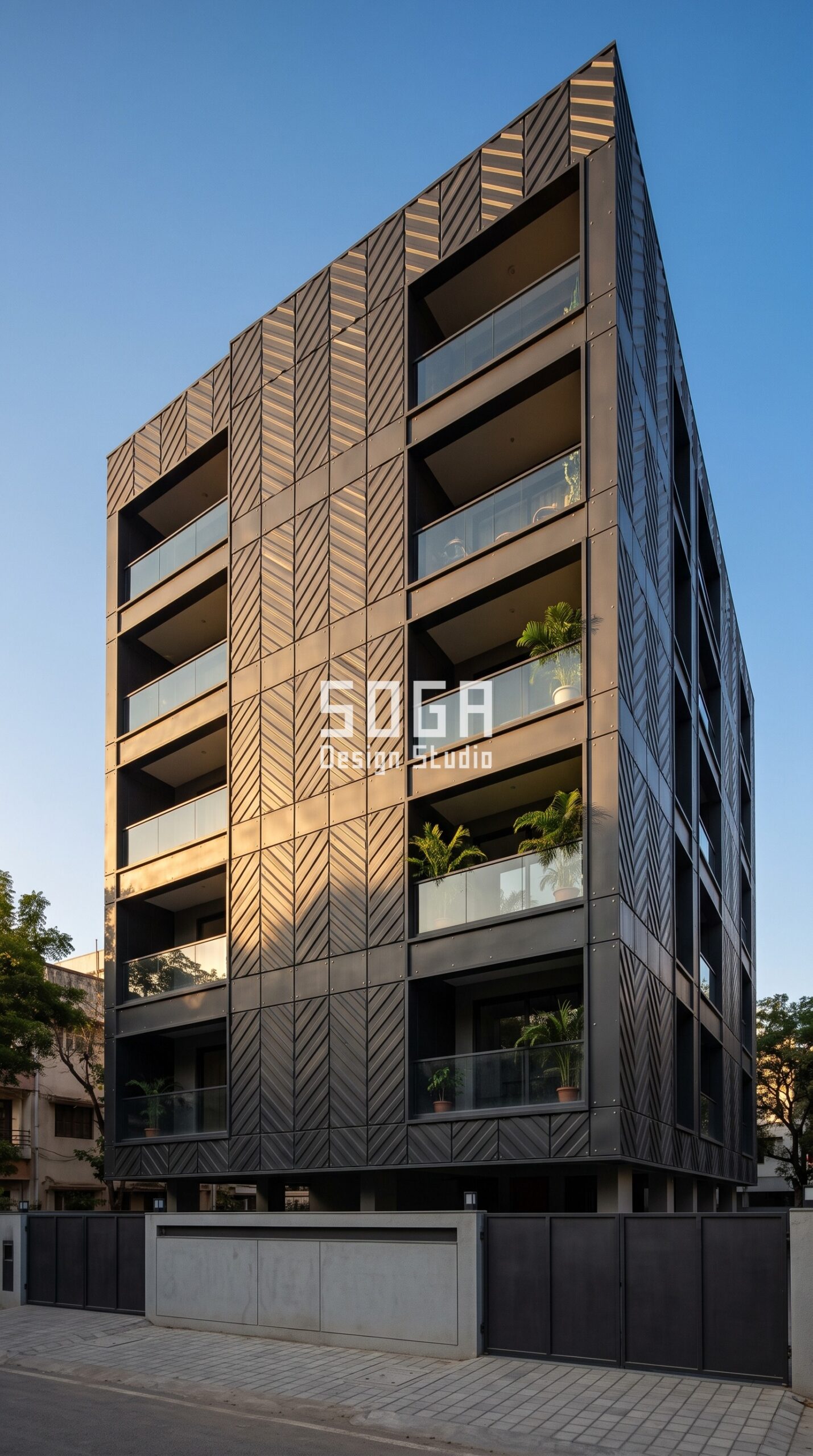
Ahmedabad is shown as a Parametric Herringbone Relief in matte powder-coated RAL 7021 dark black-grey pressed steel: chevron panels stacked floor to floor, the chevron pitch and panel grid identical everywhere, only the emboss depth changing from almost flat at the base to deepest at the top. As an elevation it is the strongest of the four, and as a laundry solution it is the one to be careful with, because a deep relief panel across a recessed balcony conceals completely – and concealing completely is how you stop the balcony working. Drying is evaporation, evaporation needs the humid air next to the wet fabric carried away, and a solid panel across the opening is the one device here that genuinely reduces air exchange rather than just redirecting a view. In a city that hits the mid-forties in May the shading is welcome and the drying will still happen; in a humid August it will not, and clothes left behind a sealed screen will smell of it. Use this system on the street-facing display elevation and keep the service balcony on a different face, or open the panel up at the balcony bays and accept that the relief reads as two zones. Pressed steel panels of this type fall in the ₹1,200–₹2,800 per sq ft installed range, and the honest note is that spending the top of that band to make a balcony unusable is the most expensive mistake on this page.
What a Balcony Screen Costs in India (2026)
A balcony screen is priced like any other facade area — per square foot of screen, installed — which is good news here, because a service balcony is a small surface. Measure the opening you actually want covered, not the elevation, and multiply it by the relevant band below. These are the current all-in installed rates in India:
- Steel facade (full design + install): ₹1,200–₹2,800 per sq ft
- Anodised or powder-coated metal panels: ₹800–₹2,500 per sq ft
- Zinc cladding: ₹1,500–₹3,000 per sq ft
- ACM panels (3 mm basic): ₹200–₹250 per sq ft (basic)
- ACM panels (4 mm): ₹250–₹350 per sq ft
- Solid metal panels: ₹800–₹1,800 per sq ft
- Installation labour: ₹50–₹150 per sq ft (varies by height + access)
- Conventional cladding (for comparison): ₹400–₹1,200 per sq ft installed (stone veneer / ceramic / standard ACM)
On a screen specifically, the number that moves the price is not the material but the set-out. A flat panel is cheap to press and cheap to fix; a blade held at a varying angle needs a bracket per blade and a fabricator who can hold that angle across a full floor. Access moves it just as much — the same screen costs more on an occupied second-floor balcony than on a building still under scaffold, which is what the labour band above is really measuring. SOGA Design Studio prices the screen against the measured opening, so one balcony stays one balcony on the estimate.
The Drying Balcony Is an Indian Design Problem
Outdoor drying is not a habit to be designed away. Across most of India line-drying is faster than a machine, it is free, it is gentler on the fabric, and the sun does a sanitising job no dryer replicates. That is why this problem looks different here than it does in London or Singapore: the correct move is not to take the laundry off the balcony, it is to take the balcony out of the street’s line of sight. The studio meets the same brief in Mumbai, Delhi, Bangalore, Hyderabad, Pune and Chennai, and for clients building back home from Dubai, Singapore and the UK — and the geometry does not change with the postcode. What changes is the climate the screen has to stay honest about: the porosity that is right for dry Jaipur heat is the wrong porosity for a humid Kochi August.
Why Trust SOGA Design Studio on Balcony Screening
- Experience: SOGA Design Studio has delivered parametric metal facades across India, Dubai and Singapore, including service-balcony screening on occupied buildings where the line had to keep working through the installation.
- Expertise: The studio designs each screen from the measured sightline of the actual street, not from a catalogue – set angle, blade width, spacing and clear depth behind the screen are all fixed against the plot before a panel is priced.
- Authority: One of the few studios in India that develops its own facade systems in-house, from the computational model through to the fixing detail and the fabrication drawings.
- Trust: Rates on this page are published installed bands, not quotes, and the limits of each system are stated alongside it – including the one concept on this page we would advise against for a drying balcony.
Frequently Asked Questions
How do I hide clothes drying on my balcony without stopping them drying?
Screen the lower part of the opening only, and screen it directionally. Laundry hangs in roughly the first 1.7 metres above the balcony floor, so that is the only band that needs to be opaque from the street. Keep the opening above it clear for sun and keep the sides open for cross-ventilation. An angled fin or a projecting shelf blocks the upward sightline the street uses while leaving the air path intact; a solid panel or a curtain blocks both, which is why the laundry stays damp behind it.
What is the best screen for a balcony facing a narrow street?
A horizontal projecting shelf or a deep spandrel. A narrow setback forces steep viewing angles – from three metres out you are looking up at close to 60 degrees – and a horizontal element cuts a steep sightline with very little projection. On a wide road the angle flattens to 20 or 30 degrees and the same shelf would have to be impractically deep; there, angled vertical fins are the efficient device.
Do balcony screens make clothes take longer to dry in India?
A screen that reduces airflow will. A screen that only redirects sightlines will not, or not noticeably. Drying is evaporation, and evaporation depends on moving air carrying humid air away from the fabric more than it depends on direct sunlight – which is why an open screen at 50 per cent porosity dries a load nearly as fast as an open railing, while a sealed panel of the same area does not. In humid coastal cities the airflow rule matters more than anywhere else.
How much does a balcony screen cost in India in 2026?
Anodised or powder-coated metal screens run ₹800–₹2,500 per sq ft installed, and steel screens ₹1,200–₹2,800 per sq ft installed. Access and height add a further ₹50–₹150 per sq ft. Measure the balcony opening you actually want screened and multiply – a service balcony is a small area, so this is usually one of the cheapest meaningful changes you can make to an elevation.
Can a screen be added to a balcony on an existing building?
Usually yes. A screen is a light, self-supporting layer carried on brackets off the slab edge or the balcony upstand rather than off the wall, so it does not depend on the original structure. The two things that decide it are access for installation and, in an apartment, permission – many societies treat the balcony face as common elevation and will want the screen approved before it goes up.
Is drying clothes on the balcony allowed in an apartment society?
It depends on the society’s own bye-laws, and a growing number of urban associations restrict drying on street-facing balconies specifically because of how it looks. That is an argument for a designed screen rather than against drying outdoors: a screen that conceals the line from the road usually satisfies the objection, and it is worth getting the design approved by the committee before fabrication rather than after.
Should the service balcony be on the front of the house at all?
If the plot allows a choice, no – put the drying balcony on a side or rear face and give the front elevation the display balcony. Most Indian plots do not allow the choice, which is why screening exists. Where the service balcony must sit on the street face, treat it as part of the elevation system rather than as an exception to it, so the screen reads as design and not as a patch.
Related Reading
- How to hide AC outdoor units on a house facade
- Balcony facade design in India
- Stop rain water entering a balcony
- Dust-proof facade design for an Indian house
- Front elevation design for a double-floor house with balconies
- Does a Facade Screen Block Mobile Signal? India 2026
Start Your Balcony Screen Project
Measure the distance from your balcony to where people actually stand, work out the angle they see you at, and let that number choose the device: close street and steep angle wants a horizontal shelf or a deep spandrel, wide road and flat angle wants an angled vertical fin. Screen the lower 1.7 metres of the opening and leave the rest clear. Never buy concealment with airflow – a balcony that hides the laundry and stops it drying has solved nothing.
Send a photograph of the balcony taken from across the street, the distance to the road, and the floor it sits on, and SOGA Design Studio will come back with the device and the set angle that suit it. Start the conversation here — consultations are free and no-commitment.