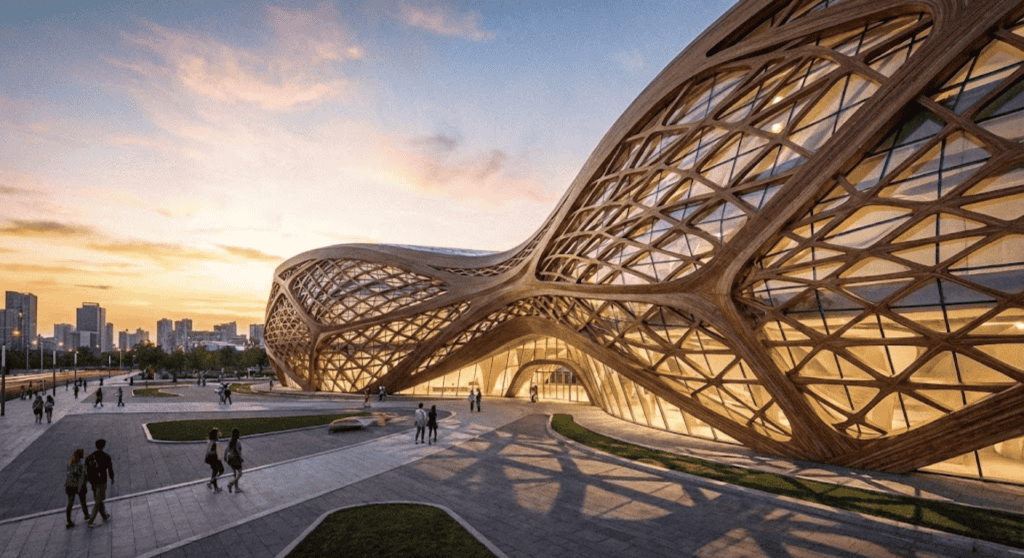
We treat glare as too much light. So every fix sold against it removes daylight, and none of them removes the glare. Film, a curtain, a smaller window — each dims the sky and the wall together, and the step between them never moves.
Window glare is discomfort caused by the luminance ratio between a bright opening and the surface framing it, not by how much daylight enters the room. In an Indian living room a clear afternoon sky reads about 9,000 cd/m² against an interior wall near 31 cd/m²: a step of 290:1, in one jump.
The eye sets its adaptation luminance by the brightest thing it can see. Put a lit reveal cheek beside the glass and the largest single step falls to 15.4:1, nineteen times smaller, with no daylight removed. The cheek is lit by the same sky, so its brightness is borrowed.
What Window Film, Curtains And A Smaller Window Actually Do
The film is not a con. A spectrally selective solar film takes a clear 6 mm float pane from a solar heat gain coefficient of about 0.72 to about 0.35, halving the heat through the largest cooling load in a west-facing Indian house. A curtain does real acoustic and privacy work. Solar-control and low-E glass do the same at specification. Each answers an honest problem. None is a glare product, and the arithmetic below says why.
The Taq: The Kashmiri Window Bay That Solved This By Accident
The taq is the pier-and-window bay of the old Kashmiri house, and the unit the house is measured in. The masonry piers are roughly 450 to 600 mm square, laced with deodar runners, so the glass sits at the outer face with the full pier depth beside it. The eye never jumped from a snow-bright sky to a dark deodar interior; it crossed 450 to 600 mm of plastered cheek on the way, lit by the same sky. The plaster was mud, not lime: a beige clay-and-straw coat rewashed about every fortnight in a cycle called livun, holding the cheek near 0.45 to 0.55 reflectance instead of letting it soot down. That re-coat is a maintenance clause we now write into a specification. Two things not to overclaim: taq names the bay layout, not the timber lacing, and nobody in Srinagar was solving glare on purpose.
The Rule: Do Not Dim The Window, Light Its Edge
Do not dim the window. Light its edge. Glare is a ratio, and everything on the concession list moves both sides of it at once. The one surface you can brighten without brightening the sky is the one between them: the edge of the opening. Rake it, chamfer it, set the glass back behind it, splay it, or crown it. Each puts a lit surface where the eye finds a hard join. The five buildings below are SOGA concept studies developed for this argument, not completed commissions.
How Much Does A Lit Reveal Reduce The Contrast?
A lit reveal takes the largest step in the eye’s path from 290:1 to 15.4:1, nineteen times smaller, without removing a lumen of daylight. Bare opening: sky 9,000 cd/m², interior wall at 150 lux and 0.65 reflectance, 31 cd/m².
Window film cannot change a luminance ratio, because it scales both terms. A 35 percent VLT film takes a 9,000 cd/m² sky to 3,150, and the wall it lights from 31 to 10.9 cd/m². Still 290:1.
Daylight Glare Probability (DGP) is the measure the daylighting field uses, having largely replaced the older Daylight Glare Index (DGI). Below 0.35 glare is imperceptible, 0.35 to 0.40 perceptible, 0.40 to 0.45 disturbing, above 0.45 intolerable. An unsplayed west opening in an Indian living room sits above 0.45 all afternoon.
| The luminance chain | What the eye is crossing |
|---|---|
| Bare — clear Indian afternoon sky | 9,000 cd/m² |
| Bare — interior living room wall | 150 lux × 0.65 ÷ π = 31 cd/m² |
| Bare — largest single step | 290:1, in one jump |
| Lit — external cheek, splayed 24° | 32,000 lux × 0.55 ÷ π = 5,600 cd/m² |
| Lit — internal reveal cheek | 2,000 lux × 0.75 ÷ π = 480 cd/m² |
| Lit — the three steps in sequence | 1.6:1, then 11.7:1, then 15.4:1 |
| Lit — largest single step | 15.4:1 |
Does A Chajja Reduce Glare, Or Only Heat?
A chajja controls solar gain and keeps rain off the opening. It does close to nothing for late-afternoon glare. A 600 mm chajja over a 2.1 m opening only cuts the beam once the vertical shadow angle passes arctan(2100 ÷ 600) = 74°. At 16:00 on a west face the sun sits near 22°, a shadow angle near 23°. The overhang is idle at the hour the complaint is made.
Indian sunshade projection depths are quoted inconsistently because they answer different questions. The 450 to 600 mm figure, 600 mm being the span limit before a chajja needs support, is a rain projection. The 200 to 300 mm figure for south and west openings is a solar-gain number. Neither is a glare number: the glare budget is spent beside the opening, not above it.
| City and latitude | Noon sun altitude, and the edge surface worth lighting |
|---|---|
| Tirunelveli, 8.71° N | December 57.8°, June 75.3°. Light the cavity soffit |
| Warangal, 17.97° N | December 48.6°, June 84.5°. Light the vertical blade nose |
| Bilaspur, 22.08° N | December 44.5°, June 88.6°. Light the raked tray top face |
| Anand, 22.55° N | December 44.0°, June 89.1°. Light the vertical splayed cheek |
| Saharanpur, 29.97° N | December 36.6°, June 83.5°. Lowest sun: light the pier flank |
| The arithmetic, in the open | December noon = 90 − latitude − 23.44; June noon = 90 − |latitude − 23.44| |
What Sets The Brightness Of The Edge Beside The Window
Four quantities decide how bright that edge gets, and only one is cheap. Splay and depth are paid for in plan and in masonry, reflectance with a skim coat, latitude not at all. Every figure below is worked at one design hour on a west opening: solar altitude angle 22°, solar azimuth 15° north of due west, 55,000 lux of direct normal illuminance.
| Driver | What it sets, and to what |
|---|---|
| Splay angle of the reveal cheek, measured from square | 0° gives 13,200 lux on the cheek, 24° gives 32,100 lux — a 2.4× jump bought with rotation, not with a bigger opening. At ρ 0.55 that is 2,310 → 5,620 cd/m² |
| Surface reflectance of the cheek, an optical component and not a colour | L = E × ρ ÷ π. At 30,000 lux: eucalyptus 0.22 gives 2,100 cd/m², clay brick 0.28 gives 2,670, brass 0.52 gives 4,970, aluminium 0.55 gives 5,250, UHPC 0.62 gives 5,920, white cement plaster 0.78 gives 7,450 |
| Depth of the cheek, read as the angle it subtends from the sofa | From a seat 3.5 m back at a 1.8 m opening: a 150 mm setback shows 37 mm of cheek, 0.59°; 460 mm splayed 24° shows 286 mm, 4.13°. Below 2° the eye reads a line, not a field |
| Latitude, which decides whether the head soffit or the window jamb is worth lighting | 8.71° N at Tirunelveli to 29.97° N at Saharanpur: 21 degrees of latitude, and 21 degrees of December noon altitude between the ends |
Two drivers meet on one window in Anand, bay six. At 24° of splay the south cheek runs a 0.583 cosine and in wire-cut brick at ρ 0.28 sits at 2,860 cd/m². The same 24° on the north cheek buys almost nothing, because the sun is 15° north of west: 7,980 lux, 720 cd/m². Same brick, same depth, same angle, 4.0:1 across a 1.8 m gap. Splay wins on the cheek the sun can reach; where it cannot, geometry stops and reflectance takes over. The same sum is why we stop at 24° rather than Alexander’s 35°: at a 460 mm reveal, 24° costs 410 mm of pier in a 3.6 m bay and 35° costs 644 mm. The plan runs out before the sun does. So the shaded cheek takes a skim at ρ 0.78 instead: 1,990 cd/m², and the asymmetry falls to 1.4:1.
Five Lit Edges: Glare Control Facade Design In Five Indian Cities
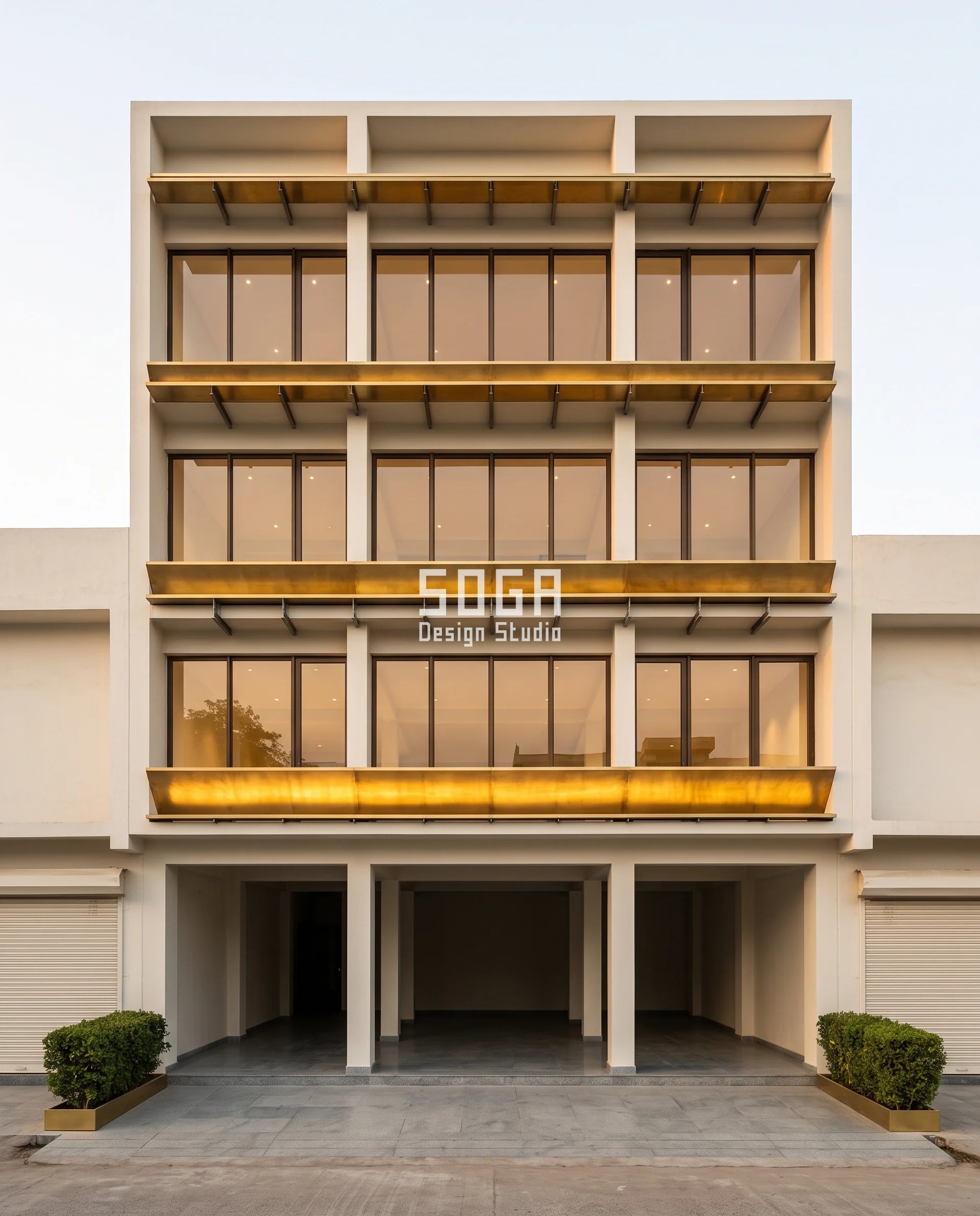
One repeating unit runs through all five: a lit cheek, two per opening, subtending at least 2° from the seat. Cheek luminance runs 1,400 to 7,400 cd/m².
Parametric Wash Tray
Bilaspur, 22.08° N: the sun is high most of the year, so the horizontal surface is the one to light. A press-braked Muntz brass tray sits above each opening at a fixed 620 mm depth; only the rake of its top face changes. At ρ 0.52 the lowest band reads 4,970 cd/m² — a 1.8:1 step where the bare wall gives 290:1.
| Specification | Parametric Wash Tray |
|---|---|
| Product | Muntz brass tray pans, 1.5 mm, on galvanised MS outriggers at 1200 mm centres, welted cheeks, 25 mm drip return |
| What varies | Tray rake, 4 / 12 / 22 / 33° over four counted bands |
| Indicative rate | ₹3,200–4,800 / sq ft |
Parametric Chamfer Blade
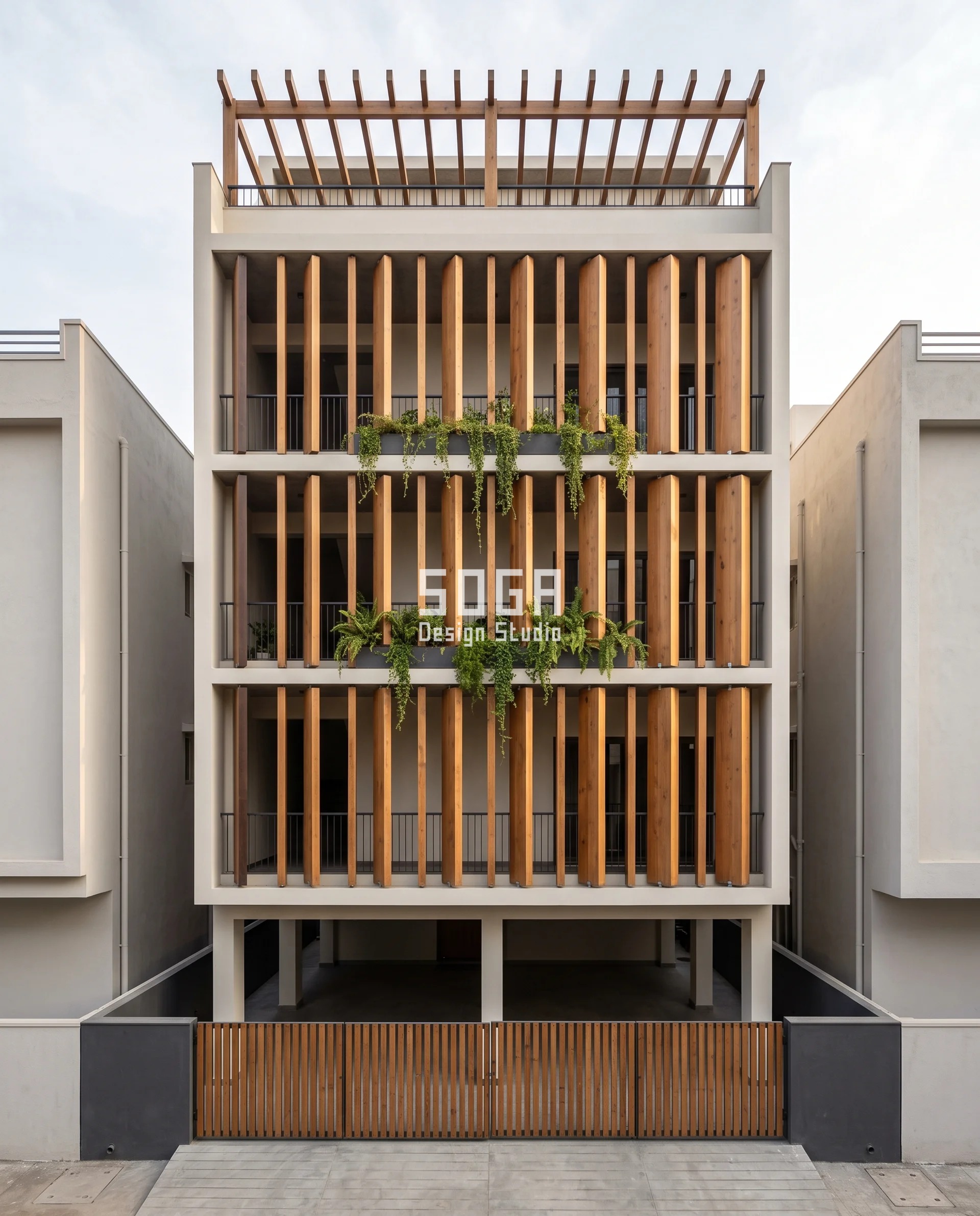
Warangal, 17.97° N, west elevation. Caramel-brown thermally modified eucalyptus battens, 220 × 60 mm, at fixed 250 mm centres and 220 mm depth; only the CNC chamfer on the nose varies. Timber is the darkest cheek here at ρ 0.22, 2,100 cd/m² and a 4.3:1 step: bright enough to work, dark enough to keep the room’s colour.
| Specification | Parametric Chamfer Blade |
|---|---|
| Product | Thermally modified eucalyptus batten, CNC bevel on the street arris, on a concealed aluminium T-rail with 304 stainless clips |
| What varies | Nose chamfer, 0 / 18 / 37 / 55 / 74 / 93 / 111 / 130 mm over eight counted blades |
| Indicative rate | ₹1,450–2,200 / sq ft |
Parametric Recess Plane
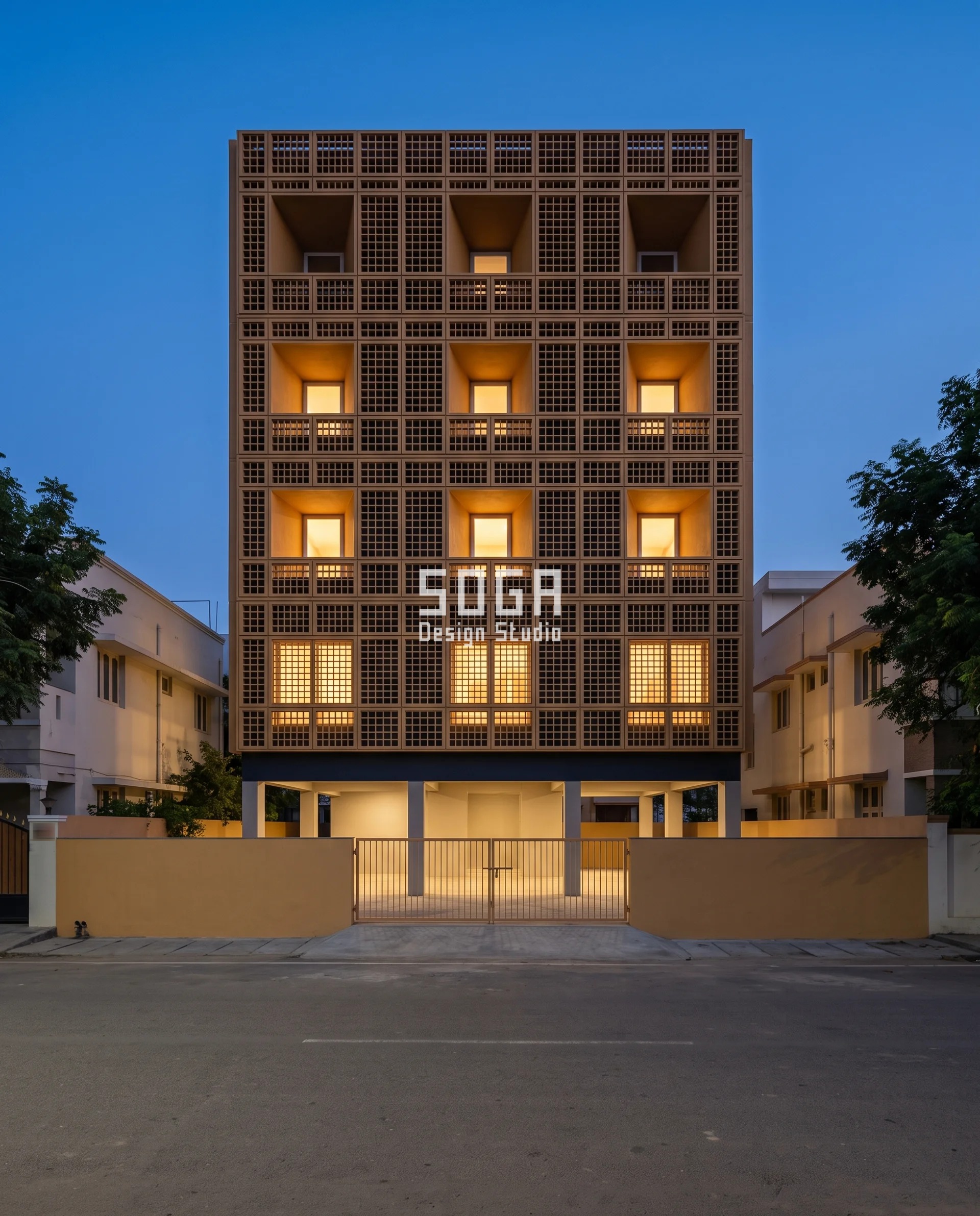
Tirunelveli is the southernmost at 8.71° N, so the cavity soffit does the work. A biscuit-ochre sand-cast aluminium grille holds one dead-flat plane of 300 mm cells, 140 mm deep. At a 150 mm setback the cheek subtends 0.59° from a seat 3.5 m back and reads as a line; at 900 mm, 2.92°, and it is a surface.
| Specification | Parametric Recess Plane |
|---|---|
| Product | Sand-cast aluminium grille frames, 140 mm deep members, on a galvanised MS ladder frame at 400 mm standoff |
| What varies | Glazing setback, 150 / 400 / 650 / 900 mm over four counted levels |
| Indicative rate | ₹2,400–3,600 / sq ft |
Parametric Splay Cheek
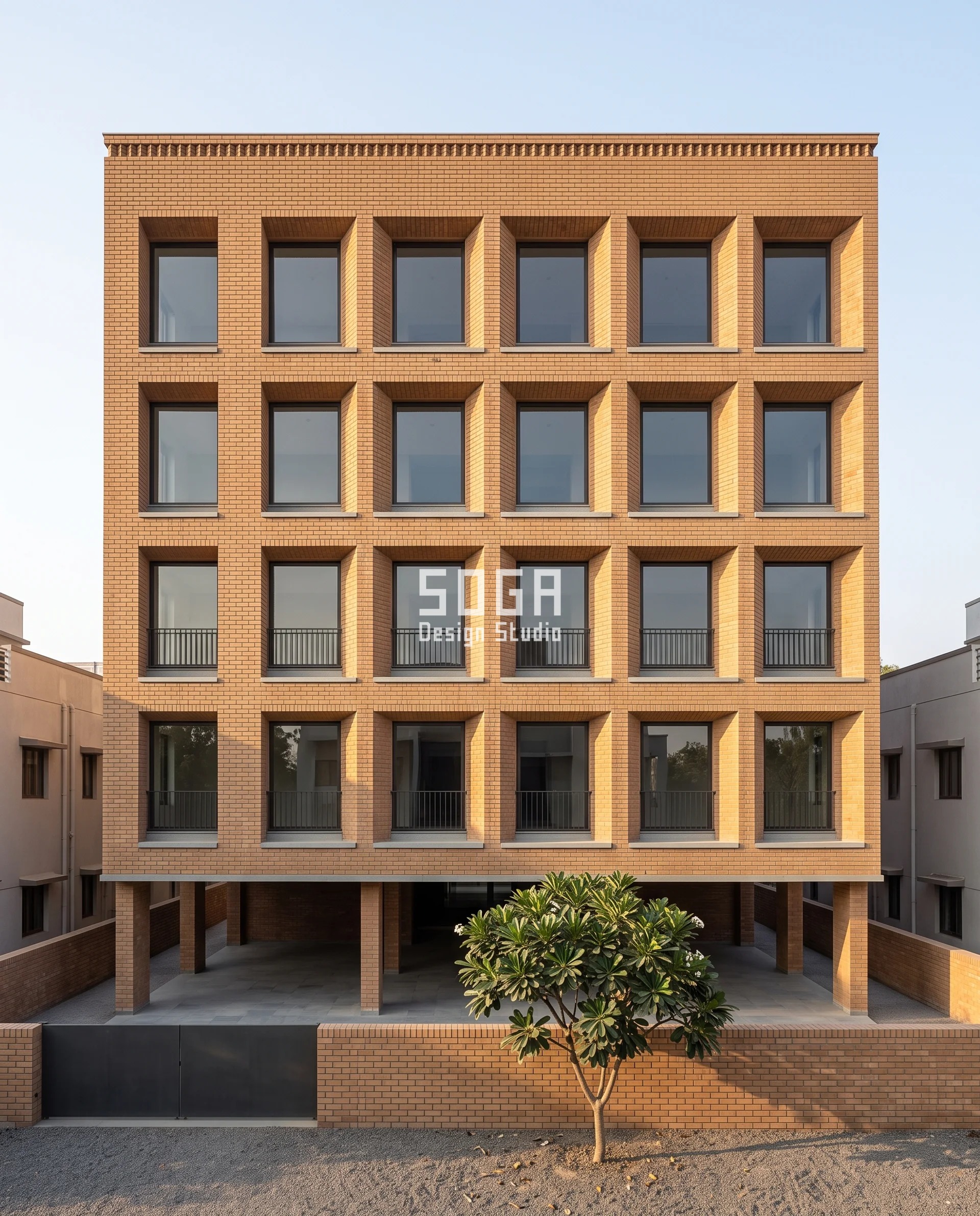
Anand is the reference case. The opening is fixed at 1.8 × 2.1 m, the reveal at 460 mm, the bay at 3.6 m, the brick honey-buff wire-cut solid; only the splay of the two cheeks moves. At 0° the sunlit cheek collects 13,200 lux; at 24°, 32,100 lux, showing 286 mm of lit brick instead of 115 mm.
| Specification | Parametric Splay Cheek |
|---|---|
| Product | Wire-cut solid clay brick, purpose-cut splay units, 304 stainless bed-joint reinforcement every fourth course, precast throated sill |
| What varies | Cheek splay, 0 / 5 / 10 / 15 / 20 / 24° over six counted bays |
| Indicative rate | ₹850–1,450 / sq ft, or ₹26,000–44,000 per opening |
Parametric Crown Pier
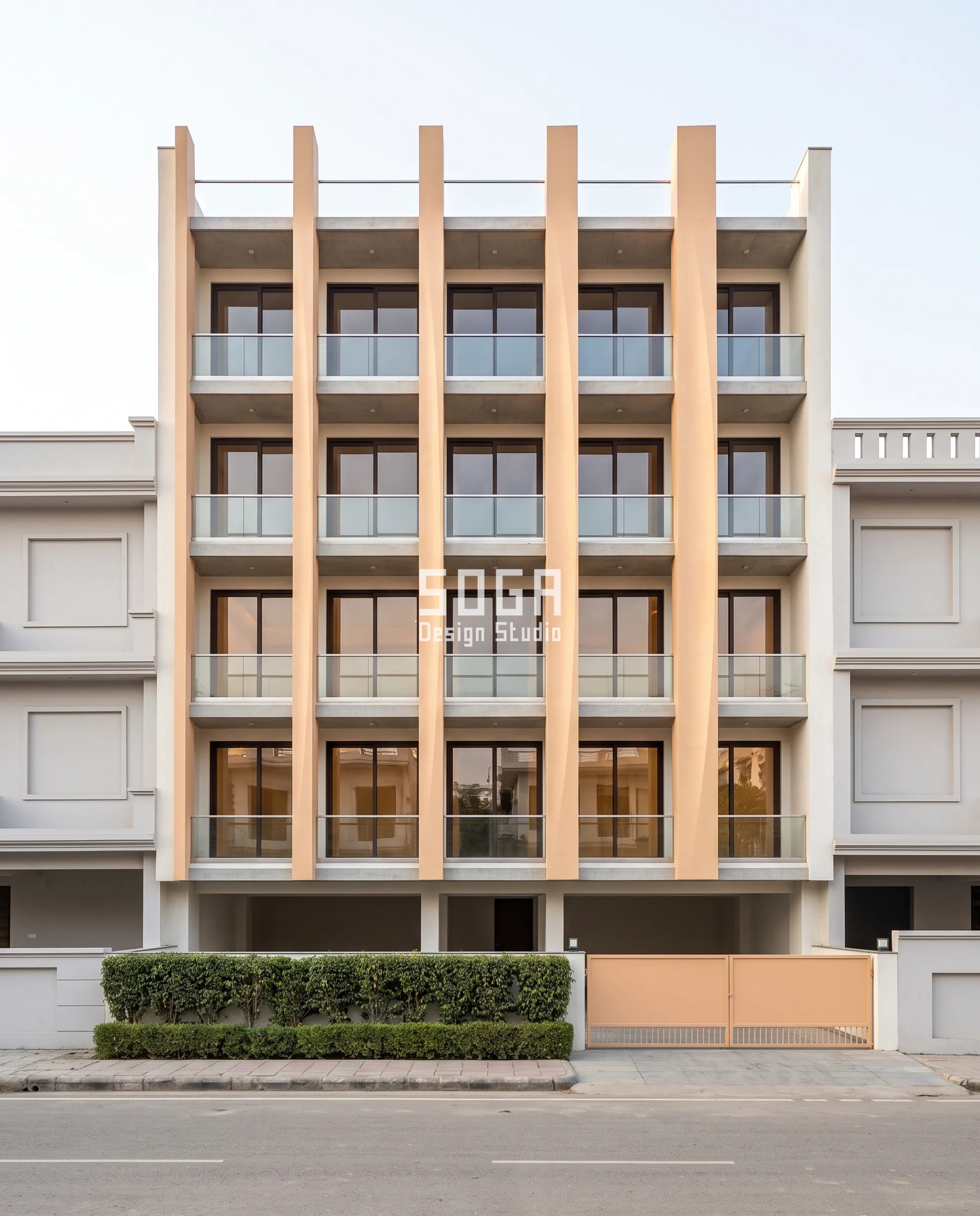
Saharanpur is the northernmost at 29.97° N, December noon 36.6°, the lowest sun on this page, so the vertical face gets lit. Apricot-buff pigmented 25 mm UHPC shells clad an RCC pier core at a fixed 700 mm width and 2.6 m centres; only the crown rise moves. At ρ 0.62 the fullest crown carries 5,920 cd/m², a 1.5:1 step.
| Specification | Parametric Crown Pier |
|---|---|
| Product | Pigmented 25 mm UHPC shells on 304 stainless undercut anchors to an RCC pier core, 10 mm open joints, EPDM back-gasket |
| What varies | Crown rise, 40 / 105 / 170 / 235 / 300 mm over five counted piers |
| Indicative rate | ₹1,900–2,900 / sq ft |
How Deep Should The Reveal Be, And What Finish?
At least 200 mm of reveal, and a finish above ρ 0.5, if the geometry is to pay for itself. The check an owner can run on a drawing with a scale rule is the angle the cheek subtends from the seat, not its depth: from 3.5 m back it must show at least 2° of face. A 460 mm reveal splayed 24° shows 286 mm, 4.13°. A 115 mm reveal in a 230 mm leaf shows 29 mm, 0.47°, and no splay rescues it. LBNL puts an effective reveal at 230 to 300 mm at 60° to the glass plane — 30° of splay here.
| Design parameter | Specification |
|---|---|
| The repeating unit | One lit cheek, two per opening, subtending at least 2° from the seat |
| Eucalyptus cheek, Warangal | ρ 0.22 → 2,100 cd/m² at 30,000 lux → 4.3:1 to the sky |
| Clay brick cheek, Anand | ρ 0.28 → 2,670 cd/m² → 3.4:1 |
| Muntz brass cheek, Bilaspur | ρ 0.52 → 4,970 cd/m² → 1.8:1 |
| Cast aluminium cheek, Tirunelveli | ρ 0.55 → 5,250 cd/m² → 1.7:1 |
| Pigmented UHPC cheek, Saharanpur | ρ 0.62 → 5,920 cd/m² → 1.5:1 |
| White cement skim, the retrofit | ρ 0.78 → 7,450 cd/m² → 1.2:1 |
| Minimum reveal depth worth building | 200 mm; below it the cheek subtends under 2° |
| Splay convention, settled | Ours is from square. Alexander’s 50 to 60° to the glass plane is 30 to 40° here; our 24° is 66° in his |
The two details that decide whether a lit cheek stays lit
- The splayed brick cheek gets a purpose-cut closer at the outer arris, never a rubbed or angle-ground brick. Grinding a wire-cut solid opens the fired skin on an acute arris and it spalls inside two monsoons, and a spalled cheek is a reflectance failure before it is a cosmetic one. Under it the precast sill runs a 1:60 fall with a 20 mm throated drip: a splayed cheek gathers rain across a 500 mm face.
- Every lit cheek is detailed to stay lit, because reflectance is a maintenance number, not a finish. The Bilaspur brass pans carry a 25 mm nose drip return and a 1:100 fall to a 12 mm slot, so the top face washes down its own slot. A cheek soiling from ρ 0.52 to 0.30 drops from 4,970 to 2,870 cd/m², giving back 42 percent of what the geometry bought.
Where This Stops: The Sun Disc, And Reveals Under 200 mm
This stops at the sun disc, and it stops hard. Everything above works because a 9,000 cd/m² sky and a 5,600 cd/m² cheek are within reach of each other. The disc is not. Low on the horizon, after atmospheric extinction, it still runs around 600,000 cd/m²: sixty-seven times the sky it sits in, a hundred times the brightest cheek here. The moment the disc enters the opening you have left discomfort glare and entered disability glare, and no reveal, splay, chamfer, rake or crown touches it. On a due-west living room in India the sun sets within about 24° of the wall normal all year, so that is the last half hour of daylight, most days. For it we draw an opaque element: a top-fixed blackout roller in the head reveal, down about thirty minutes. Mixed-mode, not ideology. The second limit disqualifies most Indian retrofits. Below roughly 200 mm of reveal there is no cheek to light: at 150 mm it subtends 0.59°, and a full 24° splay gets it to 1.9°. There, reflectance is the only instrument left, and a skim lifts the cheek by roughly 70 percent. The smallest thing on this page.
What A Glare-Reducing Window Edge Costs In India (2026)
2026 India rates, indicative and itemised per project. Read the last row first: a shaped edge on an existing opening is a masonry-and-finishes job, not a cladding job, and prices below the rest.
| System / material | Indicative rate (per sq ft) |
|---|---|
| Purpose-cut splayed clay-brick reveal, both cheeks, precast sill (Anand) | ₹850–1,450 per sq ft |
| The same, per opening — one 1.8 × 2.1 m window, both cheeks plus sill | ₹26,000–44,000 per opening |
| Thermally modified eucalyptus chamfered blades, CNC bevel, aluminium T-rail (Warangal) | ₹1,450–2,200 per sq ft |
| Pigmented 25 mm UHPC crown-pier shells on stainless undercut anchors (Saharanpur) | ₹1,900–2,900 per sq ft |
| UHPC mould set, amortised over five crown rises | ₹1.6–2.6 lakh per mould |
| Powder-coated sand-cast aluminium grille, 140 mm members (Tirunelveli) | ₹2,400–3,600 per sq ft |
| Mill-finish Muntz brass 1.5 mm wash trays on galvanised MS outriggers (Bilaspur) | ₹3,200–4,800 per sq ft |
| Retrofit: white cement skim to an existing reveal, ρ 0.45 to 0.78 | ₹90–180 per sq ft of reveal, or ₹1,100–2,400 per opening |
That heat half is answered in full, hour by hour and in millimetres, in our guide to elevation design to reduce wall heat.
Related Reading
- parametric facade design in India
- house facade design in India
- a facade screen that keeps a room bright
- west-facing house elevation design
- modern chajja design in India
- why elevation colour fades in the Indian sun
- Do Curved Balconies Reduce Usable Area? India 2026
- Can an Algorithm Design Your Dream Living Room?
- 7 Ways Parametric Design is Revolutionizing Luxury Home Living
Frequently Asked Questions
How do I reduce sun glare in my living room window in India?
Widen the brightness step instead of dimming the glass. A clear Indian afternoon sky reads about 9,000 cd/m² against a wall near 31 cd/m², a 290:1 jump. A reveal cheek 200 mm deep, finished above 0.5 reflectance, takes that step to about 15:1.
Why does window film not fix glare?
Because film scales both sides of the ratio. A 35 percent VLT film takes a 9,000 cd/m² sky to 3,150 and the wall from 31 to 10.9 cd/m²: still 290:1. It does halve solar heat gain, 0.72 SHGC to 0.35 — a heat product, not a glare one.
How deep should a window reveal be to stop glare?
At least 200 mm, and 460 mm splayed 24° is what we build to. The test is the angle it subtends from the sofa: from 3.5 m back a 460 mm cheek at 24° shows 286 mm of lit face, 4.13°. A 115 mm reveal shows 0.47°.
Can I fix glare on a window that is already built?
Yes, with reflectance instead of geometry. A white cement skim takes an existing reveal from 0.45 to 0.78 reflectance and lifts cheek luminance by roughly 70 percent, at ₹90–180 per sq ft or ₹1,100–2,400 per opening.
Does a chajja reduce glare or only heat?
Mostly heat and rain. A 600 mm chajja over a 2.1 m opening only cuts the beam above a 74° vertical shadow angle, and at 16:00 on a west face the shadow angle is about 23°. The 450 to 600 mm and 200 to 300 mm depths in circulation are rain and solar-gain numbers.
Design The Edge, Not The Tint
Send us the window: orientation, wall thickness, the reveal depth you have, and where the sofa sits. We come back with the cheek geometry, the finish reflectance and a rate band for your city. SOGA Design Studio designs facades and window reveals across India. [email protected].