The question arrives in almost every enquiry, usually after the drawings are approved and just before the order is placed: won’t it rust? It is a fair question. Most Indian homeowners have watched a metal gate bleed orange down a compound wall, or seen a neighbour’s railing give up in four monsoons, and they are being asked to wrap an entire elevation in metal. But the fear is aimed at the wrong component. In the corrosion failures SOGA Design Studio has been called to look at, the visible panel was almost always still intact. What had gone was behind it – the sub-frame carrying the panel, the brackets holding the sub-frame, the fasteners, or a drainage cavity that had silted up and stopped letting water out. The skin gets blamed for a skeleton problem. This post takes four concepts in four Indian climates and, for each one, names the thing that would actually corrode first and what stops it.
Do Metal Facades Rust in India? What Actually Corrodes First
Do metal facades rust in India? In almost every failure SOGA Design Studio has been called to inspect, the visible coated panel was still sound and the corrosion was behind it – in the mild-steel sub-frame, the brackets, the fasteners, or a drainage cavity that had silted up and stopped draining. A powder-coated or anodised skin is a finish on a substrate, and it is the substrate and the fixings that decide the lifespan. That is why the useful question to put to a fabricator is not what colour system the panel carries but what grade the brackets and screws are, whether dissimilar metals are isolated where they touch, and where water leaving the cavity is supposed to go. Get those three answers and the rust question is largely settled, in Kochi, Lucknow, Bangalore and Nagpur alike. This detail-first approach is the same one behind SOGA’s parametric facade design work across India.
1. Kochi Parametric Splay Screen: Salt Air Attacks the Fixings, Not the Finish
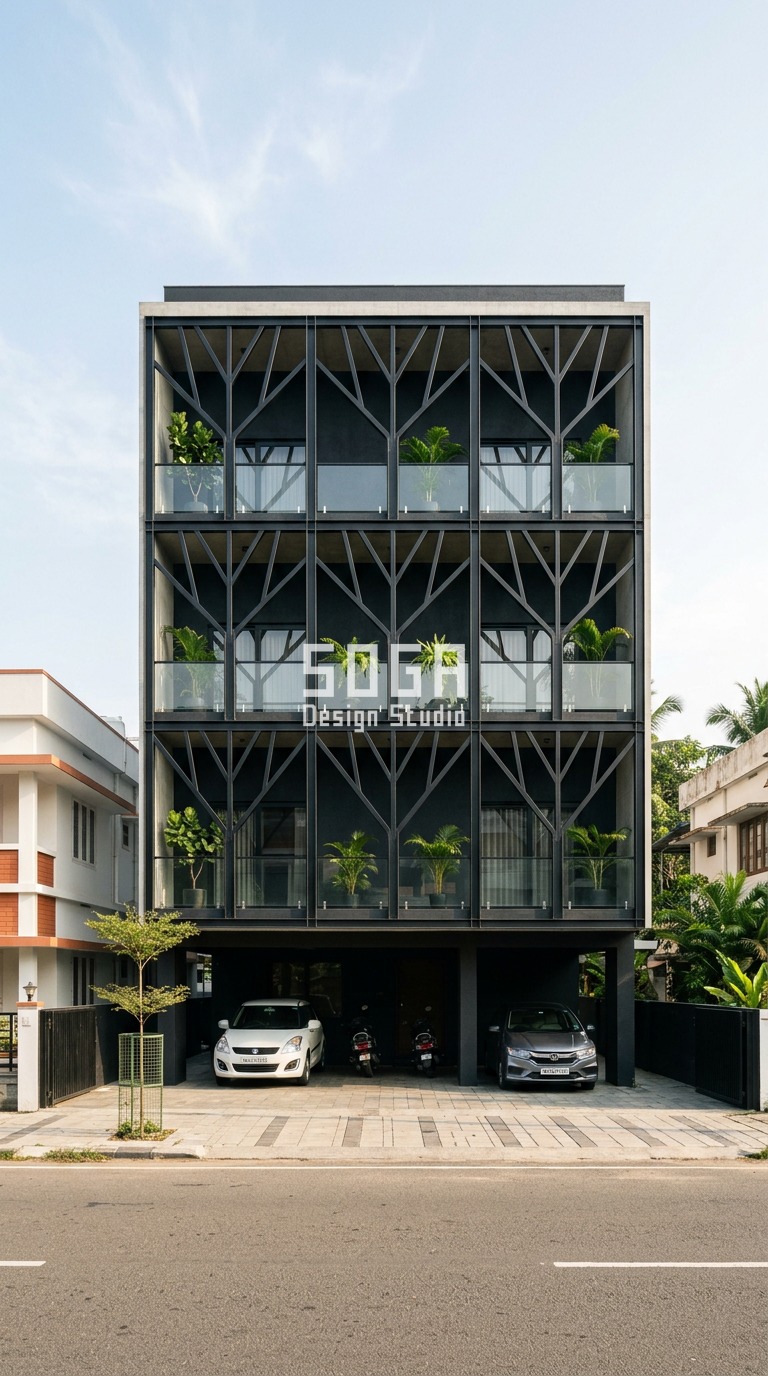
Kochi is the hardest corrosion environment of the four, and the reason is not rain – it is airborne chloride. Within roughly a kilometre of the backwaters and the coast, salt settles on every surface and stays there between showers, and chloride is what breaks down a protective oxide layer and gets underneath a coating. The Parametric Splay Screen on this G+3 keeps three identical branching frames on every floor and grades only the branch spread angle as it rises, so the geometry stays simple enough to be hot-dip galvanised before it is powder-coated in matte RAL 9005 jet black. That sequence matters more than the colour: galvanising first means a scratch during installation exposes zinc rather than bare steel. The failure point that has to be designed out here is the fastener. A stainless fastener into a galvanised bracket, with an isolating washer where the two metals meet, is the difference between a screen that lasts and one that weeps rust streaks down its own face by the third monsoon. Every branch node is also detailed to shed water outward rather than hold it in the fork, because a coastal screen that ponds is a coastal screen that fails.
2. Lucknow Parametric Relief Grid: Dry Air, But the Cavity Still Has to Drain
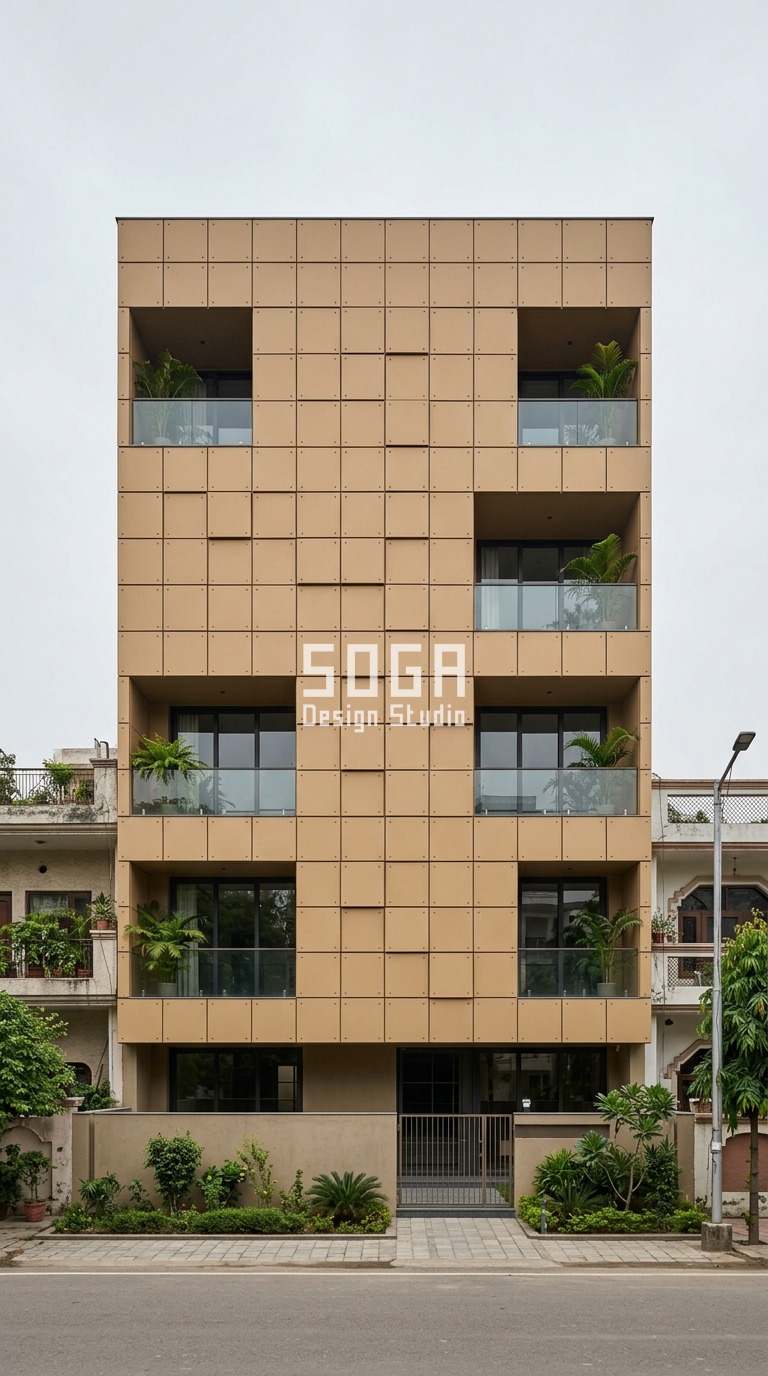
Lucknow inverts the Kochi problem. The air is dry for most of the year, chloride is negligible, and a coated steel tile will sit happily for a long time – which is exactly why the drainage detail gets skipped here more often than anywhere else. The Parametric Relief Grid holds a fixed square tile layout on every floor and varies only how far each tile stands off the wall, from flush to about the depth of a brick laid flat. Those stand-off depths create dozens of small horizontal ledges, and in a dry-dust city each ledge collects a fine silt that behaves like a sponge for the six weeks of monsoon. Damp dust held against a coated surface for weeks is a far more aggressive condition than clean rain running off it. So the tiles are set out with a continuous open joint at every horizontal line rather than a sealed one, the cavity behind is vented top and bottom, and the deepest tiles are given a slight fall so silt washes off instead of banking up. The warm desert sand finish is chosen partly because it does not advertise the dust that will inevitably land on it between washes.
3. Bangalore Parametric Bevel Fold: Composite Panels Move, and Movement Opens Coatings
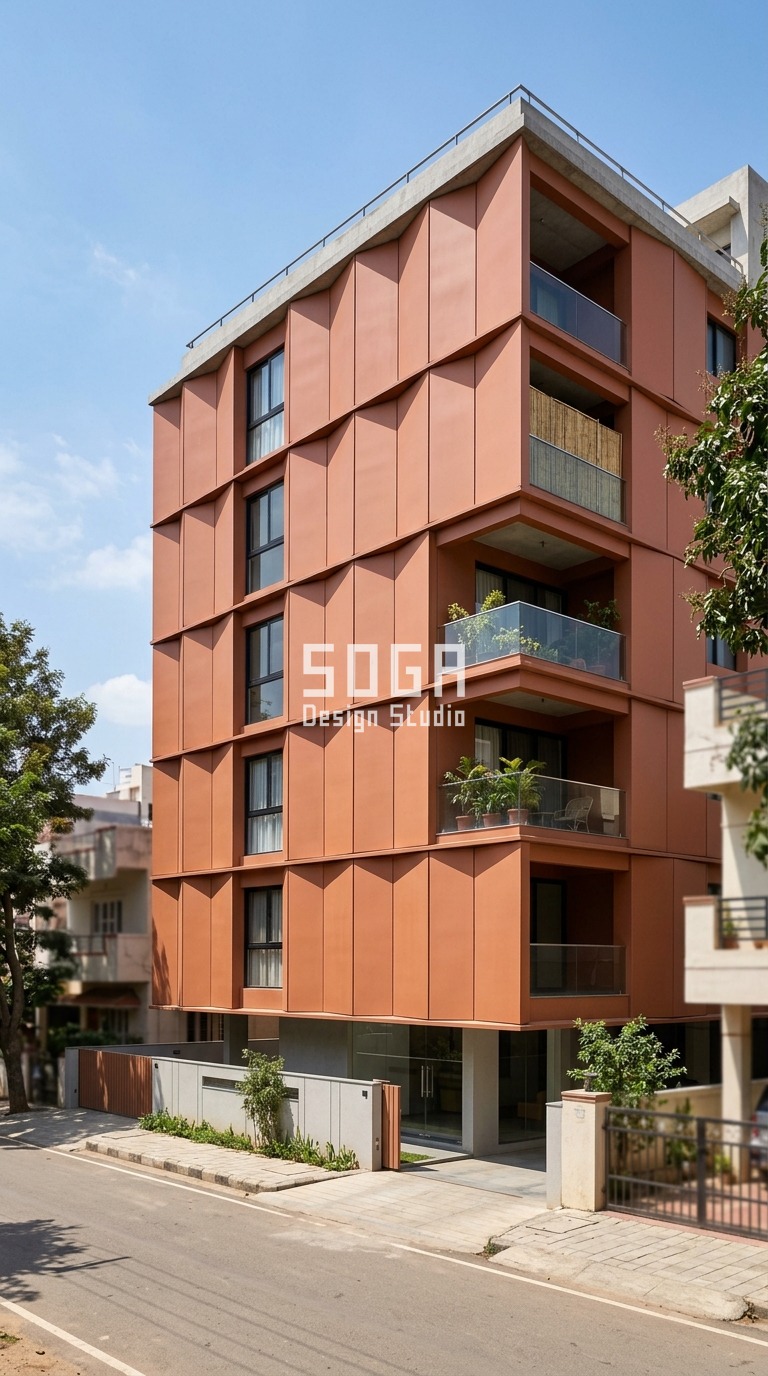
Bangalore is the mildest climate of the four and produces the fewest corrosion complaints – but it produces a different one. The city’s daily temperature swing is wide and its monsoon is long and drizzling rather than torrential, and that combination works on joints rather than surfaces. The Parametric Bevel Fold uses six flat-sided folded panels per floor, each creased once down its centre, with only the fold depth changing from almost flat at the base to about the depth of a hand at the top. A creased composite panel expands and contracts along its fold, and if it is pinned rigidly at both ends the coating at the crease is worked back and forth until it crazes and lets moisture reach the core. The detail that prevents it is unglamorous: slotted fixing holes, so each panel is held at one fixed point and allowed to slide everywhere else. The warm terracotta tone is a through-coloured system rather than a surface paint, which means a knock during installation shows as a dent, not as a bright silver scar that then becomes the first corrosion site.
4. Nagpur Parametric Bolster Shell: Heat Is the Corrosion Driver Nobody Expects
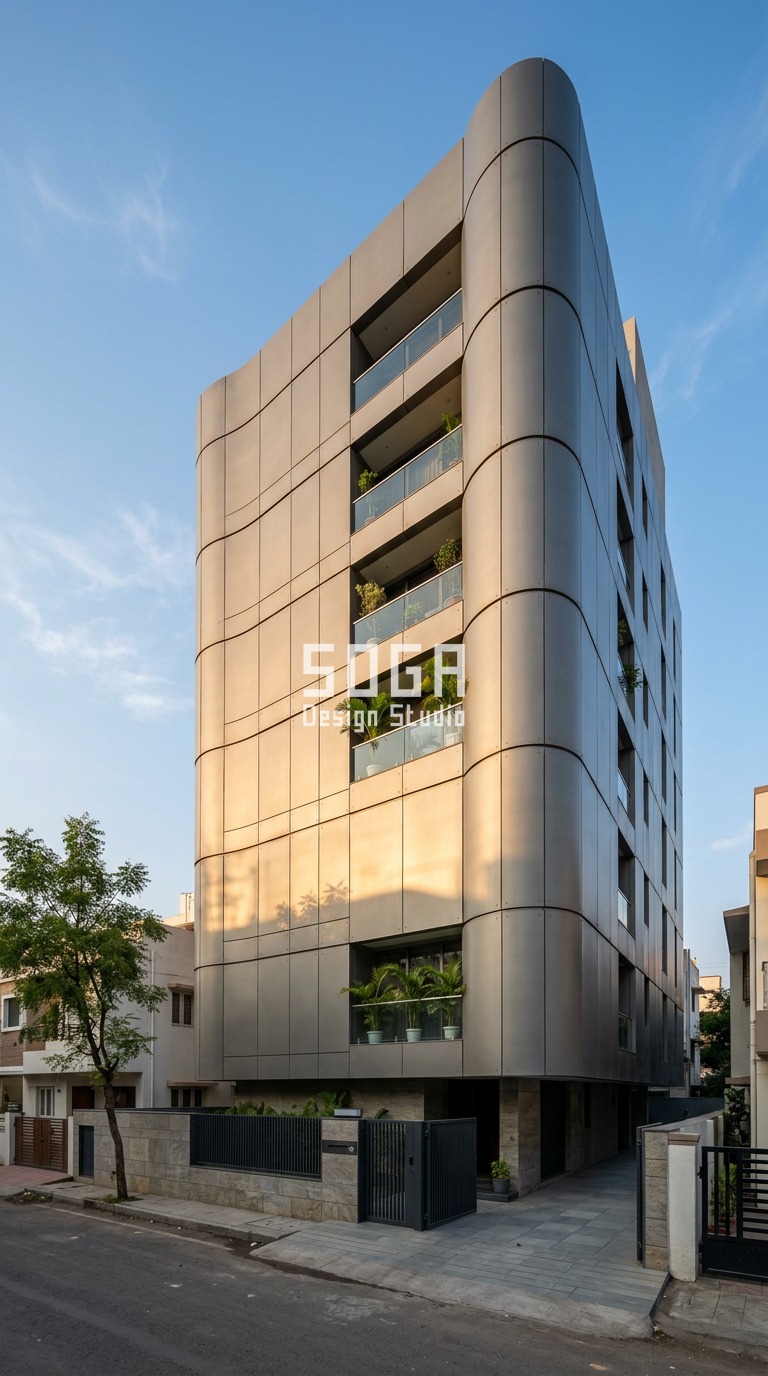
Nagpur regularly runs above 45 degrees in May, and on a west elevation a dark metal panel can sit far hotter than the air around it. Heat does not corrode metal on its own, but it accelerates everything else: it drives thermal cycling that fatigues fixings, it bakes coatings toward embrittlement, and on a G+8 it produces enough cumulative movement across a tall elevation to loosen a bracket that was tightened correctly on day one. The Parametric Bolster Shell answers this by keeping five separate gently bowed panels on every floor and varying only the bulge depth, from nearly flat low down to about the depth of three fingers near the top. Separate panels mean every module has its own expansion allowance instead of one continuous skin trying to grow in a single direction. The titanium grey anodised finish is specified over a coated one here because anodising is an integral conversion of the surface rather than a layer sitting on top, so it does not soften or chalk at the temperatures this elevation reaches. The brackets are the maintenance item, not the panels – and they are placed where a person on a ladder can actually reach them.
What Rust-Resistant Detailing Actually Costs in India in 2026
Corrosion resistance is not a premium product you buy; it is a set of decisions about substrate, coating sequence, fastener grade and drainage, and it moves a facade quote by a modest amount compared with what getting it wrong costs later. The bands below are the ones SOGA Design Studio works to in 2026.
- Steel facade (full design + install): ₹1,200–₹2,800 per sq ft
- Anodised or powder-coated metal panels: ₹800–₹2,500 per sq ft
- Zinc cladding: ₹1,500–₹3,000 per sq ft
- ACM panels (3 mm basic): ₹200–₹250 per sq ft (basic)
- ACM panels (4 mm): ₹250–₹350 per sq ft
- Solid metal panels: ₹800–₹1,800 per sq ft
- Installation labour: ₹50–₹150 per sq ft (varies by height + access)
- Conventional cladding (for comparison): ₹400–₹1,200 per sq ft installed (stone veneer / ceramic / standard ACM)
The difference between a facade detailed for its climate and one detailed generically usually sits inside these bands rather than above them – galvanising before coating, stainless fasteners and isolating washers are small line items. Replacing a corroded sub-frame five years in is not. Ask for the fixing schedule and the drainage detail in writing before you compare two quotations, because that is where the real difference between them is hiding.
Corrosion Is a Local Question: India, Dubai and Singapore
The same panel system behaves differently depending on where it lands, which is why SOGA Design Studio specifies substrate and fixings per project rather than per catalogue. Coastal Indian cities such as Kochi, Mumbai, Chennai and Goa are chloride environments and drive the fastener grade. Inland cities such as Lucknow, Delhi, Nagpur, Hyderabad and Pune are dust-and-heat environments and drive the drainage and expansion detailing. Bangalore and Pune sit in a milder band where joint movement matters more than surface attack. Outside India, Dubai combines high heat with coastal salt and is the most demanding of all, while Singapore’s constant humidity means a cavity that cannot dry out is the primary risk. NRI clients commissioning a house in India from Dubai, Singapore or the UK get the same fixing schedule and drainage drawings as a local client, because a remote client is exactly the one who cannot inspect the work themselves.
Why Trust SOGA Design Studio for Facade Design in Kochi
- Experience: SOGA Design Studio has been called in to inspect corroding metal facades built by others across Indian cities, and in those inspections the coated panel was intact while the sub-frame, brackets or fasteners had failed.
- Expertise: Every SOGA concept is resolved to sub-frame, bracket, fastener and drainage-cavity level before it is presented to a client, not after the order is placed.
- Authority: One studio working across India, Dubai and Singapore, which means specifying for chloride, dust, heat and constant humidity rather than for one climate.
- Trust: Published cost bands, a written fixing schedule and drainage drawings issued with every facade package – including for NRI clients who cannot visit the site.
Frequently Asked Questions
Do metal facades rust in India?
The coated or anodised panel itself very rarely rusts first. What corrodes is usually the mild-steel sub-frame behind it, the brackets, the fasteners, or a drainage cavity that has silted up and stopped draining. A facade detailed with a galvanised or stainless sub-frame, stainless fasteners, isolation where dissimilar metals touch, and a vented cavity that actually drains will not give you rust streaks – the same facade with untreated mild-steel brackets will, whatever the panel is coated with.
Which part of a metal facade fails first?
The fasteners, then the brackets, then the sub-frame – in that order, in almost every case. They are the smallest components, they are usually the cheapest line in a quotation, and they sit in the wettest part of the assembly. Ask any fabricator for the fastener grade and the bracket treatment in writing; a vague answer there tells you more about the quotation than the panel specification does.
Is a metal facade a bad idea for a coastal house in Kerala or Goa?
No, but it has to be specified for chloride rather than generically. That means hot-dip galvanising the steel sub-frame before any coating goes on, using stainless fasteners with isolating washers where they meet a different metal, detailing every horizontal member to shed water outward rather than hold it, and accepting a rinse-down as part of normal maintenance. Coastal facades detailed this way are routine; coastal facades detailed like inland ones are the ones that streak.
Does powder coating stop a metal facade from rusting?
Powder coating is a finish on a substrate, not a substitute for the right substrate. It protects well while it is unbroken, but a single installation scratch through to bare mild steel becomes a corrosion site. That is why the sequence matters: galvanise first, then powder coat, so a scratch exposes zinc rather than steel. Anodising works differently – it converts the surface itself rather than sitting on top of it – which is why it is preferred where the elevation runs very hot.
How do I tell from a quotation whether a facade will corrode?
Look for three things most quotations leave out. One, the sub-frame material and its treatment – mild steel, galvanised, or stainless. Two, the fastener grade, and whether dissimilar metals are isolated where they touch. Three, a drainage detail showing where water in the cavity goes and how the cavity is vented. A quotation that specifies the panel in detail and says nothing about these three is quoting you a skin, not a facade.
What maintenance does a metal facade need to stay rust-free in India?
Less than most people expect, but not none. A rinse with plain water once or twice a year is enough for inland cities, and a rinse after the dry season plus one during it is sensible within a kilometre of the coast. The item that genuinely needs checking is the fixings – a visual check of brackets and fasteners every couple of years, which is why they should be placed where someone on a ladder or a light cradle can actually reach them. Facades that become maintenance problems are almost always the ones where nothing can be reached.
Will a rusting sub-frame damage the building itself?
It can, and that is the real argument for getting it right at specification stage rather than treating corrosion as a cosmetic issue. Corroding steel expands as it rusts, and a bracket expanding inside a fixing hole in an RCC or masonry wall will crack the surrounding material and open a path for water into the structure. The visible rust streak on the elevation is the symptom people notice; the spalled concrete around the anchor is the part that costs money to put right.
Related Reading
- Facade finishes, coatings and realistic lifespan in India
- Will your elevation colour fade in the Indian sun?
- Facade panel wind load on an Indian house
- Dust-proof facade design for an Indian house
- Adding a facade to an existing house
- Stopping rainwater entering a balcony
Start Your Facade Project With SOGA Design Studio
Do not buy a metal facade on the strength of the coating warranty. Buy it on the fixing schedule and the drainage detail – the coating is the part you can see, and the parts you cannot see are the ones that decide how it looks in ten years.
If any of the tree-branch inspired parametric metal concepts above resonate with your project, send us your brief. SOGA Design Studio delivers customised parametric facade concepts for India, Dubai, Singapore, and the UK.