Eight jewellery showroom concepts, eight Indian cities, eight different metal facade systems. Each one below is a fabrication-ready SOGA design — bronze fins, perforated copper jaali, gold-anodised louvres, woven steel mesh — with the parametric variation stated as a number, not a mood word, and a 2026 cost band for the system it uses.
These are concept designs by SOGA Design Studio, produced as design visualisations under invented showroom names for illustration, rather than photographs of completed buildings.
Why a Jewellery Showroom Needs a Different Facade Brief
A clothing or electronics storefront wants maximum glass — 60 to 80% of the ground-floor frontage, by the usual retail brief — because the goal is to show the whole store from the street. A jewellery showroom works against that brief. Across the eight concepts below, ground-floor glazing stays under 20% of the frontage: one or two sealed display niches instead of a full storefront, framed by a solid metal-clad wall that reads as secure rather than closed. The metal skin above does the job the glass would otherwise do — catching light, carrying the brand, and giving the building a presence from fifty metres away — without opening up the ground floor.
The eight showrooms below are concept designs, one metal system each, developed for eight Indian cities. Every system carries a real, numbered variation — a spacing gradient, a rotation field, a perforation fade, a weave density, a depth curve — because a parametric facade that cannot be described in numbers usually cannot be fabricated either.
1. Jaipur: Shree Ratna Jewellers — Bronze-Anodised Metal Fin Field
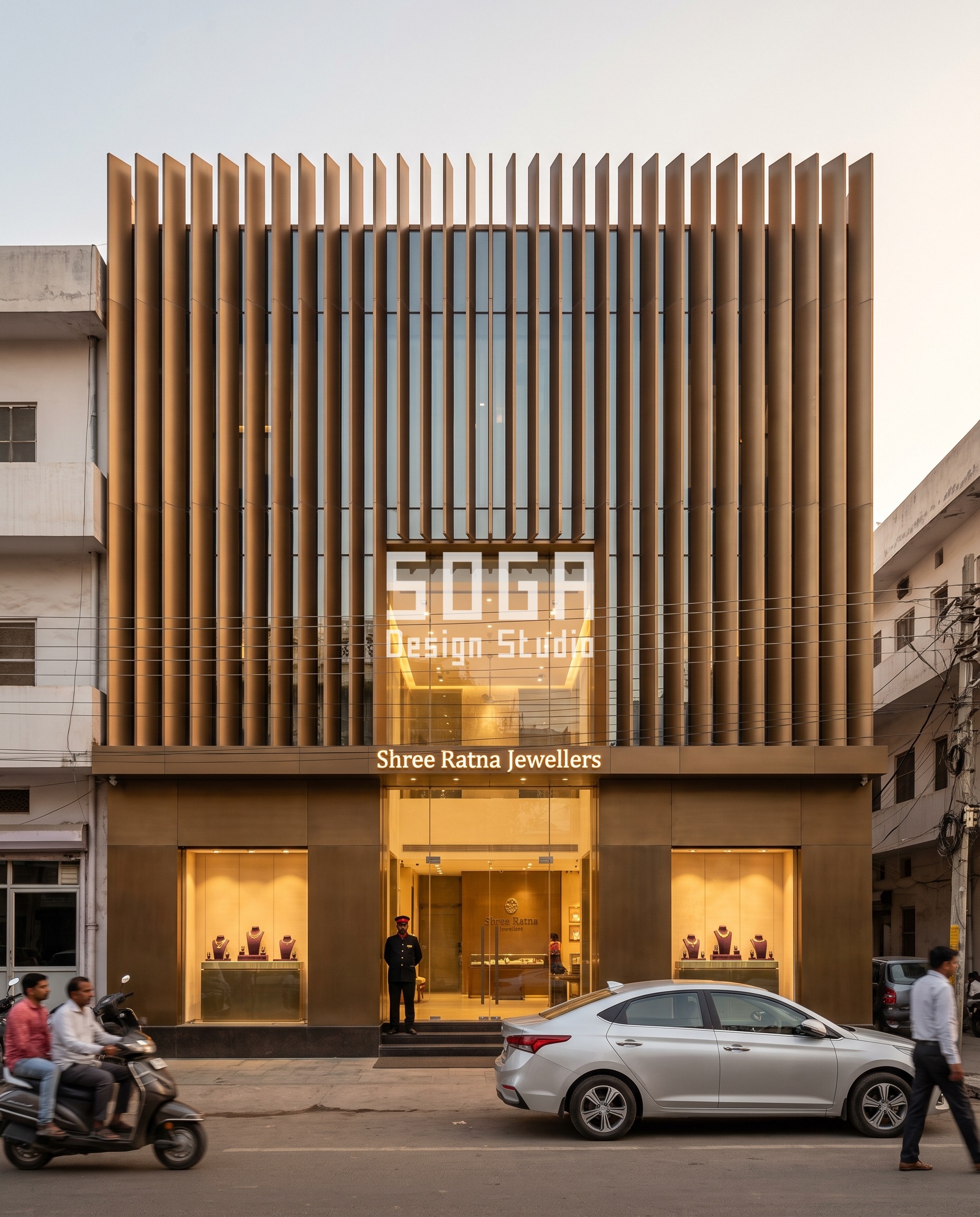
Shree Ratna Jewellers sits on a busy Jaipur commercial street where a flat glass storefront would compete with hoardings on either side. The facade instead reads as one folded bronze surface: extruded fins in a 100×300mm profile, standing 1.8 to 3.2 metres tall, spaced from 150mm centre-to-centre near the entrance widening to 900mm at the far end of the 18-metre frontage — a 6× spread that reads clearly from the pavement rather than as an even, forgettable rhythm. Each fin also rotates 0 to 20 degrees toward the entrance, so the whole field visually funnels the eye to the door without a single arrow or sign.
Fabrication specification
| Design parameter | Specification |
|---|---|
| Metal system | Bronze-anodised extruded metal fins |
| Fin profile | 100 x 300mm, height 1.8-3.2m |
| Spacing gradient | 150mm to 900mm centre-to-centre (6x spread) |
| Rotation | 0-20 degrees, driven toward the entrance |
| Substructure | Unitised metal brackets, ventilated cavity |
| Ground floor | Solid bronze-clad wall, two sealed display niches |
Indicative facade cost: Rs 900-1,600 per sq ft, fabricated and installed, with an itemised estimate produced per project.
2. Surat: Suvarna Mahal — Perforated Bronze Paisley Cassettes
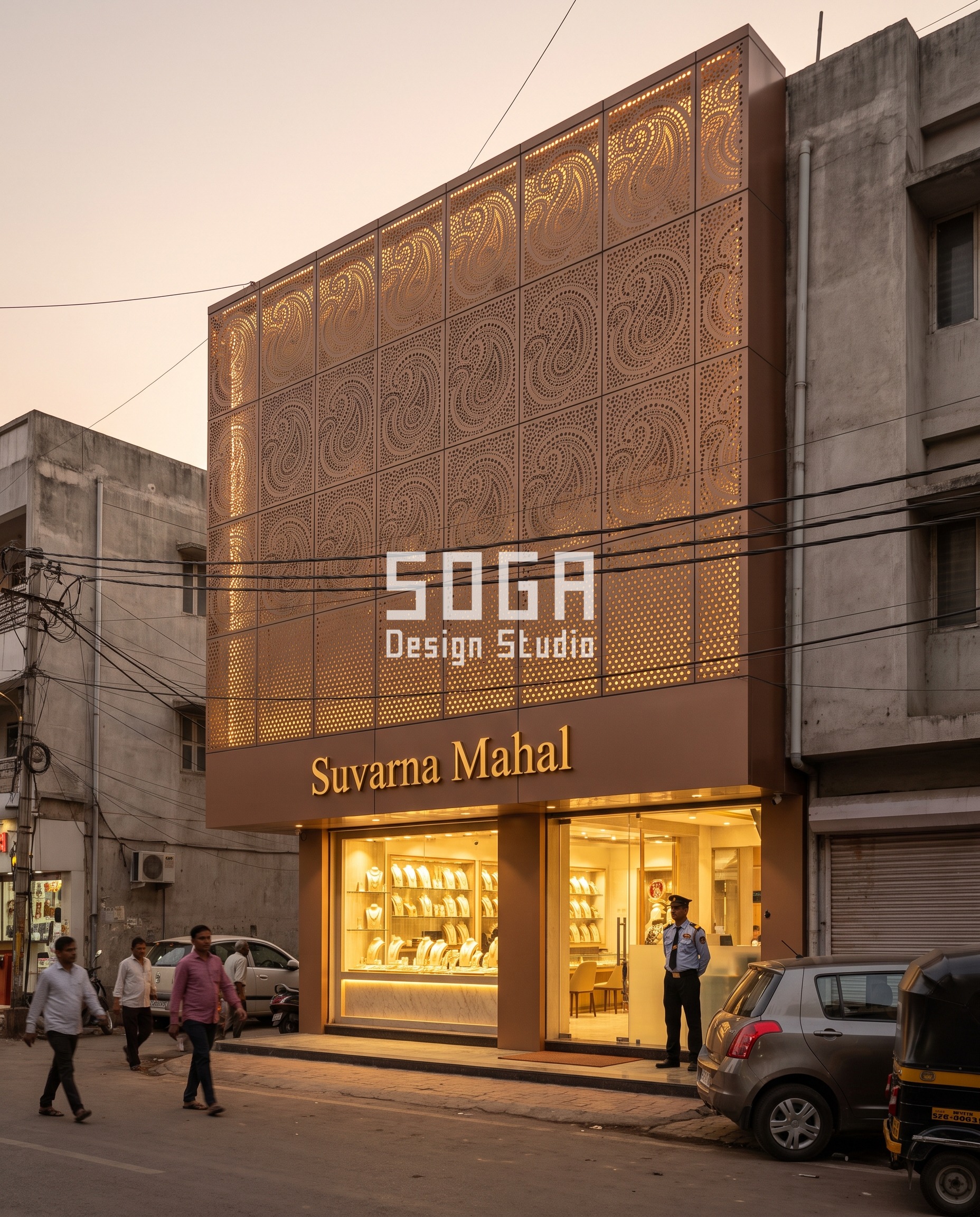
Surat’s diamond and textile trade has its own visual vocabulary, so Suvarna Mahal’s upper facade is built from 3mm perforated bronze-tone metal cassettes, CNC-cut with a paisley motif rather than a generic hole grid. The perforation opens from 25% near the ground — where the pattern needs to hold its shape at eye level — to 85% near the roofline, with hole diameters running 8 to 15mm. At dusk the denser upper zone glows warmer than the lower band, so the gradient reads as much through light as through the metal itself.
Fabrication specification
| Design parameter | Specification |
|---|---|
| Metal system | Perforated bronze-tone metal cassettes, 3mm |
| Motif | CNC-cut paisley, hole diameter 8-15mm |
| Perforation gradient | 25% open (ground) to 85% open (roofline) |
| Cassette module | Standard CNC nesting, FR backing |
| Ground floor | Solid bronze cladding, single sealed display niche |
Indicative facade cost: Rs 1,100-1,900 per sq ft, fabricated and installed, with an itemised estimate produced per project.
3. Coimbatore: Anmol Zaveri — Rotating Gold-Anodised Louvre Field
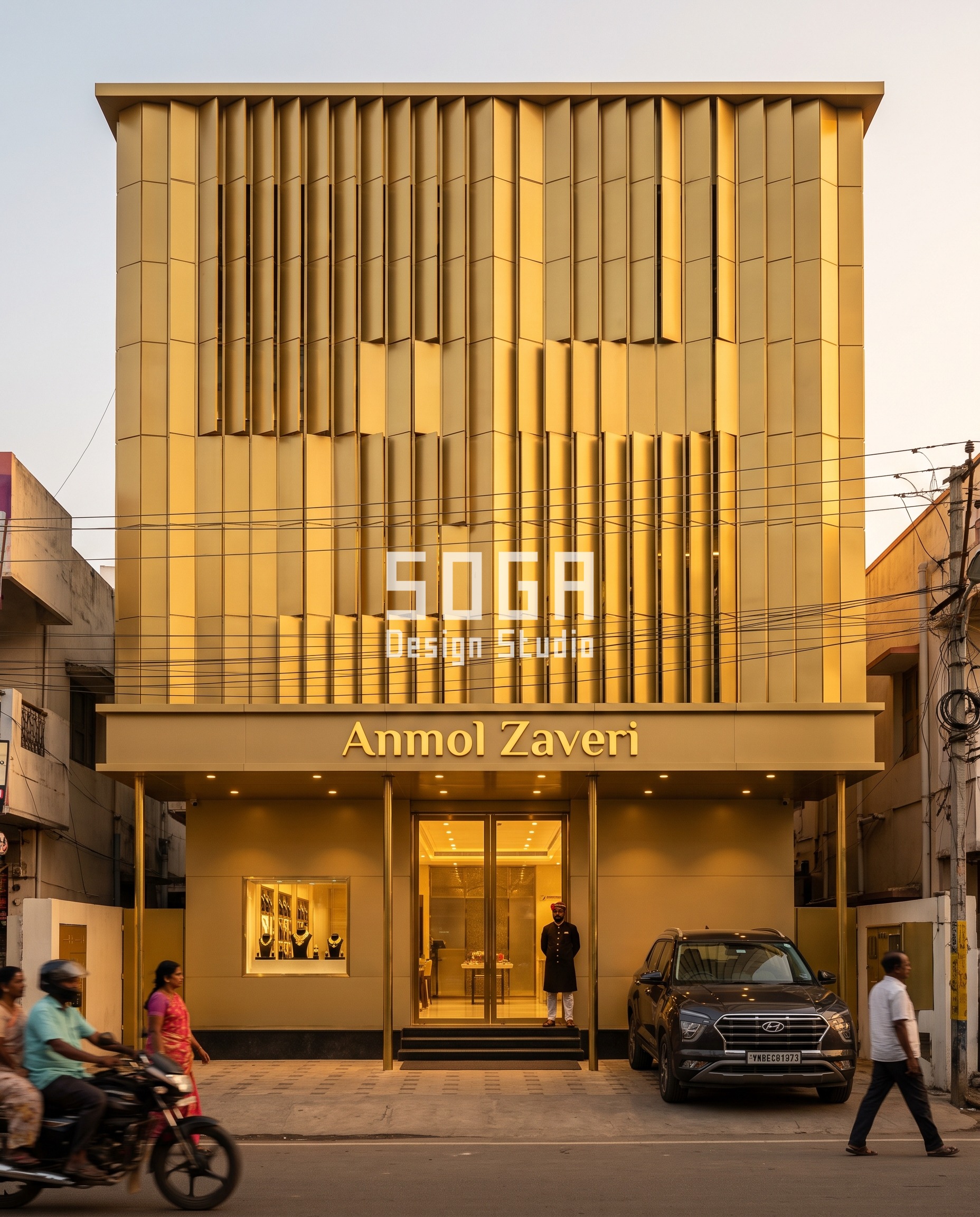
Anmol Zaveri fronts a main road in Coimbatore where the building needed a porch anyway, for cars to pull up under. The gold-anodised louvre tiles — 400×1200mm modules — use that porch as their attractor: every tile is flat (0 degrees) at the two outer edges of the building and rotates up to 40 degrees where it meets the entrance canopy, so the facade itself points at the one place a client actually needs to go.
Fabrication specification
| Design parameter | Specification |
|---|---|
| Metal system | Gold-anodised metal louvre tiles |
| Module | 400 x 1200mm |
| Rotation field | 0 degrees at building edges to 40 degrees at entrance |
| Substructure | Pivoted brackets on a structural grid, fixed rotation (non-kinetic) |
| Ground floor | Projecting entrance porch, single sealed display niche |
Indicative facade cost: Rs 950-1,700 per sq ft, fabricated and installed, with an itemised estimate produced per project.
4. Lucknow: Ganga Ornaments — Copper-Tone Pixel Grid
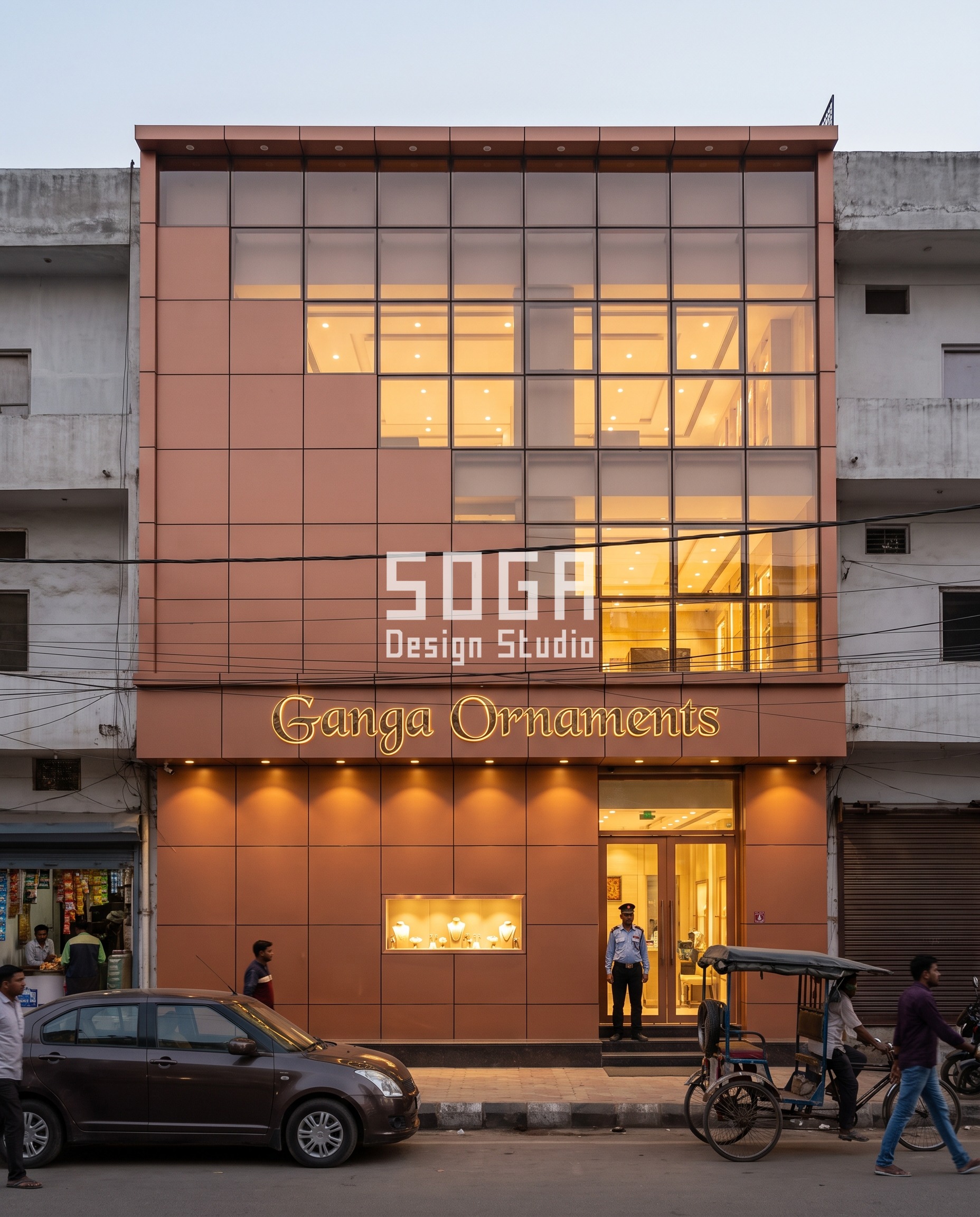
Ganga Ornaments takes a different route: instead of one continuous metal skin, the facade is a 600×600mm grid of copper-tone metal panels and glass, and the ratio between the two shifts through the building’s height — 90% solid copper near the plinth, where the showroom needs to feel secure and grounded, down to 40% solid near the parapet, where interior light can carry the building’s presence after dark.
Fabrication specification
| Design parameter | Specification |
|---|---|
| Metal system | Copper-tone metal + glass pixel grid |
| Module | 600 x 600mm |
| Solid-to-glass gradient | 90% solid (plinth) to 40% solid (parapet) |
| Substructure | Panelised grid on a stick curtain wall frame |
| Ground floor | Solid copper-tone cladding, single sealed display niche |
Indicative facade cost: Rs 1,400-2,400 per sq ft, fabricated and installed, with an itemised estimate produced per project.
5. Indore: Radhe Shyam Jewellers — Bronze-PVD Woven Steel Mesh
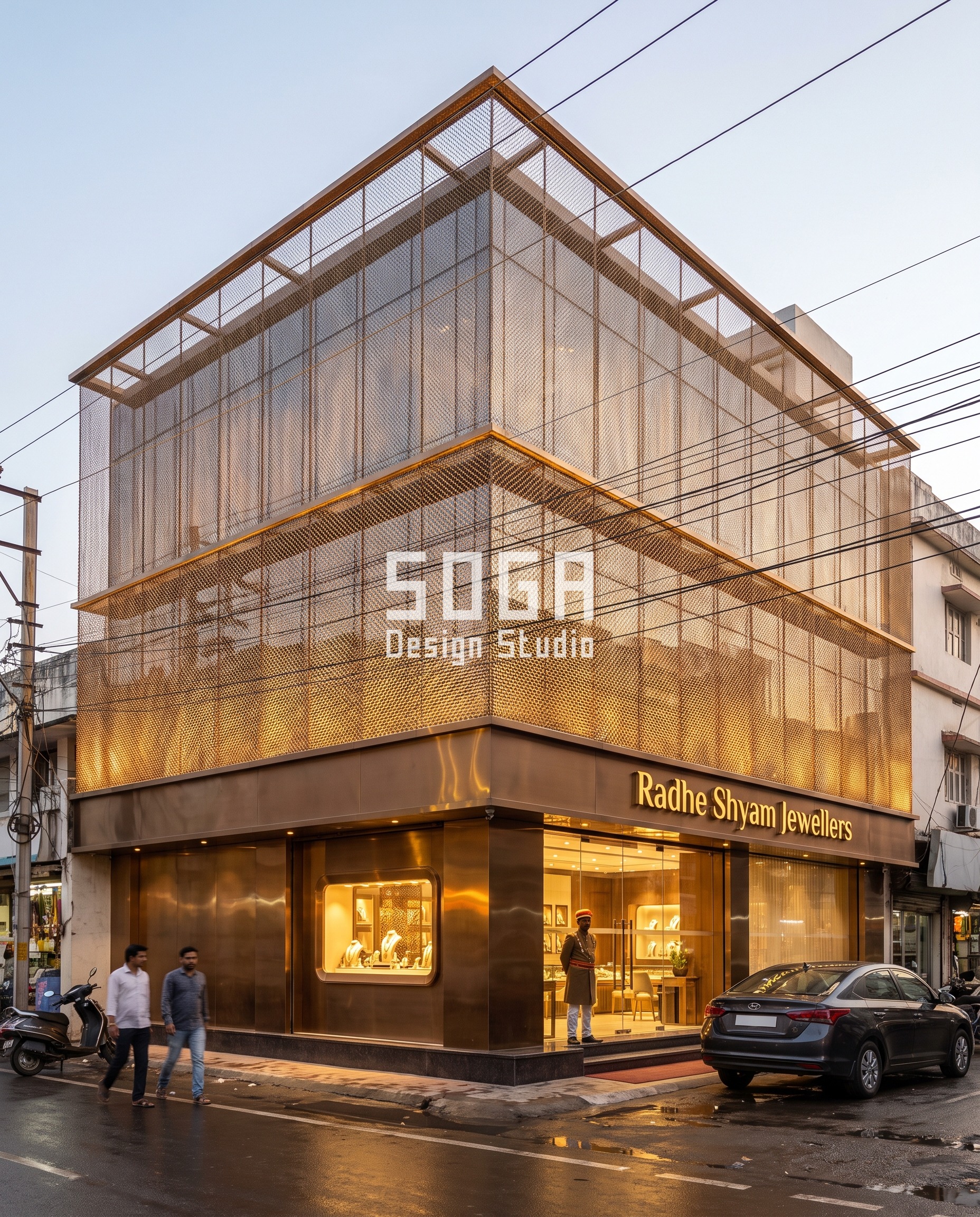
Radhe Shyam Jewellers wraps its glass upper floors in a bronze-PVD stainless steel woven mesh, tensioned top to bottom rather than hung flat. The weave itself is the parameter: 30% opaque near the top, thickening to 70% opaque near the base, so the mesh visually grounds the building the way a plinth normally would — useful on a corner plot where the ground floor needs to read as solid from two street frontages at once.
Fabrication specification
| Design parameter | Specification |
|---|---|
| Metal system | Bronze-PVD stainless steel woven mesh |
| Tensioning | Top-to-bottom, over a glazed backing wall |
| Weave gradient | 30% opaque (top) to 70% opaque (base) |
| Fixing | Perimeter tensioning frame, no intermediate brackets |
| Ground floor | Solid bronze-clad wall, single sealed display niche |
Indicative facade cost: Rs 1,600-2,800 per sq ft, fabricated and installed, with an itemised estimate produced per project.
6. Varanasi: Kashi Swarna Bhavan — Perforated Copper Floral Jaali
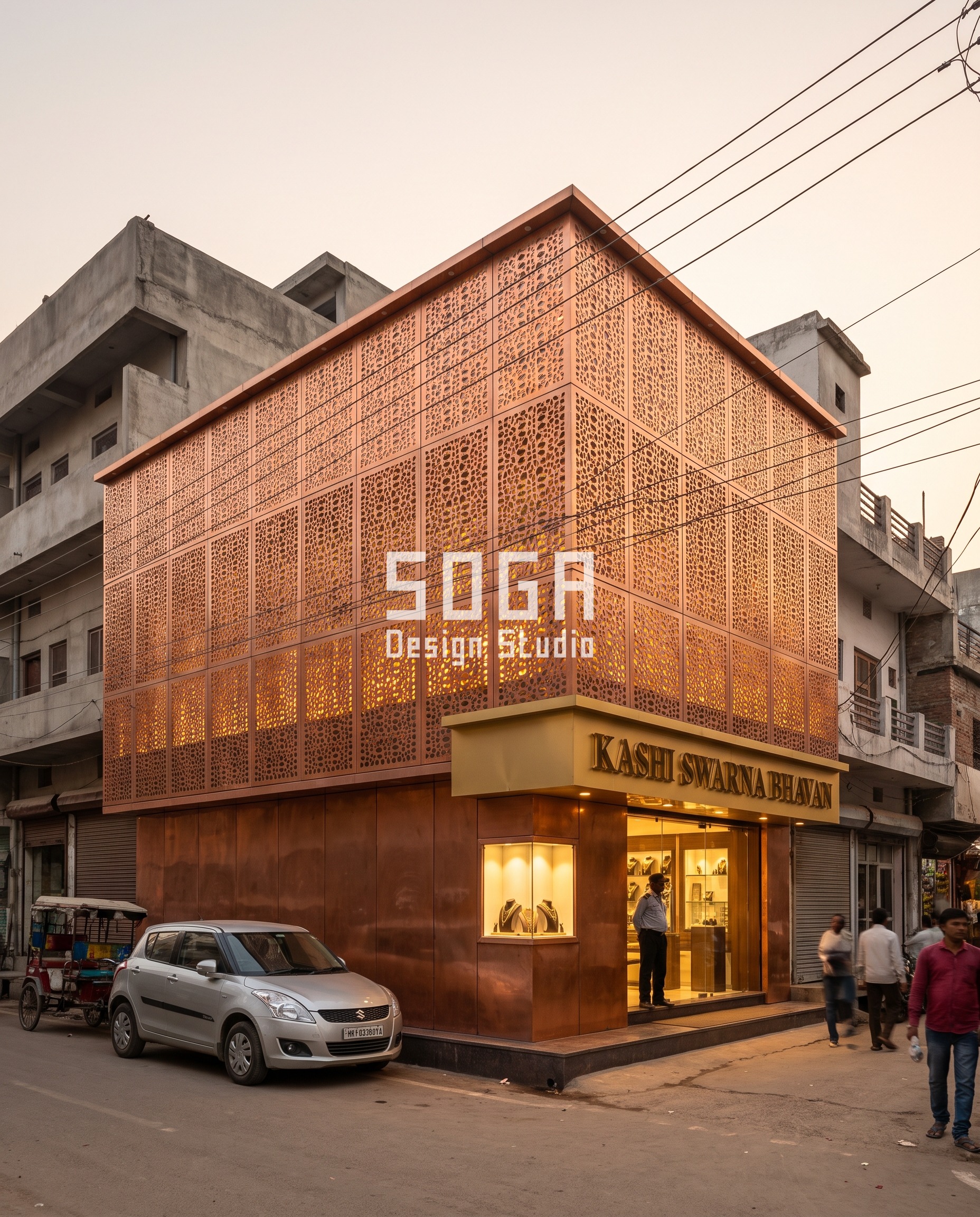
Kashi Swarna Bhavan sits in a dense Varanasi street where the reference point is the city’s own carved-stone jaali screens, translated here into perforated copper. The motif module scales from 150mm near the entrance — where a finer grain reads well up close — to 400mm near the building’s corners, with perforation opening from 20% to 70% across that same range, so the pattern still holds together when seen from across the street.
Fabrication specification
| Design parameter | Specification |
|---|---|
| Metal system | Perforated copper cassettes, floral jaali motif |
| Motif module gradient | 150mm (entrance) to 400mm (corners) |
| Perforation gradient | 20% to 70% open |
| Ground floor | Solid copper cladding, single sealed display niche |
| Corner condition | Wraps both street frontages as one continuous skin |
Indicative facade cost: Rs 1,800-3,200 per sq ft, fabricated and installed, with an itemised estimate produced per project.
7. Ahmedabad: Om Sai Jewels — Champagne-Anodised Sine-Wave Fin Field
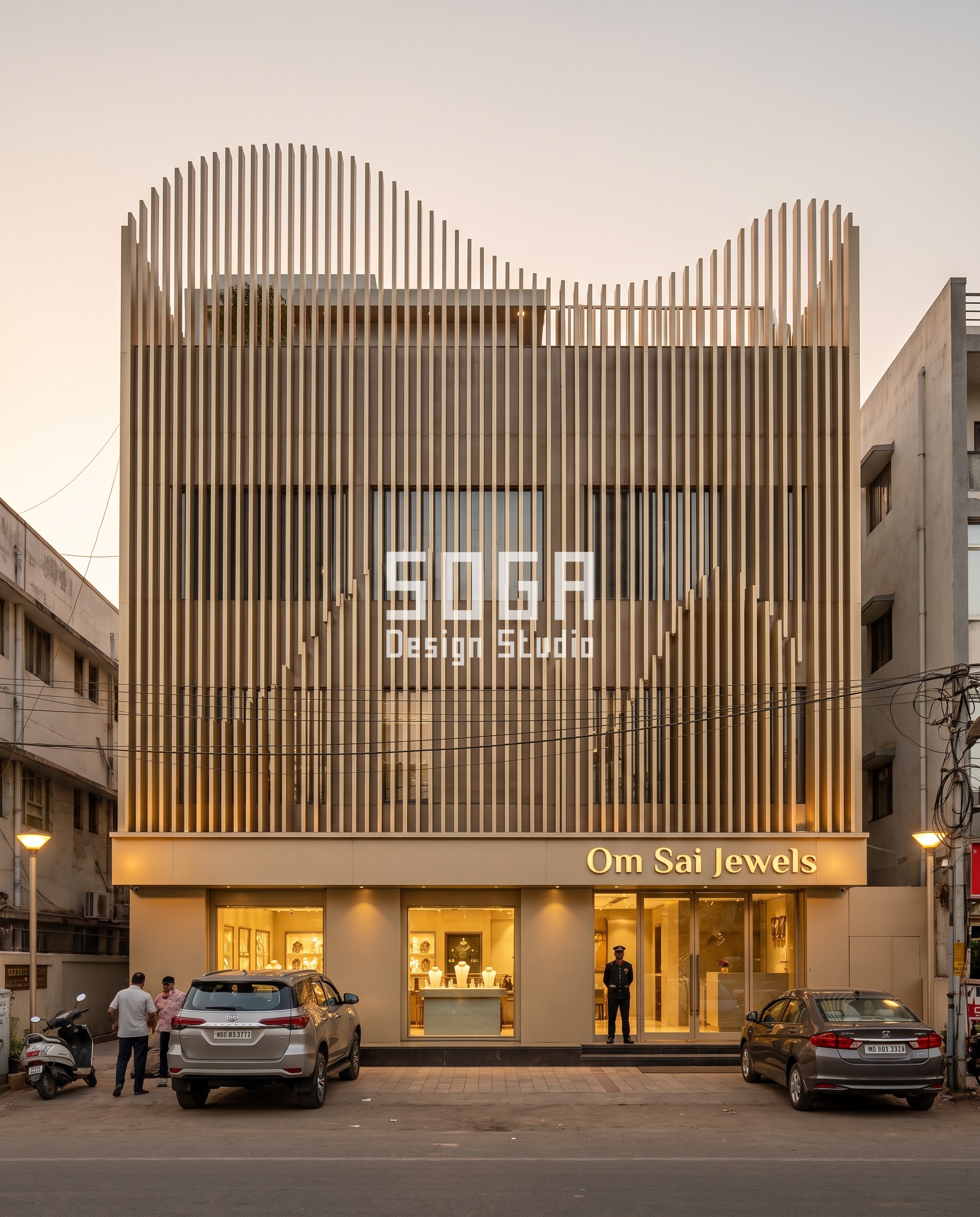
Om Sai Jewels occupies a full 24-metre-wide plot on a wide Ahmedabad road, wide enough that a flat fin field would read as wallpaper. The champagne-anodised metal fins are spaced at a constant 500mm centre-to-centre, but their exposed height runs a sine wave across the frontage — from 1.5 to 3.8 metres — so the roofline itself becomes a visible skyline silhouette rather than a straight parapet line.
Fabrication specification
| Design parameter | Specification |
|---|---|
| Metal system | Champagne-anodised extruded metal fins |
| Spacing | Constant 500mm centre-to-centre |
| Height variation | Sine wave, 1.5m to 3.8m across a 24m frontage |
| Fabrication | Standard extrusion die, cut lengths only vary |
| Ground floor | Solid champagne-clad wall, two sealed display niches |
Indicative facade cost: Rs 1,000-1,800 per sq ft, fabricated and installed, with an itemised estimate produced per project.
8. Chennai: Laxmi Heera Panna — Gold-Metallic ACP Folded Pleats
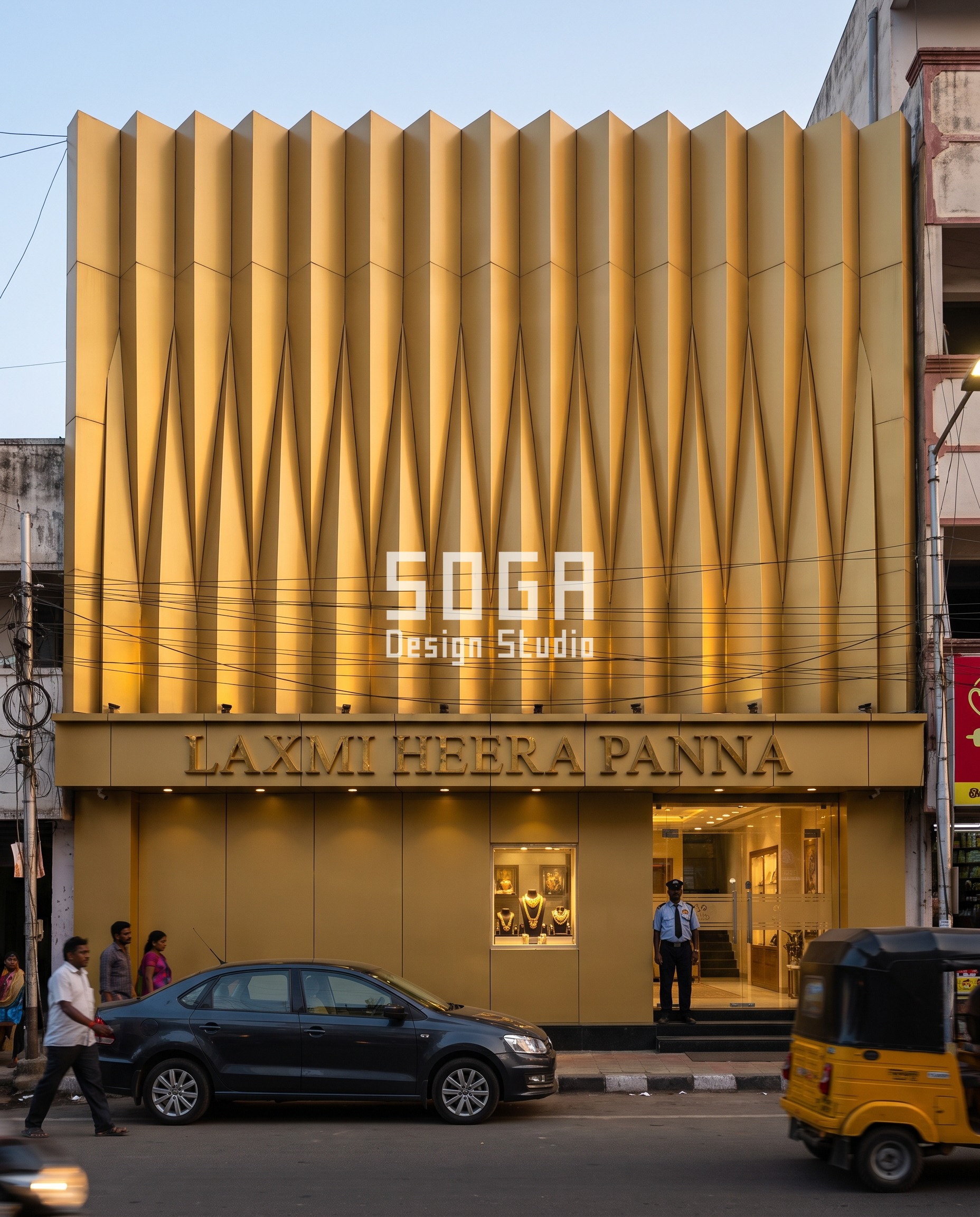
Laxmi Heera Panna uses the most affordable system in this set: gold-metallic ACP folded into pleats on a 300mm pitch, with the projection depth of each pleat varying from a shallow 40mm to a deep 220mm across the facade. At dusk the deep pleats throw hard shadow lines while the shallow ones read almost flat, which is what makes the depth gradient legible without needing direct sun — a detail worth knowing before specifying a similar system, since depth-only variation can disappear under flat daylight.
Fabrication specification
| Design parameter | Specification |
|---|---|
| Metal system | Gold-metallic ACP (4mm FR-grade) folded pleats |
| Pleat pitch | 300mm |
| Depth gradient | 40mm to 220mm projection |
| Fire rating | FR-grade core, post-Grenfell compliant |
| Ground floor | Solid gold-clad wall, single sealed display niche |
Indicative facade cost: Rs 500-950 per sq ft, fabricated and installed, with an itemised estimate produced per project.
Facade Cost Comparison Across the Eight Systems (2026)
The eight systems span a wide cost range because they are different material families, not different tiers of the same product. ACP folded pleats are the most affordable route to a distinctive metal skin; perforated copper is the most expensive because of real copper’s material cost plus CNC cutting time. All figures below are fabricated-and-installed rates, exclusive of structural work and glazing.
| System / material | Indicative rate |
|---|---|
| Gold-metallic ACP folded pleats | Rs 500-950 per sq ft |
| Bronze-anodised metal fins | Rs 900-1,600 per sq ft |
| Gold-anodised metal louvres | Rs 950-1,700 per sq ft |
| Champagne-anodised metal fins (sine-wave) | Rs 1,000-1,800 per sq ft |
| Perforated bronze-tone metal cassettes | Rs 1,100-1,900 per sq ft |
| Copper-tone metal + glass pixel grid | Rs 1,400-2,400 per sq ft |
| Bronze-PVD stainless steel woven mesh | Rs 1,600-2,800 per sq ft |
| Perforated copper floral jaali | Rs 1,800-3,200 per sq ft |
Why These Concepts Are Buildable, Not Just Renders
Every system above is specified with a real module size, a stated variation range and a fixing logic — unitised brackets, a tensioning frame, or a standard extrusion die — because a facade description that stops at a mood image cannot be quoted by a fabricator. None of these eight are built projects; they are concept visualisations produced by SOGA Design Studio to show what a numbered, fabrication-ready metal facade brief looks like before a single panel is cut. A showroom’s actual facade is always finalised against the specific plot, byelaw envelope and security requirement of that site.
Related Reading
- Parametric facade design in India
- Jewellery Showroom Facade Design 2026: India, Dubai, UAE
- Graduated Perforation Jewellery Showroom Facade India
- Corner Plot Jewellery Shop Facade Design India: 5 Moves
Related Reading
Frequently Asked Questions
How much does a metal facade cost for a jewellery showroom in India?
Across the eight systems in this set, indicative rates run from Rs 500 per sq ft for gold-metallic ACP folded pleats up to Rs 3,200 per sq ft for perforated copper floral jaali, fabricated and installed. The spread reflects real material cost — ACP sheet versus solid copper — not different quality tiers of the same system.
Why do jewellery showrooms use less glass than clothing or electronics stores?
Ground-floor glazing on the eight showrooms in this set stays under 20% of the frontage, against 60-80% on a typical retail storefront brief. Less open glass at street level supports a controlled single entry point and lets the display area sit inside sealed, secure niches rather than a fully open shopfront.
Which metal finish suits a jewellery showroom best – bronze, copper or gold-anodised?
It depends on budget and street context. Gold- and champagne-anodised metal fin systems (Rs 900-1,800 per sq ft) suit a bright, reflective read on a wide road. Bronze and copper systems (Rs 1,100-3,200 per sq ft) read warmer and heavier, and work well on denser streets such as Varanasi’s, where the facade sits close to the viewer.
Can the facade carry the showroom’s own name without other signage crowding it?
Yes. Each of the eight concepts carries a single illuminated fascia nameplate with the showroom’s own name, and nothing else — no additional hoarding, no neighbouring shop signage borrowed into the frame. Keeping one clean nameplate is a deliberate choice: multiple signs on one small frontage read as clutter rather than as a jewellery brand.
How long does a parametric metal facade take to fabricate and install for a showroom this size?
For a G+1 to G+3 showroom of the scale shown here, fabrication typically runs 6-10 weeks once shop drawings are approved, with on-site installation adding a further 2-4 weeks depending on access and the number of unique panel or fin variants in the design.
Start Your Jewellery Showroom Facade Project
SOGA Design Studio designs and details parametric metal facades for jewellery and luxury retail showrooms across India, Dubai, the UAE and Singapore, from concept through fabrication drawings. Share your plot, frontage width and city to get a system-specific concept and cost estimate for your showroom.