Every deep elevation enquiry reaches the same sentence, usually from a relative who has seen one go black: it will look beautiful for two years, and then who is going to clean it? It is a fair question, and most answers dodge it. The honest answer is that depth is not what costs you. Two things do – how much of your relief faces the sky, and whether a person can reach it from a floor slab or only from a rope. Get those two right and a deep elevation needs an annual rinse. Get them wrong and a shallow one bills you twice a year, forever.
\n\n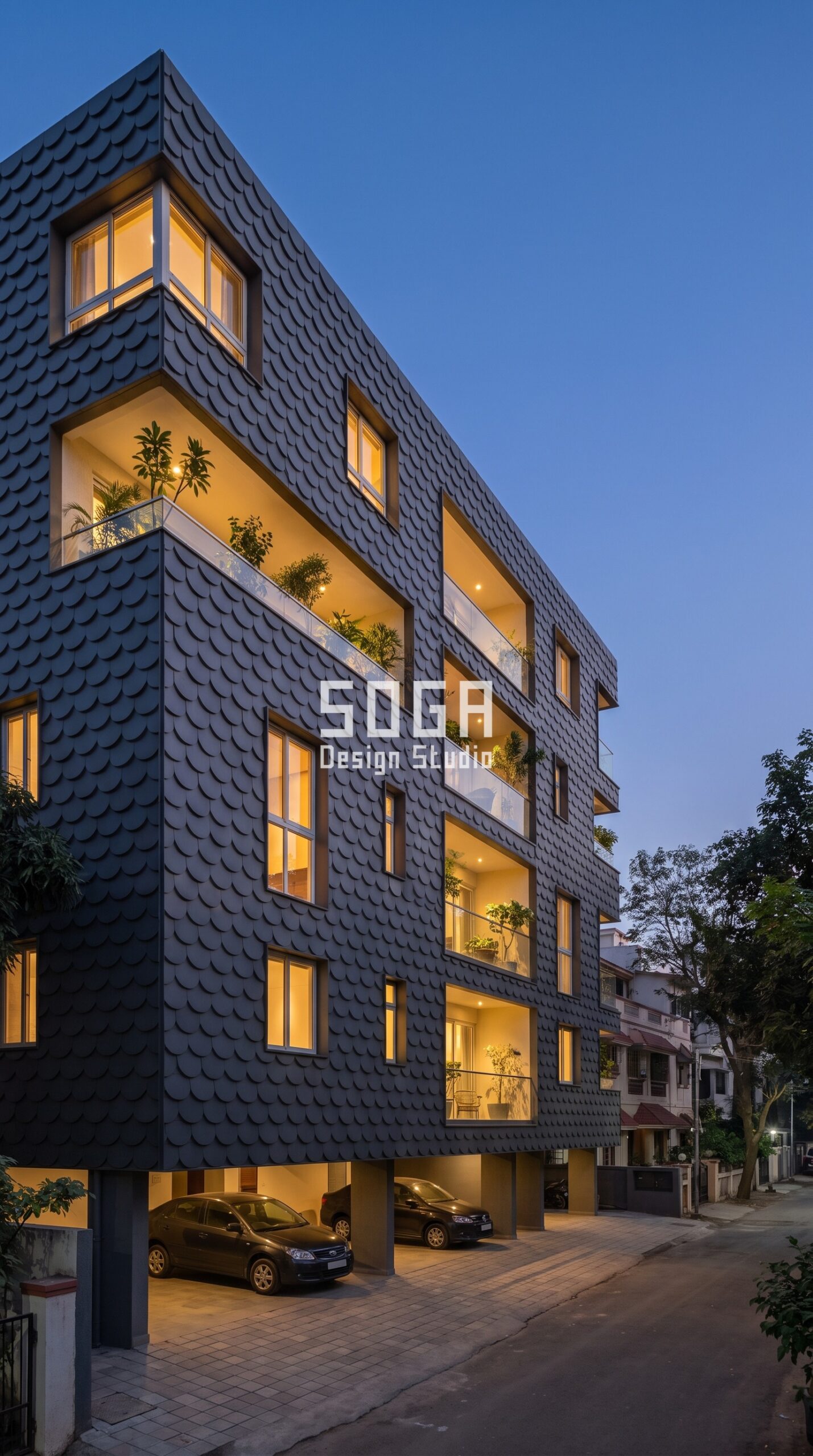
How To Clean Elevation Panels Upper Floors India: What Actually Decides It in 2026
How To Clean Elevation Panels Upper Floors India is one of the questions that decides whether a facade gets built or quietly dropped. SOGA Design Studio hears it from Pune and from Mumbai, Bangalore, Delhi and Hyderabad, usually with a contractor standing nearby. Each concept below is taken down to sub-frame, bracket and fixing before it is presented, drawing on the parametric facade systems the studio builds across India, Dubai and Singapore, shown here in matte powder-coated ral 7016 anthracite grey steel panels.
1. Pune: Lap the Tiles Downward and the Rain Does the Washing
The self-shedding case. 45 mm convex tiles lapped downward like fish scales – every joint sheds onto the tile below, so there is no upward-facing ledge anywhere on the elevation. Koregaon Park gets real monsoon, and the rain does the washing. The detail that makes it work is lap direction, decided on paper, costing nothing. Reverse the lap for looks and the same facade becomes three hundred little shelves.
2. Mohali: A Curve With No Fall Holds Water
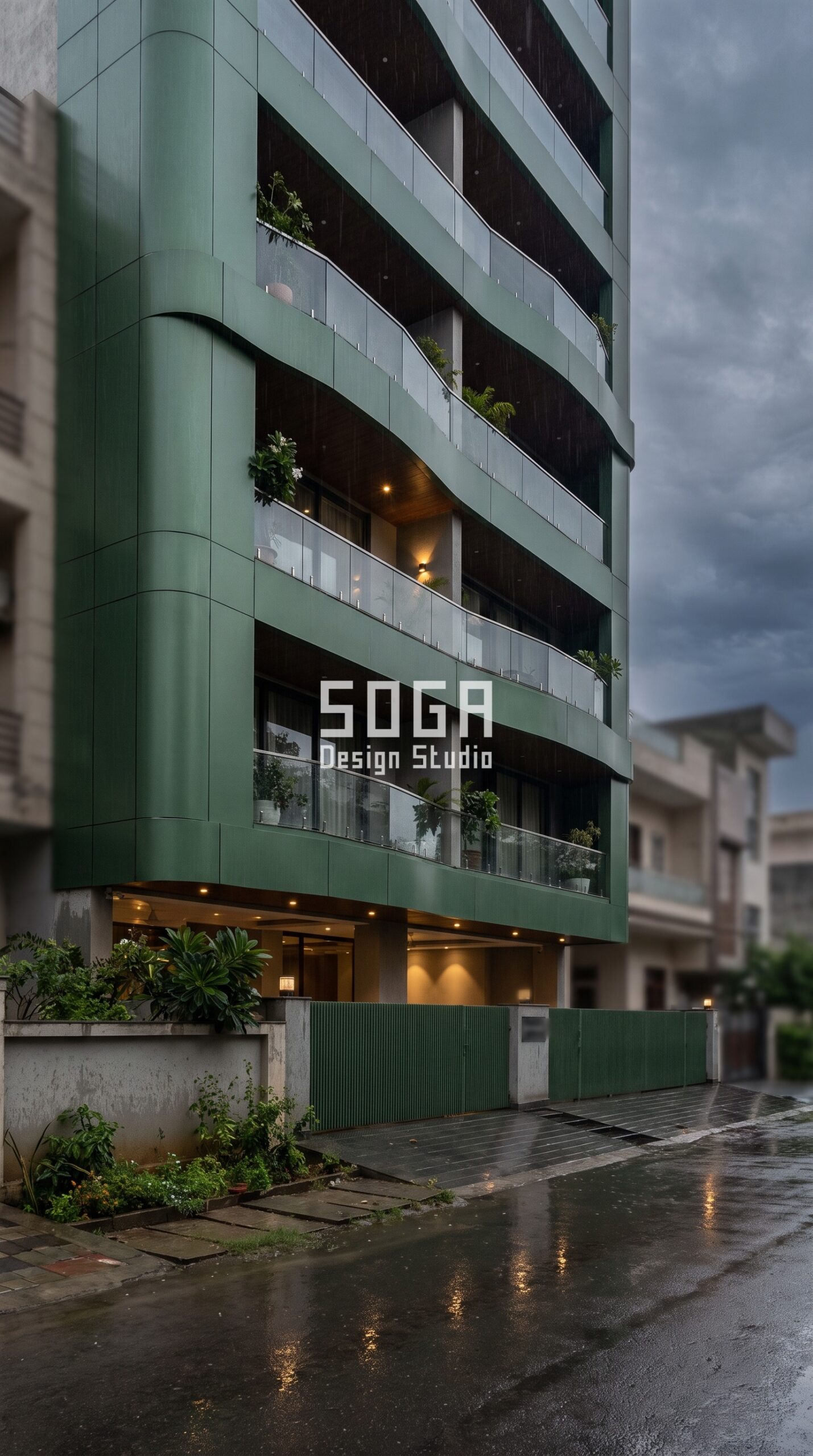
The trough case. A continuous 120 mm swell has no ledges either – but it has valleys, and a valley without a fall holds water and leaves a tide line. Mohali stacks Punjab dust onto post-monsoon damp. The fix is a cross-fall built into the trough so water leaves sideways instead of sitting, plus a finish dark enough that the fortnight before the rinse does not show. An anodised finish holds colour where a cheap coat chalks.
3. Gurugram: The Deepest Relief Here Is the Easiest to Clean
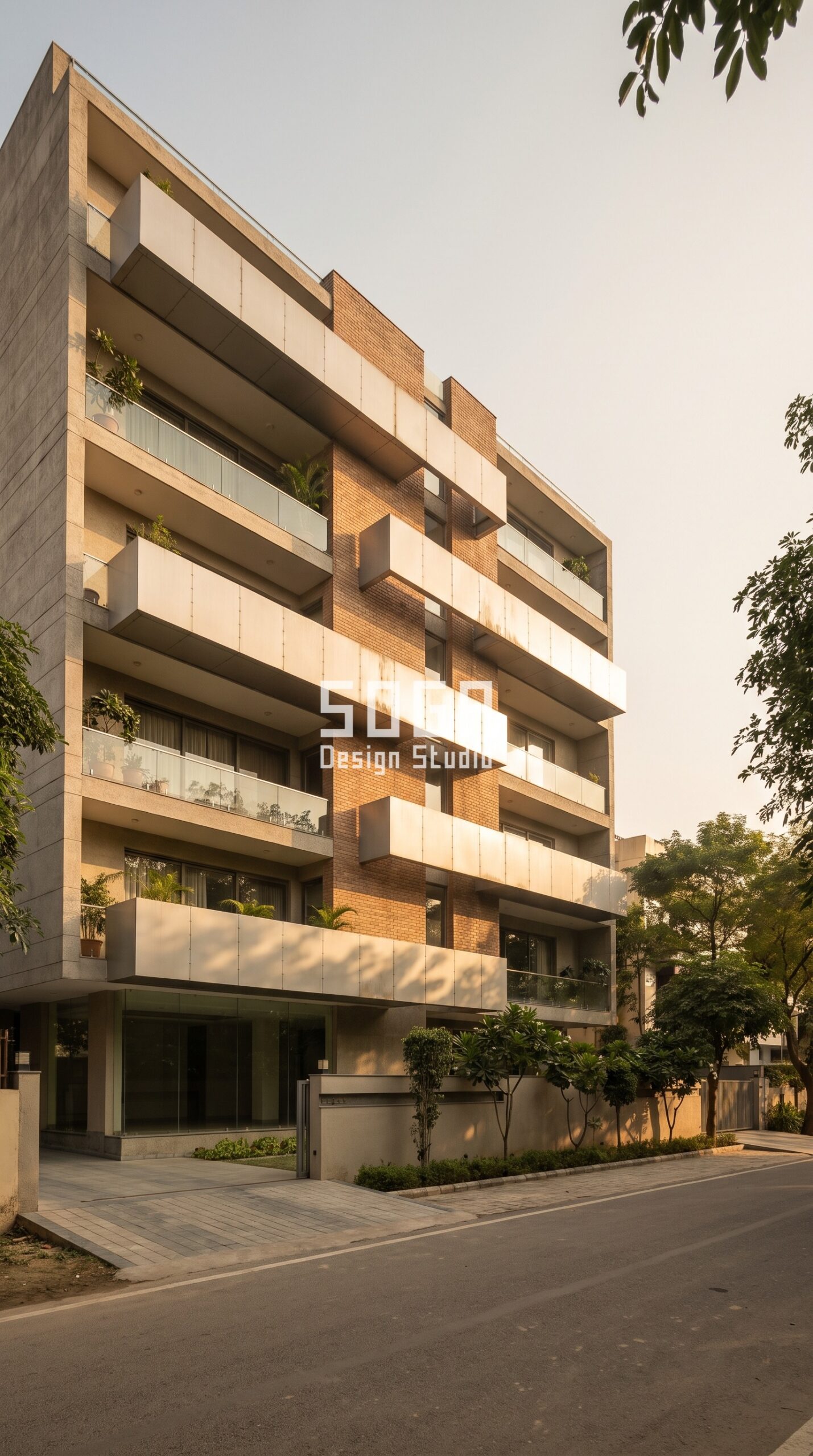
The case that looks worst and cleans best. 600 mm trays are the biggest upward-facing area in this set, and Gurugram supplies the dust to fill them – but they sit on alternate floors, which puts every tray top and soffit within arm’s reach of the balcony one floor above. No rope, no cradle, no scaffold. That reach is worth more than any coating. The deepest relief in this set is also the cheapest to maintain, which is the opposite of what almost everyone assumes when they see it.
4. New Delhi: When You Cannot Reach It, Colour Does the Work
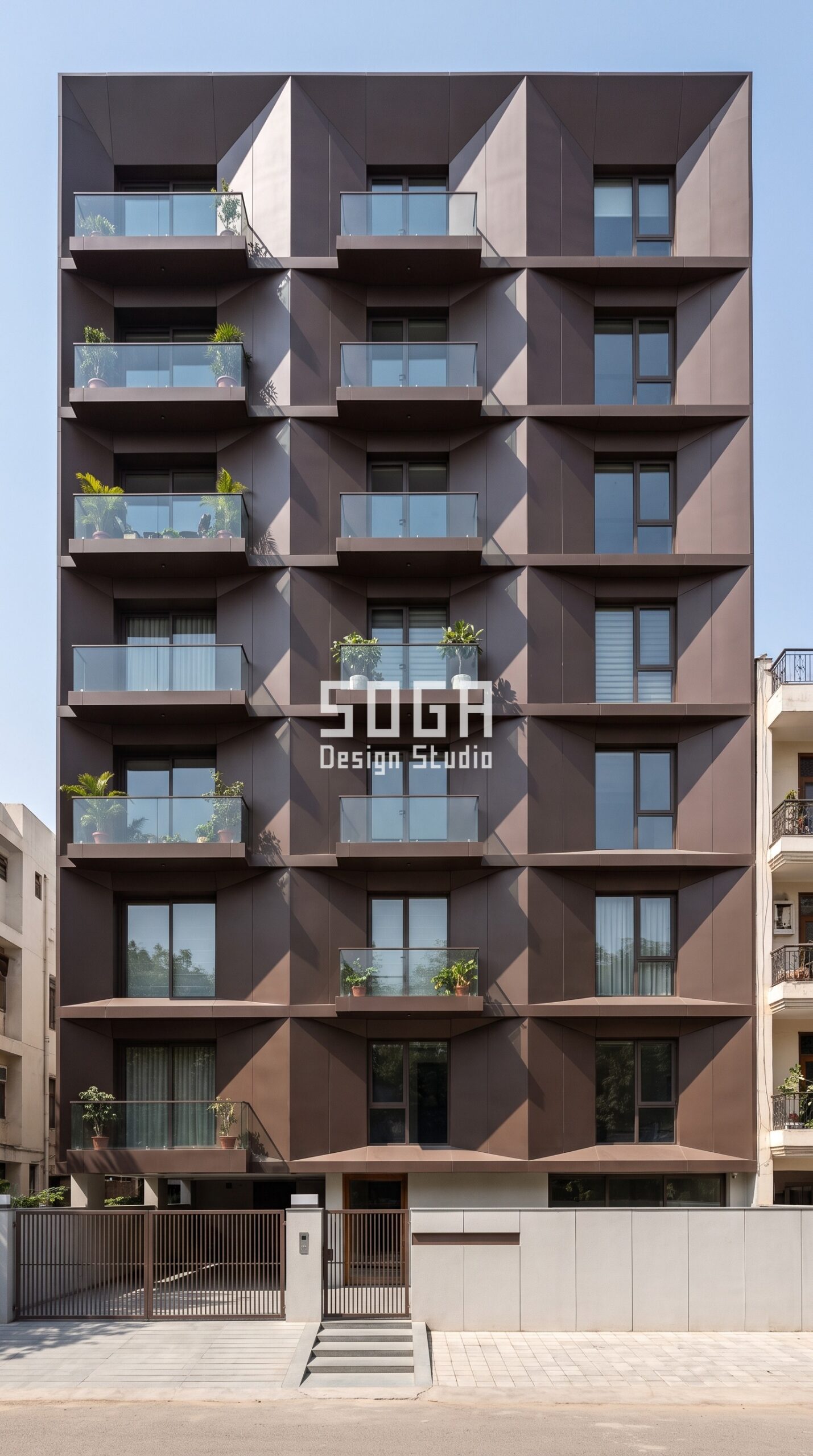
The case where reach runs out. Origami folds alternate up-facing and down-facing facets at 90 mm, so only half the surface ever collects anything and the down-facing half stays clean for years. But Defence Colony here is G+8 – no balcony above the top band, nothing within arm’s reach – so the lever that saved Gurugram is gone. What is left is colour: sepia brown sits close enough to Delhi’s own dust that the elevation reads clean between rinses. When you cannot reach it, you choose a colour that forgives the wait.
What Depth and Access Add to an Elevation Budget in 2026
Budget is usually the second question on a Pune brief, right after whether the idea is buildable at all. These are the current all-in installed rates in India:
- Steel facade (full design + install): ₹1,200–₹2,800 per sq ft
- Anodised or powder-coated metal panels: ₹800–₹2,500 per sq ft
- Zinc cladding: ₹1,500–₹3,000 per sq ft
- ACM panels (3 mm basic): ₹200–₹250 per sq ft (basic)
- ACM panels (4 mm): ₹250–₹350 per sq ft
- Solid metal panels: ₹800–₹1,800 per sq ft
- Installation labour: ₹50–₹150 per sq ft (varies by height + access)
- Conventional cladding (for comparison): ₹400–₹1,200 per sq ft installed (stone veneer / ceramic / standard ACM)
These are baseline ranges, not a quotation. What moves a real number is the facade area, how many distinct pieces the design needs, where it is fabricated and how it is finished. SOGA Design Studio itemises that at consultation rather than quoting a single figure.
Dust, Salt and Rain: How Indian Cities Change the Cleaning Cycle
The cleaning interval is set by the city as much as by the geometry. Delhi NCR and Jaipur load fine construction dust onto every up-facing surface through the dry months, which is why colour choice and tray reach matter most there. Mumbai, Chennai and Kochi trade dust for salt, so the coating specification carries more weight than the geometry and a coastal elevation wants rinsing twice a year rather than once. Bangalore and Pune sit easiest: enough rain to wash a well-lapped facade, not enough salt to attack it. Mohali and Chandigarh get both, Punjab dust through summer and heavy monsoon after, so drainage falls do the work that coatings cannot. SOGA Design Studio details facades across these cities and in Dubai and Singapore, where blown sand and constant humidity reset the same arithmetic in their own directions.
Why Trust SOGA Design Studio on Elevation Maintenance
- Experience: Written from SOGA’s own detailing decisions – lap direction, trough cross-falls, tray soffit reach and finish-versus-dust colour choices made on live Indian projects.
- Expertise: SOGA Design Studio, Gurugram, run by co-founders Gajender Jaiswal and Sonali Jaiswal; 150+ projects across India, Dubai and Singapore.
- Authority: One of the few studios in India that details its own parametric facades through to fabrication rather than handing a render to a contractor.
- Trust: Where there is no sourced number – a per-sq-ft cleaning rate – the post says so and leaves a bracket rather than inventing one. Cost bands quoted are the published 2026 benchmarks.
Frequently Asked Questions
How often does a metal elevation need cleaning in India?
For a correctly detailed and ventilated powder-coated or anodised elevation, maintenance is an annual rinse-down – not the repainting cycle a plaster facade needs. Cities with heavy construction dust or coastal salt may want it twice a year. The variable is not the material, it is how much of the geometry faces upward.
Does a deeper elevation cost more to clean?
Not by depth itself. The bill follows access. Published 2026 installation labour for facade work runs Rs 50-150 per sq ft and explicitly varies by height and access – the same logic drives cleaning. A 600 mm relief reachable from the slab above is cheaper to maintain than a 45 mm relief on the seventh floor that needs rope access. [SOGA to insert its own current per-sq-ft cleaning rate here – no sourced 2026 India benchmark exists for facade cleaning, so none is quoted.]
How long does a powder-coated metal elevation last in Indian conditions?
Quality powder-coated metal or galvanised steel, correctly detailed and ventilated, lasts 25-30 years before recoating is needed, even in coastal Mumbai, Chennai and Kochi. Dark anodised metal and pre-patinated zinc or copper can exceed 40 years.
Can a deep relief facade be cleaned without scaffolding?
Yes, if it was planned that way. Placing the deep elements on alternate floors puts every surface within reach of the balcony or slab above. Running the same relief unbroken up all eight floors is what forces a cradle or a rope crew, and that decision is made in the design, not on site.
Which elevation finish hides dust best in Delhi NCR?
Mid-tone earth colours – sepia, bronze, warm grey – sit closest to NCR’s own dust and read clean longest between rinses. Very pale and very dark finishes both show it fastest. This is a real design lever, not a compromise: pick the colour against your city’s dust rather than against a mood board.
Does lap direction really matter on a shingle elevation?
It is the cheapest maintenance decision on the drawing. Lapped downward, every tile sheds onto the one below and the rain washes the face. Reversed for appearance, the same tiles become hundreds of small upward-facing shelves that collect grit and streak the elevation below each one.
Start Your Facade Project With SOGA Design Studio
Ask two questions of any elevation before you approve it. How much of this faces the sky, and can someone stand on a slab to reach it? Depth is free. Access is not.
Whether you are building new or retrofitting an existing block, SOGA Design Studio can adapt the concepts above to your exact plot and budget. Start the conversation here — consultations are free and no-commitment.