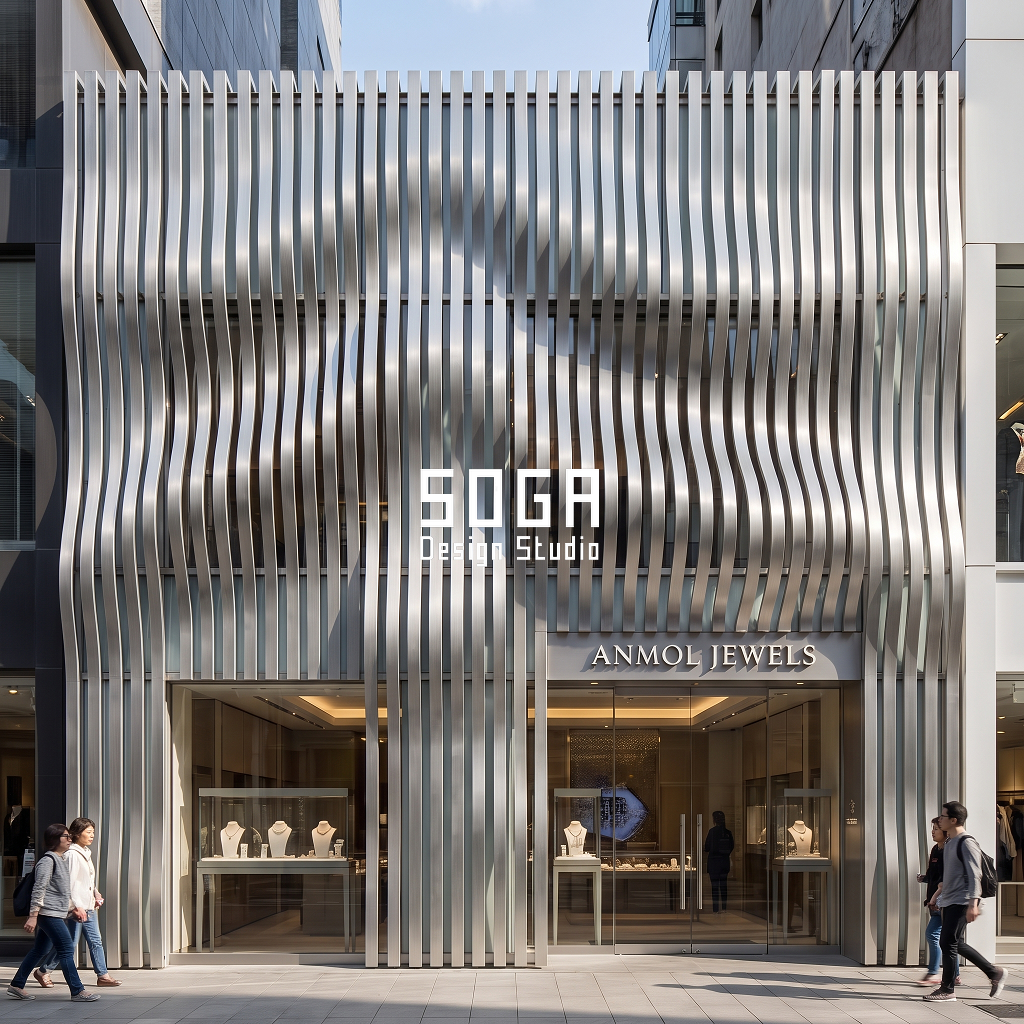
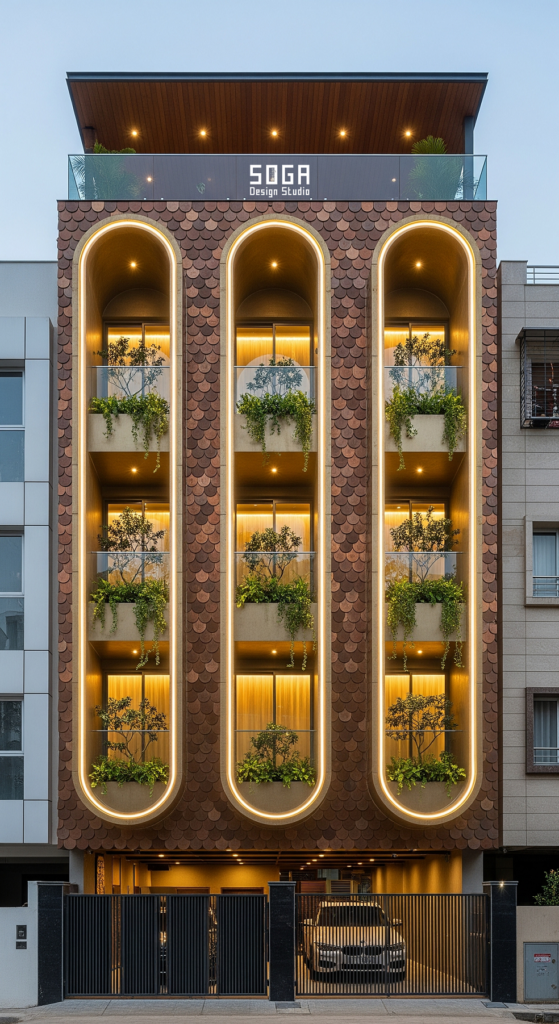
A flat panel on a retail flagship reads as signage — a surface with a message on it. A continuous curve reads as an object, something a shopper’s eye follows the way it follows a car’s bodywork. That difference, not the material underneath, is why five of SOGA Design Studio’s current retail and mixed-use concepts share one rule: nowhere the facade’s gesture is active does the skin return to a flat plane or break at a sharp facet. Below are five buildings in five Indian cities, each built around a single curved move, each with the swell range and cost band that decide whether the curve actually gets built or gets value-engineered back to a flat panel at the drawing stage.
A continuous curved facade is a building skin that bends smoothly across its full height or width with no flat return or sharp facet anywhere the design gesture is active — the opposite of a faceted, jaali or flat-panel facade assembled from repeated straight or angled modules.
The Claim: A Curve Has to Deepen Somewhere, or It Isn’t One
Every client who has asked SOGA for a ‘curved facade’ has, at some point in the brief, also asked for it to be cheap, which is the same as asking for it to be flat. A curve that holds one constant radius top to bottom can be formed once and repeated — which is exactly why it photographs as a mould, not a gesture. The five buildings here concede that tension instead of hiding it: each one’s curve visibly deepens, widens or swells from one end of the facade to the other, because a curve that does not change is doing the same job as a flat panel wearing a curved hat.
A curved gesture carries no flat return anywhere it is active — the moment the skin meets a straight edge or an unchanging radius, the whole move reads as applied ornament rather than a built form. That is the rule behind every one of these five facades, and it is a harder rule to hold to than ‘pick a curve and repeat it’, because it means every panel on the gesture is a slightly different size.
Stage 1, Programme: Five Different Retail Problems
None of these five buildings is solving the same programme. A jewellery flagship needs a double-height, glare-controlled display window that still reads from a moving car. A fashion flagship on a dense market street competes with a dozen neighbouring signboards for the same five seconds of attention. A ground-plus-four mixed-use block has to let a facade move read at pedestrian scale on the retail floors and at a calmer rhythm on the office floors above — without looking like two different buildings stacked on top of each other.
| Programme | Area / count |
|---|---|
| Toran Showroom, Lucknow | G+2 jewellery flagship, double-height retail + first-floor stock |
| Ashma Showroom, Ludhiana | G+2 jewellery flagship, double-height retail + first-floor stock |
| Kosh Flagship, Pune | G+2 jewellery flagship, hero volume = 60% of frontage width |
| Vahini Arcade (Lotus Studio), Kochi | G+4 mixed-use, retail ground + first floor, offices above |
| Lehar Flagship (Vastra House), Bengaluru (Indiranagar) | G+3 designer-fashion flagship, double-height retail + stock |
Stage 2, Massing: One Curved Move, Nothing Else Competing With It
Every showroom strip in urban India has the same visual noise problem: ACP boxes, box signboards, overhead wiring, a dozen competing shopfronts within one eyeline. A single dominant curved move only wins that fight if nothing else on the building is allowed to argue with it — which is why all five concepts keep the rest of the elevation deliberately calm, glazed or plain, and let one gesture carry the entire read.
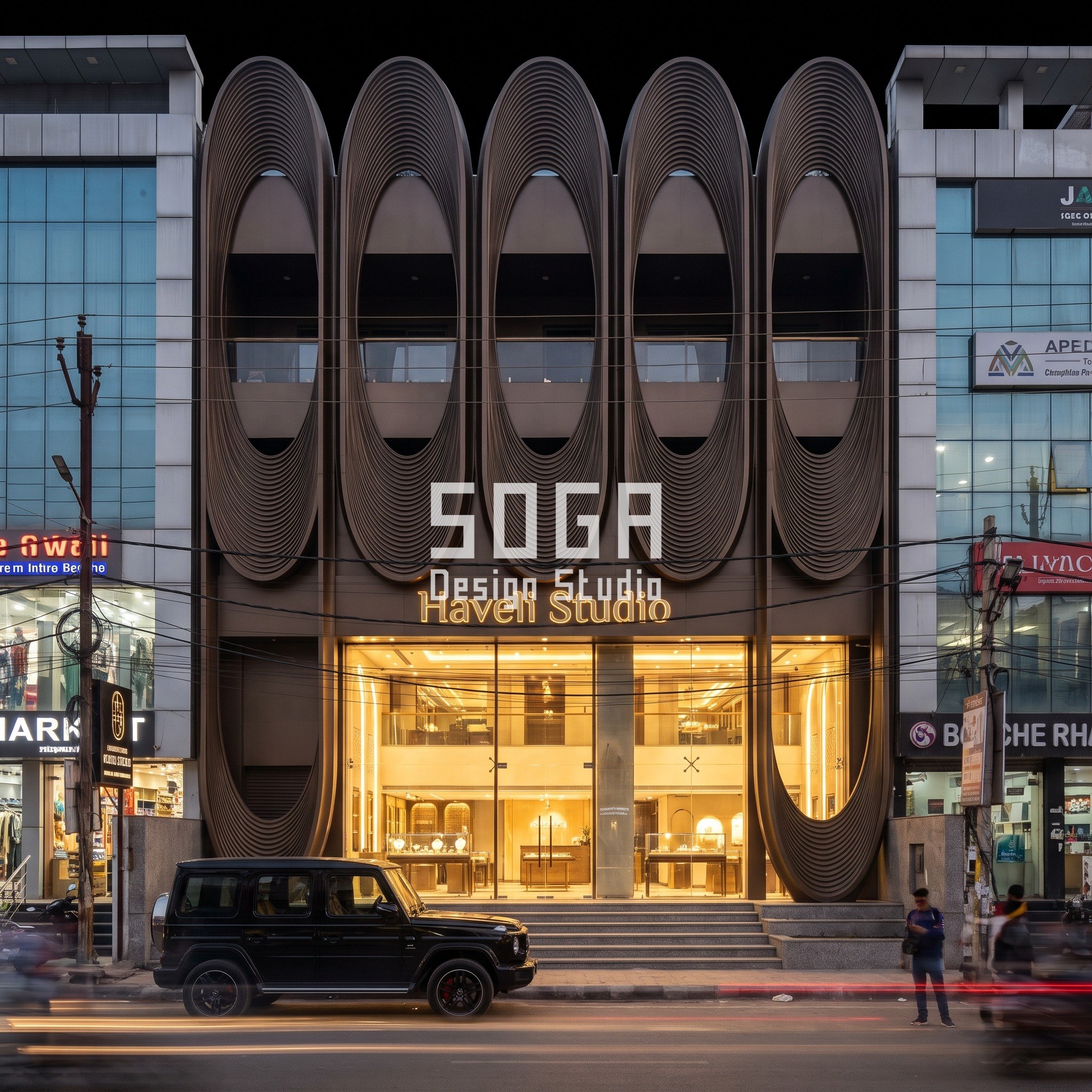
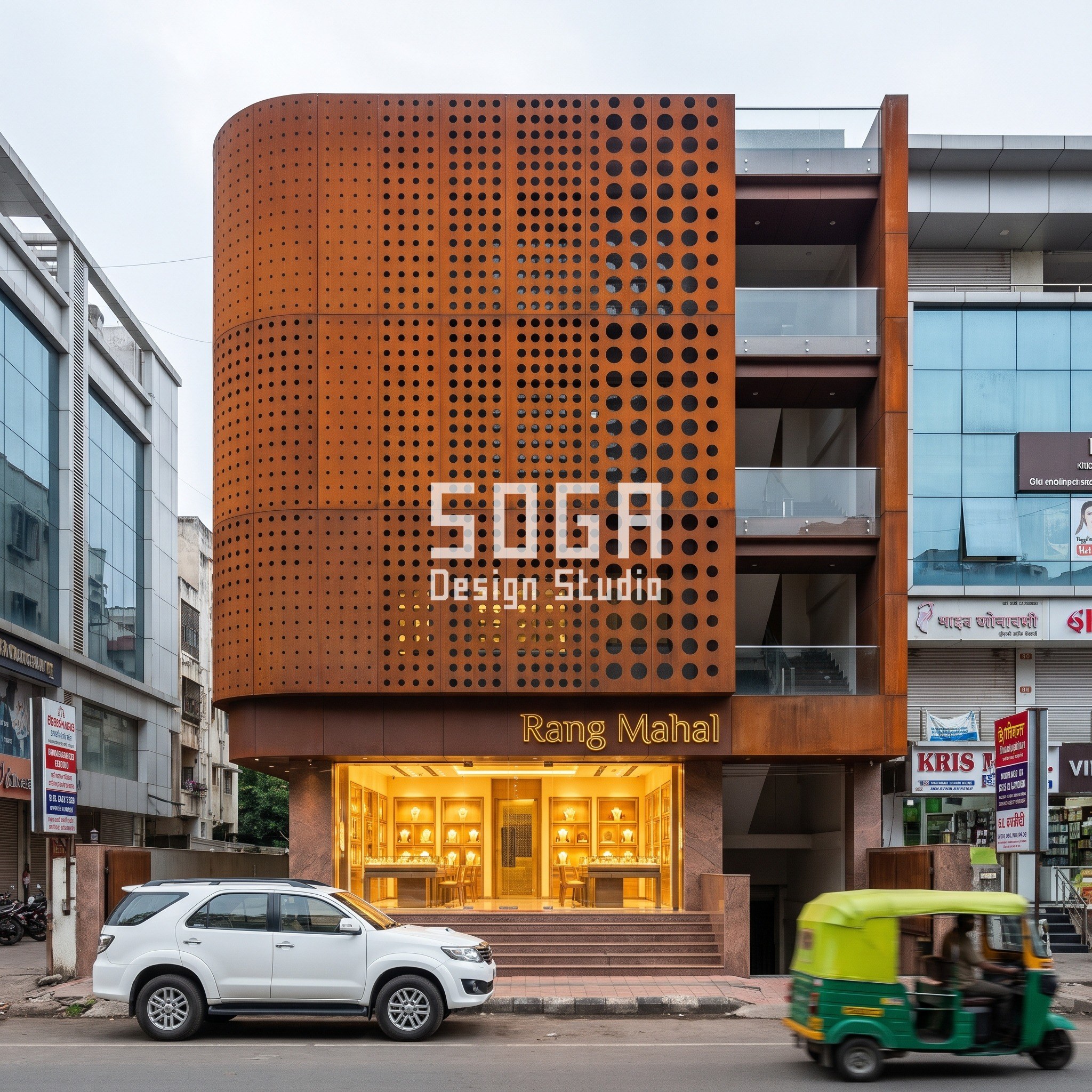
At Toran Showroom in Lucknow, that gesture is five tall elliptical loops running the full height of the facade, with the building’s balconies tucked into the gaps between them rather than cut through them. At Kosh Flagship in Pune, it is the opposite strategy: one sculpted hero volume occupies roughly 60% of the frontage and does all the sculptural work, while the remaining width stays plain stacked balconies behind frameless glass — a deliberate, almost architectural concession that not every bay needs to be special for the gesture to read.
Stage 2b, The Parametric Rule: Five Buildings, Five Swept Numbers
A parametric rule only earns the word if it states a real, measurable quantity, the two ends of its range, and what physical reason drives the change — rotation and phase-shift don’t count, because a viewer’s eye can’t measure an angle at street level the way it can measure a visibly thicker or thinner panel. Each of these five facades sweeps exactly one quantity end to end, between roughly 7.5 and 8.7 times its own smallest value, and holds every other dimension — panel count, grid, module shape — fixed.
| Building | Swept quantity and range |
|---|---|
| Toran Showroom, Lucknow | Loop thickness: 140mm at the ends (a brick on edge) to 1050mm mid-height (wider than a shoulder span) — 7.5x |
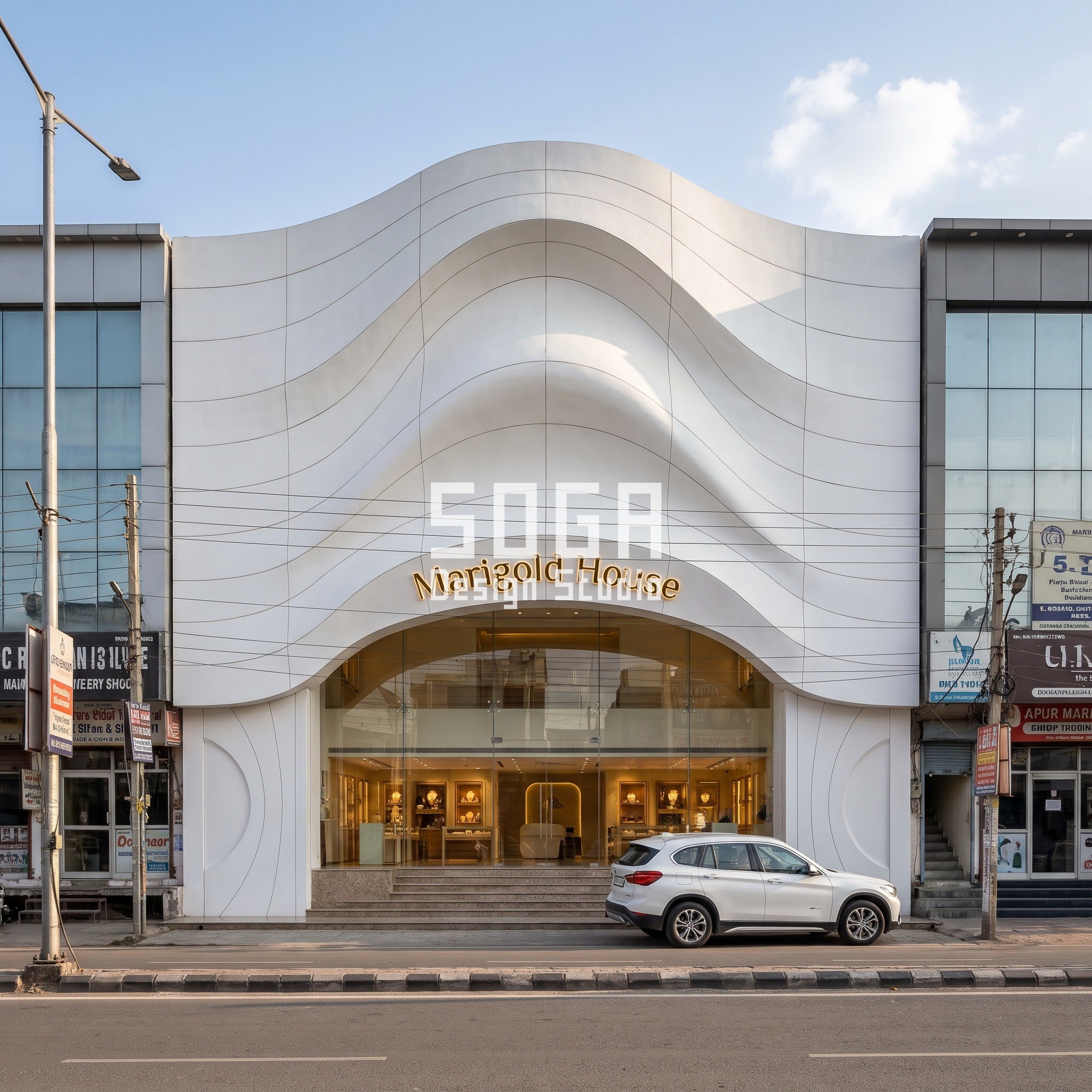
| Ashma Showroom, Ludhiana | Panel projection depth: 120mm at the base (a door slab) to 980mm at the crest (deeper than a person is wide) — 8.2x |
| Kosh Flagship, Pune | Perforation hole diameter: 12mm (a coin) to 100mm (a dinner plate) across the hero volume — 8.3x |
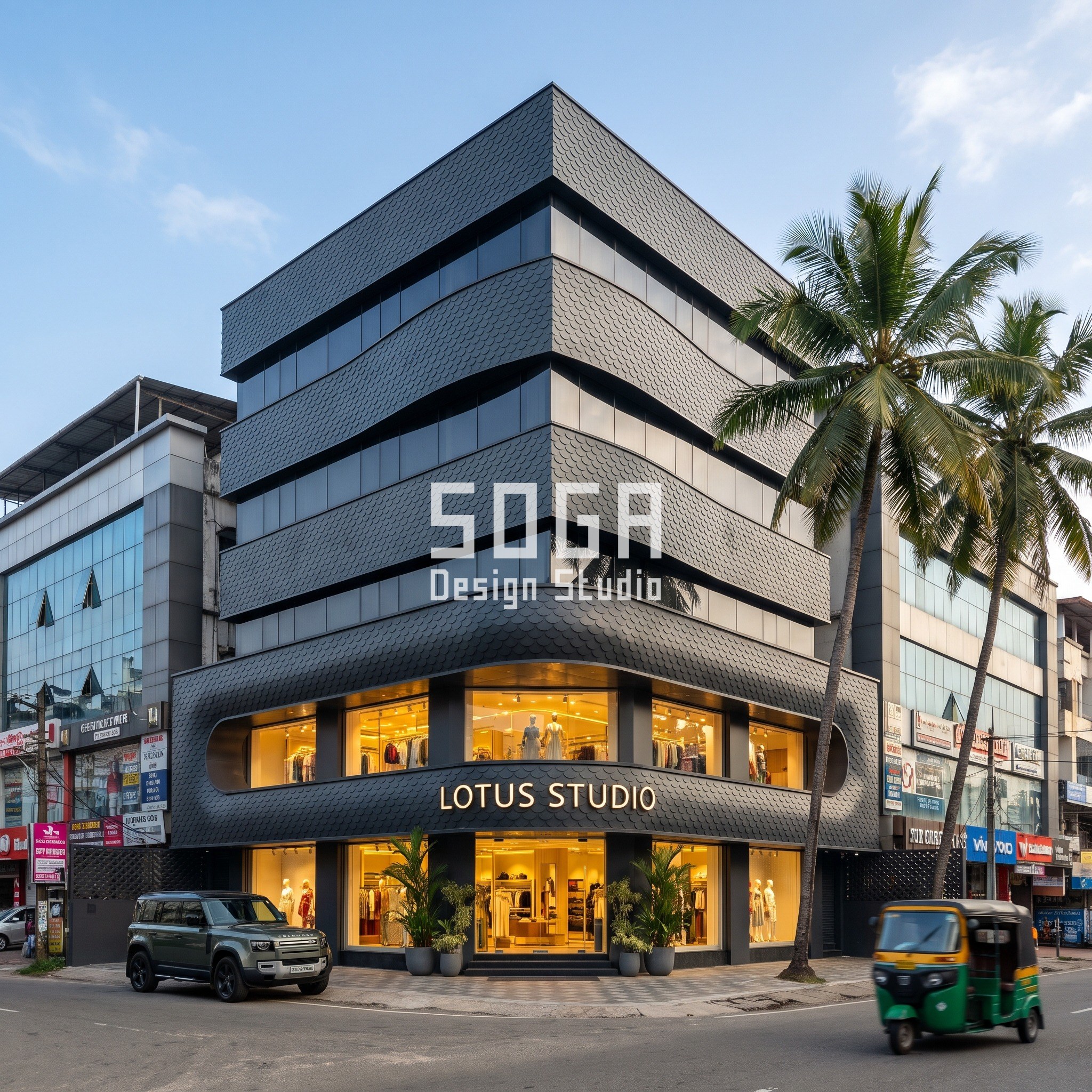
| Vahini Arcade, Kochi | Lens-band height: 130mm at the ends (a door handle) to 1100mm at mid-span (taller than a shop counter) — 8.5x |
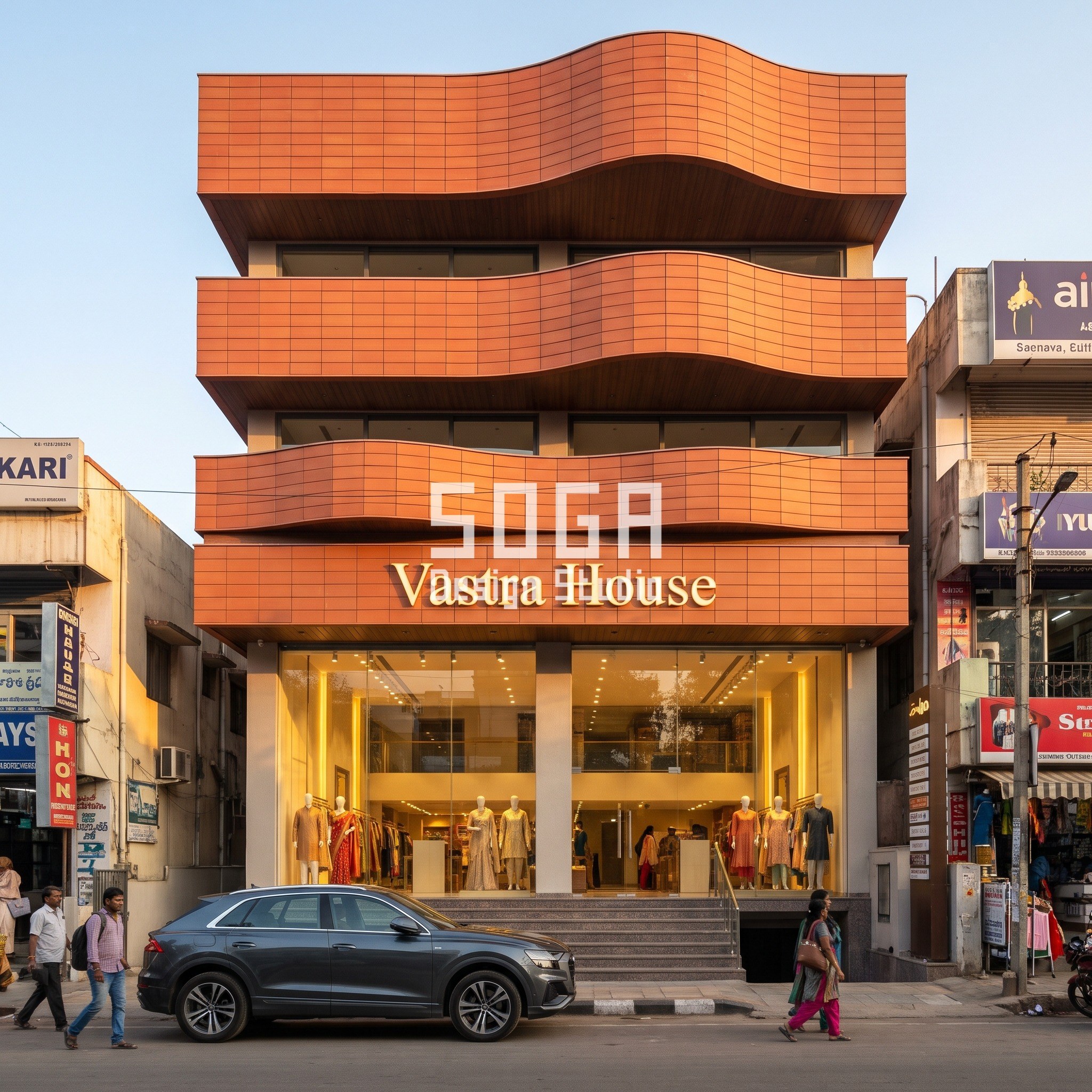
| Lehar Flagship, Bengaluru | Wave amplitude: 150mm at ground level (a single brick) to 1300mm at the top floor (deeper than a person is wide) — 8.7x |
Stage 3, Grain: What a Shopper Actually Sees at the Kerb
A parametric gesture that only works from across the street is a billboard, not a facade. All five ground floors keep the same discipline: a double-height glass storefront with warm, legible display lighting, polished stone steps, and the hero material brought down to the pilasters at hand height so the material reads as real at arm’s length, not just as a rendering trick two storeys up. At Vahini Arcade in Kochi, the ground-floor canopy is cut from the same fish-scale pattern as the upper facade at a smaller, denser scale — so the gesture is legible from a parked car and from the pavement, at two different resolutions of the same idea.
Lehar Flagship in Bengaluru puts pedestrians and a parked Audi Q8 in frame deliberately: on a dense Indiranagar market street, a facade’s scale only reads against something the viewer already knows the size of. Strip that reference out and a 1300mm fascia band looks like a rendering error rather than a deliberate gesture.
Stage 4, Skin: Why Each Gesture Got the Material It Did
Toran Showroom’s loops are clad in a dark bronze finish, finely ribbed with slim horizontal slats every 90mm — a satin metallic sheen chosen specifically because Lucknow’s loops are lit at night, and a dark, low-reflectance finish keeps the uplighting from washing out into glare off a shinier surface. Ashma Showroom’s sweeping crest is finished in seamless satin-white GFRC, cast rather than rolled, because its curve changes direction twice across the width and a cast panel can hold a compound curve that a rolled sheet cannot.
Kosh Flagship’s hero volume is clad in weathered Corten with a rust-orange patina and a graded perforation — chosen because a single-curve rolled sheet like Corten can be cold-formed on site into a gentle curve without a casting mould, which keeps the cost down on a facade that is already paying for a 60%-width sculptural volume. Vahini Arcade’s lens-bands are built from overlapping fish-scale shingles in a matte charcoal-anthracite finish, laid with a deliberate 15% tonal variation between scales so the band reads as handmade rather than extruded. Lehar Flagship’s sine-wave bands are seamless fired terracotta in warm red-orange, chosen for its kiln-to-kiln variation — a material that already looks hand-finished needs less additional detailing to avoid looking machine-repetitive.
Buildability: What a Curved Gesture Actually Costs the Drawing Set
A curved skin changes three things in the construction drawings that a flat panel never touches. First, every panel on the active gesture is a unique size and curvature, not a repeated module off one shop drawing — Toran’s five loops alone generate roughly 40-60 individually profiled cladding pieces once the swell is accounted for. Second, the substructure has to carry the curve’s geometry, not the building’s: a curved bracket system typically needs 20-30% more fixing points per square metre than a flat rain-screen grid, because a curved panel can’t rely on a straight edge for stiffness the way a flat one can.
Third, and most often missed in an early cost estimate, is facade access: a curved skin at height needs a cradle or BMU track that follows the curve, not a straight vertical track, which adds to the maintenance-access budget line that a flat ACP job can usually skip entirely.
- Movement joints placed at the natural inflection points of the curve (where the radius changes sign), never mid-panel
- Cavity drainage sized for a concentrated water line at the base of each curve, not a distributed flat-panel drip edge
- Facade-access track specified to follow the curve geometry before the structural grid is finalised, not retrofitted after
Cost: What a Curved Retail Facade Runs in India, 2026
Cost is always the honest answer here, re-checked against the current Indian market rather than carried forward from an older post: a curved skin costs more than a flat one almost entirely in tooling and fixing, not in raw material. A flat ACP or stone-cladding job buys sheet off the shelf and cuts it; a curved job pays for a mould, a cast panel, or a cold-rolled curve, and for a denser bracket grid to hold it. The numbers below are indicative 2026 market ranges per square foot of facade area, inclusive of substructure and fixing, exclusive of GST.
| Scope | Indicative market range (2026) |
|---|---|
| Flat ACP or flat stone cladding (baseline, for comparison) | Rs 1,800 – Rs 2,600 |
| Single-curve rolled Corten or metal skin (Toran, Kosh) | Rs 2,800 – Rs 4,200 |
| Fired terracotta, curved/profiled cladding (Lehar) | Rs 3,000 – Rs 4,400 |
| Overlapping curved shingle skin on a formed substructure (Vahini) | Rs 3,200 – Rs 4,600 |
| Cast/CNC-moulded compound-curve GFRC skin (Ashma) | Rs 3,600 – Rs 5,200 |
The Honest Limit: Where a Curve Stops Being Worth It
Ashma Showroom’s GFRC crest is the most expensive skin in this set for a reason worth stating plainly: a compound curve that changes direction twice needs its own cast mould for every panel shape along that change, and on a two-storey facade that mould cost gets amortised over maybe 30-40 panels instead of the hundreds a taller building would spread it across. On a building this size, that’s roughly a 35-45% premium over the single-curve Corten skin next door at Kosh Flagship, for a gesture most passersby will register as ‘curved’ rather than specifically ‘compound-curved’ — the extra spend buys a distinction that reads clearly in a photograph and barely at all from a moving car.
Vahini Arcade’s drifting lens-bands are the hardest of the five to keep visually coherent above four storeys: the sideways drift that makes the pattern feel alive on a G+4 podium would, on a G+10 tower, either have to repeat its drift cycle (and start looking mechanical) or keep drifting indefinitely (and start looking arbitrary, with no logic a viewer could ever reconstruct by eye). None of these five curves is free, and none of them is right for every building — which is exactly why each one is tied to a specific, stated reason rather than offered as a default.
The Five Buildings, Side by Side
Laid out together, the five swell ranges and skins show the same rule applied five different ways — never the same number twice, never the same material twice.
| Building, city, typology | Gesture | Swell range | Skin |
|---|---|
| Toran Showroom — Lucknow — Jewellery flagship, G+2 | 5 elliptical loops, full height | 140mm-1050mm | Dark bronze finish, ribbed |
| Ashma Showroom — Ludhiana — Jewellery flagship, G+2 | Sweeping crest panels | 120mm-980mm | Satin-white GFRC |
| Kosh Flagship — Pune — Jewellery flagship, G+2 | Hero volume, 60% width | 12mm-100mm (perforation) | Weathered Corten |
| Vahini Arcade — Kochi — Mixed-use, G+4 | Lens-shaped floor bands | 130mm-1100mm | Charcoal fish-scale finish |
| Lehar Flagship — Bengaluru — Fashion flagship, G+3 | Sine-wave fascia band | 150mm-1300mm | Fired terracotta |
Monsoon and Dust at a Compound Curve
A curved facade sheds water differently from a flat one, and the difference matters more in India than almost anywhere else a curved skin gets specified. Water on a flat panel drips fairly evenly along a straight bottom edge; water on a curve runs toward the curve’s own lowest line and arrives there concentrated, not distributed — so the cavity drainage and drip-edge detail at the base of every one of these five curves has to be sized for a line load, not a spread load, or the monsoon finds the one low point the designer didn’t size for.
Dust behaves the opposite way: a flat panel’s straight joint collects a thin, even line of grit that a monsoon wash mostly clears; a compound-curve joint, like the one running up Ashma Showroom’s crest, has a joint line that changes angle continuously, which traps dust unevenly along its length and needs a wider service-access allowance in the maintenance plan than a flat-panel facade ever requires.
Related Reading
- Parametric Facade Design in India: The Complete Guide
- Office & Retail Facade Design: India, Dubai and Singapore Compared
- Corten, Bronze and Aluminium Facade Finishes for a Retail Showroom in India
- Jewellery Showroom Facade Design in India
- Retail Store Exterior Design in India
Frequently Asked Questions
How much does a curved parametric facade cost per square foot in India in 2026?
A curved retail facade in India typically runs Rs 2,800 to Rs 5,200 per square foot of facade area in 2026, depending on the curve type: roughly Rs 2,800-4,200 for a single-curve rolled metal or Corten skin, and Rs 3,600-5,200 for a cast or CNC-moulded compound-curve GFRC skin. A flat ACP or stone-cladding baseline runs Rs 1,800-2,600 for comparison.
Why do curved facades cost more than flat panel cladding?
The premium is almost entirely in tooling and fixing, not material: a flat panel is cut from stock sheet, while a curved panel needs either a cast mould (for a compound curve) or extra cold-rolling and a denser bracket grid (for a single curve). On the five buildings compared here, that premium runs roughly 35-60% over an equivalent flat-panel facade, concentrated in the mould or forming cost per panel.
Can a Corten steel facade be curved without a casting mould?
Yes, within limits — Corten and most structural-grade metal sheet can be cold-rolled on site into a single, constant-direction curve down to roughly a 3-metre radius without a mould, which is why Kosh Flagship’s Corten hero volume in Pune uses a single-curve rolled form rather than a cast panel. A compound curve that changes direction, like Ashma Showroom’s crest, needs a cast or CNC-formed panel instead.
How does a curved facade handle monsoon water compared to a flat one?
A curved facade concentrates water along its own lowest line rather than spreading it evenly along a straight bottom edge, so the drip-edge and cavity-drainage detail at the base of the curve has to be sized for roughly 2-3 times the line flow a flat panel’s edge would see in the same rainfall, or water finds the curve’s low point before the drainage does.
Does a mixed-use building need a different facade module than a single-use retail flagship?
Yes — Vahini Arcade’s G+4 mixed-use podium in Kochi uses a lens-band height range of 130mm to 1100mm specifically because the lower two retail floors need a denser, more legible rhythm at pedestrian eye level than the office floors above, where the same band can run shallower without losing legibility from a higher vantage point.
Thinking Through a Curved Facade for a Retail or Mixed-Use Project
SOGA Design Studio designs parametric and curved retail facades for flagship stores, showrooms and mixed-use developments across India, Dubai and Singapore — from the first massing sketch through to a fixing and buildability pack a contractor can price. If a project is weighing a curved gesture against a flat panel, reach out through sogadesignstudio.com with the plot, the typology and the budget band, and get back a real swell range and cost number before committing to either.