A facade cladding rate card lines up what a facade actually costs against two things at once — the material you specify and the city you are building in. Most “parametric facade cost” answers online give you one national number, which is honest about the material and silent about the city: fabrication and labour rates in Mumbai are not Ahmedabad’s. This guide cross-tabs five Indian metros against six real finish families, so the number you budget against is closer to the number your fabricator will actually quote.
4 Key Takeaways
- A single national “Rs/sq ft” figure hides real city variance — the cross-tab below gives ranges, not one number, for five metros and six facade material families.
- GRC and corten-finish steel track cheapest in Ahmedabad because Gujarat’s precast/casting industry and a dry inland climate both favour these materials; the same spec can cost 15–30% more once it travels to a coastal metro.
- Patinated copper-bronze finish is the most expensive tier in every city (roughly ₹2,900–4,600/sq ft) and needs the most climate-aware upkeep plan once it sits in Mumbai’s salt air.
- Every number on this page is indicative. Get a fixed per-sq-ft quote tied to your actual plot, access condition and panel schedule before you budget off any published range — including this one.
What Is a Facade Cladding Rate Card, and Why Doesn’t One National Number Work?
Ask fabricators in five different Indian cities to quote the identical GRC screen, and you get five different numbers before anyone has discussed the design. That is the first thing we tell a client who has read a national average and wants to hold us to it. The concession first: for most metal finishes — anodised, powder-coated, PVDF — the city swing is real but modest, five to fifteen percent, which is why our own parametric facade design in India pillar guide and our per-sq-ft price breakdown both treat most metros as “on-band.”
The claim that actually needs its own page: for two material families — GRC and corten-finish weathering steel — the city swing is structural, not incidental, because the industry that makes them is geographically concentrated. A rate card that averages those two into one national number is not simplifying, it is hiding the single biggest lever a client has over the final bill: where the panel gets made, not just what it is made of.
How Much Does Each Facade Material Cost, City by City, in India (2026)?
The table below is built the way a real quote gets built — six material families priced installed, city by city, in ₹/sq ft of facade area (not built-up area). Basis for every figure: indicative, current 2026 fabrication + installation rate, including design/shop drawings, CNC-folding, press-braking or casting, freight, scaffolding/access, fixing and a standard workmanship warranty — not bare ex-factory material pricing, which runs lower on every row.
| Material (finish family) | Mumbai | Delhi NCR | Bangalore | Pune | Ahmedabad |
|---|---|---|---|---|---|
| PVDF powder-coated panel cladding | ₹2,900–3,900 | ₹2,700–3,700 | ₹2,600–3,500 | ₹2,800–3,800 | ₹2,500–3,400 |
| Anodised bronze-tone panel cladding | ₹2,300–3,100 | ₹2,150–2,950 | ₹2,050–2,800 | ₹2,200–3,000 | ₹1,950–2,700 |
| GRC perforated screen (glass-fibre reinforced concrete) | ₹820–1,150 | ₹650–950 | ₹700–1,000 | ₹700–980 | ₹480–750 |
| Corten-finish weathering steel screen | ₹1,950–2,750 | ₹1,650–2,350 | ₹1,600–2,250 | ₹1,700–2,400 | ₹1,550–2,150 |
| Patinated copper-bronze finish screen | ₹3,400–4,600 | ₹3,100–4,300 | ₹3,000–4,100 | ₹3,200–4,350 | ₹2,900–3,950 |
| Timber-look HPL cladding (metal-free laminate) | ₹950–1,350 | ₹820–1,180 | ₹780–1,120 | ₹830–1,200 | ₹720–1,050 |
Indicative only, current 2026 fabrication + installation rate for each material in each city. Every fabricator quotes differently, and these are budgeting bands, not fixed prices — project scale (a 50,000 sq ft mall panel run prices lower per sq ft than a 4,000 sq ft house run of the same material), site access, and the finish grade chosen inside each family can move a specific quote outside this band. Cross-check against our own 3D parametric facade panel cost guide and the GRC vs ACP vs HPL comparison for the ex-factory-only figures those pages use.
Why Does the Same Material Cost More in Mumbai Than in Ahmedabad?
A facade’s price is the visible trace of where its panel was actually made, not just what city it ends up installed in. GRC is cast in Gujarat’s precast industry in volumes most other states don’t match, so an Ahmedabad GRC screen travels a few kilometres from casting yard to site; the identical screen specified in Mumbai travels on a truck, and that freight, plus Mumbai’s general labour and scaffolding cost, is what separates ₹480–750/sq ft from ₹820–1,150/sq ft on the table above. Corten-finish steel follows a related but different logic: it needs a dry, inland climate to patinate the way the spec intends without a protective sealant upcharge, which is exactly Ahmedabad’s climate and exactly not Mumbai’s coastal salt air.
| City | What pushes cost up | What pulls cost down | SOGA loading vs Ahmedabad baseline |
|---|---|---|---|
| Mumbai | Salt-spray-rated finish usually mandatory; crane/scaffold access on congested plots; high general labour cost | Large MMR fabrication base nearby | +15–25% |
| Delhi NCR | Dust load favours a matte/anti-graffiti finish upcharge | Established NCR metal-fabrication and ACP hub keeps most items close to band | +8–15% |
| Bangalore | GRC travels in from outside Karnataka | Mild, inland climate keeps the spec simple; strong CNC/metal fabrication base | +5–12% |
| Pune | Shares part of Mumbai’s freight and labour premium | Less site-access congestion than central Mumbai; close to Mumbai fabrication yards | +10–18% |
| Ahmedabad | — | Dry inland climate simplifies finish choice; regional GRC/precast casting industry; generally lower labour cost | Baseline |
Indicative loading only, built from SOGA’s own 2026 fabricator quotes across these five cities — not a published index. The direction matches what independent construction-cost benchmarking shows for India more broadly: Statista’s city-wise construction cost index has tracked Mumbai highest among major Indian metros, and Gleeds’ India construction market reporting uses Bangalore, not Mumbai or Delhi, as its base city precisely because it sits closer to the national average. See Sources below.
Which Facade Material Gives the Best Cost-to-Durability Ratio in Each City?
Durability risk, not sq ft price alone, decides the honest answer here, and it changes by city:
- Ahmedabad: GRC and corten-finish steel both make sense on cost-to-durability. The dry inland climate lets corten self-patinate without a protective clear coat, and the regional casting industry keeps GRC the cheapest material on this page that still delivers real 3D relief.
- Mumbai: corten needs a sealant upcharge against salt-spray rust-through, and copper-bronze needs an explicit patina-monitoring plan in humid salt air, so anodised or PVDF panel cladding often wins on cost-to-durability despite a higher sq ft number — the maintenance call-outs over 10 years tend to even the gap.
- Delhi NCR: anodised or PVDF with a matte or anti-graffiti finish suits the dust load; GRC performs fine here since the city is not coastal.
- Bangalore: mild, inland, moderate humidity — almost every material in the table performs well, so the honest advice is to choose on brand and visual criteria, since durability risk is low across the board. This is the closest city on the list to Ahmedabad’s “forgiving” profile, minus the GRC casting discount.
- Pune: similar profile to Bangalore with slightly more dust; corten or GRC both perform well without a finish upcharge.
For the deeper material-vs-material trade-offs behind this list — weight, fire rating, shape freedom — see our full GFRC vs GRC vs ACP vs HPL comparison and parametric facade vs stone vs ACP guide.
Want the number for your specific plot, not a national average? Book a free 30-minute discovery call with SOGA Design Studio. Tell us your city, facade area and material shortlist, and we return a fixed per-sq-ft proposal tied to an actual panel schedule — not a rate-card range — within 48 hours.
What Else Changes the Final Number Beyond Material and City?
- Project scale: a 50,000 sq ft commercial panel run drops per-sq-ft cost 15–25% below a 4,000–6,000 sq ft house run of the identical material, because mould/die and shop-drawing cost spreads over more panels.
- Site access and building height: beyond G+4, suspended-platform or crane access adds a cost line this table does not carry; see our facade substructure and wind-load guide for what height does to the sub-frame spec too.
- Panel module standardisation: a facade with three repeated module sizes fabricates cheaper than one with thirty bespoke sizes, independent of material or city.
- Finish grade inside the family: “anodised” alone is not one price — a 15-micron coastal-grade anodise coat costs more than a 7-micron inland-grade coat, same family, same city.
- Fabricator competition: metros with three or more qualified fabricators for a given material (Bangalore and NCR for metal, Ahmedabad for GRC) see tighter quote spreads than cities with one or two.
The Honest Limit of This Rate Card
This grid is useful for budgeting and genuinely not useful as a drop-in quote. It will get a client within a lakh or two on a mid-size house facade, never to the rupee, because it cannot see your plot’s actual access condition or your fabricator’s current backlog. If the brief is pure budget and the city is coastal, timber-look HPL cladding delivers most of the material story — a rhythmic, textured, non-flat skin — for roughly a quarter of the top-tier copper-bronze cost, and it is the one family on this table that needs no climate-driven upcharge in any of the five cities.
Three SOGA Concepts at Three Cost Tiers
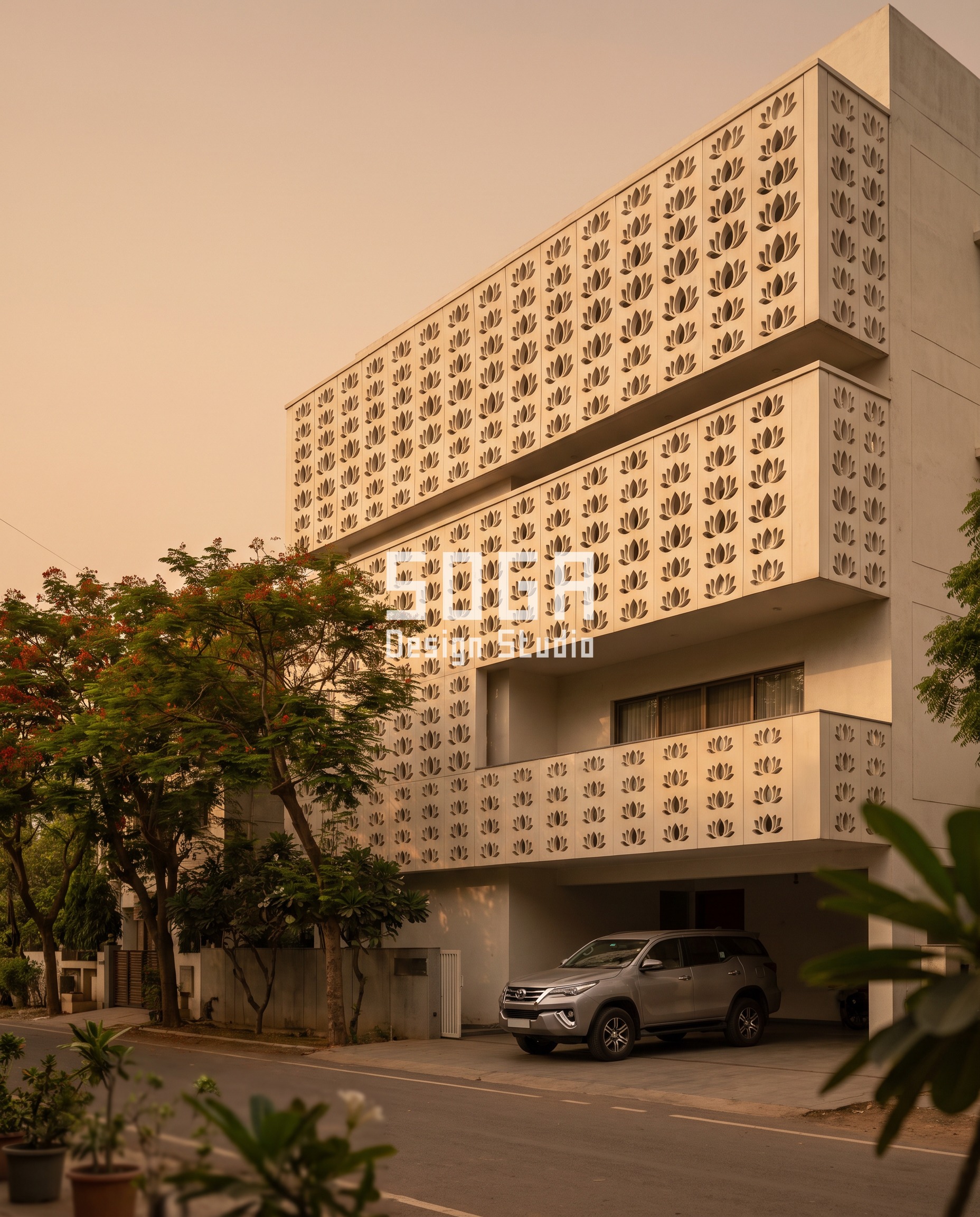
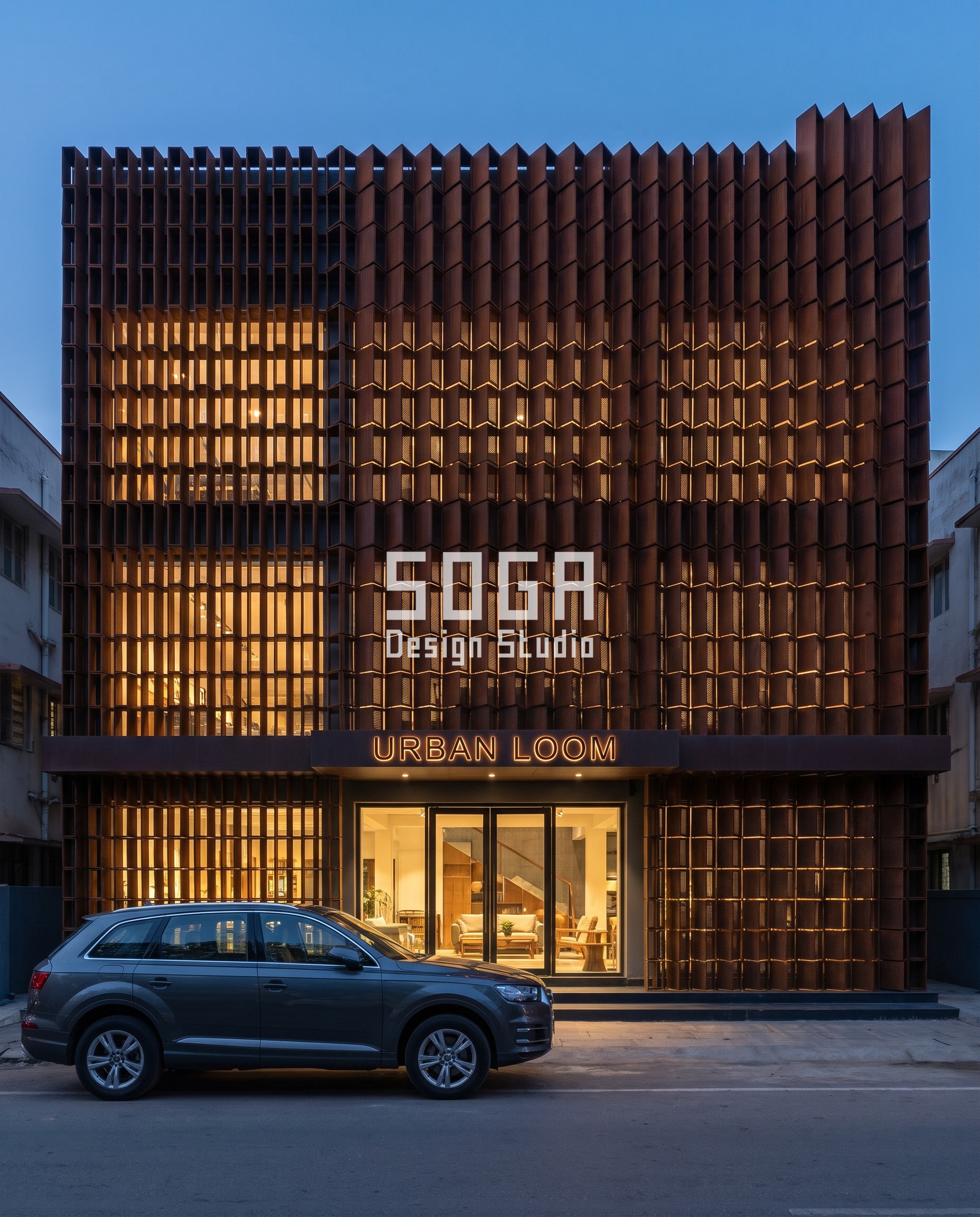
Three unbuilt SOGA Design Studio concept renders below illustrate how the table above plays out at the budget, mid and premium tiers. These are AI-generated design concepts created to illustrate this cost comparison — not photographs of completed, built projects.
SOGA Concept — Ahmedabad, GRC perforated screen (budget tier). A G+3 residential balcony band in a dense field of lotus-motif apertures, deepening from 90mm to 650mm floor by floor — the cheapest material on this page that still reads as genuinely parametric rather than flat.
SOGA Concept — Bangalore, corten-finish weathering steel screen (mid tier). A boutique furniture showroom elevation in deep folded box-fin modules, projection sweeping from 120mm to 980mm left to right — mid-band cost, Bangalore’s forgiving climate, no finish upcharge.
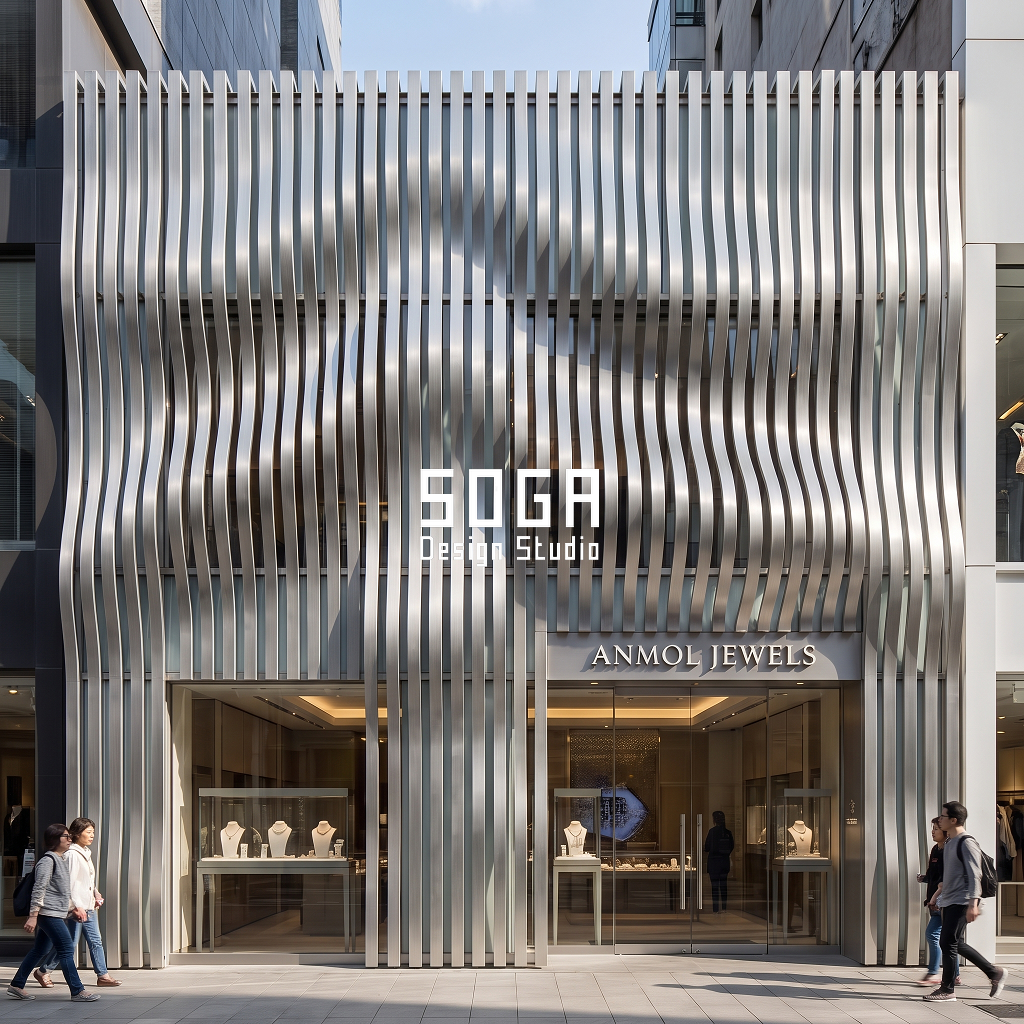
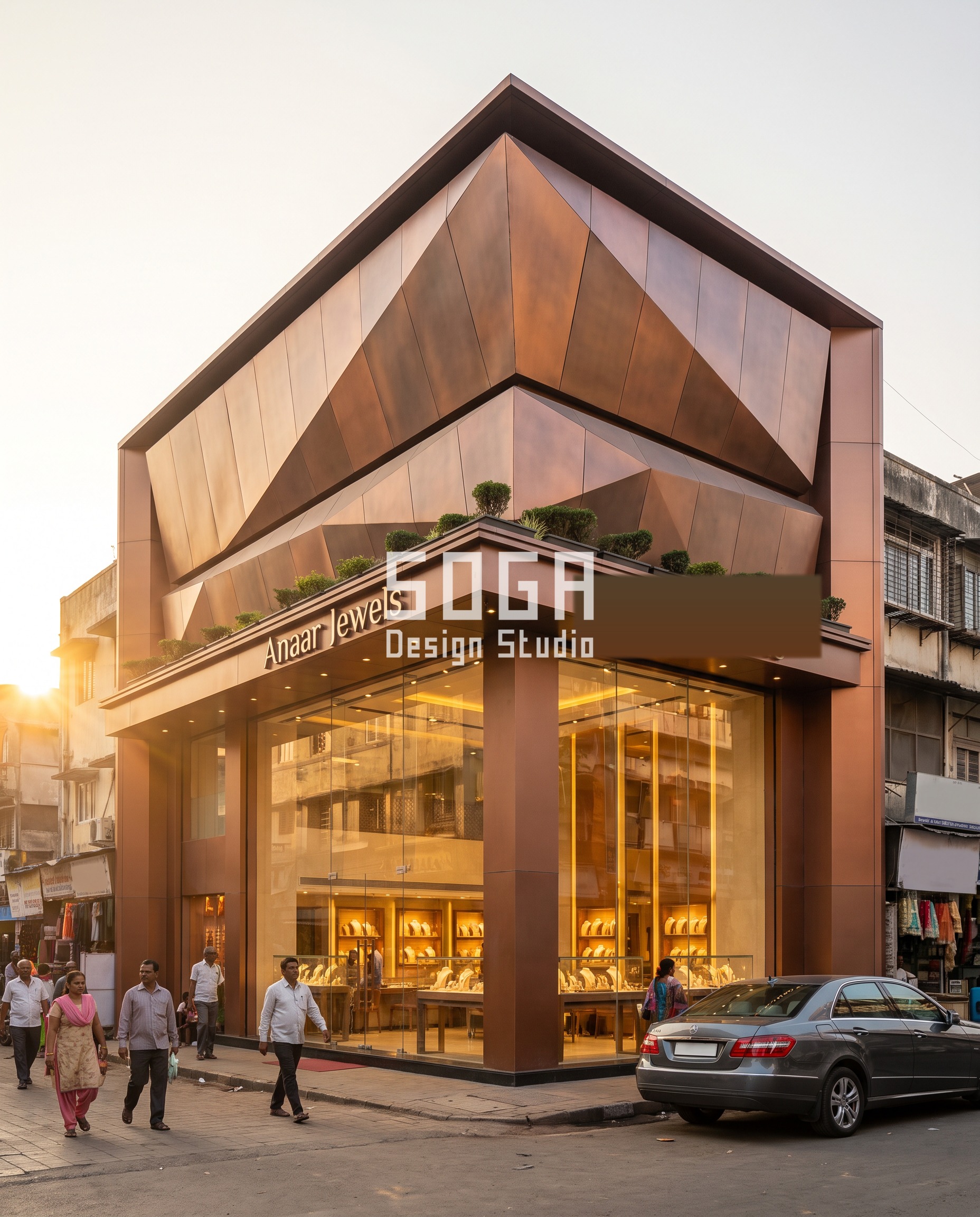
SOGA Concept — Mumbai, patinated copper-bronze finish screen (premium tier). A jewellery showroom facade in deep carved aperture modules, depth sweeping from 100mm to 900mm end to end — the most expensive tier on the table, in the one city where its upkeep plan matters most.
Frequently Asked Questions
How much does a parametric facade cladding system cost per sq ft in India in 2026?
Indicative, current 2026 installed rates run from roughly ₹480/sq ft for a budget GRC screen in Ahmedabad to ₹4,600/sq ft for a premium patinated copper-bronze finish screen in Mumbai, depending on material and city. See the full cross-tab above; always confirm with a fixed quote tied to your actual panel schedule.
Why is the same facade material cheaper in Ahmedabad than in Mumbai?
Mostly freight, labour and climate-driven finish upgrades. GRC is cast regionally in Gujarat, so an Ahmedabad job skips the freight a Mumbai job pays; Mumbai’s salt-spray climate also forces a coastal-grade finish upcharge on several materials that Ahmedabad’s dry inland climate does not need.
Which facade material is the cheapest option that still looks genuinely parametric and 3D?
Indicative 2026 figures put GRC perforated screens lowest of the six families compared here (roughly ₹480–1,150/sq ft depending on city), while still delivering real cast relief rather than a flat panel — see our GRC vs ACP vs HPL breakdown for the trade-offs against weight and fire rating.
Does city matter more than material for the final facade cost?
No — material family is still the bigger lever; the gap between GRC and patinated copper-bronze finish in the same city is far larger than the gap between cities for the same material. City is the second-order correction, except for GRC and corten-finish steel, where it becomes close to a first-order one.
Is GRC or corten-finish steel the better budget choice for a dry-climate city like Ahmedabad or Jaipur?
Both perform well in dry, inland climates for different reasons — GRC on regional casting economics, corten on a climate that lets it self-patinate without a sealant upcharge. The choice usually comes down to whether the brief wants a cast, 3D sculptural module (GRC) or a folded, planar one (corten).
How do I get an accurate quote instead of relying on a published rate card?
Share your city, exact facade area in sq ft, building height and material shortlist with a fabricator or facade studio and ask for a fixed per-sq-ft number tied to an actual panel schedule, not a range. Book a free discovery call with SOGA Design Studio for a proposal within 48 hours.
Read next: our parametric facade design in India pillar guide, the per-sq-ft price breakdown by system and city, the corten, bronze and metal finish guide for showrooms, the commercial facade renovation cost guide, and 10 questions to ask a facade contractor in Mumbai, Delhi or Bangalore.
Sources
- Bureau of Indian Standards — India’s national standards body, for facade material and fire-safety standards.
- International GRC/GFRC Association (GRCA) — technical specification and manufacturing guidance for glass-fibre reinforced concrete.
- Statista — Construction Cost Index in India by City — independent benchmarking confirming city-wise construction cost variance across Indian metros.
Gajender Sharma
Updated: 24 October 2026