A seamless facade is one poured or cast as a single continuous surface, with no visible panel joints breaking the curve, rather than a flat wall dressed with applied cladding. The three homes below carry that idea into three different gestures — a wave that parts into balconies, a ribbon that wraps a corner, and an S-curve that crosses a jaali screen — each cast in glass-fibre reinforced concrete (GFRC) as one continuous run per floor, with every joint hidden inside the curve’s own fold rather than left as a visible seam.
These are concept designs by SOGA Design Studio, produced as design visualisations rather than photographs of completed buildings.
Why These Read As One Surface, Not Applied Panels
A curved facade is not automatically a seamless one. Most “wave” or “organic” cladding jobs are still built from small repeating flat or single-curved panels, bolted on in a grid, and the joint lines between those panels are exactly what gives the trick away up close. All three homes here are cast instead — one continuous GFRC pour per floor band or per corner wrap, using a single reusable mould that is repositioned rather than a different mould for every panel — so the only places a joint can sit are the points the form itself already turns or folds, where the eye is reading shadow, not seam. That is the one rule behind all three: hide the joint in the geometry, never on the flat.
1. Pune: Lahar — Continuous Wave Facade Seamless Facade Concept
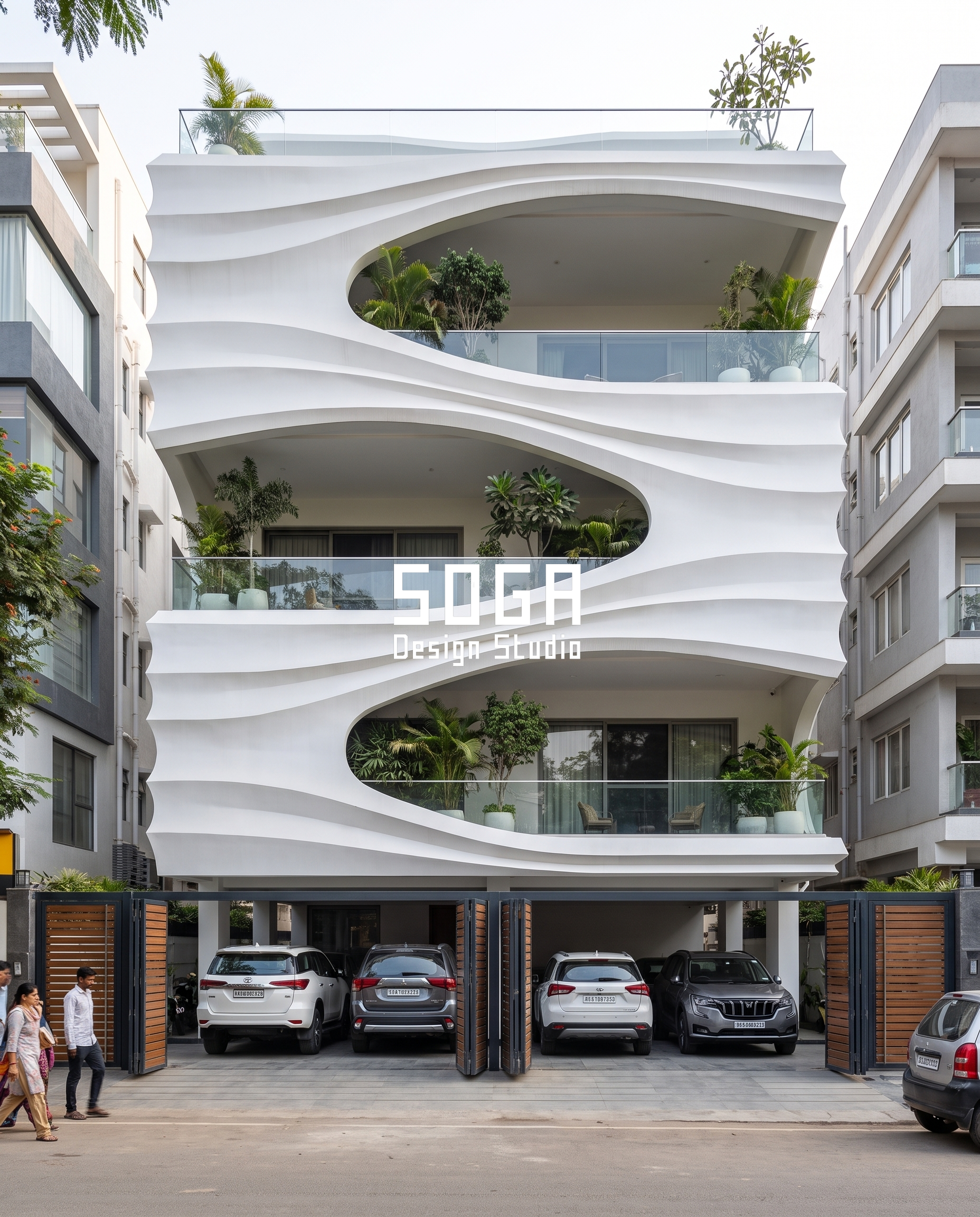
Design seed: a single sine-wave section, cast once per floor band and allowed to dilate locally into an oval void. This G+3 residence in Koregaon Park, Pune wears a Lahar — Continuous Wave Facade skin in seamless white GFRC, cast in one continuous run per floor band with no visible panel joints. Pune’s mild, mostly dry climate lets the wave stay a daylight and privacy device rather than a sun-shading load, so the amplitude is set by the balcony depth the family wanted, not by a solar cutoff angle. The parametric variation is written into the fabrication drawings, not sprayed on afterwards.
How the Lahar — Continuous Wave Facade is built
| Design parameter | Specification |
|---|---|
| Wave amplitude | 420mm, crest to trough |
| Wave pitch | 2.6m, one full cycle per bay |
| Balcony void size | 2.1m wide x 1.6m deep, cut where the wave crests |
| Cast module | 3.2m x floor-height sections, joints hidden in the wave’s own trough line |
| Relief depth | 180mm at the deepest fold |
Material & colour: hero skin in matte white, uniform across the whole run, kept to a restrained palette so the geometry does the talking. Indicative facade cost: Rs 2,400-3,200 per sq ft, fully designed and installed, with an itemised estimate produced per project.
2. Indore: Tarang — Corner-Wrapping Ribbon Facade Seamless Facade Concept

Design seed: one continuous ribbon band, held at a constant width and let to rise and dip in elevation as it turns the building’s corner. This G+4 residence in Vijay Nagar, Indore wears a Tarang — Corner-Wrapping Ribbon Facade skin in seamless white-grey GFRC ribbon, cast as one continuous band wrapping the corner with no mitred joint. Indore’s hot, dry summers put real sun load on the west-facing corner this ribbon wraps, so the rise-and-dip isn’t only visual — the ribbon’s highest points fall exactly where the west sun angle needs the deepest overhang. The parametric variation is written into the fabrication drawings, not sprayed on afterwards.
How the Tarang — Corner-Wrapping Ribbon Facade is built
| Design parameter | Specification |
|---|---|
| Ribbon width | 900mm, constant along its full run |
| Rise/dip amplitude | 650mm at the corner, flattening to 150mm mid-facade |
| Corner wrap radius | 1.8m |
| Cast module | 4.0m runs, joints routed into the ribbon’s own underside |
| Projection | 350mm at the deepest overhang |
Material & colour: hero skin in soft warm white-grey, deepening slightly in the folds for shadow contrast, kept to a restrained palette so the geometry does the talking. Indicative facade cost: Rs 2,200-3,000 per sq ft, fully designed and installed, with an itemised estimate produced per project.
3. Jaipur: Chhaya — S-Curve Jaali Screen Seamless Facade Concept

Design seed: a single S-curve band cast through a flat field of jaali openings, so one element stays liquid while the other stays a strict grid. This G+3 residence in Vaishali Nagar, Jaipur wears a Chhaya — S-Curve Jaali Screen skin in cast stone-finish jaali grid in a warm off-white, with the S-curve band cast separately in matching GFRC and pinned 40mm proud of the grid face. Jaipur’s harsh summer sun and dusty wind make a deep punched jaali the right call — small apertures cut glare and dust ingress while still moving air, and the S-curve band shades the two window bays it crosses so they never need the jaali’s own density. The parametric variation is written into the fabrication drawings, not sprayed on afterwards.
How the Chhaya — S-Curve Jaali Screen is built
| Design parameter | Specification |
|---|---|
| Jaali aperture | 140mm square, 65% solid / 35% open |
| Grid module | 280mm centres, cast in 1.2m x 1.2m precast blocks |
| S-curve band width | 750mm, constant |
| Curve standoff | 40mm proud of the jaali face |
| Curve reveal depth | 220mm where it crosses each window |
Material & colour: hero skin in warm off-white, grid and curve in matching tone so the contrast is in form, not colour, kept to a restrained palette so the geometry does the talking. Indicative facade cost: Rs 1,900-2,800 per sq ft, fully designed and installed, with an itemised estimate produced per project.
Facade Cost (2026)
A seamless cast facade costs more than a flat ACP rainscreen for two reasons that have nothing to do with the material itself: a curved or folded mould is more expensive to build and strike than a flat sheet-metal brake, and a continuous run cannot be value-engineered down to a smaller repeating unit the way a flat panel grid can. The jaali-based Chhaya system comes in cheapest of the three because only its one S-curve band needs a custom mould — the grid around it is a repeating precast block, not a continuous cast run.
| System / material | Indicative rate |
|---|---|
| Lahar — continuous wave GFRC (Pune) | Rs 2,400-3,200 per sq ft, indicative, itemised per project |
| Tarang — corner-wrapping ribbon GFRC (Indore) | Rs 2,200-3,000 per sq ft, indicative, itemised per project |
| Chhaya — S-curve band + precast jaali grid (Jaipur) | Rs 1,900-2,800 per sq ft, indicative, itemised per project |
| Standard flat ACP rainscreen, for comparison | Rs 400-900 per sq ft, indicative, itemised per project |
How A Seamless Curve Is Actually Cast
Each of these runs from a single GRP (glass-reinforced plastic) master mould for its repeating bay — one mould for Lahar’s wave cycle, one for Tarang’s rise-and-dip ribbon length, one for Chhaya’s S-curve band — cast, struck, cleaned and reused down the elevation rather than a new mould per floor. The GFRC skin itself runs 10-13mm thick over a welded steel sub-frame that carries the real structural load; the concrete is doing the shape, not the holding. Movement joints are planned at the same points the mould itself breaks — inside a trough, under a dip, behind a reveal — so a joint that has to exist for thermal movement never reads as one in the finished elevation. On Chhaya, the precast jaali blocks are independently fixed on a separate sub-frame 40mm behind the S-curve band, so the two elements can move independently without stressing either one.
Related Reading
- Parametric facade design in India
- Organic facade design: why it doesn’t mean curves
- Why India’s retail flagship facades are going curved
- Modern jharokha design in India
- Facade gradient spread ratio: the 6-9x rule
- Lime Concrete Facade Design: 5 Organic Curved Homes
Frequently Asked Questions
What is a seamless facade in architecture?
A seamless facade is cast or poured as one continuous surface rather than assembled from small flat panels bolted on in a grid. The curve and the joint both come from the same mould, so there is no visible seam line breaking the form the way there is on a panelised cladding job.
How is a continuous curved GFRC facade actually cast?
A single GRP master mould is built for one repeating bay of the pattern, then cast, struck and reused down the elevation rather than remade for every section. The 10-13mm GFRC skin sits over a welded steel sub-frame that carries the structural load, and movement joints are placed inside the curve’s own folds so they stay invisible.
Is a seamless curved facade more expensive than a flat one?
Yes — typically Rs 1,900-3,200 per sq ft against Rs 400-900 for a standard flat ACP rainscreen. The premium comes from the custom curved mould, not the GFRC material itself, and a continuous run cannot be value-engineered into a smaller repeating module the way a flat panel grid can.
Can a jaali screen and a curved band work on the same facade?
Yes, as long as they are built on independent sub-frames. On the Chhaya system in Jaipur, the precast jaali grid and the S-curve GFRC band are fixed 40mm apart on separate frames, so each can expand and contract with temperature without transferring stress into the other.
How long does a seamless GFRC facade last in Indian weather?
A properly detailed GFRC skin with correctly specified movement joints and drainage typically carries a 25-30 year service life in Indian conditions, the same order as precast concrete cladding generally. The joint detailing matters more than the material — a joint placed on a flat run will open and streak long before one hidden inside a fold does.
Start Your Project
SOGA Design Studio designs and engineers seamless, continuous-surface facades for homes and commercial buildings across India — from the first concept sketch through to fabrication drawings a contractor can actually mould and cast. Write to us with your plot, elevation and the gesture you have in mind.