A sports centre facade design india brief is usually answered with a plain metal box and a signboard. That misses the one advantage a sports building has over every other commercial type: the activity inside already has a shape, a ripple, a bounce, a stride, a swing. A density-gradient perforated panel can carry that shape directly in its own material, hole by hole, with nothing painted or applied on top. Five SOGA sports concepts, in Ahmedabad, Bengaluru, Pune, Hyderabad and Chennai, each wrap a bold piece of massing, a leaning wall, a folded roof, an upturned stand, a faceted hoop-cut corner, a lifted verandah, in a single perforated metal panel whose hole size alone carries the image, from a 3 mm pale background to 20 to 22 mm holes in the darkest areas.
A density-gradient perforated facade is a metal skin whose hole diameter is set hole by hole to match an image, so darker areas get larger, more closely spaced holes and lighter areas get smaller, more sparse ones. Nothing is painted or printed; the image exists only as the pattern of the holes themselves. The source image can be a physical curve, a wave ripple, a bouncing ball’s decaying arc, or a single action silhouette, an athlete mid-stride. Both are the same operation, read the same way. The test is numeric: a stated hole grid, a stated diameter range, and the viewing distance the range is legible from.
Why a Sports Facade Should Carry Its Own Image in Holes Alone
Most sports facility facades are generic sheds: a metal box, a canopy, a signboard naming the sport. That wastes the one thing a sports building has that an office never does. Its activity already has a shape, worth drawing directly onto the wall, not painted on top of it but built from the wall’s own material.
A density-gradient perforated panel does exactly that: every hole is punched through one sheet, and the image is nothing but the pattern those holes make, larger and closer together where the source is dark, smaller and further apart where it is pale. There is no ink, no applied colour, no printed layer sitting on the metal; the image is the metal.
This only works if it survives distance. A hole reads clearly from about 100 times its own size; smaller than that, it blurs into a flat tone. Every concept here states its hole grid and diameter range against the panel size it sits on, so the image reads whole from a normal approach, not just from a render.
This page does not repeat the massing-move method applied to hospitals (the hospital facade guide) or schools (the sustainable school facade guide), or general parametric metal facade options (the parametric metal facade guide). It applies the density-gradient perforation operation, in both its physical-curve and figurative-silhouette forms, to five sports buildings.
Stage 1, Programme: Five Sports, One Bold Move Each
The method runs programme, massing, grain, skin, in that order. Programme comes first because each shell follows its span: a pool hall wants one long uninterrupted wall, a badminton hall wants a clear-span roof, a stadium wants a stand wrapping a track. The perforated panel is placed only after that shell is settled, on whichever face or corner reads best from the approach.
Five different projects, five cities and five sports sit under one thesis: the pattern is built from perforation holes alone, no paint, no applied colour. None is a stock product and none has been built. Each is a SOGA concept.
| Programme | Area / count |
|---|---|
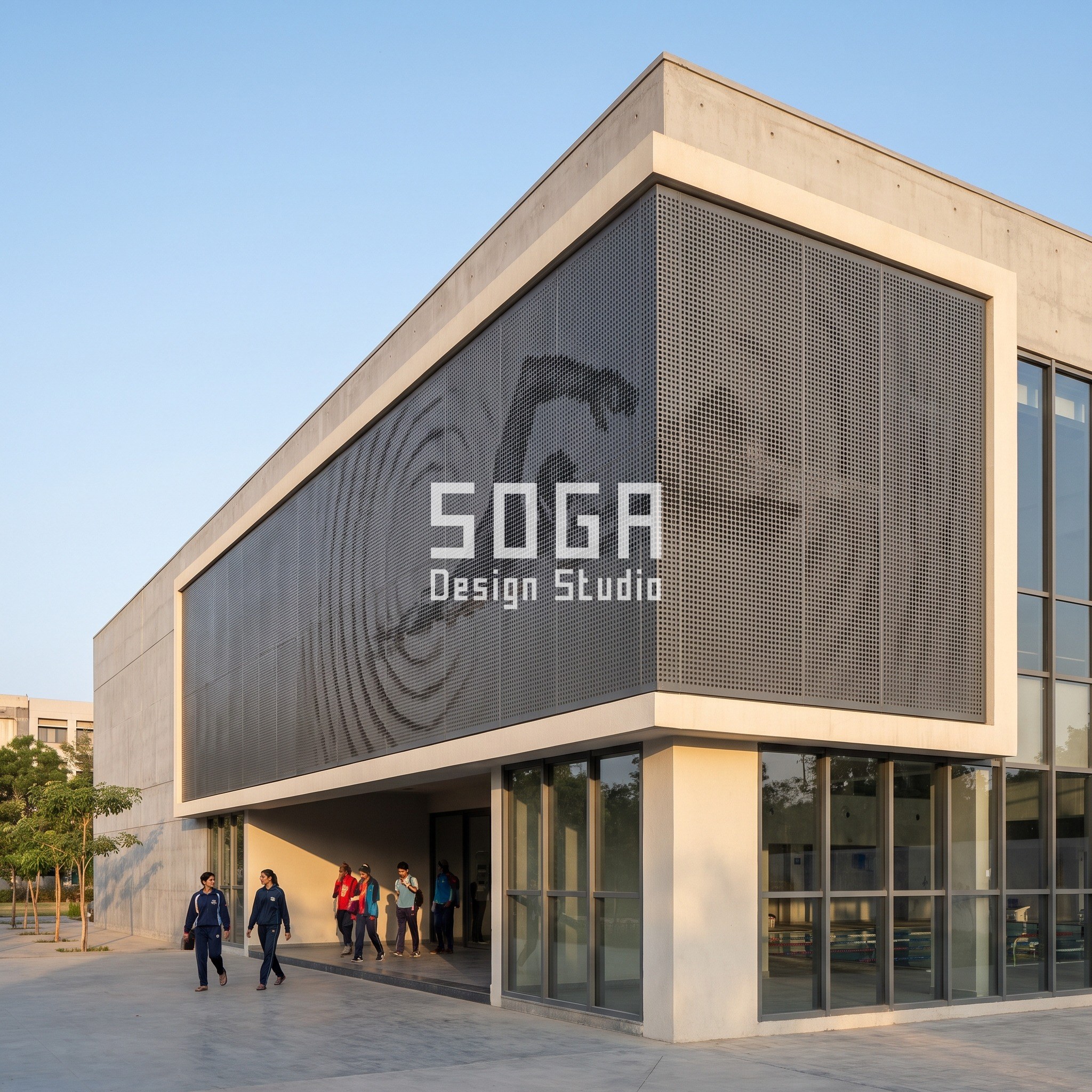
| Aquatic Centre, Ahmedabad | 1-storey pool hall, wall leaning 15 degrees; ripple-ring perforation, holes 3 to 20 mm on a 28 mm grid |
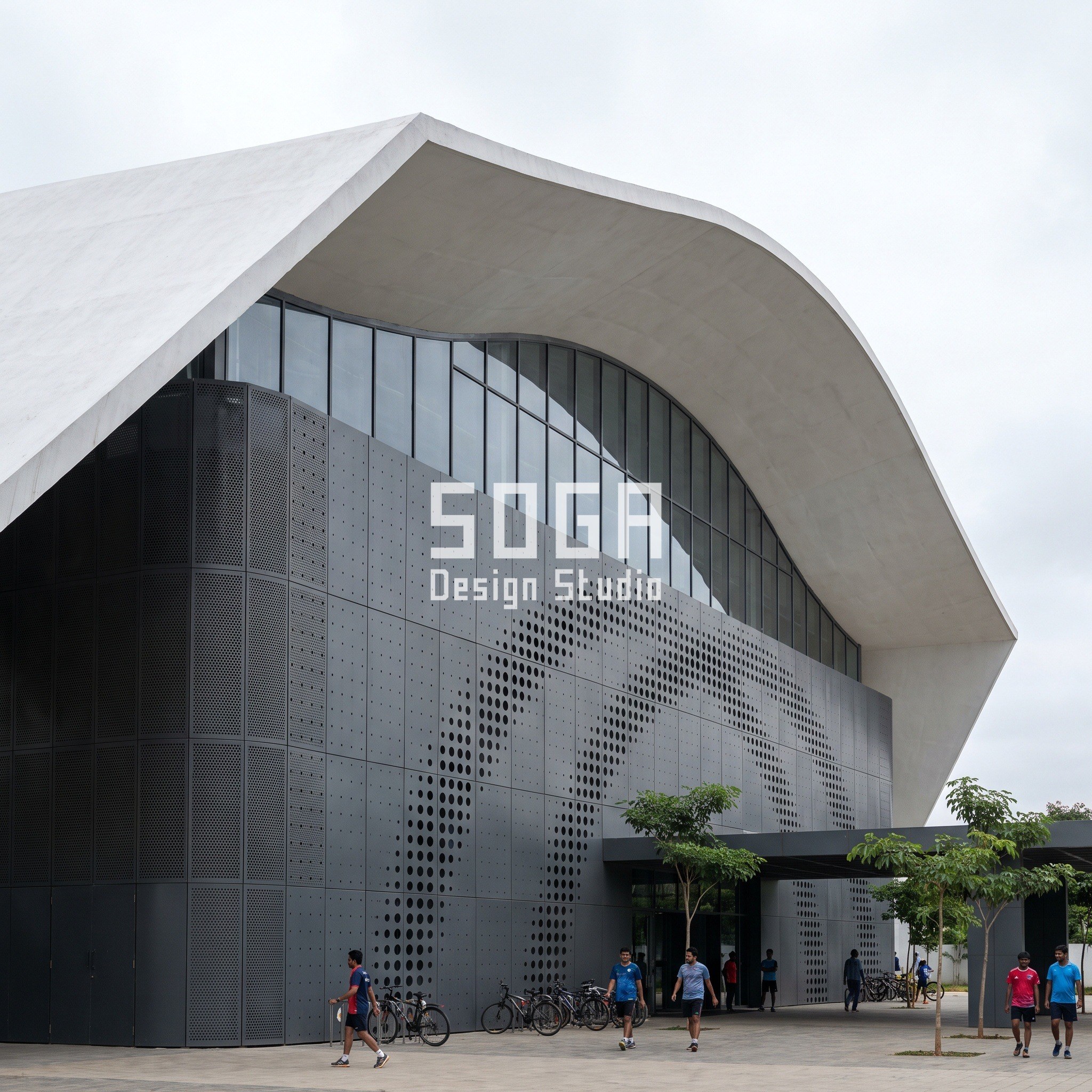
| Badminton Arena, Bengaluru | 2-storey hall under a folded roof; rising density-gradient perforation, holes 3 to 20 mm on a 28 mm grid |
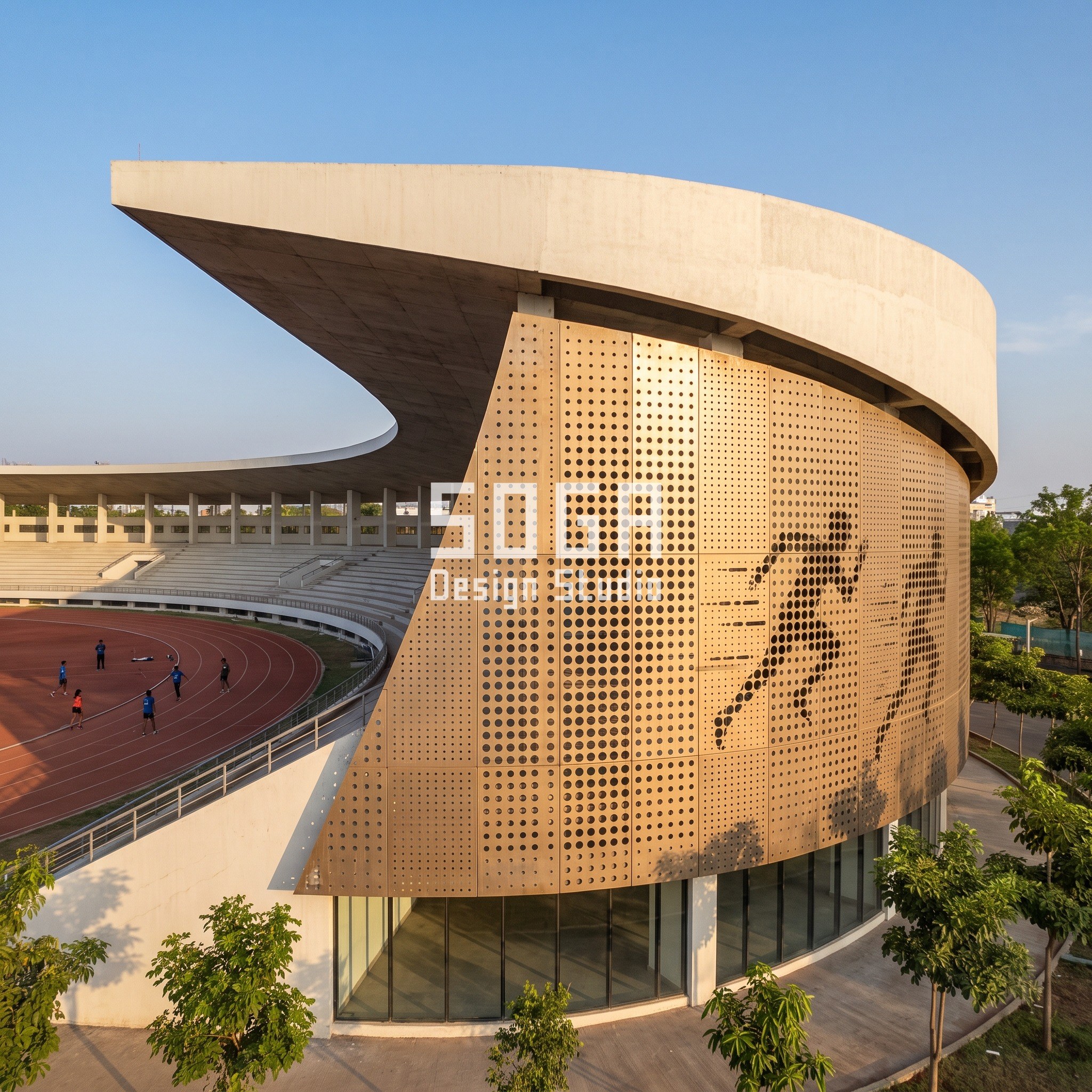
| Athletics Stadium, Pune | Curved grandstand, roof kicking up 5 m at the corner; sprinter portrait, holes 3 to 20 mm on a 28 mm grid |
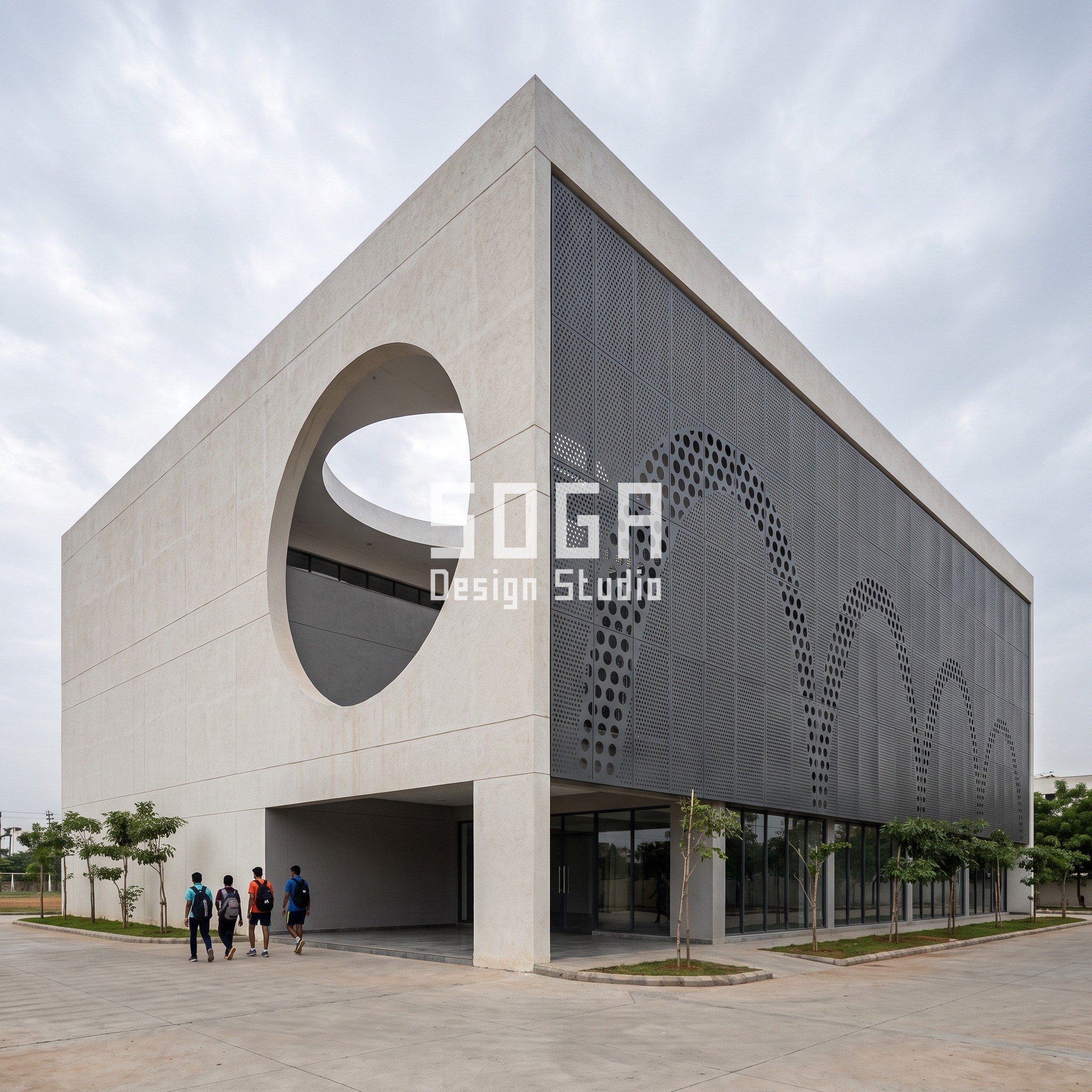
| Basketball Academy, Hyderabad | Faceted entrance corner with a circular hoop void; 3 decaying bounce arcs, holes 3 to 22 mm on a 28 mm grid |
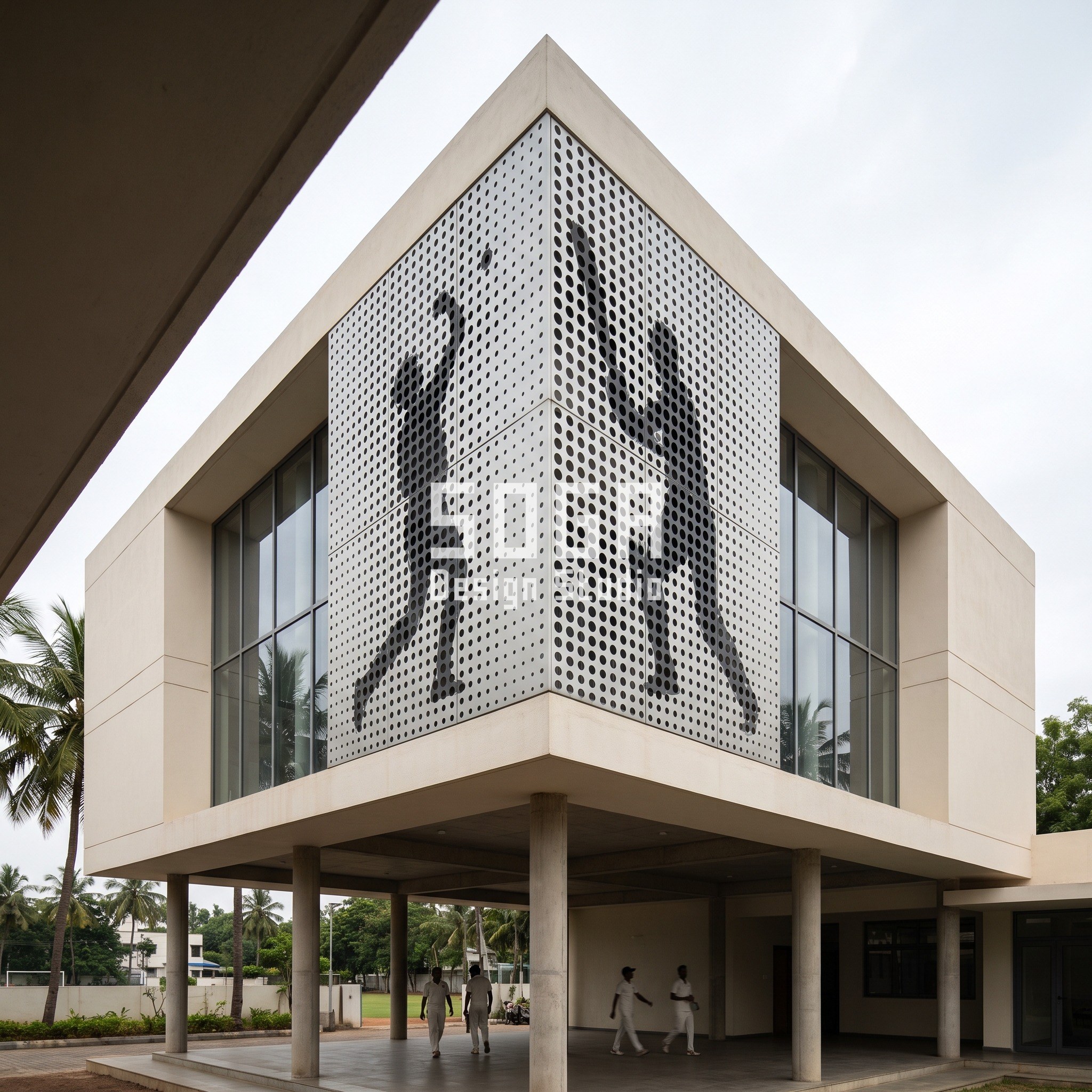
| Cricket Academy, Chennai | Upper storeys lifted 4 m on columns; bowler and batsman portrait, holes 3 to 22 mm on a 30 mm grid |
Stage 2, Massing: Five Bold Moves, Each Carrying a Perforated Panel
Ahmedabad leans a wall. The pool hall’s end wall tilts 15 degrees off vertical, like a wave about to break, and the corner where it meets the plumb return wall is where the ripple panel sits, so the pattern and the lean read together as one gesture, not two.
Bengaluru folds a roof. A single folded concrete plane rises and falls over the courts, and the tall entrance wall beneath it carries a density gradient that opens from tight, small holes near the ground to a broad field of large ones higher up, echoing the roof’s own rise.
Pune kicks a roof upward. The grandstand’s own curve is already dynamic; at one corner the roof edge lifts sharply, projecting 5 m past the wall below, and the perforated panel under that lift carries the one figurative image in this set, a sprinter caught mid-stride.
Hyderabad cuts a hoop. The entrance corner is faceted at 45 degrees instead of meeting at a plain right angle, and a large circular void is cut straight through it, standing in for a basketball hoop without literally drawing one; the perforated panel beside the void carries the bounce arcs a real ball makes as it loses height.
Chennai lifts a volume. The upper two storeys stand clear on slim columns, 4 m above the ground, forming a shaded verandah underneath, and the lifted corner above carries the second figurative panel in this set, a bowler and a batsman side by side.
The Rule Table: Hole Grid, Diameter Range and What Drives It
A density-gradient panel is only as good as its stated numbers: the grid every hole sits on, the diameter range, and what actually drives the gradient, a physical curve or a source silhouette. The table sets out each concept’s numbers.
The range is deliberately wide, about 6 to 7 times between the smallest and largest hole, because a narrower range fades the pattern into its own background instead of standing out from it.
| Concept and grid | Diameter range | what sets the pattern |
|---|---|
| Ahmedabad, 28 mm grid | 3 to 20 mm, 6.7x | driven by ripple decay: ring spacing and hole size both fall off with distance from the implied source point |
| Bengaluru, 28 mm grid | 3 to 20 mm, 6.7x | driven by a stated rising density curve, no source image, a pure geometric gradient |
| Pune, 28 mm grid | 3 to 20 mm, 6.7x | driven by a greyscale source silhouette of one sprinter, remapped hole by hole |
| Hyderabad, 28 mm grid | 3 to 22 mm, 7.3x | driven by a basketball’s real bounce decay, each arc peak about 25% lower than the last |
| Chennai, 30 mm grid | 3 to 22 mm, 7.3x | driven by a greyscale source silhouette of two figures, a coarser grid since two poses share one panel |
Stage 3, Grain: The Panel Has to Read From the Approach, Not Just the Render
A visitor reads the panel while walking, from about 15 to 40 m out and closing, not from the fixed frontal distance a render implies. Ahmedabad’s and Hyderabad’s corner placements mean the panel is visible from two directions of approach; Bengaluru’s and Chennai’s sit on the single face a visitor meets first.
Ground level carries the human-scale reading underneath the panel. A shaded entrance walk, a bicycle rack, a few players or swimmers in ordinary kit, sized and placed far enough from the camera that they read as scale figures against the panel above them, not as a lifestyle shot. None of the five concepts writes the sport’s name on the building; the pattern and the massing move are the identity.
The panel also has to survive being cleaned and repaired. Every concept keeps its hole diameters to a working set of standard CNC tool sizes rather than a continuously variable diameter at every hole, so a damaged section can be re-cut from the same tool library.
Stage 4, Skin: One Perforated Metal System, Five Different Drivers
All five panels use the same underlying system, CNC-cut 3 mm matte metal cassettes on a ventilated rail with full-height glazing behind, so daylight still reaches the space inside through the gaps between holes. What varies is only what drives the hole diameter: a physical decay curve in three concepts, a mapped silhouette in two.
Ahmedabad’s and Hyderabad’s patterns are pure geometry, calculated directly from a ripple-decay or bounce-decay formula with no source image at all. Bengaluru’s is a stated density curve. Pune’s and Chennai’s are prepared as a greyscale source silhouette, then remapped hole by hole, the darkest cells getting the largest hole in the stated range, the palest cells the smallest.
Fixings are concealed throughout: every panel hangs on a rail with hairline joints, and nothing on the outer face shows a fastener.
Buildability: Tool Libraries, Corner Geometry and What Actually Gets Cut
Every panel here is cut from a working library of 6 to 8 standard hole diameters across its stated range, not a continuously variable diameter at every one of the thousands of holes a panel this size actually contains. That keeps CNC programming and tool changes close to what a standard perforated panel run already costs.
Ahmedabad’s leaning wall and Hyderabad’s faceted corner are both built as flat cassette panels meeting at a mitred edge, not a continuously curved sheet; Pune’s curved grandstand panel uses a small number of pre-curved cassette widths instead.
A geometric pattern, Ahmedabad’s ripple or Hyderabad’s bounce arcs, is fixed once as a formula and can be recomputed at any scale if the panel size changes. A silhouette pattern, Pune’s or Chennai’s, is fixed at the design stage as a specific image file; a damaged cassette is replaced from the same cut file.
Access and maintenance close the check: every panel has a cleaning route from grade or from the glazing behind it, and cassettes are individually removable.
Cost Ranges for a Density-Gradient Perforated Facade in India
Costs below are indicative 2026 market ranges checked this month against published supplier lists. They are ranges, not quotes, and vary by city, brand, hole count and finish. A density-gradient panel costs more than a single-size perforated wall of the same area, because the varied hole sizes mean more tool changes and more sorting during fabrication, even on the same base sheet.
Budget perforated metal sheet is listed from about Rs 55 to 150 per sq ft; a full parametric metal facade system is listed at roughly Rs 800 to 2,500 per sq ft installed, and steel systems at about Rs 1,200 to 2,800. A density-gradient panel, given its varied hole sizes, sits toward the upper half of that installed range.
That upper-range cost is the price of control, not decoration: see the one-variable rule behind a facade gradient for why a density gradient only reads as deliberate rather than random when exactly one quantity is varied end to end.
| Scope | Indicative market range (2026) |
|---|---|
| Ahmedabad ripple panel, leaning corner | Sheet Rs 55 to 150 per sq ft; full installed system Rs 1,200 to 2,500 per sq ft |
| Bengaluru density-gradient panel, entrance wall | Sheet Rs 55 to 150 per sq ft; full installed system Rs 1,200 to 2,500 per sq ft |
| Pune sprinter portrait, curved corner panel | Curved cassettes add to tooling; installed system Rs 1,500 to 2,800 per sq ft |
| Hyderabad bounce-arc panel, faceted corner | Sheet Rs 55 to 150 per sq ft; full installed system Rs 1,200 to 2,500 per sq ft |
| Chennai bowler-batsman portrait, lifted corner | Two-figure composition adds design time only; installed system Rs 1,200 to 2,500 per sq ft |
The Honest Limit: A Panel Reads Once, Then It Has to Be a Building
A perforated panel, geometric or figurative, is a strong first impression, read once from the approach. It does not substitute for what a sports facility actually needs: correct court and track dimensions, sightlines, changing rooms, equipment storage, and a structure sized for the actual span, none of which the panel touches.
None of these five concepts has been built. The two figurative panels use invented poses, not photographs of real athletes; mapping a real person’s likeness onto a permanent facade raises its own rights questions separate from the facade design itself, so a real project would need a commissioned illustration or a licensed image before any hole pattern is cut.
Cost is the last limit. A density-gradient panel with a 6 to 7 times hole-size range costs meaningfully more than a plain single-size perforated wall of the same material and area. A budget-constrained club may keep the bold massing move, which costs nothing extra, and use a simpler, narrower-range pattern to control cost.
Legibility: How Far a Hole Reads From
As a design rule of thumb, a hole reads clearly from about 100 times its own size; closer than that it is crisp, further than that it blurs into a flat tone. It is a rule of thumb from studio practice, not a measured result.
| Hole size | Reads as a shape from about |
|---|---|
| 3 mm hole | About 0.3 m; a flat pale tone by 15 to 20 m, which is why it is used only as background field |
| 8 to 12 mm hole | About 1 m; reads as a fine line or edge detail |
| 20 mm hole | About 2 m; reads clearly as a shape, and as part of a larger dark mass from further away |
| 22 mm hole | About 2.2 m; the largest hole used, for the darkest, most solid parts of a pattern |
Two Ways to Drive the Same Operation
Density-gradient perforation takes its hole sizes from either a calculated physical curve or a mapped image; both are the same underlying operation.
| Driver type | Used in |
|---|---|
| Physical decay curve (no source image) | Ahmedabad’s ripple rings, Bengaluru’s rising density field, Hyderabad’s bounce arcs |
| Mapped source silhouette | Pune’s sprinter, Chennai’s bowler and batsman |
Related Reading
- Parametric Facade Design in India: Systems, Materials and Cost per Sq Ft
- Facade and Elevation Design in India: Complete FAQ Guide
- Hospital Facade Design India: Five Rule-Built Concepts
- Sustainable School Facade Design India: Rule-Built Campuses
- Stacked Volume Facade Design India: Shift, Then Skin
- Bazaar Street Facade Design India: The 3-Second Read
- Best Facade Design in New Delhi 2026: Parametric Metal Facade Ideas
Frequently Asked Questions
How does a facade draw a pattern using only perforation holes?
By setting each hole’s diameter to match how dark that part of a source image or curve is: darker areas get larger, closer holes, lighter areas get smaller, sparser ones. There is no paint or print; the image is the pattern of the holes themselves.
What is the difference between a geometric and a figurative perforation pattern?
A geometric pattern, like a ripple or a bounce arc, is calculated from a physical decay curve with no source image. A figurative pattern, like an athlete’s silhouette, is prepared as a greyscale source image and remapped hole by hole onto the same kind of grid.
How wide must a perforation hole be to read from the road?
As a rule of thumb, a hole reads clearly from about 100 times its own size. A 20 mm hole reads as a shape from about 2 m; the 3 mm background holes are a pale tone by about 20 m, which is why the range spans 3 to 22 mm rather than one size.
What does a sports centre facade cost in India?
Indicative 2026 ranges: budget perforated metal sheet Rs 55 to 150 per sq ft, a full parametric metal system about Rs 800 to 2,500 per sq ft installed, and a density-gradient panel, given its varied hole sizes, toward the upper half of that range, Rs 1,200 to 2,800 per sq ft.
What is the honest limit of a perforation-pattern sports facade?
The pattern is a strong first impression read once from the approach; it does not substitute for correct court dimensions, sightlines or storage, and a figurative panel mapping a real athlete’s photograph raises likeness and rights questions separate from the facade design itself.
Want the Pattern Tested Before the Panel Sizes Are Fixed?
SOGA Design Studio designs parametric metal facade concepts for sports centres, arenas and academies across India. Send the sport, the plot and the approach distance, and we will set out the massing move, the perforation pattern and the cost band.