A fin leaves the cutting bed flat. Whether it reaches the scaffold straight, at the right stand-off depth, and indexed to the correct rotation is decided on the shop floor, not on the design drawing. Depth, chord, taper and twist are settled before this begins — the territory of the complete Slicing Fin Facade guide. This article starts where that one stops: the five shop-floor operations that turn a fin schedule into a crate of blades ready to hang, in the sequence SOGA Design Studio worked out with Indian fabricators while putting the system into production.
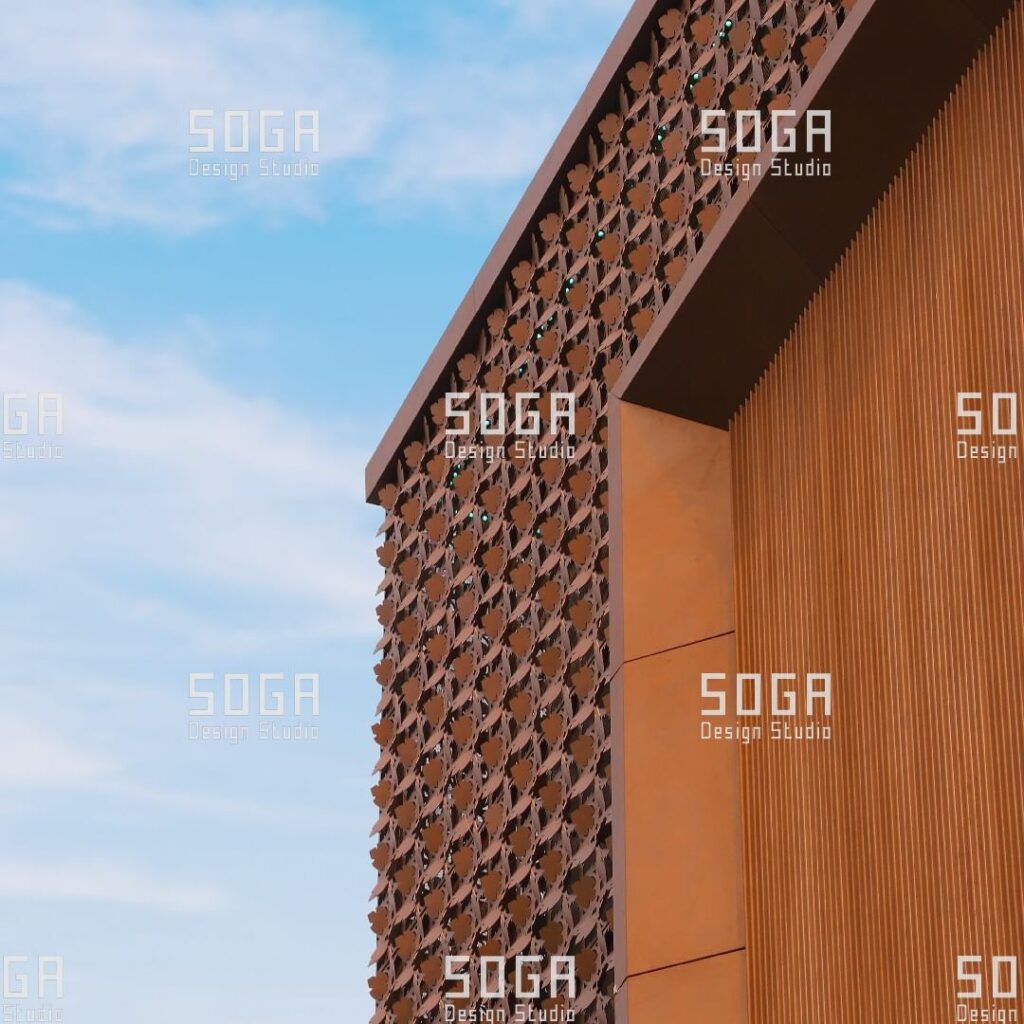
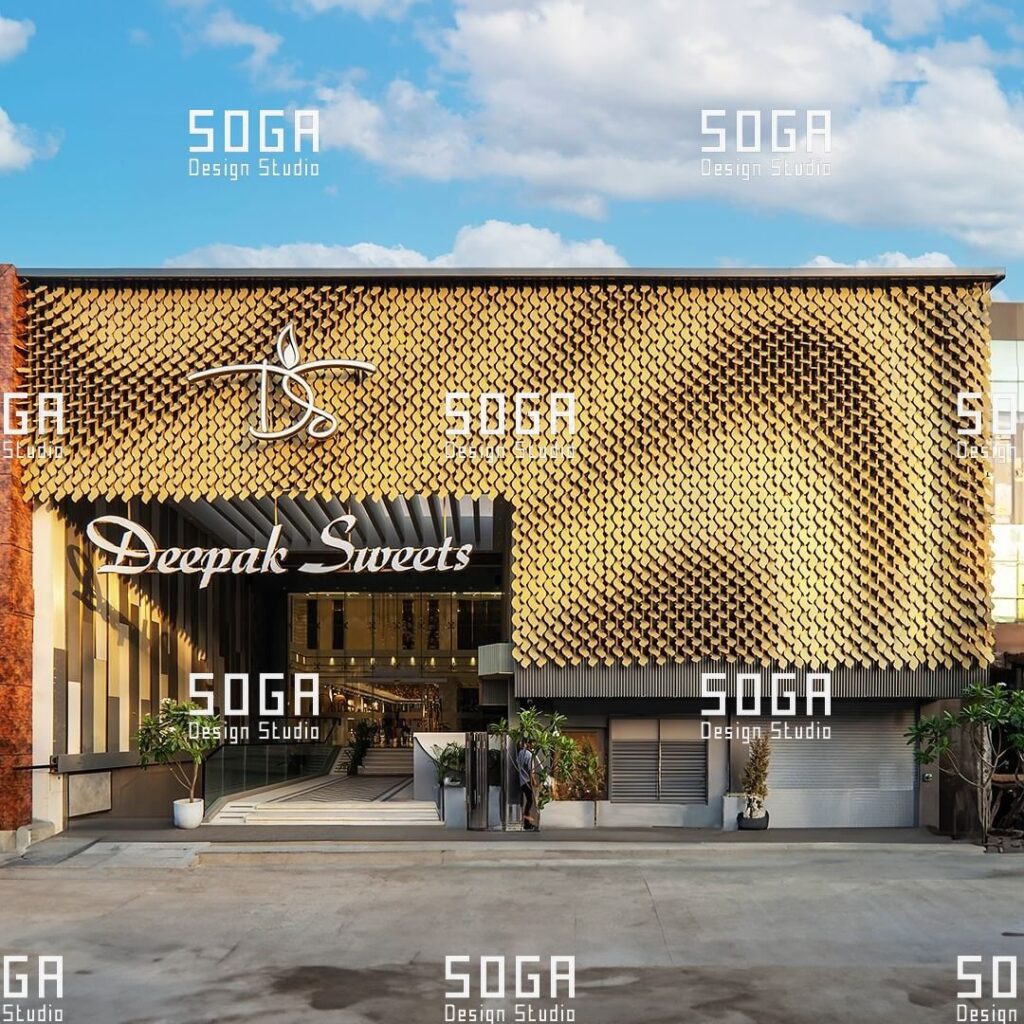
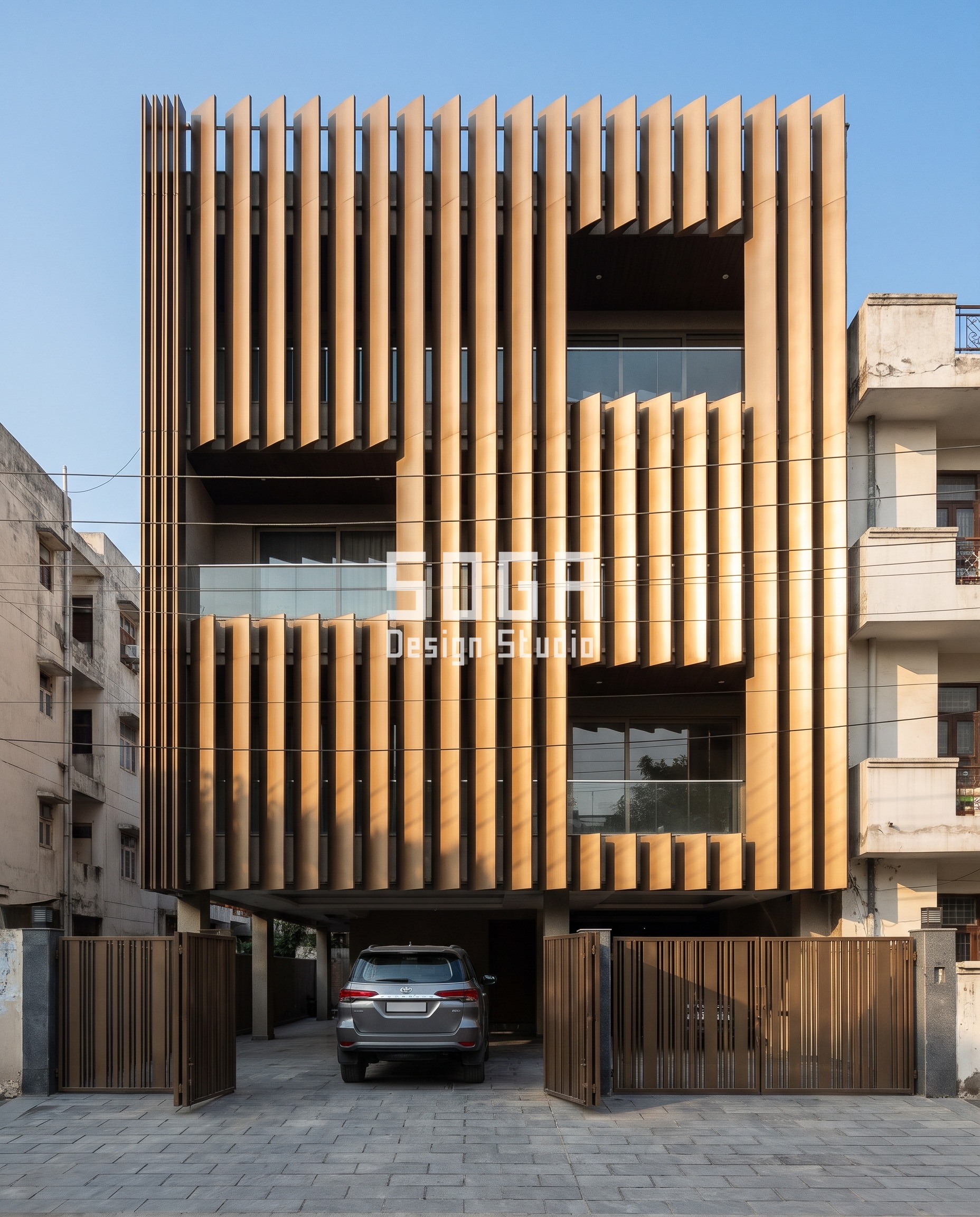
The photographs here are studio visualisations of the SOGA Fin Facade system, used to illustrate the manufacturing sequence rather than documentation of one specific built project.
From Fin Schedule to Cutting List
The fin schedule that leaves the design table is sorted by elevation and bay — fin 1 to fin 140, in the order a viewer walks past them. The shop floor cannot work from that order. A brake press holds one backstop setting for an entire run and loses an hour resetting it; a schedule that jumps between depths every few fins forces a reset every few fins. The first manufacturing operation is a re-sort, by profile family and depth-step rather than by position, so that the forty fins sharing one quantised depth band run together regardless of where they sit on the building.
What the re-sort must not lose is identity. Two fins fifteen millimetres apart in depth look identical off the rack, and a slicing fin facade depends on every one of them landing in its own bay, at its own rotation. The position code is etched on a concealed face at the first cutting operation — never printed on protective film, which is stripped before finishing and takes the identity with it. One blade from each depth family is then run through all five stages below, signed off as a first article, and kept rather than shipped.
Step 1 — Cutting the Blade Blank
SOGA cuts fin blanks from flat bronze-anodised sheet stock rather than ordering a bespoke extrusion die per depth. An extrusion is cheaper only at volumes a single facade rarely reaches once a die, minimum run length and lead time are priced in; a flat blank cut to the blade’s developed width (its chord) and length keeps the whole depth family on one sheet-metal line. The trade-off is that a flat sheet has to earn its stiffness in the forming step that follows — it does not arrive with it.
| Cutting method | Edge quality | Tooling cost | Best suited to |
|---|---|---|---|
| Laser cutting | Clean profile; a heat-affected zone and recast layer need dressing before finishing | Low; nothing part-specific | Mixed widths and lengths in one nested sheet, which is the normal case on a slicing facade |
| Guillotine shear | Clean straight edge, no heat-affected zone, fastest cycle time | Lowest | Blades with parallel long edges and no curved cut-outs — most of a fin family |
| Punch press | Repeatable edge while the tool is sharp; a burr forms on the exit face as it dulls | High per width; needs volume to justify | A single depth run at high quantity, rarely the case across a quantised family |
The recurring failure at this step is not the cut itself but sheet orientation: a laser bed marks the underside with spatter from the cutting slats, and a sheet flipped mid-run leaves half a batch identity-marked on the face that is meant to be shown. SOGA fixes which face is “up” in the cutting package issued to the floor, not as a verbal instruction at the machine.
Step 2 — Forming the Profile
A flat strip this long and this thin oil-cans and drums in wind before it ever reaches depth. Forming is what gives the blade a cross-section that resists both: a folded channel or a hemmed edge, pressed on the same brake that cuts nothing — it only bends. Depth is set by where the backstop sits, which is why one tool can serve an entire quantised depth family: the step between a 150 mm and a 950 mm blade is a backstop index change, not a different die.

Springback is the main variable the brake operator fights. The sheet recovers elastically after the punch retreats, by an amount that shifts with alloy temper, sheet thickness within its own tolerance band, and tool temperature over a shift. The compensation angle is established at the first-article trial for each depth family and written on the tool sheet — it is not a constant the operator can carry from the last job.
Forming quality checks per batch
- Depth and fold angle, checked against a go/no-go profile gauge rather than a tape measure, so the operator makes a pass or fail call rather than a judgement
- Straightness along the full length, on a flat table under a taut string line — a slicing fin facade reads a bowed blade immediately, because its neighbours are all dead straight
- Twist, where the family includes it: measured end to end, since a blade that turns on its own axis defeats the rotation set later at the bracket
Step 3 — Finishing
SOGA finishes fin blades in a PVDF-coated or anodised bronze tone, chosen by exposure and budget rather than by appearance alone: PVDF holds colour longer on a west-facing run, anodising reads truer on a brushed or metallic finish. Either way the blade’s length is the problem a disc never has. A 3–4 metre blade racked at two points sags under its own weight through a cure oven unless it is supported along most of its span, and an under-supported blade comes out of the oven with a visible bow that no amount of later straightening removes.
Tone consistency works the same way it does on any large metal run: one retained reference sample per batch, compared under fixed lighting, and coating or anodising lots distributed across every elevation rather than given one elevation each. A single lot assigned to one face of the building shows up as a hard tone line the day the sun crosses it; the same lots spread across all faces do not.
Step 4 — Bracket Fabrication and Rotation Indexing
Rotation is the cheapest parameter to vary in a slicing fin facade and the most visually powerful, because changing it changes nothing about the blade itself — only the bracket that holds it. That makes the bracket, not the blade, the part that actually carries each fin’s unique setting-out data: its rotation angle top and bottom, its stand-off distance from the wall, and which end is fixed and which is left free.
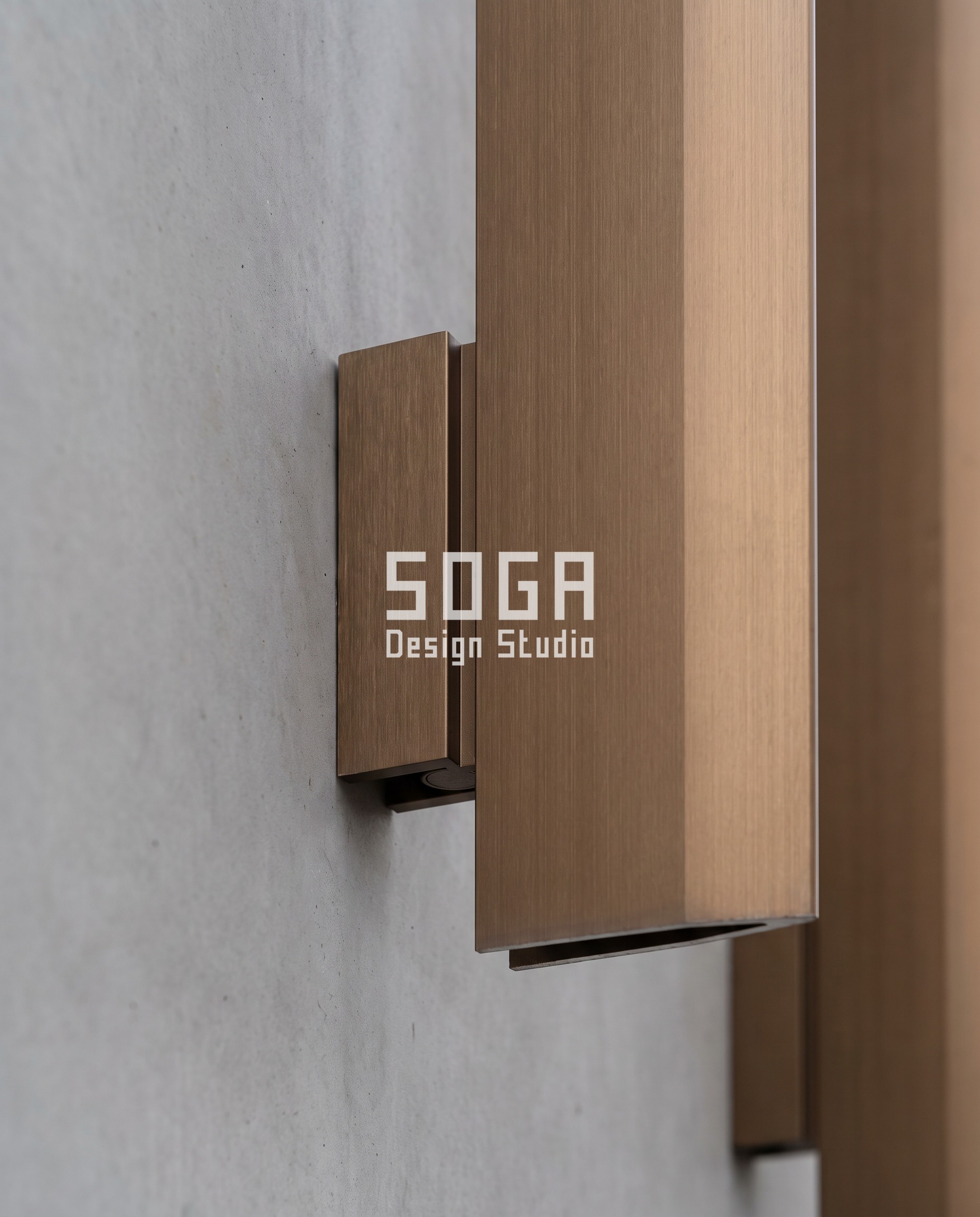
The free end matters more than it looks. The blade moves with temperature over a 3–4 metre length by an amount that is small per degree and real over an Indian summer, and a blade pinned rigid at both ends has nowhere to put that movement except a buckle. One bracket is fixed; the other carries a slotted fixing that lets the blade slide a few millimetres without transferring load into the wall. Skip the slot and the first hot season finds it.
Step 5 — Inspection, Tagging and Packing
The dominant risk in a fin facade is shape, not load — a point worth restating here because it changes what final inspection actually checks. Every blade is laid flat and sighted down its length before it is allowed to leave the shop, because a twist invisible on a bench reads instantly in raking sun once two hundred neighbours are dead straight beside it. The orientation mark set at cutting is verified against the schedule, the position code is checked legible, and blades are packed by installation zone so the crate that reaches the scaffold first is the one the erection sequence actually needs first.
The Honest Limits
Twist costs more than depth or rotation to produce, because it is a forming operation on top of a forming operation, and it is the one parameter worth checking is truly needed before it is specified across an entire family. A blade under-stiffened for its length will hum in a strong cross-wind at certain gaps and depths, which is a reason the bracket spacing and blade section are sized together rather than the blade alone. And none of the five steps above fix a schedule that arrives with an incomplete fin identification system — the fixed-and-sliding designation and the orientation mark are the two fields most often missing from a schedule, and both turn into site problems that cost far more to resolve on a scaffold than on a shop floor.
Related Reading
- SOGA Slicing Fin Facade: the complete design guide
- How the SOGA Coin Facade is manufactured
- How the SOGA Sequin Facade is manufactured
- Parametric facade design in India: systems, materials and cost per sq ft
If you are pricing a facade whose depth changes across the elevation rather than staying flat, see Graded-Depth Facade Panel Fabrication Cost in India for how CNC-cut and moulded systems price that depth-grading differently.
Frequently Asked Questions
Are fin facade blades extruded or cut from sheet?
SOGA cuts fin blades from flat bronze-anodised sheet stock and forms the stiffening profile on a brake press, rather than ordering a bespoke extrusion die. A flat-sheet blank keeps an entire quantised depth family on one cutting and forming line, where a dedicated extrusion die would only pay for itself at volumes a single facade rarely reaches.
How is a different fin depth achieved without a different tool?
Depth is set by the backstop position on the same brake press, not by a different die. A quantised family of depths — say five or six steps from shallow to deep — runs through identical tooling with the backstop re-indexed between batches.
What stops a fin blade from bowing in the sun?
Thermal movement is accommodated at the bracket, not the blade. One end is fixed; the other carries a slotted fixing that lets the blade move a few millimetres along its length as it expands and contracts, so the movement never has to buckle the blade itself.
Why does bracket design matter as much as the blade?
Rotation, the parameter with the largest effect on shading and view, is set entirely at the bracket rather than by changing the blade. That makes the bracket the part carrying each fin’s individual setting-out data, and a bracket fabrication error reads as a rotation error on the finished elevation.
What is checked before fin blades leave the shop?
Every blade is laid flat and sighted for straightness and twist, since a facade of identical neighbouring fins makes any single bowed or twisted blade immediately visible in raking light. Position codes and orientation marks are verified against the schedule, and blades are packed by installation zone to match the site erection sequence.
Start Your Fin Facade Project
SOGA Design Studio designs and manufactures the Parametric Fin Facade system for residential and commercial buildings across India, Dubai, Singapore and the UK. Get in touch with your plot, orientation and budget for a fin schedule and fabrication plan.