Every elevation colour guide in India shows you the same thing: a grid of finished houses with a palette swatch underneath. None of them tell you the one thing you actually need – which part of your elevation gets which colour, and why. That is not a taste question. On a real building the base wall and the feature band are doing two completely different jobs, and the moment you allocate finishes by job instead of by mood board, the question of how many colours to use answers itself. Here is that method, worked through four buildings in four Indian cities, each shot in the light its city actually gets.
\n\n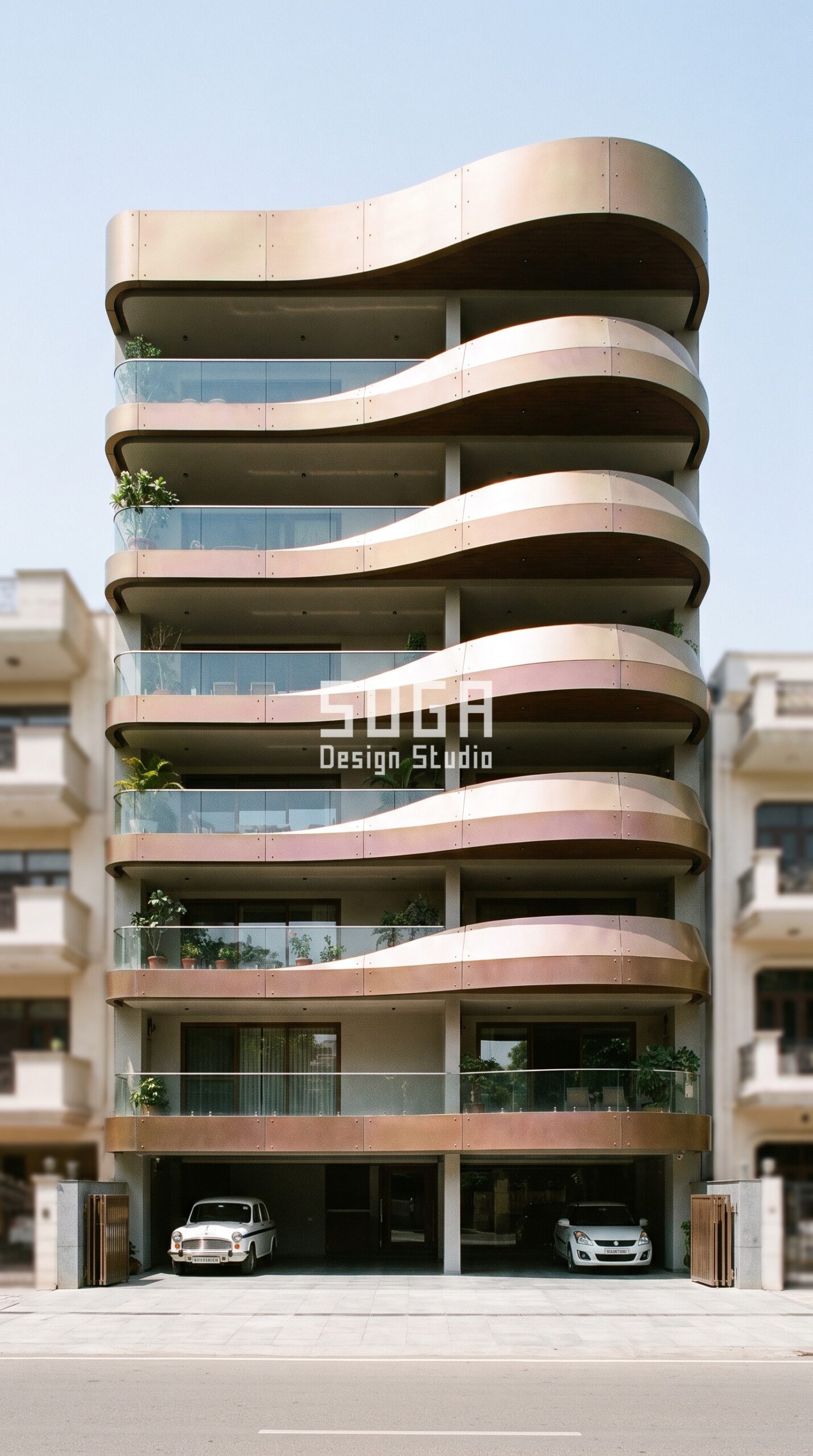
Elevation Colour Combination India: What Actually Decides It in 2026
An elevation colour combination in India is best decided by job, not by palette. The base wall and the feature band do two different things: the base wall is meant to recede, the feature band is meant to be read from the street. Allocate one finish to each job and the count answers itself – two finishes on most Indian elevations, one where the relief itself supplies the tonal variation. City light and city grime then decide which two: mid-tone metallics hold a dust film better than white or true black in Delhi, a single warm finish carries the low raking light in Chennai, deep desaturated blues belong on self-shaded bands rather than full sun-facing walls, and a neutral anthracite is the safest choice in Bangalore where the light is diffuse for much of the year.
1. The Two-Job Rule: Defence Colony, New Delhi
This building in Defence Colony carries a single continuous band at every slab edge – one unbroken ribbon per floor, bowing outward in a shallow horizontal wave that runs from roughly 120 mm of projection at the lower floors to 380 mm at the top. Only two finishes appear on the whole building. The RCC frame behind is an off-white matte and it is meant to disappear: it is background, and background that competes is the single most common failure on an Indian elevation. The band is an iridescent bronze-tone finish, and it is the only element allowed to be seen. That allocation is the whole decision. Delhi adds one constraint no palette collage accounts for: a fine dust film settles on every north Indian facade within weeks of a clean, and a mid-tone metallic carries that film almost invisibly, where a bright white shows it as streaking and a true black shows it as bloom. Two finishes, one job each, chosen for the dust the city actually has.
2. When One Finish Is Enough: Saidapet, Chennai
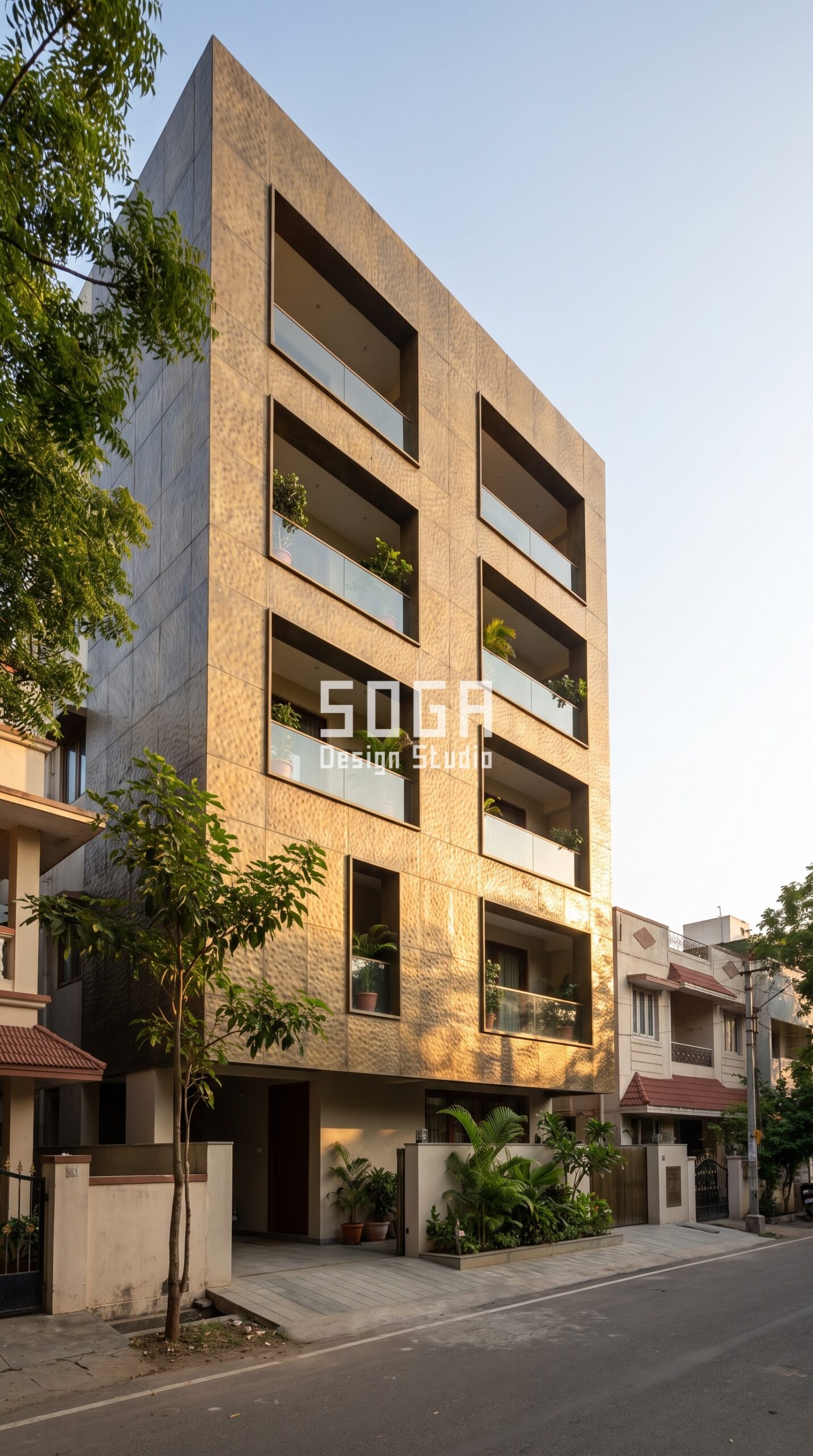
The Saidapet building breaks the two-finish default, and it is worth understanding why before copying it. Here the entire street face is one continuous hand-worked surface in a single warm brass-tone finish, cut by three large rectangular openings per floor – the same grid repeated on every floor, with the opening width growing as the building rises. There is no second colour anywhere on it. It works because the relief does the job the second finish would normally do: the surface is a true hammered texture with a few millimetres of real depth, so in the low, raking late-afternoon light of Chennai it throws thousands of small shadows, and the wall delivers a continuous range of tones from a single specified finish. This is the honest test for a one-finish elevation. If the surface has real, measurable relief, one finish reads as intentional. If the surface is flat, one finish reads as unfinished, and no amount of choosing a nicer colour fixes it.
3. Where Dark Colours Belong: Lutyens, New Delhi
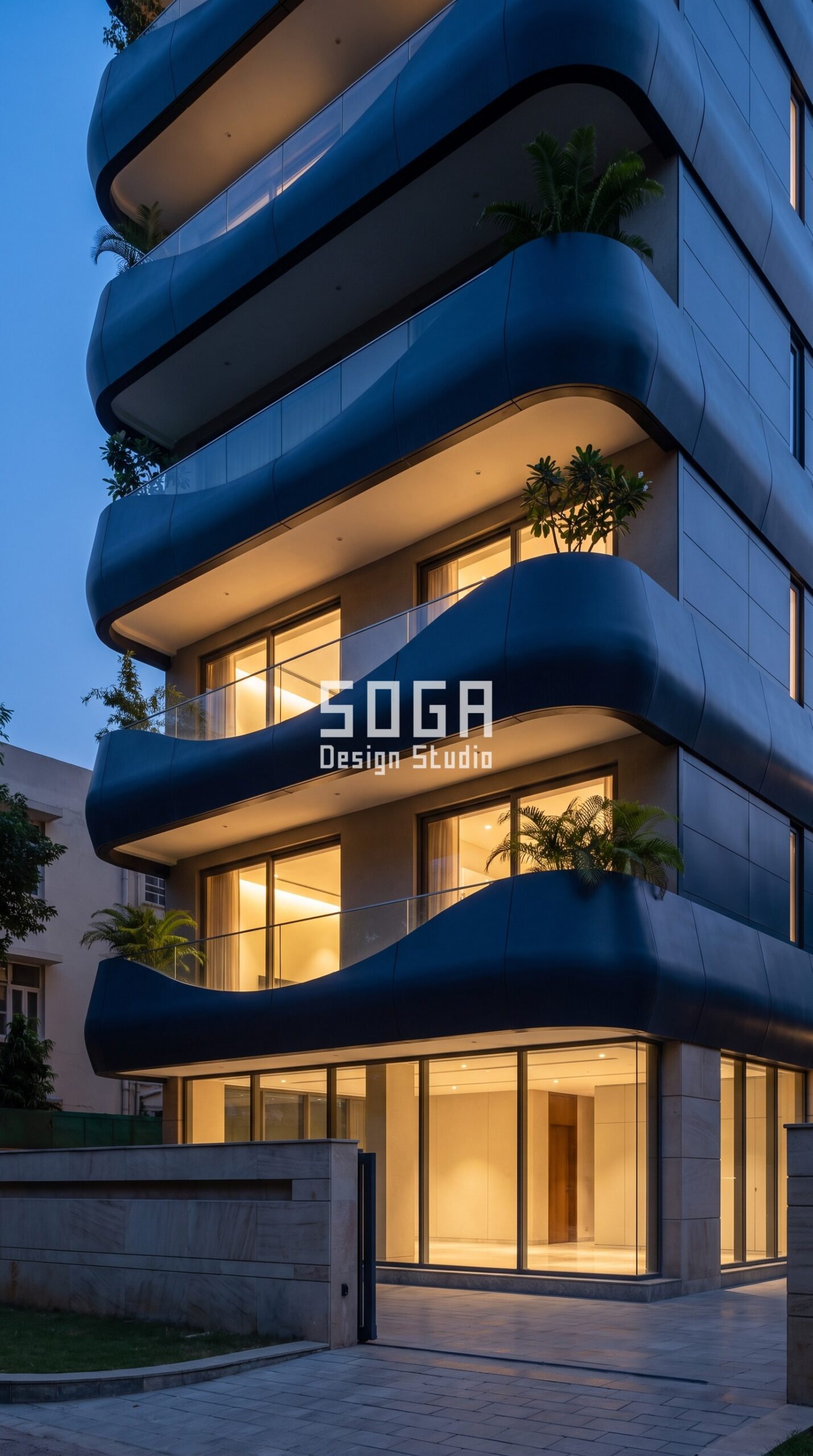
The Lutyens building uses the palette that dominates contemporary Indian luxury work – the deep desaturated blues and greens, here a matte powder-coated RAL 5004 black-blue. The rule this building demonstrates is placement, not permission. Each floor plate is wrapped by a curved band that swells from 250 mm deep where it passes the columns to 600 mm at mid-span, and that band is the only dark element: it stands proud of the wall and shades itself for much of the day, while the sun-facing wall behind it stays light. Put a saturated dark finish across an entire west or south-facing wall in Delhi and you are heating the wall you most need to keep cool. Put it on a band that already sits in its own shadow and you get the depth of colour without that penalty. The second reason it earns its place here is low light: a deep blue-black still reads with structure at dusk, when a mid-grey has already gone flat.
4. The Safe Neutral: Koramangala, Bangalore
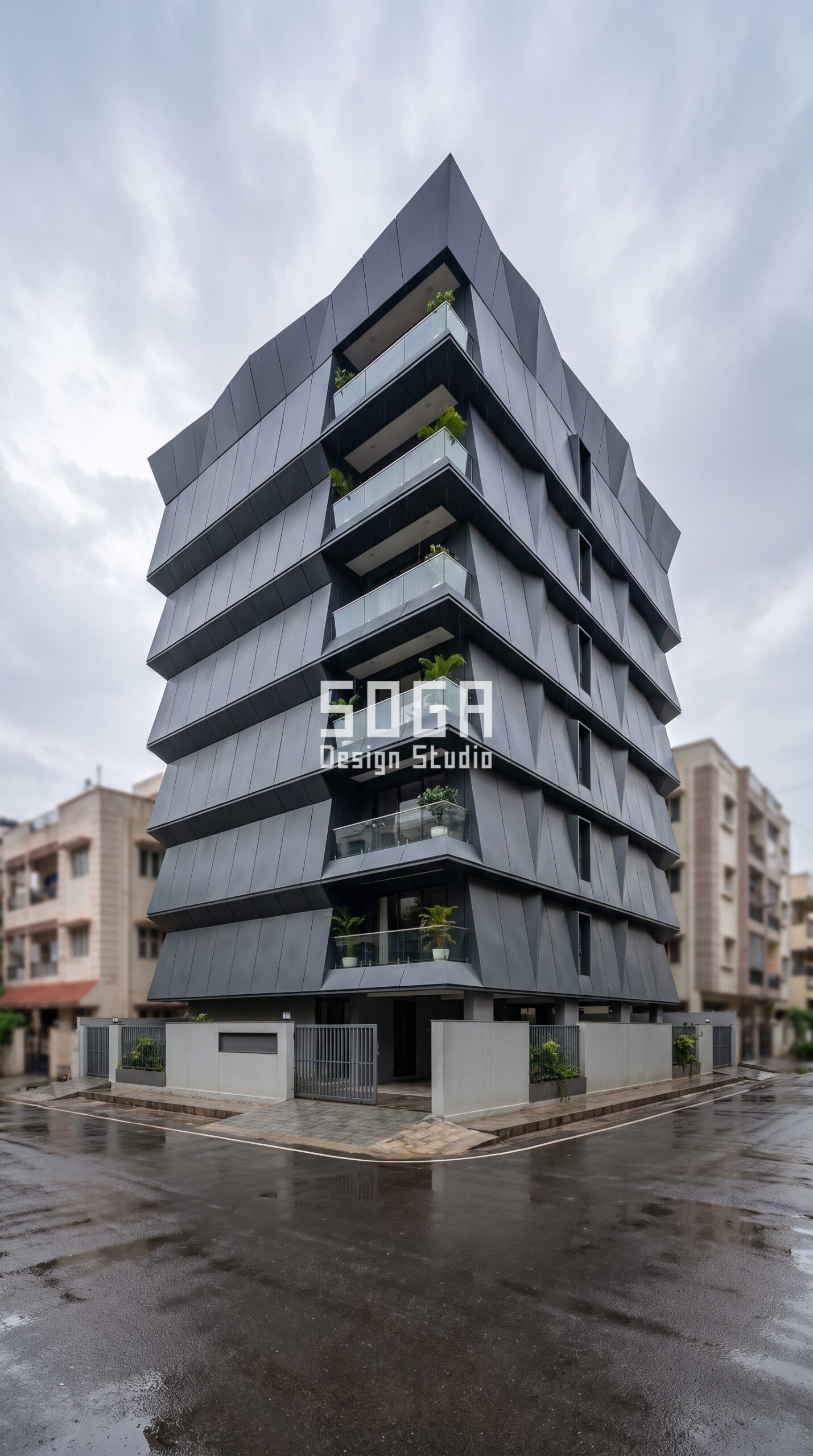
The Koramangala building is anthracite – matte powder-coated RAL 7016 – on a folded skin whose creases alternate in and out across the whole face, running from roughly 150 mm of fold depth at the lower floors to 400 mm near the top. Bangalore is the argument for a neutral. For much of the year the light there is diffuse rather than directional, and a finish chosen to look spectacular under hard sun does not get that sun often enough to justify itself. A neutral grey does not depend on the weather to look deliberate: it reads the same on a bright morning and under the flat overcast that follows a monsoon shower, and the crisp fold lines supply the contrast the sky is not supplying. If you want warmth in a scheme like this it belongs as an accent – a brass-tone or copper-tone at the entrance and the railing line – not as a second field colour competing with the band.
What an Elevation Finish Actually Costs in India (2026)
Colour itself is close to cost-neutral – a different shade within the same finish system rarely moves the number. The finish system does move it. Powder-coated and anodised metal facades run ₹800-₹2,500 per sq ft for full design and install, steel ₹1,200-₹2,800 per sq ft, and zinc ₹1,500-₹3,000 per sq ft. Basic ACM cladding at 3-4 mm starts at ₹200-₹350 per sq ft. Installation labour adds ₹50-₹150 per sq ft depending on building height and access.
- Steel facade (full design + install): ₹1,200–₹2,800 per sq ft
- Anodised or powder-coated metal panels: ₹800–₹2,500 per sq ft
- Zinc cladding: ₹1,500–₹3,000 per sq ft
- ACM panels (3 mm basic): ₹200–₹250 per sq ft (basic)
- ACM panels (4 mm): ₹250–₹350 per sq ft
- Solid metal panels: ₹800–₹1,800 per sq ft
- Installation labour: ₹50–₹150 per sq ft (varies by height + access)
- Conventional cladding (for comparison): ₹400–₹1,200 per sq ft installed (stone veneer / ceramic / standard ACM)
- which facade colour suits your context
The number that should decide the specification is not the install rate but the recoat interval. A correctly detailed and ventilated powder-coated or galvanised steel facade lasts 25-30 years before recoating is needed, and that holds in coastal Mumbai, Chennai and Kochi as well as inland; dark anodised finishes and pre-patinated zinc or copper can exceed 40 years. Maintenance across that life is an annual rinse-down, not repainting. Spread over that interval the gap between a cheap finish and a correctly specified one is small. The gap in how the building looks in year eight is not.
Elevation Colour Combinations Across India, Dubai and Singapore
The allocation method travels, but the deciding constraint changes with the place. In Mumbai, Chennai and Kochi the coastal air rather than the sun sets the limit, and the finish specification matters more than the shade. In Delhi, Jaipur and Hyderabad it is dust and heat load, which pushes mid-tone metallics and keeps saturated darks on self-shaded bands. Bangalore and Pune sit under diffuse light for much of the year, which is where neutrals hold up best. In Dubai the sheer intensity of the light flattens mid-tones, so the contrast between the two finishes usually has to be widened. In Singapore, persistent humidity and rain-streaking decide more than colour does. NRI clients commissioning from the UK, Singapore or the UAE hit the same trap every time: a palette chosen on a screen under even, neutral light, for a building that will stand in none of those conditions.
Why Trust SOGA Design Studio for Facade Design in New Delhi
- Experience: SOGA Design Studio has specified finishes on 900+ facade and elevation projects across India, Dubai and Singapore, including all four typologies shown here – slab-edge bands, hammered relief surfaces, curved wrapped plates and folded panel systems.
- Expertise: Every finish decision on these projects is made against a named specification – RAL reference, finish system and coating type – not against a mood board, and is checked for orientation and local grime load before it is released for fabrication.
- Authority: The studio is one of the few in India that designs the parametric geometry and details the fixing, drainage and access for the same facade, which is why the finish recommendations here are tied to buildable band depths rather than to a palette.
- Trust: Co-founded by Gajender Jaiswal and Sonali Jaiswal, based in Gurugram. The cost bands quoted here are published Indian market ranges for 2026, not studio fees, and the recoat intervals are the rated service life for correctly detailed and ventilated assemblies.
Frequently Asked Questions
How many colours should a house elevation have in India?
Almost always two, and occasionally one. Allocate by job rather than by palette: one finish for the base wall, which is meant to recede, and one for the feature element, which is meant to be read from the street. A third field colour is where most Indian elevations go wrong, because it leaves the eye with no clear hierarchy. One finish is only enough when the surface carries real relief – a pressed, folded or coursed texture with measurable depth – so that shadow supplies the tonal variation a second colour would otherwise provide.
Which RAL colours work best for Indian residential facades?
Ask it as two questions, because a RAL reference behaves differently depending on which job you give it. For the element that must be seen – the band, the fin, the relief – the references that hold up are the warm bronze family (RAL 8004, 8019) where the building sits among older neighbours, the deep blue-greens (RAL 5004, 5011, 6009) where you want weight at dusk, and anthracite (RAL 7016) or near-black (RAL 9005) where the light is diffuse for most of the year. For the element that must recede, almost none of those are right: the base wall wants an off-white or a pale warm grey with no strong hue in it at all, because any saturated base competes with the element you actually chose. If you take one rule from this, it is that a RAL number is not a house colour, it is an element colour.
Does a dark elevation colour make the house hotter?
A dark finish absorbs more solar radiation than a light one, so the real question is where you put it, not whether you may use it. Across a full west or south-facing wall in Delhi, Jaipur or Hyderabad a saturated dark raises the heat load on the wall you most need to protect. On a projecting band that shades itself for much of the day, or on any surface sitting behind a ventilated gap, that penalty largely disappears. Note also that the shade of the finish and the shading done by the assembly are two different effects, and the second one is far larger than the first. A ventilated screen standing off the wall removes a large share of the direct solar load before it reaches the masonry at all, which is why a dark band in front of a ventilated gap can outperform a pale finish painted flat onto the wall behind it. Choose the shade for how the elevation reads, and solve the heat with the gap and the geometry.
What does an elevation finish cost per sq ft in India in 2026?
Powder-coated and anodised metal facades run ₹800-₹2,500 per sq ft for full design and install, steel ₹1,200-₹2,800 per sq ft and zinc ₹1,500-₹3,000 per sq ft. Basic ACM cladding at 3-4 mm starts at ₹200-₹350 per sq ft, and installation labour adds ₹50-₹150 per sq ft depending on height and access. Changing the shade within the same finish system is close to cost-neutral; changing the finish system is what moves the number.
How long before an elevation finish needs recoating?
A quality powder-coated metal or galvanised steel facade, correctly detailed and ventilated, lasts 25-30 years before recoating is needed, and that holds in coastal Mumbai, Chennai and Kochi as well as inland. Dark anodised finishes and pre-patinated zinc or copper can exceed 40 years. Routine maintenance across that period is an annual rinse-down rather than the repainting cycle a plaster facade needs.
Should the compound wall and gate match the elevation?
Match them to the base wall, not to the feature band. The boundary is read at close range and almost never in the same view as the upper floors, so repeating the feature finish there spends your one strong element on the least visible part of the elevation. Carrying the base finish across the compound wall and picking up the feature finish only as a narrow accent – a gate frame or a handrail – keeps the hierarchy intact from the street.
Related Reading
- parametric facade design in India
- what actually fades on an Indian elevation
- anodising vs powder coating vs PVDF
- elevation lighting integration
- elevation design to reduce wall heat
Start Your Facade Project With SOGA Design Studio
Stop choosing an elevation colour combination and start allocating finishes to jobs. Decide what must recede and what must be seen, give each one finish, and let the count fall out of that – two on most elevations, one where the relief is deep enough to do the work itself. Then let the city decide which two: dust in Delhi, raking light in Chennai, self-shading for saturated darks, and a neutral wherever the light is diffuse. A combination chosen that way still looks right in year eight, which is the only test that matters.
If any of the wavy undulating organic floor slabs concepts above resonate with your project, send us your brief. SOGA Design Studio delivers customised parametric facade concepts for India, Dubai, Singapore, and the UK.