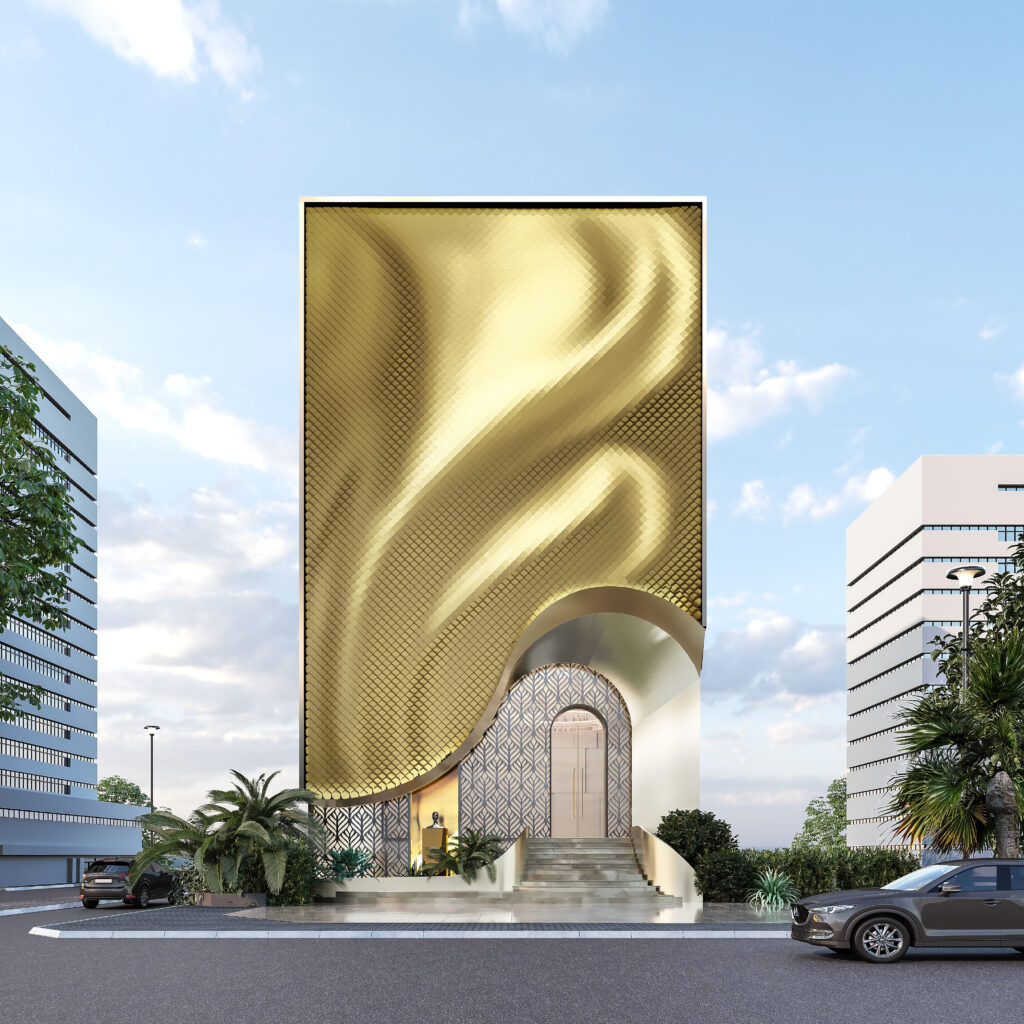
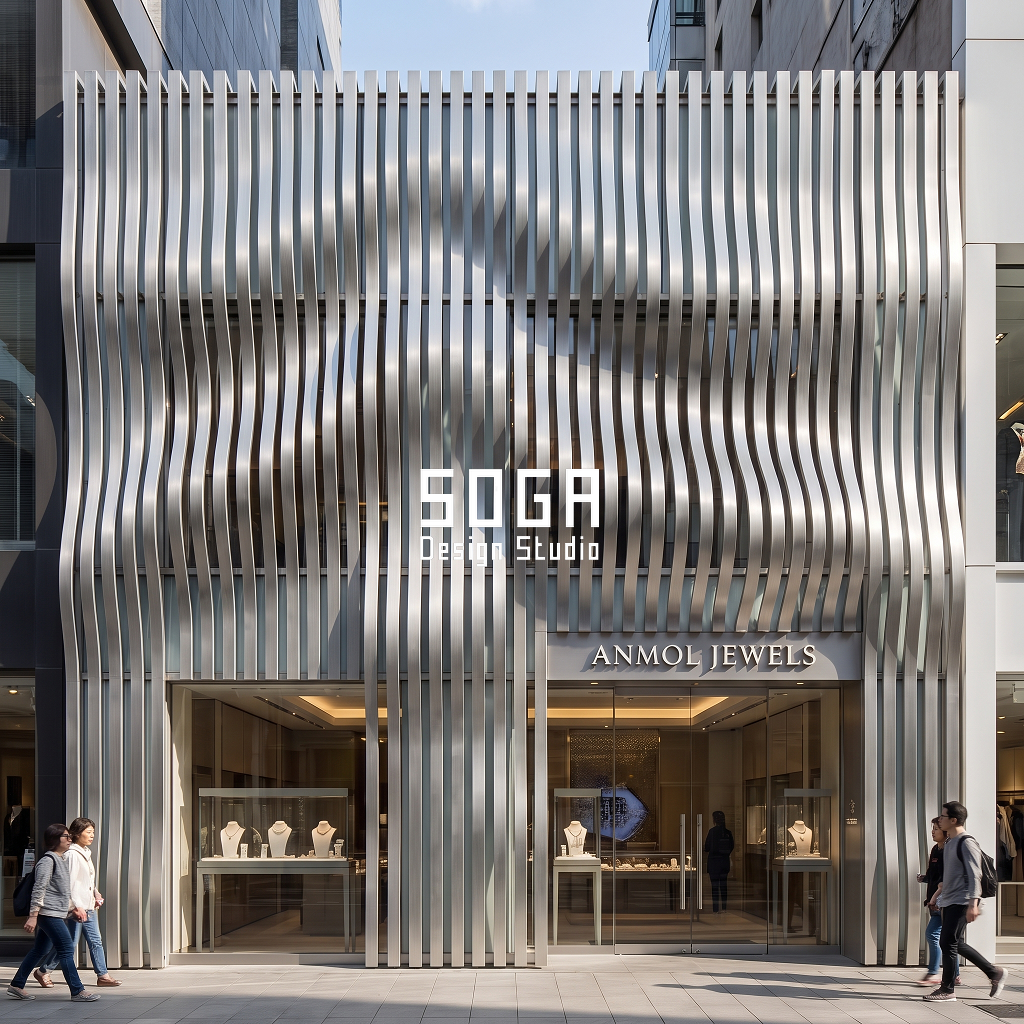
Five showroom briefs landed on our table this year, and nobody asked for the same metal facade finish twice. A jewellery house in Chandigarh wanted teak-warm aluminium; a bridal couture flagship in Mumbai wanted copper-bronze; a fashion store in Gurugram wanted corten steel’s raw rust. That is not five tastes — it is one specification decision, made five different ways, and this piece shows the arithmetic behind each one.
A retail showroom facade’s metal finish should be chosen by climate and brand identity, not looks alone: anodised or powder-coated aluminium (₹800–2,500 per sq ft, 25–40+ years) suits coastal or humid Indian cities, while corten steel, also called weathering steel (₹1,200–2,800 per sq ft), suits only inland, dry-climate flagships that want a self-patinating, sculptural identity.
Why Do Five Showroom Brands Specify Five Different Metal Facade Finishes?
A facade metal finish is a specification decision, not a styling choice: it is chosen against a city’s humidity, a brand’s colour identity and a parametric gesture’s need to read consistently in shadow — and across SOGA’s five showroom concepts below, no two cities or climates produced the same answer.
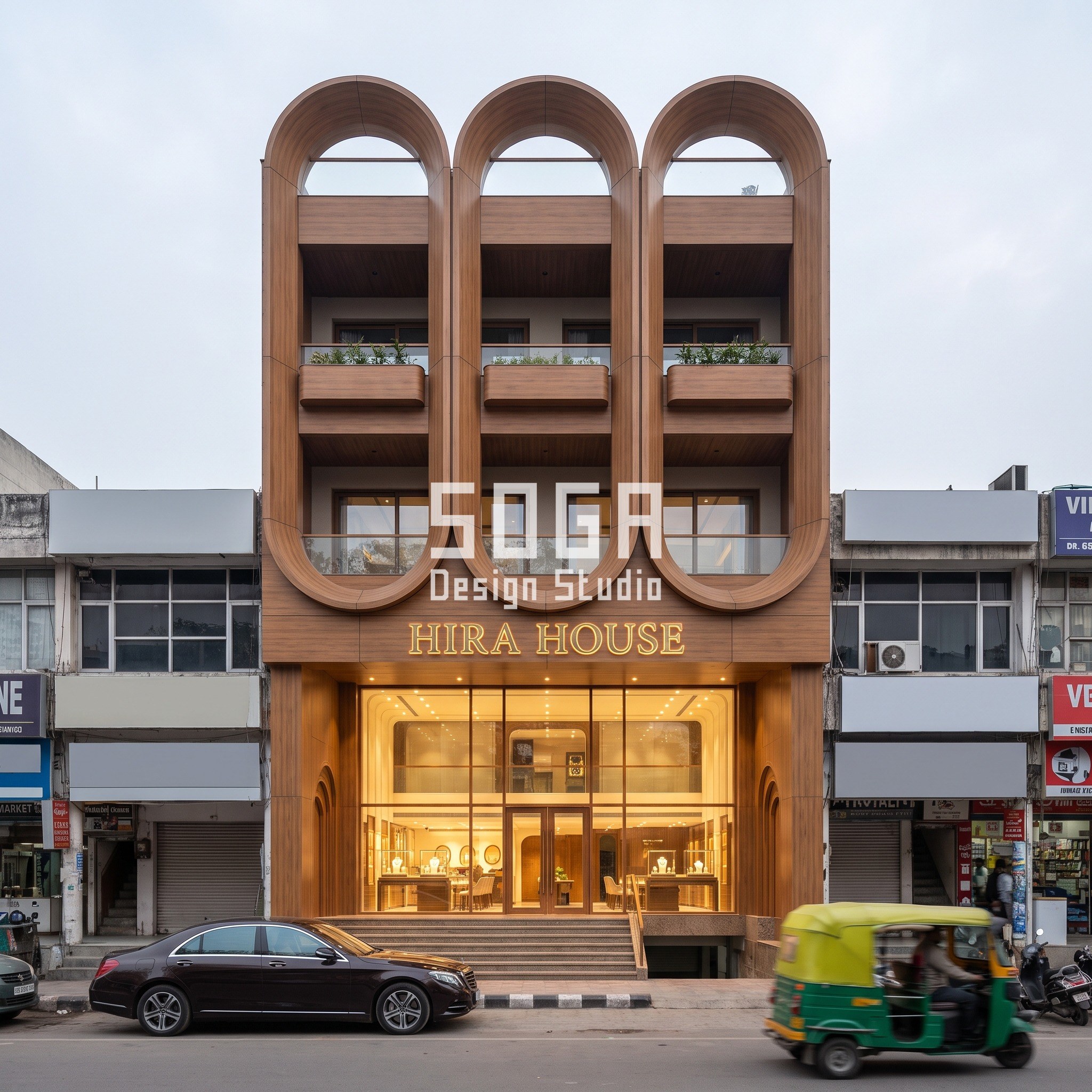
Start with Hira House, our jewellery showroom concept for Chandigarh: the brief wanted warmth without wood’s maintenance problem, so the facade specifies teak wood-finish aluminium (a wood-grain powder-coat or anodised finish baked onto aluminium, not timber) across three full-height elliptical loops that swell from 200mm to 650mm in section. Chandigarh’s dry, inland climate is forgiving — it is one of the few Indian cities where almost any finish survives — so the choice here was driven by colour and brand warmth, not by weather risk.
What Facade Finishes Are Actually Available for an Indian Retail Showroom?
Three finish families cover almost every Indian showroom facade: corten steel, or weathering steel, which forms its own rust patina with no coating at all; anodised aluminium, an electrochemically sealed colour layer baked into the metal itself; and powder-coated aluminium, a separate baked-on polymer coat applied over plain aluminium sheet or extrusion.
Corten steel needs no coating at all — the surface itself rusts into a stable skin over two to three monsoon wet-dry cycles, shifting from yellow to orange to a dark red-brown. Anodised aluminium gets its colour from an electrochemical bath that seals dye into the metal’s own oxide layer, which is why saffron, bronze and teak-wood anodised tones hold their hue for decades. Powder-coated aluminium is cheaper to produce in a wider palette — RAL 8004 and RAL 8019 cover most of the bronze range used here — but the coat sits on top of the metal rather than inside it, so it is the one finish of the three that eventually needs recoating.
| Programme | Area / count |
|---|---|
| Hira House, jewellery showroom, Chandigarh | 3 full-height elliptical loops, 200mm–650mm swelling section, teak-finish aluminium |
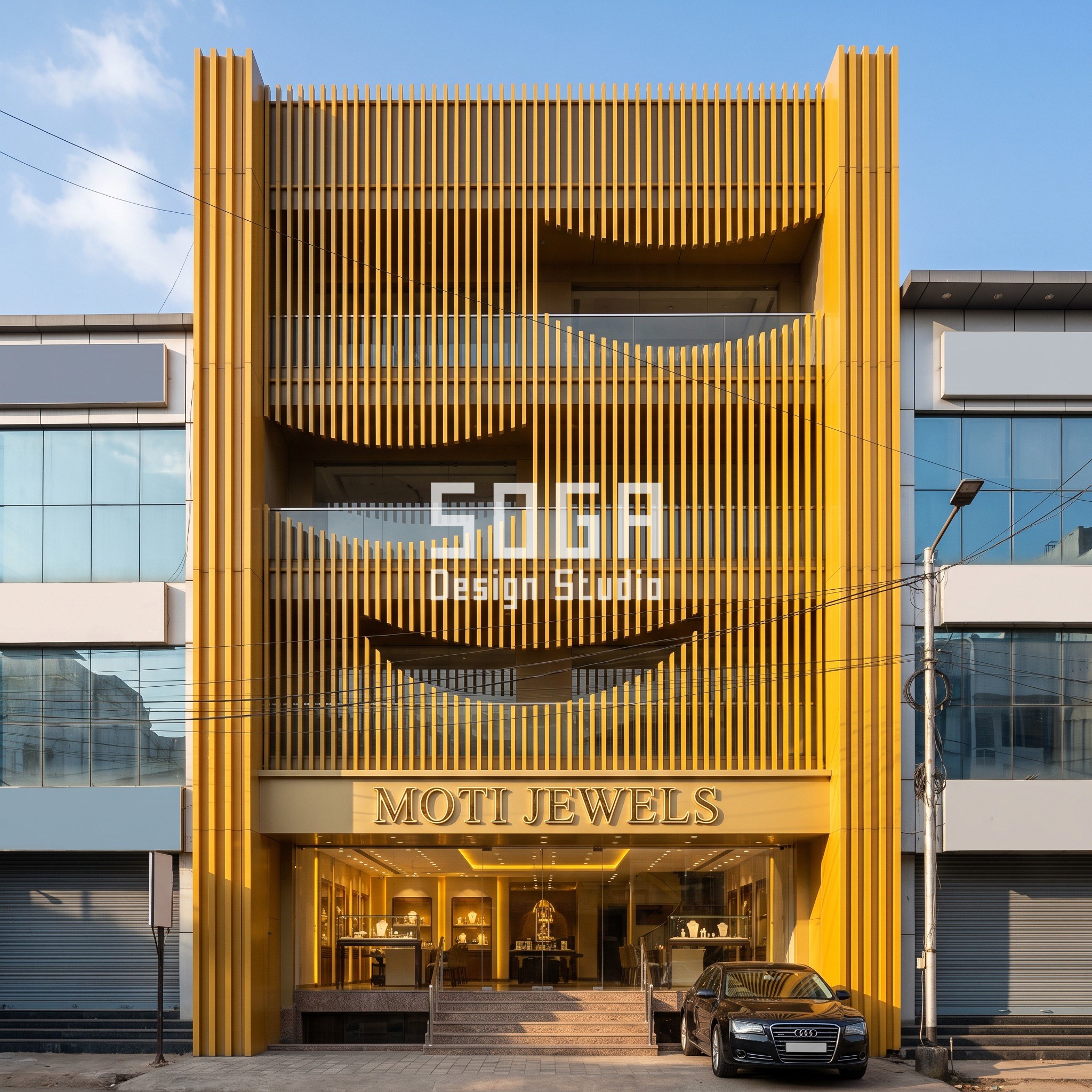
| Moti Jewels, jewellery showroom, Chennai | Vertical louvers 60x200mm at 200mm centres, saffron anodised aluminium |
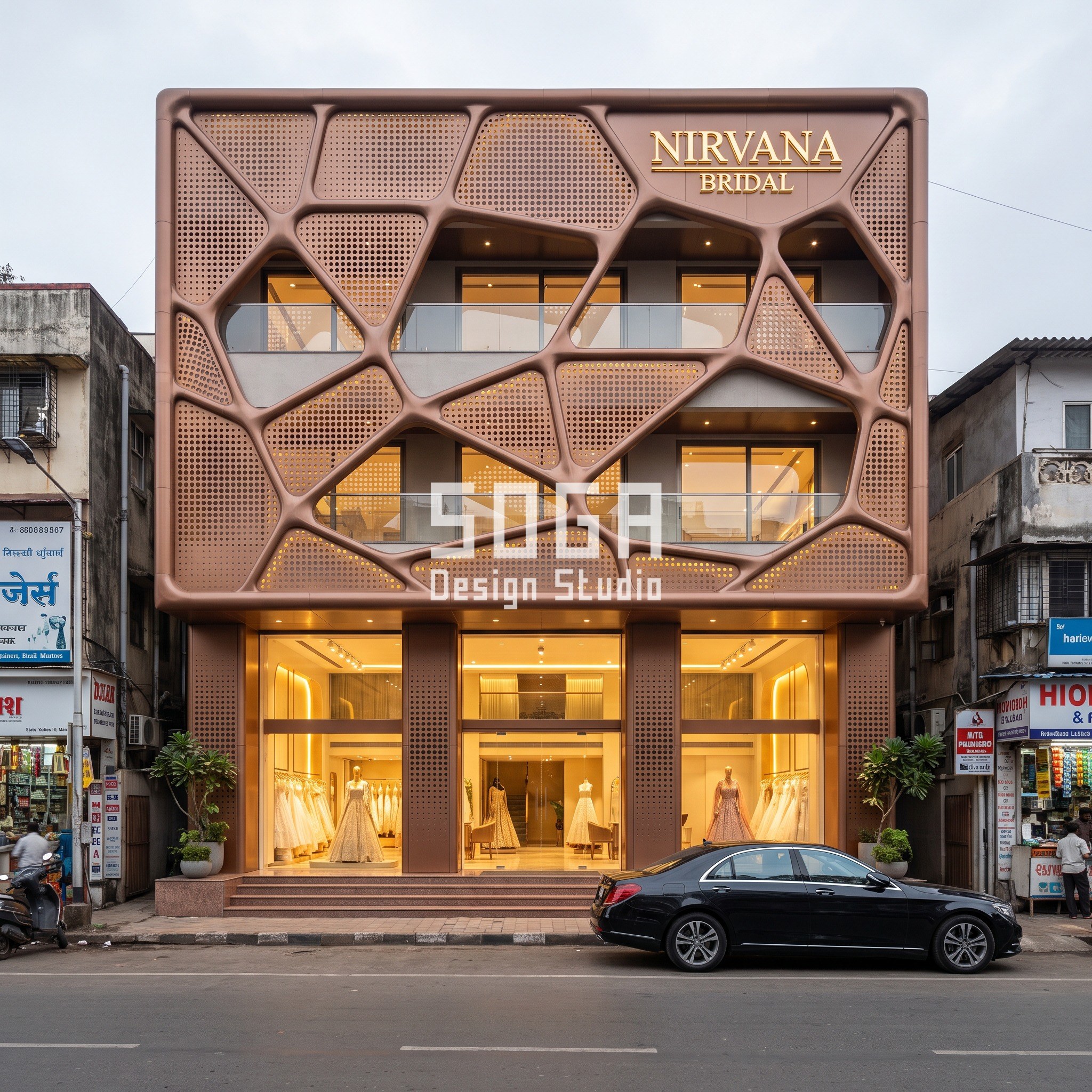
| Nirvana Bridal, bridal couture showroom, Mumbai (Bandra) | Voronoi perforated frame, 400mm mullions, copper-bronze anodised aluminium |
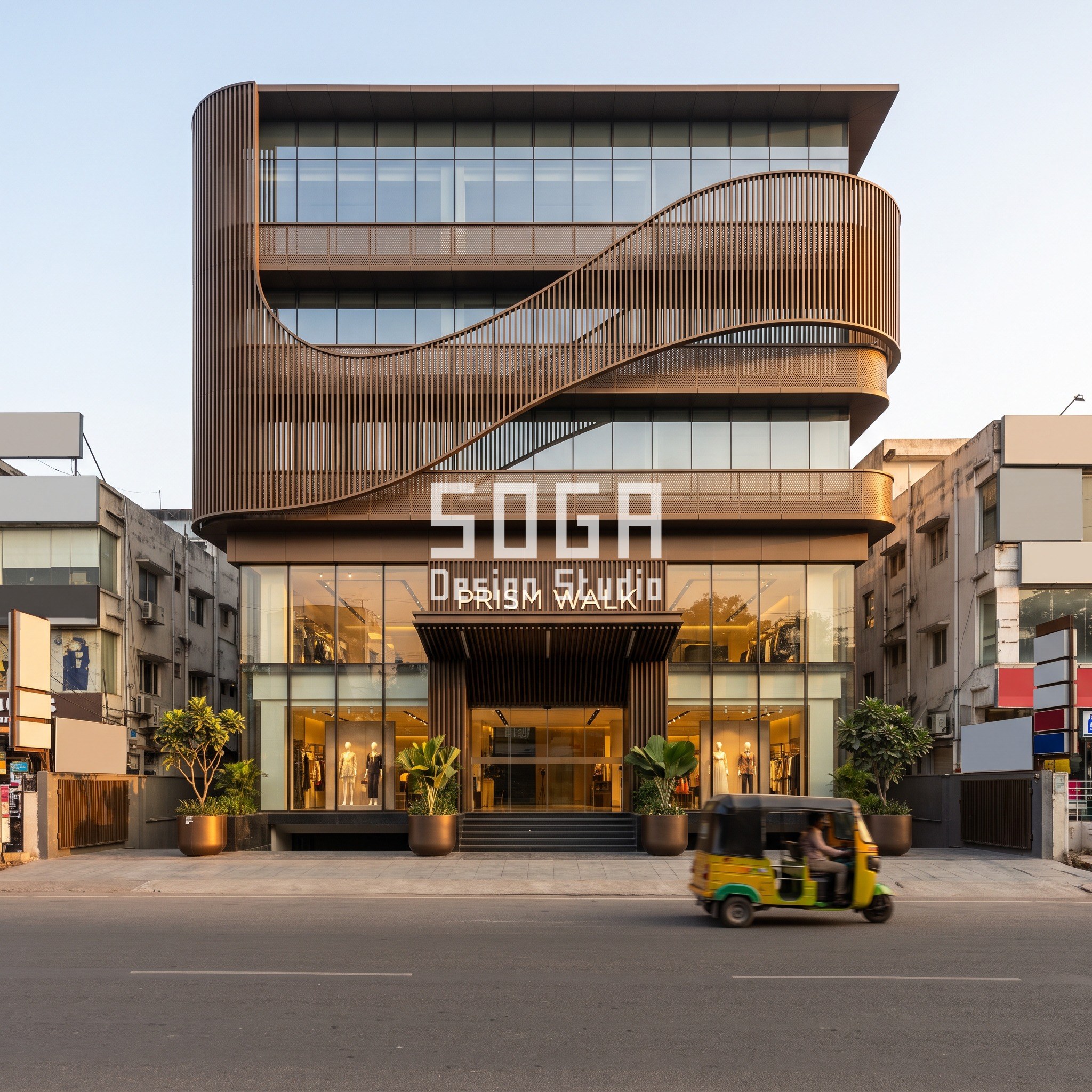
| Prism Walk, mixed-use retail + office, Hyderabad (Jubilee Hills) | Ribbon louvers 40x225mm at 150mm centres, dark bronze powder-coated aluminium |
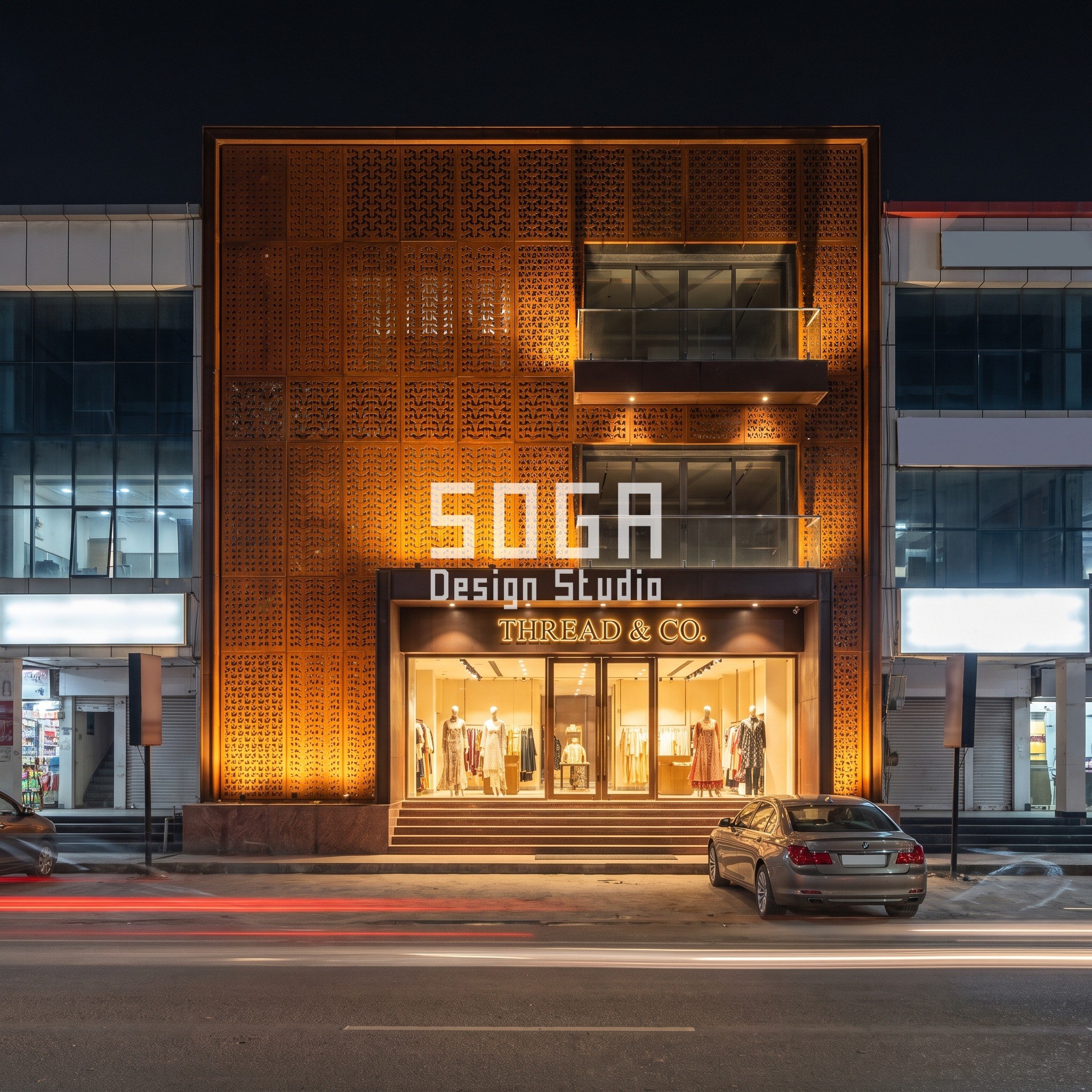
| Thread & Co, designer fashion showroom, Gurugram | Laser-cut jaali screen, 20%–65% graded open ratio, corten steel |
Why Does Moti Jewels Specify Saffron Anodised Aluminium Instead of Corten in Chennai?
Moti Jewels is our concept for a Chennai jewellery showroom, and Chennai’s coastal, high-salt-air climate rules out corten before colour even enters the conversation: anodised aluminium’s sealed finish resists chloride attack where an unprotected rusting skin would streak and pit unpredictably within a few monsoon seasons.
The facade’s vertical louvers run 60x200mm at 200mm centres, carved through by a sine-wave void whose fin length swings from zero to 2.5 metres floor by floor, and that void is exactly where a flat or mottled finish would fail — the deeper the carve, the more shadow the surface has to read through evenly. Saffron anodised aluminium (electrochemically colour-sealed aluminium) holds one consistent tone whether a fin sits in full sun or deep shade, which plain mill-finish or powder-coated aluminium in a bright hue cannot always guarantee at this depth of carve.
Which Facade Finish Suits Which Parametric Gesture — And Why?
A parametric gesture decides what a finish must survive, not the other way round: a carved void needs colour that reads evenly in shadow, a perforated frame needs an edge that will not streak, and a graded-open screen needs one material read from 20% to 65% open. The table below maps each of SOGA’s five projects against the finish specified to survive its own geometry.
Read down the table and the brand-fit logic repeats: every finish choice here was made against a named climate and a named geometry, never against a swatch book alone — which is the exact comparison missing everywhere else this keyword is searched.
| Project & Parametric Gesture | Finish Specification & Brand-Fit Reason |
|---|---|
| Hira House, Chandigarh — 3 elliptical loops swelling 200mm to 650mm | Teak wood-finish aluminium (wood-grain anodised/powder-coat finish): warmth for a jewellery brand, in a dry inland climate that does not force a harder-wearing finish |
| Moti Jewels, Chennai — sine-wave carved voids, fin length 0 to 2.5m | Saffron anodised aluminium: holds one consistent hue in deep shadow and resists Chennai’s coastal salt air, where corten would be unreliable |
| Nirvana Bridal, Mumbai (Bandra) — Voronoi perforated frame, holes graded 20mm to 45mm | Brushed copper-bronze anodised aluminium: a warm, couture-appropriate tone that will not streak at hundreds of perforation edges over Mumbai’s humid monsoon |
| Prism Walk, Hyderabad — ribbon louvers wrapping a street corner | Dark bronze powder-coated aluminium (RAL 8019 range): a precise, repeatable colour across a long wraparound run, for a mixed-use brand that needed consistency over drama |
| Thread & Co, Gurugram — laser-cut jaali, open ratio graded 20% to 65% | Corten steel (weathering steel): Gurugram’s dry inland climate lets the rust patina develop safely, giving a fashion flagship a sculptural, self-finishing identity no painted metal can fake |
Why Did Nirvana Bridal Choose Brushed Copper-Bronze Aluminium in Mumbai?
Nirvana Bridal is a couture showroom, not a jewellery store, and its copper-bronze finish is specified for a different reason than warmth or sparkle: brushed copper-bronze anodised aluminium (a specialty anodised aluminium finish, not solid copper) holds a soft, fabric-like sheen under Mumbai’s grey monsoon light that a brighter metallic would turn harsh.
The frame is a perforated Voronoi lattice on 400mm mullions, its cells running 1.5 to 4 metres and its hole diameters graded from 20mm at the base to 45mm overhead, and every one of those several hundred cut edges is a place a lesser finish could streak under Mumbai’s year-round humidity. Brushed copper-bronze anodised aluminium is specialty work, typically fabricated in Ahmedabad’s brass-and-copper cluster rather than a general aluminium shop, and it is the one finish in this set that can hold an even tone across that many perforation edges without a visible patch.
Why Does Prism Walk Use Dark Bronze Powder-Coated Aluminium in Hyderabad?
Prism Walk is a mixed-use retail-and-office building, not a single showroom, so its facade has to read as one calm identity across tenants it does not fully control — which is why it specifies dark bronze powder-coated aluminium (a baked polymer coat on plain aluminium, RAL 8019 range) instead of a louder anodised colour.
The ribbon louvers run 40x225mm at 150mm centres and sweep continuously around the street corner, and a wraparound run that long is exactly where colour drift between panel batches shows up fastest. Powder coating is baked in a controlled booth rather than an electrochemical bath, so RAL-coded dark bronze repeats batch to batch with less variation than anodising can guarantee at this volume — the trade-off is that the coat sits on the surface and is due for recoating in 25 to 30 years, where a pre-patinated or dark-anodised finish could run past 40.
How Is Each Facade Finish Fabricated and Fixed in India?
India’s metal-facade finishes are not made in one place: corten and heavy steel fabrication cluster around Mumbai-Pune and Chennai-Coimbatore, aluminium louvers and powder-coating lines run through Delhi-NCR and Chennai-Coimbatore, and specialty copper-bronze anodising is concentrated in Ahmedabad’s brass-and-copper trade — which city a project sits near can quietly decide which finish is actually practical to specify.
Every one of the five facades here is detailed as a rainscreen on a ventilated cavity, hung off its own substructure rather than glued or welded direct to the structural wall, because every finish in this set — corten included — needs air behind it to dry out after monsoon rain.
- Corten (weathering steel): bolted, slotted fixings only — welding breaks the patina and leaves a bare, rust-prone scar
- Anodised aluminium: factory-finished extrusions, cut and drilled after anodising so the cut edge is the only exposed raw metal
- Powder-coated aluminium: finished after fabrication wherever possible, since a field-cut powder-coat edge needs a touch-up to match
- Copper-bronze anodised aluminium: specialty Ahmedabad fabrication, shipped finished, installed with concealed clip fixings to protect the anodised face
How Much Does Each Facade Finish Cost Per Sq Ft in India?
Corten steel facades cost roughly ₹1,200–2,800 per sq ft fully installed in India, against ₹800–2,500 per sq ft for anodised or powder-coated aluminium and ₹800–1,800 per sq ft for plain solid aluminium panels — the steel is not automatically the expensive option, but it is the one with no repaint option if the colour ever needs to change.
These are market design-and-install ranges for the finish and its substructure at commercial scale, not SOGA’s own fee, and a client licenses the finished design rather than owning the underlying drawings. Treat every figure here as a planning range to confirm against a current quotation, not a fixed quote.
| Scope | Indicative market range (2026) |
|---|---|
| Corten / weathering steel (self-patinating rust skin) | ₹1,200–2,800/sq ft · no recoat, ever · poor fit for coastal, high-salt-air cities |
| Anodised aluminium (electrochemically colour-sealed finish) | ₹800–2,500/sq ft · 25–40+ years before any work · good fit for coastal and monsoon cities |
| Powder-coated aluminium (baked polymer coat) | ₹800–2,500/sq ft · 25–30 years before recoating · good fit for coastal and monsoon cities |
| Brushed copper-bronze anodised aluminium (specialty anodised finish) | ₹800–2,500/sq ft · 40+ years with an annual rinse · good fit for humid cities, Ahmedabad fabrication |
| Plain solid aluminium panels (unfinished baseline) | ₹800–1,800/sq ft · shortest service life of the five without a sealed finish · needs recoat soonest near the coast |
Where Does Corten Steel Fail as a Showroom Facade Finish in India?
Corten steel is the riskiest specification in this set of five, and Thread & Co in Gurugram only works because Gurugram’s climate is dry and inland — move the same corten jaali screen to Mumbai or Chennai and the same rust patina that looks sculptural in the render can streak, pit unevenly, or stain the pavement below within two to three monsoons.
The jaali screen’s open ratio is graded from 20% to 65% across its height, which means the thinnest, most open sections carry the least structural steel — on a coastal project we would have to add roughly 15–20% more plate thickness at the open end purely to compensate for long-term section loss, a real cost nobody researching corten facades usually sees stated. For three of the five brands in this piece, anodised or powder-coated aluminium would have delivered 90% of the same visual warmth with none of that long-term uncertainty — corten earns its place only when a brand genuinely wants the raw, weathering identity, not merely a bronze colour that aluminium could match more safely.
When Should a Retail Showroom Avoid Corten and Choose Aluminium Instead?
A retail showroom should avoid corten steel in coastal or high-humidity Indian cities — Mumbai, Chennai, Kolkata, coastal Gujarat — where airborne salt can make the rust patina behave unevenly, and should specify anodised or powder-coated aluminium instead, which holds a precise colour for 25 to 40+ years in the same conditions with no corrosion risk.
None of the five SOGA concepts in this piece puts corten within a few kilometres of open sea — Thread & Co’s Gurugram site is as inland as Delhi-NCR gets — and that is not an accident. The safer rule for a brand team weighing this decision: pick corten for an inland, dry-climate flagship that wants a weathered, sculptural story, and pick anodised or powder-coated aluminium for everything within reach of a coastline or a genuinely humid monsoon season.
- Inland, dry climate (Delhi-NCR, Gurugram, much of Rajasthan): corten is viable
- Coastal or high-salt-air (Mumbai, Chennai, Kolkata, coastal Gujarat): specify anodised or powder-coated aluminium instead
- Humid but not coastal (Bengaluru, Pune): either finish works; let brand colour decide
- Budget-constrained: powder-coated aluminium at ₹800–2,500/sq ft usually beats corten’s ₹1,200–2,800/sq ft for a comparable visual weight
Related Reading
- Parametric Facade Design in India: Systems, Materials and Cost per Sq Ft
- Anodising vs Powder Coating vs PVDF: Which Lasts in India
- Mixed-Use Commercial Facade Design India 2026 Guide
- Retail Podium Facade Design: Footfall Sets The Geometry
- Facade Design in Mumbai 2026: Parametric Metal Facade Guide
Frequently Asked Questions
Which facade finish is best for a retail showroom in India?
Anodised or powder-coated aluminium is the safer default for most Indian retail showrooms, costing ₹800–2,500 per sq ft installed and lasting 25 to 40+ years, while corten steel (₹1,200–2,800 per sq ft) suits only inland, dry-climate flagships willing to trade a repaint option for a weathered, sculptural look.
How much does a corten steel facade cost per sq ft in India?
Roughly ₹1,200 to ₹2,800 per sq ft fully installed in India, covering the steel, its patina development and a ventilated substructure. Unlike aluminium, corten is never repainted, so that range is effectively a one-time cost for the life of the facade.
Can corten steel be used on a coastal or humid-city showroom facade?
Not reliably. In high-salt-air cities like Mumbai and Chennai, corten’s rust patina can streak or pit unevenly within 2 to 3 monsoon seasons, so anodised or powder-coated aluminium is the recommended specification in those climates instead.
What is the difference between anodised aluminium and powder-coated aluminium facades?
Anodised aluminium seals colour into the metal’s own oxide layer electrochemically and typically lasts 25 to 40+ years, while powder-coated aluminium bakes a polymer coat on top of the metal and typically needs recoating after 25 to 30 years. Both cost roughly ₹800–2,500 per sq ft installed in India.
How long does an anodised or powder-coated aluminium facade last before maintenance?
25 to 30 years for correctly detailed powder-coated aluminium before recoating is due, and 25 to 40+ years for anodised aluminium, which can need only an occasional rinse rather than a full recoat. Dark anodised and pre-patinated finishes sit at the long end of that range.
Need the Right Facade Finish Specified for Your Showroom?
SOGA Design Studio designs parametric metal facades for retail, showroom and mixed-use projects across India, and specifies the finish against your city’s climate before any pattern is drawn. Share your plot, city and brand identity, and we will test corten, anodised or powder-coated aluminium against your actual humidity and budget. Design concepts are provided under licence to the client; SOGA retains the underlying design IP.