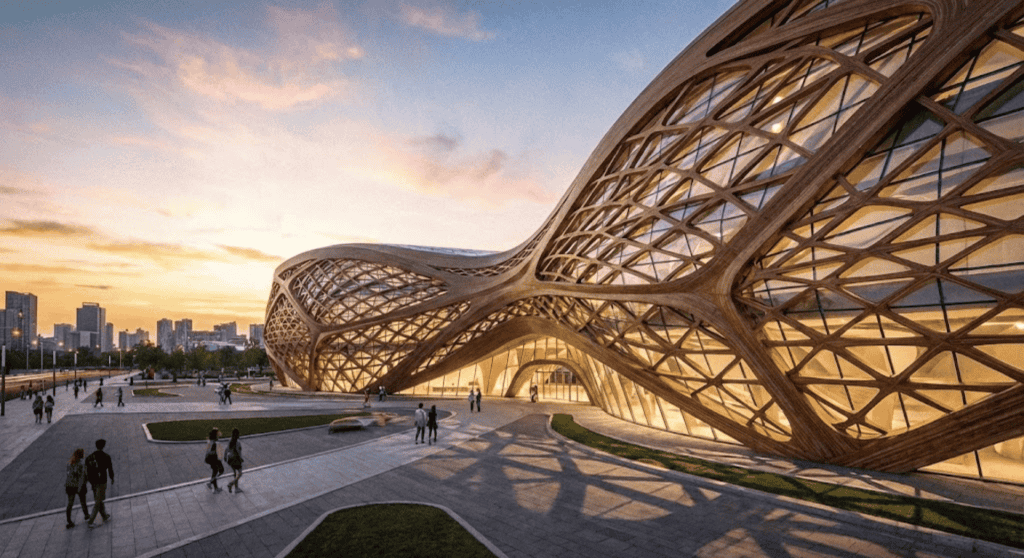
A jali is a hand-carved stone or cast-concrete lattice screen — one pattern, repeated identically across the whole wall. A perforated screen is a flat metal sheet with a single uniform hole size and spacing, cut from one digital file by a laser or punch press. A parametric facade is neither: a computational model sets the depth, size or angle of every panel individually, driven by the sun path and privacy need of that exact spot on the building. All three filter light and air. Only one of them is actually designed for where it sits.
4 Key Takeaways
- A jali and a generic perforated screen apply one repeated pattern everywhere; a parametric facade varies panel-by-panel across the elevation, driven by orientation.
- Indicative 2026 India fabrication costs run roughly ₹150–₹500/sq ft for a built jali, ₹450–₹950/sq ft for a generic perforated screen, and ₹1,200–₹3,800/sq ft for an engineered parametric system — not a flat multiple of each other, because the fabrication logic is different, not just the price tag.
- The parametric premium pays for the computational model and per-panel CNC programming, not a prettier version of the same hole pattern.
- A jali or perforated screen is still the right call for heritage context, tight budgets, or plant/utility screening — places where identical coverage is actually what the brief wants.
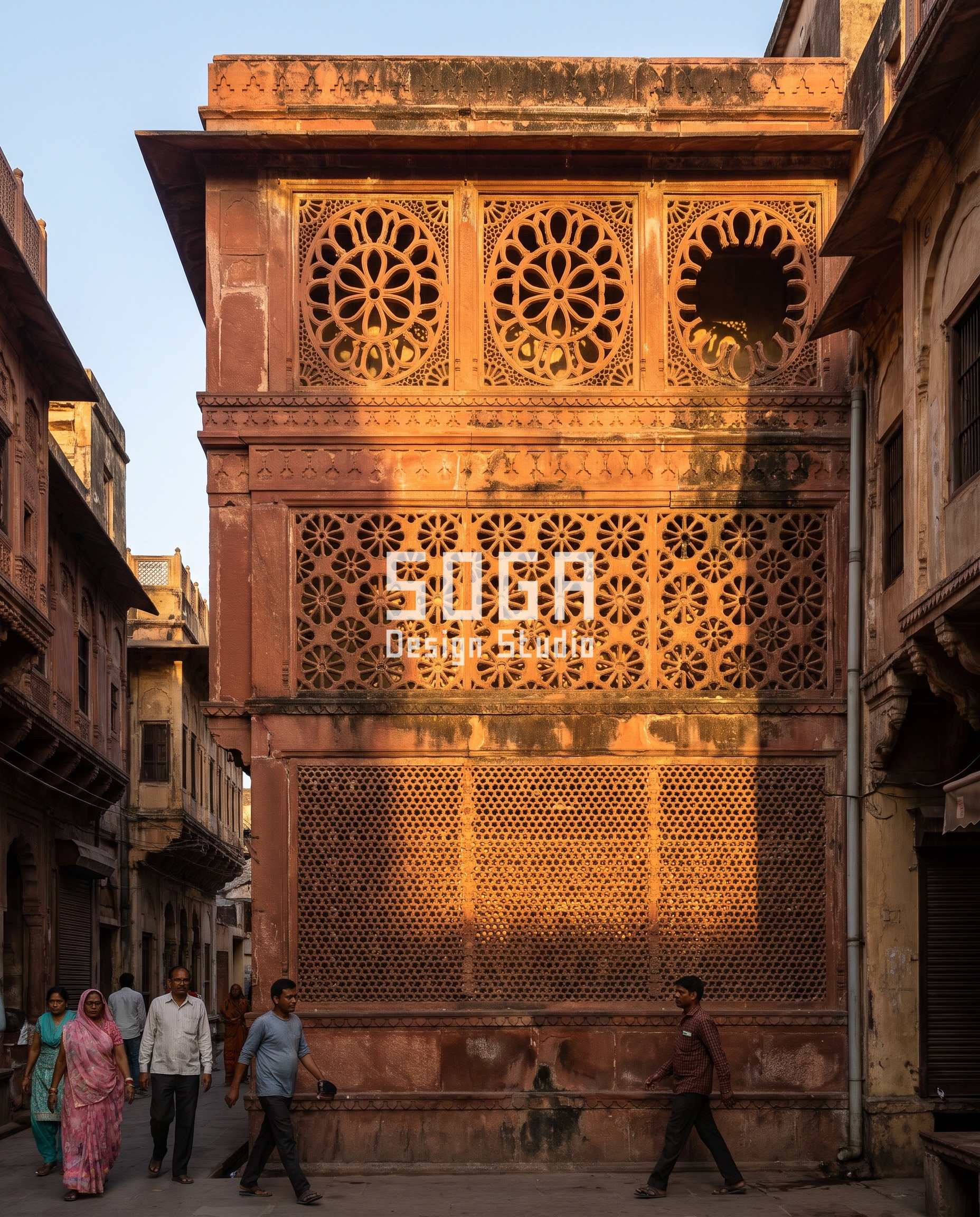
Generic reference, not a SOGA project. One repeated floral lattice motif, identical hole size, depth and spacing from end to end.
What Do Jali, Perforated Screen and Parametric Facade Actually Mean?
Jali: One Carved or Cast Pattern, Repeated
A jali (jaali) is India’s own answer to solar screening — centuries older than the word “facade.” A mason or stone-carver cuts a single geometric or floral motif into red sandstone, Jaisalmer stone or cast RCC, then repeats that one motif across the opening by hand or with a reusable mould. The pattern doesn’t change from one end of the wall to the other, and it doesn’t change because the wall turns a corner from a shaded north face to a sun-blasted west one. What you see on the first panel is what you get on the hundredth.
Perforated Screen: One Hole, Cut by Machine Instead of Hand
A generic perforated screen replaces the mason with a laser or CNC punch press, but keeps the same logic: one hole diameter, one spacing, one openness percentage, applied to a flat metal sheet from a single repeating digital pattern. It is faster and cheaper to produce than a jali because the machine doesn’t care how many times it repeats the same cut. It is still, geometrically, the same decision made once and copy-pasted across the whole elevation.
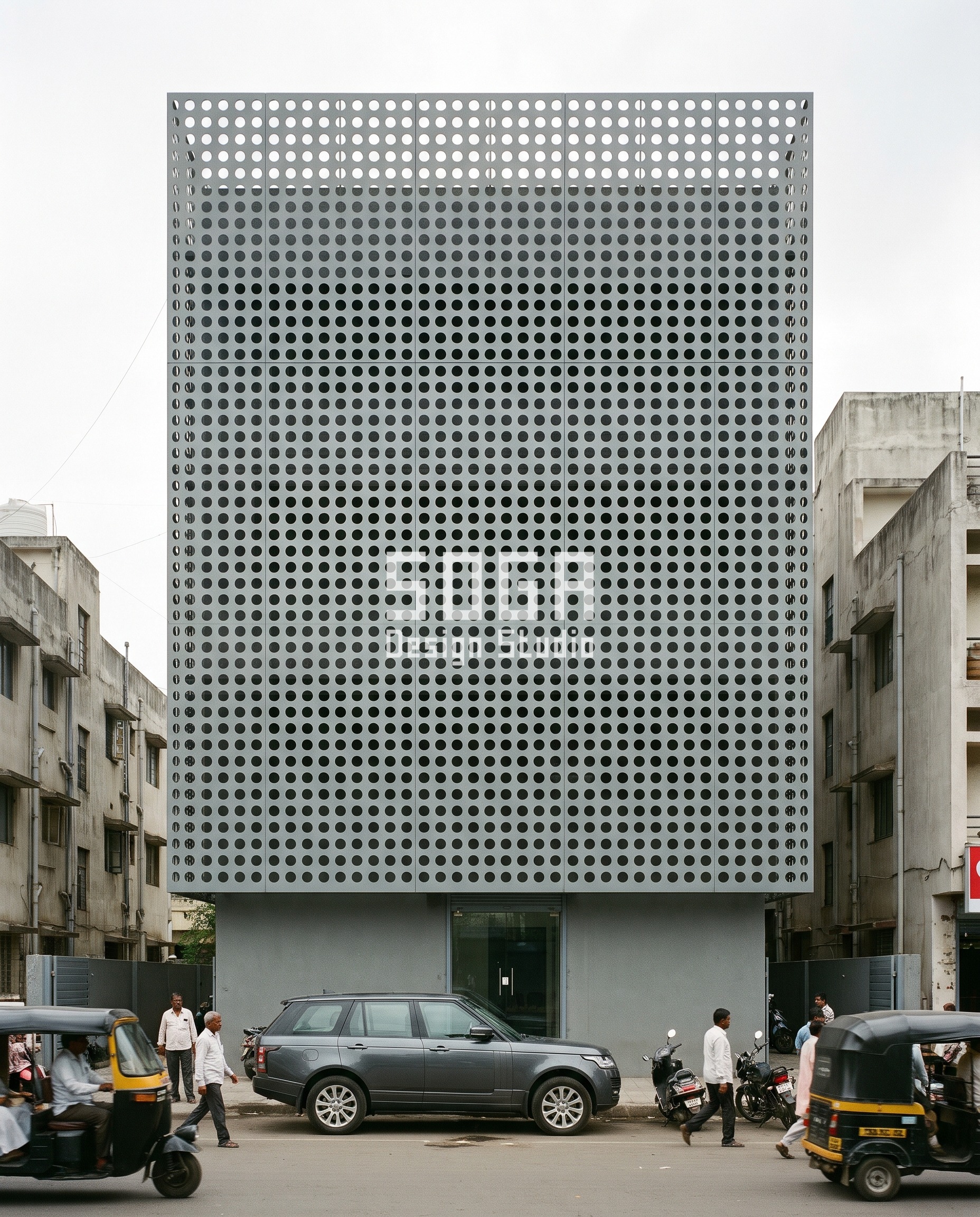
Generic reference, not a SOGA project. One hole diameter and spacing repeated identically across the sheet, flat with no depth or relief.
Parametric Facade: A Model, Not a Pattern
A parametric facade starts from a computational model — built in a parametric modelling tool, not drawn panel by panel — that is given real inputs: this building’s solar exposure on each elevation, the privacy need at each floor, the view each room is trying to keep or block. The model then outputs a different panel for different conditions: tighter and deeper where the sun is harshest or the street is closest, more open where neither applies. SOGA delivers this through its own named systems — SogaGrid™, SogaWeave™ and SogaScreen™, among others — each a defined module and material spec, not a one-off sketch.
Jali vs Perforated Screen vs Parametric Facade: Side by Side
| Jali | Perforated Screen | Parametric Facade | |
|---|---|---|---|
| Cost (installed, indicative) | ₹150–₹500/sq ft | ₹450–₹950/sq ft | ₹1,200–₹3,800/sq ft |
| Customisation range | One motif, fixed | One hole size, fixed | Every panel can differ |
| Fabrication method | Hand-carved stone or cast RCC, reusable mould | CNC laser/punch cut from one repeating file | CNC-cut/folded per panel from a computational model |
| Typical material | Red sandstone, Jaisalmer stone, cast RCC | Mild steel or standard-gauge metal sheet | Engineered metal panel system, custom finish |
| Orientation-aware? | No — same pattern every face | No — same opening % every face | Yes — depth/opening set per elevation |
| Typical lifespan | 25–50+ years (stone), needs re-pointing | 8–15 years before recoat/replacement | 20–30 years, module-by-module replacement |

True parametric facade system: box-frame fin projection depth sweeps from 180mm to 1500mm end to end (an 8.3x spread). AI-generated concept render; not a completed or built project; no claimed completion year.
How Much Does Each One Actually Cost in India?
These figures are indicative, based on SOGA’s own 2026 fabricator quotes across Delhi-NCR, Mumbai and Bengaluru projects — not list prices, and not what a quotation on your specific plot will say without a site visit. Three things drive the spread within each row: stone type and carving depth for a jali, sheet gauge and coating for a perforated screen, and panel count and depth range for a parametric system.
| Facade choice | Installed cost (2,000 sq ft, indicative) | Annual maintenance (indicative) | 10-year indicative total |
|---|---|---|---|
| Jali (stone/RCC) | ₹3–10 lakh | ₹15,000–30,000 | ₹4.5–13 lakh |
| Generic perforated screen | ₹9–19 lakh | ₹25,000–45,000 (recoat cycle) | ₹11–23 lakh |
| Parametric facade (SOGA system) | ₹24–76 lakh | ₹15,000–30,000 | ₹25–79 lakh |
This is a 2,000 sq ft illustrative elevation, not a quote — a real project needs plot dimensions, city and floor count. The parametric row is not cheaper up front; the comparison it wins is design outcome and lifespan per rupee, covered in the next section.
The cost gap between a perforated screen and a parametric facade is not decoration — it is a different manufacturing step. A perforated screen is one CNC file run across one sheet size, over and over. A parametric facade is hundreds of individual CNC files, each panel its own entry in a fabrication schedule, each one checked before it ships. That per-panel engineering, not a fancier hole pattern, is what the extra ₹750–₹2,850 per sq ft is actually paying for.
Which One Shades, Ventilates and Protects Privacy Better?
A client once asked us to simply make the perforated screen on their site office “more parametric” by varying the hole size randomly. That is not what the word means, and it is worth saying plainly: randomising a pattern doesn’t make it climate-responsive, it just makes it look unplanned. Real performance difference comes from whether the screen design actually knows which way it’s facing.
- Jali — good light diffusion and real thermal mass cooling from stone, but the same motif on an east wall and a shaded courtyard wall behaves identically, because it was never calculated against either one.
- Perforated screen — one openness percentage (commonly 30–50%) applied everywhere. The same number that gives comfortable privacy on a ground-floor street wall will usually be too open for a west-facing bedroom and too closed for a shaded corridor.
- Parametric facade — the aperture is set per panel: a street-facing ground-floor bay can run tighter (around 20–30% open) for privacy, while an upper study window runs more open (60–70%) for daylight, on the same elevation, calculated against that building’s own sun path.
Not Sure Which One Your Project Actually Needs?
Send SOGA Design Studio your plot dimensions, city and floor count and we’ll tell you honestly whether a jali, a generic perforated screen or an engineered parametric system is the right call for that specific elevation — with a costed indicative range, not a sales pitch. Talk to SOGA Design Studio.
Which Lasts Longer, and Which Costs More to Maintain?
Stone jali work genuinely lasts — 25 to 50-plus years is realistic for a well-detailed installation — but repair is where it gets honest: a damaged motif is usually hand re-carved on site, because there is no factory running that exact die any more. In monsoon zones, unsealed stone joints still pick up efflorescence and algae the same way a stone-clad facade does.
A generic perforated screen is the one that ages the fastest in practice. Powder coat chips first at the laser-cut hole edges, where the coating is thinnest, and corrosion starts there — especially within 25–30 km of a coastline. Most installations need a recoat or panel swap inside 8–15 years. Replacement is at least modular — sheets can be swapped — but every sheet in stock looks identical, so there’s no way to upgrade just the worst-hit bay without it showing.
An engineered parametric system sits in between on raw material life and ahead on repairability: panels on a documented fabrication schedule can be replaced one at a time, from the same digital file that made the original, without re-skinning the building or the patch being visible from the street. That is the maintenance argument for the premium, not the shading argument.
So Which One Should You Actually Choose?
Choose a jali if: the project is heritage, temple or classically-detailed architecture where a carved stone screen is contextually correct; the budget genuinely can’t stretch past perforated-screen money for anything structural; or the brief specifically wants visible handcraft, not a machine-made pattern.
Choose a generic perforated screen if: you need to hide a transformer yard, DG set, or parking deck behind something that isn’t a blank wall, on a fast turnaround and a tight budget, and the whole screened area faces roughly the same way — so one openness percentage is an honest answer, not a compromise.
Choose a parametric facade if: the elevation turns more than one direction, privacy and daylight needs actually differ bay to bay, or the building is meant to read as designed — a flagship showroom, a signature residence, a project where the facade itself is part of why someone remembers the address.
Further Reading on Jali, Perforated Metal and Parametric Design
- Jali — traditional Indian lattice screen architecture (Wikipedia)
- Perforated metal — material and fabrication overview (Wikipedia)
- Parametric Facade Design: Tools and Workflows for Architects (Novatr)
Frequently Asked Questions
What is the actual difference between a jali, a perforated screen, and a parametric facade?
A jali is a hand-carved or cast stone/RCC lattice with one repeated motif. A perforated screen is a flat metal sheet with one uniform hole size and spacing, machine-cut from a single pattern. A parametric facade is generated by a computational model that varies panel depth, size or angle individually across the elevation, based on each panel’s own sun exposure and privacy need. The first two repeat one decision; the third makes a different decision for every panel.
Is a parametric facade just an expensive version of a jali or perforated screen?
No — the extra cost is not for a prettier hole pattern, it is for a different manufacturing process. A jali or perforated screen is produced from one design repeated by hand or machine. A parametric facade is hundreds of individually engineered panels, each on its own line in a fabrication schedule, driven by a computational model rather than a single repeated template.
Which is cheaper in India — jali, perforated screen, or parametric facade?
Indicatively, a built stone/RCC jali runs roughly ₹150–₹500 per sq ft installed, a generic perforated metal screen roughly ₹450–₹950 per sq ft, and an engineered parametric facade roughly ₹1,200–₹3,800 per sq ft, based on SOGA’s 2026 fabricator quotes across Delhi-NCR, Mumbai and Bengaluru. These are starting bands, not a quote — stone type, sheet gauge, coating and panel count all move the number.
Does a jali or perforated screen perform as well as a parametric facade for shading and privacy?
Not when the building faces more than one direction. A jali or perforated screen applies one fixed pattern or opening percentage everywhere, regardless of orientation. A parametric facade sets a different aperture per panel — tighter where the sun or the street demands it, more open where it doesn’t — because it is calculated against that specific building’s sun path rather than applied as one generic number.
Which lasts longer — a jali, a perforated screen, or a parametric facade?
A well-detailed stone jali can last 25 to 50-plus years, though repairs usually mean hand re-carving on site. A generic perforated screen typically needs a recoat or panel swap within 8–15 years, with corrosion starting at the laser-cut hole edges. An engineered parametric system typically runs 20–30 years and can be repaired one documented panel at a time from the original fabrication file, without the patch being visible.
When should I choose a traditional jali instead of a parametric facade?
Choose a jali for heritage, temple or classically-detailed buildings where a carved stone screen is contextually correct, for projects where visible handcraft is specifically wanted over a machine-made system, or where the facade budget cannot stretch to engineered parametric panel costs. A parametric facade earns its premium on orientation-driven performance and architectural identity — neither of which every project needs.
Get a Costed Comparison for Your Own Facade
Contact SOGA Design Studio with your plot dimensions, city and floor count, and we’ll return an honest recommendation — jali, perforated screen, or a named parametric system — with an indicative costed range, inside 48 hours.
By Gajender Sharma, SOGA Design Studio — Gurugram | Updated: 24 October 2026
Related Reading
- Parametric Facade Design in India: Systems, Materials & Cost per Sq Ft
- Facade Design Ideas 2026: Homes, Offices & Commercial Buildings
- Facade Screens Without Making the Room Dark: India Numbers
- Parametric Architecture India 2025-26: Top Facade Trends
- Double-Storey House Front Elevation Designs 2026
- Facade & Elevation Design in India: Complete FAQ Guide
- Parametric Facade vs Stone Cladding vs ACP: Cost & Performance Comparison
- Graduated Perforation Jewellery Showroom Facade India
- Perforated Metal Facade in Mumbai 2026: Jali Design
- Designed in India, Engineered in India: How Parametric Facades Became Manufacturable