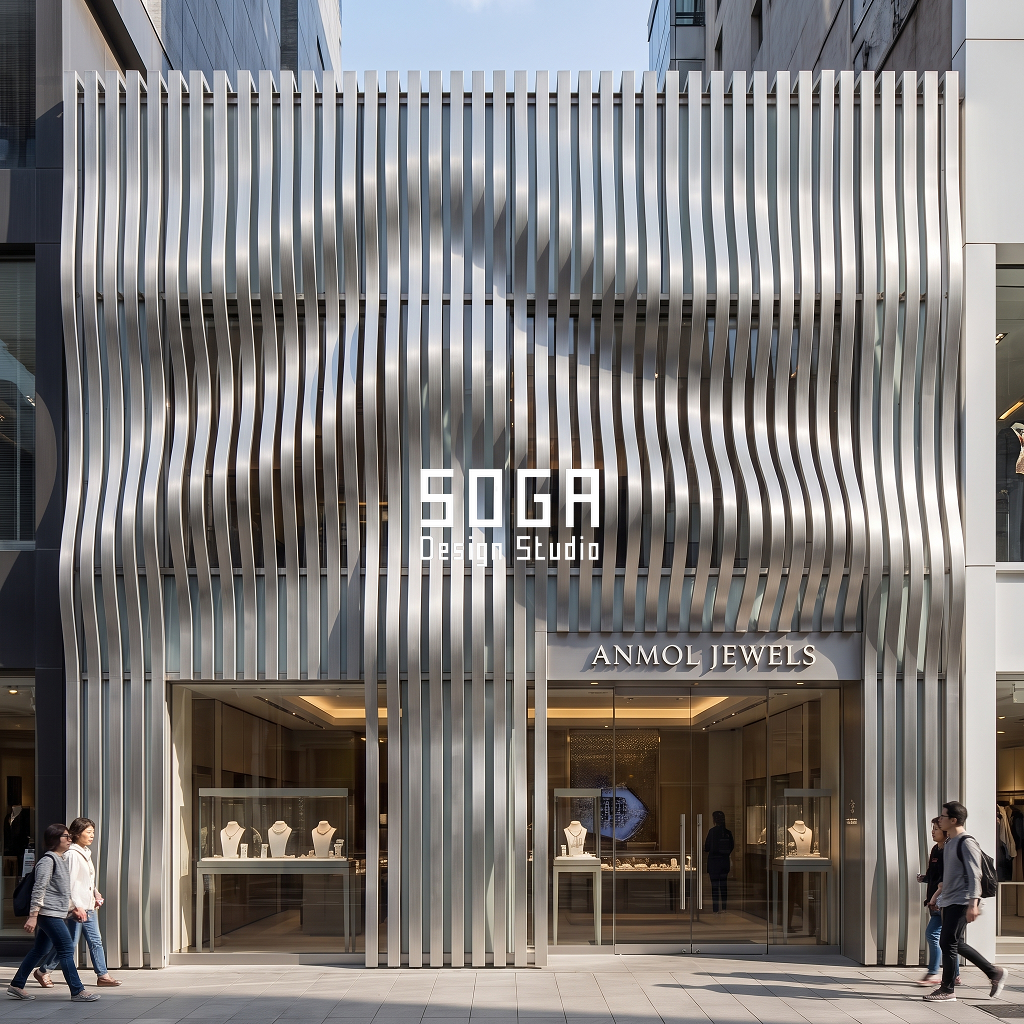
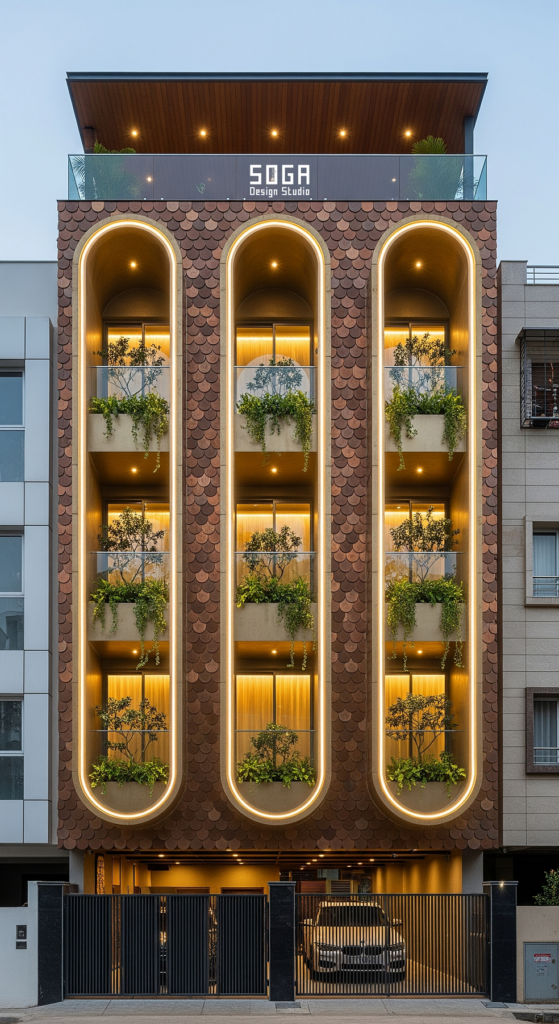
A watch showroom facade design india brief has one odd feature: the product is measured in tenths of a millimetre, so the frontage is judged the same way. In five SOGA concepts, in Pune, Ludhiana, Gurugram, South Delhi and Bengaluru, each frontage is governed by one numeric rule, and each is priced by how many identical units it contains. A 250 mm scale gives about 16 units per square metre, a 325 mm scale about 9.5, and 150 mm fin centres 6.7 fins per metre. All five are SOGA concepts, drawn, not built work.
A watch showroom facade is the street frontage of a watch boutique, flagship or the ground-floor watch tenant of a mixed-use block, built from small, repeated, tightly toleranced units so the building reads as precisely as the product inside.
What a Watch Showroom Facade Has to Signal
A watch buyer decides how careful a brand is before reaching the door. On a street of signboards, the one frontage where every unit lines up to a visible rule says something a sign cannot. That is the whole brief: the facade is a countable object, and the count has to be right.
We separate this from the size question. How large a module must be to read from the pavement is a viewing-distance argument, and it is already set out in the fashion showroom guide and the mall entrance guide, so we do not repeat it here. This page asks a different question: once the module size is chosen, what does it cost to hold it exactly, and what does the unit count tell a client before a drawing exists?
Our answer is that precision here is arithmetic. Unit count per square metre, joint length per square metre and the tolerance a fabricator can hold decide how the frontage reads and what it costs. For jewellery frontages the same logic applies at a smaller scale, covered in the jewellery showroom guide.
Stage 1, Programme: Two Flagships and Three Blocks with a Watch Tenant
The method runs programme, massing, grain, skin, in that order. Programme comes first because a watch retailer occupies very little frontage. A boutique needs about 8 to 12 m of street face and a ground floor of one or two double-height bays. Two of the five concepts are stand-alone flagships, G+2, where the whole elevation is the watch brand. The other three are G+5 mixed-use blocks, where the watch retailer holds the ground floor and the upper storeys are offices, apartments or serviced units.
That split changes the job. A flagship can spend its whole facade budget on one rule. A block must carry the rule up through balconies and floor edges that belong to other tenants, so the rule has to survive being cut by slabs, and each block treats that problem differently.
| Programme | Area / count |
|---|---|
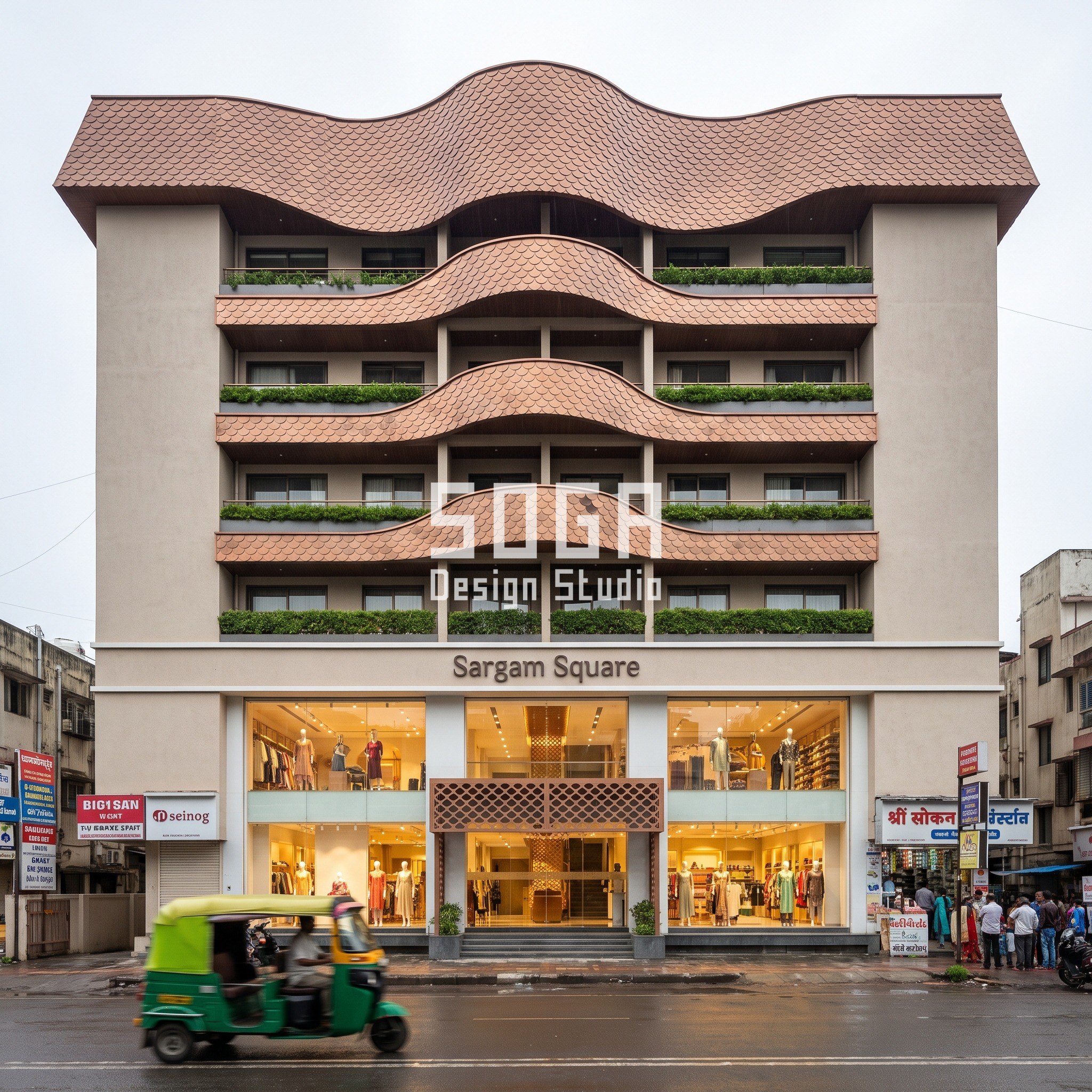
| Sargam Square, Pune | G+5 mixed-use; watch retailer at ground; 325 mm copper-bronze anodised scales; crest 900 mm above parapet |
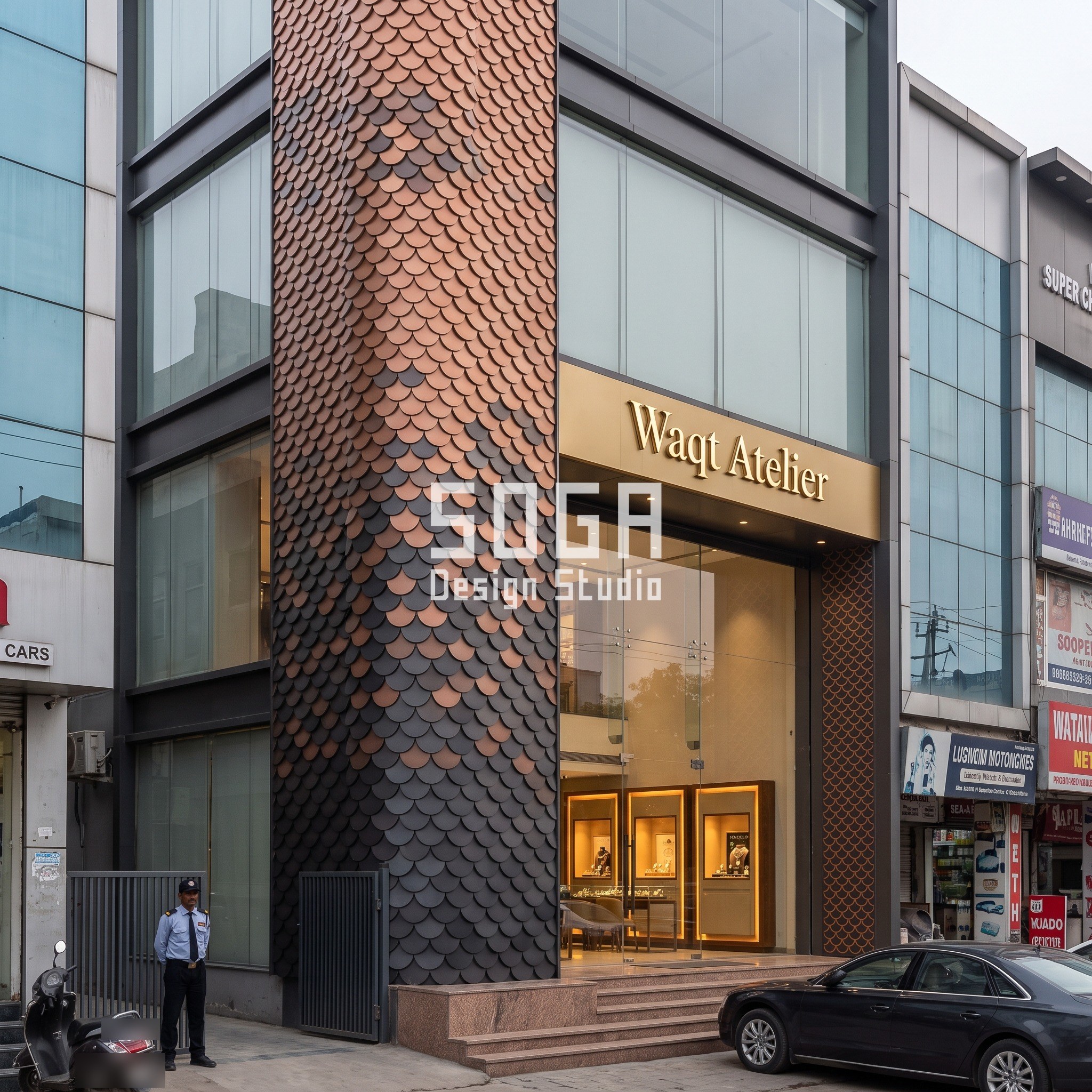
| Waqt Atelier, Ludhiana | G+2 watch and lifestyle flagship; full-height column of 250 mm two-tone scales; 30% tonal variation |
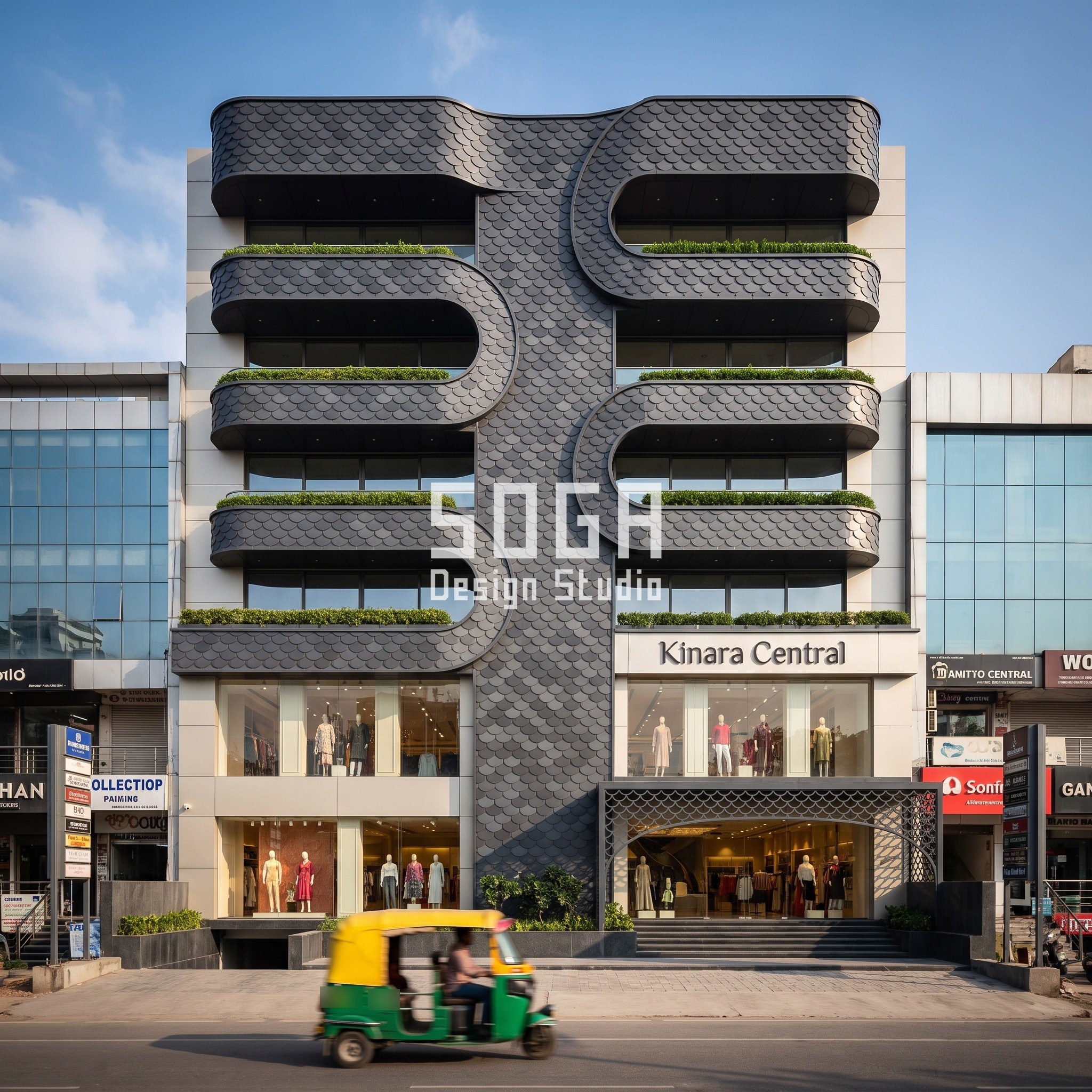
| Kinara Central, Gurugram | G+5 mixed-use; watch tenant at ground; 325 mm charcoal scale band in a serpentine path; 25% variation |
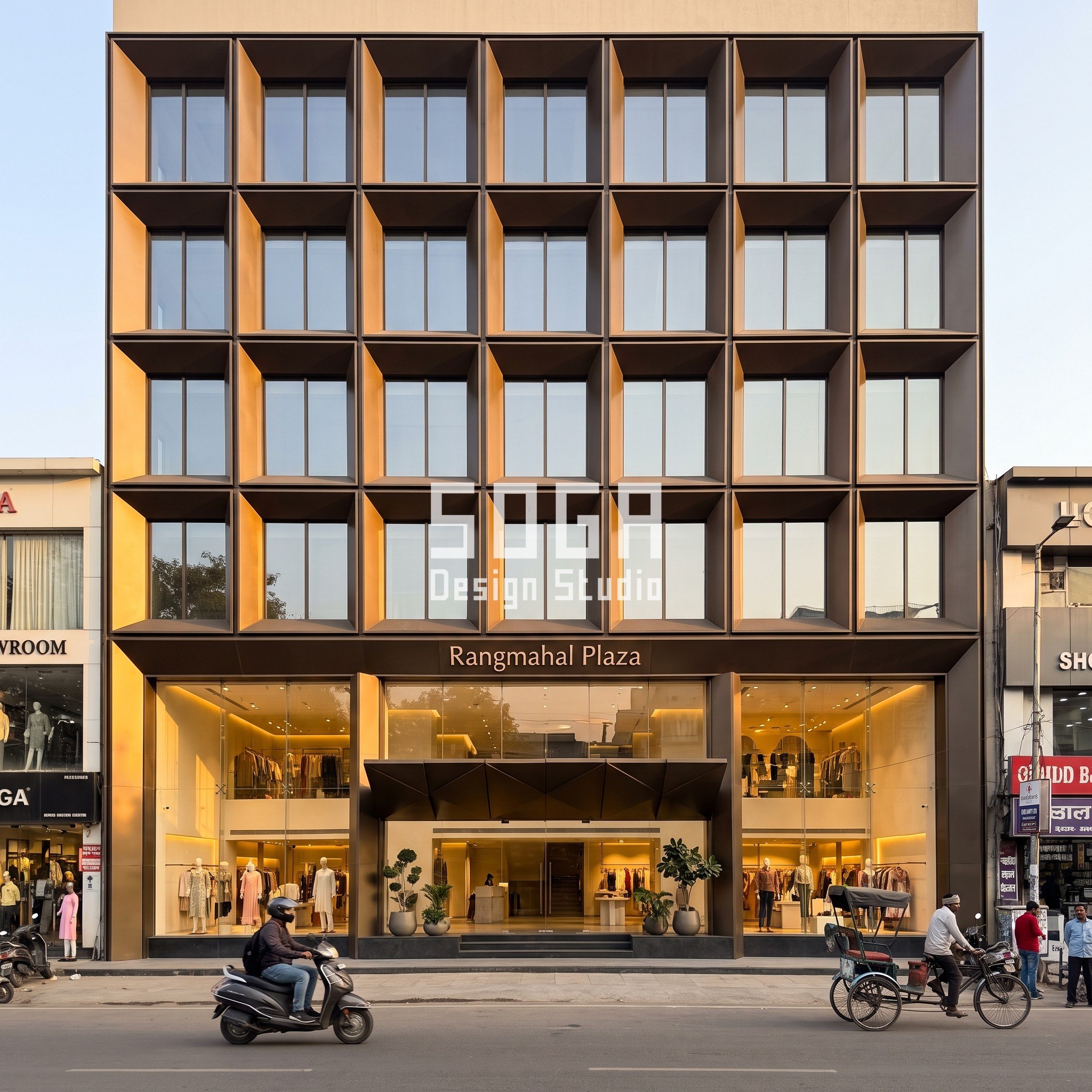
| Rangmahal Plaza, South Delhi | G+5 mixed-use; watch retailer at ground; 7 bays of folded-plate frames, 600 mm deep tapering to a mullion; facets 4 to 17 degrees |
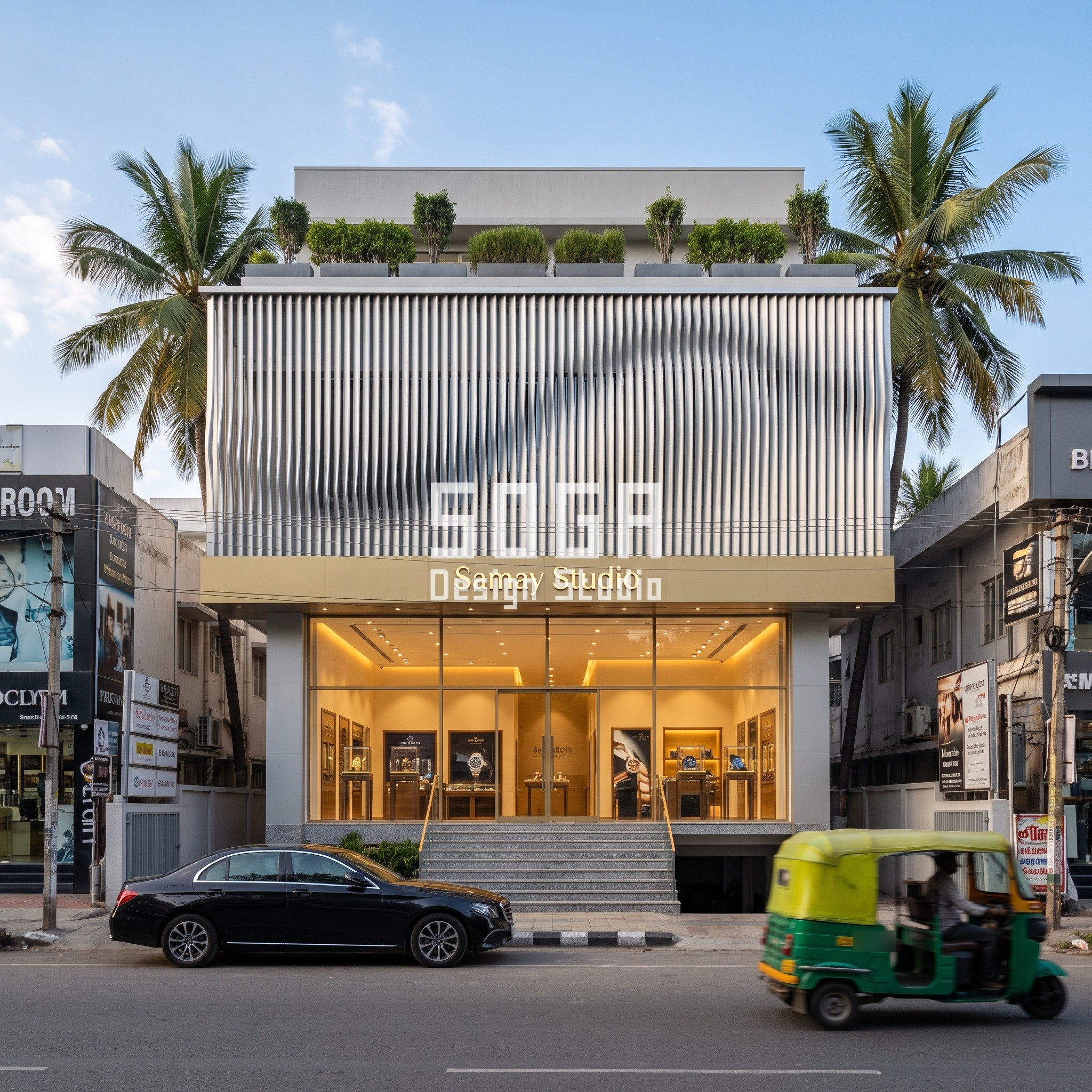
| Samay Studio, Bengaluru (Indiranagar) | G+2 watch flagship; 40 x 225 mm fins at 150 mm centres; 700 mm sine amplitude in plan |
Stage 2, Massing: A Different Move in Each City
Pune gets the crest. Sargam Square’s roof canopy rises 900 mm above the parapet in one wave, and the wave steps down through the five balcony fascias at 150 mm per floor: 900, 750, 600, 450, 300, then 150 mm at the lowest fascia. Amplitude falls toward the street, so the eye reads the strongest movement at the top and a near-flat line at the entrance where the watch retailer sits. The scale system itself is the one described in our copper shingle fabrication notes, and we keep that mechanic to this paragraph.
Ludhiana gets the column. Waqt Atelier is one full-height strip about 2.4 m wide and 12 m tall, which is 48 courses of 250 mm scales and roughly 460 scales in all (2.4 x 12 m is 28.8 sq m, at 16 per sq m). The tone runs dark at the base and brighter at the top, so the pavement sees the darkest units at eye level and the sky sees the brightest.
Gurugram gets the snake. Kinara Central’s charcoal band runs up the centre and, on alternate floors, wraps the left half and then the right, so five balcony floors give a left, right, left, right, left rhythm. Each wrap becomes a deep C-shaped pocket, about 1.8 m deep on our drawing, which shades the glazing behind it.
South Delhi gets the frame grid. Seven bays, each a tapered folded-plate frame, narrow from 600 mm deep at the edges to a slim mullion at the centre. Across the seven bays the facet tilt steps from 4 to 17 degrees in about 2.2-degree increments: 4, 6.2, 8.3, 10.5, 12.7, 14.8 and 17. Folded-plate mechanics are owned by the sculptural facade guide.
Bengaluru gets the wave in plan. Samay Studio’s fins hold a fixed 150 mm pitch while their offset from the glass follows a sine curve of 700 mm amplitude, so the total swing is 1.4 m. The fin mechanics are covered in the slicing fin guide; the rule here is the count.
The Numeric Rule: Units per Square Metre and per Metre Run
The count is easy to compute and is the number a client should ask for first. For a square scale of pitch p metres, units per square metre is 1 divided by p squared, and joint length per square metre is 2 divided by p. Both are simple geometry, not tested results.
The 250 mm scale therefore gives 16 units and 8.0 m of joint per sq m. The 325 mm scale gives 9.5 units and 6.2 m of joint. The difference is 1.7 times the units but only 1.3 times the joint length, which is why the small scale costs more to make and fix but does not multiply the sealing work by the same factor. A 12 m by 12 m frontage of 250 mm scales holds about 2,300 units; the same frontage in 325 mm scales holds about 1,360.
Fins and frames count per metre run instead. Fins at 150 mm centres give 6.7 fins per metre, so a 9 m flagship frontage carries 60 fins. A 600 mm frame module gives 1.7 frames per metre run, so seven bays are seven frames rather than a field of units.
| Module | Count and joint length (our arithmetic) |
|---|---|
| 250 mm scale | 16 units per sq m; 8.0 m of joint per sq m |
| 325 mm scale | 9.5 units per sq m; 6.2 m of joint per sq m |
| 150 mm fin centres | 6.7 fins per m run; 60 fins across a 9 m frontage; 110 mm clear gap between 40 mm fins |
| 600 mm frame module | 1.7 frames per m run; 7 bays in the Delhi concept |
| 12 x 12 m frontage, 250 mm scales | about 2,300 units |
| 12 x 12 m frontage, 325 mm scales | about 1,360 units |
Stage 3, Grain: Tonal Variation as a Controlled Quantity
Grain is where tone is added, and tone is the easiest place to lose the precision the frontage is selling. Three concepts carry a stated variation: 10% in Pune, 25% in Gurugram and 30% in Ludhiana. We read the figure as the share of units that sit one step off the dominant tone in any zone.
At 10%, Sargam Square has about one off-tone scale in every square metre (9.5 units, so roughly one in ten). It reads as a quiet flicker across a copper-bronze field. At 30%, Waqt Atelier has about five off-tone scales per square metre and a visible dither, which is what makes a dark-to-bright ramp read as a ramp and not as two blocks of colour.
The variation must be larger than the accident. Anodised finishes vary from batch to batch, and if that drift is 5%, a 10% design variation is barely twice the noise. So the rule is to order every scale for one facade from one anodising lot, then add the designed variation as separate, labelled tones. Otherwise a repair years later, from a new lot, shows as a patch.
Ludhiana’s ramp is then a ratio schedule. Divide the 12 m column into eight bands of 1.5 m: the lowest band is mostly charcoal, the highest mostly warm copper, and each band is a fixed mix in which 30% of scales sit off the band’s dominant tone.
Stage 4, Skin: Finish, Coating and Fixing
Copper-bronze scales are an anodised or coated finish, not real copper. The colour comes from electrolytic colouring in the anodic film, or from a PVDF or powder coat, and there is no natural patina to depend on. That is a benefit here: the tone at handover is the tone that lasts, which suits a brand that sells consistency. Architectural anodic films are commonly specified at about 20 micron; the fabricator’s certificate governs.
The charcoal-anthracite finish in Gurugram is matt, because a gloss surface on a 325 mm scale reflects the street and breaks up the band. The dark bronze frames in South Delhi are powder-coated, since a folded plate has sharp edges where anodising builds up unevenly. The brushed silver fins in Bengaluru are anodised, and the brushing runs along the fin’s length so light catches the 40 mm edge.
Every fixing is concealed: scales hang from hidden clips on horizontal rails, fins sit on a concealed shoe, and frame joints are closed by a shadow gap. Nothing is visible at 1 m, which is where a watch buyer looks. Material selection between anodised, PVDF and powder-coat is a project decision, and the fire route (non-combustible cladding to NBC 2016 Part 4 for the height and use) is confirmed with the local fire officer before a finish is fixed.
Buildability: What a Fabricator Can Hold
A render promises a tolerance; a fabricator delivers one. These are the points we check first on each frontage, all as design assumptions to be confirmed with the supplier.
- Joint tolerance. Plan for plus or minus 2 mm on every visible joint. On a 250 mm scale that is under 1% of the module, which is tight but held in sheet work by laser cutting and CNC folding.
- Datum, not chain. Scales are hung to a rail set to a surveyed datum every course, so errors do not add up across the width. Chained joints would drift: at plus or minus 2 mm each, 48 joints across 12 m could accumulate about 14 mm in a root-sum-square sense, and 96 mm in the worst case.
- Thermal movement. The metal moves about 0.023 mm per metre per degree. A 3.6 m storey rail over a 40 degree swing moves about 3.3 mm, more than the plus or minus 2 mm joint tolerance, so rails need slotted fixings and joints are designed to open and close.
- Oil-canning. Flat sheet at 250 to 325 mm reads wavy in raking light unless it is folded, stiffened or embossed at the edge. Each scale takes a returned edge, which also gives the shadow line.
- Fin straightness. A 40 x 225 mm fin at 150 mm centres shows any bow across a 110 mm gap. Set a straightness limit with the extruder and check it before anodising.
- Bracket count. Bengaluru’s sine offset needs stand-offs from 0 to 1.4 m. Quantised at 50 mm steps that is about 29 bracket lengths, and at 25 mm steps about 56, so choose the coarser step and accept a 25 mm error.
Cost Ranges by Skin and Unit Density
The ranges below are indicative market figures from vendor and marketplace price pages for 2025 to 2026, installed, and they are not SOGA fees. An itemised estimate is issued per project. Volume orders are commonly quoted 15 to 25% lower. We found no published benchmark for copper-bronze anodised scales or for folded-plate frames, so we give none and treat them as project-priced. As a guide, more units per square metre means more parts, more joints and more hand fixing, so a 250 mm scale should sit higher in a band than a 325 mm scale.
The last three rows come from secondary pages that include design fees, so read them as a market band only. On a 144 sq m frontage (about 1,550 sq ft) the arithmetic runs from roughly Rs 3.9 to 6.5 lakh at the ACP band up to Rs 18.6 to 34.1 lakh at the premium showroom band.
| Scope | Indicative market range (2026) |
|---|---|
| ACP 4 mm PVDF exterior with framing | Rs 250-420 / sq ft |
| ACP 3-4 mm panel, supply and fix | Rs 200-350 / sq ft |
| Solid metal panels | Rs 400-600 / sq ft |
| Custom laser-cut metal panels | Rs 600+ / sq ft |
| Installation labour | Rs 50-150 / sq ft |
| HPL exterior cladding | Rs 341-727 / sq ft |
| Designed parametric metal facade (secondary, includes design) | Rs 800-2,500 / sq ft |
| Premium showroom facade band (secondary) | Rs 1,200-2,200 / sq ft; fully lit 3D faceted Rs 1,800-3,000+ |
| Copper-bronze scales, folded-plate frames | No benchmark found; project-priced |
The Honest Limit: What Each Concept Cannot Do
Scale skins raise the unit count, and every unit adds a joint that has to be held. If the fabricator cannot keep plus or minus 2 mm, a plain flush panel is the better answer, because a wobbling scale field reads as cheap, not precise. The 250 mm scale in Ludhiana is the most exposed to this, at 16 units per sq m.
Dust and monsoon matter as much as tolerance. Ludhiana and South Delhi carry fine dust that settles on every upward-facing scale edge, so the lower courses need a cleaning route and a joint that sheds water. Pune and Bengaluru see heavy monsoon rain, so every horizontal rail needs weep paths and the fins need a drip line. The Delhi frames have deep pockets that hold water and grit unless they drain.
Anodising sourcing is the last risk. Colour is set per lot, so a facade needs one lot for its main field and a reserve of spare scales for repairs. The Gurugram serpentine and the Pune cascade, being mixed-use, also depend on the upper tenants: a balcony enclosed later breaks the wrap. None of these concepts is a stock product, and none has been built.
Tolerance Stack over a 12 m Frontage
The chain arithmetic shows why a datum matters. Joints across 12 m are 12 divided by the pitch. Worst case is the joint count times 2 mm. Root-sum-square is 2 mm times the square root of the joint count, a statistical estimate and not a guarantee.
In both cases the numbers say the same thing: never let a scale course build on the one beside it. Reset every course to the rail, and the stack over 12 m stays at the plus or minus 2 mm you specified.
| Module | Joints across 12 m | worst case | root-sum-square (at plus or minus 2 mm) |
|---|---|
| 250 mm scale | 48 joints | 96 mm | about 14 mm |
| 325 mm scale | 37 joints | 74 mm | about 12 mm |
| 150 mm fin centres | 80 fins | 160 mm | about 18 mm |
| With datum reset each course or fin | Held to plus or minus 2 mm from the rail |
Night Lighting on a Metal Frontage
A watch frontage is seen mostly after dark, so the lighting plan is part of the skin. Scales take a grazing strip light at the head of each course, set at about 100 mm from the surface so the returned edge throws a line of shadow. The 110 mm gap between Bengaluru’s fins takes a concealed strip behind them, so the wave shows as a lit line, not as a wash of light.
Keep colour temperature warm and constant along the whole frontage, about 2,700 to 3,000 K, because a shift in colour reads as a shift in tone and would undo the 10 to 30% variation designed into the scales.
Five Frontages Side by Side
The table below puts the five rules in one place. Every figure is a drawing dimension or our own arithmetic.
| Concept | Rule | count | variation |
|---|---|
| Sargam Square, Pune | 325 mm scales | 9.5 per sq m | crest 900 mm, falling 150 mm per floor | 10% tonal variation |
| Waqt Atelier, Ludhiana | 250 mm scales | 16 per sq m | about 460 scales in the column | 30% variation |
| Kinara Central, Gurugram | 325 mm scales | 9.5 per sq m | 5 alternating wraps | 25% variation |
| Rangmahal Plaza, South Delhi | 7 bays | 600 mm deep tapering to mullion | facets 4 to 17 degrees |
| Samay Studio, Bengaluru | 40 x 225 mm fins | 6.7 per m | 700 mm sine amplitude |
Related Reading
- Parametric Facade Design in India: Systems, Materials and Cost per Sq Ft
- Facade and Elevation Design in India: Complete FAQ Guide
- Fashion Showroom Facade Design India: 5 Concepts
- Mall Entrance Facade Design India: 5 Concepts at 80 m
- Jewellery Showroom Facade Design in India
- Corner Plot Jewellery Shop Facade Design India: 5 Moves
- Exposed Structure Facade India: 5 Concepts, 1-2 mm Joints
Frequently Asked Questions
What is a watch showroom facade?
It is the street frontage of a watch boutique or flagship, built from small, repeated, tightly toleranced units so it reads as precisely as the product. In our five concepts the unit sizes are 250 mm, 325 mm, 600 mm and 40 x 225 mm.
How many units per square metre does a scale facade have?
A 250 mm scale gives about 16 units per sq m and a 325 mm scale about 9.5, from 1 divided by the pitch squared. A 12 x 12 m frontage holds about 2,300 or 1,360 units respectively.
What joint tolerance can a fabricator hold on a metal frontage?
We plan for plus or minus 2 mm on every visible joint. Over a 12 m frontage of 250 mm scales, chained joints could drift about 14 mm, so each course is reset to a rail datum.
How much does a watch showroom facade cost in India?
Market ranges run from about Rs 250-420 per sq ft for 4 mm PVDF ACP up to Rs 1,200-2,200 for a premium showroom band, indicative for 2025 to 2026. There is no benchmark for copper-bronze scales, and an itemised estimate is issued per project.
Can a mixed-use block carry a watch showroom facade?
Yes, if the rule survives the slabs. Three of our concepts are G+5 blocks with a watch tenant at ground, and the rule, such as a 150 mm-per-floor fall in wave amplitude, runs up through the balcony fascias.
Want a Frontage Counted Before It Is Drawn?
SOGA Design Studio designs parametric facade concepts for watch boutiques, retail podiums and mixed-use blocks across India. Send the plot width, the floor count and the fabricator’s tolerance, and we will set out the unit count, the joint length and a cost range before any module is fixed. Design concepts are provided under licence to the client, and SOGA retains the underlying design IP.