Long before a customer reaches the door, the frontage has been judged as a photograph 1,080 pixels wide. Whatever shrinks below a few pixels in that frame, be it a pattern, a lit line or a shop name, is not seen. This post gives the pixel test for instagrammable facade design India owners can apply, then runs it on six SOGA retail concepts.
An instagrammable facade is a building front whose graded feature, lighting and name each stay legible inside a 1,080 x 1,350 px phone frame. The test is arithmetic: divide the frame width in millimetres by 1,080 to get millimetres per pixel, then check every feature against a minimum pixel size.
What Makes a Facade Instagrammable: The Frame Comes First
An instagrammable facade is one whose design still reads inside a 1,080 x 1,350 px phone frame. Its graded feature must span about 6 px and its name about 12 px of letter height. On a 20 m frontage shot full-width, that means modules of roughly 130 mm and letters of about 260 mm.
Third-party size guides report a feed photograph 1,080 px wide: 1,080 x 1,350 for 4:5 portrait, 1,080 x 1,080 for square and 1,080 x 566 for landscape, with the profile grid showing a 3:4 crop. We found no first-party page, so treat these as current practice. A 12 MP or 48 MP capture is reduced to that width on upload, so count the budget at 1,080 px, not at the sensor.
Frame width in millimetres divided by 1,080 gives millimetres per pixel. A 20 m frontage framed with 15 per cent margin is a 23 m frame, so one pixel is about 21 mm. A module must span about 6 px to read, which is roughly 130 mm on that frontage. Halve the frontage and the minimum halves too.
This is the question the fashion showroom post asks of a person at the door; a sensor cannot walk closer, so the phone version is stricter.
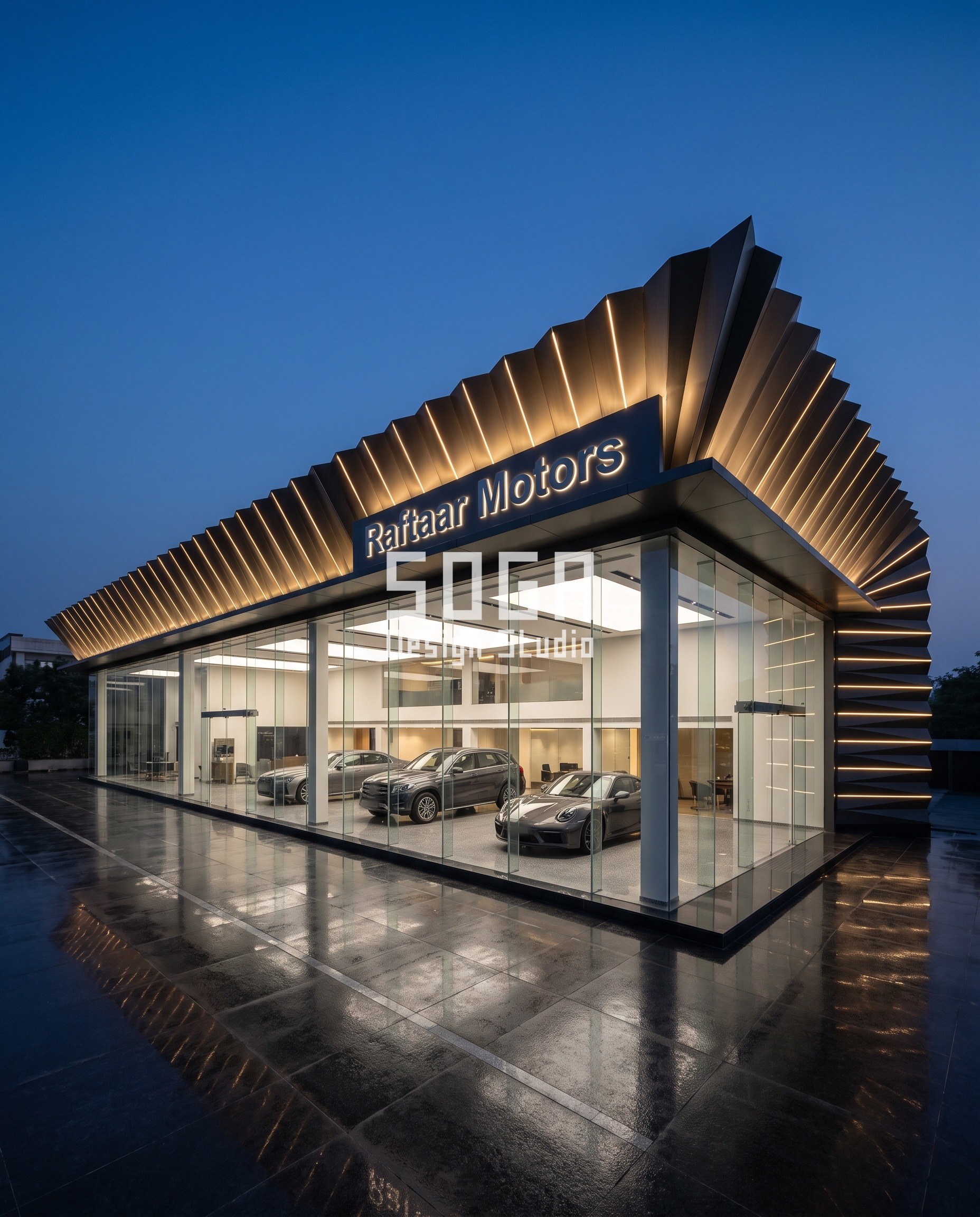
The lead image shows why. Raftaar Motors folds its pleats from 150 mm deep to 1,200 mm along 64 m, but dead-on 150 mm is 2.2 px. The fold reads only because 3000K linear LED grazes every pleat and turns depth into brightness.
Six Concepts, Six Frontages, One 1,080 px Frame
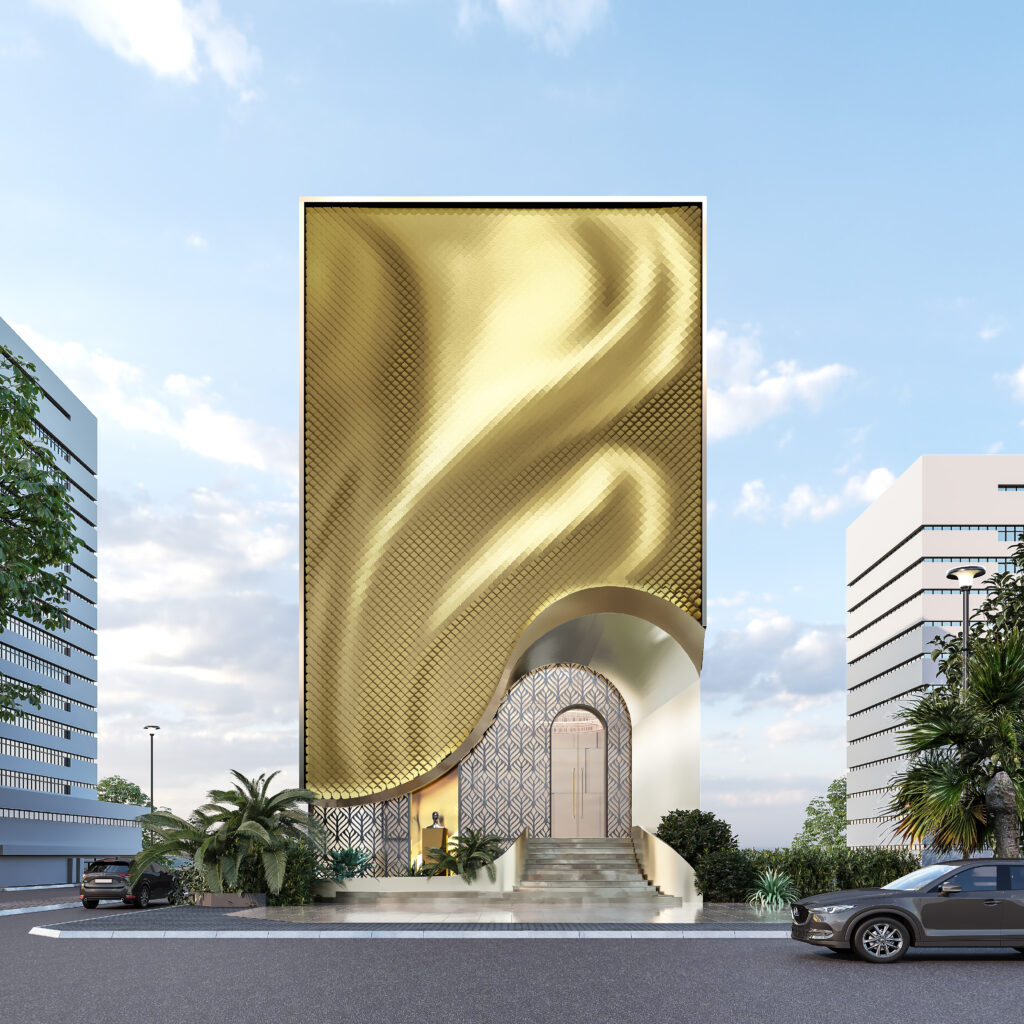
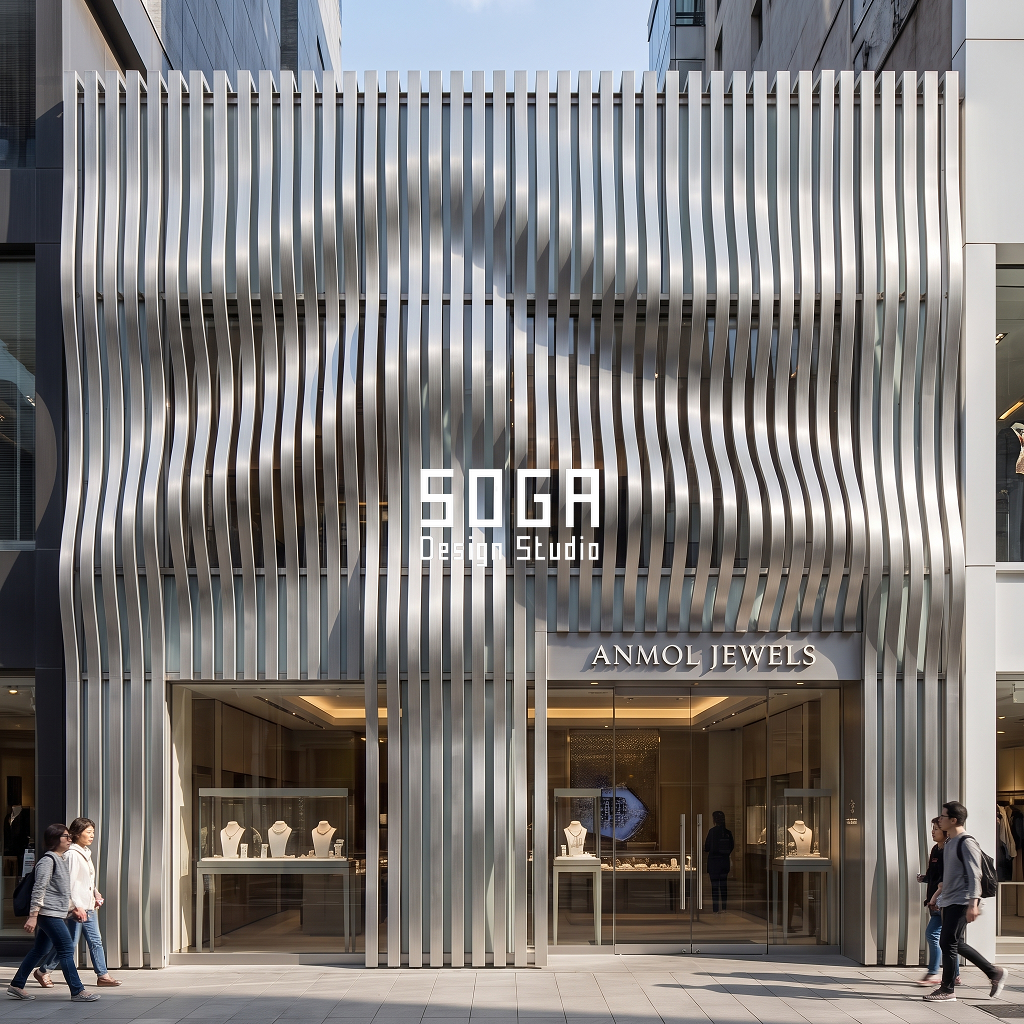
All six buildings are SOGA concept designs shown as AI-rendered visuals; none is built and every fascia name is invented. Three widths are design assumptions, because the briefs set none: 14 m for Vaqt, 18 m for Kamaan and 8 m for Shalka. Raftaar, Solstice and Lakdi are 4:5 renders; the other three are square.
The table gives frontage, frame width (frontage x 1.15, a margin for the photographer) and millimetres per pixel.
| Programme | Area / count |
|---|---|
| Raftaar Motors, Gurugram: two-storey car showroom | 64 m x 11 m; frame 73.6 m; 68 mm per px |
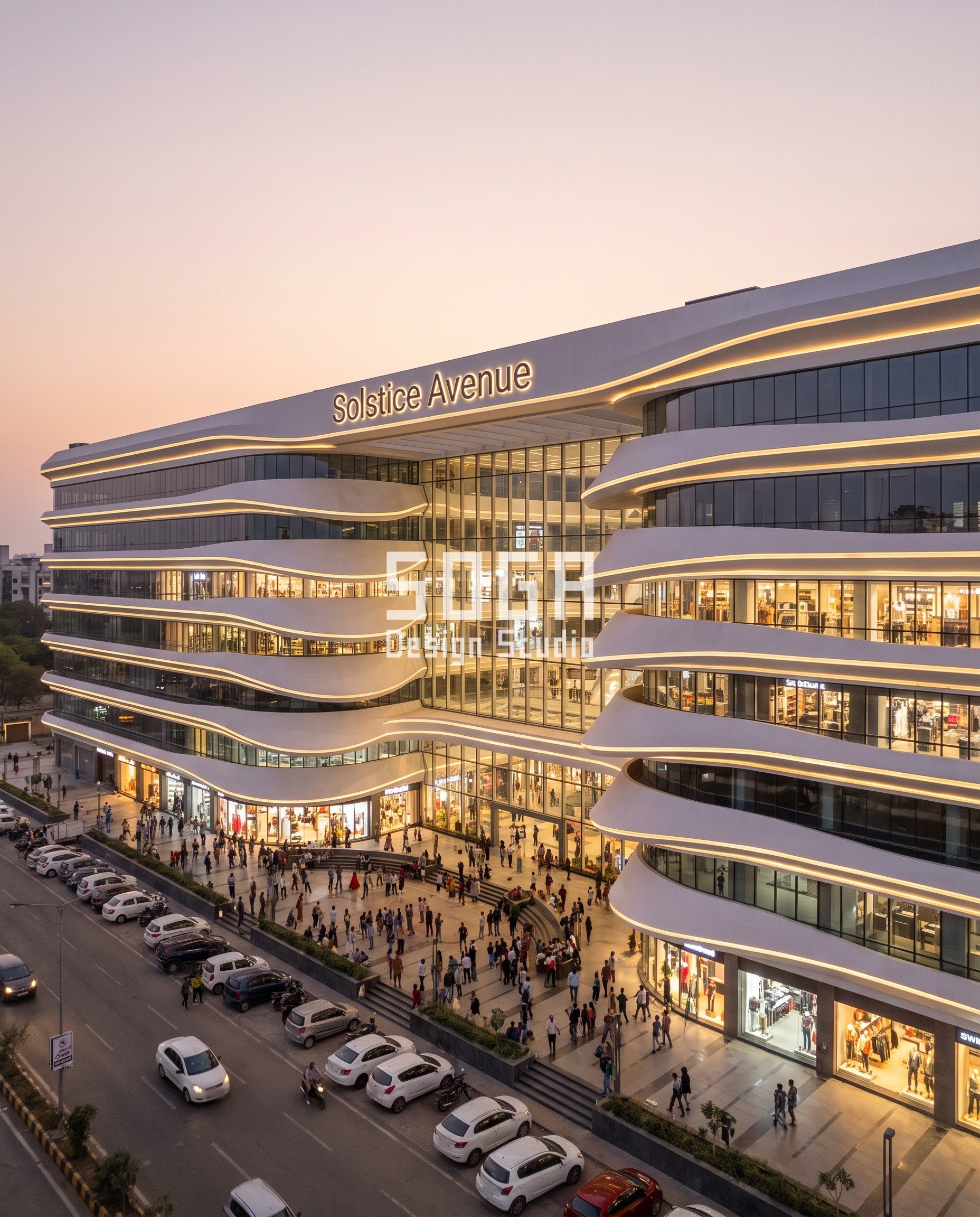
| Solstice Avenue, Ahmedabad: seven-storey mall | about 260 m long; frame about 300 m; 278 mm per px |
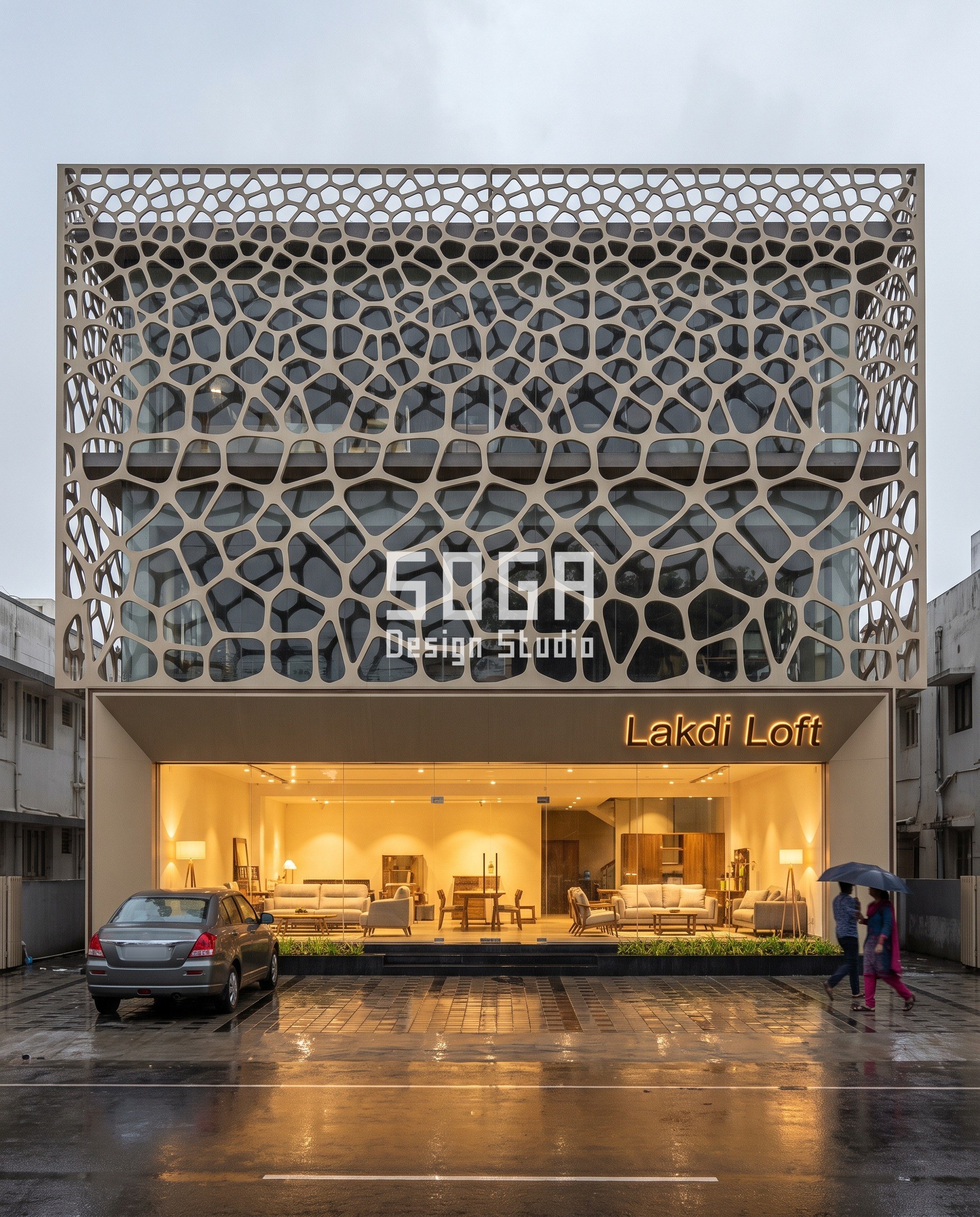
| Lakdi Loft, Coimbatore: three-storey furniture showroom | 30 m x 15 m; frame 34.5 m; 32 mm per px |
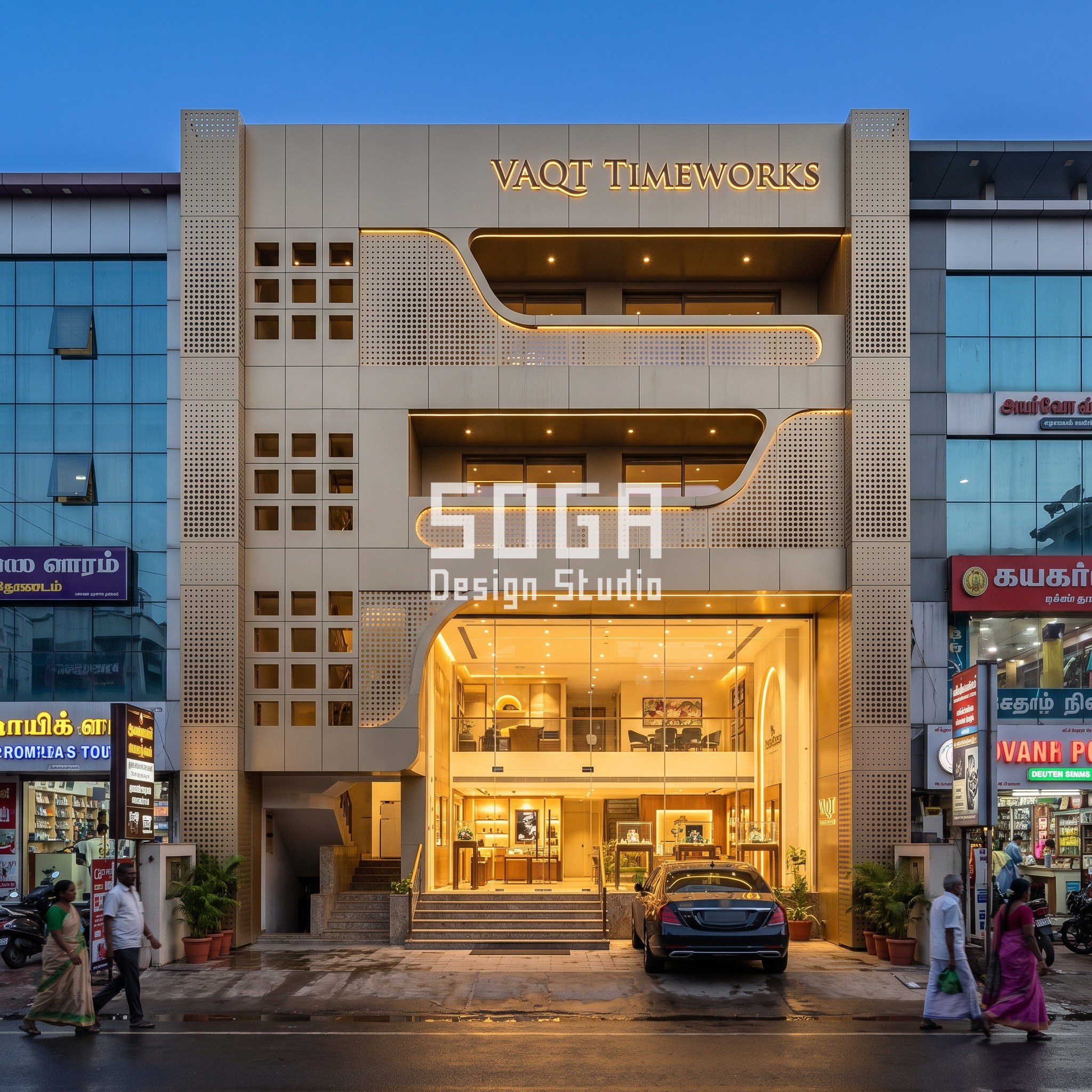
| Vaqt Timeworks, Chennai: G+3 watch flagship | 14 m (assumed); frame 16.1 m; 15 mm per px |
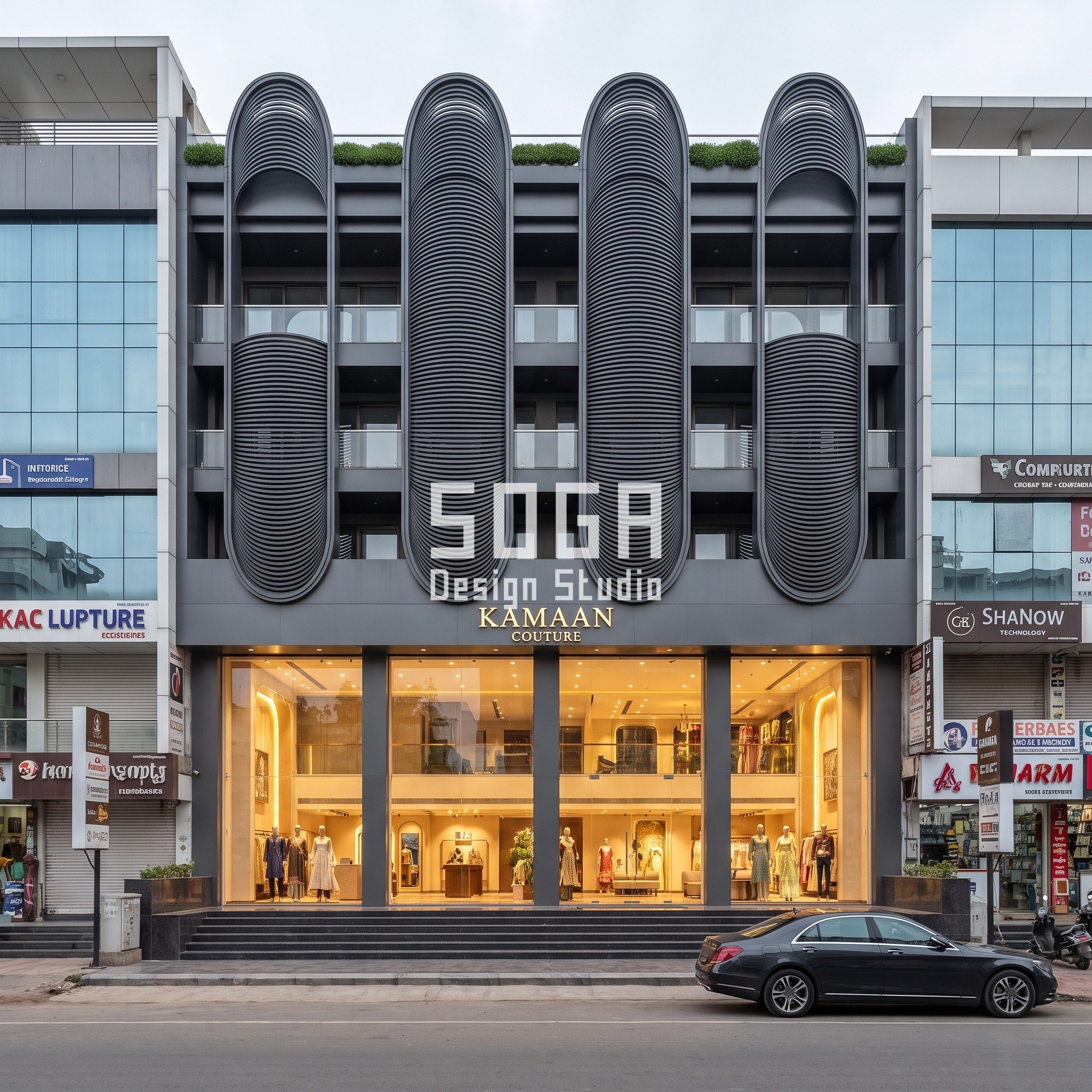
| Kamaan Couture, Ahmedabad: G+3 fashion flagship | 18 m (assumed); frame 20.7 m; 19 mm per px |
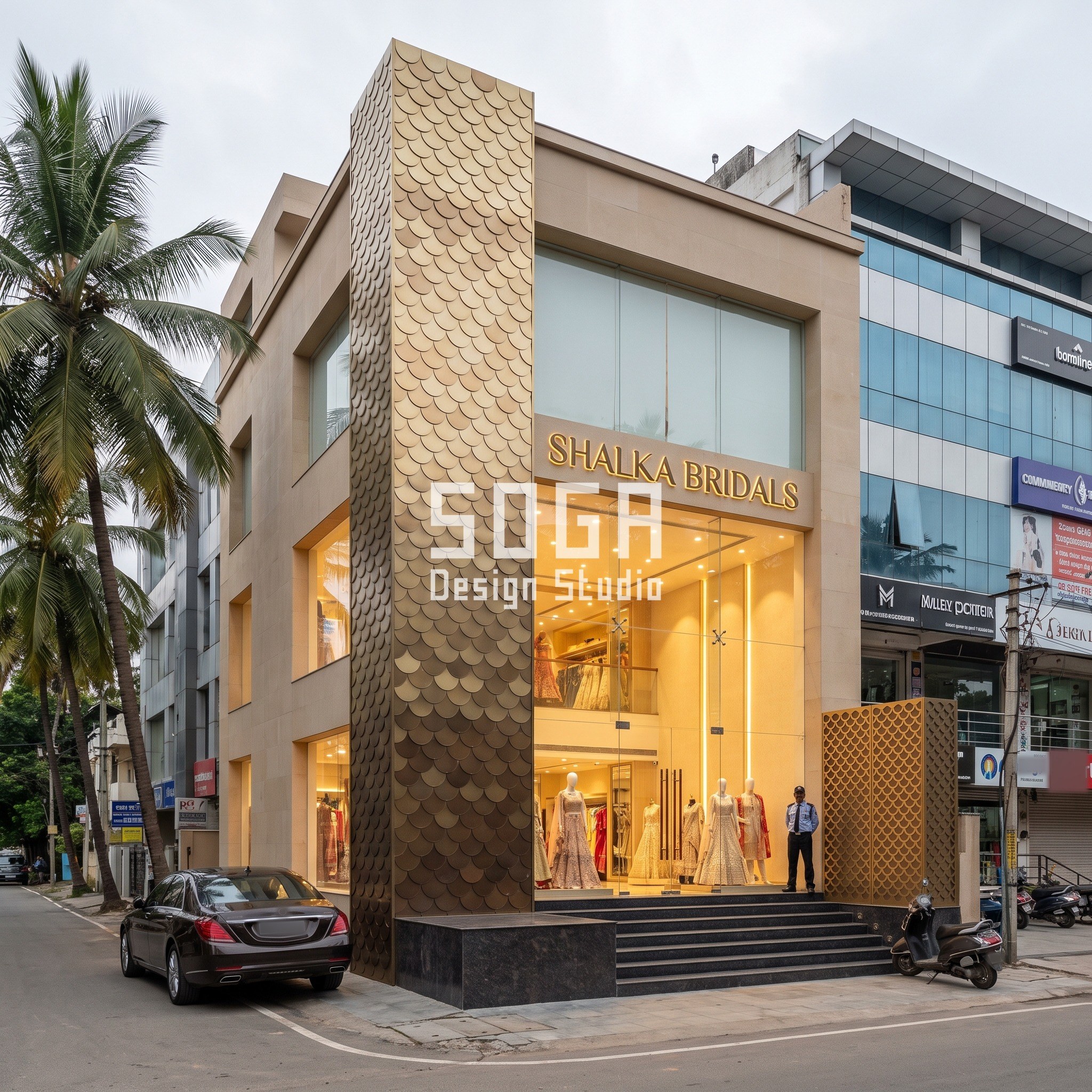
| Shalka Bridals, Bengaluru: G+3 bridal flagship | 8 m column (assumed); frame 9.2 m; 8.5 mm per px |
Where to Stand: Camera Distance and the 260 m Mall
On a phone’s main camera, held upright, the frame is about as wide as you stand far away. That comes from an angle of view near 53 to 57 degrees across the short side of a 24 to 26 mm equivalent lens. To fit a 20 m frontage plus margin, stand roughly 21 to 23 m back.
We derived it from 2 x arctan(d / 2f) on a 4:3 sensor; phone models differ. A 2x lens (about 48 mm equivalent) sees about half that width, an ultrawide (about 13 mm) about twice. Sources printing a much wider portrait angle quote the diagonal.
Full-frontage stand-back is 74 m for Raftaar, about 300 m for Solstice, 35 m for Lakdi, 16 m for Vaqt, 21 m for Kamaan and 9 m for Shalka. Raftaar’s 74 m means shooting across a carriageway and forecourt, so real photographs will be crops (SOGA judgement).
Solstice Avenue makes the point at scale: about 260 m long, drawn from the air at dusk from about 120 m. From there a main lens frames about 120 m of it, 46 per cent; an ultrawide about 240 m, 92 per cent, and would need about 150 m for the full 300 m. The image shows the mall whole; a phone there would not, unless raised or flown where a drone is permitted (no regulatory claim made).
Ribbon projection swells from 300 mm at the ends to 2,400 mm at the atrium. At 278 mm per pixel the 1.1 m ribbon is 4.0 px, the 300 mm end 1.1 px and the 2,400 mm centre 8.6 px, so the swell reads only in the middle, where 3000K LED under each ribbon edge keeps the shadow band alive. The 3 m halo-lit letters reach 10.8 px, just short of 12.
On a 260 m frontage a variable has to start large. Clearing 6 px at the thin end takes about 1,670 mm of projection, and 8x from there reaches 13 m, so choose a smaller ratio, such as 1,700 to 3,400 mm, or accept a centre-only read. Ramp direction and run length are argued in the retail podium post; reading distance from the road is in the mall entrance post.
Overhead wires, hoardings, parked vehicles and hawker stalls land in frame from the kerb, the far pavement or the corner, so keep the graded feature and name clear of them (SOGA observation).
Two Thresholds: A 6 px Module and a 12 px Letter
Both thresholds are SOGA working rules, not standards, and no code clause sets them. Six pixels is our reasoning about how a feature survives JPEG’s 8 x 8 pixel blocks; 12 px is the smallest cap height we would sign off for a name that must be read.
A halo-lit name is legible in a phone photo when its cap height reaches about 12 px in the finished 1,080 px frame. On a 64 m frontage shot full-width that needs letters near 820 mm, so 400 mm letters fail at about 6 px. Either enlarge the letters or plan a tighter crop.
In a dead-on full-frontage 4:5 frame Raftaar’s picture would also be mostly empty: an 11 m band fills about 162 of 1,350 px, 12 per cent (this render escapes that with a three-quarter view). A 1.91:1 crop fixes that (29 per cent of the height) but not the name; the width is still 1,080 px, so letters stay at 5.9 px. A half-frontage crop of 32 m (34 mm per pixel) brings 400 mm letters to about 12 px.
Published stand-off distances between letter and wall run from about 19 to 75 mm, so take the figure from the fabricator’s drawing. Sources also say a halo reads weakest on dark surfaces and Raftaar’s letters sit on a graphite blade, so verify with a lit mock-up. Sign zones are argued in the signage integration post.
The table below applies both rules to seven frontages at a 15 per cent margin.
| Frontage and frame width | Millimetres per pixel, minimum module and letter, stand-back |
|---|---|
| 8 m (frame 9.2 m) | 8.5 mm per px; module 51 mm; letter 102 mm; stand-back 9 m |
| 14 m (frame 16.1 m) | 14.9 mm per px; module 89 mm; letter 179 mm; stand-back 16 m |
| 18 m (frame 20.7 m) | 19.2 mm per px; module 115 mm; letter 230 mm; stand-back 21 m |
| 20 m (frame 23 m) | 21.3 mm per px; module 128 mm; letter 256 mm; stand-back 23 m |
| 30 m (frame 34.5 m) | 31.9 mm per px; module 192 mm; letter 383 mm; stand-back 35 m |
| 64 m (frame 73.6 m) | 68.1 mm per px; module 409 mm; letter 818 mm; stand-back 74 m |
| 260 m (frame 300 m) | 278 mm per px; module 1,667 mm; letter 3,333 mm; stand-back 300 m |
Lakdi Loft: A Cell Range That Clears 6 px From Parapet to Entrance
Lakdi Loft is the clean pass: a three-storey furniture showroom, 30 m x 15 m, with a 7 m deep recessed glazed ground floor, in a Voronoi screen of sand-beige powder-coated 25 mm plate with 150 mm deep ribs, fixed 1.2 m off the glazing and tied back at every slab.
Cells grow from 250 mm at the parapet to 2,000 mm above the entrance, 8x, with rounded corners. At 32 mm per pixel that is 7.8 px to 63 px, so the smallest cell clears 6 px with under 2 px to spare. The 450 mm halo-lit bronze letters on the recess soffit reach 14 px.
A 3000K glow inside passes through a screen standing 1.2 m off the glass, 38 px of depth in the frame, so it reads as a layer over a lit ground. In the render’s drizzle the wet pavement adds a reflected second copy of the gradient (SOGA observation), at the price of rain streaks on the glass and ground glare.
Furniture as metaphor is in the furniture showroom post; here the cell range was set against the frame first.
Vaqt Timeworks: A Hole Grade That Fails, and the Tone Ramp That Fixes It
Vaqt Timeworks fails by its own numbers. The G+3 Chennai watch flagship is a carved monolith wall in champagne-gold PVD stainless steel with holes graded from 10 mm at the base to 90 mm at the top, 9x. On the assumed 14 m frontage one pixel is 15 mm, so the 10 mm hole is 0.7 px and even the 90 mm hole is 6.0 px.
The render does not resolve the holes. The 10 to 90 mm range is a rule for the fabricator; at this distance the camera records the average tone of each zone.
The fix changes the variable, not the picture: specify open area per zone. At an assumed 120 mm pitch on a square grid, a 10 mm hole opens 0.55 per cent of the panel and a 90 mm hole 44 per cent, from almost solid at the base to nearly half open at the top. Lit from inside at 2700K at blue hour, that is a ramp a sensor can record; hole detail is kept for the close-up.
The fabricator cuts holes and the camera records tone, so name both. How far a hole reads from is worked in the sports centre post, and tonal control on metal in the watch showroom post.
Kamaan Couture, and What to Specify So the Number Survives
Kamaan Couture is the control: soft overcast light, no lighting help. The G+3 Ahmedabad fashion flagship has four full-height elliptical loops in charcoal-anthracite PVDF-coated ribbed sections, slats every 80 mm, balconies tucked between. Loop thickness swells from 200 mm at the ends to 850 mm at mid-height, 4.25x.
On an assumed 18 m frontage one pixel is 19 mm, so the loops run 10.4 to 44.3 px and read as silhouette, while the 80 mm slats are 4.2 px and register as texture only. With nobody lighting the building, a silhouette variable beats a texture variable. Its name is not scored, as the brief set no letter height; 12 px would need about 230 mm caps.
A pixel budget survives fabrication only if the tender carries it:
- A full-size mock-up bay photographed from the stand-back, smallest feature measured in the exported 1,080 px image (see the elevation mock-up post).
- LED colour temperature, fixture position and aiming drawn and held by the fabricator; 3000K is a common retail choice, not a standard.
- A matte or satin face, gloss stated in units, where the camera meets it head-on.
- Letter cap height in millimetres and the intended crop written on the drawing.
- A sight line from the stand-back kept clear of hoardings and parked-vehicle bays.
What the Photographic Layer Adds to a Facade Package in India (2026)
The photographic layer is what exists so the frame works: continuous linear LED, halo-lit letters, a clean ground plane, a marked viewing spot and a mock-up photographed at the real distance. We found no published Indian benchmark pricing these together, and trade listings for basic LED strip and acrylic letters sit far below architectural-grade fittings.
The ranges are planning allowances as a share of the facade package, SOGA judgement, not quotations. Run length drives the lighting line: one vertical line per Raftaar pleat is 43 pleats at a 1.5 m pitch and about 140 m of fixture. An itemised estimate is issued per project.
| Scope | Indicative market range (2026) |
|---|---|
| Linear LED grazing or tuck lighting on the graded feature: fixtures, drivers, aiming | About 2% to 6% of the facade package |
| Halo-lit letters in the name zone, sized to 12 px at the intended crop | About 0.5% to 2% |
| Frontage ground plane: level matte paving, cables underground on the plot | About 1% to 4% |
| Marked viewing spot at the stand-back: paving, planter or bench | About 0.5% to 2% |
| Full-size mock-up bay photographed at the real distance | About 1% to 3% |
| All five together | Roughly 5% to 17% of the package; lower where lighting is already in the base scope |
What Survives Compression, and What Pixels Cannot Settle
Compression keeps tone and loses geometry. JPEG works in 8 x 8 pixel blocks and stores colour at half resolution each way (4:2:0), so thin coloured lines smear but brightness steps survive. Instagram re-encodes every upload at an unpublished quality; one third-party estimate is 70 to 75 per cent.
Shalka Bridals is built for that: a full-height Bengaluru column of overlapping champagne PVD stainless scales, about 325 mm wide, graded dark at the base to bright at the top. On the assumed 8 m column one pixel is 8.5 mm and each scale 38 px, but the read is tone, which needs no resolution. Overcast light from a corner three-quarter keeps the top from clipping to glare.
Its limit is arithmetic. The scales carry 15 per cent random tonal variation, which must stay below one gradient step. As an illustration, 8 bands across 50 reflectance points give 6-point steps, and a 15-point random spread turns the ramp to noise.
Pixel budgeting cannot predict dust on horizontal faces, monsoon streaking or west-sun glare. It cannot settle night-time glare limits or local signage and lighting permissions, which belong to the local authority. Platforms change ratios and compression, so re-run the table.
Above all it cannot make a building work for the people using it. A facade that photographs well but fails at 3 m from the door has solved half the problem; loud is not the aim, as argued for a street of shopfronts read in seconds.
The Scorecard: Three Pass, Two Half-Pass, One Fail-and-Fix
Pass: the graded variable reads at its finest end, or is carried by light, silhouette or tone, and any scored name reaches 12 px. Half-pass: one of the two fails at full frontage. Fail: the finest step is under 1 px and light cannot rescue it. Only three briefs set letter heights, so only Raftaar, Solstice and Lakdi are scored on name.
| Concept | Variable in px; name in px; light; verdict |
|---|---|
| Raftaar Motors | Pleats 22 px, blade 47 px; fold depth 2.2 px, carried by LED. Name 5.9 px, needs about 820 mm. HALF-PASS |
| Solstice Avenue | Ribbon 4.0 px; ends 1.1 px, centre 8.6 px. Name 10.8 px. HALF-PASS, centre only |
| Lakdi Loft | Cells 7.8 to 63 px. Name 14 px. 3000K glow. PASS |
| Vaqt Timeworks | Holes 0.7 to 6.0 px. Name not scored. FAIL as drawn; PASS after the open-area fix |
| Kamaan Couture | Loops 10.4 to 44.3 px; slats 4.2 px. Name not scored. Overcast. PASS |
| Shalka Bridals | Scales 38 px; tone survives compression. Name not scored. PASS while random variation stays under one step |
Light and Vantage: What Each Concept Asks of the Photographer
Blue hour is the window when the sun sits 4 to 8 degrees below the horizon. Near the equator the sun drops steeply, so in Chennai, Coimbatore or Bengaluru that window is only about 16 minutes at the equinox by simple geometry. Set the facade lights to 3000K or warmer and be shooting before it starts.
Our arithmetic, 4 degrees over 15 degrees an hour times the cosine of latitude, gives 16.3 minutes at Coimbatore, 16.4 at Chennai and Bengaluru, 17.4 at Ahmedabad and 18.2 at Gurugram, shifting with season. The facade lighting post covers the lighting drawing.
| Concept, light and vantage | What the camera records, and the risk |
|---|---|
| Raftaar: night, dead-on, wet forecourt | 3000K grazing turns depth into brightness; forecourt adds a reflected copy; risk is glass glare and a weak halo on the dark blade |
| Solstice: dusk, aerial three-quarter | LED under ribbon edges holds the shadow band; reads at the atrium only |
| Lakdi: drizzle, frontal | Glow behind the screen plus a wet-pavement copy; risk is rain streaks and ground glare |
| Vaqt: blue hour, frontal | 2700K glow gives the open-area ramp; window about 16 minutes |
| Kamaan: overcast, frontal | No light needed; loops read, slats flatten |
| Shalka: overcast, corner three-quarter | Tone ramp without glare; two faces in one frame |
Related Reading
- Parametric Facade Design India 2026: Systems, Materials & Cost
- Commercial Facade Design: India, Dubai & Singapore 2026
- Fashion Showroom Facade Design India: 5 Concepts
- Mall Entrance Facade Design India: 5 Concepts at 80 m
- Facade Signage Integration: India, UAE, Singapore 2026
- Facade Lighting Design India 2026: Night Identity
- Watch Showroom Facade Design India: 5 Precise Frontages
- How Many Floors Can One Facade Gesture Run? 5 Retail Concepts, India
Frequently Asked Questions
How big must a facade module be to show up in an Instagram photo?
About 6 px in the 1,080 px frame, a SOGA working rule, not a standard: roughly 130 mm on a 20 m frontage, 410 mm on a 64 m one and 51 mm on an 8 m column, at a 15 per cent margin.
How far back do I stand to fit a 20 m shopfront in one phone photo?
About 21 to 23 m on a 24 to 26 mm equivalent main camera held upright, because frame width is about the same as distance. A 2x lens needs roughly 42 m. These are derived planning figures.
How tall should a shop name be to read in a phone photo?
About 12 px cap height, another SOGA working rule: roughly 260 mm on a 20 m frontage, 820 mm on a 64 m one. A half-frontage crop halves the size needed.
What size is an Instagram feed photo?
Third-party guides report 1,080 x 1,350 px for 4:5 portrait, 1,080 x 1,080 for square and 1,080 x 566 for landscape. The profile grid is reported to crop to 3:4, trimming a square to 75 per cent of its width.
How long does blue hour last in Indian cities?
Tropical twilight is short; the 4 to 8 degree blue window is about 16 to 18 minutes at the equinox in Chennai, Coimbatore, Bengaluru, Ahmedabad and Gurugram. That is our calculation, and it varies by season.
Bring the Frontage Width and the Crop You Expect
If a retail frontage is being briefed and the photograph matters, SOGA Design Studio can size the graded feature, lighting and name in pixels before the pattern is drawn. Send the city, frontage width and shooting position; an itemised estimate is issued per project.